• 검색 결과가 없습니다.

GIS-based Meteorological Data Processing Technology for Forest Fire Danger Rating Forecast System of China

N/A
N/A
Protected

Academic year: 2021

Share "GIS-based Meteorological Data Processing Technology for Forest Fire Danger Rating Forecast System of China"

Copied!
7
0
0

로드 중.... (전체 텍스트 보기)

전체 글

(1)

197

F OREST S OCIETY

GIS-based Meteorological Data Processing Technology for Forest Fire Danger Rating Forecast System of China

Yinghui Zhao, Zhen Zhen and Fengri Li

1

*

School of Forestry, Northeast Forestry University, Harbin 150040, P. R. China

Abstract : The data of average temperature, average relative humidity, precipitation and average wind speed were collected from 674 meteorological stations in China. A specific procedure that processes original data into a new data format needed in forest fire danger rating forecast system of China was introduced systematically, and the feasibility of this method was validated in this paper. In addition, a set of meteorological data processing software was constructed by the secondary development of GIS in order to realize automation of processing data for the system. Results showed that the approach preformed well in handling temperature, average relative humidity and average wind speed, and the processing effect of precipitation was acceptable. Moreover, the automated procedure could be achieved by GIS and the working efficiency was about 3 times as much as that of manual handling. The informationization level of processing meteorological data was greatly enhanced.

Key words : GIS, forest fire danger rating forecast system, ArcGIS Engine, VBA

Introduction

Forest fire forecast refers to forecast possibility of fire outbursts, index of forest fire behaviors after fire and difficulty level of controlling fire through measuring and calculating some nature and human factors (Hu, 2005).

It experienced a development history of nearly a hun- dred. Owing to the strong scale effect of forest fire forecast, different regions or scales require various forecasting meth- ods. Forest fire danger rating forecast is a kind of weather forecast of potential of forest fire (Yan, 2001), and an effective method for reducing fire outbursts and concomitant damage. It enhanced the level of forecasting techniques that focused on qualitative fire weather fore- cast in the beginning of 20

th

century. Since 1960s, an expanding number of countries have paid more attention to this method. The Fire Danger Rating System pro- duced by A.G. McArthur has been used as the standard forest fire danger rating system in eastern Australia in 1960’s (Hu, 2005). In 1972, the National Fire Danger Rating System (NFDRS) was released for general use by agencies throughout the United States. The current form of the Canadian Forest Fire Danger Rating System (CFFDRS) has been under development by the federal forestry service in Canada since 1968 (Tian et al. , 2005).

Nevertheless, spatial variation in fuels and terrain is a

fire management information problem not easily handled by most systems, unless linked by computer technology to a geographic information system (GIS) (Lee et al. , 2002). To some extent, meteorological data used in for- est fire danger rating forecast system are defined as a sort of geographic information since temperature, humidity, wind speed and precipitation should be serviced for spe- cific spatial and time domain. And, GIS, which is a type of computer system of visualization of spatial informa- tion (Li, 2002) just finds a breakthrough for processing and operating meteorological data. In the 1990s, popu- larization of GIS brought a radical revolution to forest fire forecast (Hu, 2005).

With continual improvement, nowadays the CFFDRS is one of the most well developed and widely applied schemes in the world (Harris et al. , 2001), including two major subsystems---the Canadian Forest Fire Weather Index (FWI) System and the Canadian Forest Fire Behavior Prediction (FBP) System. CFFDRS, which is applicable to any scale, has been used in New Zealand, Fiji, Mexico, Alaska, Florida and Southeast Asia nations successfully. Due to its favorable adaptability, it is better to develop the fire danger rating system of China based on the technologies of the CFFDRS (Tian et al ., 2005).

However, CFFDRS is a non-spatial system, which pro- vides the science framework for fire danger rating in Canada (Lee et al. , 2002). It deals with the prediction of fire occurrence and behavior from point-source weather measurement and does not account for spatial variation

*Corresponding author

E-mail: [email protected]

(2)

in weather elements between points of measurement.

Models and other systems external to the CFFDRS must handle such interpolation (Lee et al. , 2002).

To solve this problem, this study researched an approach that could convert original data to a new data format needed in Forest Fire Danger Rating Forecast System of China, which based on fire weather index (FWI) model in CFFDRS and combined mathematical analysis and field experiments. This method was validated daily by data from 168 independent meteorological stations. In view of abundance and complexity of data, meteorolog- ical data processing software for auto-processing mete- orological data for the system was constructed through secondary development of GIS. In addition, taking other 506 meteorological stations as example, forest fire dan- ger rating of China from July 21 to July 31, 2009 was forecasted efficiently. The application of the software greatly enhanced process speed and ameliorated display effect of meteorological data.

Materials and Method

1. Study area

China, ranging across 73° 40' E-135° 2' E and 3° 52' N-53° 33' N, possesses 96,000,000 (sq.km) and covers approximately one fifths of total terrestrial area on the Earth. The immense coverage area results in a span of six temperature zones, of which, the area of subtropical zone, warm temperate zone and middle latitude temper- ate zone accounts for 70% of that of the whole country.

The dominant factors of formation of climates in China are geographical latitude, solar radiation, ocean current, terrain, and atmosphere circulation. The interac- tion and mutual checks among them engender diverse climate types of China. The east is mainly dominated by monsoon climate, that is, continental monsoon climate leads to chilliness and desiccation in winter, while mar- itime monsoon climate brings on torridity, humidity and raininess in summer. Particular frigid climate is formed in Qinghai-Tibetan Plateau for its high elevation and enor- mous area. The west, which is far from ocean, is under the control of inland acid climate instead.

2. Data collection

Data for this study were collected from 674 meteoro- logical stations, which were distributed in 31 districts, including 22 provinces, 4 municipalities and 5 autono- mous regions (Figure 1). Financing by Planning Pro- grams for Science and Technology Support of China, core user of China meteorological data sharing service system (http://cdc.cma.gov.cn/) was applied and meteo- rological data were downloaded from surface daily cli- mate dataset of China. The data, comprising meteorological

station index number, date, average temperature, average relative humidity, precipitation and average wind speed, were TXT format and recorded daily.

Geographic information is the premise of processing and manipulating meteorological data, that is, meteoro- logical data should be attached to geographic location.

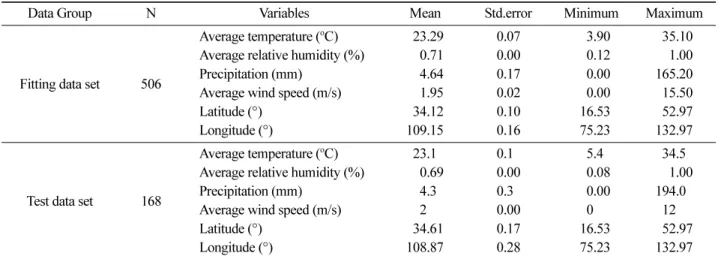
However, few of meteorological stations supply this kind of data. Therefore, before processing data, pre-process- ing was demanded, including converting units, process- ing outlier and connecting meteorological stations to data. After preparation procedure, 674 simple meteoro- logical stations divided into two groups: fitting data set (506 stations) and test data set (168 stations). The sta- tistical results of 674 meteorological stations from 07/21/

2009 to 07/31/2009 are presented in Table 1.

3. Data processing

In order to acquire reliable forecasting results, the nation-

wide meteorological data in a certain resolution should

be predicted by interpolation algorithms. Interpolation can

be defined succinctly as the process of predicting the

value of a given variable at an unknown location from

values of the same variable at surrounding, known loca-

tions (Harris et al. , 2001). The interpolation method used

in this study is Thiessen polygon interpolation. Thiessen

polygon was originally employed for calculating average

precipitation from discrete meteorological stations (Huang

and Li, 1996; Zhang and Cui, 1991). At present, this

Figure 1. The distribution map of meteorological stations

used in this paper.

(3)

approach, which can obtain polygon by point sources, is widely used in fields of geoscience, resource science, environmental science, meteorology and so forth.

The principle of Thiessen polygon interpolation was showed by Figure 2. The perpendicular dissectors of the lines joining No.1 station and its adjacent stations (No.2 to No.7) form the Thiessen polygon and define which stations are neighbors. Obviously, No.8-10 stations are not neigh- bors. Therefore, Thiessen polygon (polygon ABCDFE) pre- sents neighborhood region of No.1 station and share its attributes. Considering a certain amount of meteorolog- ical stations (506) as generators, data covered the whole research area were gained by constructing Thiessen polygon.

In order to generate ASCII file of each meteorological factor precisely, triangulated irregular networks (TIN) that Z value is meteorological factor should be con- structed based upon Thiessen polygon (SHAPE file).

TIN model is a sort of methods for fitting terrain by

applying a series of plant triangles with the same slope (Fan and Zhou, 2003). This idea was adopted in this study: every meteorological factor (average temperature, average relative humidity, precipitation and average wind speed) was fitted by a chain of plant triangles with the same value. Due to avoiding limitation of distribu- tion of meteorological stations, this kind of TIN model expressed meteorological characteristics well. After that, TIN model of each meteorological factor should be con- verted to raster model since attribution can be expressed in explicit form (Fan and Zhou, 2003), and then to ASCII file. Owing to cell size of GRID model can be set up as required, we define cell size as 10000 m according to display effect of forecast map. The GRID model of 10000 m resolution, dividing the research area into 506×700 cells, could meet the requirement of forecast results. In this way, meteorological factors in each cell will be described readily and conveniently.

4. Validation

After data processing, cross-validation is needed to analyze the results of processing, that is, 75% of mete- orological stations are involved into interpolation while the others are used to verify precision estimation (Feng, 2002). Hence, 168 independent stations were drawn ran- domly from 674 stations in daily validation and process- ing results of 11 days were verified. The validation is performed by Mean Error (ME), Mean Absolute Error (MAE) and Precision Estimation (P%).

5. Techniques of automated data processing

Recent years, diverse professional development kits of GIS swarm into GIS market. And component GIS best represents the development trend of GIS. Based on Component Object Model (COM), Microsoft released ActiveX component technique, which was employed in most of component GIS. It provides developers a more Table 1. The statistical results of 674 meteorological stations from 07/21/2009 to 07/31/2009.

Data Group N Variables Mean Std.error Minimum Maximum

Fitting data set 506

Average temperature (

o

C) 023.29 0.07 03.90 035.10

Average relative humidity (%) 000.71 0.00 00.12 001.00

Precipitation (mm) 004.64 0.17 00.00 165.20

Average wind speed (m/s) 001.95 0.02 00.00 015.50

Latitude (°) 034.12 0.10 16.53 052.97

Longitude (°) 109.15 0.16 75.23 132.97

Test data set 168

Average temperature (

o

C) 023.1 0.1 05.4 034.5

Average relative humidity (%) 000.69 0.00 00.08 001.00

Precipitation (mm) 004.3 0.3 00.00 194.0

Average wind speed (m/s) 002 0.00 00 012

Latitude (°) 034.61 0.17 16.53 052.97

Longitude (°) 108.87 0.28 75.23 132.97

Figure 2. The construction of Thiessen polygons.

(4)

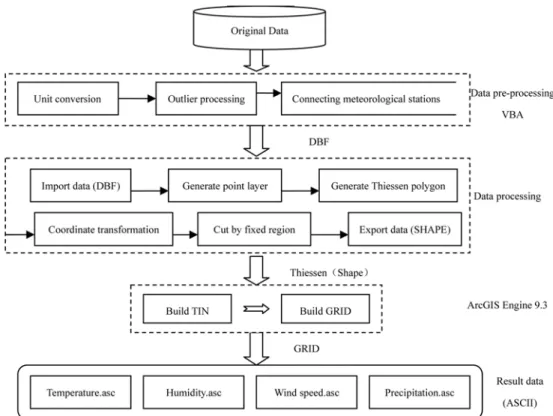
efficient and flexible approach to achieve GIS functions using various program languages. In this study, meteo- rological data processing software was constructed by component GIS and programmed in Visual Basic 6.0 (VB6.0) development platform, including data pre-pro- cessing and processing module. In data pre-processing mod- ule, software fulfilled unit conversion, outlier processing and connection of meteorological data and stations by Visual Basic for Application (VBA); in data processing module, interpolation, coordination transformation, data convertion etc were accomplished by ArcGIS Engine 9.3.

According to principles and techniques above, the development framework of meteorological data process- ing software was designed (Figure 3).

Results

Meteorological data processing software was con- structed in order to validate the practicability of the method above. Taking data of July 23

th

, 2009 for exam- ple, the data processing will be demonstrated follow- ing.

1. Data pre-processing

Meteorological data processing software provided pro- cessing methods for two main kinds of data. One was downloaded from China meteorological data sharing ser- vice system (http://cdc.cma.gov.cn/); the other was input

by manual from other ways, including electrical trans- mission, telephone, text message, etc. Whichever kinds of data, they must contain four meteorological factors (average temperature, average relative humidity, precip- itation and average wind speed) and date. The down- loaded data were needed unit conversion and outlier correction in pre-processing.

The main interface of meteorological data processing software furnished two buttons, named “data pre-pro- cessing” and “data processing”. In the interface of data pre-processing, two main menus called “data acquisi- tion” and “data pre-processing” were offered (Figure 4).

The functions of each menu were listed in Table 2.

Figure 3. Software development framework.

Figure 4. Interface of data pre-processing.

(5)

2. Data processing

After data pre-processing, users can click into data processing interface. Click “generate ASCII” button and select a pre-processing result data (DBF format), and then the software will auto-generate result data, includ- ing a folder for storing ASCII and the other for process- ing data (TIN, GRID format). Finally, a message box will pop up and present memory location. Figure 5 pre- sents the interface of data processing.

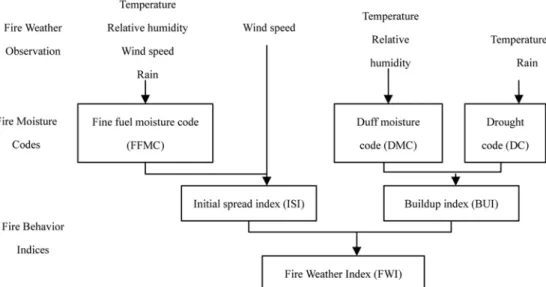
Result data will be read automatically by forest fire danger rating forecast system of China, which continues to use the FWI system of CFFDRS. Figure 6 presented structure of the FWI system.

According to Figure 6, FWI is computed by forest fire danger rating forecast system of China hierarchically.

Firstly, fire moisture codes, including FFMC, DMC, DC are calculated by four meteorological factors. Secondly, fire moisture codes and wind speed are used to compute ISI and BUI. Finally, FWI is computed by ISI and BUI using following formulae.

(1)

(2) Where I

s,j

is initial spread index (ISI), B

u,j

is buildup index (BUI), F is an intermediate value of F

w,j

and F

w,j

is fire weather index. Hence, daily fire danger rating (DSR) will be obtained by equation (3).

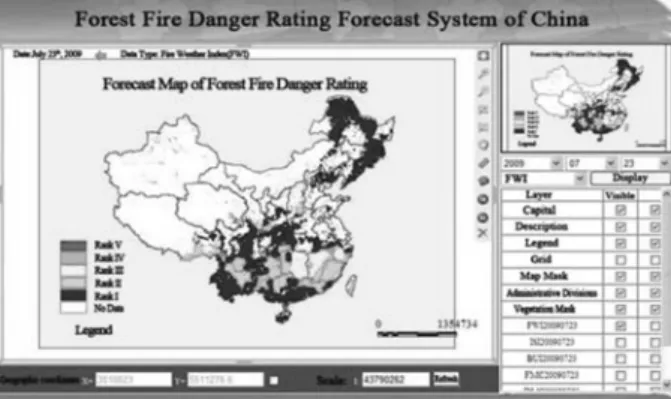
(3) After reading ASCII file, Forest fire danger rating

F 0.1 ⋅ I s j , ⋅ ( 0.626 B u j 0.809 , + 2 ) B u j , ≤ 80 100 ⋅ I s j, ⁄ ( 25 108.64 + e 0.023B

u j,

) B u j , > 80

⎩ ⎪

⎨ ⎪

= ⎧

In F w i, = 2.72 0.434In ( F ) 0.647 F > 1

F w i , = F F ≤ 1

⎩ ⎨

DSR = 0.0272 ( F w j, ) 1.77 Table 2. Menus and functions provided by data pre-processing interface.

Menu name Submenu name Functions

Data acquisition Manual Input (Ctrl+H) Open a specific Excel book that used for inputting data manually Auto-separation by date

(For downloaded data) (Ctrl+D) Auto-separate the downloaded data in consecutive period by date Data pre-processing

Pre-process manual inputting data

(Ctrl+B) Pre-process manual inputting data (EXCEL format) and output DBF format data

Pre-process downloaded data

(Ctrl+L) Pre-process downloaded data (TXT format) and output DBF for- mat data

Figure 5. Interface of data processing.

Figure 6. Simplified structural diagrams for the FWI system of CFFDRS.

(6)

forecast system of China auto-calculated fire F

w,i

and DSR and formed forecast map of forest fire danger rat- ing (Figure 7). In this study, we adjusted corresponding value of F

w,i.

for each fire danger rating according to actual situation of China. Table 3 presents forest fire danger rating in forecast map, the corresponding F

w,i

and danger level.

3. Validation

In validation procedure, meteorological factors inter- polated by fitting data set (506 meteorological stations) and located in the same position of testing stations (168)

were worked out. In order to compare predicted value with true value, the performance evaluation criteria were calculated in daily validation. The validation results of meteorological factors were summarized in Table 4.

From Table 4, it was conclusion that process effects of all meteorological factors were performed well. The esti- mated precisions of average temperature and average rel- ative humidity for testing data set were above 97% and much better than that of average wind speed and pre- cipitation. The estimated precision of precipitation was the lowest one because of its strong heterogeneity of spatial distribution. Though process effect of precipita- tion was lower, it was above 70% and acceptable. There- fore, the procedure, including Thiessen polygon interpolation, TIN model and raster with a resolution of 10000 m, is acceptable.

Discussion

In ecology, meteorology and hydrology, daily meteo- rological factors, such as precipitation, temperature and so forth, play a significant role in driving various mod- els. However, because it is difficult to obtain adequate data from the limited meteorological stations, it is nec- essary to find out an appropriate interpolation method to over come the limitation of distribution of stations. Thiessen polygon provides an easy and expeditious means to inter- polate data. Though it is acceptable to employ Thiessen polygon interpolation in this study, interpolation effect should be improved in future, especially that of precip- itation. Therefore, in next stage, different interpolation aiming at different meteorological factors should be studied to acquire more accurate results.

Although it is possible to process meteorological data for forest fire danger rating forecast system by manual handling with help of conventional software, such as Figure 7. The forecast map of forest fire danger rating of

China, July 23

th

, 2009.

Table 3. Fire danger rating, the corresponding F

w,i

and danger level.

Fire danger rating F

w,i

Danger level

Rank I 0-2 Extremely low

Rank II 2-6 Low

Rank III 6-12 Middle

Rank IV 12-24 High

Rank V >24 Extremely high

Table 4. The validation results of meteorological factors.

Date Average temperature Average relative humidity Precipitation Average wind speed

ME MAE P ME MAE P ME MAE P ME MAE P

07/21/2009 0.20 1.37 98.60 0.00 0.07 97.94 -0.30 1.93 76.03 0.08 0.67 91.57

07/22/2009 -0.15 2.25 97.88 -0.02 0.08 97.58 0.56 1.39 85.71 0.13 0.60 93.47

07/23/2009 0.19 1.91 98.13 -0.03 0.07 97.67 1.16 2.85 73.89 0.13 0.59 93.74

07/24/2009 0.04 2.00 97.95 -0.02 0.08 97.62 0.19 3.11 70.62 0.18 0.56 93.54

07/25/2009 0.17 1.78 98.40 0.00 0.06 98.21 -0.03 2.41 82.61 0.12 0.51 93.04

07/26/2009 -0.30 1.97 97.83 -0.01 0.06 98.23 0.60 3.43 73.46 0.32 0.58 92.62

07/27/2009 0.15 2.03 97.84 0.00 0.06 98.23 -0.19 2.83 81.30 0.02 0.53 91.63

07/28/2009 0.31 1.94 97.96 -0.20 0.07 98.05 0.66 2.69 78.54 0.15 0.52 93.12

07/29/2009 -1.43 1.89 97.97 -0.01 0.07 97.85 0.73 1.87 70.26 0.21 0.48 93.87

07/30/2009 -0.02 1.94 98.21 -0.01 0.07 98.21 -0.22 1.85 80.09 0.12 0.53 93.60

07/31/2009 -0.02 1.75 98.38 0.00 0.06 98.40 -0.19 1.22 86.80 0.07 0.47 94.05

ME: Mear Error, MAE: Mean Absolute Error; P(%): Precision Estimation

(7)

Excel, ArcGIS and so on, the operational process is quite complex. However, the meteorological data processing software provides a novel approach to auto-process data.

About 6 min will be spent for an experienced worker to process data of 674 meteorological stations by utilizing meteorological data processing software instead of 20 min by manual handling. The working efficiency was approximate 3 times as much as that of traditional method.

Taking full advantages of GIS in meteorology field, the informationization level of processing meteorological data was greatly enhanced.

Acknowledgements

This study was financed by Planning Programs for Sci- ence and Technology Support of China, No.2006BAK01A16,

“Forecasting and warning technique for emergency event- Simulation techniques of forecasting and warning”.

Literature Cited

1. Lee, B.S., Alexander, M.E., Hawkes, B.C., Lynham, T.J., Stocks, B.J. and Englefield, P. 2002. Information sys- tems in support of wildland fire management decision making in Canada. Computers and Electronics in Agri- culture. 37: 185-198.

2. Dong, G.S. and Ge, X.L. 1997. Forest Fire. Harbin:

Northeast Forestry University Press. 89p. (in Chinese) 3. Fan, W.Y. and Zhou, H.Z. 2003. Resource and Envi- ronment Geographic Information System. Beijing: Sci- ence Press. 80-82. (in Chinese)

4. Feng, Z., Yang, Y., Ding, X. and Lin, Z. 2004. Optimiza-

tion of the spatial interpolation methods for climate resources. Geographical Research, 23(3): 357-364. (in Chinese)

5. Han, P., Wang, Q., Wang, P., Qi, W. and Wu, P. 2008.

Development of Geographic Information System-ArcE- ngine.Wuhan:Wuhan University Press. 4p. (in Chinese) 6. Harris, J.R., Wilkinson, L., Heather, K., Fumerton, S., Bernier, M.A., Ayer, J. and Dahn, R. 2001. Application of GIS processing techniques for producing mineral pro- spectivity map-a case study: Mesothermal Au in the Swayze Greenstone Belt, Ontario, Canada. Natural Resources Research. 10(2): 98-99.

7. Huang, B. and Li, R.R. 1996. Thiessen polygon and its application in calculating the biomass of any depth contour. Remote Sensing Technology and Application, 3: 35-38.

8. Hu, H.Q. 2005. Forest Fire Ecology and Management.

Beijing: China Forestry Publishing House. 188-190. (in Chinese)

9. Li, J.N. 2002. Application of GIS technique in meteo- rological data processing. Guangdong Meteorology. 4:

9-14. (in Chinese)

10. Tian, X.R., Douglas, J.M., Den, B.C., Jin, J.Z., Gao, C.D., Shu, L.F. and Wang, M.Y. 2005. Comparisons and assessment of forest fire danger systems. Forestry Stud- ies in China. 7(1): 53-61.

11. Yan, H. 2001. Forecast System of Forest Fire Weather Ranks. Forest Resources Management. 3: 69-72.

12. Zhang, D.W. and Cui, Y.S. 1991. Calculation of water- shed average precipitation using thiessen polygon . Hydrology, 1: 52-53. (in Chinese)

(Received January 4, 2010; Accepted February 8, 2010)

수치

Figure 2. The construction of Thiessen polygons.
Figure 3. Software development framework.
Figure 6. Simplified structural diagrams for the FWI system of CFFDRS.
Table 3. Fire danger rating, the corresponding F w,i  and danger level.

참조

관련 문서

Abstract The variability and temporal trends of the annual and seasonal minimum and maximum temperature, rainfall, relative humidity, wind speed, sunshine hours, and

Daily mean of air pressure, air temperature, dew-point temperature, wind direction and speed, relative humidity and cloud amount is the average of hourly

Daily mean of air pressure, air temperature, dew-point temperature, wind direction and speed, relative humidity and cloud amount is the average of hourly

Daily mean of air pressure, air temperature, dew-point temperature, wind direction and speed, relative humidity and cloud amount is the average of hourly

Daily mean of air pressure, air temperature, dew-point temperature, wind direction and speed, relative humidity and cloud amount is the average of hourly

Daily mean of air pressure, air temperature, dew-point temperature, wind direction and speed, relative humidity and cloud amount is the average of hourly

As a first step, we obtained the data of the meteorological factors (i.e., precipitation, humidity, temperature, insolation, snowdrifts, wind velocity) and the output of

National integrated daily weather index (DWI) model to calculate the forest fire danger rating by Spring and Fall (T mean : average temperature, Eh : effective humidity, Rh