RELATIONSHIP BETWEEN CANOPY RELFECTANCE AND LAI UNDER FULL CANOPY CONDITION
Jung-Il Shin and Kyu-Sung Lee
Department of Geoinformatic Engineering, Inha University, S. Korea [email protected]
ABSTRACT ... Spectral reflectance of tree canopy is related with various biophysical and biochemical parameters.
LAI is one of the important parameters that is known to be closely related with canopy reflectance. This preliminary study tries to analyze relationship between canopy reflectance and LAI under full canopy condition with time series field measurements and radiative transfer (RT) model simulation. We measured time series canopy reflectance along with canopy coverage, and LAI over two forest stand during the growing season of 2009. In addition to field-measured tree parameters, additional biophysical parameters were estimated by simulation of RT model. The result shows that correlation coefficients between canopy reflectance and LAI were not very strong under the full crown closure. The reasons could be explained by the difference in species (leaf shape and canopy structure) and variation of canopy water content. Consequently, canopy reflectance is not always strongly related with LAI under full canopy condition.
KEY WORDS: Canopy reflectance, canopy coverage, LAI, chlorophyll content, canopy water content.
1. INTRODUCTION
Spectral reflectance of tree canopy is related with various biophysical and biochemical parameters such as leaf area index (LAI), canopy coverage (CC), canopy water content (CWC), and chlorophyll content. These parameters are important to investigate forest environment because they are strongly related with photosynthesis, biomass and carbon cycling (Goel and Strebel, 1983; Schlerf and Atzberger, 2006).
Therefore, many studies tried to investigate the relationship between remote sensing signal and these parameters. Recently, hyperspectral data were used to analyze such relationships quantitatively in narrow wavelength range (Asner, 1998; Brown et al., 2000; Chen et al., 1999; Schlerf et al., 2005; Thenkabail et al., 2000;
Clevers et al., 2010). Biophysical or biochemical parameters could be acquired from field measurement and/or from the simulation of radiative transfer (RT) model. Since field measurements are time and labor consuming, many studies used RT model to estimate these parameters (Zhang et al., 2005; Colombo et al., 2008; Clevers et al., 2010).
Several studies have reported the saturation problem of canopy reflectance in high LAI (Asner, 1998; Brown et al., 2000; Thenkabail et al., 2000). Currently, canopy density of Korean forest is very high, which is somewhat different from previously studies conducted over open canopy condition.
This preliminary study tries to analyze relationship between canopy reflectance and LAI under full canopy condition. RT model was used to estimate additional biochemical parameters, which might be used to explain the relationship under full canopy condition.
2. STUDY TARGET AND DATA 2.1 Study targets and field measurements
A white oak (Quercus aliena) tree and a pitch pine (Pinus rigida) tree locating in Incheon city were targets of this study, which are some of dominant species in the Korean peninsula.
Time series spectral measurements were performed on ground from May to October 2009 (Table 1). Spectral reflectance, canopy coverage, and LAI were measured simultaneously. During the spectral measurement, some geometrical parameters were also measured such as solar zenith and azimuth angle, sensor to ground height, tree height. Spectral reflectance was measured using field spectro-radiometer (FieldSpec-3, ASD) to nadir that has 10° FOV and 1nm bandwidth from 350nm to 2500nm.
Spectral reflectance of canopy was measured 40m above ground using mobile crane which is about 20m height from top of the canopy. Canopy coverage was measured from the digital photos which were taken from 20m height nadir. For each time series measurements, we adjusted measurement time to keep about the same solar zenith angle and measuring geometry for preventing BRDF effect. LAI was measured using LAI-2000 (LICOR) optical instrument that measure LAI through ratio of irradiance between open area and under canopy. LAI and measuring geometry were then used to estimate other parameters using RT model.
2.2 Simulation of canopy reflectance with RT model Canopy spectra were simulated for each measurement using PROSAIL-5 which is combined radiative transfer model of PROSPECT and SAIL. PROSAIL is one of the most popular radiative transfer models to simulate spectral reflectance from 400 to 2500nm by 1nm of vegetation canopy that consider various biophysical and
biochemical parameters of leaf and canopy (Jacquemoud et al., 2009).
Table 1. The geometric condition, canopy coverage and LAI of the Pinus rigida and Quercus aliena trees by time series measurements.
Pinus rigida Date SZA
(°)
Sensor –
target (m) Canopy
coverage (%) LAI
Apr. 23 36 23.2 87.34 5.68
May 22 29 23.1 81.69 5.64
Jun. 11 32 23.7 88.69 5.97
Jun. 24 40 23.1 90.56 6.62
Jul. 22 41 25.1 95.78 8.36
Aug. 17 42 23.5 91.14 8.05
Sep. 1 42 23.5 96.39 6.77
Sep. 24 42 24.3 96.91 7.62
Oct. 12 51 23.6 97.02 7.43
Quercus aliena Date SZA
(°)
Sensor – target (m)
Canopy
coverage (%) LAI
May 22 23 22.6 94.29 5.85
Jun. 11 28 23.0 90.81 6.88
Jun. 24 33 22.0 91.40 7.12
Jul. 22 31 21.9 98.30 7.34
Aug. 17 32 22.9 94.80 6.71
Sep. 1 34 22.9 96.10 6.16
Sep. 24 40 23.2 94.45 6.09
Oct. 12 48 22.6 97.71 5.82
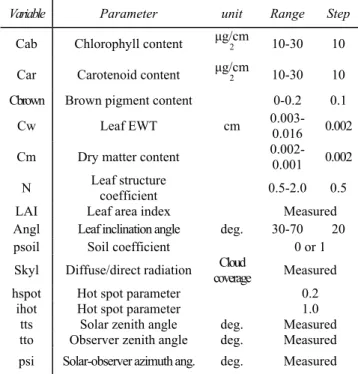
Table 2. PROSAIL-5 input parameters, meaning, and input range to simulate canopy reflectance.
Variable Parameter unit Range Step Cab Chlorophyll content μg/cm
2 10-30 10
Car Carotenoid content μg/cm
2 10-30 10
Cbrown Brown pigment content 0-0.2 0.1
Cw Leaf EWT cm 0.003-
0.016 0.002 Cm Dry matter content 0.002-
0.001 0.002 N Leaf structure
coefficient 0.5-2.0 0.5
LAI Leaf area index Measured
Angl Leaf inclination angle deg. 30-70 20 psoil Soil coefficient 0 or 1 Skyl Diffuse/direct radiation Cloud
coverage Measured
hspot Hot spot parameter 0.2
ihot Hot spot parameter 1.0
tts Solar zenith angle deg. Measured tto Observer zenith angle deg. Measured psi Solar-observer azimuth ang. deg. Measured
Table 2 shows input parameters and those meaning, input range for PROSAIL-5. 9720 canopy reflectance spectra
were simulated per every field measurement with known variables and unknown variables by certain steps then the best simulated spectrum was selected by minimum error rule (Figure 1). Unknown biochemical and biophysical parameters could be estimated through selected best simulation result.
Figure 1. Field measured and best simulated canopy spectra of Quercus aliena for two dates as an example.
3. RELATIONSHIP BETWEEN CANOPY REFLECTANCE AND LAI
Canopy reflectance is affected by several biophysical and biochemical parameters at certain wavelength. For example chlorophyll content, LAI, and canopy water content is primarily related with visible, NIR, SWIR reflectance respectively (Jacquemoud et al., 2009).
Correlation coefficients between time series canopy reflectance and LAI are plotted to investigate the relationship under full canopy condition. Figure 2 shows the correlation coefficients from 400nm to 2500nm.
Pinus rigida shows strong negative relationship in visible and SWIR region. However it shows no correlation at NIR region. Quercus aliena shows weak positive relationship through visible-SWIR region that is not matched with previous studies.
400 600 800 1000 1200 1400 1600 1800 2000 2200 2400 -1.0
-0.8 -0.6 -0.4 -0.2 0.0 0.2 0.4 0.6 0.8 1.0
correlation coefficient
Wavelength (nm)
Pinus rigida Quercus aliena
Figure 2. Correlation coefficients between time series canopy reflectance and LAI under full canopy condition.
(1) Visible region
Chlorophyll content is mainly related to canopy reflectance in visible region. Chlorophyll absorbs strongly radiative energy in visible wavelength. Therefore canopy reflectance has negative relationship with LAI because chlorophyll content per unit area is increase with higher LAI. Pinus rigida shows this relationship with theoretical background. However, Quercus aliena shows weak positive relationship in visible wavelength, which could be explained by shape and size of deciduous leaves.
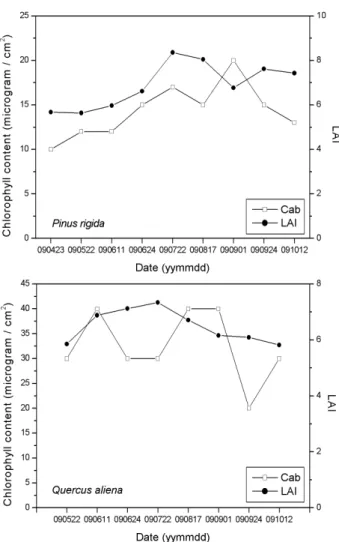
Thenkabail et al. (2000) and Asner (1998) presented that relationship of LAI and canopy reflectance was not strong in visible because most of radiative energy is reflected on top of the deciduous canopy by short wavelength. It could be shown by the estimated chlorophyll contents using RT model simulation. In figure 3, chlorophyll content of Quercus aliena shows no relationship with LAI, while Pinus rigida shows similar pattern between chlorophyll content and LAI.
Figure 3. Change of chlorophyll content (Cab) and LAI by time series measurement and simulation.
(2) NIR region
NIR reflectance has been known to have positive relationship with LAI. However, Chen et al. (1999) and
Brown et al. (2000) reported that canopy reflectance had negative relationship with LAI under LAI 3. They showed that NIR reflectance is decreased by shadow effect as LAI increase when canopy coverage and LAI is low. Then volume scattering is overcome the shadow effect in high LAI condition that canopy reflectance has positive relationship with LAI. In figure 2, Quercus aliena shows positive relationship with LAI and Pinus rigida shows nocorrelationalthough both trees have high LAI (5-8). It should be explained by difference of leaf shape that needle leaves of Pinus rigida has weaker volume scattering than broad leaves of Quercus aliena.
Figure 4. Change of canopy water content (Cw) and LAI by time series measurement and simulation.
(3) SWIR region
SWIR is strong water absorption band in canopy reflectance. Therefore, canopy reflectance generally shows negative relationship with LAI due to canopy water content. Pinus rigida shows strong negative correlation with LAI in SWIR region although Quercus aliena shows positive relationship with LAI. It could be explained by the research of Kodani et al. (2002) which reported senescence of broad leaves from June in temperate forest. Deciduous leaves lose water from middle of June even though LAI kept growing. Therefore SWIR reflectance of deciduous tree could have positive
relationship with LAI. To prove this phenomenon, canopy water content was estimated using RT model simulation. In figure 4, estimated canopy water content shows similar pattern with LAI for Pinus rigida.
However, canopy water content of Quercus aliena shows decreasing pattern from June 11th although LAI increasing until July.
4. CONCLUSION
LAI is one of the key parameters on various fields such as ecology, hydrology and agriculture. This study attempted to define the relationship between LAI and canopy reflectance under full canopy condition.
Theoretically LAI is correlated with other tree parameters, such as chlorophyll content and canopy water content, which are also affecting canopy reflectance. However it is not matched well under full canopy condition of temperate forest from result of this study. Effect of chlorophyll content is not strong with LAI for deciduous tree due to high canopy coverage and leaf shape. LAI did not show positive relationship with NIR reflectance of coniferous, which may be explained by the saturation of volume scattering by leaf shape (needle). Canopy water content is not agreed with LAI for deciduous due to senescence of leaves from June. Consequently, canopy reflectance is not always strongly related with LAI under full canopy condition of temperate forest. In further study, the relationship analysis is needed for wide area and more forest stands using hyperspectral imagery.
Acknowledgements
This research was supported by the Defense Acquisition Program Administration and Agency for Defense Development, Korea, through the Image Information Research Center at Korea Advanced Institute of Science & Technology under the contract UD100006CD.
References
Asner G. P., 1998. Biophysical and biochemical sources of variability in canopy reflectance. Remote Sensing of Environment, 64 (3), pp. 234-253.
Brown L., Chen J. M., Leblanc S. G. and Cihlar J., 2000.
A shortwave infrared modification to the simple ratio for LAI retrieval in boreal forests: An image and model analysis. Remote Sensing of Environment, 71 (1), pp. 16- 25.
Chen J. M., Leblanc S. G., Miller J. R., Freemantle J., Loechel S. E., Walthall C. L., Innanen K. A., and White H. P., 1999. Compact Airborne Spectrographic Imager (CASI) used for mapping biophysical parameters of boreal forests. Journal of Geophysical Research, 104 (D22), pp. 27945-27958.
Clevers, J.G.P.W., Kooistra, L., and Schaepman, M.E., 2010. Estimating canopy water content using hyperspectral remote sensing data. International Journal of Applied Earth Observation and Geoinformation, 12(2), pp. 119-125.
Colombo, R., Meroni, M., Marchesi, A., Busetto, L., Rossini, M., Giardino C., and Panigada, C., 2008.
Estimation of leaf and canopy water content in poplar plantations by means of hyperspectral indices and inverse modelling. Remote Sensing of Environment, 112 (4), pp.
1820-1834.
Goel, N. S. and Strebel, D. E., 1983. Inversion of vegetation canopy reflectance models for estimating agronomic variables. I. Problem definition and initial results using the suits model. Remote Sensing of Environment, 13 (6), pp. 487-507.
Jacquemoud, S., Vefhoef, W., Baret, F., Bacour, C., Zarco-Tejada, P., Asner, G. P., Francois, C., and Ustin, S.
L., 2009. PROSPECT + SAIL models: A review of use for vegetation characterization. Remote Sensing of Environment, 113(S1), pp. S56-S66.
Kodani, E., Awaya, Y., Tanaka, K., and Matsumura, N., 2002. Seasonal patterns of canopy structure, biochemistry and spectral reflectance in a broad-leaved deciduous Fagus crenata canopy. Forest Ecology and Management, 167(1-3), pp. 233-249.
Schlerf M., Atzberger C., and Hill J., 2005. Remote sensing of forest biophysical variables using HyMap imaging spectrometer data. Remote Sensing of Environment, 95 (2), pp. 177-194.
Schlerf, M. and Atzberger, C., 2006. Inversion of a forest reflectance model to estimate structural canopy variables from hyperspectral remote sensing data. Remote Sensing of Environment, 100 (3), pp. 281-294.
Thenkabail P. S., Smith R. B., and De Pauw E., 2000.
Hyperspectral vegetation indices and their relationships with agricultural crop characteristics. Remote Sensing of Environment, 71 (2), pp. 158-182.
Zhang, Q., Xiao, X., Braswell, B., Linder, E., Baret, F., and Moore, B., 2005. Estimating light absorption by chlorophyll, leaf and canopy in a deciduous broadleaf forest using MODIS data and a radiative transfer model.
Remote Sensing of Environment, 99 (3), pp. 357-371.