Risks and Supervisory Challenges of Financial Conglomerates in Korea
Joon-Ho Hahm
(Associate Professor, International Economics and Finance, Graduate School of International Studies, Yonsei University)
Joon-Kyung Kim
(Senior Fellow, Korea Development Institute)
금융그룹화와 금융위험: 실증분석 및 정책과제
함 준 호
(연세대학교 국제학대학원 부교수)
김 준 경
(한국개발연구원 선임연구위원)
* (함준호-제1저자, 김준경-공저자) This paper is a revised version of the paper presented at the 2004 KDI/KAEA international conference on ‘Current Economic Issues of Korea,’ Seoul, August 10, and at the EWC/KDI conference on ‘Regulatory Reforms in the Age of Financial Consolidation: Emerging Market Economy and Advanced Countries,’ Honolulu, Hawaii, July 29-30, 2004. The authors thank Howell Jackson and two anonymous referees for numerous constructive comments. The first author also gratefully acknowledges a financial support from the Yonsei University.
• Key Word: Financial Consolidation(금융대형화), Financial Conglomerate(금융그룹), Risk (리스크), Supervision(금융감독)
• JEL code: G20, G21, G28
• Received: 2005. 10. 6 • Referee Process Started: 2005. 11. 3
• Referee Reports Completed: 2005. 12. 29
This paper studies implications of financial conglomeration for both financial risk of individual conglomerates and systemic risk potential in post-crisis Korea. Our analyses suggest that we cannot conclude that financial conglomerates are taking on higher risks relative to non-conglomerate independent institutions. We also find that larger financial institutions show a significantly higher profitability and lower variability in profitability operating on a superior efficient frontier. However, it turns out that the consolidation has raised systemic risk potential as direct and indirect interdependencies among large banking institutions have substantially increased. Furthermore, financial conglomerates have become more vulnerable to contagion risks from non-bank sectors and capital markets. In the face of the shifting risk structure, financial supervisory and regulatory systems must be upgraded toward a more risk-based, consolidated supervision. Prompt corrective action provision for financial conglomerates must be based upon fully consolidated group risks, and effective supervisory devices need to be introduced to avoid inadvertent extension of public safety net to cross-sectoral activities of financial conglomerates. It is also critical to strengthen internal control and risk management capacities at financial conglomerates, and to establish strong market discipline by improving information transparency and monitoring incentives in the financial market.
본 논문은 외환위기 이후 빠르게 진전되 어 온 금융 대형화, 그룹화 현상이 개별 금 융기관과 시장 전반의 시스템 리스크에 미 치는 영향에 대하여 분석하였다. 실증분석 결과에 따르면, 위기 이후 독립 금융기관과 비교하여 금융그룹 소속 금융기관의 도산위 험이 대체로 낮은 것으로 나타나며, 겸업화 효과보다는 대형화에 의한 수익성 및 수익 변동성 개선효과가 유의하게 나타나는 것으 로 분석되었다. 따라서 아직까지 우리나라 에서 고위험 추구를 통한 대형 금융그룹의 위험상승 현상은 관측되지 않고 있다. 그러 나 대형 은행그룹 간 직간접적 상호의존도 가 높아짐에 따라 시스템 위험의 발생 가능
성이 증대되고, 겸업화로 비은행부문 및 자본시장으로부터의 위험전이 가능성도 높아지고 있어 이에 대한 정책대응이 요 구된다. 특히 금융그룹을 하나의 동일체 로 인식하고 그룹단위로 건전성 규제 등 을 실시하는 위험 중심의 연결감독체제 가 확립될 필요가 있으며, 겸업화로 인한 공적 안전망의 확대를 효과적으로 차단 하기 위한 감독장치도 마련될 필요가 있 다. 아울러 금융그룹의 내부통제 및 위험 관리체제를 강화하고, 경영투명성의 제고 를 통해 금융그룹에 대한 시장의 모니터 링 기능도 확충할 필요가 있다.
I. Introduction
The structure of the Korean financial services industry has been rapidly transformed since the 1997 financial crisis. Initially driven by the government restructuring program, the combined trends of financial consolidation, conglomeration and internationalization not only caused a dramatic change in the competition structure but also significantly eroded the effectiveness of existing regulatory regime in maintaining financial stability. Integration among traditionally separated financial services and the emergence of a few large financial conglomerates have brought about a fundamental shift in the nature of financial risks embedded in the financial system.
While it is required to understand the evolving nature and structure of risks implied in the new financial regime, a clear-cut relationship between financial consolidation and financial stability does not exist. Indeed, financial consolidation may increase or decrease risks of individual financial conglomerates. With scale and scope economies, and benefited from increased market power, financial conglomerates may be able to enhance profitability thereby containing financial risks.
However, complexity in operation and incentives to take on more risks based upon
‘too-big-to-fail’ may actually increase financial risks of large conglomerates.
Financial consolidation and conglomeration may also increase systemic risk potential. Incentives of financial markets as well as regulatory authorities in monitoring and supervising large conglomerates can be significantly undermined.
Even if individual conglomerates are able to benefit from diversification, interdependency and mutual exposure among large financial conglomerates may substantially increase as they share homogeneous business portfolios and asset structure.
In the face of the increasingly limited ability of supervisory and monetary authorities to cope with financial risks, it has become an urgent task to devise a new regulatory regime capable of preventing excessive risk-taking of financial conglomerates and regulatory forbearance of financial supervisors. It is also required to create an environment where market participants have a strong incentive to monitor risks and penalize financial institutions if they take on too much risk.
Given the imperatives of the supervisory and regulatory reform in the face of on- going consolidation and conglomeration, we address following inquiries in the present paper: How can we characterize the financial consolidation process that has accelerated during the post-crisis period in Korea? What is the evolving nature of risks associated with financial consolidation and conglomeration? Do large financial conglomerates composed of various financial businesses differ significantly from the institutions running a single business in terms of risk characteristics? If so, in what manner should the risks of financial conglomerates be contained and managed?
How should the system-wide risk that may be amplified to ignite systemic crises be classified, observed, and responded to? What is the nature of the financial safety net in which the perverse incentives of market participants as well as financial regulators can be curbed to reinforce both financial stability and efficiency?
The present paper is organized as follows: Section 2 summarizes the post-crisis
financial restructuring program and characterizes the development in financial consolidation and conglomeration in Korean financial industries. This section also analyses the shift in financial industry structure by examining the degree of concentration. Section 3 presents a conceptual framework as well as empirical analyses in order to understand risk implications of financial conglomeration in Korea. This section explores potential risk impacts by focusing on the channels through which financial consolidation may influence financial risks of individual conglomerates and systemic risk potential. We conduct regression analyses to explore possible linkages between financial conglomeration and profitability as well as firm risk of financial institutions. Section 4 outlines current regulatory framework of financial supervision for financial conglomerates in Korea. Finally, section 5 discusses policy implications and suggestions.
II. The Rise of Financial Conglomerates in Korea
Since the onset of the 1997 financial crisis, the Korean financial industry has seen the rise of financial conglomerates as well as massive consolidation and concentration. Prior to the crisis in Korea, there had existed two types of financial groups. One is the “financial conglomerate”1 whose business lines were exclusively in financial activities, in which their organizational structure took the form of a parent’s participation in financial subsidiaries (parent-subsidiary model) which was partly allowed in the mid 1980s.2 However, financial institutions in Korea were prohibited from establishing financial holding companies(FHCs)3; in that financial activity among financial institutions were strictly separated for fears that financial concentration through holding companies would lead to side effects including the potential for anti-competitive behavior. Later on, as will be mentioned in the proceeding section, financial holding companies were introduced in Korea following the crisis as a part of the government’s restructuring efforts.
Another form of financial group prevalent in Korea has been the “mixed conglomerate,” which is predominantly commercially oriented, but contains at least one regulated non-bank financial institution (NBFI). In Korea, many NBFIs are owned by the chaebols (large family-owned conglomerates). According to the Fair Trade Commission, the amount of assets for 10 largest mixed conglomerates totaled about 172 trillion won as of April 2005, of which Samsung’s share of assets totaled about 110 trillion won, or 64%. Figure 1 shows the ownership structure of Samsung Group. As can be seen, the group ownership structure is characterized by two
1 According to the Tripartite Group of bank, securities and insurance regulators (the Basel Committee on Banking Supervision (BCBS), the International Organization of Securities Commissions (IOSCO) and the International Association of Insurance Supervision (IAIS)), the term “financial conglomerate” would be used to refer to “any group of companies under common control whose exclusive or predominant activities consist of providing significant services in at least two different financial sectors (banking, securities, insurance).” (Joint Forum on Financial Conglomerates, ‘Supervision of Financial Conglomerates,’ 1999)
2 Korean banks have been permitted to own securities companies as subsidiaries since 1984.
3 Financial holding companies are defined as entities that control regulated financial intermediaries:
typically depository institutions, insurance companies, or securities firms. (Howell Jackson, 1997)
[Figure 1] Ownership Structure of Samsung Group
9.9 11.45.5 80.0
50.0 65.4 12.0
19.3 11.6 14.0
75.0
7.0 7.7 Life Insurance (Lee, Gun Hee: 4.5)
Electronics C (Lee, Gun Hee: 1.9) Everland. (Lee, Jae Yong: 25.0) Fire Insurance Co. Securities Co.
ITC Futures Co.
Real Estate Trust Co
.
Credit Card
Capital Co.
<Table 1> Financial Institutions Closed or Merged
(As of June 2003, unit: number of institution) Type of Resolution
Total No. of Institutions (end-1997)
(A)
License
Revoked Merger Others1) Subtotal (B)
Ratio(%) (B/A)
New Entry
Total No. of Institutions (end of June
2003)
Banks 33 5 10 - 15 45.5 1 19
Merchant Bank
Corporations 30 22 6 - 28 93.3 1 3 Securities Companies 36 5 3 2 10 27.8 18 44 Insurance Companies 50 8 6 2 16 32.0 13 47 Investment Trust
Companies 31 6 1 - 7 23.3 9 32
Mutual Savings and
Finance Companies 231 100 27 1 128 55.4 12 115 Credit Unions 1,666 2 106 463 571 34.3 9 1,104 Leasing Companies 25 9 1 1 12 48.0 4 17
Total 2,101 157 161 469 787 37.5 67 1,381
Note: 1) Includes dissolution and asset transfers to bridge institutions.
Source: Public Fund Management Committee, Ministry of Finance and Economy, White Paper on Public Fund.
major holding companies and circular equity subscription. Everland is functioning as a virtual holding company, which governs Electronics through Life Insurance.
Samsung Life Insurance in turn functions as a financial holding company that governs other non-bank financial institutions.
During the restructuring process following the crisis, a number of insolvent financial institutions were closed or merged with other institutions. Indeed, as can be seen in Table 1, the number of financial institutions in Korea fell from 2,101 in 1997 to 1,381 by the end of June 2003, a drop of 34.3%. Among the 787 financial institutions that underwent restructuring, 161 institutions were merged during the same period. In particular, the number of banks sharply decreased to 19 by the end of June 2003 from 33 in 1997 through closures and mergers ⎯ Korea had never once experienced such a dramatic turn of events, which led to the resolution of major financial institutions. In the case of NBFIs, 28 merchant banking corporations (MBCs), 10 securities companies, 7 investment trust companies (ITCs), and 16 insurance companies had been closed down through exits or mergers by the end of June 2003.
1. Resolution of Distressed Institutions and Financial Consolidation
At the time of the crisis, many Korean financial institutions were significantly undercapitalized. Because of large non-performing loans (NPLs) and weak capital
base, troubled Korean banks struggled to improve their BIS capital adequacy ratios by curtailing lending as raising new capital was virtually impossible. Such financial implosion further intensified already severe credit crunch and resulted in massive corporate bankruptcies. Under these circumstances, the top priority in financial restructuring was the disposal of NPLs and the recapitalization of banks.
The first policy response by the Korean government was to identify insolvent financial institutions and resolve them. In January 1998, the government nationalized two major banks ⎯ the Korea First Bank and Seoul Bank ⎯ that had become insolvent. Moreover, the Financial Supervisory Commission (FSC) ordered twelve other banks that had capital adequacy ratios of less than 8 percent at the end of 1997 to prepare rehabilitation plans by April 1998. In June 1998, five banks were identified as being insolvent and their rehabilitation plans were rejected by the FSC following a comprehensive review of their financial conditions. Each of these banks was acquired through P&A (Purchase and Assumptions) agreement by relatively healthy banks (See Figure 2).4
The plans of the other seven banks with capital adequacy ratios below 8 percent at the end of 1997 were given tentative approval to continue operations under the condition that those banks would pursue cost reductions through branch closures and staff downsizing. In addition, the government offered support by recapitalizing the seven banks and purchasing their impaired assets. As little progress was being made in the restructuring, the government stepped in by encouraging the mergers of the troubled banks. As such, in January 1999, two major banks, Korea Commercial Bank and Hanil Bank merged to form Hanvit Bank, and again in July 1999, another major bank, Chohung Bank acquired two regional banks: Kangwon Bank and Chungbuk Bank.5
At the same time, bank mergers not directly led by the supervisory authority were also undertaken. With support from the government, in January 1999, Kookmin Bank merged ailing Korea Long-Term Credit Bank, which enabled them to achieve synergy between Kookmin’s wide retail network and Korea Long-Term Credit’s corporate finance. In addition, Hana Bank also merged Boram Bank amid the wave of consolidation. Note that both Korea Long-Term Credit Bank and Boram Bank had been showing a possibility of significant undercapitalization and, without the mergers, corrective supervisory actions would have been inevitable.
The bank consolidation trend was marked in April 2001 with the merger of Korea’s two large banks — the Kookmin Bank, the largest by asset size, and the Korea Housing & Commercial Bank, the third largest. The merger, which created the largest bank in Korea, was the first bank merger between healthy banks in genuine sense. In fact, as of the end of 2003, the Kookmin Bank’s assets totaled 214.8 trillion won, accounting for nearly 27% of total assets in the banking sector. Furthermore, in December 2002, Seoul Bank, which had been nationalized following the crisis and unable to find any strategic investors, ultimately merged with Hana Bank.
4 The suspended banks and their respective acquirers are as follows: Daedong Bank by Kookmin Bank, Dongnam Bank by Korea Housing & Commercial Bank, Dongwha Bank by Shinhan Bank, Chungchung Bank by Hana Bank, and Kyungki Bank by KorAm Bank.
5 Among the seven troubled banks, only Korea Exchange Bank was not merged but received a capital injection from Commerzbank.
[Figure 2] Consolidation of Korean Banking Industry Following the Crisis
CBK Hanil Peace Kwangju Kyungnam
Hanvit Jan. 1999
Woori FHC Apr. 2001
Hana Chungchong Boram
Hana Hana
Jun. 1998 Jan. 1999
Dec. 2002
Seoul (Management Consulting from Seoul Deutsch Bank, Apr. 2000)
Kookmin Daedong KLTC KHCB Dongnam
Kookmin Jun. 1998
KHCB Jun. 1998
Kookmin
KHCB Jan. 1999
Kookmin Apr. 2001
Shinhan Donngwha Cheju
Shinhan Jun.1998
Shinhan Jan. 2001
Shinhan Sep. 2001 FHC
(Management Consulting from Shinhan Bank) Chohung
Kangwon Chungbuk
Chohung Jul. 1999
Sep. 2003
Kor Am Kyongki
Kor Am Jun.1998
Korea First (Sold to New Bridge Capital Korea First Dec. 1999)
<Table 2> Affiliates of Financial Group in Korea
(As of September 2003, unit: number of institution) Bank Insurance Securities ITC Card Others Total
Woori 3 0 1 1 0 0 5
Shinhan 3 1 1 2 1 1 9
Dongwon 0 0 1 1 0 2 4
Financial Holding Company
Subtotal 6 1 3 4 1 3 18
Banking 8 2 2 4 1 8 25
Insurance 0 3 1 2 0 1 7
Securities 0 1 9 7 0 3 20
Financial Conglomerate
Parent- Subsidiary
Model
Subtotal 8 6 12 13 1 12 52
Samsung 0 2 1 1 1 2 7
LG 0 0 1 1 1 2 5
SK 0 1 1 1 0 1 4
Others 0 7 7 6 2 13 35
Mixed Conglomerate
Subtotal 0 10 10 9 4 18 51
Total 14 17 25 26 6 33 121
Source: Choi (2004), Establishment of the Korean Supervisory System for Financial Conglomerates.
In the meantime, to deal with the other weak banks, the government enacted
Financial Holding Company Act in October 2000, and created a financial holding
company in April 2001. Under a holding company structure, numerous synergy effects can be achieved such as enabling the cross selling of financial products, lowering funding costs, and streamlining IT investment. At the same time, the government hoped that affiliated companies would be able to retain their client base while being able to avoid employee downsizing, further helping to lessen employee resistance, in contrast to the P&A approach used in 1998.At first, two nation-wide banks (Hanvit and Peace) and two regional banks (Kwangju and Kyungnam) were placed under a government-run holding company, Woori Financial Holdings. Before doing so, the NPLs of candidate banks were disposed, and in addition, public funds were injected to raise their capital adequacy ratios above 10 percent. Aside from the banks, a securities company, an ITC, and a credit card company6 were placed under the Woori financial holding company.
6 In 2003, Woori Credit Card Company experiencing financial distress under a pile of NPLs was acquired by Woori Bank. According to the OECD report (1993), under a financial holding company, a bank’s relation to non-bank affiliates is indirect as there exists a cushion ⎯ a holding company ⎯ between them. Because the legal separation is more extensive than in the case of the parent-subsidiary model, the cost of producing a given mix of products tends to be more expensive. However, it is often
<Table 3> Fiscal Support for Financial Restructuring (11/1997 ~ 6/2003)
(Unit: trillion won)
KDIC and Others KAMCO
Recapitalization Capital Contribution
Deposit Repayment
Purchase of Assets
Purchase of NPLs
Total
Banks 34.0 13.7 0 14.0 24.6 86.2
NBFIs 26.3 3.3 29.8 0.3 14.5 74.2
Merchant Banking Corporations
2.7 0.2 17.2 0.0 1.6 21.7
Insurance
Companies 15.9 2.9 0.0 0.3 1.8 21.0
Securities and
ITCs 7.7 0.0 0.01 0.0 8.5 16.2
Mutual
Savings Banks 0.0 0.2 7.9 0.0 0.2 8.2
Credit
Cooperatives 0.0 0.0 4.7 0.0 0.0 4.7
Others 0.0 0.0 0.0 0.0 2.4 2.4
Total 60.3 17.0 29.8 14.3 39.1 160.4
Source: Public Fund Management Committee, Ministry of Finance and Economy, White Paper on Public Fund.
Then, in September 2001, a second financial holding company was established, Shinhan Financial Holdings, under which Shinhan and Cheju Banks along with a life insurance company, a securities company, an ITC, and a credit card company were placed under the same umbrella. In September 2003, Chohung Bank, the fourth largest bank at the end of 2002, was also placed under the Shinhan Financial Holdings, making it the second largest financial group in Korea.78
In tandem with these measures for the resolution of weak or insolvent institutions, the government injected a total of 160.4 trillion won (26 percent of GDP) in fiscal resources to rehabilitate the financial system from the late 1997 until the end of June 2003 (see Table 3). The operating arms of the government in this regard were the
argued that, because of the indirect relationship, the safety and soundness of the bank can be more isolated from the non-bank affiliates and the bank may have less incentive to bail out a faltering non-bank affiliate. In practice, the opposite can be said to be true, as non-bank affiliates in distress tends to be rescued, mainly for the purpose of protecting group’s reputation. This is the case for the Woori Credit Card Company, and as a result, the Woori Bank’s access to official safety net has been indirectly extended to the non-bank subsidiary.
7 In 2003, another financial holding company, Dongwon Financial Holdings, was established.
However, unlike Woori and Shinhan Financial Holdings, only NBFIs were placed under this holding company.
8 Recent developments in the Korean banking industry since June 2003 are the following: Koram bank was acquired by Citibank in November 2004, and the Korea First Bank was acquired by Standard Chartered Bank in January 2005. Recently in December 2005, Hana Financial Holdings, the fourth financial holding company group in Korea, was launched controlling four major subsidiaries – Hana Bank, Daehan Investment Securities, Hana Institute of Finance, and Hana INS.
Korea Asset Management Corporation (KAMCO) and the Korea Deposit Insurance Corporation (KDIC). Out of the total amount of fiscal support, 60.3 trillion won was used for recapitalization, 39.1 trillion won for the purchase of NPLs, and 29.8 trillion won for the deposit repayments for closed institutions. The recapitalization of financial institutions using public money left a substantial share of the banking sector in the hands of the government.9
2. Concentration of the Financial Industry in Korea
As a result of the government-led financial restructuring after the financial crisis, which brought about massive consolidation, market concentration increased significantly in Korea’s banking industry. To determine the degree of market concentration in Korea’s banking industry, we use two kinds of measures. The first is the so-called k–th bank concentration ratio (CRk) which takes the market shares of the first to the k–th largest banks in the market. The second index we use is the Herfindhal-Hirshman Index (HHI)10, which is calculated by summing the squares of the individual percent market shares of all the participants in a market. Total assets are taken as the measure of bank size.
As a result of the consolidation trend in the banking industry, market concentration increased significantly, in a large part due to the merger of Korea’s two large banks, Kookmin Bank and Korea Housing & Commercial Bank. In terms of CR3, the ratio rose substantially to 53.2% in 2003 from 28.4% in 1997, as can be seen in Figure 3-1. Similarly, the HHI index showed a sharp increase from 664 in 1997 to 1,497 by the end of 2003, which is considered as being “moderately concentrated.”
Figures 3-2 and 3-3 show the changes in the concentration ratios of the life- insurance industry and securities industry, respectively. According to the HHI index, Korea’s life-insurance industry is considered as being “highly concentrated” with HHI exceeding 2,500, even with Daehan life-insurance company losing market share after the crisis, Samsung and Kyobo life-insurance companies were able to maintain an oligopolistic market structure, as the industry saw a reduction in the number of smaller sized companies. As for the securities industry, though a number of firms were closed, there were also a sizable number of new entries, which allowed the industry to maintain a competitive market environment.
Lastly, in considering the entire financial industry, Figure 3-4 shows the changes in the concentration ratio of the financial groups instead of individual financial entities. According to the HHI index, although there was a steady increase in the index from 405 in 1997 to 800 in 2003 reflecting the emergence of financial conglomerates following the financial crisis, the level of market concentration is still considered as being competitive.
9 Indeed, KDIC currently owns Woori Financial Holdings Company with 86.8% ownership, which includes Woori, Kwangju, and Kyongnam Banks, all of three are 100% owned by the Woori Financial Holding Company.
10 Regulators assessing the effect of mergers on concentration in local financial markets typically rely on HHI. U.S. Department of Justice divides the spectrum of market concentration into three categories:
“not concentrated” (HHI below 1,000), “moderately concentrated” (HHI between 1,000 and 1,800), and highly concentrated (HHI above 1,800).
[Figure 3-1] Concentration Ratio of the Korean Banking Industry (based on assets)
0 20 40 60 80 100
1997 1998 1999 2000 2001 2002 2003
0 500 1000 1500 2000
CR1 CR3 CR5 HHI
1800
[Figure 3-2] Concentration Ratio of the Korean Life-Insurance Industry (based on assets)
0 2 0 4 0 6 0 8 0 1 0 0
1 9 9 7 1 9 9 8 1 9 9 9 2 0 0 0 2 0 0 1 2 0 0 2 2 0 0 3
0 5 0 0 1 0 0 0 1 5 0 0 2 0 0 0 2 5 0 0 CR1
CR3 CR5 HHI
1 8 0 0
[Figure 3-3] Concentration Ratio of the Korean Securities Industry (based on assets)
[Figure 3-4] Concentration Ratio of the Korean Financial Group (based on assets)
Source: Bank of Korea (2004).
0 20 40 60 80 100
1997 1998 1999 2000 2001 2002 2003
0 500 1000 1500 2000
CR1 CR3 CR5 HHI
1800
0 2 0 4 0 6 0 8 0 1 0 0
19 9 7 19 9 8 19 9 9 20 0 0 20 0 1 20 0 2 20 0 3
0 5 0 0 1 0 0 0 1 5 0 0 2 0 0 0
CR1 CR3 CR5 HHI
1 8 0 0
III. Financial Consolidation and Changing Risks
1. Conceptual Framework
As described above, the financial consolidation in Korea encompasses both consolidation of large financial institutions through mergers and acquisitions (M&As) within the same financial industry, and cross-industry conglomeration among bank and non-bank financial institutions - either in the form of parent- subsidiary model or of financial holding company structure. Note that these two types of consolidations often occur simultaneously and banks are in general at the center of the consolidation process. As a result, a few large bank-centered financial groups have emerged, within which various non-bank financial institutions are clustered around a large bank. Henceforth, in this section, we explore risk implications of the typical bank-centered financial conglomeration without explicitly distinguishing bank consolidation from cross-industry conglomeration.
Before we examine the implications of financial consolidation on financial risks, it would be informative to explore the relationship between financial efficiency and stability. Traditional literature often suggests that there exists a potential tradeoff between financial efficiency and stability. Specifically, while large banks with increased market power may potentially undermine competition and efficiency of resource allocation, large banks can be more profitable and financially robust, which promotes financial stability. For instance, Keeley (1990) found that the erosion of market power due to increased competition led to higher default risk premium and lower capital ratios for U.S. banks in the 1980s. He argued that, with asymmetric information and provision of bank deposit insurance, lower charter values led to higher risk and failure rate of banks due to moral hazard and agency problem.11 In retrospect, the bank restructuring policy in Korea during the post-crisis period seemed to be based upon this charter value hypothesis, that is, the implied trade-off between competition and stability. In an effort to promote bank profitability and financial stability, mergers between insolvent banks and creation of large leading banks were often an explicit policy objective of the government authorities.
Recent research, however, indicates that one cannot ascertain a clear-cut relationship between consolidation and financial stability challenging the traditional view. First, according to a group of research, financial concentration may not always create market power for large institutions.12 Indeed, even with few participants, financial markets can be sufficiently contestable.13
11 For instance, the view that the erosion of bank market power is associated with financial instability can also be found in Marcus (1984).
12 G10 report (2001) suggested that consolidation of US banking organizations had only minor effects on market power because most M&As did not increase local concentration in a significant way, and because antitrust authorities, potential market entrants, deregulation and advances in technology increased the degree of competition.
13 Allen and Gale (2000) showed that, under search cost, a branch banking system with only two nation-wide banks can lead to a perfectly competitive pricing, while the system with multiple unitary banks may lead to monopoly pricing. Also, contrary to the result of Bikker and Haaf (2000), which reported a negative relationship between concentration and degree of competition, Claessens and Laeven (2003) found that bank concentration is only weakly correlated with the degree of competition as
<Table 4> Financial Consolidation and Financial Risks
Types of Risk Channels Factors
Profitability and Cost Efficiency
- Scale and scope efficiencies - Market power rents Earnings Variability - Geographic diversification
- Product diversification
Operational Risk
- Complexity in business - Organizational diseconomies - Difficulties in monitoring / control - Heterogeneity in culture
- Difficulties of harmonizing risk management Financial Risk of
Individual Conglomerate
Risk Preference - Moral hazard based upon TBTF Effectiveness of Supervision,
Monitoring and Market Discipline
- Regulatory forbearance - Concentration and difficulty of orderly workouts
- Opacity and information asymmetry Direct Interdependencies
- Short-term inter-bank lending - Medium and long-term loans - OTC derivatives transactions Indirect Interdependencies
- Homogeneous balance sheet structure - Homogeneous business / profit structure - Common exposure to market risks Systemic Risk
Potential
Contagion from Integration, Alliance and Reputation, De facto Extension of Public Safety Net
- Risks from non-bank subsidiaries - Risks from strategic alliance with non-financial companies
- Exposure to foreign and capital market shocks
Second, even though we admit that large financial conglomerates can reduce financial risks benefiting from increased market power and diversification of their geographic and business portfolios, various features of conglomeration may actually increase the scope for instability, in particular when they lead to a small number of large ‘national champions,’ which are too big and few to fail, to discipline, and to liquidate.
It may be a challenging task to systematically characterize and classify potential channels through which financial consolidation and conglomeration has impact on the risk and stability of a financial system. Following the spirit of G10 report (2001) and De Nicolo et al. (2003), we distinguish financial risks of individual financial conglomerates on a standalone basis from systemic risk potential for the financial system as a whole.
In this regard, the conceptual framework we employ in investigating risk implications of financial consolidation and conglomeration is summarized in Table 4.14
measured by H-statistics. Rather, they argued that it is foreign bank participation and low entry barrier that fosters competitive pricing.
14 Hahm and Hong (2003) provided a diagnostic analysis on the risk implications of bank
A. Risk of Individual Financial Conglomerates
Financial risks of individual conglomerates can be impacted through four conceptually distinctive channels - expected earnings, variability of earnings, operational risk and risk preference of individual conglomerates. First, profitability and earnings potential would be enhanced for large financial conglomerates if they can exploit and realize the scale and scope economies. For instance, financial conglomerates can achieve cost saving by spreading out large fixed cost required in IT investment over larger asset base. Subsidiaries in a financial group can also share marketing and distribution channels as well as database and IT systems. Financial consolidation and conglomeration can lead to revenue enhancement if increased size raises market power and if product diversity and cross-selling increases profit opportunities. With enhanced profitability and cost efficiency, insolvency risk of individual conglomerates would be reduced, ceteris paribus. Note also that increased profitability and higher charter value would lessen moral hazard incentive of large conglomerates.15
Second, financial consolidation and conglomeration may lower risk of individual financial conglomerates with greater opportunities for risk diversification.
Geographic consolidation would yield a potential for risk diversification if merged financial firms operate in heterogeneous markets and are expected to show relatively low or negative return correlations. In a similar vein, cross-industry financial consolidation may also contribute to reductions in earnings variability by facilitating product diversification if expected returns are sufficiently heterogeneous across different financial services. On the other hand, as noted by Cumming and Hirtle (2001), the risk faced by a financial conglomerate could be larger than the sum of risks of each subsidiaries if the volatility of a subsidiary is affected by the actions of other subsidiaries.16
Third, while large conglomerates may be able to benefit from the scale and scope economies and risk diversification, operational risk may substantially increase with
consolidation for Korean banking industry. This section is mainly based upon the analytical framework of Hahm and Hong (2003).
15 Empirical evidence is mixed for the argument that large banks are more efficient and more profitable. For instance, Berger et al. (1999), Hughes and Mester (1998) reported the existence of a significant scale economy in the U.S. banking industry. Numerous authors such as Hannan (1991) and Calem and Carlino (1991) also supported the positive association between bank size and market power measured, for instance, by higher lending rate, lower deposit rate, and higher profitability. Craig and Santos (1997) found that profitability increased and risk decreased after the mergers of U.S. bank holding companies. However, there also exists counter evidence. Boyd and Runkle (1993) reported that there was no significant positive relationship between Tobin’s q and the size of US bank holding companies. Also, Akhavein et al. (1997) and Chamberlain (1998) reported that profitability had not significantly improved for banks that had undergone M&As.
16 In general, empirical evidence seems to be relatively favorable for the existence of geographic diversification effect. For instance, Benston et al. (1995) found that the motivation for mergers in the U.S.
in the 80s was mainly risk diversification effect rather than the exploitation of the deposit insurance put option value. Hughes et al. (1996) found that well diversified interstate banks could reduce insolvency risks. Craig and Santos (1997) found lower default risks as measured by the z-score and lower stock return volatilities for merged bank holding companies. Demsets and Strahan (1997) also argued that large banks had lower stock return volatility if their portfolios were held constant. As for the product diversification, empirical evidence is more limited. For instance, the studies of Kwast (1989), Boyd et al.
(1993), and Kwan (1997), among others, imply that there exists a relatively limited potential for product diversification benefits.
growing organizational complexity, inefficiencies in management and internal control, heterogeneous culture among subsidiaries, and difficulties of harmonizing risk management, etc. Indeed, large and complex financial conglomerates may no longer be able to understand exact nature of their risks.
Finally, financial consolidation and resulting dominance of a few large financial conglomerates can bring about moral hazard for financial conglomerates especially if they believe they are too big to fail (TBTF). The emergence of a small number of large financial conglomerates creates an incentive for regulatory forbearance because the failure of a large conglomerate will threaten the stability of the entire financial system. In turn, this creates a perverse incentive for financial market participants in monitoring financial conglomerates and penalizing them for taking on excessive risks. Possibilities of regulatory forbearance and weakening market discipline cause moral hazard of large conglomerates, which makes them take risks more aggressively. Note also that, based upon TBTF, risks will be under-priced for large conglomerates and this implicit subsidy provides further incentives toward additional consolidation and conglomeration. All in all, financial conglomerates may have incentives to pursue riskier investments, and more aggressive risk taking may offset the risk reduction effects potentially achievable through revenue enhancement and diversification.17
B. Systemic Risk Potential
As summarized in Table 4, financial consolidation and conglomeration has potentially significant implications not only for the risk of individual conglomerates but also for systemic risk potential. As discussed above, the dominance of a small number of large financial conglomerates that are too big and few to fail and increased concentration of the financial industry around these large conglomerates could significantly increase systemic risk potential. Note also that the emergence of TBTF institutions would undermine the effectiveness of financial supervision and market monitoring. As a result, excessive risk taking and moral hazard of large financial institutions may lead to higher systemic risk potential.
Even in the absence of the incentive problems, increasing complexity of financial conglomerates would make it more difficult for regulators and market participants to comprehend risks and take early corrective actions. Belated recognition of the problems due to information opacity in turn increases incentives for regulatory forbearance, and sudden disclosure of the problems and possible disorders in the
17 A group of research investigated potential effects of financial consolidation on the risk profile of large financial institutions. While Boyd and Runkle (1993) and Craig and Santos (1997) reported risk reduction effect of bank mergers, Chong (1991) found that interstate consolidation actually increased stock return volatility based upon an event study of U.S. bank mergers. Boyd and Gertler (1993) also reported a similar incentive effect for more risk taking of large banks using U.S. data. In a similar vein, Demsets and Strahan (1997) argued that financial risks of large banks were not necessarily low as they expanded risky loan portfolios exploiting the diversification effect. De Nicolo (2000) found that default risks of large banks measured by z-score index actually increased with bank size not only for U.S. banks but also for European and Japanese banks, which implies more aggressive risk taking of large institutions.
De Nicolo et al. (2003) also reported evidence that z-score index was systematically lower and thus default risk was higher for both financial conglomerates and large financial firms based upon the data for world largest 500 financial firms.
resolution of large ailing conglomerates may cause a serious system-wide disruption.
Increasing degree of interdependence among the large and complex financial conglomerates also implies higher potential for systemic risk. The Group of 10 Ferguson report (2001) indicates that areas of direct interdependency that are most associated with consolidation include mutual credit risk exposures through inter- bank loans, on and off-balance sheet activities such as financial derivatives, and from the payment and settlement relationships. The systemic risk potential may also increase if large conglomerates are simultaneously and similarly exposed to adverse shocks. While financial conglomerates are able to diversify within each group, they are getting more homogeneous as business areas as well as asset and profit structures become increasingly similar. Resulting indirect interdependencies among large conglomerates raise systemic risk potential as well.18 Finally, financial conglomeration may aggravate the problem of systemic risk as banks expand their involvement in high risk activities that are closely tied to non-bank financial firms and capital markets. As a result, banking institutions would be more vulnerable to contagion risks from non-bank and non-financial sectors as well as capital markets.
The use of identical brand name for affiliated non-bank subsidiaries may also erode firewall within a conglomerate and increases pressure for both managers and financial regulators to protect affiliated non-bank subsidiaries. The shift of financial savings from bank deposits to affiliated non-bank financial subsidiaries also implies de facto extension of public safety net.
2. Diagnostic Analysis of Risk Implications A. Risk of Individual Financial Conglomerates
As discussed above, financial consolidation and conglomeration may increase or decrease financial risks of individual financial conglomerates. With the scale and scope economies financial conglomerates may be able to enhance profitability thereby reducing financial risks. However, increasing complexity in operation and incentives to take on more risks based upon moral hazard may actually increase financial risk of large conglomerates on a net basis. As there exists no comprehensive measure of financial risks readily observable, rather than directly quantifying the risks of financial conglomerates, this section focuses on the respective channels outlined in Table 4 to explore the potential implications of financial consolidation and conglomeration.
18 G10 report (2001) suggests that interdependencies among large and complex banking organizations have increased over the last decade in the U.S. and Japan and began to increase in Europe.
De Nicolo and Kwast (2002) investigated the systemic risk potential presented in the U.S. banking industry over the period of 1988-99 based upon correlation measures of stock returns of large and complex banking organizations, and found a positive consolidation elasticity of stock return correlations.
They interpreted the evidence as suggesting that the systemic risk potential increased with consolidation in the banking industry. As for the cross-country studies, empirical evidence is mixed. Beck et al. (2003), using a logit model, found that banking crises were less likely in countries with a more concentrated banking system. On the other hand, De Nicolo et al. (2003) reported that the aggregate z-score index obtained from the top 5 banks in each country was significantly negatively associated with the degree of bank concentration. That is, bank consolidation is positively associated with the systemic risk potential.
a. Scope of Geographic Diversification
To promote financial stability through geographic diversification, sufficient heterogeneity is required across regional markets so that idiosyncratic risks may be diversified away. To diagnose the scope of geographic diversification over business cycle, we investigated degree of correlations among regional industrial productions.
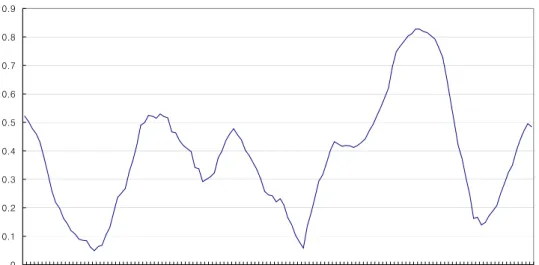
Figure 4 shows the trend in the average cross-correlation among major cities and provinces in Korea from January 1992 to September 2002.19 The average correlation coefficient turned out to be positive and less than 0.5 except in the period of 1999.6 - 2001.6, indicating that the potential scope of geographic diversification would be in general limited. However, it is noteworthy that the correlation shows a cyclical pattern with relatively low correlations in business cycle recessions. This implies that geographically well-diversified financial conglomerates would suffer less from the adverse impact of recessions on the asset quality and profitability.
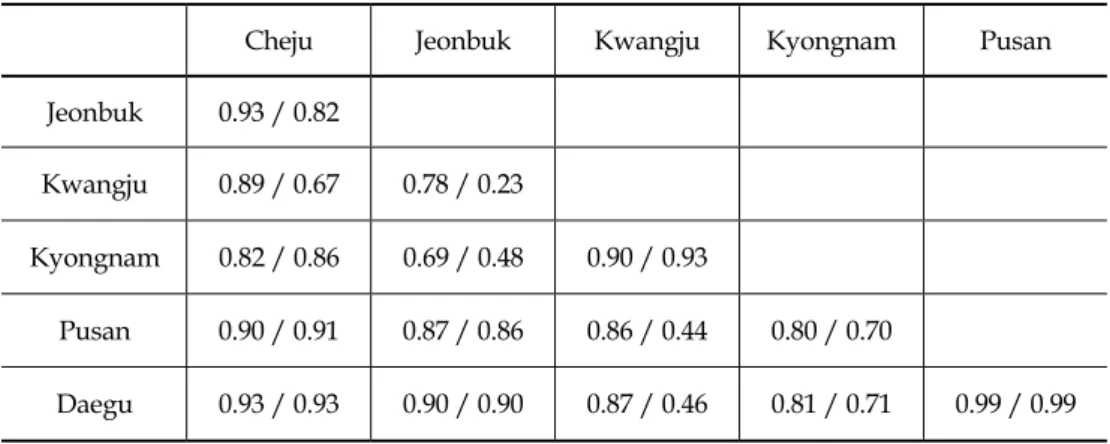
For more direct evidence on the scope of geographic diversification, we investigated historical profitability of Korean regional banks. As shown in Table 5, earnings of regional banks measured in return on equities (ROEs) for Jeonbuk- Kwangju, Jeonbuk-Kyongnam, Kwangju-Pusan, and Kwangju-Daegu pairs showed relatively low degree of correlations. This again implies that, while the diversification effect may not be substantial, there could be a potential benefit from the cross-regional consolidation among those regional bank pairs.
[Figure 4] Average Cross-Correlation in Regional Industrial Productions
Source: Hahm and Hong (2003).
19 At each point in time the cross-correlation matrix of industrial production indices for 14 major cities and provinces was computed using the prior 24 months industrial production time-series, and then, the average cross-correlation was obtained based on the matrix. Seasonally adjusted industrial production series were used.
0 0.1 0.2 0.3 0.4 0.5 0.6 0.7 0.8 0.9
1992.01 1992.10 1993.07 1994.04 1995.01 1995.10 1996.07 1997.04 1998.01 1998.10 1999.07 2000.04 2001.01 2001.10 2002.07
<Table 5> Cross-Correlations in the Profitability of Regional Banks (ROAs / ROEs, 1991-2002)
Cheju Jeonbuk Kwangju Kyongnam Pusan
Jeonbuk 0.93 / 0.82
Kwangju 0.89 / 0.67 0.78 / 0.23
Kyongnam 0.82 / 0.86 0.69 / 0.48 0.90 / 0.93
Pusan 0.90 / 0.91 0.87 / 0.86 0.86 / 0.44 0.80 / 0.70
Daegu 0.93 / 0.93 0.90 / 0.90 0.87 / 0.46 0.81 / 0.71 0.99 / 0.99 Source: Hahm and Hong (2003).
b. Scope of Product Diversification
Next we focus on the scope of diversification across different financial services industries to explore potential benefits from conglomeration. Table 6 shows the cross-correlation in historical earnings measured from the yearly return on assets (ROAs) among three major financial industries in Korea. Note that earnings correlation was relatively high between commercial bank and life insurance industries, while other industry pairs – commercial bank and securities, and securities and life insurance, showed relatively low correlations. This implies that the alliance between bank and life insurance may be able to produce a positive synergy in profitability. However, it may potentially amplify earnings variability as well.
Figure 5 shows the cross-correlation coefficients among monthly stock price indices of bank, securities and life insurance industries.20 It is noteworthy that the cross-correlation increased substantially after the financial crisis in 1997-98 implying a much limited potential for diversification across different financial industries in the post-crisis period.
<Table 6> Cross-Correlations in ROAs of Financial Industries (1991-2001)
Commercial Banks Securities Companies Securities Companies 0.1014Life Insurance Companies 0.8755 0.0882
Source: Hahm and Hong (2003).
20 The cross-correlation coefficient at each point in time was computed using the previous 24 month time-series for monthly changes in log stock price indices of three financial services industries.
[Figure 5] Cross-Correlations in Stock Price Indices of Financial Industries
-0.6 -0.4 -0.2 0 0.2 0.4 0.6 0.8 1 1.2
1992.01 1992.11 1993.09 1994.07 1995.05 1996.03 1997.01 1997.11 1998.09 1999.07 2000.05 2001.03 2002.01 2002.11
Bank-Security Bank-Insurance Security-Insurance
Source: Hahm and Hong (2003).
c. Market Power and Increased Profitability
As discussed above, there has been a view that consolidation increases franchise value and profitability of large banks and thus lowers financial risks of consolidated banks. This view in large part hinges upon the assumption that consolidation undermines competition. However, as discussed above, recent studies report evidence that consolidation has only minor effects on competition and market power.
Figure 6 shows the trends in the deposit and lending interest rate spread of major commercial banks in Korea for new deposits and new loans extended in a month.
Note that the significantly higher spread for relatively large leading banks such as Kookmin and Woori banks has actually disappeared recently as competition among banks became more intense. This implies that the market power effect of consolidation may not be significant in Korea, and hence, consolidation would not undermine competition due to increased contestability.
d. Risk-taking and Moral Hazard
Finally, individual financial conglomerates may have incentives to take on risks more aggressively based upon the expectation that they are too big and few to fail.
Deteriorations in the monitoring capacity of supervisory authorities and financial markets being faced with ever-increasing complexity and information opacity of financial conglomerates also encourage risk-taking incentives of TBTF institutions.
It is too early to evaluate the change in the risk-taking behavior of Korean
[Figure 6] Deposit-Lending Interest Rate Spreads of Major Banks
1.2 1.4 1.6 1.8 2 2.2 2.4 2.6 2.8
ave.
2002 Jan.
2003
Feb. M ar. Apr. M ay June July Aug. Sep. Oct. Nov. Dec. Jan.
2004
Woori Bank Haha Bank Shinhan Bank Kookmin Bank
financial conglomerates in this regard. As noted above, bank consolidation at early stage in post-crisis Korea has been driven by the government’s restructuring initiative, and the banks intervened by the government had no freedom of taking risks at their own will as they were tightly monitored by the Korean Deposit Insurance Corporation (KDIC) and Financial Supervisory Service (FSS).
A recent study on the risk of Korean commercial banks by Kim (2003) found that bank asset risk indicators such as non-current loan ratio and loan loss provision ratio were not significantly associated with bank size variables. However, Kim reported a weakly positive association between bank size and unsystematic component of stock return volatility, which is a more forward-looking measure of risk relative to the accounting measure. Kim interpreted the evidence as possibly indicating a more aggressive risk taking behavior of large banks.
B. Systemic Risk Potential
As emphasized above, financial consolidation and conglomeration may increase systemic risk potential as incentives of both large financial conglomerates and financial markets and regulatory authorities in monitoring and supervising them may also change. Even without distortions in incentives toward risk taking, the degree of systemic risk potential may increase with financial consolidation because, although the extent of diversification can increase at individual institutions, financial conglomerates tend to share increasingly similar
characteristics in their business portfolios and asset structures. Following the conceptual framework outlined above and in the spirit of G10 Ferguson report (2001), this section focuses on these risk channels and explores potential impacts on the systemic risk in Korea.
a. Direct Interdependencies among Conglomerates
One such channel of direct interdependencies is mutual exposure of large banks through short-term lending. Figure 7 shows the size of call loans relative to bank equity capital for top three and top five banking institutions in Korea since 1990. As can be seen, the ratio increased systematically during the post-crisis period. The rising credit risk exposure to short-term inter- bank lending indicates a higher potential for contagion of liquidity risk and hence systemic risk potential. Note also that not only the level but also the variability of the call loan to bank equity capital ratio increased substantially after the crisis.
While the risk exposure of large banking institutions in short-term lending market has increased substantially, the counter-party risk exposure through financial derivative transactions shows a mixed picture. Figure 8 shows the trend in the net position of derivative transactions for top 3 and top 5 commercial banks relative to bank equity capital, which does not reveal a structural increase after the financial crisis.
[Figure 7] Call Loan to Bank Equity Capital Ratios
0 0.1 0.2 0.3 0.4 0.5 0.6 0.7 0.8
1990.1 1991.1 1992.1 1993.1 1994.1 1995.1 1996.1 1997.1 1998.1 1999.1 2000.1 2001.1 2002.1 Top 3 Banks Top 5 Banks
Source: Hahm and Hong (2003).
[Figure 8] Net Positions in Financial Derivative Transactions
-0.2 -0.1 0 0.1 0.2 0.3 0.4 0.5
1996.1 1997.1 1998.1 1999.1 2000.1 2001.1 2002.1
Top 3 Banks Top 5 Banks
Source: Hahm and Hong (2003).
b. Indirect Interdependencies among Conglomerates
While diversified within respective financial conglomerates, the structure of balance sheet and profit strategy may become increasingly similar across financial conglomerates. Figure 9 shows the time-series of standard deviation in the corporate loan to bank asset ratios for top 5 and top 10 commercial banks in Korea since 1990.
Note that the standard deviation fell gradually for top 10 banks. For top 5 banks, the standard deviation had increased during the 1998-2001 period, but then it fell sharply from 2002. This reflects that the competition among large banking institutions has become more intense in consumer and retail banking as banks that traditionally focused on large corporate lending gradually shifted their portfolios toward more household and small and medium-sized enterprise loans.
Stock market also seems to perceive these increasing interdependencies among large banking institutions. Aside from direct and indirect interdependencies reflected in the bank balance sheet, more forward-looking stock market may better capture the degree of mutual exposure and linkage among conglomerates. Indeed, the herd behavior of depositors and financial market investors could provide additional source for systemic risk. Figure 10 shows the trend in the cross-correlation in daily stock prices of top 3 banks – Kookmin bank, Woori Financial Holdings and