• 검색 결과가 없습니다.

Characteristics Analysis of the Heat Exchange Rate according to Soil Temperature and Grout Material using Numerical Simulation

N/A
N/A
Protected

Academic year: 2021

Share "Characteristics Analysis of the Heat Exchange Rate according to Soil Temperature and Grout Material using Numerical Simulation"

Copied!
8
0
0

로드 중.... (전체 텍스트 보기)

전체 글

(1)

KIEAE Journal

Korea Institute of Ecological Architecture and Environment 66

1)

Characteristics Analysis of the Heat Exchange Rate according to Soil Temperature and Grout Material using Numerical Simulation

Oh, Jin Hwan*⋅Nam, Yu Jin**

* Dept. of Architecture, Cheongju University, South Korea

** Corresponding author, Dept. of Architecture, Cheongju University, South Korea ([email protected])

A B S T R A C T K Y E W O R D S

The ground source heat pump (GSHP) system has attracted much of attention, because of its stability of heat production and the high efficiency of the system. Performance of the heat exchanger is dependent on the soil temperature, the ground thermal conductivity, the operation schedule, the pipe placement and the design temperature. However, in spite of the many variables of these systems, there have been few research on the effect of the systems on system performance. In this study, analysis of the heat exchange rate according to soil temperature and grout material was conducted by numerical simulation. Furthermore, the heat distribution around the ground heat exchanger was presented on the different conditions of grout and underground temperature by the simulation.

ⓒ 2014 KIEAE Journal

Ground source heat pump, Ground temperature, Grout,

Heat exchange rate, Simulation

A C C E P T A N C E I N F O

Received March 5, 2014

Final revision received March 20, 2014 Accepted March 25, 2014

1. Introduction

The thermal heat pump system is a temperature differential energy technology, utilizing the underground temperature in order to keep the yearly constant temperature and to secure the stable heat source. Because its system coefficient of performance is higher than the existing general air heat pump system, it is expected as a sustainable and greenhouse gas reducing next generation energy technology.

Also, most equipments are installed underground, allowing the buildings with mandatory renewable energy use the flexible exterior design, compared to other renewable energy sources. However, the thermal heat pump system, with its high initial investment cost and the system performance, varies depending on the various conditions,

pISSN 2288-968X, eISSN 2288-9698 http://dx.doi.org/10.12813/kieae.2014.14.2.029

such as the earth condition, underground water, grout material; in order to achieve high system efficiency, there needs to be the appropriate design considering the conditions of the selected site and the comprehensive analysis of the construction cost and system performance.

Especially, the land's heat conductivity and the underground temperature, and the underground water current speed, etc. are the important elements that influence this system. On the other hand, Fig. 1 shows the mean underground water temperature distribution. 1) The under- ground water mean temperature distribution in the central region is about 13℃, and in the south about 15℃, which implies that even in the same system condition, the heat performance varies according to the installed areas.

However, there are few quantitative analysis study data

on such influence, and especially so in the areas of the long

(2)

Fig. 2 General heat exchanger

Fig. 1 Distribution of mean groundwater temperatures of Shallow wells (Lee et.al. 2006)

term simulation through the detailed interpretation. For the thermal heat pump system performance analysis as per the underground temperature distribution and the grout material variation, there are many studies domestically and overseas. In the areas of the underground temperature distribution application, Penghui Gao et. al. 2) investigated the underground temperature distribution characteristics including the earthen porosity and the water's rate, utilizing the simulation, and implemented the underground heat exchanger arrangement study; C.O. Popiel et. al. 3) monitored the underground temperature in Poznan City and proposed the appropriate underground heat exchanger at the selected site.

Domestically, Shin Hyun-Jun, et. al. 4) measured the per depth underground temperature distribution and evaluated the thermal energy use potential of the selected site. Also, Fabien Delaleux et. al. 5) and A.A. Alrtimi et. al. 6) compared in analysis the heat conductivity variation according to the grout admixture variation; Roque Borinaga-Trevino et.al. 7) implemented the heat conductivity analysis as per the admixture rate variation through the experiments, to confirm the influence of the revised admixture use on the underground heat exchanger design length. Im Hyo-jae et.

al. 8) measured the heat conductivity of the underground heat exchanger as per the grout material through the

experiments to analyze the influence of the grout material on the heat delivery of the underground heat exchanger.

However, few studies compared and analyzed in detail the performance of the thermal heat pump system through the detailed analysis of the heat transfer between the underground heat exchanger and the circulating water and soil as per the earthen condition and the grout material.

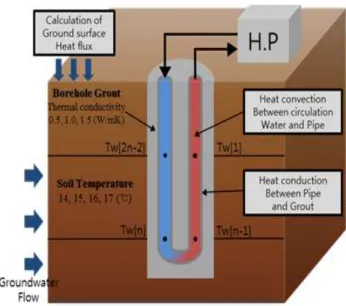
In order to predict the underground heat correctly, we need to interpret correctly the circulating water within the heat exchanger, and the convection heat delivery within the pipe interior walls, and the heat transfer between the pipe and the grout and soil. Fig. 2 shows the heat transfer concept drawings around the underground heat exchanger.

The domestic underground heat exchanger materials are generalized for considering the design condition, but the variables as per the regional climate and the underground temperature have to be considered in the system design.

In this study in order to optimize the underground heat exchanger design, we reviewed the underground heat variation as per the initial underground temperature and grout material variation, utilizing the underground heat prediction simulation developed in the previous study.

Through the interpretation result, we analyzed the

relationship between the underground temperature and the

underground heat of the place from which the system was

introduced from. The study is intended to be used as a

basic data for the feasibility decision in selecting the grout

material.

(3)

2. Study method

2.1. Simulation summary

In the underground heat exchanger design, in order to find the optimum design method, we need to review the various variables such as geotechnical condition of the selected site. Also, we have to determine what materials will be used as well, in considering the grout material characteristics. In this study in order to interpret precisely underground heat exchanger and with the soil heat exchange, and underground heat exchanger and the circulating water's heat exchange, 3-dimensional underground heat /underground water transfer simulation method developed in the previous study 9) was used as a tool combined with the underground heat exchanger model and the earth surface heat resin model. For the circulating water model within the underground heat exchanger, the interpretation model was used with phase 1 convection expansion formula was dioxided. Also, German WASY company's FEFLOW based on the finite-element method (FEM) was used for the underground water and underground heat move's interpretation code.

Regarding the interpretation method and soil's heat material property estimation method, the methods implemented in the previous study 10) was used in reference. The solid state thermal conductivity of the soil was calculated, using the weighted geometric mean method of each element in solid state thermal conductivity and the mixing rate, as in formula (1).

     

 ·     

 (1)

Here, and are each the elements A, B's thermal conductivity, m and n are each the elements A, B's volume rates. Also, the heat capacity is calculated as per the soil particle's specific heat and density.

     (2)

 is heat capacity,  is material's own specific heat,  is material's own density,  is the volume rate when  =1. In this review, thermal conductivity of the mean of the solid

part and the opening part was calculated according to the liquid parallel model, including the solid part and the opening part. On the other hand, the underground heat exchanger model was based on the one-dimensional 이류 expansion equation, calculating the heat exchanger pipe inner walls and circulating water's heat exchange quantity, and implemented the abnormal calculation of calculating the Circulating Water temperature at each points and the underground releasing heat current quantity. Formula (3) shows the Circulating Water model's formula used in this interpretation model.
 



   

 

   



  



    (3)

Here, T means Circulating Water temperature(℃), p is density (kg/㎥), U is current speed (m/s), P is currency quantity (l/s), C is specific heat (J/kg℃), A is area (㎡), h is Circulating Water's convection heat delivery rate within the heat exchanger (J/s㎡℃). On the other hand, the soil's heat flux in the earth surface (Q) is calculated by the earth surface heat balance formula such as formula (4).

                      (4)

 is long wave radiation from the sun,   is short wave radiation,    is earth surface long wave radiation,

 is latent heat move,    is convection heat delivery.

2.2. Simulation interpretation condition

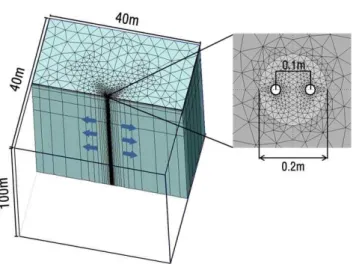
In this study for the precise heat prediction, we implemented the Tetra mesh using pipe shape realization, to identify the influence of the soil and grout material's heat material property on the heat, the underground heat exchange U tube (Depth 100m) of the general borehole method use used. Fig. 3 shows the simulation Base Case model.

Within the 40m × 40m × 100m area center a borehole

with diameter 0.2m is installed, in which the underground

heat exchanger (U-tube, 32A, external diameter 32mm,

internal diameter 26mm) is inserted. The current speed of

the Circulating Water in the pipe is 0.292 m/s, and between

the borehole and U-tube, concrete (thermal conductivity :

1.5W/mK, heat capacity 2.8 MJ/㎥K) was inserted. Table 1

(4)

Calculation Tool FEFLOW + User subroutine Ground Heat

Exchanger(GHE)

Single U-tube 32 A Bore Hole Concrete Grouting Operation Condition Initial △T 10℃

Limitation Temp. 5℃

Domain 40m × 40m × 100m

Operation 12/1 ~ 2/28. 3 months 09:00 ~ 18:00 Soil Condition Granite (λ : 3.5 W/mK)

Initial Temp. 16℃

Table. 2 Simulation conditions

soil Temperature (℃)

Thermal conductivity of the Grout

(W/mK)

Porosity of the Grout

Case 1 14 1.5 0.001

Case 2 15 1.5 0.001

Case 3

(Base Case) 16 1.5 0.001

Case 4 17 1.5 0.001

Case 5 16 0.5 0.001

Case 6 16 1.0 0.001

Case 7 16 0.58 (water) 1

Table. 3 Case condition

Porosity

Thermal Conductivity

(W/mK)

Heat Capacity (MJ/㎥K)

Granite 0.10 3.50 2.92

Concrete 0.001 1.50 2.80

U-tube 0.58 0.41 2.38

Table 1. Thermal Properties of Base Case Fig. 3 Simulation Model

shows Base Case soil and grout and U-tube's heat material property value.

Table 2 shows simulation condition and operation schedule. The earth condition is assumed to be granite stone with the initial stage temperature at 16℃, entrance temperature differential는 10℃, Circulating Water temperature limitation is set up at 5℃. On the other hand, the excessive heat operation in the thermal heat pump system induces the underground temperature to go down, preventing the stable heat source from being secured, which is a strong point of the thermal system.

In order to prevent this, the operation condition is set up so that the heat pump exit temperature doesn't go above

5℃. The operation period is the winter 3 months (December ~ February), operation time at 09:00 ~ 18:00.

In this study 7 cases were set up, and a simulation was implemented. In the case 1~4, we gave the underground temperature the variation in the range 14℃~17℃, for case 5~6, at the underground temperature same as the base case and the heat material property value with the grout material's thermal conductivity at 0.5 W/mK, 1.0 W/mK, 1.5 W/mK, the heat characteristics analysis was implemented. Also, the concrete filled base case and water was compared with the filled Case 7 for the analysis.

3. Result and analysis

3.1. Heat source temperature and period mean Circulating Water temperature differential analysis

Fig. 4 shows the Circulating Water entrance temperature variation of the Base Case for 1 week. The Circulating Water entrance mean temperature is 5.0℃, and at the exit 10.4℃, the mean entrance temperature differential is 5.4℃, and the heat at 34.9 W/m. Also, we confirmed that the Circulating Water exit temperature shows the nearing temperature with the initial underground temperature 16℃, and that after the system operation due to the underground temperature because of the underground heat, it abruptly lowered down.

Moreover, the Circulating Water's operation initial

temperature lowered down than the previous temperature

from the initial 15.4℃, and as the heat progresses the next

day 15.1℃, 15℃, 14.9℃, 14.8℃, 14.8℃, 14.7℃,

showing that it lowered than the previous day. This means

(5)

Fig. 4 Fluctuation of circulatory water temperature

Fig. 5 Average of temperature difference of circular for soil temperature change

Fig. 7 Average of temperature difference of circular for grout material change

that the restoration of the underground temperature is not complete in the non-operative hours, and that it leads to the mean heat reduction due to the heat source temperature reduction.

1) Circulating Water temperature differential as per the underground temperature variation

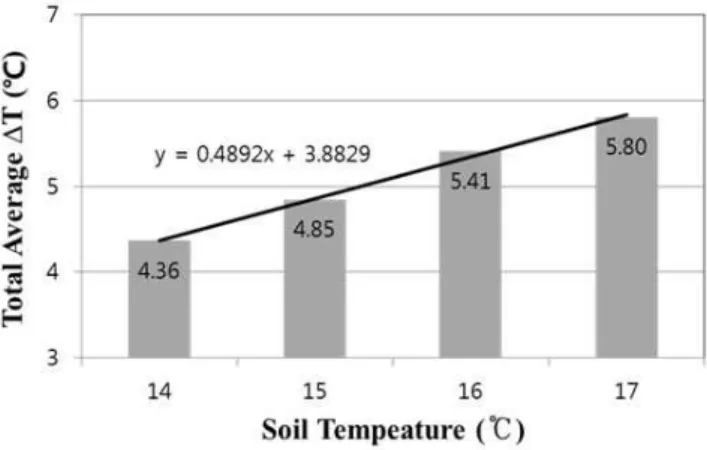
Fig. 5 shows the mean Circulating Water temperature differential of Case 1~4 for 3 months at the same material property with the underground temperature variation at the range 14℃~17℃. The mean Circulating Water temperature differentials per each case period are each 4.36℃, 4.85℃, 5.41℃, 5.80℃, showing the correspondence as the heat source temperature rises, with the underground temperature variation range the biggest at Case 1 and at Case 4 with the mean Circulating Water temperature differential at 1.44℃.

2) Circulating Water temperature differential as per the grout material's thermal conductivity variation Fig. 6 shows the mean Circulating Water temperature

differential of the grout material's thermal conductivity with the variation at the Base Case and Case 5, 6 for 3 months. The mean Circulating Water temperature differentials with the base case and at Case 5~6 period are each 3.86℃, 4.93℃, 5.41℃. Base Case showed the mean Circulating Water temperature differential 40% higher than Case 5.

3) Circulating Water temperature differential as per the grout material variation

Fig. 7 shows the mean Circulating Water temperature differential with the borehole with the concrete filled Base Case and water filled Case 7 for 3 months. The simulation result shows that the period mean Circulating Water temperature differentials are each 5.41℃ and 4.41℃, showing the concrete filled Base Case Circulating Water temperature differential 1℃ higher.

3.2. Underground heat analysis

1) heat analysis per underground temperature variation

Fig. 8 shows the calculation result of the mean heat

(Heat Exchange Rate, HER) as per the underground

temperature variation per Case for 3 months. Case 1~4

period mean heat are each 28.40 W/m, 31.55 W/m, 35.24

W/m, 37.79 W/m, confirming the heat corresponds with

the heat source temperature. In this interpretation result,

Case 4 with the highest underground temperature showed

the heat about 30% higher than the small Case 1, whose

result confirmed that the site's underground temperature is

the major factor influencing the thermal system's system

performance and construction cost.

(6)

Fig. 9 Average of heat exchange rate for thermal conductivity change

Fig. 10 Average of heat exchange rate for grout material change Fig. 8 Average of heat exchange rate for soil temperature change

Soil Temperature (℃)

Thermal conductivity of the grout

(W/mK)

Porosity of the

grout EWT (℃) Average

∆T (℃)

Average HER (W/m)

Case 1 14 1.50 0.001 9.45 4.36 28.40

Case 2 15 1.50 0.001 9.94 4.85 31.55

Case 3

(Base Case) 16 1.50 0.001 10.40 5.41 35.24

Case 4 17 1.50 0.001 10.92 5.80 37.79

Case 5 16 0.50 0.001 8.88 3.86 25.12

Case 6 16 1 0.001 9.93 4.93 32.11

Case 7 16 0.58 (water) 1 9.41 4.41 28.69

Table. 4 Simulation results

2) The heat analysis as per the grout material's thermal conductivity variation

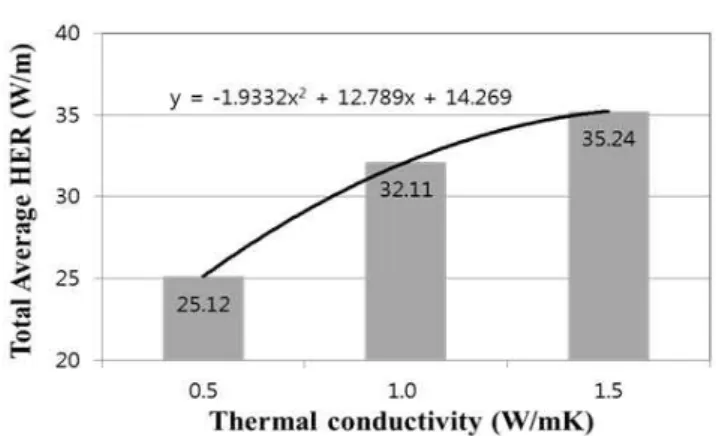
Fig. 9 shows the calculation result of the grout material's mean heat as per the thermal conductivity variation per case for 3 months. The Case 5~6 period mean heats that gave the variation to the Base Case and the grout thermal conductivity are each 25.12 W/m, 32.11 W/m, 35.24 W/m.

We confirmed that the heat corresponds with the grout material's thermal conductivity increase; and it is expected that the grout material variation will contribute to the thermal heat pump system's performance improvement

3) heat analysis per the grout material variation

Fig. 10 shows the mean heat calculation result of Base Case and Case 7 for 3 months. The period mean heat with the concrete filled Base Case as the grout material and with the water filled Case 7 were each 35.24 W/m and 28.69 W/m; the concrete filled Base Case showed the higher heat performance by 6.55 W/m. With water as filling material, convection induced heat delivery effect can be expected but when it is compared with the heat analysis result as per the thermal conductivity variation in the previous paragraph, the effect is considered minimal.

3.3. Result contemplation

Table. 4 shows the total simulation result: each case's underground temperature, grout material's thermal conductivity, grout material porosity, mean heat source temperature (EW. T), mean circulating water temperature differential, per unit length mean heat. as per the underground temperature variation per unit length from the mean heat 14℃ 28.40 W/m to 17℃ 37.79 W/m.

The mean Circulating Water temperature differential as per the grout material thermal conductivity variation at 0.5 W/mK is 3.86℃ and 5.41 at 1.5 W/mK, showing 1.55℃

difference; overall as the underground temperature and

(7)

grout material thermal conductivity increases, the system performance increases as well.

4. Conclusion

In this study in order to establish the design method of the appropriate thermal system at the site for its land condition, the underground heat was predicted using the underground heat and underground water move simulation. Especially, the Circulating Water temperature and the underground heat was calculated as per the site's initial underground temperature and grout material variation within the underground heat exchanger, to understand their relationship. The result can be summarized as the following:

1st, the mean Circulating Water temperature differential of the Base Case with the grout material's thermal conductivity variation and of Case 5, 6 were calculated for 3 months, whose calculation result showed the cor- respondence; and Base Case showed about 40% higher than Case 5.

2nd, the heat analysis result as per the underground temperature variation showed that Case 4 with the highest underground temperature showed the heat performance of about 30% higher than the lowest Case 1.

3rd, the heat analysis result as per the grout material change showed that the concrete filled Base Case showed the higher heat than the water filled Case 7 by 6.55W/m.

This implies that the water convection heat delivery effect was not big. Rather, the higher the thermal conductivity, the higher the heat performance of the underground heat exchanger.

In the future, we are planning to implement the comparison analysis with the substantiated experiments and to improve the simulation precision. Also, more diverse Case Studies will be implemented, and from the result to quantitatively define the relationship between each of the design factors and the thermal heat pump system performance, and develop the handy design tool the designers in practice can use easily

Acknowledgement

This work was supported by the New & Renewable Energy Core Technology Program of the Korea

Institute of Energy Technology Evaluation and Planning(KETEP) granted financial resource from the Ministry of Trade, Industry & Energy, Republic of Korea (No. 0000000014249)

References

[1] Jin-Youn Lee, Jeong-snag Hahn, Characterization of groundwater temperature obtained from the korean national groundwater monitoring stations:

lmplications for heat pumps, Journal of Hydrology, 2006, pp.514-526

[2] Penghui Gao, Guoqing Zhou, Study on temperature field around heat pipe underground based on lime heat source theory, Energy and Buildings, 2011, pp.2483-2487

[3] C.O. Popiel, J. Wojtkowiak, Temperature distributions of ground in the urban region of Poznan City, Experimental Thermal and Fluid Science, 2013, pp.135-148

[4] H. J. Shin, C. H. Ahn, C. S. Cho, Overview for the effective use of geothermal energy, Magazine of the SAREK, 1995, pp. 409-419

[5] Fabien Delaleux, Xavier Py, Regis Olives, Antoine Dominguez, Enhancement of geothermal borehole heat exchangers performances by improvement of bentonite grouts conductivity, Applied Thermal Engineering, 2012, pp. 92-99

[6] A.A. Alrtimi, M. Rouainia, D.A.C. Manning, Thermal enhancement of PFA-based grout for geothermal heat exchangers, Applied Thermal Engineering, 2013, pp. 559-564.

[7] Roque Borinaga-Trevino, Pablo Pascual-Munoz, Daniel Castro -Fresno, Juan Jose Del Coz-Diaz, Study of different grouting materials used in vertical geothermal closed-loop heat exchangers, Applied Thermal Engineering, 2013, pp. 159-167.

[8] Hyo Jae Lim, Hyoung Jin Kong, Yoon Seok Song, Seong Koo Park, Thermal conductivity measurement of grouting materials for geothermal heat exchanger, Journal of SAREK, 2005, Vol. 17, No.

4, pp. 364-369

[9] Nam Yujin, Numerical analysis for the effect of

ground and groundwater conditions on the

(8)

performance of ground source heat pump system, Journal of SAREK, Vol. 23, No. 5, pp. 321-326 [10] Nam Y. J., Ooka R. and Hwang S. H., Development

of a numerical model to predict heat exchange rates

for a ground-source heat pump system, Energy

and Buildings, 2007, Vol. 40, pp.2133-2140.

수치

Fig. 2  General heat exchanger
Table 1. Thermal Properties of Base CaseFig. 3 Simulation Model
Fig.  7  Average  of  temperature  difference  of  circular  for  grout  material  change
Fig. 10 Average of heat exchange rate for grout material changeFig. 8 Average of heat exchange rate for soil temperature change

참조

관련 문서

Also, the design of an optimal heat sink requires a complete knowledge of all heat transfer characteristics between the heat source and the ambient air

This study the changes in structure and mechanical characteristics by the analysis on mechanical characteristics of the welding part and the post weld

To find out the main features of the heat exchange from the interaction between atmosphere and sea, this thesis covers the meterological property and

5.16 Overall heat transfer coefficient and convective heat transfer coefficient of hot side according to mass flow rate and inlet temperature (High temperature condition)

To visualize the vari- ation in various transport characteristics (the non-dimen- sional axial velocity and temperature distributions, pressure gradient, rate of heat

Various studies have been performed to improve properties of material, electrical and mechanical properties of railway train according to the increase of the speed in the

High heat transfer coefficient High thermal conductive material coatings.. Can reduce the constriction resistance

✓ The rate of change of energy is equal to the sum of the rate of heat addition to and the rate of work done on a fluid particle.. ▪ First