Tuberc Respir Dis 2010;69:271-278
CopyrightⒸ2010. The Korean Academy of Tuberculosis and Respiratory Diseases. All rights reserved.
비소세포폐암에서 PNA-Mediated PCR Clamping을 이용한 EGFR 돌연변이 분석법
건국대학교 의학전문대학원
1내과학교실,
2병리학교실
이계영1, 김희정1, 김순종1, 유광하1, 김원동1, 오서영2, 김완섭2
PNA-Mediated PCR Clamping for the Detection of EGFR Mutations in Non-Small Cell Lung Cancer
Kye Young Lee, M.D., Ph.D.
1, Hee Joung Kim, M.D.
1, Sun Jong Kim, M.D.
1, Gwang Ha Yoo, M.D.
1, Won Dong Kim, M.D.
1, Seo Young Oh, M.S.
2, Wan Seop Kim, M.D.
2Departments of
1Internal Medicine,
2Pathology, Konkuk University School of Medicine, Seoul, Korea
Background: Recent studies have demonstrated that the epidermal growth factor receptor (EGFR) genotype is the most important predictive marker to EGFR-tyrosine kinase inhibitors (TKIs) and first-line gefitinib treatment will be approved in the near future for use in non-small cell lung cancer (NSCLC) patients with the EGFR mutation.
Direct sequencing is known to be the standard for detecting EGFR mutations; however, it has limited sensitivity.
Peptide nucleic acids (PNA)-mediated PCR clamping method is a newly introduced method for analyzing EGFR mutations with increased sensitivity and stability.
Methods: A total of 71 NSCLC patients were analyzed for EGFR mutations using the PNA-mediated PCR clamping technique. Sixty-nine patients were analyzed for clinicopathologic correlation with EGFR genotype; 2 patients with indeterminate results were excluded. In order to determine EGFR-TKI drug response, 57 patients (42 gefitinib, 15 erlotinib) were included in the analysis.
Results: The EGFR mutation rate was 47.8%. Being female, a non-smoker, and having adenocarcinoma were favorable clinicopathologic factors, as expected. However, more than a few smokers (33.3%), male (28.1%), and patients with non-adenocarcinoma (28.6%) had the EGFR mutation. Having a combination of favorable clinico- pathologic factors did not increase the EGFR mutation rate significantly. Drug response to EGFR-TKIs showed significant differences depending on the EGFR genotype; ORR was 14.3% for wild type vs 69.0% for mutant type;
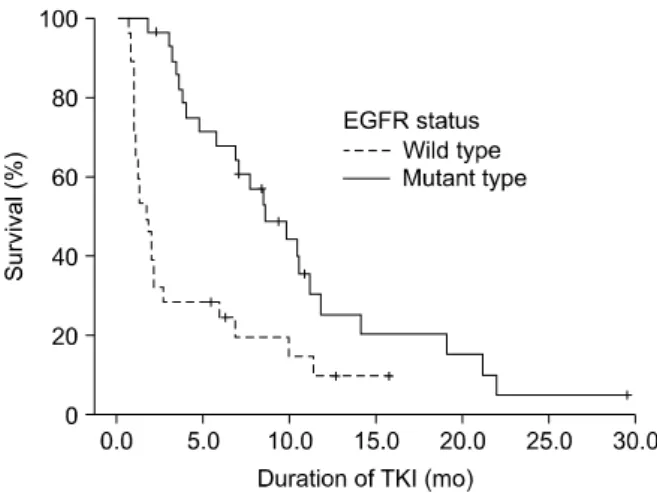
DCR is 28.6% for wild type vs 96.6% for mutant type. The median EGFR-TKI treatment duration is 7.6 months for mutant type group and 1.4 months for wild type group.
Conclusion: EGFR genotype determined using the PNA-mediated PCR clamping method is significantly correlated with the clinical EGFR-TKI responses and PNA-mediated PCR.
Key Words: Peptide Nucleic Acids; Receptor, Epidermal Growth Factor; Carcinoma, Non-Small-Cell Lung
Address for correspondence: Kye Young Lee, M.D., Ph.D.
Department of Internal Medicine, Konkuk University School of Medicine, 4-12, Hwayang-dong, Gwangjin-gu, Seoul 143- 729, Korea
Phone: 82-2-2030-7521, Fax: 82-2-2030-7748 E-mail: [email protected]
Received: Sep. 3, 2010 Accepted: Oct. 15, 2010
서 론
Epidermal growth factor receptor-tyrosine kinase in- hibitors (EGFR-TKIs)가 임상에 도입된 초기에는 여성, 비 흡연자, 선암, 동양인 등과 같은 임상-병리적 요소들이 약 제를 선택하는 기준이었지만1-3, 최근에는 EGFR 돌연변이 가 EGFR-TKI에 대한 약제반응을 결정하는 가장 중요한 인자라는 것이 밝혀지면서4,5 EGFR 돌연변이 분석검사의
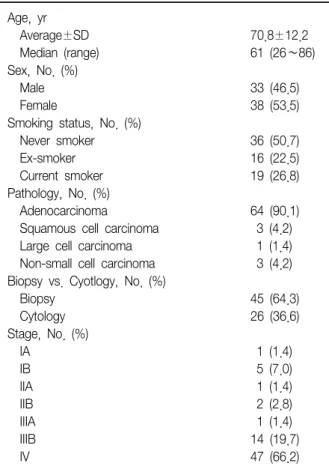
Table 1. Patient characteristics (n=71)
Age, yr
Average±SD 70.8±12.2
Median (range) 61 (26∼86)
Sex, No. (%)
Male 33 (46.5)
Female 38 (53.5)
Smoking status, No. (%)
Never smoker 36 (50.7)
Ex-smoker 16 (22.5)
Current smoker 19 (26.8)
Pathology, No. (%)
Adenocarcinoma 64 (90.1)
Squamous cell carcinoma 3 (4.2) Large cell carcinoma 1 (1.4) Non-small cell carcinoma 3 (4.2) Biopsy vs. Cyotlogy, No. (%)
Biopsy 45 (64.3)
Cytology 26 (36.6)
Stage, No. (%)
IA 1 (1.4)
IB 5 (7.0)
IIA 1 (1.4)
IIB 2 (2.8)
IIIA 1 (1.4)
IIIB 14 (19.7)
IV 47 (66.2)
중요성이 대두되고 있다. 또한 조만간 EGFR 돌연변이 양 성 비소세포폐암 환자는 1차 항암약제로서 세포독성 항암 제를 지양하고 gefitinib와 같은 EGFR-TKI가 선택 처방될 것으로 예상되는 시점에서, EGFR 돌연변이 분석검사는 이제 연구적 가치를 넘어서 임상에서 반드시 필요한 검사 방법으로 자리 매김 할 것으로 예상하고 있으며, 정확하고 예민한 EGFR 돌연변이 분석검사 방법의 도입은 필연적이 라 하겠다.
EGFR 돌연변이를 검사할 수 있는 분석 방법으로는 di- rect sequencing이 표준 방법으로 알려져 있고 현재 대다 수의 문헌 자료들은 이 방법에 의한 결과들이다6. 그러나 direct sequencing 방법은 민감도가 떨어져서 mutant DNA가 최소 20% 이상의 농도를 유지해야 검출되므로 정 상 DNA에 의한 희석효과를 감소시키기 위하여 조직에서 종양세포의 세포비율(cellularity)이 40% 이상은 되어야 하며 정확한 분석을 위해서 암세포조직에 대한 laser cap- ture microdissection이 필요하다7. 따라서 예민도가 높고 임상적으로 EGFR-TKI에 대한 약제 반응과의 일치도가 높 은 검사 방법이 요구되고 있는데, IPASS study에서 사용된 Scorpion 방법이 널리 알려져 있기는 하지만8, 고비용과 검사 키트의 물리적 안정성 등의 문제점으로 인해 현재 국내에 널리 보급되고 있지 않은 상황이다. 최근 peptide nucleic acids (PNA)를 이용한 방법, 즉 PNA-mediated PCR clamping이란 방법이 개발되어 EGFR 돌연변이 분석 에 이용하려는 움직임이 있어 주목 받고 있으며9, 국제적 으로도 이 방법을 이용한 연구 결과가 이미 보고되기 시작
하였다10,11. 이에 저자들은 비소세포폐암 환자에서 PNA-
mediated PCR clamping 방법을 이용하여 EGFR 돌연변 이 검사를 시행하고 그 결과와 EGFR-TKI에 대한 약제반 응과의 일치도를 분석 조사하여 비소세포폐암에서 PNA- mediated PCR clamping을 이용한 EGFR 돌연변이 분석 검사의 임상적 유용성을 조사하여 보고하는 바이다.
대상 및 방법
1. 연구대상
건국대학교병원에서 비소세포폐암으로 진단받은 71명 의 환자를 대상으로 하였고, 연령은 70.8±12.2세(26∼
86세) 남녀 비는 33:38 (46.5%:53.5%), 흡연력은 비 흡연자 36명(50.7%), 과거 흡연자 16명(22.5%), 현재 흡 연자 19명(26.8%)이며, 선암이 64명(90.1%)으로 대다수 를 차지하고 있었으며 기타 평편상피암 3명(4.2%), 대세
포암 1명(1.4%), 비소세포폐암 3명(4.2%)이었으며, 조직 검사 시료가 45명(64.3%)이었으며 세포진 검사 시료는 26명(36.6%)이었다(Table 1). 병기별로는 IV병기가 47명 (66.2%)으로 가장 많았고 IIIB가 14명(19.7%)으로 뒤를 이었다.
2. DNA 분리
병리 의사가 현미경으로 관찰하여 파라핀 포매 조직 및 세포 슬라이드에서 종양세포가 최소 50% 이상 포함되도 록 영역을 표기하였다. 커버글라스를 xylene으로 제거 한 후 26 gauge 주사기 바늘을 이용하여 암 세포만을 분리 채취하였다. 10% Resin이 들어 있는 DNA extraction buf- fer (50mMTris-cl pH 8.5, 1mMEDTA pH 8.0, 0.5%
Tween 20) 50∼100 μL에 채취된 암 세포만을 분리하여 넣고 200 μg/mL Proteinase K와 혼합한 후 56oC에서 최 소 1시간 이상 처리한 후 100oC에서 10분 동안 가열하였 다. 그리고 12,000 rpm에서 10∼15분 동안 원심분리하고 Resin이 혼입되지 않도록 주의하면서 상층액만을 채취하 여 PCR 반응에 사용하였다12,13.
Table 2. The PCR protocol
One cycle
Pre-denaturation 94
oC 5 min
4-Step cycling
Denaturation 94
oC 30 sec
PNA clamping 70
oC 20 sec
Annealing 63
oC 30 sec
Extension 72
oC 30 sec
No. of cycles: 40 cycles One cycle
Final extension 72
oC 5 min
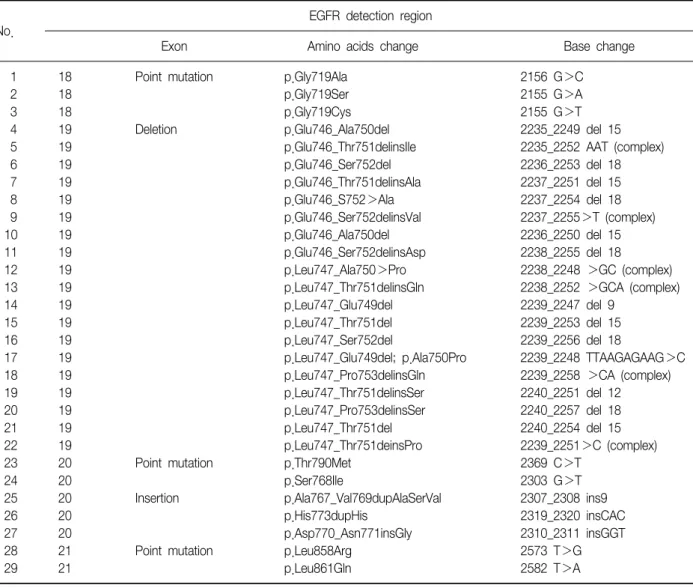
Table 3. The PNA-mediated clamping method detects 29 mutations of the EGFR gene
No.
EGFR detection region
Exon Amino acids change Base change
1 18 Point mutation p.Gly719Ala 2156 G>C
2 18 p.Gly719Ser 2155 G>A
3 18 p.Gly719Cys 2155 G>T
4 19 Deletion p.Glu746_Ala750del 2235_2249 del 15
5 19 p.Glu746_Thr751delinsIle 2235_2252 AAT (complex)
6 19 p.Glu746_Ser752del 2236_2253 del 18
7 19 p.Glu746_Thr751delinsAla 2237_2251 del 15
8 19 p.Glu746_S752>Ala 2237_2254 del 18
9 19 p.Glu746_Ser752delinsVal 2237_2255>T (complex)
10 19 p.Glu746_Ala750del 2236_2250 del 15
11 19 p.Glu746_Ser752delinsAsp 2238_2255 del 18
12 19 p.Leu747_Ala750>Pro 2238_2248 >GC (complex)
13 19 p.Leu747_Thr751delinsGln 2238_2252 >GCA (complex)
14 19 p.Leu747_Glu749del 2239_2247 del 9
15 19 p.Leu747_Thr751del 2239_2253 del 15
16 19 p.Leu747_Ser752del 2239_2256 del 18
17 19 p.Leu747_Glu749del; p.Ala750Pro 2239_2248 TTAAGAGAAG>C
18 19 p.Leu747_Pro753delinsGln 2239_2258 >CA (complex)
19 19 p.Leu747_Thr751delinsSer 2240_2251 del 12
20 19 p.Leu747_Pro753delinsSer 2240_2257 del 18
21 19 p.Leu747_Thr751del 2240_2254 del 15
22 19 p.Leu747_Thr751deinsPro 2239_2251>C (complex)
23 20 Point mutation p.Thr790Met 2369 C>T
24 20 p.Ser768Ile 2303 G>T
25 20 Insertion p.Ala767_Val769dupAlaSerVal 2307_2308 ins9
26 20 p.His773dupHis 2319_2320 insCAC
27 20 p.Asp770_Asn771insGly 2310_2311 insGGT
28 21 Point mutation p.Leu858Arg 2573 T>G
29 21 p.Leu861Gln 2582 T>A
PNA: peptide nucleic acids; EGFR: epidermal growth factor receptor.
3. PNA-mediated PCR clamping
추출된 DNA에서 EGFR 돌연변이 분석 검사는 PNA
ClampTM EGFR mutation detection kit (PANAGENE, Daejeon, Korea)를 사용하여 검출하였다. Real time PCR 기기는 CFX 384 (Bio-Rad, Hercules, CA, USA)를 사용하 였으며 Table 2의 반응조건으로 실험하였다.
PNAClampTM EGFR mutation detection kit에서 검출 가능한 돌연변이는 Table 3에 나타내었다. 야생형 유전자 와 혼성화되도록 고안된 PNA 프로브가 EGFR 돌연변이 코돈 유전자 부위에 혼성화되어 증폭을 저해하게 되면 증 폭이 저해되어 Ct값이 높게 나타난다. 반면 EGFR 돌연변 이 코돈 부위에 돌연변이가 발생한 경우 PNA 프로브와 혼성화되지 못하고 증폭되어 Ct값이 낮게 나타나게 된다.
Standard Ct값에서 미지의 시료로부터 얻어진 Ct값을 빼 어 얻어진 △Ct의 값을 확인하여 각 코돈의 돌연변이 유 무를 확인하였다.
Table 4. EGFR mutation testing results using PNA-medi- ated PCR clamping (n=71)
Wild type 36 (50.7)
Indeterminate 2 (2.8)
Mutant type 33 (46.5)
Exon19 del 18 (54.5)
Exon21 L858R or L861Q 14 (42.4) Exon19 del+T790M 1 (3.0) Values are presented as number (%).
EGFR: epidermal growth factor receptor; PNA: peptide nucleic acids.
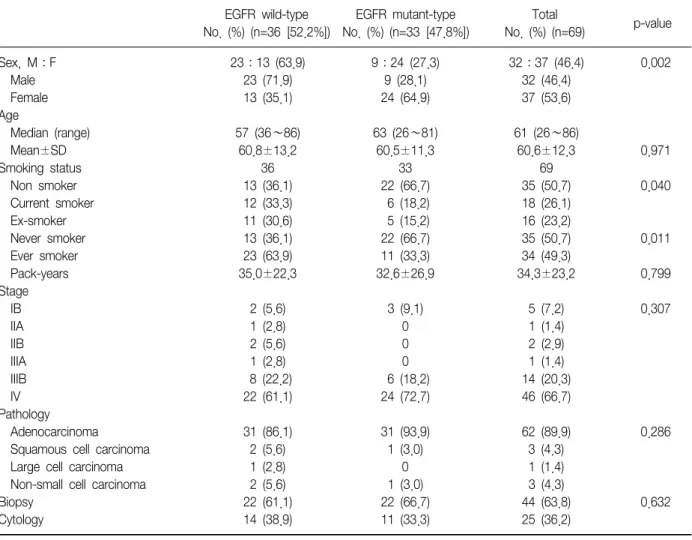
Table 5. Comparisons of clinicopathologic factors depending on EGFR genotype
EGFR wild-type
No. (%) (n=36 [52.2%])
EGFR mutant-type No. (%) (n=33 [47.8%])
Total
No. (%) (n=69) p-value
Sex, M:F 23:13 (63.9) 9:24 (27.3) 32:37 (46.4) 0.002
Male 23 (71.9) 9 (28.1) 32 (46.4)
Female 13 (35.1) 24 (64.9) 37 (53.6)
Age
Median (range) 57 (36∼86) 63 (26∼81) 61 (26∼86)
Mean±SD 60.8±13.2 60.5±11.3 60.6±12.3 0.971
Smoking status 36 33 69
Non smoker 13 (36.1) 22 (66.7) 35 (50.7) 0.040
Current smoker 12 (33.3) 6 (18.2) 18 (26.1)
Ex-smoker 11 (30.6) 5 (15.2) 16 (23.2)
Never smoker 13 (36.1) 22 (66.7) 35 (50.7) 0.011
Ever smoker 23 (63.9) 11 (33.3) 34 (49.3)
Pack-years 35.0±22.3 32.6±26.9 34.3±23.2 0.799
Stage
IB 2 (5.6) 3 (9.1) 5 (7.2) 0.307
IIA 1 (2.8) 0 1 (1.4)
IIB 2 (5.6) 0 2 (2.9)
IIIA 1 (2.8) 0 1 (1.4)
IIIB 8 (22.2) 6 (18.2) 14 (20.3)
IV 22 (61.1) 24 (72.7) 46 (66.7)
Pathology
Adenocarcinoma 31 (86.1) 31 (93.9) 62 (89.9) 0.286
Squamous cell carcinoma 2 (5.6) 1 (3.0) 3 (4.3)
Large cell carcinoma 1 (2.8) 0 1 (1.4)
Non-small cell carcinoma 2 (5.6) 1 (3.0) 3 (4.3)
Biopsy 22 (61.1) 22 (66.7) 44 (63.8) 0.632
Cytology 14 (38.9) 11 (33.3) 25 (36.2)
EGFR: epidermal growth factor receptor.
4. 통계분석
수집한 자료는 SPSS version 17.0 (SPSS Inc., Chicago, IL, USA)를 이용하여 통계처리 하였다. 임상 특성 비교에 있어서 연령은 Mann-Whitney U test, 성별, 흡연력, 병기,
조직형, 검체 종류, 약제 사용에 대한 반응은 chi-square test, 무진행 생존율은 Kaplan Meier법과 log rank test를 이용하여 분석하였다. p값이 0.05 미만인 경우 통계적으 로 유의한 것으로 판단하였다.
결 과
1. PNA-mediated PCR clamping을 이용한 EGFR 돌연 변이 분석
71명의 비소세포폐암 환자에서 PNA-mediated PCR clamping 방법을 이용하여 EGFR genotyping을 시행한 결과 36명(50.7%)에서는 wild-type이 33명(46.5%)에서는 mutant-type이 결정되었고, 2명(2.8%)에서는 genotype을 결정할 수 없었다(Table 4). 그 이유는 추출된 DNA의 질 적인 문제 때문에 PCR 증폭이 잘 되지 않은 것으로 생각
Figure 1. The proportions of favorable clinicopathologic factors and each combination in EGFR mutation positive group (n=33).
Table 6. EGFR mutation positive rate depending on favor- able clinicopathologic factors
Female 24/37 (64.9%)
Non-smoker 22/35 (62.9%)
Adenocarcinoma 31/62 (50.0%)
Female and non-smoker 19/35 (54.3%)
Female and adenocarcinoma 23/35 (65.7%) Non-smoker and adenocarcinoma 21/33 (63.6%) Female and non-smoker and 18/28 (64.3%) adenocarcinoma
EGFR: epidermal growth factor receptor.
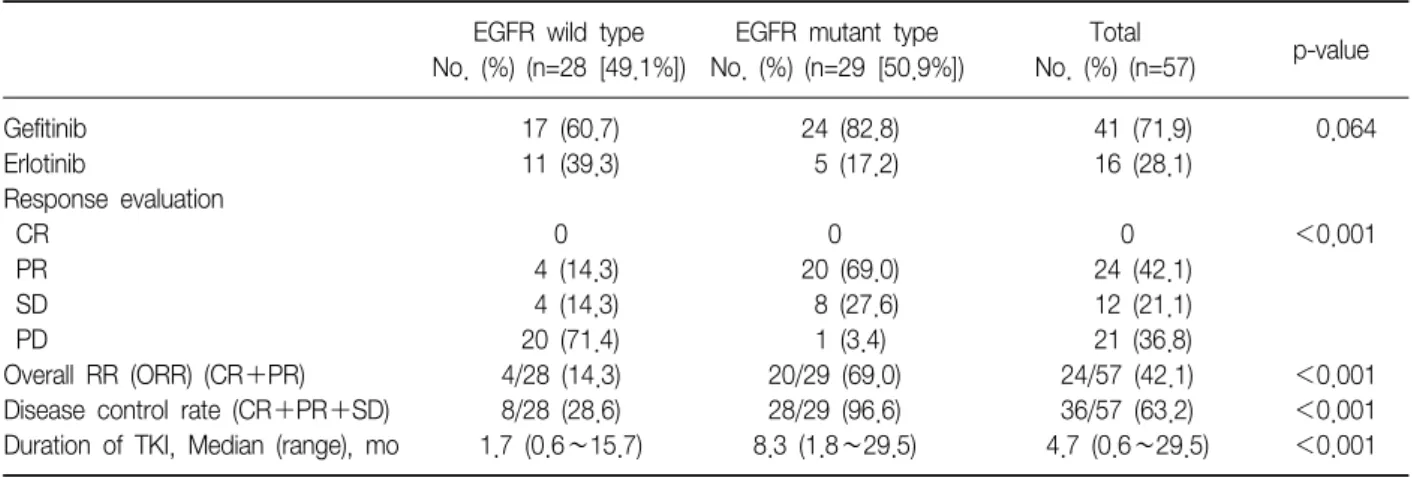
Table 7. The concordance rate between EGFR genotypes and TKI responses
EGFR wild type
No. (%) (n=28 [49.1%])
EGFR mutant type No. (%) (n=29 [50.9%])
Total
No. (%) (n=57) p-value
Gefitinib 17 (60.7) 24 (82.8) 41 (71.9) 0.064
Erlotinib 11 (39.3) 5 (17.2) 16 (28.1)
Response evaluation
CR 0 0 0 <0.001
PR 4 (14.3) 20 (69.0) 24 (42.1)
SD 4 (14.3) 8 (27.6) 12 (21.1)
PD 20 (71.4) 1 (3.4) 21 (36.8)
Overall RR (ORR) (CR+PR) 4/28 (14.3) 20/29 (69.0) 24/57 (42.1) <0.001
Disease control rate (CR+PR+SD) 8/28 (28.6) 28/29 (96.6) 36/57 (63.2) <0.001
Duration of TKI, Median (range), mo 1.7 (0.6∼15.7) 8.3 (1.8∼29.5) 4.7 (0.6∼29.5) <0.001 EGFR: epidermal growth factor receptor; TKI: tyrosine kinase inhibitors.
된다. EGFR 돌연변이는 exon 19 del이 18명(54.5%)으로 가장 빈도가 높았고 뒤이어 exon 21 L858R이 14명 (42.4%), 그리고 1명의 환자에서는 exon 19 del과 획득내 성 돌연변이인 T790M이 동시에 발견되었다.
2. EGFR genotype과 임상-병리 인자들과의 비교
EGFR genotype이 결정된 69명 환자들을 야생(wild- type)군과 변이(mutant)군으로 구분하여 주요 임상-병리 인 자들에 대하여 비교 분석하여 보았다(Table 5). EGFR 돌연 변이는 예상대로 여성(64.9%:28.1%), 비흡연자(62.9%:37.1%)에서 유의하게 높은 빈도를 보였지만 상대적으로 적지 않은 숫자의 남성, 흡연자에서도 EGFR 돌연변이가 발견되었다. 연령, 흡연량, 병기에 대해서는 유의한 차이 를 발견할 수 없었고 병리학적으로는 선암에서는 62명 중 31명, 즉 50%의 양성률을 보이고 비선암에서는 7명 중 2 명 28.6%의 양성률을 보였으나 통계적 유의성을 발견할 수 없었던 것은 비선암의 환자수가 절대적으로 적었기 때
문이라고 생각된다. 조직검사로 진단된 경우와 세포진 검 사로 진단된 경우 사이에서 EGFR 돌연변이 검출률에는 유의한 차이를 관찰할 수 없었다.
EGFR-TKI에 대한 약제 반응이 좋다고 알려진 임상-병 리 인자인 여성, 비흡연자, 선암 등의 인자와 돌연변이의 빈도와의 관련성을 비교해 볼 때 우호적 인자들이 두 가지 조합, 심지어 세 가지 조건 모두를 가지고 있는 경우에도 EGFR 돌연변이율이 크게 증가하지 않는다는 사실을 확인 할 수 있어(Table 6), 임상-병리 인자들만 가지고 EGFR 돌연변이를 예측해서는 안되고 반드시 EGFR 돌연변이 검 사를 시행해야 한다는 것을 시사하는 자료라고 생각한다.
한편 EGFR 돌연변이가 확인된 33명의 환자들을 분석해보 면 우호적 인자가 하나도 없는 경우는 1명(3.0%)에서만 돌연변이 양성이었고, 두 가지 인자를 가지고 있는 경우는
Figure 2. Progression free survival (duration of EGFR-TKI treatment) according to EGFR genotype.
9명(27.3%), 그리고 세 가지 인자 모두를 가지고 있는 경 우는 18명(69.7%)으로서 우호적 인자가 많을수록 돌연변 이를 가지고 있을 확률은 증가한다는 사실을 확인할 수 있었다(Figure 1).
3. EGFR-TKI 약물반응과 EGFR genotype
EGFR genotype이 결정된 69명의 환자 중에서 EGFR- TKI를 사용한 57명의 환자를 대상으로 EGFR 돌연변이 유 무에 따른 EGFR-TKI에 대한 약제 반응을 분석하여 보았 다(Table 7). 분석 대상 57명의 환자 중 28명(49.1%)이 야 생형이었고 29명(50.9%)이 변이형이었으며 42명은 gefiti- nib를 15명은 erlotinib를 처방 받았다. 변이형에서는 gefi- tinib 처방이 상대적으로 월등히 많았음을 확인할 수 있었 는데 이는 gefitinib에 대한 국내 처방기준과 연관이 있을 것으로 생각된다. 양 군에서 완전관해 환자는 1명도 없었 으며, 변이형군에서 부분관해 69.0%, 안정질환 27.6%로서 질병 조절률이 96.6%로서 야생형의 각각 14.3%, 14.3%, 28.6%의 결과보다 현저한 차이를 보이고 있음을 확인할 수 있었다(p<0.001). 또한 EGFR-TKI 약제 사용 기간(무 진행 생존기간; progression free survival)도 중앙값이 변 이형이 7.6개월인 반면 야생형은 1.4개월로 뚜렷하고도 유의한 차이를 나타내었다(Figure 2).
고 찰
PNA는 인공 DNA의 일종으로 DNA보다 유전자를 인식 하는 능력이 뛰어나고 nuclease와 같은 생물학적 효소에 대하여 매우 안정적인 특징을 가지고 있어서, PNA-medi-
ated PCR clamping 방법은 EGFR 돌연변이를 PCR 반응만 으로 신속하고 정확하게 찾아낼 수 있는 방법으로 알려져
있다10,14,15. 일본에서는 PNA-LNA PCR clamp를 이용한
EGFR mutation kit가 상용화되어 있고 이미 이를 이용한 임상시험 결과들이 보고된 바 있으며, 임상 연구 수준이 아니라 일반적인 폐암 임상에 정규 검사로 시행되고 있다 고 한다16. 이러한 배경에서 PNA에 대한 대량 생산에 대 한 기술적 원천 특허권을 국내 기업인 (주)PANAGENE이 가지고 있다는 사실을 생각해 볼 때, 국내에서 PNA를 이 용한 EGFR mutation kit가 이제 개발되어 그 임상자료가 이제 발표된다는 사실은 뒤늦은 감이 없지 않다고 생각된 다. 더욱이 EGFR 돌연변이의 임상적 중요성과 그 빈도가 우리나라와 같은 동양인에 많다는 사실에 착안하여 이에 대한 관심을 배가시킬 필요가 있다고 생각한다.
본 연구에서 71명의 환자 시료를 대상으로 검사를 시행 한 결과 두 명의 환자에서는 명확한 EGFR 유전형을 결정 하지 못하였는데, 이 두 예는 모두 DNA 추출에 문제가 있었던 것으로 생각된다. 이는 돌연변이를 분석 및 검출 하는 방법도 중요하지만 이에 앞서 양질의 DNA를 분리하 는 것이 선행되어야 함을 확인할 수 있는 사실이라고 생각 된다. 본 연구에서 현재 표준 방법으로 알려져 있는 direct sequencing 방법과의 직접적인 비교연구는 시행하지 못 하였지만, EGFR 유전자형에 따른 임상-병리 인자들과의 상관성과 EGFR-TKI에 대한 약물반응과의 일치도 결과에 서 볼 때 PNA-mediated PCR clamping 방법은 비소세포 폐암에서 EGFR 돌연변이를 검출하는 데 매우 유용한 검 사 방법이 될 것으로 예상된다.
본 연구결과에서 보듯이 EGFR 돌연변이는 선암, 여성, 비흡연자에서 월등히 그 빈도가 높다는 사실을 확인할 수 있었지만, 적지 않은 숫자의 흡연자, 남성 그리고 때로는 비선암 환자에서도 EGFR 돌연변이가 관찰되고 이러한 EGFR 돌연변이는 EGFR-TKI에 대한 약제 반응과 명백한 관련성이 있다는 사실에서 EGFR 돌연변이 검사는 이제 폐암의 진료에 있어서 일상적으로 시행되는 검사방법이 되어야 할 것으로 생각한다. 또한 본 연구의 시료 분포를 보면 61.1%가 조직검사 시료인 반면 38.9%가 세포진 검 사 시료를 이용하여 조직검사 시료에 비하여 그 검사 결과 의 예민도가 떨어지지 않았다는 점에서 PNA-mediated PCR clamping 방법의 예민도를 증명할 수 있었다고 생각 한다. 이 방법은 1%의 돌연변이 DNA만 있어도 검출해낼 수 있는 예민한 방법이라고 알려져 있다10. 반면 direct se- quencing 방법은 정상 DNA에 의한 희석 효과 때문에 돌
연변이 DNA가 20% 이상은 되어야 검출해 낼 수 있다고 알려져 있다.
하지만 PNA-mediated PCR clamping 방법은 direct se- quencing과는 달리 새로운 돌연변이를 검출해 낼 수는 없 는 단점이 있다. 즉, 기존의 잘 알려진 돌연변이형에 대한 kit를 개발한 검사법이고 본 연구에 사용한 PANAGENE사 의 PNAClampTM EGFR mutation detection kit는 지금까지 알려진 돌연변이형 중 임상적으로 중요하고 빈도가 흔한 29가지 종류를 망라하고 있어서 임상적으로 중요한 돌연 변이를 놓칠 가능성은 높지 않다고 생각한다. 실제로 EGFR 돌연변이는 EGFR 유전자의 TK domain (exon 18
∼21)에 예외 없이 존재하는데 현재까지 250여 가지 이상 의 돌연변이가 보고되고 있지만 이 중에서 임상적 중요성 이 알려진 돌연변이는 10개를 넘지 않고 있다고 알려져
있다17-19. 다만 아직 임상 시료에 대한 분석 경험이 많지
않아 이에 대한 충분한 임상 적용이 필요한 상태이다. 현 재 저자를 중심으로 200여 명의 비소세포폐암 환자에서 파라핀 포매 병리조직을 이용하여 direct sequencing과 PNA-mediated PCR clamping 방법 간의 비교연구가 진행 중인데 이 연구가 끝나면 보다 정확한 비교 임상 자료를 얻을 수 있을 것으로 생각된다.
EGFR 돌연변이는 민감성(sensitizing) 돌연변이와 내성 (resistant) 돌연변이로 대별되는데 exon 19의 deletion과 exon 21의 L858R point mutation이 가장 중요한 민감성 돌연변이로서 약 85∼90%를 차지하고 있고 exon 19 del 돌연변이가 TKI에 대한 민감성이 더 좋은 것으로 알려져 있다20. 반면 exon 20의 T790M 점 돌연변이는 가장 중요 한 내성 돌연변이로서 획득 내성 환자의 50% 이상에서 발견되는 것으로 알려져 있다21. 따라서 T790M 점 돌연변 이의 검출 문제는 EGFR-TKI의 획득 내성의 문제가 부각 되고 이에 대한 대안으로 개발되고 있는 BIBW2992와 같 은 제2세대 EGFR-TKI의 임상 도입에 있어서 매우 중요한 이슈로 부각될 수 있는 문제이기에 예민도가 높은 PNA- mediated PCR clamping과 같은 방법을 혈장 DNA에 적용 하는 시도가 필요할 것으로 예상된다22,23. 원칙적으로 T790M 검출에 대해서는 재조직검사(rebiopsy)가 필요하 지만 현실적으로 재조직검사에 대한 어려움이 너무 크므로 혈장 DNA에서 돌연변이를 검색할 수 있는 방법들에 대한 많은 연구가 진행 중이어서 조만간 이에 대해서도 그 임상 적 유용성에 대한 결론이 내려질 것으로 생각된다24. 결론적으로 본 연구를 통하여 비소세포폐암 환자에서 EGFR 돌연변이를 검출하는데 있어서 PNA-mediated PCR
clamping 방법은 신속하고 예민한 방법임을 확인할 수 있 었으며 EGFR-TKI에 대한 약물 반응과의 일치도가 비교적 매우 정확하다는 점에서 그 임상적 유용성이 높다고 판단 되며, 국내 비소세포폐암 환자에서 EGFR 돌연변이에 관 한 임상자료를 얻는데 향후 기여도가 매우 높은 검사방법 으로 자리매김할 수 있도록 다양한 임상 연구가 진행되어 야 할 것으로 생각한다.
감사의 글
This study was supported by a grant from Korean Association for the Study of Lung Cancer (KASLC-1002).
참 고 문 헌
1. Lynch TJ, Bell DW, Sordella R, Gurubhagavatula S, Okimoto RA, Brannigan BW, et al. Activating mutations in the epidermal growth factor receptor underlying re- sponsiveness of non-small-cell lung cancer to gefitinib.
N Engl J Med 2004;350:2129-39.
2. Paez JG, Jänne PA, Lee JC, Tracy S, Greulich H, Gabriel S, et al. EGFR mutations in lung cancer: correlation with clinical response to gefitinib therapy. Science 2004;304:
1497-500.
3. Pao W, Miller VA. Epidermal growth factor receptor mutations, small-molecule kinase inhibitors, and non- small-cell lung cancer: current knowledge and future directions. J Clin Oncol 2005;23:2556-68.
4. Cappuzzo F, Hirsch FR, Rossi E, Bartolini S, Ceresoli GL, Bemis L, et al. Epidermal growth factor receptor gene and protein and gefitinib sensitivity in non-small- cell lung cancer. J Natl Cancer Inst 2005;97:643-55.
5. Zhu CQ, da Cunha Santos G, Ding K, Sakurada A, Cutz JC, Liu N, et al. Role of KRAS and EGFR as biomarkers of response to erlotinib in National Cancer Institute of Canada Clinical Trials Group Study BR.21. J Clin Oncol 2008;26:4268-75.
6. Dacic S. EGFR assays in lung cancer. Adv Anat Pathol 2008;15:241-7.
7. Pao W, Ladanyi M. Epidermal growth factor receptor mutation testing in lung cancer: searching for the ideal method. Clin Cancer Res 2007;13:4954-5.
8. Mok TS, Wu YL, Thongprasert S, Yang CH, Chu DT, Saijo N, et al. Gefitinib or carboplatin-paclitaxel in pul- monary adenocarcinoma. N Engl J Med 2009;361:947- 57.
9. Lee KY. Molecular diagnosis in lung cancer. J Lung
Cancer 2010;9:9-14.
10. Tanaka T, Nagai Y, Miyazawa H, Koyama N, Matsuoka S, Sutani A, et al. Reliability of the peptide nucleic acid-locked nucleic acid polymerase chain reaction clamp-based test for epidermal growth factor receptor mutations integrated into the clinical practice for non-small cell lung cancers. Cancer Sci 2007;98:246-52.
11. Mitsudomi T, Morita S, Yatabe Y, Negoro S, Okamoto I, Tsurutani J, et al. Gefitinib versus cisplatin plus doce- taxel in patients with non-small-cell lung cancer har- bouring mutations of the epidermal growth factor re- ceptor (WJTOG3405): an open label, randomised phase 3 trial. Lancet Oncol 2010;11:121-8.
12. Hwang TS. Molecular biologic techniques in cytopatho- logic diagnosis. Korean J Pathol 2009;43:387-92.
13. Kim SK, Kim DL, Han HS, Kim WS, Kim SJ, Moon WJ, et al. Pyrosequencing analysis for detection of a BRAFV600E mutation in an FNAB specimen of thyroid nodules. Diagn Mol Pathol 2008;17:118-25.
14. Nagai Y, Miyazawa H, Huqun, Tanaka T, Udagawa K, Kato M, et al. Genetic heterogeneity of the epidermal growth factor receptor in non-small cell lung cancer cell lines revealed by a rapid and sensitive detection sys- tem, the peptide nucleic acid-locked nucleic acid PCR clamp. Cancer Res 2005;65:7276-82.
15. Miyazawa H, Tanaka T, Nagai Y, Matsuoka M, Sutani A, Udagawa K, et al. Peptide nucleic acid-locked nu- cleic acid polymerase chain reaction clamp-based de- tection test for gefitinib-refractory T790M epidermal growth factor receptor mutation. Cancer Sci 2008;99:
595-600.
16. Tanaka T, Matsuoka M, Sutani A, Gemma A, Maemon- do M, Inoue A, et al. Frequency of and variables asso- ciated with the EGFR mutation and its subtypes. Int J Cancer 2010;126:651-5.
17. Sharma SV, Bell DW, Settleman J, Haber DA. Epidermal
growth factor receptor mutations in lung cancer. Nat Rev Cancer 2007;7:169-81.
18. Chou TY, Chiu CH, Li LH, Hsiao CY, Tzen CY, Chang KT, et al. Mutation in the tyrosine kinase domain of epidermal growth factor receptor is a predictive and prognostic factor for gefitinib treatment in patients with non-small cell lung cancer. Clin Cancer Res 2005;11:
3750-7.
19. Cortes-Funes H, Gomez C, Rosell R, Valero P, Garcia- Giron C, Velasco A, et al. Epidermal growth factor re- ceptor activating mutations in Spanish gefitinib-treated non-small-cell lung cancer patients. Ann Oncol 2005;16:
1081-6.
20. Jackman DM, Yeap BY, Sequist LV, Lindeman N, Holmes AJ, Joshi VA, et al. Exon 19 deletion mutations of epidermal growth factor receptor are associated with prolonged survival in non-small cell lung cancer pa- tients treated with gefitinib or erlotinib. Clin Cancer Res 2006;12:3908-14.
21. Balak MN, Gong Y, Riely GJ, Somwar R, Li AR, Zakow- ski MF, et al. Novel D761Y and common secondary T790M mutations in epidermal growth factor receptor- mutant lung adenocarcinomas with acquired resistance to kinase inhibitors. Clin Cancer Res 2006;12:6494-501.
22. Engelman JA, Zejnullahu K, Mitsudomi T, Song Y, Hy- land C, Park JO, et al. MET amplification leads to gefiti- nib resistance in lung cancer by activating ERBB3 signaling. Science 2007;316:1039-43.
23. Engelman JA, Jänne PA. Mechanisms of acquired resist- ance to epidermal growth factor receptor tyrosine kin- ase inhibitors in non-small cell lung cancer. Clin Cancer Res 2008;14:2895-9.
24. Maheswaran S, Sequist LV, Nagrath S, Ulkus L, Branni- gan B, Collura CV, et al. Detection of mutations in EGFR in circulating lung-cancer cells. N Engl J Med 2008;359:366-77.