191 This is an Open-Access article distributed under the terms of the Creative Commons Attribution Non-Commercial License (http://
creativecommons.org/licenses/by-nc/3.0) which permits unrestricted non-commercial use, distribution, and reproduction in any medium, provided the original work is properly cited.
J. Mushrooms 2016 December, 14(4):191-196 http://dx.doi.org/10.14480/JM.2016.14.4.191 Print ISSN 1738-0294, Online ISSN 2288-8853
© The Korean Society of Mushroom Science
*Corresponding author E-mail : [email protected]
Tel : +82-43-871-5711, Fax : +82-43-871-5702 Received December 6, 2016
Revised December 12, 2016 Accepted December 15, 2016
버섯 세균성회색무늬병균(Pseudomonas agarici)에 대한 길항 세균 Alcaligenes sp. HC12의 대량배양을 위한 최적 배양조건
이찬중* · 문지원 · 정종천
농촌진흥청 국립원예특작과학원 버섯과
Optimum cultivation conditions for mass production of antagonistic bacterium Alcaligenes sp. HC12 effective in antagonistic of browning disease caused by Pseudomonas agarici
Chan-Jung Lee*, Ji-Won Moon, and Jong-Chun Cheong
Mushroom Research Division, NIHHS, RDA, Eumseong 369-873, Korea
ABSTRACT: This study was conducted to investigate optimum conditions for mass production of ntagonistic microbes Alcaligenes sp. HC12. Alcaligenes sp. HC12 had a potent biological control agent to control browning disease caused by Pseudomonas agarici. Alcaligenes sp. HC12 markedly showed the antagonistic activity against Pseudomonas agarici, the most destructive pathogen of cultivated mushrooms. To define the optimum conditions for the mass production of the Alcaligenes sp. HC12, we have investigated optimum culture conditions and effects of various nutrient source on the bacterial growth. The optimum initial pH and temperature were determined as pH 9.0 and 30o, respectively. The optimal concentration of medium elements for the growth of pathogen inhibitor bacterium(Alcaligenes sp. HC12) was determined as follows: 0.5% dextrine, 1.5% yest extract, 1.0%
NaNO3, 0.5% KH2PO4, and 1.5% asparagine.
KEYWORDS: Antagonistic microbes, Mushrooms, Optimum culture, Alcaligenes sp., Pseudomonas agarici
서 론
버섯에 병을 일으키는 세균으로 Pseudomonas tolaasii, Pseudomonas agarici, Pseudomonas gingeri 그리고 병원
성 Pseudomonas reactans 등이 보고되었다(Wells et al., 1996; Wong et al., 1982). 이들 병원균들은 버섯의 수량 감소 및 시장에서 상품가치를 떨어뜨리는 하나의 원인이 되고 있다. 세균성갈색무늬병은 Tolaas (1915)에 의하여 처음으로 보고되었고, Paine (1919)에 의하여 P. tolaasii 로 명명되었다. 병징에 있어서는 P. tolaasii에 의한 갈색 무늬 증상은 P. gingeri에 의해 발생되는 옅은 갈색 (yellow-brown)의 반점병인 ginger blotch disease와 유사 한 특성을 갖는다(Wong et al., 1982, Cutri et al., 1984).
양송이 재배에 있어 또 다른 2종류의 세균이 병을 일으키 고 있으며 이들 중 Pseudomonas gingeri 는 giner blotch 을 일으키고(Geels et al., 1994), Pseudomonas agarici 는 양송이 갓의 표면에 갈색의 점무늬를 넓게 형성하여 상품성을 저하시키는 것으로 보고되어 있다(Bessette et al., 1985]. 또한 Pseudomonas agarici 는 느타리버섯에 yellow blotch을 일으키고(Lee et al., 1998), 양송이 갓과 대에 회색무늬병을 일으킨다. 이병은 병 발생의 예측이
매우 어렵고, 병 발생 후에는 방제가 거의 불가능하며, 한 번 발생하면 재배사 전체로 급격하게 전염되어 심한 경우 에는 버섯을 전혀 수확하지 못하게 하는 특성이 있다 (Scherwinski et al., 2008).
최근에는 지속 가능한 친환경농업에 대한 관심이 증대 되면서 화학농약의 대안으로 식물병원균에 대한 길항미생 물의 생물학적 방제에 의한 연구가 활발하게 진행되고 있 다(Scherwinski et al., 2008). 길항균을 이용한 갈색무늬 병의 방제를 오스트리아에서 Nair과 Fahy(1972)가 처음 으로 연구하였고, 프랑스(Olivier et al., 1978)와 타이완 (Liao et al., 1980)에서 시행한 연구를 이용해 한때 상업 적으로 생물학적 제제로 이용하였다. P. fluorescens가 P.
tolaasii에 대해 길항성을 가진다고 하였으나 병원균에 비 해 80배의 많은 수가 있어야 효과가 있으므로 실용성이 떨어진다고 보고 하였다(Nutkins et al., 1991). 국내에서 는 Lee 등(2013; 2014)이 세균갈색무늬병이 분비하는 독 소(tolaasin)을 무독화하는 Pseudomonas 속균을 선발하여 대량배양 조건을 설정하였고 보고하였다. 일부 항생제를 이용한 화학적 방제와 길항미생물을 이용한 생물적 방제 법이 계속하여 시도되고 있지만 아직 만족할 만한 효과를 거두지 못하고 있는 실정이다(Park et al., 1992). 또한 버 섯은 화학 처리에 의한 방제는 안전성문제로 사용이 어렵 기 때문에 생물적 방제법에 의한 새로운 방법의 도입이 요구되고 있다.
따라서 본 연구에서는 화학농약을 대체하고 친환경 버 섯 생산을 위해 세균성회색무늬병의 생물학적 방제를 위 하여 선발된 길항미생물의 최적 배양조건을 조사한 결과 를 보고하고자 한다.
재료 및 방법
공시균주 및 배양
세균성회색무늬병원균 P. agarici에 항균활성을 가지는 것으로 확인된 Alcaligenes sp. HC12 균주(Lee et al., 2016)를 공시하였다. 이하 모든 실험에서는 R2A배지 (Reasoner and Geldreich, 1985)와 기본배지(Stanier et al., 1966)를 이용하여 실험하였다.
배양적온
길항미생물의 배양적온을 조사하기 위해 R2A 액체배지 에 Alcaligenes sp. HC12 균주를 접종한 후 5oC에서 40oC까지 5oC 간격으로 조정된 진탕배양기(180 rpm, 24 시간)에서 24시간 배양한 후 600 nm에서 흡광도를 조사 하면서 세균의 밀도를 측정하였다.
초기 pH의 영향
초기 pH에 따른 Alcaligenes sp. HC12 균주의 생육정 도를 조사하기 위하여 R2A 액체배지를 1 N NaOH와 1N HCl을 이용하여 pH 3에서 pH 11까지 pH 1.0 간격으로 보정하고 진탕배양기(180 rpm, 28oC)에서 Alcaligenes sp. HC12를 24시간 배양 후 600 nm에서 흡광도를 조사 하면서 세균의 밀도를 조사하였다.
영양원에 따른 길항미생물의 증식에 미치는 영향 길항미생물의 최적 배양조건을 조사하기 위하여 기본배 지(Stanier et al., 1966)에 탄소원 fructose 등 18종, 무기 질소원 NH4Cl 등 6종, 유기질소원 peptone 등 6종 그리 고 아미노산 asparagine 등 11종을 각각 1%씩 첨가하였 고, 무기염류 13종을 1 mM 농도로 첨가하여 각각에 대한 생육정도를 조사하였다. 또한 선발된 각각의 성분들에 대 한 최적 농도를 조사하기 위하여 각각의 성분을 최소 0.1%에서 최대 4.0%까지 배지에 첨가하여 24시간동안 진 탕배양(180 rpm, 28oC) 후 생육정도를 조사하였다.
결과 및 고찰
온도와 pH에 따른 영향
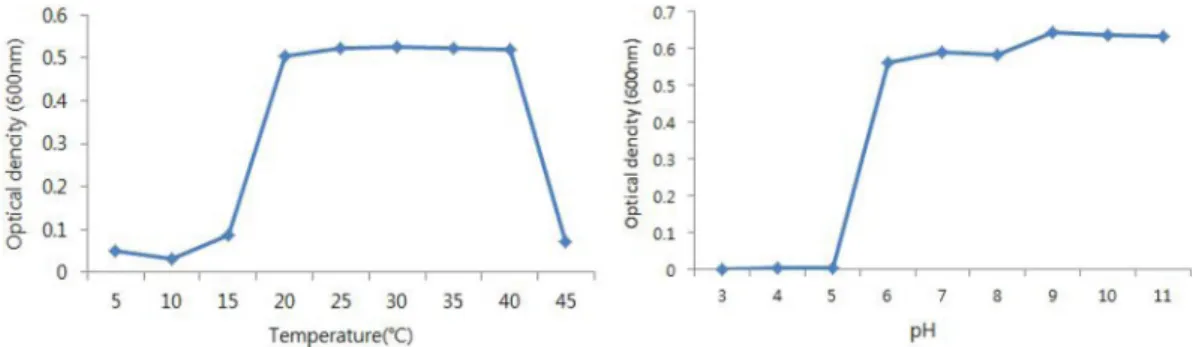
저해균 Alcaligenes sp. HC12 균주의 최적 생육온도를 구 명하기 위하여 다양한 온도에 실험을 실시하였다. 저해균 을 5oC~45oC까지 5oC간격으로 생육정도를 조사한 결과 15oC 이후에 급격한 생육을 보였고, 20oC~40oC에서 가장 높은 생육을 유지하였다. (Fig. 1). 저해균 Alcaligenes sp.
HC12 균주의 생육에 미치는 pH의 효과를 검증하기 위하 여 pH 3, 4, 5, 6, 7, 8, 9, 10, 11에서 생육정도를 조사한 결 과, pH 6.0 이상에서 높은 생육을 보였고 pH 5.0이하에서
Fig. 1. Effect of temperature and pH on the growth of Alcaligenes sp. HC12.
는 균사가 거의 생육하지 못하였다. 따라서 균주의 최적생 육 온도는 30oC, pH는 9.0인 것으로 확인되었다(Fig. 1).
탄소원에 따른 영향
탄소원을 선발하기 위하여 fructose, galactose, saccharose, soluble starch, inositol 등 19가지의 탄소원을 기초배지에 각각 1%씩 첨가하여 20oC, 180 rpm으로 진탕배양하여 24시간 후 균주의 생육을 조사하였다. 그 결과 dextrine을 첨가한 배지에서 가장 높은 생육을 보였다(Fig. 2).
dextrine의 농도별로 균 생육정도를 조사한 결과 0.5% 이 하에서 급격한 생육 저해현상을 보였고, 2.0%에서는 거의 생육하지 못하였다(Fig. 3).
무기질소원에 따른 영향
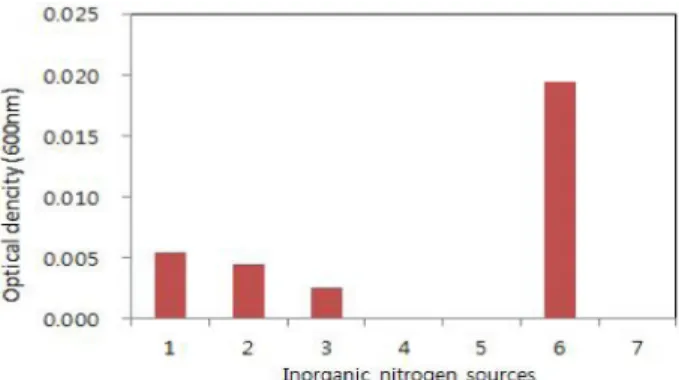
무기질소원을 선발하기 위하여 NH4Cl, (COONH4)2, NH4H2PO4, (NH4)2HPO4, NH4NO3, NaNO3, (NH4)2SO4을 기초배지에 각각 1%씩 첨가하여 20oC, 180 rpm으로 진 탕배양하여 24시간 후 균주의 성육을 확인하였다. 그 결 과 NaNO3를 첨가한 배지에서 균생육이 가장 좋았고, NaNO3의 최적농도를 선발하기위하여 0.1~1.0% 농도에서
균 생육을 조사한 결과 NaNO3을 1.0% 첨가한 배지에서 균 생육이 가장 좋았다(Fig. 5).
유기질소원에 따른 영향
유기질소원을 선발하기 위하여 peptone, soytone, urea, casamino acid, tryptone, yeast extract, malt extract을 기 초배지에 각각 1%씩 첨가하여 20oC, 180 rpm으로 진탕 배양하여 24시간 후 Alcaligenes sp. HC12 균주의 생육을
Fig. 2. Effect of carbon sources for the growth of Alcaligenes sp. HC12 in basal medium. 1: Fructose, 2: Galactose, 3:
Saccharose, 4: Soluble starch, 5: Inositol, 6: Glycerol, 7:
Xylose, 8: Dextrose, 9: Lactose, 10: Dextrine, 11: Na-CMC, 12: Adonitol, 13: Mannitol 14: Mannose, 15: Maltose, 16:
Raffinose, 17: Cellobiose, 18: Ethanol, 19: Salicine.
Fig. 3. Effect of dextrine concentration on the production of inhibition substance by Alcaligenes sp. HC12 in basal medium.
Fig. 4. Effect of inorganic nitrogen sources for the growth of Alcaligenes sp. HC12 in basal medium. 1. NH4Cl, 2:
(COONH4)2, 3: NH4H2PO4, 4: (NH4)2HPO4, 5: NH4NO3, 6:
NaNO3, 7: (NH4)2SO4.
Fig. 5. Effect of NaNO3 concentration of the production of inhibition substance by Alcaligenes sp. HC12 in basal medium.
Fig. 6. Effect of organic nitrogen sources for the growth of Alcaligenes sp. HC12 in basal medium. 1: Peptone, 2:
Soytone, 3: Urea, 4: Casamino acid, 5: Tryptone, 6: Yeast extract, 7: Malt extract.
확인하였다. 그 결과 다른 질소원에 비해 soytone과 yeast extract에서 균 생육이 빨랐다. 이들 중 균 생육이 가장 좋 은 yeast extract을 첨가한 배지를 선발하였다(Fig. 6).
Yeast extract의 최적농도를 선발하기 위하여 0.5~4.5% 농 도에서 균 생육을 조사한 결과 1.5% 첨가한 배지에서 균 생육이 가장 좋았다(Fig. 7).
아미노산에 따른 영향
아미노산을 선발하기 위하여 asparagine, methionine, proline, leucine 등 12가지 아미노산을 기초배지에 각각 1%
씩 첨가하여 20oC, 180 rpm에서 진탕배양하여 24시간 후 HC12균주의 생육을 확인하였다. 그 결과 asparagine과 glutamic acid에서 균 생육이 가장 좋았다 (Fig. 8).
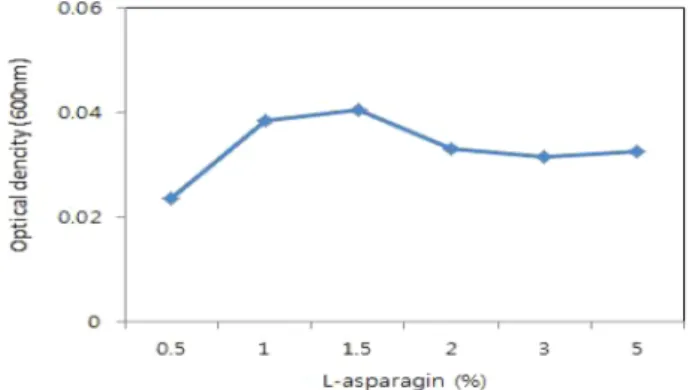
Arginine의 최적농도를 선발하기 위하여 0.1~2.5% 농도 로 생육정도를 조사한 결과 1.5% 첨가배지에서 균의 생 육이 가장 좋았으며, 1.5%의 asparagine을 최적농도로 선 발하였다(Fig. 9).
무기염류에 따른 영향
무기염류을 선발하기 위하여 KCl, BaCl2, CaCl2, MgSO4, ZnSO4 등 13가지 무기염류을 기초배지에 각각 1%씩 첨 가하여 20oC, 180 rpm에서 진탕배양하여 24시간 후 HC12 균주의 생육을 확인하였다. 그 결과 KCl과 KH2PO4을 첨 가한 배지에서 균 생육이 가장 높았다(Fig 10). KH2PO4 의 최적농도를 선발하기 위하여 1~10 mM 농도별로 균의 생육을 확인하였을 때에는 0.5~3%까지 높은 생육을 보였 고 이들 중 생육이 가장 좋은 0.5%을 무기염류 농도로 선 발하였다(Fig. 11).
Fig. 8. Effect of amino acid sources for the growth of Alcaligenes sp. HC12 in basal medium. 1: Asparagine, 2:
Methionine, 3: Proline, 4: Leucine, 5: Glutamine, 6: Valine, 7:
Aspartic acid, 8: Glutamic acid, 9: Arginine, 10: Histidine, 11:
Cysteine, 12: Threonine.
Fig. 9. Effect of L-asparagine concentration on the production of inhibition substance by Alcaligenes sp. HC12 in basal medium.
Fig. 7. Effect of yeast extract concentration on the production of inhibition substance by Alcaligenes sp. HC12 in basal medium.
Fig. 10. Effect of inorganic salts for the growth Alcaligenes sp. HC12 in basal medium. 1: KCl, 2: BaCl2, 3: CaCl2, 4:
CoCl2, 5: Li2SO4, 6: MnSO 7: MgSO4, 8: ZnSO4, 9: FeSO4, 10:
AgNO4, 11: Na2MoO4, 12: KH2PO4, 13: FeCl3.
Fig. 11. Effect of KH2PO4 concentration on the production of inhibition substance by Alcaligenes sp. HC12 in basal medium.
길항미생물 HC12의 최적 배양조건
길항미생물 HC12의 최적 배양조건은 Table 1과 같다.
온도는 15oC, pH 6.0, 탄소원 0.6% adonitol, 유기질소원 1.5% yeast extract, 무기질소원 0.8% NH4H2PO4, 아미노 산 0.2% asparagine 그리고 무기염류는 5 mM MgSO4에 서 생육이 가장 좋았다(Table 1).
적 요
버섯 세균갈성색무늬병원균인 Pseudomonas agarici에 대한 길항미생물로 보고된 Alcaligenes sp. HC12 균주의 배양적 특성과 대량 배양을 위한 최적배양 조건을 설정하 였다. HC12균주의 생육온도는 20~40oC, pH는 6.0 이상 에서 왕성한 생육을 보였다. 대량배양을 위한 효율적인 영양원 선발을 위하여 기본배지에 탄소원 fructose 등 18 종, 무기질소원 NH4Cl 등 6종, 유기질소원 peptone 등 6 종 그리고 아미노산 asparagine 등 11종을 각각 1%씩 첨가하였고, 무기염류 13종을 첨가하여 각각에 대한 생 육에 미치는 영향을 조사하였다. 또한 선발된 각각의 영 양성분들에 대한 최적 농도를 조사하기 위하여 각각의 성분을 최소 0.1%에서 최대 4.0%까지 배지에 첨가하여 배양 후 생육정도를 조사하였다. 그 결과, 대량배양을 위한 생육최적조건은 온도 30oC, pH 9, 탄소원 0.5% dextrine, 유기질소원 1.5% yeast extract, 무기질소원 1.0% NaNO3, 아미노산 1.5% asparagine 그리고 무기염류는 0.5%
KH2PO4에서 왕성한 생육을 보였다.
감사의 말씀
본 연구는 농촌진흥청 공동연구과제 (PJ011125)에 의하 여 수행된 연구결과입니다.
References
Bessette AE, Kerrigan RW, Jordan DC. 1985. Yellow blotch of Pleurotus ostreatus. Appl Environ Microbiol. 50:1535-7.
Cutri SS, Macauley BJ, Roberts WP. 1984. Characteristics of
pathogenic non-fluorescent (smooth) and non-pathogenic fluorescent (rough) forms of Pseudomonas tolaasii and Pseudomonas 'gingeri'. J Appl Bacteriol. 57:91-298.
Geels FP, Hesen LP, Van Griensven LJ. 1994. Brown discoloration of mushrooms caused by Pseudomonas agarici. J Phytopathol, 140:249-59.
Lee CJ, Yoo YM, Han JY, Jhune CS, Cheong JC, Moon JW, Suh JS, Han HS, Cha JS. 2014. Isolation of the bacterium Pseudomonas azotoformans HC5 effective in antagonistic of brown blotch disease caused by Pseudomonas tolaasii. Kor J Mycol 42:219-224.
Lee CJ, Yoo YM, Han JY, Jhune CS, Cheong JC, Moon JW, Suh JS, Han HS, Cha JS. 2013. Isolation of the bacterium Pseudomonas sp. HC1 effective in inactivation of tolaasin produced by Pseudomonas tolaasii. Kor J Mycol. 41: 248- 254.
Lee CJ, Moon JW, Cheong JC, Kong WS. 2016. Effective in antagonistic on browning disease caused by Pseudomonas agarici of the bacterium Alcaligenes sp. HC12. Kor J Mycol.
44:171-175.
Lee HI, Cha JS. 1998. Cloning of a DNA fragment specific to Pseudomonas tolaasii causing bacterial brown blotch disease of oyster mushroom (Pleurotus ostreatus). Korean J Plant Pathol. 14:177-83.
Liao YM, Tu CC, Jeng JJ. 1980. Control of bacterial blotch of mushroom. Taiwan Mushrooms. 4:34-41.
Nair NG, Fahy PC. 1972. Bacteria antagonistic to Pseudomonas tolaasii and their control of brown blotch of the cultivated mushroom Agaricus bisporus. J Appl Bacteriol. 35:439-42.
Nutkins JC, Mortishire-Smith RJ, Packman LC, Brodey CL, Rainey PB, Johnstone K, Williams DH. 1991. Structure determination of tolaasin, an extracellular lipodepsipeptide produced by the mushroom pathogen Pseudomonas tolaasii Paine. J Am Chem Soc. 113:2621-7.
Olivier JM, Guillaumes J, Martin D. 1978. Study of a bacterial disease of mushroom caps. In: Proceedings of 4th International Conference Plant Pathogenic Bacteria.; 1978 Aug 27-Sep 2; Angers, France. Paris: INRA. p. 903-16.
Paine SG. 1919. Studies in bacteriosis II. A brown blotch disease of cultivated mushrooms. Ann Appl biol. 5:206- 219.
Park BS, Cho NC, Chun UH. 1992. Identification of Pseudomonas fluorescens antagonistic to Pseudomonas tolaasii and its cultivation. Kor J Biotechnol Bioeng. 7:296- 301.
Reasoner DJ, Geldreich EE. 1985. “A new medium for the enumeration and subculture of bacteria from potable water,”
Appl Environ Microbiol. 49:1-7.
Scherwinski K, Grosch R, Berg G. 2008. Effect of bacterial antagonists on lettuce: active biocontrol of Rhizoctonia solani and negligible, short-term effects on nontarget microorganisms.
FEMS Microbiol Eco. 64:106-16.
Stainer RY, Palleroni NJ, Doudoroff M. 1966. The aerobic pseudomonads: a taxonomic study. J general Microbiol 43:159-271.
Tolaas AG. 1915. A Bacterial disease of cultivated mushrooms.
Phytopathology 5: 51-54
Wells JM, Sapers GM, Fett WF, Butterfield JE, Jones JB, Bouzar H, Miller FC. 1996. Postharvest discolorization of the Table 1. Culture condition of Alcaligenes sp. HC12 for the
maximal production of inhibition substance
Induction temperature 30oC
Initial pH 9
Optimal medium Carbon source 0.5% Dextrine Organic N-source 1.5% Yeast Extract
Amino acid 1.5% L-asparagin Inorganic N-Source 1.0% NaNO3
Inorgarnic salt 0.5% KH2PO4
cultivated mushroom Agaricus bisporus caused by Pseudomonas tolaasii, P. 'reactans', and P. 'gingeri'.
Phytopathology 86: 1098-1104.
Wong WC, Fletche, JT, Unsworth BA, Preece TF. 1982. A note on ginger blotch, a new bacterial disease of the cultivated mushroom, Agaricus bisporus. J Appl Bacteriol. 52:43-48.