Original Article
Received: Jul 17, 2015; Revised: Nov 13, 2015; Accepted: Nov 15, 2015 Correspondence to: Sejun Park
Department of Urology, Ulsan University Hospital, University of Ulsan College of Medicine, 877 Bangeojinsunhwan-doro, Dong-gu, Ulsan 44033, Korea.
Tel: +82-52-250-7190, Fax: +82-52-250-7198, E-mail: [email protected]
Hypercholesterolemia Is Associated with a Shorter Time to Castration-Resistant Prostate Cancer in Patients Who Have Undergone Androgen Deprivation Therapy
Jong Chul Jeon, Jaeyoung Park, Sungchan Park, Kyung Hyun Moon, Sang Hyeon Cheon, Sejun Park
Department of Urology, Ulsan University Hospital, University of Ulsan College of Medicine, Ulsan, Korea
Purpose: The goal of this study was to investigate the association between hypercholesterolemia and the time required for progression to castration-resistant prostate cancer (CRPC) in patients who have undergone androgen deprivation therapy (ADT).
Materials and Methods: Data from 154 patients with prostate cancer between 2005 and 2012 were reviewed retrospectively.
ADT was employed as a treatment modality for these patients either due to multiple bone metastases at the time of diagnosis or due to old age in combination with other morbidities. Serum cholesterol levels and statin use were reviewed. We analyzed the factors associated with the development of CRPC after ADT treatment. The mean follow-up period was 34.8 months.
Results: The mean age of the patients was 71.3 years old and their mean prostate-specific antigen level was 141.8±212.6 ng/mL.
Their mean cholesterol level was 175.9±37.7 mg/dL, and 14 patients (9.1%) were statin users. CRPC developed in 44 patients (28.6%), and the mean duration from ADT treatment to CRPC was 24.1 months. In a multivariate analysis, hypercholesterolemia was associated with the development of CRPC (hazard ratio [HR]=1.017, p<0.001), depending on clinical T stage (p=0.005) and the presence of bone metastasis (p<0.001). A subanalysis showed that hypercholesterolemia was associated with the development of CRPC in patients with bone metastasis (HR=1.032, p<0.001), but not in patients without bone metastasis.
Conclusions: Hypercholesterolemia may be associated with the development of CRPC after ADT in patients with bone metastasis. Further studies with longer follow-up periods and larger samples are needed to validate this finding.
Key Words: Cholesterol; Prognosis; Prostatic neoplasms
INTRODUCTION
Prostate cancer is the second leading cause of cancer death in men in the United States [1]. Prostatectomy and radiation therapy are the preferred treatment modalities in
men with localized prostate cancer. Androgen depriva- tion therapy (ADT) is used as an adjuvant therapy after rad- ical prostatectomy and for the treatment of metastatic pros- tate cancer. Although prostate cancer is generally sensi- tive to initial ADT, tumors that have overcome the absence
http://dx.doi.org/10.5534/wjmh.2016.34.1.28
www.wjmh.org
of gonadal androgens eventually regrow [2]. When pros- tate cancer progresses despite castration levels of testoster- one, it is termed castration-resistant prostate cancer (CRPC) a term that reflects the knowledge that such cases of re-emergent prostate cancer are not independent of an- drogens, as was once believed. Unfortunately, recurrent tumors are more aggressive, evasive, and deadly [3], and most prostate cancer deaths are from CRPC.
Cholesterol has been implicated in the pathogenesis of diseases such as cardiovascular disease and in many forms of cancer, including prostate cancer [4]. Prostate cancer is associated with elevated levels of cholesterol, which may support cell proliferation by contributing cholesterol for membrane composition and signal transduction [5,6].
Based on these findings, several studies have explored the relationship between serum cholesterol levels and the in- cidence of prostate cancer and associated mortality.
However, these studies have reported inconsistent results [7-11]. Similarly, the effects of statins on the overall risk re- duction of prostate cancer remains controversial [12-14], with some studies suggesting that statins have no effect, while others have found statins to be associated with sig- nificant risk reduction, especially in advanced-stage tu- mors [15,16]. However, previous research has not ad- dressed the relationship between levels of cholesterol and tumor progression to CRPC in patients with prostate cancer.
In this study, we aimed to investigate the potential asso- ciation between hypercholesterolemia and the risk of pro- gression to CRPC in men who have undergone ADT.
MATERIALS AND METHODS
1. Patient characteristics
After Institutional Review Board approval in Ulsan University Hospital (No. 2015-06-009), data from 314 pa- tients who were diagnosed with prostate cancer from 2005 to 2012 were reviewed retrospectively. After ex- cluding 160 patients who underwent radical prostatec- tomy or were transferred to other clinics, 154 patients who were initially treated with ADT were included. ADT was employed as a treatment modality for these patients either due to multiple bone metastases at the time of diagnosis (n=50, 32.5%) or due to old age accompanied by other
morbidities (n=104, 67.5%), instead of radical prostatec- tomy or radiotherapy. ADT involved bilateral orchi- ectomy in nine patients and maximal androgen blockade including luteinizing hormone-releasing hormone agonist injection and oral antiandrogens in 145 patients. The pri- mary outcome was the time to prostate-specific antigen (PSA) progression. In patients with castration serum levels of testosterone (<50 ng/dL), the time to PSA progression indicative of CRPC while undergoing ADT was defined as the time from the initiation of ADT to a 50% increase in PSA from its lowest level or the time from the initiation of ADT to a 25% increase in PSA levels from baseline, and was confirmed using PSA consensus criteria [17]. The mean follow-up was 34.8 months (median, 25.4 months).
2. Cholesterol levels and statin use
Patients’ levels of serum cholesterol at diagnosis and statin use were reviewed. The levels of serum cholesterol were available in all patients. Cholesterol levels were cate- gorized as hypercholesterolemia (>240 mg/dL, n=8), borderline (200∼240 mg/dL, n=40) and desirable (<200 mg/dL, n=106). High- and low-density lipoprotein (HDL and LDL) cholesterol levels were not present for all patients and, therefore, were not included in the analysis.
Patients who took statins before being diagnosed with prostate cancer were categorized as statin users. The sta- tins used in these patients included atorvastatin (n=6), simvastatin (n=4), pravastatin (n=2), and rosuvastatin (n=2). The doses of statin were translated into dose equiv- alents based on previous published study [18], with 20 mg of simvastatin assigned a value of 1. Dose equivalents of
<1, 1, and >1 were present in two patients (14.3%), nine patients (64.3%), and three patients (21.4%), respectively.
The duration of statin use was not evaluated.
3. Statistical analyses
Clinicopathological characteristics were compared be- tween patients with and without bone metastasis at the time of diagnosis using the chi-square test and the Student’s t-test. Multivariate analysis was performed to evaluate the factors associated with the development of CRPC after ADT treatment. Since statin use and cholesterol could af- fect each other, multivariate analysis was performed again, including statin use instead of cholesterol. A subanalysis
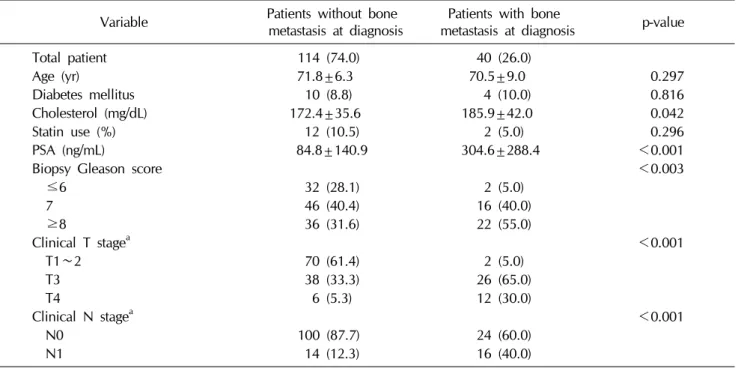
Table 1. Baseline characteristics of the patients
Variable Patients without bone
metastasis at diagnosis Patients with bone
metastasis at diagnosis p-value
Total patient 114 (74.0) 40 (26.0)
Age (yr) 71.8±6.3 70.5±9.0 0.297
Diabetes mellitus 10 (8.8) 4 (10.0) 0.816
Cholesterol (mg/dL) 172.4±35.6 185.9±42.0 0.042
Statin use (%) 12 (10.5) 2 (5.0) 0.296
PSA (ng/mL) 84.8±140.9 304.6±288.4 <0.001
Biopsy Gleason score <0.003
≤6 32 (28.1) 2 (5.0)
7 46 (40.4) 16 (40.0)
≥8 36 (31.6) 22 (55.0)
Clinical T stagea <0.001
T1∼2 70 (61.4) 2 (5.0)
T3 38 (33.3) 26 (65.0)
T4 6 (5.3) 12 (30.0)
Clinical N stagea <0.001
N0 100 (87.7) 24 (60.0)
N1 14 (12.3) 16 (40.0)
was performed according to the presence of bone meta- stasis at the initial diagnosis. PSA levels were measured ev- ery three months after ADT treatment. Radiographic eval- uation using abdominopelvic computed tomography or pelvic magnetic resonance and radionuclide bone scan- ning was performed every six months and when clinically indicated. None of the patients experienced severe com- plications requiring the discontinuation of ADT therapy.
SPSS ver. 12.0 (SPSS Inc., Chicago, IL, USA) was used for all statistical analyses, with p-values <0.05 considered to indicate statistical significance.
RESULTS
The mean age of the patients was 71.3 years old, and their mean PSA level was 141.8±212.6 ng/mL at the time of diagnosis (range, 1.5∼876 ng/mL). The clinical T stage was T1 or T2 in 72 patients (46.8%), T3 in 64 patients (41.6%), and T4 in 18 patients (11.7%). The Gleason score (GS) was ≤6 in 34 patients (22.1%), 7 in 62 patients (40.3%), and ≥8 in 58 patients (37.7%). The mean level of serum cholesterol was 175.9±37.7 mg/dL and 14 pa-
tients (9.1%) were statin users. Patients without bone metastasis had lower PSA levels (84.8 ng/mL vs. 304.6 ng/mL) and lower cholesterol levels (172.4 mg/dL vs.
185.9 mg/dL) than those with bone metastasis (Table 1).
Furthermore, patients without bone metastasis had lower GSs and less advanced T stage findings than patients with bone metastasis.
CRPC developed in 44 patients (28.6%) and the mean duration from ADT treatment to CRPC was 24.1 months.
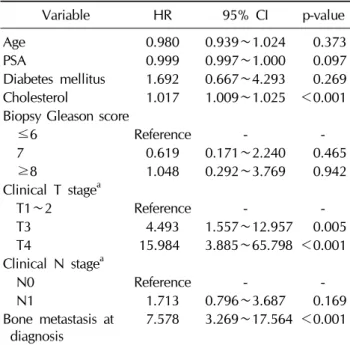
CRPC developed in 16 patients (10.4%) of the patients without bone metastasis, with a mean duration of 24.8 months, and 10 patients exhibited newly developed bone metastasis when CRPC was diagnosed. In contrast, CRPC developed in 28 patients (56.0%) with bone metastasis, with a mean duration of 23.6 months, and all patients in this group exhibited aggravated metastatic bone lesions when CRPC was diagnosed. In multivariate analysis, hy- percholesterolemia was associated with the development of CRPC (hazard ratio [HR]=1.017, p<0.001), depending on the clinical T stage (HR=4.493, p=0.005 for T3 vs.
HR=15.98, p<0.001 for T4), and the presence of bone metastasis (HR=7.578, p<0.001) (Table 2). Statin use
www.wjmh.org Table 2. Multivariate model for time to PSA progression
according to age and clinical variables
Variable HR 95% CI p-value
Age 0.980 0.939∼1.024 0.373
PSA 0.999 0.997∼1.000 0.097
Diabetes mellitus 1.692 0.667∼4.293 0.269 Cholesterol 1.017 1.009∼1.025 <0.001 Biopsy Gleason score
≤6 Reference - -
7 0.619 0.171∼2.240 0.465
≥8 1.048 0.292∼3.769 0.942
Clinical T stagea
T1∼2 Reference - -
T3 4.493 1.557∼12.957 0.005
T4 15.984 3.885∼65.798 <0.001
Clinical N stagea
N0 Reference - -
N1 1.713 0.796∼3.687 0.169
Bone metastasis at diagnosis
7.578 3.269∼17.564 <0.001
PSA: prostate-specific antigen, HR: hazard ratio, CI: confi- dence interval.
aClassification according to the standard of 7th edition of the American Joint Committee on Cancer staging system.
Table 4. Multivariate model for time to PSA progression according to age and clinical variables in patients without bone metastasis at diagnosis
Variable HR 95% CI p-value
Age 1.034 0.932∼1.148 0.527
PSA 0.998 0.994∼1.002 0.297
Diabetes mellitus 2.689 0.603∼11.982 0.194 Cholesterol 0.984 0.965∼1.004 0.115 Biopsy Gleason score
≤6 Reference - -
7 1.413 0.250∼7.999 0.696
≥8 0.717 0.080∼6.459 0.767
Clinical T stagea
T1∼2 Reference - -
T3 7.967 1.527∼41.545 0.014
T4 16.664 1.758∼157.892 0.014
Clinical N stagea
N0 Reference - -
N1 5.716 1.077∼30.329 0.041
PSA: prostate-specific antigen, HR: hazard ratio, CI: confi- dence interval.
aClassification according to the standard of 7th edition of the American Joint Committee on Cancer staging system.
Table 3. Multivariate model for time to PSA progression according to age and clinical variables in patients with bone metastasis at diagnosis
Variable HR 95% CI p-value
Age 0.881 0.799∼0.972 0.011
PSA 0.996 0.993∼0.999 0.007
Diabetes mellitus 1.668 0.314∼8.862 0.548 Cholesterol 1.032 1.016∼1.048 <0.001 Biopsy Gleason score
≤6 Reference - -
7 0.015 0.001∼0.240 0.003
≥8 0.136 0.017∼1.069 0.058
Clinical T stagea
T1∼2 Reference - -
T3 15.523 1.677∼143.573 0.016
T4 43.051 3.595∼515.589 0.003
Clinical N stagea
N0 Reference - -
N1 1.073 0.302∼3.818 0.913
PSA: prostate-specific antigen, HR: hazard ratio, CI: confi- dence interval.
aClassification according to the standard of 7th edition of the American Joint Committee on Cancer staging system.
was not associated with the development of CRPC. In the subanalysis, hypercholesterolemia was associated with the development of CRPC in patients with bone metastasis at diagnosis (HR=1.032, p<0.001) (Table 3). However, in patients without bone metastasis, hypercholesterolemia was not associated with the development of CRPC (Table 4).
DISCUSSION
In this cohort, patients without bone metastasis were found to have lower cholesterol levels than patients with bone metastasis. Our findings are comparable with those from other studies, which have shown an inverse associa- tion between statin use and the risk of advanced-stage and high-grade disease, with or without M1 lesions [15,16,19,20].
After excluding statin users, the inverse associations for high-grade tumors persisted. This finding suggests that cholesterol itself may play a role in pathogenesis. The mechanisms through which statins inhibit cancer proc- esses can be classified into cholesterol-mediated and non- cholesterol-mediated mechanisms [12]. Statins decrease cholesterol levels by inhibiting HMG-CoA reductase.
Cholesterol is a major component of lipid rafts, which are involved in signaling pathways regulating prostate cancer cell survival and proliferation [12,21]. Additionally, statins may influence the rate of prostate cancer progression by inhibiting the synthesis of isoprenoids. In observational studies, statin use has been found to be associated with a reduced risk of aggressive prostate cancer [15,16]. However, previous studies analyzing the relationship between cho- lesterol levels and the incidence of aggressive prostate cancer have reported inconsistent conclusions [7-11]. A possible explanation for these discrepancies is the possi- bility that cholesterol levels in the environment of the tu- mor may not be reflective of serum levels.
The present study found hypercholesterolemia to be as- sociated with the development of CRPC after ADT in pa- tients with bone metastasis at the time of the initial diag- nosis of prostate cancer. Similarly, a previous study evalu- ating the association of cholesterol levels with grades of prostate cancer found that men with higher cholesterol levels (>240 mg/dL) were more likely to develop high- grade or rapidly growing metastatic prostate cancer than men with desirable (<200 mg/dL) or borderline levels (200∼240 mg/dL) [9]. However, in the present study, it was found that the development of CRPC was not asso- ciated with the presence of high, borderline, or desirable cholesterol levels. While cholesterol levels have been re- ported to increase concomitantly with the transition from non-cancerous to cancerous prostate epithelial cells [22], little is known about how this correlates with the pro- gression to CRPC. A previous study reported that choles- terol homeostasis can be maintained during the pro- gression of prostate cancer [23]. If CRPC cells maintain cholesterol homeostasis, cholesterol accumulation will occur during the progression to the advanced stage of prostate cancer. Thus, hypercholesterolemia at the time of prostate cancer diagnosis might imply that the disease has progressed. However, the relationship between hyper- cholesterolemia and tumor progression has not yet been fully elucidated. It has not been conclusively determined whether initiating cholesterol-lowering drugs (statins) af- ter the diagnosis of prostate cancer is capable of delaying disease progression.
type and dose of statin were not associated with the devel- opment of CRPC. However, considering the cholester- ol-lowering effect of statins and the fact that previous stud- ies have demonstrated an association between statins and less progressive prostate cancer, it is possible that further studies with larger populations may lead to meaningful results.
This study has some limitations. First, the present study included a relatively small sample size and was a retro- spective study. Second, LDL and HDL cholesterol levels were not analyzed. LDL cholesterol levels are more strongly associated with prostate cancer recurrence after radiotherapy than total cholesterol levels [24]. Nonethe- less, our study suggested that hypercholesterolemia may be associated with the development of CRPC in patients with bone metastasis at the time of diagnosis. Clinicians may wish to consider cholesterol levels as a prognostic factor in metastatic prostate cancer before starting ADT treatment.
CONCLUSIONS
Hypercholesterolemia may be associated with the de- velopment of CRPC after ADT in patients with bone metastasis. Further studies with longer periods of follow- up and larger samples will be needed to validate this finding.
CONFLICT OF INTEREST
No potential conflict of interest relevant to this article was reported.
REFERENCES
1. Jemal A, Siegel R, Ward E, Hao Y, Xu J, Thun MJ. Cancer statistics, 2009. CA Cancer J Clin 2009;59:225-49.
2. Goldenberg SL, Gleave ME, Taylor D, Bruchovsky N.
Clinical experience with intermittent androgen suppression in prostate cancer: minimum of 3 years' follow-up. Mol Urol 1999;3:287-92.
3. Feldman BJ, Feldman D. The development of androgen-in- dependent prostate cancer. Nat Rev Cancer 2001;1:34-45.
www.wjmh.org 5. Di Vizio D, Solomon KR, Freeman MR. Cholesterol and
cholesterol-rich membranes in prostate cancer: an update.
Tumori 2008;94:633-9.
6. Freeman MR, Solomon KR. Cholesterol and prostate cancer.
J Cell Biochem 2004;91:54-69.
7. Batty GD, Kivimäki M, Clarke R, Davey Smith G, Shipley MJ. Modifiable risk factors for prostate cancer mortality in London: forty years of follow-up in the Whitehall study.
Cancer Causes Control 2011;22:311-8.
8. Iso H, Ikeda A, Inoue M, Sato S, Tsugane S; JPHC Study Group. Serum cholesterol levels in relation to the incidence of cancer: the JPHC study cohorts. Int J Cancer 2009;125:
2679-86.
9. Mondul AM, Clipp SL, Helzlsouer KJ, Platz EA. Association between plasma total cholesterol concentration and incident prostate cancer in the CLUE II cohort. Cancer Causes Control 2010;21:61-8.
10. Platz EA, Clinton SK, Giovannucci E. Association between plasma cholesterol and prostate cancer in the PSA era. Int J Cancer 2008;123:1693-8.
11. Bravi F, Scotti L, Bosetti C, Talamini R, Negri E, Montella M, et al. Self-reported history of hypercholesterolaemia and gallstones and the risk of prostate cancer. Ann Oncol 2006;
17:1014-7.
12. Papadopoulos G, Delakas D, Nakopoulou L, Kassimatis T.
Statins and prostate cancer: molecular and clinical aspects.
Eur J Cancer 2011;47:819-30.
13. Friedman GD, Flick ED, Udaltsova N, Chan J, Quesenberry CP Jr, Habel LA. Screening statins for possible carcinogenic risk: up to 9 years of follow-up of 361,859 recipients. Pharma- coepidemiol Drug Saf 2008;17:27-36.
14. Murtola TJ, Tammela TL, Määttänen L, Huhtala H, Platz EA, Ala-Opas M, et al. Prostate cancer and PSA among statin users in the Finnish prostate cancer screening trial. Int J Cancer 2010;127:1650-9.
15. Platz EA, Leitzmann MF, Visvanathan K, Rimm EB, Stampfer
MJ, Willett WC, et al. Statin drugs and risk of advanced prostate cancer. J Natl Cancer Inst 2006;98:1819-25.
16. Jacobs EJ, Rodriguez C, Bain EB, Wang Y, Thun MJ, Calle EE. Cholesterol-lowering drugs and advanced prostate can- cer incidence in a large U.S. cohort. Cancer Epidemiol Biomarkers Prev 2007;16:2213-7.
17. Scher HI, Eisenberger M, D'Amico AV, Halabi S, Small EJ, Morris M, et al. Eligibility and outcomes reporting guide- lines for clinical trials for patients in the state of a rising prostate-specific antigen: recommendations from the Prostate- Specific Antigen Working Group. J Clin Oncol 2004;22:
537-56.
18. Hamilton RJ, Banez LL, Aronson WJ, Terris MK, Platz EA, Kane CJ, et al. Statin medication use and the risk of bio- chemical recurrence after radical prostatectomy: results from the Shared Equal Access Regional Cancer Hospital (SEARCH) Database. Cancer 2010;116:3389-98.
19. Shannon J, Tewoderos S, Garzotto M, Beer TM, Derenick R, Palma A, et al. Statins and prostate cancer risk: a case-con- trol study. Am J Epidemiol 2005;162:318-25.
20. Loeb S, Kan D, Helfand BT, Nadler RB, Catalona WJ. Is sta- tin use associated with prostate cancer aggressiveness? BJU Int 2010;105:1222-5.
21. Roy M, Kung HJ, Ghosh PM. Statins and prostate cancer:
role of cholesterol inhibition vs. prevention of small GTP- binding proteins. Am J Cancer Res 2011;1:542-61.
22. Schaffner CP. Prostatic cholesterol metabolism: regulation and alteration. Prog Clin Biol Res 1981;75:279-324.
23. Krycer JR, Brown AJ. Cholesterol accumulation in prostate cancer: a classic observation from a modern perspective.
Biochim Biophys Acta 2013;1835:219-29.
24. Gutt R, Tonlaar N, Kunnavakkam R, Karrison T, Weichselbaum RR, Liauw SL. Statin use and risk of prostate cancer re- currence in men treated with radiation therapy. J Clin Oncol 2010;28:2653-9.