163 https://doi.org/10.9713/kcer.2020.58.1.163
PISSN 0304-128X, EISSN 2233-9558
Synthesis and Characterization of Fe-Co/mesoHZSM-5 : Effect of Desilication Agent and Iron-cobalt Composition
Jimmy, Achmad Roesyadi†, Suprapto and Firman Kurniawansyah
Chemical Engineering Department, Institut Teknologi Sepuluh Nopember, ITS Sukolilo Campus, Surabaya, East Java, Indonesia-60111 (Received 24 October 2019; Received in revised form 20 May 2019; accepted 13 November 2019)
Abstract − Synthesis of Fe-Co/meso-HZSM5 catalyst, intended to be applied in Fischer-Tropsch (FT) reaction was investigated. The study emphasized the effect of desilication agents, NaOH and KOH, on the catalyst materials properties.
Impregnation composition of active metal (Fe and Co) was also examined. HZSM-5, converted from ammonium ZSM-5 through calcination, was treated with NaOH and KOH for desilication, followed by impregnation with 10% metal loading.
Fe composition in the initial mixture was varied at 10-50% from total composition. After impregnation, reduction was applied by flowing hydrogen gas at 400oC for 10 hours. The use of KOH solution induced greater mesoporous volumes;
however, it had a detrimental effect on zeolite crystal structure. NaOH solutions, on the other hand, increased mesopore area as high as 100%, indicated from surface area increase from 266.28 m2/g of HZSM-5, to 526.03 m2/g of NaOH- desilicated HZSM-5. In addition, the application of NaOH solution increased pore volume from 0.14 cc/g to 0.486 cc/g.
Further, more Fe-Co alloys and less oxide of iron (Fe2O3) as well cobalt (Co3O4) had been commonly observed in the produced catalysts. The largest Fe-Co alloys could be found in 50Fe-50Co/HZSM-5.
Key words: HZSM-5, Mesopore, Impregnation, Fe-Co, Desilication
1. Introduction
Zeolites are aluminosilicate crystals with unique pore structures.
They are widely used in the adsorption, separation and catalytic processes (cracking and other hydrotreating process) due to their unique properties. They have homogeneous micropores, high thermal stability, acidity, and unique ability to stabilize metallic species [1].
Microporous HZSM-5 has been inapplicable in catalyzing large molecules, because of the diffusion limitations in micropore channels and carbon deposition in the pore system. Construction of HZSM-5 materials with larger pore sizes can improve reaction efficiency and minimize channel closure. The pore size of the material can be classified into micropores (pore diameter smaller than 2 nm), mesopores (pore diameter 2-50 nm) and macropores (pore diameter greater than 50 nm). The mesoporous structure provides greater space for metal catalysts to occupy more support pores. The micropore structure can be converted to mesopore using desilication, which is a process used to form mesopores through decreasing of silicon content in zeolites.
The type of alkaline, concentration, temperature, process duration and Si/Al ratio affect desilicated mesopore material resulting.
Commonly, Tetrapropylammonium hydroxide (TPAOH) or NaOH solution are used as desilication agents. TPAOH treatment provides a larger mesoporous area than NaOH, but NaOH solution gives a larger
pore volume [2]. TPAOH is more expensive and difficult to obtain, so the use of NaOH is more attractive. The use of other bases such as KOH solution is still possible in this desilication process. Nitric acid solution is used to transform the mesoporous HZSM-5 into amorphous structure. The formation of the amorphous phase can improve the adhesion of the metal catalyst on the mesoporous HZSM-5 support [3,4].
Metallic iron and cobalt are used as polymerization catalyst in Fischer-Tropsch synthesis. The impregnated iron and cobalt on HZSM-5 can be used as bifunction catalyst which combines polymerizing synthesis gas and cracking long chain hydrocarbon for making biofuel [5-9]. Cobalt catalyst has some advantages compared to iron catalyst and is preferred in Fischer-Tropsch synthesis. The advantages are middle chain growth probability, very low water gas- shift activity and CO2 selectivity, and low reaction temperature. But cobalt catalyst has some disadvantages parameter that can be reduced by iron catalyst added. Iron catalyst is added in small amount to improve the cobalt catalyst performance (improve olefin selectivity, reduce methane selectivity, reduce temperature and pressure sensitivity to product distribution and reduce the catalyst price) [10,11]. In this research, the catalyst was made by less iron content to improve cobalt performance as main catalyst. Incipient wetness impregnation has been the considered method for metallic impregnation to mesoporous HZSM-5 support. The reduction would convert oxide form to their free metallic form of Fe and Co [8,12,13].
The study emphasized studying the effect of desilication agents, NaOH and KOH, on the catalyst materials properties. Additionally, impregnation composition of active metal (Fe and Co) was also
†To whom correspondence should be addressed.
E-mail: [email protected]
This is an Open-Access article distributed under the terms of the Creative Com- mons Attribution Non-Commercial License (http://creativecommons.org/licenses/by- nc/3.0) which permits unrestricted non-commercial use, distribution, and reproduc- tion in any medium, provided the original work is properly cited.
examined. The data obtained from this study will be used to develop zeolites based catalyst for Fischer-Tropsch reaction.
2. Methods
Materials used in this experiment were zeolite ZSM-5 in ammonium form (CBV 8014, Amberlyst International), Fe(NO3)3·9H2O (Merck), Co(NO3)2.6H2O (Merck), NaOH p.a. (Merck), KOH p.a. (Merck), nitric acid p.a. (Merck), Hydrogen and Nitrogen gas (PT. Samator Gas Industry, Surabaya, Indonesia), Aquadest. The equipment used was the calcination reactor (Fig. 1), quartz furnace crucible, hotplate magnetic stirrer, vacuum filter, air compressor, hot air oven, syringe, digital scales and standard glassware.
The ammonium salt of ZSM-5 was calcined at 550oC for 5 hours to obtain microporous HZSM-5. HZSM-5 was desilicated by 1 M KOH and 1 M NaOH solution with stirring at 70oC for 1 h. The suspension was cooled in an ice bath, separated from the zeolite crystals by dispersion in deionized water and filtered until neutral pH, stated for 24 hours at 50oC, dried at 120oC for 12 hours and finally calcined at 550oC for 5 hours. The mesoporous HZSM-5 product was treated using 1 M HNO3 solution at 70oC for 2 h and stirred to form an amorphous phase. Subsequently, the sample was washed with deionized water, dried and calcined by the same procedure after the desilication above [14,15]. Iron and cobalt from Co(NO3)2·6H2O and/or Fe(NO3)3·9H2O solutions were impregnated using incipient wetness impregnation (IWI) process on amorphous meso-HZSM-5.
Loading metal catalyst was 10% and Fe composition in the initial mixture was varied at 10-50% from total composition. The impregnated HZSM-5 was kept in desiccator at room temperature for 24 hours, dried in oven at 120oC for 12 hours and then calcined at 550oC for 2 hours. After impregnation, reduction was applied by flowing hydrogen gas at 400oC for 10 hours.
Brunauer-Emmett-Teller (BET), X-ray diffraction (XRD) and scanning electron microscopy (SEM) with energy dispersive X-ray spectroscopy (EDX) analysis were used for materials characterization. The BET model was used to analyze the volume and surface area of micropore and mesopore (deriving from t-plot data) [16], the pore size distribution (derived from BJH model) [17]. XRD analysis was used to determine the crystal structure and the form of the impregnated iron and cobalt.
The SEM was used to analyze the structure image for material. The Si and Al concentration in the solid materials before and after alkali treatment were analyzed with EDX.
3. Result and Discussion
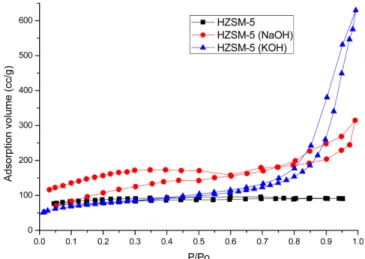
3-1. Effect of desilication agent for mesopore development Ammonium ZSM-5 (Si/Al = 40) was converted to microporous HZSM-5 through calcination process in the tube furnace reactor (Fig. 1). The formation of mesoporous structures was obtained through the desilication process in which silicon was partly removed from zeolite framework. Generally, silicon and aluminum in the zeolite framework are removed with the use of strong bases such as NaOH and KOH. But silicon is more soluble in NaOH and KOH solution in form Si(OH)4- than of aluminum. Aluminum is less soluble in strong base solutions because the negative charge on the aluminum tetrahedral limits the interaction of Al and the strong base. The desilication process decreased the Si/Al ratio in HZSM-5 [18]. BET (Brunauer-Emmett-Teller) analysis was used to determine surface area, pore volume and pore size (Table 1). Pore size distribution in untreated HZSM-5 and desilicated HZSM-5 was analyzed by N2 adsorption isotherm (Fig. 2).
The analysis confirmed that mesopore structure enlargement could be achieved, pore diameter in range of 2-50 nm was observed.
In Fig. 2, the N2 adsorption and desorption isotherms profile showed a small and constantly adsorptive volume at various pressures [19], which was a confirmation of micropore presence without significant
Fig. 1. Tube furnace reactor (Linn Elektro Therm) for calcination and reduction process.
1. Nitrogen bottle 6. Isolator 2. Pressure regulator 7. Crusible
3. Ball valve 8. Temperatur controller 4. Plug reaktor 9. Exit gas washing tank 5. Electric heater
Fig. 2. N2 adsorption and desorption isotherms profile at 77 K for untreated HZSM-5 and desilicated HZSM-5 with NaOH and KOH solution.
mesopore in HZSM-5. The NaOH treated HZSM-5 shows very unusual N2 physisorption pattern. This is an adsorption hysteresis, which according to IUPAC isotherm classification standard, is associated with capillary condensation inside pore structure [17]. The N2 physisorption pattern in observed in Fig. 2 refers to Type H4 of the classification, which is usually associated with narrow slit-like pores.
This phenomenon is indicated by reducing mesopore (0.3496 cc/g) and micropore (0.137cc/g) ratio. (Table 1). The BET model confirmed that micropore volume (0.124 cc/g) was more dominant than mesopore volume (0.0161 cc/g). Both NaOH and KOH desilicated HZSM-5 enhanced nitrogen uptake at higher pressure, which indicated the presence of more mesopore in the hierarchycal pore system (micropore and mesopore mixture) as shown in Fig. 3.
The NaOH desilicated HZSM-5 increased mesoporous diameter from 3.4-12.4 nm to 6.1-29.9 nm. The mesoporous volume also increased about 20.7 times from 0.0161 to 0.3496 cc/g. The surface area of the pore increased about 98% from 266.288 to 526.035 cc/g.
The KOH desilicated HZSM-5 increased mesoporous diameter from 3.4-12.4 nm to 2.1-48.0 nm. The mesoporous volume also increased about 54-times from 0.0161 to 0.3496 cc/g. The surface area of the pore showed similar value (266.288 to 258.470 cc/g). KOH desilicated HZSM-5 gave similar nitrogen uptake with untreated HZSM-5 at lower to intermediate pressure and rise significantly at higher pressure (Fig. 2). The increasing of pore diameter and volume but stagnant surface area was an interesting phenomenon for KOH treatment. The KOH treatment destroyed the crystalline structure of HZSM-5 (Fig. 4) that caused decreasing surface area that might have before.
Mesoporous formation as indicated by increasing in mesoporous area and volume was due to the OH-alkali ions which were selectively
bound to the silicon framework [18]. The Si/Al ratio decreased from 40 (for initial feedstock ZSM-5 ammonium) to 27.9832 (untreated HZSM-5), subsequently further decreased to 22.1059 in the desilication of NaOH and to 16.3032 at KOH desilication as shown in Table 1.
The strength of the KOH base (pKb = 0.5) is greater than NaOH (pKb
= 0.2), so that the KOH solution was stronger in removing Si in the zeolite structure of HZSM-5 than NaOH solution. The larger the pKb, the more OH-ions were released and the more Si could be removed from the HZSM-5 zeolite framework, enlarging the pore volume.
This result supported the HZSM-5 crystalline destroyed during KOH treatment.
The crystallinity and type of component were analyzed by XRD according to diffraction angle (2θ) on the X-ray diffraction spectra.
XRD analysis was performed on microporous HZSM-5, mesoporous HZSM-5 (NaOH and KOH desilication), impregnated and reduced Fe-Co/HZSM-5. Comparison of crystallinity of microporous HZSM- 5, mesoporous HZSM-5 (NaOH and KOH desilication) can be seen in Fig. 4. The crystallinity of the microporous HZSM-5 and the mesoporous HZSM-5 (NaOH desilication) showed identical spectral patterns with sharp peaks formed at 2θ angle of 7.89o, 8.08o, 23o, 23.27o and 23.91o. These both results were identical with ZSM-5 and HZSM-5 spectra that are shown in Fig. 4 (inset), with peaks at 7-8o and 23-24o which was the characteristic peak of HZSM-5 [20]. Garcia- Martinez and Li [21] compared the micropore volumes calculated from the isotherms with the nitrogen sorption isotherms. Alkali treatment did not change the material crystallinity determined by X-ray diffraction (XRD). The parent HZSM-5 and NaOH treated HZSM-5’s XRD pattern had identical pattern but they gave different peak intensity.
Desilication just reduced Si content from zeolite framework and it was needed to maintain the crystallinity and characteristic for catalyst support. These results indicated that HZSM-5 desilication using 1 M NaOH solution maintained the original crystal structure. Different phenomenon showed in desilication using 1 M KOH solution. Although the spectral peaks had the same 2θ position as the previous spectra, but the intensity was much smaller. It indicated that the crystallinity of the HZSM-5 which was dissolved with the KOH solution decreased significantly because of the considerable Si adsorption shown by the decrease of Si/Al ratio from 40 to 16.3032 (EDX analysis). KOH desilication studies could not be found, so it may have not been investigated before. The possibility of KOH desilication was investigated here according to NaOH and KOH characteristics similarity. Unfortunately, it was found that KOH destroyed the crystallinity of desilicated HZSM-5 zeolites. NaOH desilicated HZSM-5 was further investigated with various composition metal Table 1. Comparison for HZSM-5, desilicated HZSM-5 (NaOH) and desilicated HZSM-5 (KOH) in pore characteristics (BET) and Si/Al ratio (EDX)
Sample Stotal Vtotal Vmikro Vmeso dmeso
Si/Al
m2/g cc/g cc/g cc/g nm
HZSM-5 266.288 0.1401 0.124 0.0161 3.4-12.4 27.9832
Desilicated HZSM-5 (NaOH) 526.035 0.4866 0.137 0.3496 6.1-147.6 22.1059
Desilicated HZSM-5 (KOH) 258.470 0.9737 0.085 0.8887 1.7-99.8 16.3032
Fig. 3. Pores size distribution profile BJH adsorption for untreated HZSM-5 and desilicated HZSM-5 with NaOH dan KOH solution.
(iron and cobalt) impregnation.
Solution of 1 M HNO3 was used to form amorphous phase formation of the mesoporous HZSM-5 that treated at 70oC for 2 hours in the stirred tank. Subsequently, the sample was washed with deionized water, dried and calcined by the same procedure after the above desilication process. The formation of an amorphous phase was analyzed by XRD spectra as shown in Fig. 6. The noise of spectra showed the amorphous phase that was formed during the process.
The morphological changes of HZSM-5 before and after desilication were observed through scanning electron microscopy (SEM) at 15,000 times magnification (Fig. 5). Desilicated HZSM-5 (NaOH) showed the rigid particle structure, the similar structure with original HZSM-5.
It indicated crystallinity structure in the zeolite HZSM-5. Desilicated HZSM-5 (KOH) showed larger pores and less rigidity compared with original HZSM-5 and desilicated HZSM-5 (NaOH). It indicated the crystalline degradation in KOH desilication treatment.
Fig. 4. XRD spectra for HZSM-5, desilicated HZSM-5 (NaOH) and desilicated HZSM-5 (KOH). Inset : ZSM-5 and HZSM-5 Spectra [20].
Fig. 5. SEM image for HZSM-5, desilicated HZSM-5 mesopore (NaOH) and desilicated HZSM-5 mesopore (KOH).
3-2. Effect of iron and cobalt composition on Fe-Co/HZSM-5 characteristics
The Fe and Co catalysts loading was 10% weight in mesoporous desilicated HZSM-5 (NaOH). The catalyst compositions were 10Fe-90Co, 20Fe-80Co, 30Fe-70Co, 40Fe-60Co, 50Fe-50Co/HZM-5.
Impregnated varied composition of Fe and Co into meso-HZSM-5 was analyzed with XRF. Table 2 shows a comparison of the prepared Fe content and impregnated Fe and Co into HZSM-5 from NaOH and KOH desilication. The real Fe and Co compositions were at column 5 and 6 in Table 2. The metal composition still was in tolerance limit from designed composition (less than 5%). Columns 3 and 4
were the overall composition in all of the metal in catalyst (zeolite material and metal catalyst). The absorption of Fe-nitrate solution was less than the absorption of Co-nitrate in mesoporous HZSM-5 pore, so the Fe content obtained was smaller than the prepared one.
The absorption of Fe-nitrate and Co-nitrate into impregnated HZSM-5 (NaOH) was larger than impregnated HZSM-5 (KOH). It can be seen that iron and cobalt content (XRF reading) in NaOH desilicated HZSM-5 was larger than KOH. Impregnated HZSM-5 (KOH) had better mesopore structure, but less crystallinity that gave less affinity with Fe and Co precursor. Loading quantities could not be calculated from XRF results because Al metal and its compounds were not Fig. 6. XRD Spectra for Fe-Co/HZSM-5 (NaOH) after reduction with varied composition of Fe and Co.
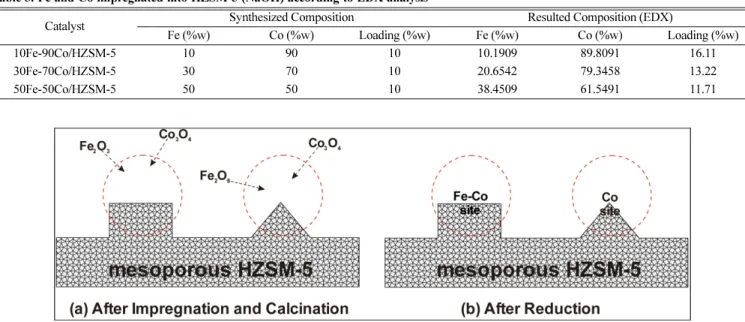
identified from this analysis. The loading of catalyst was calculated from EDX analyzing (Table 3). The average metal loading was 13.5%.
The results indicated the nonhomogeneous distributed/impregnated metal on HZSM-5. EDX has some limitations. EDX analyze the narrow spot from sample surface (required stable, flat, homogeneous and void-free specimens), then non-homogeneous metal distribution in this study might lead to different content of value.
The impregnated mesoporous HZSM-5 was reduced to obtain a metal catalyst on the active surface. The reduction was done in the furnace using excess hydrogen stream at 400oC for 8 hours. XRD analysis was used to observe the reduction results. The diffraction angle position of the metal peaks refers to the spectral database of Tavasoli et al. [22]. Fig. 7 shows the spectra of Fe. Co and Fe-Co alloys formed. There were still Fe2O3 and Co3O4 oxides present in the catalyst. which indicated an imperfect reduction process. The reduction results of 30, 40 and 50% Fe content in Fe-Co showed Fe- Co alloys were formed much more than Fe2O3 and Co3O4 oxides. Fe and Co did not appear on the spectra as they may occur around the diffraction angle of 45o which is very close to the Fe-Co diffraction
angle. The opposite result was obtained in the results of the composition of 10% and 20% Fe in Fe-Co. The presence of Co3O4 oxide was more dominant than the Fe-Co alloys formed. When viewed thoroughly, only Co3O4 oxides were likely to form. This suggested that the reduction conditions used were more suitable for Fe reduction than Co.
The schematic representations of elementary mechanisms for catalyst formation can be made according to these results. In Fig. 7, the transformation of iron and cobalt precursor to oxide occurred after impregnation and calcination. Reduction process produced active metal catalyst Fe-Co alloys and Co on mesoporous HZSM-5.
4. Conclusion
Although the use of KOH solution induced greater mesoporous volume, it had a detrimental effect on zeolite crystal structure. NaOH solutions, on the other hand, increased mesopore area as high as 100%, indicated from surface area increase from 266.28 m2/g of HZSM-5, to 526.03 m2/g of NaOH-desilicated HZSM-5. In addition, the application of NaOH solution increased pore volume from 0.14 cc/g to 0.486 cc/g.
Fig. 7. Schematic representations of elementary mechanisms for catalyst transformation from iron and cobalt precursor to active metal cata- lyst Fe-Co alloys and Co on mesoporous HZSM-5.
Table 2. Impregnated iron and cobalt composition on Fe-Co/HZSM-5 catalyst according to XRF analysis
Desilication Agent Catalyst Iron and Cobalt Content (XRF Reading) Iron and Cobalt Composition
Fe Co Impregnated Fe Impregnated Co
NaOH 10Fe-90Co/HZSM-5 4.150% 26.800% 13.41% 86.59%
NaOH 20Fe-80Co/HZSM-5 11.000% 51.430% 17.62% 82.38%
NaOH 30Fe-70Co/HZSM-5 15.800% 45.230% 25.89% 74.11%
NaOH 40Fe-60Co/HZSM-5 21.400% 40.000% 34.85% 65.15%
NaOH 50Fe-50Co/HZSM-5 27.100% 33.300% 44.87% 55.13%
KOH 10Fe-90Co/HZSM-5 1.805% 16.198% 10.03% 89.97%
KOH 20Fe-80Co/HZSM-5 3.219% 14.149% 18.53% 81.47%
KOH 30Fe-70Co/HZSM-5 4.818% 12.146% 28.40% 71.60%
KOH 40Fe-60Co/HZSM-5 6.512% 10.897% 37.40% 62.60%
KOH 50Fe-50Co/HZSM-5 8.841% 9.365% 48.56% 51.44%
Table 3. Fe and Co impregnated into HZSM-5 (NaOH) according to EDX analysis
Catalyst Synthesized Composition Resulted Composition (EDX)
Fe (%w) Co (%w) Loading (%w) Fe (%w) Co (%w) Loading (%w)
10Fe-90Co/HZSM-5 10 90 10 10.1909 89.8091 16.11
30Fe-70Co/HZSM-5 30 70 10 20.6542 79.3458 13.22
50Fe-50Co/HZSM-5 50 50 10 38.4509 61.5491 11.71
Further, more Fe-Co alloys and less oxide of iron (Fe2O3) as well cobalt (Co3O4) were commonly observed in the produced catalysts.
The largest Fe-Co alloys could be found in 50Fe-50Co/HZSM-5.
References
1. Wang, Y., Wang, R., Xu, D., et al., “Synthesis and Properties of MFI Zeolites with Microporous, Mesoporous and Macroporous Hierarchical Structures by a Gel-casting Technique,” New J. of Chemistry, 40, 4398-4405(2016).
2. Sartipi, S., Parashar, K., Makkee, M., et al., “Breaking the Fischer- Tropsch Synthesis Selectivity: Direct Conversion of Syngas to Gasoline Over Hierarchical Co/H-ZSM-5 Catalysts,” Catalysis Science & Technology, 3, 572(2013).
3. Sun, X., Sartipi, S., Kapteijn, F. and Gascon, J., “Effect of Pre- treatment Atmosphere on the Activity and Selectivity of Co/:
Meso HZSM-5 for Fischer-Tropsch Synthesis,” New J. of Chem- istry, 40, 4167-4177(2016).
4. Valero-Romero, M. J., Sartipi, S., Sun, X., et al., “Carbon/H- ZSM-5 Composites as Supports for bi-functional Fischer-Tropsch Synthesis Catalysts,” Catalysis Science and Technology, 6, 2633- 2646(2016).
5. Sineva, L. V., Asalieva, E. Y. and Mordkovich, V. Z., “The Role of Zeolite in The Fischer-Tropsch Synthesis over Cobalt-Zeolite Catalysts,” Russian Chemical Reviews, 84, 1176-1189(2015).
6. Pour, A. N., Zare, M., Kamali Shahri, S. M., et al., “Catalytic Behav- iors of Bifunctional Fe-HZSM-5 Catalyst in Fischer-Tropsch Synthesis,” J. of Natural Gas Science and Engineering, 1, 183- 189(2009).
7. Sartipi, S., Parashar, K., Valero-Romero, M. J., et al., “Hierarchical H-ZSM-5-supported Cobalt for the Direct Synthesis of Gasoline- range Hydrocarbons from Syngas: Advantages, Limitations, and Mechanistic Insight,” J. of Catalysis., (2013).
8. Valero-Romero, M. J., Sartipi, S., Sun, X., et al., “Carbon/H-ZSM-5 Composites as Supports for bi-functional Fischer-Tropsch Synthesis Catalysts,” Catalysis Science and Technology., (2016).
9. Kim, C. U., Kim, Y. S., Chae, H. J., et al., “Effect of Cobalt Cat- alyst Type and Reaction Medium on Fischer-Tropsch Synthesis,”
Korean J. of Chemical Engineering, 27, 777-784(2010).
10. Luo, Bao, Keogh, et al., Fischer Tropsch synthesis: A compari- son of iron and cobalt catalysts. AIChE Annual Meeting, Con- ference Proceedings. (2006).
11. Min, S. K., No, S.-R. and You, S.-S., “Effect of Composition of γ-Al2O3/SiO2 Mixed Support on Fischer-Tropsch Synthesis with Iron Catalyst,” Korean Chemical Engineering Research, 55, (2017).
12. Kim, J. C., Lee, S., Cho, K., et al., “Mesoporous MFI Zeolite Nanosponge Supporting Cobalt Nanoparticles as a Fischer-Tropsch Catalyst with High Yield of Branched Hydrocarbons in the Gas- oline Range,” ACS Catalysis, 4, 3919-3927(2014).
13. Pour, A. N., Zare, M., Kamali Shahri, S. M., et al., “Catalytic Behaviors of Bifunctional Fe-HZSM-5 Catalyst in Fischer-Tropsch Synthesis,” J. of Natural Gas Science and Engineering., (2009).
14. Sartipi, S., Alberts, M., Santos, V. P., et al., “Insights into the Catalytic Performance of Mesoporous h-zsm-5-supported Cobalt in Fischer-tropsch Synthesis,” ChemCatChem., (2014).
15. Abelló, S., Bonilla, A. and Pérez-Ramírez, J., “Mesoporous ZSM-5 Zeolite Catalysts Prepared by Desilication with Organic Hydroxides and Comparison with NaOH Leaching,” Applied Catalysis A: General, 364, 191-198(2009).
16. Lippens, B. C., de Boer, J. H., “Studies on Pore Systems in Cat- alysts. V. The t method,” J. of Catalysis., (1965).
17. Barrett, E. P., Joyner, L. G. and Halenda, P. P., “The Determination of Pore Volume and Area Distributions in Porous Substances. I.
Computations from Nitrogen Isotherms,” J. of the American Chemi- cal Society., (1951).
18. Groen, J. C., Peffer, L. A. A., Moulijn, J. A. and Pérez-Ramírez, J., “Mesoporosity Development in ZSM-5 Zeolite Upon Optimized Desilication Conditions in Alkaline Medium,” Colloids and Sur- faces A: Physicochemical and Engineering Aspects, 241, 53-58 (2004).
19. Sing, K. S. W., Everett, D. H., Haul, R. A. W., et al., “International Union of Pure and Applied Chemistry Physical Chemistry Division Reporting Physisorption Data for Gas/soils Systems with Special Reference to the Determination of Surface Area and Porosity,”
Pure Appl Chemistry., (1985).
20. Al-Thawabeia, R. A. and Hodali, H. A., “Use of Zeolite ZSM-5 for Loading and Release of 5-Fluorouracil,” J. of Chemistry, (2015).
21. Garcia-Martinez, J. and Li, K., “Mesoporous Zeolites : Preparation, Characterization and Applications,” Wiley-VCH Verlag GMbH
& Co., Weinhmeim, Germany (2015).
22. Tavasoli, A., Trépanier, M., Malek Abbaslou, R. M., et al., “Fischer- Tropsch Synthesis on Mono- and Bimetallic Co and Fe Catalysts Supported on Carbon Nanotubes,” Fuel Processing Technology, 90, 1486-1494(2009).