INTRODUCTION
Human metapneumovirus (HMPV), a recently discovered member of the family Paramyxoviridae, has been isolated from the respiratory secretions of patients worldwide (1-4). Though not as common as respiratory syncytial virus (RSV), it is a fre- quent etiologic agent of both upper and lower respiratory tract infections. Evidence suggests that this virus has been circulat- ing for over 50 yr and most individuals have been exposed to it by the age of 5 (5). However, the epidemiological picture of HMPV infections in Korean children remains unclear.
RSV is a common cause of respiratory illness in children, and is considered the most important cause of viral bronchi- olitis in young children (6). Several studies have shown clin- ical manifestations of HMPV and RSV infections to be very similar, and range from mild respiratory problems to bron- chiolitis, pneumonia, severe cough, high fever, and myalgia;
consequently, they are difficult to distinguish clinically (5, 7). RSV is known as a major causative agent of acute wheez- ing in children, and RSV bronchiolitis in early childhood is
strongly associated with asthma development later in life (8).
Several research groups have reported HMPV is also an eti- ologic agent of wheezing illness in children and adults (9-12), though there have been contradictory results (13).
RSV and HMPV share genomic (14) and seasonal distribu- tion (15, 16) patterns, as well. Both viruses circulate in the winter and spring months with recurrent epidemics occur- ring in the winter. Studies have also shown that HMPV caus- es persistent infections, as does RSV, due to these viruses elic- iting only a partially protective immune response (17). Because of their clinical, genetic, and epidemiological homogeneity, it has been suggested they also share similar replicative, patho- physiologic, and immunologic functions (14). To date this question remains unanswered.
In our previous report, HMPV was found to be prevalent in Korean children ≤5 yr hospitalized with acute wheezing illness from February to November 2006 (12). This study investigated the relative contribution of HMPV to the hos- pitalization of children for acute wheezing illness and to fur- ther elucidate the clinical and epidemiological differences of
342
Chang Keun Kim1, Jungi Choi1, Zak Callaway1, Hyo Bin Kim1, Ju Young Chung2, Young-Yull Koh3, and Bo Moon Shin4
Department of Pediatrics1, Asthma and Allergy Center, Departments of Pediatrics2and Laboratory Medicine4, Inje University Sanggye Paik Hospital, Seoul;
Department of Pediatrics3, Seoul National University Hospital, Seoul, Korea
Address for Correspondence Chang-Keun Kim, M.D.
Asthma & Allergy Center, Department of Pediatrics, Inje University Sanggye Paik Hospital, 620 Dongil-ro, Nowon-gu, Seoul 139-707, Korea
Tel : +82.2-950-8832, Fax : +82.2-950-1662 E-mail : [email protected]
This study was funded in part by a 2010 Inje University grant.
Clinical and Epidemiological Comparison of Human Metapneumovirus and Respiratory Syncytial Virus in Seoul, Korea, 2003-2008
Human metapneumovirus (HMPV) shares clinical and epidemiological character- istics with well-known respiratory syncytial virus (RSV). The aim of this study was to investigate the clinical and epidemiological differences between HMPV- and RSV- induced wheezing illnesses. A total of 1,008 nasopharyngeal aspirate specimens was collected from 1,008 pediatric patients hospitalized with acute respiratory tract infection at Inje University Sanggye Paik Hospital from December 2003 to April 2008, and tested for seven common respiratory viruses. Conditions classified as wheez- ing illness were bronchiolitis, reactive airways disease, and bronchial asthma. HMPV caused a significantly lower proportion of wheezing illness when compared to RSV (48.1% vs. 82.2%, P<0.05). HMPV-induced wheezing illness occurred predomi- nantly in older patients when compared to RSV patients (P<0.001). RSV infections peaked in the fall and winter followed by peaks of HMPV infection in winter and spring.
Eosinophil counts were significantly higher (P<0.01) in RSV patients when compared to HMPV patients. These results show that human metapneumovirus patients exhib- it several different clinical and epidemiological characteristics, such as higher pro- portion of wheezing illness, age and seasonal incidence, and eosinophil counts, when compared to RSV patients.
Key Words : Metapneumovirus; Respiratory Syncytial Viruses; Respiratory Sounds; Child; Seasonal Distribution
Received : 9 March 2009 Accepted : 5 May 2009
ⓒ 2010 The Korean Academy of Medical Sciences.
This is an Open Access article distributed under the terms of the Creative Commons Attribution Non-Commercial License (http://creativecommons.org/licenses/by-nc/3.0) which permits unrestricted non-commercial use, distribution, and reproduction in any medium, provided the original work is properly cited.
HMPV infection in relation to RSV infection from Decem- ber 2003 to April 2008.
MATERIALS AND METHODS Study population
A total of 1,008 nasopharyngeal aspirate (NPA) specimens were collected from 1,008 pediatric patients hospitalized with acute respiratory tract infection wheezing illness at Inje Uni- versity Sanggye Paik Hospital from December 2003 to April 2008. For this study, three different diagnoses were classifi- ed as wheezing illness: bronchiolitis, reactive airways disease (RAD) and bronchial asthma. Acute bronchiolitis was defin- ed as a first occurrence of expiratory wheezing with or with- out tachypnea, air trapping, and substernal retraction in chil- dren <3 yr of age. RAD was defined as recurrent wheezing
<3 times, and bronchial asthma was defined as recurrent wheez- ing≥3 times in any child (18). Informed consent was given before any specimens were taken and the study protocol was approved by the Ethics Committee of Inje University Sang- gye Paik Hospital (IRB # IJ 06-34).
On admission, 2 mL of normal saline were instilled into the nostril and then aspirated using a disposable catheter and suction device. NPAs were centrifuged and the supernatants were stored at -70℃until tested.
Viral detection
From December 2003 to December 2006, common res- piratory viruses (Adenovirus, RSV, Influenza A and B, and Parainfluenza viruses 1-3) were detected by immunofluores- cent-antibody test (IFA) (DAKO, Cambridgeshire, UK), while HMPV was detected using multiplex reverse transcriptase- polymerase chain reaction (RT-PCR), as previously describ- ed (12). From January 2007 to the end of the study period, RT-PCR was used to test all respiratory viruses investigated, including Rhinovirus (RV).
Statistical analysis
The chi-square test was used to compare results for the virus- es tested, and all analyses were done using SPSS version 10.0 (SPSS, Inc., Chicago, IL, USA). Differences were considered significant when P values were less than 0.05.
RESULTS Study population
From December 2003 to April 2008, 1,008 nasopharyn- geal aspirates were taken from pediatric patients hospitaliz- ed for acute respiratory tract infection and tested for six com- mon viruses (RSV, parainfluenza, HMPV, adenovirus, and influenza A and B). RV was tested for from January 2007 to April 2008.
HMPV and RSV prevalence
From the above study group, HMPV had an overall preva- lence of 7.2% (73/1,008) while prevalence of RSV was 26.0%
(262/1,008).
Patient demographics
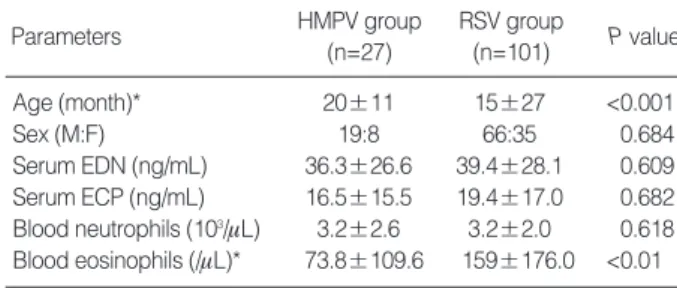
The average age of first infection in the HMPV and RSV groups are shown in Table 1. Virus-positive patients hospital- ized with acute respiratory tract infection had an average age of 20.2±21.0 months (range, 1-150 months). The most com- monly detected virus was RSV (25.5%) followed by parain- fluenza (13.6%), RV (7.3%), HMPV (6.8%), adenovirus (6.5
%), and influenza (4.8%).
Eosinophil and neutrophil counts
Eosinophil and neutrophil counts are shown in Table 1. RSV patients had significantly higher (P=0.002) eosinophil counts than HMPV patients; however, there was no significant dif- ference in neutrophil counts.
*Data are expressed as mean±standard deviation.
HMPV, human metapneumovirus; RSV, respiratory syncytial virus; EDN, eosinophil derived neurotoxin; ECP, eosinophilic cationic protein.
Parameters HMPV group
(n=27)
RSV group
(n=101) P value
Age (month)* 20±11 15±27 <0.001
Sex (M:F) 19:8 66:35 0.684
Serum EDN (ng/mL) 36.3±26.6 39.4±28.1 0.609 Serum ECP (ng/mL) 16.5±15.5 19.4±17.0 0.682 Blood neutrophils (103/mL) 3.2±2.6 3.2±2.0 0.618 Blood eosinophils (/mL)* 73.8±109.6 159±176.0 <0.01 Table 1. Demographic features of study population
*% of inpatients positive for these viruses with a wheezing illness.
HMPV, human metapneumovirus; RSV, respiratory syncytial virus; RAD, reactive airway disease; BA, bronchial asthma.
Illnesses HMPV group
(n=27)
RSV group
(n=101) P value
Wheezing illness* 48.1% 82.2% <0.05
Bronchiolitis 30.8% 79.5% <0.01
RAD exacerbation 23.1% 3.6% 0.037
BA exacerbation 46.2% 16.9% 0.068
Table 2. Wheezing illnesses in HMPV and RSV groups
Wheezing illness
Of these virus-positive cases, 48.1% of HMPV-infected and 82.2% of RSV-infected patients were diagnosed with wheez- ing illnesses (P<0.05) (Table 2). RSV caused a significantly higher (P<0.01) proportion of bronchiolitis than HMPV.
Age distribution of HMPV and RSV infection
All patients positive for HMPV or RSV and hospitalized for wheezing illness at our hospital were divided into three age groups: <12 months, 13-36 months, and >37 months.
In the 13-36 months range, the proportion of HMPV cases was significantly greater (P<0.05) than the proportion of RSV cases, while the opposite was true in children <12 months (P<0.05). In children >37 months, the proportions of HMPV and RSV were nearly the same.
Seasonal incidence of HMPV and RSV infection
The study population investigated for seasonal incidence consisted of 1,008 children cared for at our hospital from December 2003 to April 2008 (Fig. 1). RSV infection oc- curred predominantly in the fall and winter and usually fol- lowed by peaks of HMPV infection in winter and spring.
Co-infection rates
The co-infection rate in the HMPV group was much higher when compared to the RSV group (25.9% vs. 5.9%). Among HMPV patients co-infected with other respiratory viruses, parainfluenza was the most common (42.9%) followed by RV (28.6%) and adenovirus (28.6%). Among RSV patients co-infected with other respiratory viruses, adenovirus was the most common (66.7%) followed by parainfluenza (16.7%)
and RV (16.7%).
DISCUSSION
To date this is the most comprehensive comparison of HM- PV- and RSV-induced wheezing illness and the first report of its kind in Korea. Our results demonstrated HMPV wheez- ing illnesses exhibited several clinical and epidemiological differences (i.e., proportion of wheezing illness, age and sea- sonal distribution, and eosinophil counts) when compared to RSV wheezing illnesses. Both HMPV and RSV were promi- nent etiologic agents of wheezing illness. In our study, the proportions of respiratory HMPV and RSV infections man- ifesting as wheezing illness were quite substantial (48.1%
and 82.2%, respectively). Several studies have shown a strong association between HMPV infection and wheezing illness (2, 10-12, 19), though one study contradicted these results (13). Another study in particular found HMPV bronchioli- tis to be an important risk factor for asthma development in preschool years; in fact, the association was at least as strong as that found between RSV-bronchiolitis and asthma devel- opment (20). The proportional breakdown of wheezing ill- ness manifestations in our HMPV and RSV patients differed from the few recent studies also comparing them. Bronchioli- tis was a significantly more common diagnosis in RSV pati- ents than in HMPV patients in our study (79.5% vs. 30.8%).
Manoha et al. (21) found HMPV and RSV infection mani- festing as bronchiolitis in nearly equal proportions, while asth- ma was a significantly more common diagnosis in pediatric inpatients and outpatients with HMPV. A different study also found bronchial asthma significantly more prevalent in HMPV patients (22), in contrast to our results. However, Garcia-Garcia et al. (16) and Kim et al. (23) studies concur with our findings that RSV is a significantly frequent cause
Fig. 1. Seasonal incidence of HMPV and RSV infection was plotted from Decem- ber 2003 to April 2008. The Y-axis represents the pro- portion of the total number of patients with a wheezing illness positive for that res- piratory virus.
*proportion of all virus-pos- itive samples.
% positive*
60.0 50.0 40.0 30.0 20.0 10.0 0.0
Dec. 2003-Feb. 2004Mar. 2004-May. 2004Jun. 2004-Aug. 2004Sep. 2004-Nov. 2004Dec. 2004-Feb. 2005Mar. 2005-May. 2005Jun. 2005-Aug. 2005Sep. 2005-Nov. 2005Dec. 2005-Feb. 2006Mar. 2006-May. 2006Jun. 2006-Aug. 2006Sep. 2006-Nov. 2006Dec. 2006-Feb. 2007Mar. 2007-May. 2007Jun. 2007-Aug. 2007Sep. 2007-Nov. 2007Dec. 2008-Feb. 2008Mar. 2008-Apr. 2008 HMPV
RSV
of bronchiolitis. Garcia et al. also found HMPV a more fre- quent cause of recurrent wheezing. Their results, along with ours, are congruent with Kahn’s review (24) of HMPV stud- ies, which found this virus to be an important cause of wheez- ing illness in early childhood.
There were significant differences in age distribution bet- ween the HMPV and RSV patients in our study population.
The mean age of patients with HMPV was significantly greater than the age of RSV patients. RSV infection occurred pre- dominantly in infants (<12 months), while HMPV was found mainly in children 12-36 months. These results mirror those of others (23). Baer et al. (25) reported both a significantly greater median age of HMPV patients and similar propor- tions of HMPV and RSV infections in the <12 months age group (39% and 62%, respectively) compared to our study subgroup of the same age (29.6% and 63%, respectively).
However, Williams et al. (26) found a younger median age in their HMPV patients compared to those with RSV-induced lower respiratory tract infection. In a study of Danish children, hospitalization for acute respiratory tract infection caused by HMPV occurred only in very young children (1-6 months) (22). Regardless of these different results, both HMPV and RSV predominate in infants and young children as major causes of severe respiratory illness (24). In our study, as age increased, HMPV became a more important agent of wheez- ing illnesses, such as RAD and bronchial asthma. This is an expected result, as very young children previously infected with RSV would have partial immunity to the virus allow- ing HMPV to become more dominant in older children.
Analysis of the seasonal incidence of these two virus infec- tions in Korea (Fig. 1) showed that although both RSV and HMPV infections occur throughout the year, there is a gen- eral trend toward RSV occurring mainly in the fall and win- ter with HMPV infections following in the spring. Incom- plete data for the spring of 2008 also demonstrate the pre- dominance of HMPV in this season and no cases of RSV. An exception for HMPV was the winter season of 2004/2005, when this virus was more prevalent than RSV. Kim et al. (23) also reported a spring peak of HMPV and a fall/early winter peak of RSV infections in Korean children. Another study directly comparing the seasonality of RSV and HMPV found similar trends (21) except for the frequent autumnal occur- rence of RSV in our study.
Elevated blood eosinophil counts in RSV bronchiolitis were an interesting finding, as eosinophilia has been associated with recurrent wheezing/asthma development later in life (27). In our study the RSV group displayed eosinophilia when com- pared to the HMPV group. Therefore, RSV-infected patients may have a greater chance of developing recurrent wheezing in the future than HMPV-infected patients. However, a more detailed study of their immunologic profiles, including cyto- kine and chemokine profiles, will need to be done to more accurately assess HMPV’s perturbation of the immune sys- tem and to further compare the similarities and differences
of these two respiratory viruses from immunologic and patho- physiologic perspectives.
The rate of co-infection in the HMPV group was much higher when compared to the RSV group (25.9% vs. 5.9%).
The co-infecting viruses were the same for both groups: parain- fluenza, RV and adenovirus. The overlapping seasonal distri- butions (26), tendency to occur in the same patient popula- tion (infants and young children), and similar degree of patho- genicity (28) of these two common viruses may help explain why co-infections have been found in several other studies;
however, there were no cases of HMPV and RSV co-infection in our study. The higher rate of co-infection in the HMPV group (25.9%) may also be due to the viral detection meth- ods used in this study: i.e., multiplex RT-PCR for HMPV, and IFA for all other viruses (with the exception of RV) from December 2003 to December 2006, and RT-PCR for all virus- es, thereafter, until the study endpoint. In general, RT-PCR is a more sensitive test than IFA for detection of viruses (29), which may result in more HMPV infections detected. There are also conflicting results regarding whether disease severity is associated with co-infection (24). More studies are needed to answer this question.
A weakness of this study was the fact that only patients with infections severe enough to be hospitalized were includ- ed. Therefore, the prevalence of HMPV- and RSV-induced wheezing illness in our study population may underestimate their respective prevalence in the community. Furthermore, the location of our tertiary care facility is unique in that it is one of the most densely populated neighborhoods in Korea.
The correlation between degree of crowding and incidence and severity of lower respiratory tract infection has been de- monstrated (30). Thus, our results cannot be extrapolated to the entire population of Korean children. As previously men- tioned, another weakness was the different viral detection meth- ods used for HMPV versus the other viruses investigated.
The clinical relevance of this study is the etiologic deter- mination of wheezing illness in our study population. From this point, a longitudinal study is needed to investigate pati- ents who develop recurrent wheezing and/or asthma. In that way, association between HMPV and/or RSV infection in early childhood and later asthma development could be deduced.
To summarize, our data reveals, first, that HMPV is an im- portant cause of wheezing illness, though the prevalence of wheezing illness in RSV-infected patients was notably higher than the corresponding prevalence in HMPV-infected pati- ents. Second, age distribution analysis showed RSV infections occurred in significantly younger patients. Third, seasonal incidence for the two viruses were also different, though with some overlapping: RSV infections occurred predominantly in the winter, while HMPV infections in the spring. Peak incidence of RSV infection was followed by peak HMPV infec- tion. Fourth, RSV-infected patients exhibited significantly higher eosinophil counts without significant difference in neu- trophil counts.
In conclusion, HMPV is an important cause of wheezing illness in infants and young children in Korea. Comparing HMPV and RSV reveals many epidemiological and clinical differences, but many questions remain unanswered. A long- term study should be conducted to determine whether early childhood infection with this virus leads to recurrent wheez- ing and/or asthma. The next point of comparison should in- volve the study of their pathophysiology and immunologic profiles to determine how HMPV induces wheezing illness.
REFERENCES
1. Peret TC, Boivin G, Li Y, Couillard M, Humphrey C, Osterhaus AD, Erdman DD, Anderson LJ. Characterization of human metapneu- moviruses isolated from patients in North America. J Infect Dis 2002;
185: 1660-3.
2. Jartti T, van den Hoogen B, Garofalo RP, Osterhaus AD, Ruuskanen O. Metapneumovirus and acute wheezing in children.Lancet 2002;
360: 1393-4.
3. Chung JY, Han TH, Kim BE, Kim CK, Kim SW, Hwang ES. Human metapneumovirus infection in hospitalized children with acute respi- ratory disease in Korea. J Korean Med Sci 2006; 21: 838-42.
4. Madhi SA, Ludewick H, Abed Y, Klugman KP, Boivin G. Human metapneumovirus-associated lower respiratory tract infections among hospitalized human immunodeficiency virus type 1 (HIV-1)- infected and HIV-1-uninfected African infants. Clin Infect Dis 2003;
37: 1705-10.
5. van den Hoogen BG, de Jong JC, Groen J, Kuiken T, de Groot R, Fouchier RA, Osterhaus AD. A newly discovered human pneumovi- rus isolated from young children with respiratory tract disease. Nat Med 2001; 7: 719-24.
6. Glezen P, Denny FW. Epidemiology of acute lower respiratory dis- ease in children. N Engl J Med 1973; 288: 498-505.
7. Boivin G, Abed Y, Pelletier G, Ruel L, Moisan D, Cote S, Peret TC, Erdman DD, Anderson LJ. Virological features and clinical mani- festations associated with human metapneumovirus: a new paramyx- ovirus responsible for acute respiratory tract infections in all age groups. J Infect Dis 2002; 186: 1330-4.
8. Sigurs N, Bjarnason R, Sigurbergsson F, Kjellman B. Respiratory syncytial virus bronchiolitis in infancy is an important risk factor for asthma and allergy at age 7. Am J Respir Crit Care Med 2000;
161: 1501-7.
9. Jartti T, Lehtinen P, Vuorinen T, Osterback R, van den Hoogen B, Osterhaus AD, Ruuskanen O. Respiratory picornaviruses and res- piratory syncytial virus as causative agents of acute expiratory wheez- ing in children. Emerg Infect Dis 2004; 10: 1095-101.
10. Williams JV, Tollefson SJ, Heymann PW, Carper HT, Patrie J, Crowe JE. Human metapneumovirus infection in children hospitalized for wheezing. J Allergy Clin Immunol 2005; 115: 1311-2.
11. Freymouth F, Vabret A, Legrand L, Eterradossi N, Lafay-Delaire F, Brouard J, Guillois B. Presence of the new human metapneumovirus in French children with bronchiolitis. Pediatr Infect Dis J 2003; 22:
92-4.
12. Chung JY, Han TH, Kim SW, Kim CK, Hwang ES. Detection of viruses identified recently in children with acute wheezing. J Med Virol 2007; 79: 1238-43.
13. Rawlinson WD, Waliuzzaman Z, Carter IW, Belessis YC, Gilbert KM, Morton JR. Asthma exacerbations in children associated with rhinovirus but not human metapneumovirus infection. J Infect Dis 2003; 187: 1314-8.
14. Mahalingam S, Schwarze J, Zaid A, Nissen M, Sloots T, Tauro S, Storer J, Alvarez R. Perspective on the host response to human metap- neumovirus infection: what can we learn from respiratory syncytial virus infections? Microbes Infect 2006; 8: 285-93.
15. van den Hoogen BG, Osterhaus DM, Fouchier RA. Clinical impact and diagnosis of human metapneumovirus infection. Pediatr Infect Dis J 2004; 23 (Suppl 1): S25-32.
16. Garcia-Garcia ML, Calvo C, Perez-Brena P, De Cea JM, Acosta B, Casas I. Prevalence and clinical characteristics of human metapneu- movirus infections in hospitalized infants in Spain. Pediatr Pulmonol 2006; 41: 863-71.
17. Crowe JE Jr, Williams JV. Immunology of viral respiratory tract infection in infancy. Paediatr Respir Rev 2003; 4: 112-9.
18. Mertsola J, Ziegler T, Ruuskanen O, Vanto T, Koivikko A, Halonen P. Recurrent wheezy bronchitis and respiratory infections. Arch Dis Child 1991; 66: 124-9.
19. Esper F, Boucher D, Weibel C, Martinello RA, Kahn JS. Human metapneumovirus infection in the United States: clinical manifesta- tions associated with a newly emerging respiratory infection in chil- dren. Pediatrics 2003; 111: 1407-10.
20. Garcia-Garcia ML, Calvo C, Casas I, Bracamonte T, Rellan A, Goza- lo F, Tenorio T, Perez-Brena P. Human metapneumovirus bronchi- olitis in infancy is an important risk factor for asthma at age 5. Pedi- atr Pulmonol 2007; 42: 458-64.
21. Manoha C, Espinosa S, Aho SL, Huet F, Pothier P. Epidemiological and clinical features of hMPV, RSV and RVs infections in young chil- dren. J Clin Virol 2007; 38: 221-6.
22. von Linstow ML, Larsen HH, Eugen-Olsen J, Koch A, Nordmann Winther T, Meyer AM, Westh H, Lundgren B, Melbye M, Hogh B.
Human metapneumovirus and respiratory syncytial virus in hospi- talized Danish children with acute respiratory tract infection. Scand J Infect Dis 2004; 36: 578-84.
23. Kim YK, Kim JW, Wee YS, Yoo EG, Han MY. Clinical features of Human [Metapneumovirus and Respiratory Syncytial Virus infec- tion in hospitalized children.] Pediatr Allergy Respir Dis 2009; 19:
12-9.
24. Kahn JS. Epidemiology of human metapneumovirus. Clin Microbiol Rev 2006; 19: 546-57.
25. Baer G, Schaad UB, Heininger U. Clinical findings and unusual epi- demiologic characteristics of human metapneumovirus infections in children in the region of Basel, Switzerland. Eur J Pediatr 2008;
167: 63-9.
26. Williams JV, Harris PA, Tollefson SJ, Halburnt-Rush LL, Pingster- haus JM, Edwards KM, Wright PF, Crowe JE Jr. Human metapneu- movirus and lower respiratory tract disease in otherwise healthy infants and children. N Engl J Med 2004; 350: 443-50.
27. Ehlenfield DR, Cameron K, Welliver RC. Eosinophilia at the time
of respiratory syncytial virus bronchiolitis predicts childhood reac- tive airway disease. Pediatrics 2000; 105: 79-83.
28. Gerna G, Campanini G, Rovida F, Sarasini A, Lilleri D, Paolucci S, Marchi A, Baldanti F, Revello MG. Changing circulation rate of human metapneumovirus strains and types among hospitalized pedi- atric patients during three consecutive winter-spring seasons. Brief
report. Arch Virol 2005; 150: 2365-75.
29. Ebihara T, Endo R, Ma X, Ishiguro N, Kikuta H. Detection of human metapneumovirus antigens in nasopharyngeal secretions by an im- munofluorescent-antibody test. J Clin Microbiol 2005; 43: 1138-41.
30. Berman S. Epidemiology of acute respiratory infections in children of developing countries. Rev Infect Dis 1991; 13 (Suppl 6): S454-62.