INTRODUCTION
Stroke is a major cause of morbidity and mortality world- wide. Although the past 50 yr have seen a decline in the in- cidence of stroke in Western populations (1), the burden of the disease in the Korean population has increased and is expected to continue to rise with the increasing elderly pop- ulation. The burden of stroke can be reduced if at-risk indi- viduals are recognized and treated. Since only about two thirds of ischemic strokes seem to be attributable to known environmental risk factors (2), there are likely to be other as yet unknown causal risk factors for ischemic stroke.
Several epidemiologic studies in families and in twins have indicated a distinctive genetic component predisposing to stroke (3). Identification of cerebral infarction susceptibility genes might enhance prediction of disease risk. The comple- tion of the Human Genome Project brought the promise of genomic medicine, which is the use of whole-genome-derived information to prevent, diagnose and treat complex polygenic diseases such as stroke (4). One of the most significant ad- vances in our understanding of the role of genetic factors in the pathogenesis of stroke came from the deCODE Genet- ics Group in Iceland, who reported the identification and characterization of the phosphodiesterase 4D (PDE4D) gene, which appears to confer an increased risk of ischemic stroke (5).
However, recently published studies from different popu- lations provide apparently conflicting evidence on the asso- ciation between the PDE4D gene and ischemic stroke (6- 13). Furthermore, none of the previous studies clearly stated whether subjects with silent cerebral infarction or asymp- tomatic carotid atherosclerosis were appropriately excluded from their control groups. In clinical practice, evidence of silent infarction or asymptomatic carotid stenosis on mag- netic resonance imaging (MRI) or MR angiography (MRA) of the head is not uncommon in healthy-looking individu- als (14, 15).
In the present study, the relationship between a represen- tative PDE4D genotype and ischemic stroke was explored in a case-control study of consecutive Korean patients with ischemic stroke and healthy controls who were neurological- ly and radiologically proven to be stroke-free. To our knowl- edge, this is the first report concerning the association of the PDE4D gene with ischemic stroke in a Korean population.
MATERIALS AND METHODS Subjects
Consecutive first-ever ischemic stroke patients admitted
307
Myeong-Kyu Kim, Jun-Tae Kim, Sung-Min Choi, Seung-Han Lee, Man-Seok Park, and Ki-Hyun Cho
Department of Neurology, Chonnam National University Medical School and Research Institute of Medical Science, Gwangju, Korea
Address for correspondence Myeong-Kyu Kim, M.D.
Department of Neurology, Chonnam National University Medical School and Research Institute of Medical Science, 8 Hak-dong, Dong-gu, Gwangju 501-757, Korea
Tel : +82.62-220-6161, Fax : +82.62-228-3461 E-mail : [email protected]
*This work was supported by a research grant from the Research Institute of Medical Sciences, Chonnam National University.
J Korean Med Sci 2009; 24: 307-10 ISSN 1011-8934
DOI: 10.3346/jkms.2009.24.2.307
Copyright � The Korean Academy of Medical Sciences
Phosphodiesterase 4D Gene and Risk of Noncardiogenic Ischemic Stroke in a Korean Population
Recently published studies from different populations provide apparently conflicting evidence on the association between the phosphodiesterase 4D (PDE4D) gene and ischemic stroke. The relationship between a representative PDE4D genotype and ischemic stroke was explored in a case-control study of 205 consecutive Korean patients with noncardiogenic ischemic stroke and 103 healthy controls who were neurologically and radiologically proven to be stroke-free. We selected and geno- typed a PDE4D single nucleotide polymorphism (SNP 41, rs152312) as a candi- date marker for susceptibility to ischemic stroke because SNP 41 has shown the most significant association with stroke in both a meta-analysis and the original Ice- landic study of the PDE4D gene. No significant difference was observed between the cases and controls in the distribution of the PDE4D SNP 41 genotypes. The results from the adjusted conditional logistic regression analysis (adjusted for age, hypertension, diabetes and smoking status) showed no significant association bet- ween PDE4D SNP 41 genotypes and an increased risk of noncardiogenic ischemic stroke. The PDE4D gene is not a major risk factor for noncardiogenic ischemic stroke in a Korean population, which supports the recent evidence suggesting that the causative genetic variants of ischemic stroke may differ across populations.
Key Words : Phosphodiesterases 4D; Stroke; Case-Control Study; Genetics
Received : 19 August 2007 Accepted : 9 June 2008
to Chonnam National University Hospital (Gwangju, Korea) between January 2003 and December 2004 were approached for consent to participate in this study. All patients under- went MRI and MRA of the head within 48 hr after stroke onset, and their strokes were classified according to the pre- specified Trial of Org 10172 in Acute Stroke Treatment (TOAST) criteria (16). In order to ensure homogeneity of samples in terms of the underlying pathomechanism of stroke, only patients with ischemic stroke classified as large artery disease (LAD) or small vessel disease (SVD) were included in the present study.
The control subjects were selected from patients who un- derwent both MRI and MRA of the head for neurological complaints other than stroke, primarily for headache. Pati- ents having significant increased signal intensity lesions on diffusion-weighted or fluid-attenuated inversion-recovery MR images or vascular abnormalities on MRA of the head were excluded from the study, as were patients with typical vascular headaches.
Baseline demographic data (age, gender), history of con- ventional vascular risk factors (hypertension, diabetes and current smoker) and history of previous vascular events (myo- cardial infarction, angina, claudication and peripheral vas- cular disease) were obtained from each subject.
Individuals with a proven cause of cardioembolism, such as recent myocardial infarction, valvular heart disease, and arrhythmia including atrial fibrillation, and those with a history of previous peripheral vascular events were excluded from the case and control groups.
The study was approved by the Institutional Review Board of the hospital, and informed consent was obtained from all study participants.
Marker selection and genotyping
We selected a PDE4D single nucleotide polymorphism (SNP 41, rs152312) as a candidate marker for susceptibility to ischemic stroke in a Korean population because SNP 41 has shown the most significant association with stroke in a meta-analysis of nine case-control studies and in the origi- nal Icelandic study (5, 17).
Genomic DNA was extracted from peripheral blood lym- phocytes using a standard protocol. Polymerase chain reac- tion (PCR) primers for PDE4D SNP 41 were designed based
on GenBank sequences (accession number: NM_006203, AY245866): 5′-ATACATGTGCCATGCTGGTG-3′(for- ward) and 5′-CCTCCTAGGCTGGTGTGAAG-3′(reverse).
PCR assays were carried out using 1.25 U of AmpliTaq Poly- merase Gold (Applied Biosystems, CA, U.S.A.), 100 ng of genomic DNA, 2.0-2.5 mM of MgCl2, and 10 μM of primer.
The amplification conditions were as follows: an initial denat- uration cycle at 95℃for 5 min, followed by 35 amplification cycles (denaturation at 95℃for 30 sec, annealing at 62℃ for 30 sec, and extension at 72℃for 1 min), and a final exten- sion at 72℃for 7 min. The PCR products were electropho- resed in a 1.2% agarose gel, and the amplified genomic DNA fragments were extracted from the gel and purified using a QIAquick�gel extraction kit (Quiagen, Hilden, Germany) according to the manufacturer’s instructions. Direct sequenc- ing of both strands was performed using BigDye terminator kits (PE Biosystems, CA, U.S.A.) to determine the individ- ual genotypes.
Statistical analysis
The distribution of PDE4D SNP 41 among controls was tested for Hardy-Weinberg equilibrium using an exact test.
Continuous and categorical variables were tested using a t test and chi-square analysis. Single-marker associations bet- ween phenotype and genotype were tested by chi-square anal- ysis, and the relative risks for ischemic stroke associated with each genotype were calculated by logistic regression analysis (SPSS 14.OK for Windows; SPSS, Chicago, IL, U.S.A.). Dif- ferences were considered significant for p values of ≤0.05.
RESULTS
The baseline characteristics of the cases and controls are shown in Table 1. Compared with the controls, the cases were significantly older and, as expected, had a higher prevalence of conventional vascular risk factors at baseline. The cases con- sisted of 113 patients with SVD and 92 patients with LAD.
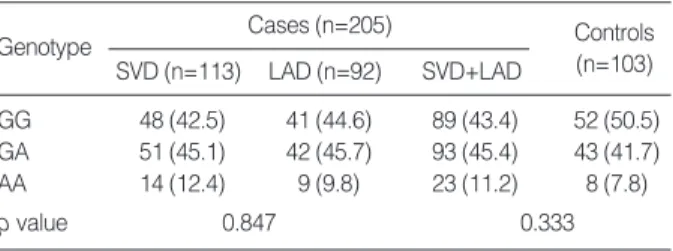
The genotype frequencies for PDE4D SNP 41 were in Hardy- Weinberg equilibrium in the control group (p=0.936)
Using a single-marker chi-square analysis, no significant
308 M.-K. Kim, J.-T. Kim, S.-M. Choi, et al.
Values are mean±SD or %.
Cases (n=205) Controls (n=103) p value
Age (yr) 64.8±11.6 61.8±10.4 0.025
Gender (female %) 47.3 54.4 0.18
Hypertension (%) 60.5 31.1 <0.001
Diabetes (%) 28.3 14.6 0.01
Smoking (%) 20 5.8 0.001
Table 1. Baseline characteristics of cases and controls
All results were expressed as number (% of total). p value for χ2test.
SVD, small vessel disease; LAD, large artery disease.
Cases (n=205)
SVD (n=113) LAD (n=92) SVD+LAD
Genotype Controls
(n=103) GG 48 (42.5) 41 (44.6) 89 (43.4) 52 (50.5) GA 51 (45.1) 42 (45.7) 93 (45.4) 43 (41.7)
AA 14 (12.4) 9 (9.8) 23 (11.2) 8 (7.8)
p value 0.847 0.333
Table 2. Distribution of PDE4D SNP41 genotypes
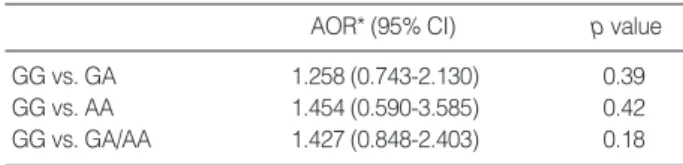
difference was observed between SVD and LAD and between the cases (SVD+LAD) and controls in the distribution of the PDE4D SNP 41 genotypes (Table 2). The results from the adjusted conditional logistic regression analysis (adjusted for age, hypertension, diabetes and smoking status) showed no significant association between the PDE4D SNP 41 geno- types and an increased risk of noncardiogenic ischemic stroke (Table 3).
DISCUSSION
A recent case-control study reported an association between risk of ischemic stroke and genetic variation of the PDE4D gene in an Icelandic population (5). However, there is a major problem with combining individuals with cardiogenic and carotid stroke into one subgroup for genetic analysis. Although the authors insist that cardiogenic and carotid strokes are most clearly related to atherosclerosis (5), only 25% of cardiogenic strokes directly result from complications of coronary athe- rosclerosis (18). Therefore, the combined subgroup is highly heterogeneous in terms of the underlying pathomechanism of stroke and therefore is not suitable for genetic analysis.
To avoid this problem in present study, only patients with noncardiogenic ischemic stroke were selected as cases.
The original Icelandic study reported that PDE4D SNP 41 was one of the variants most significantly associated with ischemic stroke (5). Furthermore, a meta-analysis of nine case-control studies consisting of 3,808 stroke cases and 4,377 controls also reported a significant association between stroke and PDE4D SNP 41 (17). However, no association was found between PDE4D SNP 41 and noncardiogenic ischemic stroke in a Korean population in the present study. This result adds to the growing body of recent evidence suggesting that vari- ants in the PDE4D gene do not constitute a major risk fac- tor for ischemic stroke (6, 7). The most likely explanation for this discrepancy is that the genetic variants tested are not causally associated with stroke, but rather are in linkage dis- equilibrium with the causative alleles, which may differ across populations.
A Japanese group genotyped 35 genetic markers in STRK1, a candidate locus for stroke identified in the original Icelandic study (19), and found that two haplotype blocks were signif-
icantly associated with noncardiogenic ischemic stroke in a Japanese population (9). Interestingly, one of the blocks was located in the region of the PDE4D gene, including SNP 41, but the other block, which was more significantly associat- ed with noncardiogenic ischemic stroke, was located beyond the region of the PDE4D gene in the STRK1 locus. The au- thors of the Japanese study suggested that the region of the PDE4D gene might be the susceptibility region for cardio- embolic stroke and that the region identified in their study might be the susceptibility region for noncardiogenic ische- mic stroke (9). This suggestion is reinforced by a non-Ice- landic European study in which a possible association bet- ween the PDE4D gene and cardioembolic stroke, rather than with ischemic stroke on the whole, was identified (6). Our study also strengthens the Japanese scenario that there may be a susceptibility region for noncardiogenic ischemic stroke other than that of the PDE4D gene within the STRK1 locus.
Although the logic of their hypothesis concerning the sus- ceptibility region for cardioembolic stroke is not clear, the lesson from the Japanese study is obvious: the causative genet- ic variants of ischemic stroke may differ across populations.
Further studies are needed to identify the causative genetic variant in the PDE4D gene and to define the region of sus- ceptibility for ischemic stroke in a Korean population.
REFERENCES
1. Carandang R, Seshadri S, Beiser A, Kelly-Hayes M, Kase CS, Kan- nel WB, Wolf PA. Trends in incidence, lifetime risk, severity, and 30-day mortality of stroke over the past 50 years. JAMA 2006; 296:
2939-46.
2. Whisnant JP. Modeling of risk factors for ischemic stroke. The Willis Lecture. Stroke 1997; 28: 1840-4.
3. Alberts MJ. Genetics of cerebrovascular disease. Stroke 2004; 35:
342-4.
4. Dominiczak AF, McBride MW. Genetics of common polygenic stroke. Nat Genet 2003; 35: 116-7.
5. Gretarsdottir S, Thorleifsson G, Reynisdottir ST, Manolescu A, Jons- dottir S, Jonsdottir T, Gudmundsdottir T, Bjarnadottir SM, Einars- son OB, Gudjonsdottir HM, Hawkins M, Gudmundsson G, Gud- mundsdottir H, Andrason H, Gudmundsdottir AS, Sigurdardottir M, Chou TT, Nahmias J, Goss S, Sveinbjornsdottir S, Valdimarsson EM, Jakobsson F, Agnarsson U, Gudnason V, Thorgeirsson G, Fin- gerle J, Gurney M, Gudbjartsson D, Frigge ML, Kong A, Stefans- son K, Gulcher JR. The gene encoding phosphodiesterase 4D con- fers risk of ischemic stroke. Nat Genet 2003; 35: 131-8.
6. Bevan S, Porteous L, Sitzer M, Markus HS. Phosphodiesterase 4D gene, ischemic stroke, and asymptomatic carotid atherosclerosis.
Stroke 2005; 36: 949-53.
7. Lohmussaar E, Gschwendtner A, Mueller JC, Org T, Wichmann E, Hamann G, Meitinger T, Dichgans M. ALOX5AP gene and the PD- E4D gene in a central European population of stroke patients. Stroke 2005; 36: 731-6.
PDE4D Gene and Risk of Noncardiogenic Ischemic Stroke 309
*AOR; adjusted odds ratio (adjusted for age, hypertension, diabetes and smoking status).
95% CI, 95% confidence interval.
AOR* (95% CI) p value
GG vs. GA 1.258 (0.743-2.130) 0.39
GG vs. AA 1.454 (0.590-3.585) 0.42
GG vs. GA/AA 1.427 (0.848-2.403) 0.18
Table 3. The odds ratio of PDE4D7 SNP41 genotypes for ische- mic stroke
8. Meschia JF, Brott TG, Brown RD Jr, Crook R, Worrall BB, Kissela B, Brown WM, Rich SS, Case LD, Evans EW, Hague S, Singleton A, Hardy J. Phosphodiesterase 4D and 5-lipoxygenase activating protein in ischemic stroke. Ann Neurol 2005; 58: 351-61.
9. Nakayama T, Asai S, Sato N, Soma M. Genotype and haplotype association study of the STRK1 region on 5q12 among Japanese: a case-control study. Stroke 2006; 37: 69-76.
10. Nilsson-Ardnor S, Wiklund PG, Lindgren P, Nilsson AK, Janunger T, Escher SA, Hallbeck B, Stegmayr B, Asplund K, Holmberg D.
Linkage of ischemic stroke to the PDE4D region on 5q in a Swedish population. Stroke 2005; 36: 1666-71.
11. Saleheen D, Bukhari S, Haider SR, Nazir A, Khanum S, Shafqat S, Anis MK, Frossard P. Association of phosphodiesterase 4D gene with ischemic stroke in a Pakistani population. Stroke 2005; 36: 2275-7.
12. van Rijn MJ, Slooter AJ, Schut AF, Isaacs A, Aulchenko YS, Sni- jders PJ, Kappelle LJ, van Swieten JC, Oostra BA, van Duijn CM.
Familial aggregation, the PDE4D gene, and ischemic stroke in a genetically isolated population. Neurology 2005; 65: 1203-9.
13. Woo D, Kaushal R, Kissela B, Sekar P, Wolujewicz M, Pal P, Alwell K, Haverbusch M, Ewing I, Miller R, Kleindorfer D, Flaherty M, Chakraborty R, Deka R, Broderick J. Association of phosphodieste- rase 4D with ischemic stroke: a population-based case-control study.
Stroke 2006; 37: 371-6.
14. Goessens BM, Visseren FL, Kappelle LJ, Algra A, van der Graaf Y.
Asymptomatic carotid artery stenosis and the risk of new vascular events in patients with manifest arterial disease: the SMART study.
Stroke 2007; 38: 1470-5.
15. Minn YK, Cho SJ, Lee JH, Kim SY, Kim CH, Kwon KH, Lee BC.
Significance of silent infarcts in acute ischemic stroke patients aged 80 years and older. Cerebrovasc Dis 2005; 20: 92-5.
16. Adams HP Jr, Bendixen BH, Kappelle LJ, Biller J, Love BB, Gor- don DL, Marsh EE 3rd. Classification of subtype of acute ischemic stroke. Definitions for use in a multicenter clinical trial. TOAST Trial of Org 10172 in Acute Stroke Treatment. Stroke 1993; 24: 35-41.
17. Staton JM, Sayer MS, Hankey GJ, Attia J, Thakkinstian A, Yi Q, Cole VJ, Baker R, Eikelboom JW. Association between phosphodi- esterase 4D gene and ischaemic stroke. J Neurol Neurosurg Psy- chiatry 2006; 77: 1067-9.
18. Cardiogenic brain embolism. The second report of the cerebral embolism task force. Arch Neurol 1989; 46: 727-43.
19. Gretarsdottir S, Sveinbjornsdottir S, Jonsson HH, Jakobsson F, Ei- narsdottir E, Agnarsson U, Shkolny D, Einarsson G, Gudjonsdottir HM, Valdimarsson EM, Einarsson OB, Thorgeirsson G, Hadzic R, Jonsdottir S, Reynisdottir ST, Bjarnadottir SM, Gudmundsdottir T, Gudlaugsdottir GJ, Gill R, Lindpaintner K, Sainz J, Hannesson HH, Sigurdsson GT, Frigge ML, Kong A, Gudnason V, Stefansson K, Gulcher JR. Localization of a susceptibility gene for common forms of stroke to 5q12. Am J Hum Genet 2002; 70: 593-603.
310 M.-K. Kim, J.-T. Kim, S.-M. Choi, et al.