Pain and quality of life related to suture removal after 3 or 7 days at the extraction sites of impacted lower third molars
Pirasut Rodanant
1, Kannika Wattanajitseree
1, Binit Shrestha
2, Natthamet Wongsirichat
31Department of Advanced General Dentistry, Faculty of Dentistry Mahidol University, Bangkok, Thailand, 2Maxillofacial Prosthetic Unit, Department of Oral and Maxillofacial Prosthodontic, Faculty of Dentistry Mahidol University, Bangkok, Thailand, 3Department of Oral
& Maxillofacial Surgery, Faculty of Dentistry, Mahidol University, Bangkok, Thailand
Background: This study aimed to evaluate the patient’s pain and quality of life after suture removal at either 3 or 7 days following the bilateral surgical extraction of impacted lower third molars.
Methods: This study was a prospective, randomized controlled clinical trial carried out in 30 patients, who acted as their own control. Each patient required the bilaterally impacted mandibular third molars to be extracted.
The impacted teeth were removed and the wound margins were approximated and sutured with black braided silk. The suture material was removed on day 3 on one side and on day 7 on the other. Each participant was asked to complete a questionnaire after the removal of the suture material on each designated day.
Results: Regarding overall clinical symptoms, the mean VAS scores of male and female participants on day 3 were not significantly different from those on day 7. A significant difference was found in female participants, in that overall daily activity was better on day 7. There were significant differences in the ability to smile and laugh in both sexes and the ability to chew in the male participants was better on day 7.
Conclusions: There were no significant differences in the patient’s pain and quality of life between suture removal on day 3 or on day 7 following surgery to remove impacted lower third molars.
Keywords: Pain; Patient satisfaction; Quality of life; Suture technique; Third molar; Trismus.
This is an Open Access article distributed under the terms of the Creative Commons Attribution Non-Commercial License (http://creativecommons.org/licenses/by-nc/3.0/) which permits unrestricted non-commercial use, distribution, and reproduction in any medium, provided the original work is properly cited.
Received: 2016. June. 5.•Revised: 2016. June. 25.•Accepted: 2016. June. 27.
Corresponding Author: Natthamet Wongsirichat, Department of Oral Maxillofacial Surgery, Faculty of Dentistry, Mahidol University, 6 Yothi Street, Rachathewee District, Bangkok 10400, Thailand
Tel: +022007777 ext 3333 E-mail: [email protected] Copyrightⓒ 2016 Journal of Dental Anesthesia and Pain Medicine
INTRODUCTION
The extraction of an impacted mandibular third molar is a common oral surgical procedure [1]. Black braided silk is usually chosen as the preferred suture material to approximate wound margins following a surgical opera- tion owing to its ease of manipulation, reduced irritation, and knot security [2]. Suturing has benefits not only in controlling hemorrhage but also in promoting primary
wound healing [3]. However, suture contamination can occur because of moist oral conditions, and it is also susceptible to infection by saliva and microorganisms that can jeopardize optimal wound healing [4,5]. A conta- minated suture is likely to cause a constant acute inflammatory response [6], which can consequently provoke pain, trismus, and swelling [7]. The occurrence of such irritating symptoms often dissatisfy patients and hinder a successful clinical outcome [8]. Accordingly, many clinicians have emphasized the necessity for
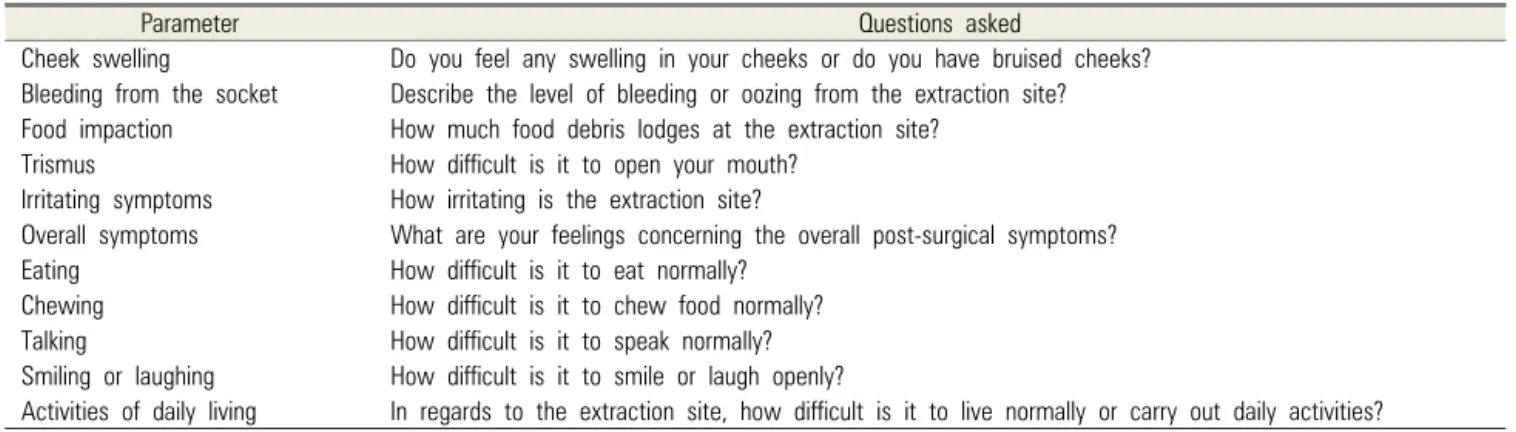
Parameter Questions asked
Cheek swelling Do you feel any swelling in your cheeks or do you have bruised cheeks?
Bleeding from the socket Describe the level of bleeding or oozing from the extraction site?
Food impaction How much food debris lodges at the extraction site?
Trismus How difficult is it to open your mouth?
Irritating symptoms How irritating is the extraction site?
Overall symptoms What are your feelings concerning the overall post-surgical symptoms?
Eating How difficult is it to eat normally?
Chewing How difficult is it to chew food normally?
Talking How difficult is it to speak normally?
Smiling or laughing How difficult is it to smile or laugh openly?
Activities of daily living In regards to the extraction site, how difficult is it to live normally or carry out daily activities?
Table 1. Questions asked to verify VAS score of each parameter
improved pain, swelling, and trismus control in patients who undergo third molar surgery [9,10]. These, in turn, can improve the patient’s quality of life during the course of treatment and healing [11]. Moreover, emotional and psychological factors play an important role in surgical outcomes. A patient’s satisfaction with the treatment might ensure favorable results and greater patient com- pliance.
On day 7 following suture placement, in addition to inadequate tension in the suture to result in wound apposition, numerous inflammatory cell infiltrations were observed in the black braided silk suture material [4].
Since the routine schedule for suture removal is 7 to 10 days after the operation, there is a risk of post-surgical complications, especially in high risk or medically compromised patients. Accordingly, the removal of the suture material as soon as possible is indicated. On the third day after surgery, the formation of a perisutural epithelial sheath was observed in the perisutural connective tissue without any inflammatory cell infiltrate, which can benefit wound healing [4].
Owing to a scarcity of evidence, it is difficult to determine the appropriate day for suture material removal after extraction of lower third molars. This study aimed to evaluate the pain perception of patients and their perceived quality of life when the suture materials were removed on day 3 versus day 7 after surgery.
MATERIALS AND METHODS
The research protocol and informed consent form were reviewed and approved by Mahidol University Institu- tional Review Board (MU-IRB). The study was carried out at the Advanced General Dentistry Clinic and Oral and Maxillofacial Surgery Clinic, Faculty of Dentistry, Mahidol University, Thailand.
This study was a prospective randomized controlled clinical trial carried out in 30 patients, who acted as their own control. After history taking, clinical examination, and radiographs, the participants were selected based on the following inclusion criteria:
(1) The mandibular third molars on both sides were fairly similar in terms of angulation and degree of impaction, and therefore of estimated difficulty for removal.
(2) Age ranged between 17-30 years (3) No concomitant systemic disease (s)
(4) No history of an allergic reaction to 4% articaine and/or epinephrine.
Prior to the trial, each patient was informed about the study, its aims, implications, and possible complications.
Signed informed consent was obtained.
The exclusion criteria were as follows:
(1) Participants who did not have the suture material removed on day 3 and day 7 respectively after the surgical removal of their lower third molars.
(2) Participants who did not return the questionnaires
Symptom Day 3 Day 7 P-value
QL (VAS) score SD QL (VAS) score SD
Pain
Male 4.18 2.56 1.91 1.92 0.007*
Female 3.11 3.23 2.00 3.33 0.016*
Cheek swelling
Male 3.36 3.14 1.73 2.37 0.053
Female 3.11 3.37 1.37 2.43 0.011*
Bleeding from socket
Male 3.36 2.98 1.45 2.38 0.012*
Female 1.84 2.63 0.84 1.34 0.040*
Food impaction
Male 6.00 2.53 5.55 2.91 0.410
Female 2.84 2.43 3.21 2.82 0.380
Trismus
Male 3.64 3.41 1.82 2.79 0.026*
Female 2.89 2.75 1.58 2.39 0.005*
Irritation
Male 4.18 2.86 2.91 2.07 0.109
Female 2.68 3.06 1.68 2.45 0.097
Overall symptoms
Male 3.27 2.28 2.73 1.42 0.176
Female 1.89 1.88 1.42 1.95 0.192
Eating
Male 5.82 2.44 6.27 2.69 0.204
Female 5.53 2.99 7.11 3.28 0.070
Chewing
Male 5.09 2.43 6.82 1.99 0.008*
Female 5.00 3.18 6.63 3.56 0.066
Talking
Male 7.18 2.71 8.64 1.69 0.100
Female 7.68 2.93 8.68 2.24 0.080
Smiling or laughing
Male 6.00 2.53 8.36 1.86 0.006*
Female 7.11 2.87 8.74 1.73 0.003*
Daily activities
Male 3.18 2.40 2.36 1.86 0.204
Female 2.37 2.27 1.37 2.17 0.032*
*Significant difference (P < 0.05) Table 2. Mean and SD of VAS scores
to the surgeon.
The surgery was performed under local anesthesia. All participants were operated on by one surgeon (K.W.), who used a standard operating technique for the surgical removal of impacted mandibular third molars. After tooth removal, the surgical field was meticulously rinsed with sterile 0.9% saline. The extractions sites were closed by the interrupted suturing method with a black braided silk material. The sites of each participant were randomized for suture removal at two different times, on day 3 and on day 7 after the operation.
The participants were asked on day 4 (or after suture
removal on day 3) following the operation to respond to a questionnaire concerning pain and quality of life, using a VAS score (1-10) (Table 1). On day 8 (or after suture removal on day 7), a second questionnaire was given to each participant to complete, asking them to assign a VAS score (1-10) to the same aspects of pain and quality of life as in the previous questionnaire.
Data management
The data were tabulated on an Excel spreadsheet and analyzed using a commercially available statistical software package (SPSS® 17.0, SPSS® Inc.).
RESULTS
All the enrolled participants completed their question- naires. Among the participants, 36.7% were male and 63.3% female, with a mean age of 20 years.
Table 2 shows the mean and standard deviation (SD) of the VAS scores concerning pain and quality of life as well as clinical symptoms.
The mean VAS score for each separate category of clinical symptom (pain, cheek swelling, bleeding from the socket, food impaction, and trismus) was less than 5, except for food impaction among male participants, who reported a score of more than 5 both on day 3 and on day 7. Regarding overall symptoms, the mean VAS score on day 3, 3.27 for male and 1.89 for female participants, was not significantly different from that on day 7 when each sex is taken separately. There were significant differences (P < 0.05) in the VAS scores for overall symptoms between the sexes.
The mean VAS score was more than 5 in all categories related to functional satisfaction (eating, chewing, talking, smile, and laughing). In contrast to the clinical symptoms, the mean VAS score for function on day 7 was higher than that on day 3. Both male and female participants demonstrated significant differences (P < 0.05) in the VAS score for smiling/laughing alone between day 7 and day 3. The mean VAS score concerning daily activities on day 7 was lower than that on day 3, with a significant difference (P < 0.05) only in female participants.
DISCUSSION
The development of an incisional wound infection is a serious complication that can occur in patients who have undergone oral surgery, such as tooth extraction. Surgical infections may not only retard the normal healing process but can also induce life-threatening complications, parti- cularly in patients suffering from chronic illnesses.
Approximation of wound margins with silk is a com-
monly employed procedure in oral surgery. Although it is cheap and easy to use, its non-absorbable and braided nature allows the accumulation of surface debris and bacteria, resulting in inflammation of the surrounding wound [5]. Furthermore, the retained suture material may provoke symptoms of irritation in the patients.
Patient satisfaction improves the relationship between the clinician and the patient as well as the perceived quality of the provided treatment. Clinicians should also focus on the patient’s satisfaction rather than solely concentrating on the objective success of the treatment [11]. Suture materials have the potential to delay wound healing and might cause the patient to feel uncomfortable.
Therefore, suture materials should be removed as soon as possible as long as this does not compromise the normal wound healing process.
This study showed that there was no significant difference in the reported overall patient satisfaction regarding clinical symptoms between removal of the suture on day 3 and on day 7. Both sexes reported more pain, bleeding from the socket, and trismus on day 3 than on day 7 (P < 0.05). This was expected, since pain usually begins after the anesthesia wears off and reaches peak levels 6 to 12 h postoperatively [12,13], following which it declines between days 1 to 5 post-surgery [14]. On day 3, the mean VAS scores for both pain and quality of life differed between the male and female participants; this observation reflects the findings of other research that females experience pain differently from male partici- pants [15]. Concomitantly, swelling and trismus tended to subside with time and showed a more favorable reported outcome on day 7 than on day 3.
Food impaction seemed to be the main reported problem in male participants, with an average VAS score greater than 5. The difference in tooth size, the degree of periodontal disease around the surgical wound, tooth alignment, or the differences in oral anatomy (e.g. the vestibular depth) between men and women might all be possible explanations of this phenomenon. Another possibility might be the patients’ eating behavior, since men may be less careful than women in following the
recommendations for food consumption after the surgery.
Any or all of these might explain why male patients reported more irritating clinical symptoms related to food impaction.
The results showed that the retention of silk sutures at the surgical sites did not compromise the patient’s functional satisfaction (eating, chewing, talking and smiling, or laughing) since the VAS score of these functions were more than 5. Moreover, the participants seemed to function better on day 7. These results correspond with those a previous study which reported that the median number of days required to return to daily activity after third molar surgery was 3 days with recovery for chewing and return to regular diet taking 5 or 7 days, respectively [16].
With regard to the healing of the surgical wound in both sexes, less inflammation was observed on day 3 than on day 7. This was in accordance with a study which reported that numerous inflammatory cells had infiltrated into the black braided silk on day 7, while no infiltrated inflammatory cells were observed on day 3 [4]. Further- more, during the 1-month follow-up examination after the extraction, we found no difference in the long-term outcome of wound healing.
In conclusion, the retention of braided silk suture at the surgical site did not have any significant effect on the patient’s pain and quality of life.
Acknowledgements: This study was supported in part by a grant from the entire staff of the Advanced General Dentistry Clinic of Mahidol University and the Mahidol University Fund. The authors are thankful to them for making this work a reality. The authors would like to thank Asst. Prof. Sumol Yudhasaraprasithi for the statistical data analysis and lecturer Rachatawan Leelarangsun for her advice on the surgical techniques.
Funding: A grant from the entire staff of the Advanced General Dentistry Clinic of Mahidol University and Mahidol University Fund
Ethics approval: COA No.MU-DT/PY-IRB 2014/014.2804
REFERENCES
1. Mercier P, Precious D. Risks and benefits of removal of impacted third molars: A critical review of the literature.
Int J Oral Maxillofac Surg 1992; 21: 17-27.
2. Ivanoff CJ, Widmark G. Nonresorbable versus resorbable sutures in oral implant surgery: a prospective clinical study.
Clin Implant Dent Relat Res 2001; 3: 57-60.
3. Banche G, Roana J, Mandras N, Amasio M, Gallesio C, Cuffini AM et al. Microbial Adherence on Various Intraoral Suture Materials in Patients Undergoing Dental Surgery.
American Association of Oral and Maxillofacial Surgeons.
J Oral Maxillofac Surg 2007; 65: 1503-7.
4. Leknes KN, Selvig KA, Bøe OE, Wikesjo UME. Tissue reactions to sutures in the presence and absence of anti-infective therapy. J Clin Periodontol 2005; 32: 130-8.
5. Selvig KA, Biagiotti GR, Leknes KN, Wikesjo UM. Oral tissue reactions to suture materials. Int J Periodontics Restorative Dent 1998; 18: 474-87.
6. Leknes KN, Røynstrand IT, Selvig KA. Human gingival tissue reactions to silk and expanded polytetrafluoroethy- lene sutures. J Periodontol 2005; 76: 34-42.
7. Oginni FO, Ugboko VI, Assam E, Ogunbodede EO.
Postoperative complaints following impacted mandibular third molar surgery in Ile-Ife, Nigeria. South Afr Dent J 2002; 57: 264-8.
8. McGrath C, Comfort MB, Lo ECM, Luo Y. Changes in quality of life following third molar surgery–the immediate postoperative period. Br Dent J 2003; 194: 265-8.
9. Bamgbose BO, Akinwande JA, Adeyemo WL, Ladeinde AL, Arotiba GT, Ogunlewe MO. Effects of co-administered dexamethasone and diclofenac potassium on pain, swelling and trismus following third molar surgery. Head Face Med 2005; 1: 11.
10. Tiwana PS, Foy SP, Shugars DA, Marciani RD, Conrad SM, White RP et al. The impact of intravenous corti- costeroid with third molar surgery in patients at high risk for delayed health-related quality of life and recovery. J Oral Maxillofac Surg 2005; 63: 55-62.
11. Shafique R. Level of patient’s satisfaction after mandibular
third molar extraction. Int J Dent Clinics 2013; 5: 3-8.
12. Susarla SM, Sharaf B, Dodson TB. Do antibiotics reduce the frequency of surgical site infections after impacted mandibular third molar surgery? Oral Maxillofac Surg Clin North Am 2011; 23: 541-6.
13. Bello SA, Adeyemo WL, Bamgbose BO, Obi EV, Adeyinka AA. Effect of age, impaction types and operative time on inflammatory tissue reactions following lower third molar surgery. Head Face Med 2011; 7: 8.
14. Garcia AG, Sampedro FG, Rey JG, Torreira MG. Trismus and pain after removal of impacted lower third molar.
J Oral Maxillofac Surg 1997; 55: 1223-6.
15. Dao TT, LeResche L. Gender differences in pain. J Orofac Pain 2000; 14: 169-84.
16. White RP, Shugars DA, Shafer DM, Laskin DM, Buckley MJ, Phillips C. Recovery after third molar surgery: clinical and health-related quality of life outcomes. J Oral Maxillofac Surg 2003; 61: 535-44.