Biomedical Science Letters 2020, 26(1): 51~56 https://doi.org/10.15616/BSL.2020.26.1.51 eISSN : 2288-7415
Anti-oxidative and Anti-inflammatory Activities of Polysaccharide isolated from Korean-Style Soy Sauce
Hoon Kim
1,*, Jungeun Park
2,**, Jaemee Jung
2,** *and Dahyun Hwang
2,3,†,** **1
Skin-biotechnology Center, Kyung Hee University, Suwon-si, Gyeonggi-do 16229, Korea
2
Department of Biomedical Laboratory Science, College of Life and Health Sciences, Hoseo University, Asan, Chungnam 31499, Korea
3
The Research Institute for Basic Sciences, Hoseo University, Asan, Chungnam 31499, Korea
Soy sauce is one of the representatives of traditional fermented foods in Korea. However, studies on soy sauce are relatively insufficient in Korea compared to Japan. In this study, antioxidant and anti-inflammatory activities of polysaccharides were measured by polysaccharides isolated from two different soy sauces, Korean and Japanese (KSS-0 and JSS-0). KSS-0 was purified into two fractions using gel chromatography and named them as KSS-I and KSS-II. To investigate the antioxidant activity of the polysaccharides, we measured the polyphenol content and radical scavenging activity using 2,2-diphenyl-1-picrylhydrazyl (DPPH) and 2,2'-azino-bis (3-ethylbenzothiazoline-6-sulfonic acid) (ABTS).
To investigate the anti-inflammatory activity of polysaccharides, we used RAW 264.7 macrophage cells and induced inflammation using lipopolysaccharide (LPS). Then, we measured levels of inflammatory mediators such as nitric oxide (NO) and tumor necrosis factor (TNF)-α. Among the four polysaccharides, KSS-II showed the highest antioxidant activity and had good anti-inflammatory activity; KSS-II decreased inflammatory mediators in a dose-dependent manner. In conclusion, the polysaccharide isolated from Korean soy sauce (KSS-II) showed better anti-oxidant and anti-inflammatory activities than polysaccharides isolated from Japanese soy sauce, and may be useful as substances for functional foods.
Key Words: Soy sauce, Anti-oxidant, Anti-inflammation, Polysaccharide, Functional foods
Soy sauce is a representative fermented food of Korea, which contains soybean as the main ingredient. As interest in health increases worldwide, interest in fermented foods is also increasing. There are some studies on the functional activities of Japanese soy sauce, such as anti-allergic activity (Kobayashi, 2005) and antiplatelet activity (Tsuchiya et al., 1999). However, studies on Korean soy sauce are relatively insufficient. Japanese and Korean soy sauce have some dif- ferences, due to variability in raw materials, fermentation
methods, and microbial differentiation. Japanese soy sauce blends soybeans and wheat flour in the 'Koji' method (Uchida et al., 2019). Korean soy sauce is fermented using only soy beans in the 'Mezu' method (Yang et al., 2012). Therefore, the physiological activities of Korean and Japanese soy sauce are expected to be different.
Oxidation is a normal process in living organisms to produce energy. In normal or pathological cell metabolism, free radicals are produced (Shirley et al., 2014). However,
Brief Communication
Received: January 29, 2020 / Revised: February 18, 2020 / Accepted: March 6, 2020
*Research professor, **Researcher, ***Undergraduate student, ****Professor.
†Corresponding author: Dahyun Hwang. Department of Biomedical Laboratory Science, Hoseo University, 20, Hoseo-ro 79 beon-gil, Baebang-eup, Asan-si, Chungcheongnam-do 31499, Korea.
Tel: +82-41-540-9628, Fax: +82-41-540-9997, e-mail: [email protected]
○CThe Korean Society for Biomedical Laboratory Sciences. All rights reserved.
○CCThis is an Open Access article distributed under the terms of the Creative Commons Attribution Non-Commercial License (http://creativecommons.org/licenses/by-nc/3.0/) which permits unrestricted non-commercial use, distribution, and reproduction in any medium, provided the original work is properly cited.
if control over oxygen-derived free radicals is lost, they pro- duce many diseases, such as cancer, rheumatoid arthritis, and arteriosclerosis (Dore et al., 2007; Shirley et al., 2014).
Inflammation is also a normal immune process to protect the host when pathogens invade the body. However, uncon- trolled inflammation causes diverse diseases such as rheu- matoid arthritis, atherosclerosis, inflammatory bowel disease, and asthma (Tak and Firestein, 2001). Therefore, it is very important to have the proper level of oxidation and inflam- mation in the body.
The need for safer drugs, without side effects, is in- creasing. Of alternative sources, polysaccharide has been reported for its multiple biological activities including as an anticarcinogenic, anticoagulant, immuno-stimulant, and antioxidant (Wang et al., 2013). Therefore, in this study, we used polysaccharide isolated from soy sauce and compared the anti-oxidative and anti-inflammatory activities between polysaccharides from Korean and Japanese soy sauce.
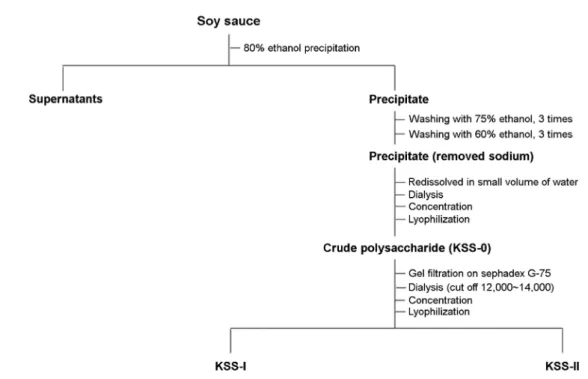
In this experiment, Japanese soy sauce was used from the Japanese company 'K' and Korean soy sauce was used from the Korean traditional food manufacturer 'S'. To isolate and purify polysaccharide, Korean and Japanese soy sauce was dissolved overnight by adding approximately 4-fold ethanol to 80% of the total concentration. After the supernatant was separated by centrifugation (6,000 rpm, 30 min), it was precipitated with three volumes of ethanol and dialyzed for two days using dialysis tubing (molecular weight cut off [MWCO]: 12,000~14,000; Sigma Aldrich, St. Louis, MO, USA). The solution was finally lyophilized to yield crude polysaccharides named as JSS-0 and KSS-0. To further purify KSS-0, crude polysaccharide was applied to an open (4 cm × 95 cm) Sephadex G-75 column (GE Healthcare Life Sciences, Uppsala, Sweden), equilibrated with 50 mM ammonium formate buffer (pH 5.5), and eluted with the same buffer. Two major purified polysaccharides (KSS-I and KSS-II) were obtained and lyophilized after desalting by dialysis.
To investigate the anti-oxidative activities, the total poly- phenol content and free radical scavenging activities were measured using 2,2'-azino-bis (3-ethylbenzothiazoline-6- sulfonic acid) (ABTS) and 2,2-diphenyl-1-picrylhydrazyl (DPPH). The total polyphenol content of polysaccharides
was determined using the Folin-Ciocalteu method with some modifications (Singleton and Rossi, 1965). Each extract (20 μL) was mixed with 100 μL of Folin-Ciocalteu reagent (Sigma chemical Co., St. Louis, MO, USA) and reacted for three min at room temperature (RT) in the dark. Then, the mixture was added to 80 μL of 7.5% Na
2CO
3and placed in the dark for 20 min at RT. The absorbance was measured at 765 nm using a SpectraMax microplate reader (Molecular Devices, Sunnyvale, CA, USA). The total polyphenol con- tent was calculated based on a calibration curve obtained with gallic acid, and expressed as gallic acid equivalents per gram of dry weight (mg gallic acid eq./g). The ABTS radical scavenging activity was determined using the method of Arnao et el. with some modifications (Arnao et al., 2001).
To make ABTS stock solution, 7.4 mM ABTS solution and 2.6 mM potassium persulfate solution were mixed in equal amounts and allowed to incubate for 12 h at RT in the dark.
Then, the stock solution was diluted to obtain an absorbance of 0.7 at 734 nm using a spectrophotometer. Polysaccharides (10 μL) were allowed to react with one mL of the ABTS stock solution and the absorbance was measured after 30 min at 734 nm using a spectrophotometer. The ABTS scavenging activity of the extracts were compared with that of ascorbic acid and expressed as mg ascorbic acid equivalent anti- oxidant capacity (mg ascorbic acid eq./g) sample. The DPPH radical scavenging activity was measured using the Blois method with some modifications (Blois, 1958). Polysaccha- rides (10 μL) were allowed to react with 100 μL of 0.2 mM DPPH (Sigma chemical Co., St. Louis, MO, USA) in a 96- well plate. The mixture was shaken vigorously in the dark at RT for 30 min, then the absorbance was measured at 517 nm.
The DPPH radical scavenging activity of the extracts were compared with that of ascorbic acid and expressed as mg ascorbic acid equivalent antioxidant capacity (mg ascorbic acid eq./g) sample. To measure the anti-inflammatory activity of the extract, we used RAW 264.7 macrophage cells and induced inflammation using LPS (Sigma, St. Louis, MO, USA). Dulbecco's modified Eagle's medium (DMEM), and penicillin/streptomycin (P/S) were purchased from Gibco BRL Co. (Grand Island, NY, USA), and fetal bovine serum (FBS) was purchased from Welgene Inc. (Gyeongsan, Korea).
A mouse TNF-α enzyme-linked immunosorbent assay
(ELISA) kit was purchased from BD Biosciences (San Diego, CA, USA).
To measure cell viability, RAW 264.7 cells were cultured in DMEM supplemented with 10% FBS and 1% P/S at 37℃ in a humidified incubator with 5% CO
2. When cells reached 70~80% confluence, cells were seeded into plates for the assays. Cell viability was measured using the WST- based reagent EZ-CyTox (Daeil Lab Service, Seoul, Korea).
Pre-confluent RAW 264.7 cells (2 × 10
5cells/mL) were seeded into 96-well plates overnight. Subsequently, the cells were treated with polysaccharides for 30 min, and cells were co-treated with LPS (1 μg/mL) for 24 h. The culture medium was removed and 100 μL of a 1:10 dilution of EZ-CyTox in PBS was added; cells were then incubated for 1 h at 37℃ in an atmosphere of 5% CO
2/95% air. The absorbance was measured at 450 nm using a SpectraMax microplate reader. Cell viability was expressed as a percen- tage relative to the deionized water-treated negative control cells.
To investigate anti-inflammatory effects, we measured the inflammatory mediators, nitric oxide (NO) and tumor necrosis factor α (TNF-α). RAW 264.7 macrophages (2 × 10
5cells/mL) were cultured in 96-well plates overnight.
The cells were treated with polysaccharides and 30 min later, cells were co-treated with LPS (1 μg/mL) for 24 h. Secretion of NO was measured using a microplate assay method as described previously (Kim et al., 1999). To measure nitrite (NO
2-), 100 μL of culture supernatant was mixed with an equal volume of Griess reagent (1% sulfanilamide/0.1% N- [1-naphthyl]-ethylenediamine dihydrochloride/2.5% H
2PO
4) and incubated for 10 min at RT. The nitrite concentration was determined by measuring the absorbance at 540 nm.
Sodium nitrite (NaNO
2) was used as a standard. TNF-α levels were measured using an ELISA kit according to the manufacturer's instructions.
All statistical analyses were performed using SPSS version 12.0 for Windows (SPSS, Chicago, IL, USA). Values are expressed as the mean ± standard deviation (SD) of three independent experiments, performed in triplicate. P < 0.05 was considered significant (Student's t-test). Statistical differ- ences among groups were evaluated with analysis of vari- ance (ANOVA), followed by Duncan's multiple range tests.
Two crude polysaccharides were isolated from the hot water extract of Japanese soy sauce (JSS) and Korean soy sauce (KSS) by 80% ethanol precipitation and named JSS-0 and KSS-0. KSS-0 showed higher antioxidant activity than
Fig. 1. Isolation and purification of crude polysaccharide isolated from Korean-style soy sauce with a Sephadex G-75 column.
JSS-0, therefore, KSS-0 was fractionated into two poly- saccharide fractions (KSS-I and KSS-II) using Sephadex G-75 size exclusion chromatography (Fig. 1). KSS-I had a relatively higher molecular weight, whereas KSS-II had a much lower molecular weight.
To determine anti-oxidative activity, we first measured total polyphenol content. A plant-based diet contains many phenolic compounds and they function as biologically active compounds for disease prevention (Upadhyay and Dixit, 2015). Total polyphenol content was calculated using gallic acid as a standard reagent. KSS-II contained the highest total polyphenol, 13.8 mg/g of the four polysaccharides. Also, KSS-0, JSS-0 and KSS-I contained 10.5 mg/g, 9.5 mg/g, and 4.4 mg/g of total polyphenol, respectively (Fig. 2A).
KSS-II also showed the highest ABTS and DPPH radical scavenging activities. Both ABTS and DPPH radical scav- enging activities were calculated using ascorbic acid as a standard reagent. KSS-II, KSS-I, JSS-0, and KSS-0 showed 374.5, 212.5, 94.4, and 75.1 mg/g ABTS radical scavenging activity, respectively (Fig. 2B). KSS-II, KSS-0, and JSS-0 showed 2.1, 1.1, and 0.2 mg/g DPPH radical scavenging Fig. 2. Antioxidant activity of two crude polysaccharides (JSS-0
and KSS-0) and their fractions (KSS-I and KSS-II). (A) Total polyphenol contents; (B) ABTS free radical scavenging activity;
(C) DPPH free radical scavenging activity. JSS-0; crude poly- saccharide of Japanese soy sauce, KSS-0; crude polysaccharide of Korean soy sauce, KSS-I; fractionized polysaccharide of Korean soy sauce (high molecular weight), KSS-II; fractionized polysac- charide of Korean soy sauce (low molecular weight).
1)