뇌졸중 환자의 사회 참여에 영향을 미치는 요인
송예원1, 김수경2*
1건양대학교 대학원 작업치료학과, 2건양대학교 작업치료학과
Factors Influencing on Social Participation in Patients with Stroke
Ye-Won Song
1, Su-Kyoung Kim
2*1Dept. of Occupational Therapy, The Graduate School, Konyang University
2Dept. Of Occupational Therapy, Konyang University
요 약 본 연구는 뇌졸중 발병 후 지역사회 참여에 영향을 미치는 요인들을 알아봄으로서 지역사회 중심 재활에 중요한 자료를 제공하는 것을 그 목적으로 하였다. 연구 대상은 발병 기간이 6개월 이상인 뇌졸중 환자 100명이었다. 대상자의 사회 참여 정도를 파악하기 위해 한국판 크레이그 장애 평가(Craig Handicap Assessment and Reporting Technique: K-CHART)를 실시하였고, 일상생활활동의 독립 수준을 알아보기 위해 한국판 수정 바델 지수(Korean-Modified Barthel Index: K-MBI) 검사 를 통해 대상자의 지역 사회 참여에 영향을 미치는 요인을 알아보았다. 결과, 뇌졸중 환자의 지역 사회 참여의 관련요인은 다음과 같이 나타났다. 일상생활활동, 연령, 고용의 유무보다는 뇌졸중 환자의 신체적 독립, 인지적 독립, 이동성, 작업, 사회 통합이 참여에 높은 설명력을 나타났다. 또한 신체적 독립, 인지적 독립, 이동성, 작업, 사회 통합이 참여에 영향을 미치는 요인들로 나타났다. 모든 항목에서 통계적으로 유의한 수준이었다(p<.01). 뇌졸중 환자의 사회참여를 증진하기 위한 작업치 료의 초점에 대한 정보를 제공하며, 참여에 영향을 미치는 요인들에 대하여 적절한 평가와 중재가 참여를 증진하기 위해 필수적인 재활이 될 것이라 사료된다.
Abstract This study aims to provide important data for community-centered rehabilitation by examining factors influencing community participation after the onset of stroke. The study subjects were 100 patients with a stroke for more than six months. Korean Craig Handicap Assessment and Reporting Technique (K-CHART) was conducted to determine the level of participation of subjects, and Korean-Modified Barthel Index (K-MBI) was conducted to examine the factors influencing the community participation of the subjects to determine the level of independence of activities of daily living. As a result, the relevant factors of community participation in stroke patients were as follows. Physical independence, cognitive independence, mobility, work, and social integration of stroke patients showed higher explanatory power than engagement in activities of daily living, age, and employment. Also, physical independence, cognitive independence, mobility, work, and social integration were factors that affected participation.
All items were statistically significant (p <.01). It is considered that this study will contribute to providing information for focusing on occupational therapy for increasing the social participation of stroke patients, and proper evaluation and intervention will work as essential rehabilitation factors for improving participation with respect to the influential factors of participation.
Keywords : K-CHART, Occupational therapy, Participation, Social integration, Stroke
*Corresponding Author : Su-Kyoung Kim(Konyang Univ.) Tel: +82-42-600-6322 email: [email protected]
Received March 6, 2017 Revised (1st March 29, 2017, 2nd April 12, 2017)
1. 서론
뇌졸중 환자는 갑작스런 의식장애와 함께 편측에 마
비를 일으키는 등의 만성적인 장애를 초래하는 질환이다 [1]. 발병 이후 손상된 뇌의 신경학적 회복은 회복 가능 한 정도의 90% 이상이 3개월 내에 결정되어 진다[2]. 신
체적 문제와 정서적 문제의 복합적인 손상은 일상생활활 동(Activities of daily living : ADL)의 통합과정에 심각 한 영향을 주게 되어 다른 사람에게 의존하게 되고[1], 질환이 장기화되고 만성화
될수록 타인의 지속적인 도움을 필요로 하게 된다[3].
뇌졸중은 작업치료사가 임상에서 가장 흔히 접하는 질환 으로[4], 뇌졸중으로 인하여 편마비를 경험하는 환자는 85% 이상이며, 이로 인하여 일상생활에 의존성을 보이 게 된다[5]. 이는 건강의 악화와 여러가지 질병에 노출되 기 쉬우며, 삶의 질까지도 저하될 수 있다[6]. 또한 개인 의 독립성 회복과 지역사회에 통합하여 참여하는 것을 목표로 치료하는 작업치료사에게 뇌졸중은 도전이 되는 질환이다[4,7,8].
지역사회 통합을 통해 사회에 참여하는 것은 사회의 여러 요소들과 다양한 관계를 가지며 연령, 성별, 문화에 따라 적합한 역할을 취득하여 참여하는 것이다[9].
효과적인 지역사회 통합을 촉진시키기 위해 의료적 접근과 더불어 지역사회 장애인의 제한된 사회 참여를 증진해야한다[10]. 지역사회 통합은 지역사회 내에서 행 복하고 생산적으로의 안정과 제한된 환경에서 생활하는 사람들에게 기회를 제공하는 의미를 가지기도 한다[11].
따라서 지역사회에 거주하고 있는 뇌졸중 환자들은 재가 서비스에 대한 요구가 증가되고 있다[12].
사회 참여를 위한 재활은 작업치료사, 언어치료사, 물 리치료사, 간호사, 사회사업가 등이 포함되어 다양한 분 야에서 팀 접근 방법(multi-disciplinary approach)을 이 용한다[13]보건의료의 전문분야인 작업치료는 장애인이 직장과 가정에서 여러 가지의 역할을 수행하고 최대한의 독립성을 성취하며, 더 나아가 지역사회에서의 참여를 목표로 한다[14].
뇌졸중 환자의 참여에 관한 선행연구들을 살펴보면 뇌졸중 환자의 여가참여[15,16], 지역사회 내에서의 이 동성과 지역사회의 참여의 연구들 주를 이루고 있다 [10]. 또한 장애인의 경제활동의 유무에 따라 자기효능 감에 차이가 있는지를 확인하였다[17]. 따라서 본 연구 는 뇌졸중 후 지역사회 참여에 영향을 미치는 요인들을 알아봄으로서 뇌졸중 후 지역사회 중심 재활에 중요한 자료를 제공하고자 한다.
2. 연구방법
2.1 연구대상
본 연구는 2016년 4월 1일부터 7월 1일까지 뇌졸중 으로 진단 받은 대전 Y병원 입원 및 외래환자 100명을 대상으로 실시되었다. 연구자와 설문을 진행할 평가자가 대상자들을 직접 접촉하고 평가하는 방법으로 진행되었 다. 대상자는 뇌졸중 이외 다른 뇌병변 장애가 없는 자, 발병 6개월 이상인 자, MMSE-K 24점 이상으로 질문에 대답할 수 있는 자로 실시하였다.
2.2 연구도구
대상자들의 사회참여 정도와 시간사용 여부를 알아보 기 위해 송예원(2015)[18]이 번안한 한국판 크레이그 장 애 평가(Craig Handicap Assessment and Reporting Technique: K-CHART)와 수정된 바델 지수(Modified Barthel Index: MBI)를 사용하였다.
2.2.1 한국판 크레이그 장애 평가(Craig Handicap Assessment and Reporting Technique:
K-CHART)
지역사회 참여 제한 정도를 측정하기 위해 일반적으 로 사용하는 도구이다[19]. 지역 사회에 거주하는 장애 인과 장애 초기 재활 이후 장애가 발생하는 정도를 간단 하고 객관적 측정값을 제공하기 위해 신체적 독립 (physical independence), 인지적 독립(Cognition independence), 이동성(mobility), 작업(occupation), 사 회 통합(social integration), 경제력(Economic Self- sufficiency) 6개의 영역, 32문항으로 간단하면서 객관적 인 측정을 하도록 개발되었다[20,21]. 점수가 높을수록 참여도가 높음을 의미한다[20]. 본 연구에서는 송예원 (2015)이 번안한 도구를 사용하였다.
2.2.1 수정 바델 지수(Korean-Modified Barthel Index: MBI)
MBI는 10개의 일상생활 평가 항목(개인위생, 목욕하 기, 식사하기, 용변처리, 계단 오르기, 옷 입기, 대변조절, 소변조절, 보행, 의자-침대이동)으로 구성되어 있다. 각 항목의 점수는 항목별로 5단계로 구분되어 있으며, 그 내용의 비중에 따라 9가지의 가중치가 적용된다.
Spec. Respondents Percentage
Age(year)
30~39 years 7 7
40~49 years 21 21
50~59 years 35 35
60~69 years 22 22
70~79 years 5 5
< 80 years 10 10
Gender Male 64 64
Female 36 36
Employment Yes 18 18
No 82 82
Type of injury infarction 54 54
hemorrhage 45 46
Education
primary school 13 13
Middle school 30 30
High school 38 38
< College 19 19
K-MMSE 28.38
Table 1. General Characteristics of Participants
Spec. ADL Aeg Gender Education Employment Physical independent
Cognitive
independent Mobility Occupation Social integration
K-CHART Total
ADL 1
Aeg -.397** 1
Gender -.234* .131 1
Education .321** -.633** -.461** 1
Employment -.091 .063 .109 -.061 1
Physical
independent .633** -.302** -.415** .197* .023 1 Cognitive
independent .597** -.290** -.412** .467** -.142 .441** 1
Mobility .500** -.146 -.207* .253* -.475** .264** .503** 1
Occupation .348** -.146 -.266** .169 -.400** .156 .264** .502** 1
Social
integration .278** -.093 -.058 -.010 -.491** .132 .138 .349** .314** 1
K-CHART
Total .369** -.231* -.194 .160 -.310** .316** .385** .345** .334** .490** 1
ADL=Korean-Modified Barthel Index: MBI; K-CHART=Craig Handicap Assessment and Reporting Technique Table 2. The Relationships Among Functional Level of participations.
2.3 자료분석
피어슨 상관분석을 이용하여 사회참여 정도와 일반 적 특성 간 상관관계를 알아보았다. 유의한 상관성을 나 타낸 요인들을 포함하여 단계선택방식 다중회귀분석을 통해 뇌졸중 환자의 참여에 대한 영향 요인들을 분석하 였다.
3. 연구결과
3.1 대상자의 일반적 특성과 참여의 상관성 3.1.1 일반적 특성
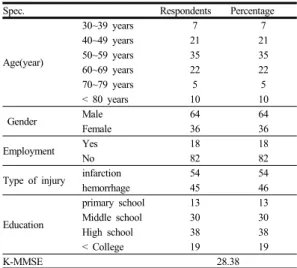
본 연구에 참여한 대상자의 일반적 특성을 Table 1.과 같다. 연령의 분포는 총 100명중 50~59세가 35명 (35.0%)으로 가장 많았으며, 성별은 남성이 64명(64%) 으로 가장 많았다. 일자리를 가지고 있지 않은 대상자가 82명(82%)로 많았고, 발병원인은 뇌경색이 54명(54%) 으로 가장 많았다. 학력은 고등학교 졸업이 38명(38%) 로 가장 많았다.
3.1.2 대상자의 일반적 특성과 참여와의 상관관계 CHART의 총점과 일반적 특성 간 유의미한 상관관계 를 나타난 요인은 일상생활활동, 고용여부(p<.01), 연령 (p<.05)이다(Table 2.). 일상생활활동과 유의미한 상관관 계를 나타낸 요인은 연령, 교육수준, 신체적 독립, 인지 적 독립, 이동성, 사회통합, 작업이 나타났다(p<.01), 연
령과 유의미한 상관관계를 나타낸 요인은 교육수준, 신 체적 독립, 인지적 독립이 나타났다(p<.01). 성별과 유의 미한 상관관계를 나타낸 요인은 교육수준, 신체적 독립, 인지적 독립, 이동성, 작업이 나타났다(p<.01). 교육수준 과 유의미한 상관관계를 타나낸 요인은 인지적 독립이 나타났다(p<.01). 고용유무와 상관관계를 나타낸 요인은 이동성, 작업, 사회통합이 나타났다(p<.01).
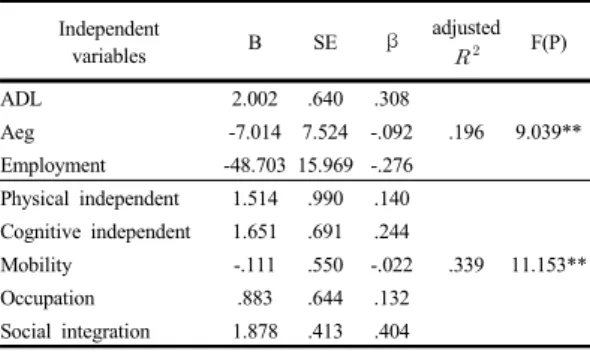
3.2 대상자의 참여에 영향을 미치는 요인 참여에 영향을 미치는 요인은 다음과 같았다(Table 3.). 일상생활활동, 연령, 고용의 유무보다는 뇌졸중 환자
의 신체적 독립, 인지적 독립, 이동성, 작업, 사회통합이 참여에 높은 설명력을 나타났다. 또한 신체적 독립, 인지 적 독립, 이동성, 작업, 사회 통합이 참여에 영향을 미치 는 요인들로 나타났다. 모든 항목에서 통계적으로 유의 한 수준이었다(p<.01).
Independent
variables B SE β adjusted
F(P)
ADL 2.002 .640 .308
.196 9.039**
Aeg -7.014 7.524 -.092
Employment -48.703 15.969 -.276 Physical independent 1.514 .990 .140
.339 11.153**
Cognitive independent 1.651 .691 .244
Mobility -.111 .550 -.022
Occupation .883 .644 .132
Social integration 1.878 .413 .404
**p<.01
Table 3. The Factors Influencing Function Level of participations.
4. 고찰
뇌졸중 발병 후 신경학적인 안정이 되었음에도 정서 적, 신체적인 문제로 지역사회로 복귀하는 것에 많은 어 려움이 따른다. 그로인해 환자는 독립적 일상생활, 사회 적 역할의 어려움으로 가정과 지역사회로의 통합에 한계 를 느끼게 된다. 따라서 작업치료는 환자가 지역사회로 의 통합 위해 돕는 필수 인력이다[14,22]. 이에 본 연구 는 뇌졸중 후 지역사회 참여에 영향을 미치는 요인들을 알아봄으로서 뇌졸중 후 지역사회 중심 재활에 중요한 자료를 제공하고자 했다.
본 연구는 뇌졸중 환자 100명을 대상으로 50~59세가 35명(35.0%)으로 가장 많았으며, 성별은 남성이 64명 (64%), 일자리를 가지고 있지 않은 대상자가 82명(82%) 이었다. 발병원인은 뇌경색이 54명(54%)으로 가장 많았 으며, 학력은 고등학교 졸업이 38명(38%)로 가장 많았 다.
본 연구 대상자의 일상생활의 독립도가 높을수록 참 여도가 높았으며, 연령이 어릴수록, 직업을 가지고 있을 수록 참여도가 높아졌다(p<.01). 이는 노년기보다 중년 기일수록 경제적 부담감, 직장복귀, 가장의 책임감 등 현 실적인 갈등을 가지고 있으며, 어릴수록 회복하려는 마
음, 새로운 환경의 적응, 재활의 강한의지로 이런 결과가 나타난 것으로 사료된다[23]또한 일상생활과 연령, 경 제활동이 참여에 많은 영향을 미치는 선행연구의 결과와 일치한다[24,25,26,27]. 본 연구에서는 여성의 비율보다 (36%) 남성의 비율이 높기 때문에 성별에 따른 요인은 배제된 것으로 보여 진다. 이는 뇌졸중 발병의 인구학적 특성이 남성이 여성보다 뇌졸중 위험비가 높기 때문이라 사료된다[28].
또한 뇌졸중 환자의 참여에 영향을 미친 요인은 신체 적 독립, 인지적 독립, 이동성, 작업, 사회통합으로 나타 났다(p<.01). 이는 신체적인 구조와 기능, 활동수준의 상 관성을 확인한 연구와 일치하는 결과이다[25]. 또한 뇌 졸중 환자의 이동성과 관련된 로봇 보행훈련 후 일상생 활활동의 참여도가 높아지는 연구결과를 지지하며[29], 이동성과 환경적 요인을 분석한 연구에는 이동능력과 인 지적 능력이 사회참여와 관련된 요소임을 확인한 결과를 지지하는 바이다[10]. 본 연구의 결과를 통해 개인적 요 인과 환경적 요인이 복합적으로 균형을 이룬 상호작용이 이루어 질 때에 사회참여도가 높아짐을 확인하였다[30].
이러한 결과를 확인해 볼 때 작업치료사는 장애를 가진 사람들에게 참여도와 만족도를 높이는데 특화되어 있기 에 작업치료가 필수적이라 사료된다[31].
뇌졸중 환자의 이동 및 접근성과 고용상태가 높은 상 관관계를 보였다. 이는 고용상태 그 자체만으로 사회참 여에 영향을 미치기도 하지만 장애인을 위한 근무지원환 경과 같은 변수로 인해 뇌졸중 환자의 사회참여가 촉진 될 수 있음을 확인한 중요한 결과이다[32].
본 연구의 제한점으로는 연구에 참여한 대상자들의 기능적 수준이 다양하지 못하였고, 입원환자와 지역사회 에 거주하는 대상자가 함께 포함되어있어 집단별 대상자 수가 적었다. 이에 본 연구의 결과로 모든 뇌졸중 환자의 사회참여도로 일반화하는 것에 제약이 있을 수 있다. 따 라서 향후 연구에는 더 많은 대상자를 대상으로 관련된 연구가 진행되어야 할 것이다.
본 연구결과는 뇌졸중 환자의 사회참여를 증진시키기 위하여 대상자들의 신체적, 생물학적 요인을 확인하였다 는 것에 의의가 있다. 또한 뇌졸중 환자들의 개인적 요소 와 환경적 요소 모두를 포함하여 다차원적인 접근하여야 할 것으로 사료된다[32]. 또한 작업치료의 목표는 환자 개개인의 제한된 참여를 재통합시키는 것으로, 손상되어 진 기능을 회복하여 과거에 참여했던 것으로 돌아갈 수
있도록 돕는 역할을 한다[33]. 이에 본 연구 결과에서처 럼 참여에 영향을 미치는 요인들에 대하여 적절한 평가 와 중재가 참여를 증진하기 위해 필수적인 재활이 될 것 이라 사료된다.
5. 결론
본 연구는 뇌졸중 후 지역사회 참여에 영향을 미치는 요인들을 알아봄으로서 뇌졸중 후 지역사회 중심 재활에 중요한 자료를 제공하고자 실시하였다. 뇌졸중 환자 100 명을 대상으로 사회참여에 미치는 요인을 확인하였다.
그 결과 뇌졸중 환자 개인의 연령, 고용의 유무가 사회참 여에 영향을 주는 요인으로 나타났다. 또한 신체적 독립, 인지적 독립, 이동성, 작업, 사회 통합의 요인은 사회참 여에 영향을 미치는 요인으로 나타났다. 본 연구의 결과 는 뇌졸중 환자의 사회참여를 증진하기 위한 작업치료의 초점에 대한 정보를 제공한다. 특히 급성기 이후의 환자 가 많은 재활병원의 작업치료는 환자의 지역사회 복귀를 위한 참여 증진이 중요하다. 기존 재활병원에서는 신체 적 독립을 위한 작업치료 접근이 주를 이루고 있다. 그러 나 뇌졸중 환자의 사회복귀와 참여를 위해서는 신체 및 인지와 이동성 등의 환자의 기능을 향상시키고 의미 있 는 작업과 사회활동, 직업생활 등의 직접적인 활동 수행 을 증진하는 작업치료가 이루어져야 할 것이다.
References
[1] A. R. Abdel-Moty, “Occupational therapy: Practice skills for physical dysfunction, edited by L. W. Pedretti, & M.
B. Early” Occup Ther Health Care, vol. 16, no. 4, pp.
77-78. 2002.
[2] S. B. Jeon, H. S. Choi, “Effects of Side Walking Training on Balance and Gait in Stroke Patients”, vol.
13, no. 10, pp. 541-548, Journal of Digital Convergence, 2015.
DOI: http://doi.org/10.14400/JDC.2015.13.10.541 [3] S. O. Lim, A Structural Model for Quality of life in
Stroke patients. Graduate School of Kyung Hee University, Directed by Professor, 2002.
[4] G. Krug, G. McCormack, “Occupational therapy:
Evidenc interventions for stroke”, vol. 106, no. 2, pp.
145-149, Missouri Medicine, 2009.
[5] I. S. W. Party, National Sentinel Stroke Audit 2010 Round 7. London, UK: Royal College of Physicians of
[6] J. H. Min, H. J. Han, “A Study on Effects of the Convergence of musculoskeletal disorders Women with Disabilities on Quality of life in Jeon-nam Area”, vol.
13, no. 9, pp. 491-504, Journal of Digital Convergence, 2015.
[7] J. C. Fletcher-Smith, M. F. Walker, C. S. Cobley, E. M.
Steultjens, C. M. Sackley, “Occupational therapy for care home residents with stroke”, vol. 6 Cochrane Database Systematic Review, 2013.
DOI: https://doi.org/10.1002/14651858.CD010116.pub2 [8] D. Petruseviciene, A. Krisciūnas, “Evaluation of activity
and effectiveness of occupational therapy in stroke patients at the early stage of rehabilitation”, vol. 44, no.
3, pp. 216-224, Medicina (Kaunas, Lithuania), 2007.
[9] M. Dijkers, “Community integration: Conceptual issues and measurement approaches in rehabilitation research”, vol. 4, no. 1, pp. 1-15, Topics in spinal cord injury Rehabilitation, 1998.
DOI: https://doi.org/10.1310/BJJA-2018-45KL-0VTL [10] Y. G. Kim, “A Search on the Necessity of Occupational
Therapy in Community Based Rehabilitation in Public Health Centers”, vol. 15, no. 3 pp13-24, The Journal of Korean Society of Occupational Therapy, 2007.
[11] M. A. McColl, Measuring community integration and social support. In M. Law, C. M. Baum, & W.
Dunn(Eds.), Measuring occupational performance:
Supporting best practice in occupational therapy, p.301-314, Thorofare, NJ:Slack. 2005.
[12] W. M. Jeong, C. S. Park, Y. J. Hwang, “A study on job competency of community-based occupational therapists:
Focusing on job analysis in dementia care centers”, vol.
21, no. 3, pp. 15-29, The Journal of Korean Society of Occupational Therapy, 2013.
[13] J. I. Won, “Necessity of Community-Based Rehabilitation System after Stroke”, vol. 8, no. 1, pp.
16-26, The Journal of the Korea Contents Association, 2008.
[14] K. Stalker, C. Jones, P. Ritchie, “All change? The role and tasks of community occupational therapist in scotland”, vol. 70, no. 1, pp. 104-108 British Journal of Occupational Therapy, 1996.
DOI: https://doi.org/10.1177/030802269605900302 [15] D. G, Hong, H. Y, Jeong, J. H Park, S. K. Kim, “The
Effect of a Leisure Motivation and Participation Restriction of Stroke Patients on Level of Leisure Activity”, vol. 23, no. 3, pp. 15-24, The journal of Korean society of occupational therapy, 2015.
[16] S. Y, Hong, K. M. Kim, “Correlation Between the Leisure Activity Participation and the Self-Efficacy with Chronic Stroke Patient”, vol. 19, pp. 277-296, Journal of rehabilitation research, 2015.
[17] J. O. Kim, C. S. Kang, J. H. Park, “Self-Efficacy According to Economic Activities of the Disabled”, vol.
17, no. 6, pp. 140-146, Journal of the Korea Academia- Industrial cooperation Society, 2016.
DOI: http://doi.org/10.5762/KAIS.2016.17.6.140 [18] Y. W. Song, “Reliability and validity of craig handicap
assessment and reporting technique-Korean(CHART-K) for patients with spinal card injury”, Graduate School of Public Health and Welfare Konyang University. master's
thesis, 2015.
[19] P. Kennedy, P. Lude, N. Taylor, “Quality of life, social participation, appraisals and coping post spinal cord injury: A review of four community samples”, vol. 44, no. 2, pp. 95-105, Spinal Cord, 2006.
DOI: https://doi.org/10.1038/sj.sc.3101787
[20] G. G. Whiteneck, S. W. Charlifue, K. A. Gerhart, J. D.
Overholser, G. N. Richardson, “Quantifying handicap: A new measure of long-term rehabilitation outcomes”, vol.
73, no. 6, pp. 519-526, Archives of Physical Medicine and Rehabilitation, 1992.
[21] G. G. Whiteneck, Craig handicap assessment and reporting technique, p.728-730. Encyclopedia of Clinical Neuropsychology, 2011.
[22] H. Kim, A. Colantonio, “Effectiveness of rehabilitation in enhancing community integration after acute traumatic brain injury: A systematic review”, vol. 64, no. 5, pp.
709-719, American Journal of Occupational Therapy, 2010.
DOI: https://doi.org/10.5014/ajot.2010.09188
[23] S. Y, Oh, J. S. Lee, “Hemiplegic Experience after Stroke among Middle Aged Man”, vol. 17, no. 5, pp. 582-593, Journal of the Korea Academia-Industrial cooperation Society, 2016.
DOI: http://dx.doi.org/10.5762/KAIS.2016.17.5.582 [24] J. P. Chau, D. R. Thompson, S. Twinn, A. M. Chang,
J. Woo, “Determinants of participation restriction among community dwelling stroke survivors: a path analysis”, vol. 9, no. 1, pp. 1, BMC neurology, 2009.
DOI: https://doi.org/10.1186/1471-2377-9-49
[25] W. h. Kim, “The Effects of Activity and Family Support on the Participation Restriction of Chronic Stroke Patients”,vol. 19, no. 1, pp. 76-85 Physical Therapy Korea, 2012.
[26] T. Kwok, X. Jin, F. Yeung, J. Cheng, R. S. K. Lo, C.
L. K. Lam, J. Woo, “A comparison of the Long-term Health Related Quality of Life and Handicap of stroke patients in Mainland china and Hong Kong”, vol. 3, pp.
3, Health Services Insights, 2010.
[27] J. H. Lee, “A study on the determinants that affect life satisfaction of the disabled”, vol. 13, no. 1, pp. 503-514, Journal of Digital Convergence, 2015.
[28] S. G. Bae, S. K Lee, C. H. Han. “Influencing and Mediating Factors in Stroke: Based on 2007 – 2012 Korea National Health and Nutrition Examination Survey”, vol. 16, no. 1, pp. 418-428, Journal of the Korea Academia-Industrial cooperation Society, 2015.
DOI: http://doi.org/10.5762/KAIS.2015.16.1.418 [29] J. H. Kim, “Effects of Robot–assisted Therapy on
Lower Limb in Patients with Subacute Stroke”, vol. 17, no. 7, pp. 459-466, Journal of the Korea Academia-Industrial cooperation Society, 2016.
DOI: http://dx.doi.org/10.5762/KAIS.2016.17.7.459 [30] E. K. Shin, “Analysis on the social participation of
people with disabilities using Hierarchical Linear Model”, School of Social Welfare Yonsei University.
Direcred by Professor, 2007.
[31] M. Law, “Participation in the occupations of everyday life”,vol. 56, no. 6, pp. 640-649 American Journal of Occupational Therapy, 2002.
DOI: https://doi.org/10.5014/ajot.56.6.640
[32] Y. I. Choi, “Predictors of participation restriction in chronic stroke survivors : a path analysis”, Graduate school, Yonsei University, Gangwon, 2013.
[33] E. R. Skidmore, E. M. Whyte, M. A. Butters, L.
Terhorst, C. F. Reynolds, “Strategy Training During Inpatient Rehabilitation May Prevent Apathy Symptoms After Acute Stroke”, vol. 7, no. 6, pp. 562-570 The Journal of injury, function, and rehabilitation, 2015.
DOI: https://doi.org/10.1016/j.pmrj.2014.12.010
송 예 원(Ye-Won Song) [정회원]
•2012년 2월 : 건양대학교 작업치 료학과(보건학사)
•2016년 2월 : 건양대학교 작업치 료학과(보건학석사)
•2016년 3월 ~ 현재 : 건양대학교 보건학과 작업치료학 박사전공
<관심분야>
성인 및 아동 작업치료
김 수 경(Su-Kyoung Kim) [정회원]
•2011년 8월 : 연세대학교 재활학 과(작업치료학전공 이학박사)
•2002년 3월 ∼ 현재 : 건양대학교 작업치료학과 부교수
<관심분야>
뇌과학, 신경계 및 정신사회 작업치료