INTRODUCTION
Depression is a serious health concern among adolescents, be- ing a significant contributing factor to suicide in that demographic [1,2]. Indeed, 17.7% of adolescents have seriously contemplated suicide because of depressive symptoms [2]. Depression is more prevalent among female adolescents than males [3]. In South Korea, 27.8% of female adolescents and 19.7% of male adoles- cents nationwide reported experiencing depressive symptoms severe enough to interfere with normal daily life patterns [4].
Previous studies that investigated factors associated with depres-
sion among female adolescents in Korea, found that prob- lem-solving abilities, interactions with family members, peer re- lationships, negative body-image, and satisfaction with school life, life stress, and sense of coherence were significant factors in de- pression among them [5,6]. Kim [7] investigated factors associ- ated with depression and found them to be different in urban and rural areas. Experience of school violence and parenting attitudes were significantly associated with depressive symptoms among urban adolescents, whereas subjective income level and stress from family were significant among rural adolescents. Most prior studies that compare depression level and differentiate factors
Address reprint requests to : Lee, Bo Gyeong
College of Nursing · The Research Institute of Nursing Science, Catholic University of Daegu, 33 Duryugongwon-ro 17-gil, Nam-gu, Daegu 42472, Korea Tel: +82-53-650-3621 Fax: +82-53-650-4392 E-mail: [email protected]
Received: March 19, 2018 Revised: August 18, 2018 Accepted: August 19, 2018
This is an Open Access article distributed under the terms of the Creative Commons Attribution NoDerivs License. (http://creativecommons.org/licenses/by-nd/4.0) If the original work is properly cited and retained without any modification or reproduction, it can be used and re-distributed in any format and medium.
J Korean Acad Nurs Vol.48 No.4, 475 https://doi.org/10.4040/jkan.2018.48.4.475
Differences in Factors Associated with Depressive Symptoms between Urban and Rural Female Adolescents in Korea
Lee, Gyuyoung
1· Ham, Ok Kyung
2· Lee, Bo Gyeong
3· Kim, Abuan Micah
21Redcross College of Nursing, Chung-Ang University, Seoul
2Department of Nursing, Inha University, Incheon
3College of Nursing · The Research Institute of Nursing Science, Catholic University of Daegu, Daegu, Korea
Purpose: To examine the prevalence of depressive symptoms and differentiate factors associated with them in urban and rural areas by applying the Ecological Models of Health Behavior. Methods: We employed a cross-sectional design and convenience sample of 460 female adolescents.
The instruments included the Adolescent Mental-Health Problem-Behavior Questionnaire (AMPQ-II) and the Beck Depression Inventory (BDI).
Results: Depressive symptoms were confirmed in 15.7% of urban adolescents and 22.9% of rural adolescents (p<.05). In the urban group, per- ception of health and stress associated with school performance were significantly associated with depressive symptoms. In the rural group, aca- demic/internet related problems and rule violations were significantly associated with depressive symptoms (p<.05). General life happiness, worry/
anxiety, and mood/suicidal ideation were common factors in both urban and rural areas (p<.05). Conclusion: Multiple factors were associated with depressive symptoms, and those significant factors differed between urban and rural female youths. Accordingly, tailored approaches are required considering urban and rural differences. The approaches should include intrapersonal, interpersonal, and organizational levels of inter- ventions.
Key words: Female Adolescents; Depression; Behavioral Problem
between urban and rural areas have targeted an older population [8,9]. However, a few studies have been conducted targeting ad- olescents that differentiate factors of depression between urban and rural areas [7] although studies that apply a theoretical framework targeting female adolescents have been scarce.
Therefore, we sought to investigate factors associated with fe- male adolescents’ depressive symptoms and compare those fac- tors between urban and rural areas by applying the Ecological Models of Health Behavior framework [10] to develop tailored interventions considering their social and environmental contexts.
The Ecological Models of Health Behavior explain that multiple levels of factors influence health behavior, including intrapersonal (biological, psychological), interpersonal (social, cultural), organi- zational, community, and public policy levels. Furthermore, these multiple factors interact across different levels [10]. Individual perceptions or emotions are intrapersonal, while dyadic or family influences such as relationship satisfaction or social support are interpersonal. The organizational and community levels are fac- tors that affect large groups such as community norms and social capital [11]. Applying a socio-ecological model, Gu et al. [12]
found that self-stigma was significantly associated with severe depression among sex workers in China. Therefore, the Ecologi- cal Models of Health Behavior framework can be an excellent guide for multi-level investigation of factors affecting depressive symptoms in female adolescents.
This study aims to describe the prevalence of depressive symptoms among female adolescents in urban and rural areas, and compare factors associated with depressive symptoms in both areas in terms of the intrapersonal (grade, academic achievement, general life happiness, perception of health, worry/
anxiety, mood/suicidal ideation, and academic/internet-related problems), interpersonal (family members living together, source of stress, and peer problems), and organizational (satisfaction with school life and rule violations) levels. Satisfaction with school life and rule violations variables are considered individual percep- tions and delinquent behaviors, however these variables are pre- dominantly influenced by organizational culture, and directly as- sociated with school policy and regulations [13]. Therefore, we included satisfaction with school life and rule violations as organi- zational level factors.
METHODS 1. Study Design
A cross-sectional descriptive study design was utilized. This study is a part of a larger study on adolescents’ suicidal ideation.
Detailed information on the original study is available elsewhere [14].
2. Participants
A convenience sample of eight middle schools in South Korea participated in our study (four urban and four rural schools). The urban schools were located in Seoul and Incheon metropolitan cities, while the rural schools were located in Gangwon, Jeon- nam, and Gyeonggi province (myeon or eup). From the eight participating schools, non-probability sample of 24 classes were selected employing a quota sampling method (three classes from each school and one class from each grade). Health teachers se- lected classes from each grade by employing a convenience sam- pling method, and they distributed questionnaires to all the stu- dents in those classes. From among the 1,029 surveys distrib- uted, 870 students returned completed questionnaires. We ex- cluded 10 questionnaires due to omitted responses on the main variables, resulting in 860 questionnaires used in our study (83.6% response rate). Among the 860 participants, 460 were females (53.5%) who were included in the final analysis. Of these, 255 were from urban schools, and the other 205 students were from rural schools. Using G*power 3.1.9., we performed a power analysis and found that 172 students were required for a regression analysis with an effect size of 0.15 and 10 predictors to produce 95% power (α=.05).
3. Measurements
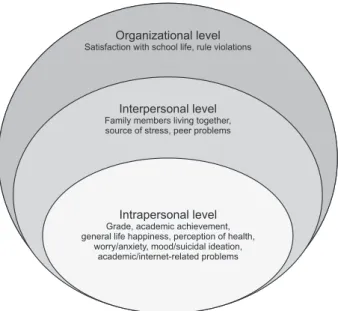
Based on the Ecological Models of Health Behavior framework, the study instruments included intrapersonal, interpersonal, and organizational level characteristics [15]. The intrapersonal level characteristics included grade, academic achievement, general life happiness, and perception of health, while the interpersonal level characteristics included family members living together, and sources of stress. In addition, subcategories of the Adolescent Mental-Health Problem-Behavior Questionnaire (AMPQ-II) were arranged to the intrapersonal level (worry/anxiety, mood/
suicidal ideation, and academic/internet-related problems), inter- personal level (peer problems), and organizational level (rule vio- lations) characteristics [15] (Figure 1). Detailed information re- garding the AMPQ-II is described below. We obtained permission from the Korea Ministry of Education, Science, and Technology to use AMPQ-II for this study.
4. Intrapersonal level characteristics
1) General life happiness
We measured general life happiness with a single question,
“How happy do you think you are in general?” on a 5-point Likert scale (from 1=very happy to 5=very unhappy). Thus, lower scores indicate relatively more happiness.
2) Perception of health
We measured perception of health using the question, “How do you think of your general health status?” on a 5-point Likert scale (1=very poor to 5=very good). Thus, higher scores indi- cate relatively better perceptions of health.
3) Worry/anxiety
The worry and thoughts subcategory of AMPQ-II was included as intrapersonal level characteristics of worry/anxiety. It com- prised 10 items about excessive worries and anxiety.
4) Mood/suicidal ideation
The mood and suicidal ideation subcategory of AMPQ-II was included as intrapersonal level characteristics of mood/suicidal ideation. It comprised 9 items related to tiredness, mood change, and suicidal ideation. A sample mood/suicidal ideation question included, “During the past one month, have you consistently thought of suicide or developed a specific suicide plan?”
5) Academic/internet-related problems
The academic and internet-related problems subcategory of AMPQ-II was included as intrapersonal level characteristics of academic/internet-related problems. It comprised five items re- lated to attention and learning difficulties, internet overuse, and impulsive tendencies.
5. Interpersonal level characteristics
1) Source of stress
To examine the major source of stress, we asked the question,
“What is the single biggest source of stress for you?” and mea- sured it employing a nominal scale with five alternatives: con- flicts with family members, school performance (academic grade), friends, health, and future uncertainty.
2) Peer problems
The peer problems subcategory of AMPQ-II was included as interpersonal level characteristics. It comprised three items about physical and verbal abuse, teasing, and bullying from peers.
6. Organizational level characteristics
1) Satisfaction with school life
We used the question, “How satisfied are you with your school life in general?” to measure satisfaction with school life using a 5-point Likert scale (1=very satisfied to 5=very unsatisfied).
Thus, lower scores indicate relatively more satisfaction.
2) Rule violations
The rule violations subcategory of AMPQ-II was included as organizational level characteristics. It comprised 5 items about tobacco, alcohol, and illicit drug use, absence without notice, and running away from home.
The AMPQ-II was developed to screen mental health problem Organizational level
Satisfaction with school life, rule violations
Interpersonal level Family members living together, source of stress, peer problems
Intrapersonal level Grade, academic achievement, general life happiness, perception of health,
worry/anxiety, mood/suicidal ideation, academic/internet-related problems
Figure 1. Intrapersonal, interpersonal, organizational level of this study.
behaviors of Korean children and adolescents, and consists of 38 questions in five subcategories: worry and anxiety, mood and suicidal ideation, academic and internet-related problems, peer problems, and rule violations. The seven questions did not have a corresponding category. Thus, we used 31 questions in five sub- categories from the AMPQ-II. All questions were measured with a 4-point Likert scale (0=strongly disagree to 3=strongly agree).
Thus, higher scores indicated more mental health and behavior problems. The reliability and validity of the AMPQ-II were veri- fied in a previous study on Korean adolescents [15]. Cronbach’s alpha of AMPQ-II was .88 in a previous study [15] and .90 in our study.
7. Depressive symptoms
We used the Beck Depression Inventory (BDI) to assess de- pressive symptoms [16]. The BDI contains 21 questions measured using 4 points from 0~3. Respondents were asked to mark the point that represents their best status during the past week.
Higher scores indicate more depressive symptoms. The BDI was translated and adapted for use in Korea, and the reliability and validity of the Korean version was previously verified with ado- lescents [17]. Additionally, former researchers confirmed the construct validity of BDI for Korean adolescents [18]. The Cron- bach’s alpha was .89 in the current study and .85 in a previous study [17]. Permission to use BDI was obtained from the Korea Psychology.
Two experts in the field of child health nursing and education and five school health teachers assessed the content validity and age-matched appropriateness and readability of our study instru- ments. We then modified those instruments for use in the current study based on the recommendations of those experts.
8. Procedures
This study was approved by the Institutional Review Board of the university with which the author(s) are affiliated (1041078- 201307-HR-0053-02). The principal investigator of this study acquired permission from the principals of eight middle schools to conduct this research in their schools. The principal investigator visited each participating school and met with the school nurse/
health teacher to explain the purpose of the study, the data col- lection methods, and the procedures. We then sent consent forms
and questionnaires with instructions to each school nurse/health teacher via postal mail. The school nurses/health teachers en- tered the randomly selected classes, explained the purpose of the study, and distributed the questionnaires and written consent forms to students and their parents, who voluntarily participated.
The school nurses/health teachers collected the completed ques- tionnaires and written consent forms and returned them to us via postal mail. It took approximately 20 minutes to complete the survey. Data collection was performed in September 2013.
9. Data analyses
We analyzed the data using SPSS 25.0 for Windows (SPSS, Inc., Chicago, IL, USA). Independent t-tests or chi-square tests were used to compare intrapersonal, interpersonal, and organi- zational level characteristics between urban and rural areas, and hierarchical multiple regression analyses were performed to ex- amine factors associated with depressive symptoms. To reduce the risk of increased type 1 error, multivariate ANOVA was con- ducted to examine whether group of AMPQ-II subcategories differ significantly between urban and rural areas [19]. If the dif- ference was significant, it was followed up by independent t-tests.
The results demonstrated significant group difference with Pillai’s Trace of .069 (F=6.710, p<.001). Thus, independent t-test was followed for each subcategory of the AMPQ-II. Data were screened for data-entry accuracy and to ensure the statistical tests’ assumptions were met. As a result of reviewing the condi- tions for regression analysis, the urban model’s Durbin-Waston statistical value was 1.87, and the tolerance was 0.61~0.96. The Durbin-Waston statistical value of the rural model was 1.88, and the tolerance was 0.43~0.93. Significance was set at p<.050 for two-tailed tests.
RESULTS
1. Differences in intrapersonal level characteristics between urban and rural areas
Among the intrapersonal characteristics, grade (p<.001), per- ception of health (p=.030) differed significantly between the ur- ban and rural groups. In the urban group, 39.6% of the partici- pating students were 2nd graders, compared to 22.0% of the ru- ral participants. In the urban group, 38.0% answered that their
health was very good compared to 24.9% in the rural group. We found no significant difference in academic achievement or gen- eral life happiness between the groups (Table 1).
2. Differences in interpersonal and organizational level characteristics between urban and rural areas
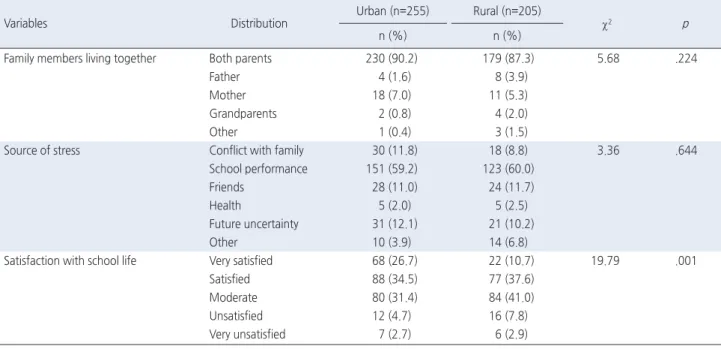
Among the interpersonal characteristics, we found no signifi- cant difference in family members living together or the source of stress between the groups. Our comparison of organizational level characteristics indicates that satisfaction with school life dif-
Table 1. Differences in Intrapersonal Level Characteristics between Urban and Rural Areas (N=460)
Variables Distribution
Urban (n=255) Rural (n=205)
χ2 p
n (%) n (%)
Grade 1st 65 (25.5) 60 (29.2) 17.09 <.001
2nd 101 (39.6) 45 (22.0)
3rd 89 (34.9) 100 (48.8)
Academic achievement Upper 60 (23.5) 30 (14.7) 5.73 .057
Middle 126 (49.4) 112 (54.6)
Lower 69 (27.1) 63 (30.7)
General life happiness Very happy 55 (21.6) 33 (16.1) 7.80 .099
Happy 104 (40.8) 72 (35.1)
Moderate 78 (30.6) 87 (42.4)
Unhappy 15 (5.9) 12 (5.9)
Very unhappy 3 (1.1) 1 (0.5)
Perception of health Very good 97 (38.0) 51 (24.9) 10.68 .030
Good 76 (29.8) 63 (30.7)
Fair 61 (23.9) 68 (33.2)
Poor 20 (7.9) 22 (10.7)
Very poor 1 (0.4) 1 (0.5)
Table 2. Differences in Interpersonal and Organizational Level Characteristics between Urban and Rural Areas (N=460)
Variables Distribution
Urban (n=255) Rural (n=205)
χ2 p
n (%) n (%)
Family members living together Both parents 230 (90.2) 179 (87.3) 5.68 .224
Father 4 (1.6) 8 (3.9)
Mother 18 (7.0) 11 (5.3)
Grandparents 2 (0.8) 4 (2.0)
Other 1 (0.4) 3 (1.5)
Source of stress Conflict with family 30 (11.8) 18 (8.8) 3.36 .644
School performance 151 (59.2) 123 (60.0)
Friends 28 (11.0) 24 (11.7)
Health 5 (2.0) 5 (2.5)
Future uncertainty 31 (12.1) 21 (10.2)
Other 10 (3.9) 14 (6.8)
Satisfaction with school life Very satisfied 68 (26.7) 22 (10.7) 19.79 .001
Satisfied 88 (34.5) 77 (37.6)
Moderate 80 (31.4) 84 (41.0)
Unsatisfied 12 (4.7) 16 (7.8)
Very unsatisfied 7 (2.7) 6 (2.9)
fered significantly between the groups (p=.001). Among urban students, 26.7% responded that they were very satisfied with school life, whereas 10.7% of rural students answered that they were very satisfied (Table 2).
3. Differences in depressive symptoms and mental health problem behaviors between urban and rural areas
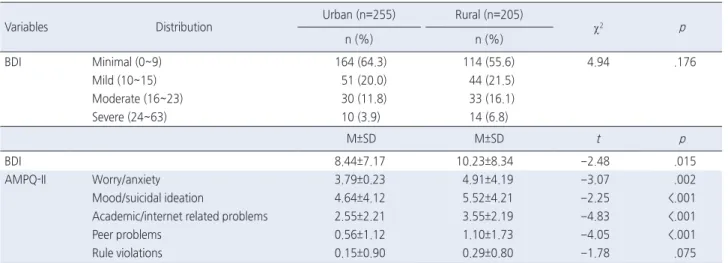
The mean BDI scores were 8.44±7.17 for the urban group and 10.23±8.34 for the rural group, indicating a significant difference between the groups (p=.015). However, BDI group distribution was not significant between the two groups. Regarding the AMPQ-II subcategories, mean scores of the rural group on worry/anxiety (p=.002), mood/suicidal ideation (p<.001), and ac- ademic/internet related problems (p<.001) was significantly higher than the urban group. The mean score of the rural group on peer problems was significantly higher than the urban group (p<.001).
However, the rule violations did not differ significantly between the groups (Table 3).
4. Differences in factors associated with depressive symptoms between urban and rural groups
Hierarchical regression analysis was performed separately for urban and rural groups, to examine whether significant factors associated with depressive symptoms differ between the urban and rural areas. For the urban group, general life happiness (β=.24, p<.001), perception of health (β=.12, p=.004), worry/
anxiety (β=.21, p<.001), and mood/suicidal ideation (β=.45, p<.001) were significant among the intrapersonal level character- istics. In Model 1, the intrapersonal level characteristics ac- counted for 68.9% of the variability in depressive symptoms (F=60.32, p<.001). In Model 2, the interpersonal level character- istics were added, increasing the explained variance by 0.7%
(F=42.50, p<.001). The source of stress (school performance) (β=.11, p=.026) was significantly associated with depressive symptoms among the interpersonal level characteristics. None of the organizational level characteristics was significant in the ur- ban group in Model 3. The variables in the model explained 69.9% of the variance in depressive symptoms in urban area (F=37.05, p<.001).
For the rural group, general life happiness (β=.26, p<.001), worry/anxiety (β=.32, p<.001), and mood/suicidal ideation (β=.26, p<.001) were significantly associated with depressive symptoms among the intrapersonal level characteristics. In Model 1, the in- trapersonal level characteristics accounted for 60.8% of the vari- ability in depressive symptoms (F=33.62, p<.001). In Model 2, the interpersonal level characteristics were added, increasing the explained variance by 0.5% (F=23.24, p<.001). None of the in- terpersonal level characteristics were significant in the rural group (p>.050). Among the organizational level characteristics, rule violation (β=-.14, p=.005) was significantly associated with depressive symptoms in Model 3. The variables in the model ex- plained 63.5% of the variance in rural area (F=21.90, p<.001) (Table 4).
Table 3. Differences in Depressive Symptoms and Mental Health Problem Behaviors between Urban and Rural Areas (N=460)
Variables Distribution
Urban (n=255) Rural (n=205)
χ2 p
n (%) n (%)
BDI Minimal (0~9) 164 (64.3) 114 (55.6) 4.94 .176
Mild (10~15) 51 (20.0) 44 (21.5)
Moderate (16~23) 30 (11.8) 33 (16.1)
Severe (24~63) 10 (3.9) 14 (6.8)
M±SD M±SD t p
BDI 8.44±7.17 10.23±8.34 -2.48 .015
AMPQ-II Worry/anxiety 3.79±0.23 4.91±4.19 -3.07 .002
Mood/suicidal ideation 4.64±4.12 5.52±4.21 -2.25 <.001
Academic/internet related problems 2.55±2.21 3.55±2.19 -4.83 <.001
Peer problems 0.56±1.12 1.10±1.73 -4.05 <.001
Rule violations 0.15±0.90 0.29±0.80 -1.78 .075
BDI=Beck depression inventory; AMPQ-II=the adolescent mental-health problem-behavior questionnaire.
DISCUSSION
We examined factors associated with depressive symptoms among female adolescents in Korea, including multiple levels of influence described in the Ecological Models of Health Behavior framework, differentiating those factors between urban and rural areas. Intrapersonal, interpersonal, and organizational level fac- tors were significantly associated with depressive symptoms among female adolescents. Some of the significant factors dif- fered between urban and rural groups. Among female adolescents in urban areas, intrapersonal level characteristics (general life happiness, perception of health, worry/anxiety, and mood/suicidal
ideation), and interpersonal level characteristics (stress associ- ated with school performance) were significant, whereas in rural areas, intrapersonal level characteristics (general life happiness, worry/anxiety, mood/suicidal ideation, and academic/internet re- lated problems) and organizational level characteristics (rule vio- lations) were significantly associated with depressive symptoms.
Our study is unique in that we analyzed factors associated with depressive symptoms in female adolescents by applying the Eco- logical Models of Health Behavior framework, and differentiated those factors between urban and rural areas.
Using the BDI, we found that 15.7% of urban female adoles- cents and 22.9% of those in rural areas had moderate or severe Table 4. Differences in Factors Associated with Depressive Symptoms between Urban and Rural Groups (N=460)
Variable
Urban Rural
Model 1 Model 2 Model 3 Model 1 Model 2 Model 3
B β VIF B β VIF B β VIF B β VIF B β VIF B β VIF
Grade
1st -1.17 -.07 1.40 -1.38 -.08 1.46 -1.36 -.08 1.45 -0.40 -.02 1.19 -0.43 -.02 1.21 -0.37 -.02 1.21 2nd -0.30 -.02 1.35 -0.32 -.02 1.36 -0.31 -.02 1.36 -0.55 -.03 1.23 -0.67 -.03 1.27 -1.11 -.06 1.29 Academic achievement
Upper -1.24 -.07 1.78 -1.07 -.07 1.83 -0.91 -.05 1.87 -1.40 -.06 1.63 -1.34 -.06 1.68 -0.94 -.04 1.70 Middle -0.82 -.06 1.61 -0.81 -.06 1.63 -0.70 -.05 1.65 -0.79 -.05 1.37 -0.97 -.06 1.44 -1.09 -.07 1.46 General life
happiness
1.94 .24** 1.52 1.86 .23** 1.59 1.62 .20** 1.90 2.54 .26** 1.42 2.54 .26** 1.42 2.14 .22** 1.58
Perception of health
0.85 .12* 1.30 0.90 .12* 1.32 0.81 .11* 1.42 0.73 .09 1.19 0.74 .09 1.21 0.71 .08 1.25
Worry/anxiety 0.42 .21** 1.92 0.44 .22** 2.06 0.45 .23** 2.16 0.63 .32** 2.02 0.62 .31** 2.38 0.58 .29** 2.42 Mood/suicidal
ideation
0.79 .45** 2.34 0.77 .44** 2.50 0.79 .45** 2.53 0.51 .26** 2.22 0.50 .25** 2.28 0.51 .26** 2.29
Academic/internet related problems
-0.10 -.03 1.58 -0.12 -.04 1.60 -0.11 -.03 1.71 0.37 .10 1.80 0.24 .09 1.83 0.48 .13* 1.90
Family members living togethera
Both parents -0.05 .00 1.07 .02 .00 1.08 0.73 .03 1.10 0.92 .04 1.11
Source of stressb
S chool performance 1.57 .11 1.84 1.65 .11* 1.88 1.12 .07 1.80 1.11 .07 1.80
Family/friends 1.76 .10* 2.12 1.72 .10 2.14 0.58 .03 1.93 0.25 .10 1.98
Peer problems -0.04 -.01 1.36 -0.02 .00 1.40 0.20 .04 1.54 0.35 .07 1.66
Satisfaction with school life -0.45 .06 1.66 -0.85 .09 1.36
Rule violations -0.27 -.03 1.35 -1.46 -.14* 1.23
F 60.32** 42.50** 37.05** 33.62** 23.24** 21.90**
Adjusted R2 .68 .68 .68 .59 .59 .61
△R2 .01 .00 .01 .02
Durbin-Waston=1.87, Tolerance=0.61~0.96, Shapiro-Wilk=.132 Durbin-Waston=1.88, Tolerance=0.43~0.93, Shapiro-Wilk=.061
*p<.05, **p<.001.
VIF=Variance inflation factor.
†Reference group, others (father, mother, grandparents, and others); ††Reference group, health/future uncertainty/other.
depressive symptoms. An accurate assessment of mental health problems and appropriate interventions are required for high-risk groups of adolescents because depression is a major risk factor for suicidal ideation and suicide attempts, and depression in ado- lescence can advance to Major Depressive Disorder in adults [1,3].
Consistent with a previous study [8], mean scores for depres- sive symptoms were higher in rural areas than in urban areas.
The prior study reported that middle school students in rural ar- eas had a significantly higher depression score than those in ur- ban areas [8]. Another study reported that adolescents in rural areas experience more stress and a lower quality of life than those in urban areas [20]. The authors contended that the gap between urban and rural differences is greater in developing countries than in developed countries, a fact that might be at- tributed to diverse modernization of the education system in ur- ban and rural areas [20]. A relatively inferior education system in rural areas could lead to a lower chance of gaining increased economic status that might be associated with lower psychological wellbeing [20]. Improvements in the education system in rural areas might promote psychological health among adolescents. In addition, in the development of psychosocial health programs, adolescents in rural areas should be a priority target for inter- vention.
Perception of health, worry/anxiety, mood/suicidal ideation, and academic/internet related problems included in intrapersonal level characteristics were significantly different between two groups.
Among these, general life happiness, worry/thoughts, and mood/
suicide were significantly associated with depressive symptoms in both the urban and rural groups. Similar to our study, a previous study found that students with depressive symptoms had lower self-reported happiness and lower health status than those with- out depressive symptoms [21]. Those results may indicate that adolescents with depressive symptoms exhibit more problem be- haviors or frequent exhibition of problems behaviors may lead to depressive symptoms. Either way, practitioners should understand that problem behaviors could accompany depressive symptoms.
Thus, screening for depression is required for adolescents who exhibit problem behaviors.
We found that academic/internet related problems were signifi- cantly associated with depressive symptoms in rural areas only, while rural adolescents reported a higher mean score for aca-
demic/internet related problems compared to urban adolescents.
Overuse of the internet affects depression in adolescents, and the career crisis of rural students directly affects their overuse of the internet [22]. Other researchers reported that rural adolescents spend more time using the internet and found that internet ad- diction was associated with depression [23]. A previous study reported that youth with depressive symptoms were more likely to interact with peers only online and found that relationship-ori- ented internet use had a negative effect on depression [24]. Bak [25] contended that lack of recreational facilities and cultural spaces in rural areas are partly responsible for higher prevalence of internet addiction among rural adolescents in Korea. There- fore, interventions to decrease academic/internet related problems such as off-line recreational activities may improve rural adoles- cents’ depressive symptoms.
Interpersonal level characteristics that affect depression were found to differ between urban and rural groups. In urban areas, stress associated with school performance was significantly as- sociated with depressive symptoms in our study. A previous study found that urban students had more aspirations for advanced ed- ucation and that they outperformed those in rural schools at both the primary and secondary levels [26]. Other researchers also found that in urban areas, parents have increased expectations for the academic achievement of their children, adolescents themselves have higher academic aspirations, and adolescents actually had higher academic grades than their peers in rural ar- eas [27]. These parental and adolescent aspirations for higher academic grades could cause depressive symptoms because of immoderate competition among adolescents in urban areas.
We found significant associations between rule violations and depressive symptoms of organizational level characteristics in rural adolescents. A previous study also reported similar results [28]. The authors found that rural adolescents were more likely to engage in juvenile delinquency and school violence than urban adolescents, and contended that adolescent counseling centers and violence prevention centers are scarce in rural areas com- pared to urban areas. Thus, rural adolescents are more vulnera- ble to conduct disorders [29]. Childhood psychopathology is often conceptualized in two broad categories: internalizing problems such as anxiety and depression, and externalizing problems such as aggression, hyperactivity, and delinquency. Both internalizing
and externalizing problems (depression and conduct disorders) can co-exist upon emergence of precipitating factors in children and youth [28]. Therefore, practitioners should be aware that ad- olescents who commit frequent rule violations might have comor- bid psychological health problems.
This study is significant in that the influence of environmental factors is considered by applying the ecological model to depres- sion related factors in female middle school students. In addition, it has confirmed that depressive factors related to urban and ru- ral females are different. Therefore, it is necessary to consider the environmental factors of urban and rural areas while devel- oping intervention for middle school students.
The limitations of this study include the convenience sampling method. Careful attention should be made when generalizing re- sults. In addition, our study cannot exclude social desirability bias in some of the questions or recall bias because data were gath- ered using a self-report method. Finally, the cross-sectional study design provides no causal relationship between depressive symptoms and independent variables. Our study may not depict current information because it took considerable time between the data collection and analysis. However, this is a comprehensive multisite study, thus it provides important messages for female adolescents’ mental health. Meanwhile, repeated studies are re- quired to portray the current status of depressive symptoms among adolescents including mental health and problem behav- iors.
CONCLUSION
Our study compared the prevalence of depressive symptoms and differentiated factors associated with them in female adoles- cents between urban and rural areas based on the Ecological Models of Health Behavior framework. We found that multiple levels of factors were associated with depressive symptoms, and those significant factors differed between urban and rural female youths. In addition, results reveal that factors associated with depressive symptoms differ between urban and rural groups.
Rural female adolescents are more vulnerable to mental health and problem behaviors than their urban peers. They require pri- ority attention and organizational and community level interven- tions including counseling and prevention programs.
In addition, our results indicate that depressive symptoms are associated with multiple level characteristics. Therefore, when assessing suicidal ideation and depression among middle school students, a macroscopic approach is required at multiple levels such as intrapersonal, interpersonal, and organizational. More- over, because psychological health problems and conduct disor- ders may co-exist, assessments should consider both mental health and delinquent behaviors when screening high-risk groups.
In particular, the various intrapersonal factors that are analyzed that affect adolescent depression in both urban and rural areas should be closely monitored in relation to suicidal ideation.
CONFLICTS OF INTEREST
The authors declared no conflict of interest.
REFERENCES
1. Dunn EC, Milliren CE, Evans CR, Subramanian SV, Richmond TK. Disentangling the relative influence of schools and neigh- borhoods on adolescents’ risk for depressive symptom. Ameri- can Journal of Public Health. 2015;105(4):732-740.
https://doi.org/10.2105/AJPH.2014.302374
2. Kann L, McManus T, Harris WA, Shanklin SL, Flint KH, Hawkins J, et al. Youth risk behavior surveillance–United States, 2015. Morbidity and Mortality Weekly Report Surveil- lance Summaries. 2016;65(6):1-174.
https://doi.org/10.15585/mmwr.ss6506a1
3. Hankin BL, Mermelstein R, Roesch L. Sex differences in ad- olescent depression: Stress exposure and reactivity models.
Child Development. 2007;78(1):279-295.
https://doi.org/10.1111/j.1467-8624.2007.00997.x
4. Korea Centers for Disease Control and Prevention (KCDC).
The 2015 Korea youth risk behavior web-based survey [In- ternet]. Cheongju: Korea Centers for Disease Control and Pre- vention (KCDC); c2016 [cited 2017 Jan 10]. Available from:
https://yhs.cdc.go.kr/new/pages/main.asp.
5. Lee H, Jung HY, Yun E, Um HY, Jee YJ. Factors influenc- ing depression among middle-school girls. Journal of Korean Academy of Nursing. 2011;41(4):550-557.
https://doi.org/10.4040/jkan.2011.41.4.550
6. Kim JH, Choi YH. Influencing factors on middle school girls’
sense of coherence and depression. Crisis and Emergency Management: Theory and Praxis. 2015;11(3):177-187.
7. Kim EY. Factors causing depression in middle school students [master’s thesis]. Daejeon: Chungnam National University;
2014. p. 1-87.
8. Kang HW, Park KM. Comparison of correlates of depression in late-life between urban and rural areas. Journal of the Korean Gerontological Society. 2012;32(1):129-143.
9. Kim YS, Jun HY, Kim CH, Hwang SH. Comparison on the depression and quality of life in low-income elderly between urban and rural area. Journal of Korean Society of Living Envi- ronmental System. 2012;19(1):42-50.
10. Sallis J, Owen N, Fisher E. Ecological models of health be- havior. In: Glanz K, Rimer BK, Viswanath K, editors. Health Behaviors and Health Education. 4th ed. San Francisco (CA):
John Wiley & Sons; 2008. p. 465-485.
11. Kaufman MR, Cornish F, Zimmerman RS, Johnson BT. Health behavior change models for HIV prevention and AIDS care:
Practical recommendations for a multi-level approach. Journal of Acquired Immune Deficiency Syndromes. 2014;66 Suppl 3:S250-S258.
12. Gu J, Lau JT, Li M, Li H, Gao Q, Feng X, et al. Socio-eco- logical factors associated with depression, suicidal ideation and suicidal attempt among female injection drug users who are sex workers in China. Drug and Alcohol Dependence. 2014;144:
102-110. https://doi.org/10.1016/j.drugalcdep.2014.08.011 13. Goodman JF. School discipline in moral disarray. Journal of
Moral Education. 2006;35(2):213-230.
https://doi.org/10.1080/03057240600681736
14. Lee G, Ham OK. Behavioral and psychosocial factors associat- ed with suicidal ideation among adolescents. Nursing & Health Sciences. 2018;10. Forthcoming. https://doi.org/10.1111/
nhs.12422
15. Bhang SY, Yoo HK, Kim JH, Kim B, Bahn GH, Ahn D, et al. Revision of adolescent mental health and problem behavior screening questionnaire: Development of adolescent mental health and problem behavior screening questionnaire-II. Jour- nal of the Korean Academy of Child and Adolescent Psychiatry.
2011;22:271-286.
https://doi.org/10.5765/jkacap.2011.22.4.271
16. Beck AT, Steer RA, Ball R, Ranieri WF. Comparison of beck depression inventories-Ia and II in psychiatric outpatients.
Journal of Personality Assessment. 1996;67(3):588-597.
https://doi.org/10.1207/s15327752jpa6703_13
17. Lee YH, Song JY. A study of the reliability and the validity of the BDI, SDS, and MMPI-D scales. Korean Journal of Clinical Psychology. 1991;10(1):98-113.
18. Park HJ, Kim HN, Kim IB, Jeon SA. Reliability of the beck depression inventory in adolescence. Journal of Korean Acade-
my of Family Medicine. 2000;21(2):244-253.
19. Pallant J. SPSS survival manual: A step by step guide to data analysis using SPSS. Philadelphia (PA): Open University Press;
2001. p. 217.
20. Yeresyan I, Lohaus A. Stress and wellbeing among Turkish and German adolescents living in rural and urban areas. Rural and Remote Health. 2014;14(2):2695.
21. Byeon H. The relationship between BMI, weight perception and depression-like symptoms in Korean middle school students.
Journal of the Korea Academia-Industrial Cooperation Society.
2013;14(12):6317-6323.
https://doi.org/10.5762/KAIS.2013.14.12.6317
22. Park JS. The direct and indirect effects of career risk on ex- cessive use of internet for rural adolescents, through depres- sion and withdrawal coping. Korean Journal of Youth Studies.
2011;18(8):21-43.
23. Yoon MS, Cho HJ, Lee HJ. Effects of internet use and alcohol use on the adolescent’s depression. Social Science Research Review. 2009;25(4):347-370.
24. Ybarra ML, Alexander C, Mitchell KJ. Depressive symptom- atology, youth internet use, and online interactions: A national survey. Journal of Adolescent Health. 2005;36(1):9-18.
https://doi.org/10.1016/j.jadohealth.2003.10.012
25. Bak SA. Study on the internet addiction of middle school stu- dents in farming community [master’s thesis]. Muan: Mokpo National University; 2006. p. 1-79.
26. Litheko SRS. The difference in performance between schools situated in the urban areas and those in the rural areas of Le- sotho. Electronic Journal for Inclusive Education [Internet].
2012;2(9):Article 2. Available From: https://corescholar.li- braries.wright.edu/cgi/viewcontent.cgi?article=1138&contex- t=ejie.
27. Park YS, Park YK, Kim UC, Han KH. Academic achievement and quality of life among urban and rural students: A com- parative analysis of the influence of residence, parental ex- pectations of academic achievement, parent-child conflict and self-efficacy. Studies on Korean Youth. 2011;22(3):5-41.
28. Shaver AE. Patterns of rule-violating behavior in children and adolescents [dissertation]. Columbus (OH): The Ohio State University; 2003. p. 1-125.
29. Kim JY, Lee IS. A study on the effect of behavioral malad- justment of youth experiencing domestic violence in urban and rural areas: Moderating effect of protective factors. Journal of Korean Association of Victimology. 2008;16(1):199-228.