Received December 5, 2014, Revised April 22, 2015, Accepted for publication May 11, 2015
Corresponding author: Incilay Lay, Department of Medical Bioche- mistry, Faculty of Medicine, Hacettepe University, Clinical Pathology Laboratory, Hacettepe University Hospitals, 06100 Sthhiye, Ankara, Turkey. Tel: 90-312-305-2841, Fax: 90-312-305-2084, E-mail: isinici@
hacettepe.edu.tr
This is an Open Access article distributed under the terms of the Creative Commons Attribution Non-Commercial License (http://
creativecommons.org/licenses/by-nc/4.0) which permits unrestricted non-commercial use, distribution, and reproduction in any medium, provided the original work is properly cited.
ORIGINAL ARTICLE
Genetic Risk Factors for Psoriasis in Turkish Population:
− 1540 C/A, −1512 Ins18, and +405 C/G Polymorphisms within the Vascular Endothelial Growth Factor Gene
Tuba Bozduman1, Sibel Ersoy Evans2, Sevilay Karahan3, Yildiz Hayran2, Filiz Akbiyik1,4, Incilay Lay1,4
Departments of 1Medical Biochemistry, 2Dermatology, and 3Biostatistics, Faculty of Medicine, Hacettepe University, 4Clinical Pathology Laboratory, Hacettepe University Hospitals, Ankara, Turkey
Background: Evidence regarding the vascular endothelial growth factor A (VEGFA) as a potent mediator of angio- genesis and inflammation in psoriasis has revealed variations in this gene as surrogate markers of psoriasis. Objective:
VEGFA gene polymorphisms (−1540 C/A, −1512 Ins18,
−460 T/C, and +405 C/G) in psoriasis susceptibility in Turkish population were investigated. Methods: A total of 200 age, sex and ethnicity-matched psoriatic and healthy in- dividuals were examined for clinical type, response to ther- apy, serum VEGFA and its receptor levels, genotypes and haplotypes. Results: The +405 GG, +405 CG, −1540 CA, and −1512 +Ins18 genotypes conferred a significant risk for developing psoriasis. The C-InsTC haplotype in the con- trols and C+InsTG, A+InsTC, and A-InsTG haplotypes in psoriatic patients were observed to be significantly high.
Increased serum levels of VEGFA were detected in psoriatic patients with the C-InsTC haplotype than that in the controls.
The +405 GG genotype was significantly more frequent in psoriatic patients with a positive family history, and the mod- erate form of psoriasis was more frequent among C+InsTG haplotype carriers than that among the other patients. The +405 GG genotype was found to be more frequent in pa- tients responding to oral retinoids. Serum VEGFR1/FLT1 and
VEGFR2/KDR levels were not significantly different when psoriatic patients and controls were stratified based on the risk polymorphic variants. Conclusion: VEGFA gene +405 GG and CG, −1512+Ins18, and −1540 CA genotypes are associated with an increased risk of psoriasis in Turkish population. The G allele at +405 and an 18-bp insertion at
−1512 are primarily the risk factors for psoriasis, and this risk is potentiated by the presence of the A allele at the −1540 locus. (Ann Dermatol 28(1) 30∼39, 2016)
-Keywords-
Angiogenesis, Psoriasis, Turkish population, Vascular en- dothelial growth factor, VEGFA gene polymorphisms
INTRODUCTION
Psoriasis (MIM 177900) is a chronic, recurrent, inflam- matory, and hyperproliferative skin disease that results from genetic predetermination in conjunction with envi- ronmental factors1. Although several genetic loci for psor- iasis have been reported, the locus with the strongest ef- fect appears to be the major psoriasis susceptibility 1 (PSORS1) locus within chromosome 6p212. Genes in PSORS1 are believed to play a role in susceptibility to psoriasis and are associated with up to 50% of psoriasis cases3,4. The vascular endothelial growth factor A (VEGFA) gene is located at the PSORS1 locus, and a substantial body of evidence for VEGFA (MIM 199240) as a potent mediator of angiogenesis and inflammation in psoriasis has been reported5-8. VEGFA is overexpressed in psoriatic epidermis, together with its receptors VEGFR1/FLT-1 and VEGFR2/KDR in papillary microvessels9-13. In addition, chronic inflammatory lesions resembling human psoriasis
Table 1. The age and sex distribution of psoriatic patients and controls
Variable Patient (n=100)
Control
(n=100) p-value
Age (yr) 40.7±13.8 40.8±13.4 0.955
Sex (male/female) 51/49 51/49 1.000
Values are presented as mean±standard deviation and number.
were reported in the skin of transgenic mice overex- pressing VEGFA by Xia et al.14 VEGFA is thought to play a critical role in the mechanisms underlying vascular changes in psoriasis, and induces psoriasis development by pro- moting and maintaining immune and inflammatory proc- esses6,7,15-21. Therefore, the contribution of VEGFA to the pathogenesis of psoriasis, together with assignment of the VEGFA gene to the PSORS1 locus, has indicated VEGFA gene variations as candidate markers of psoriasis.
More than 15 single nucleotide polymorphisms (SNPs) of the VEGFA gene have been identified within the promoter, 5’-UTR, and exon regions22-24. VEGFA gene SNPs can in- fluence VEGFA protein production; among them −1540 C/A, −1512 Ins18, −460 T⁄C, and +405 G⁄C polymor- phisms have been reported as functionally relevant and as- sociated with susceptibility, severity, or course in multiple inflammatory autoimmune diseases24-29. The −1540 C/A,
−1512 Ins18, and −460 T⁄C polymorphisms in the pro- moter region, and +405 G⁄C in the 5’-UTR, are close to the activator protein-1 sites of the VEGFA gene, and are as- sociated with both high and low VEGFA production in dis- eases with an angiogenic basis24,27,30-33. These data suggest that either of these polymorphisms within the regulatory region of the VEGFA gene may lead to differences in VEGFA expression between individuals, and that they have a regulatory function. Alternatively, there may be an allelic linkage between these polymorphisms and func- tional polymorphisms.
To date, only nine case-control studies, two meta-analy- ses, and two therapeutic response SNP studies of VEGFA gene SNPs in psoriasis have been published, and none in Turkish population34-46. The results of these previous re- ports are controversial and associations of VEGFA gene SNPs with psoriasis remain unclear. Moreover, eligible case-control studies are required to increase statistical power and provide a more precise evaluation of the asso- ciation between SNPs and diseases for meta-analysis.
However, further well-designed case-control studies are required to evaluate VEGFA gene SNPs in relation to psor- iasis in different populations for a meta-analytic approach.
Previous studies have not assessed the risk of the VEGFA gene −1540 C/A (rs699947), −1512 Ins18 (rs699947),
−460 T/C (rs833061), and +405 C/G (rs2010963) SNPs together in psoriasis susceptibility. These four VEGFA gene SNPs have a high degree of linkage disequilibrium, and were therefore used in this study to investigate psoriasis susceptibility in individuals of a single ethnicity. An asso- ciation was also analyzed in a subset of psoriatic patients classified by clinical type, disease severity, family history, and response to therapy. Circulating VEGFA together with serum VEGFR1/FLT1 and VEGFR2/KDR levels in relation
to risk polymorphic variants and haplotypes were also evaluated. We postulated that the −1540 C/A, −1512 Ins18, −460 T/C, and +405 C/G SNPs contribute to the pathogenesis of psoriasis at the genomic level.
MATERIALS AND METHODS
Study population
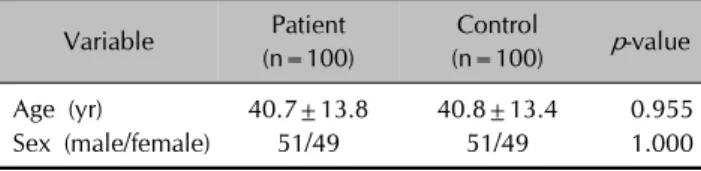
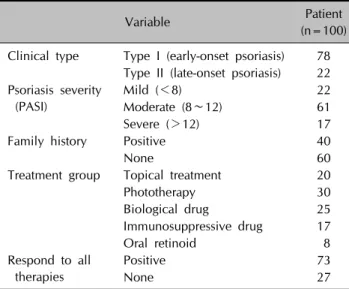
A total of 100 Caucasian patients with psoriasis who were referred to the Department of Dermatology, Hacettepe University Faculty of Medicine (Ankara, Turkey), were en- rolled in this study. A total of 100 sex-matched healthy Caucasian controls of the same ethnicity with no family history of psoriasis were also recruited (Table 1). A de- tailed interview addressing personal and family history and demographic information was performed in the con- text of a physical examination. Patients were evaluated based on clinical type (Type I, Type II), disease severity (Psoriasis Area and Severity Index, PASI), family history, and response to therapy. Patients with an age of psoriasis onset below 40 years were considered to have Type I, while those above 40 years were classified as Type II.
Psoriasis severity was assessed using PASI (<8=mild, 8∼
12=moderate, >12=severe). All patients received one of the following therapies: 1) Topical treatment (corticoste- roids, vitamin D analogues, retinoids, salicylic acid, calci- neurin inhibitors), 2) phototherapy (psoralen ultraviolet A, ultraviolet-B), 3) biological drugs (etanercept, infliximab, adalimumab), 4) immunosuppressive drugs (methotrexate, cyclosporine), or 5) oral retinoids (acitretin). Responses to therapy were objectively assessed by two expert dermatol- ogists using clinical records and direct patient questioning.
Response to treatment was determined by a decrease of at least 75% in the pre-treatment PASI after 4 months of therapy. Patient characteristics are summarized in Table 2.
Exclusion criteria were psoriatic arthropathy or other in- flammatory arthritis, pregnancy, or breastfeeding. The study protocol adhered to the Declaration of Helsinki Guidelines and was approved by the Ethics Committee of Hacettepe University (GO 2013/131-03). Written informed consent was obtained from all patients and controls.
Table 2. Characteristics of the psoriatic patients
Variable Patient
(n=100) Clinical type Type I (early-onset psoriasis) 78
Type II (late-onset psoriasis) 22 Psoriasis severity
(PASI)
Mild (<8) 22
Moderate (8∼12) 61
Severe (>12) 17
Family history Positive 40
None 60 Treatment group Topical treatment 20
Phototherapy 30
Biological drug 25
Immunosuppressive drug 17
Oral retinoid 8
Respond to all therapies
Positive 73 None 27 PASI: Psoriasis Area and Severity Index.
Table 3. PCR oligonucleotide primer pairs, PCR conditions, corresponding restriction endonucleases, PCR product and restriction fragment sizes
SNP Primers sequence
PCR product size (bp)
PCR conditions (annealing temperature,
MgCl2)
Restriction enzyme
site
Alleles
DNA fragments sizes (bp)
−1540 C/A and
−1512Ins18
F5’-CCC TGG AGC GTT TTG GTTA AA-3’ 297 (315)*
64oC, 1 mM Bg1II C 297 (315)*
R5’-CCC TTA CCT CCA AGC CCC CT-3’ A 197 (215)*,100
−460 T/C F5’-TGT GCG TGT GGG GTT GAG CG-3’ 175 63oC, 2 mM BstUI T 175
R5’-TAC GTG CGG ACA GGG CCT GA-3’ C 155, 20
+405 C/G F5’-ATT TAT TTT TGC TTG CCA TT-3’ 304 58oC, 3 mM BsmF1 C 304
R5’-GTC TGT CTG TCT GTC CGT CA-3’ G 193, 111
PCR: polymerase chain reaction, SNP: single nucleotide polymorphism. *PCR product size when the 18 bp insertion at position −1512 is present.
VEGFA genotyping
Genomic DNA was isolated from whole blood of each in- dividual using Qiagen QIAamp DNA blood mini kit (QIAGEN GmbH, Hilden, Germany). VEGFA gene SNPs were determined using polymerase chain reaction (PCR) and restriction endonuclease digestions using specific oli- gonucleotide primers and restriction enzymes under the appropriate conditions (Table 3). PCR amplification was performed in 50-μl reaction mixtures containing 100 ng of template DNA, 400 μM of each primer, 200 μM of each dNTP, 1×PCR buffer (20 mM Tris-HCl, 50 mM KCl), and 2.5 U of Taq DNA Polymerase (Fermentas Life Sciences, Leon-Rot, Germany). Initial denaturation was performed at 94oC for 5 min followed by 40 cycles of denaturation at 94oC for 1 min, annealing at the indicated temperatures
for 1 min, extension at 72oC for 1 min, with a final ex- tension at 72oC for 5 min using an ICycler (Bio-Rad, Hercules, CA, USA). The −1540 C/A and −1512 Ins18 SNPs were amplified under the same PCR conditions. The 18-bp insertion was detectable as a longer PCR product.
PCR products were digested with the appropriate re- striction enzymes (New England BioLabs Inc., Hertfordshire, UK).
Determination of serum levels of VEGFA, VEGFR1/
FLT-1, and VEGFR2/KDR
Serum levels of VEGFA, VEGFR1/FLT-1, and VEGFR2/KDR were analyzed using Boster ELISA (Boster Immunoleader;
Boster Biological Technology Co., Ltd., Abingdon, UK).
Results were expressed as picograms per milliliter and all parameters were measured in a single run in all samples.
Sensitivities of the VEGFA, VEGFR1/FLT-1, and VEGFR2/
KDR assays were <1.0 pg/ml, <30.0 pg/ml, and <4.0 pg/ml, respectively.
Statistical analysis
Statistical analyses were performed using the IBM SPSS for Windows version 21.0 statistical software (IBM Co., Armonk, NY, USA). Haplotype Analysis version 1.04 statistical soft- ware was used to determine haplotype distribution. Con- tinuous variables were presented as means±standard de- viation and medians, and categorical variables as per- centages. An independent sample t-test was used to com- pare the age distribution of the individuals in the control and psoriasis groups. Categorical variables were com- pared using the chi-squared or Fisher’s exact test, as appropriate. Odds ratios and confidence intervals were al- so calculated. Independent groups were compared by Mann-Whitney U or Kruskal-Wallis test according to the level of VEGFA. The Hardy-Weinberg equilibrium for gen-
Table 5. Genotypes that are associated with an increased risk of psoriasis
VEGFA locus Genotype Control (n) Patient (n) OR (95% CI) p-value (multivariate)
+405 C/G GG 13 40 9.40 (4.25∼20.79) <0.001*
+405 C/G CG 14 34 7.02 (3.24∼15.23) <0.001*
−1512Ins18 + Ins18 28 61 4.10 (2.26∼7.47) <0.001*
−1540 C/A AC 22 40 2.51 (1.34∼4.68) 0.004*
−460 T/C CT 25 14 0.48 (0.23∼1.00) 0.05
VEGFA: vascular endothelial growth factor A, OR: odds ratio, CI: confidence interval. *Statistically significant results.
Table 4. Genotype and allele distributions of four VEGFA SNPs in psoriatic patients and controls
VEGFA locus Genotype and alleles
Control (n=100)
Patient
(n=100) Χ2 p-value
−1540 C/A CC 78 57 12.741 0.002*
AA - 3
AC 22 40
C allele 178 154 9.373 0.002*
A allele 22 46
−1512Ins18 −Ins18 72 39 22.047 <0.001*
+Ins18 28 61
−460 T/C TT 75 86 3.185 0.074
CT 25 14
CC - -
T allele 175 186 2.841 0.092
C allele 25 14
+405 C/G CC 73 26 44.401 <0.001*
GG 13 40
CG 14 34
C allele 160 86 57.819 <0.001*
G allele 40 114
VEGFA: vascular endothelial growth factor A, SNPs: single nucleotide polymorphisms. *Statistically significant results.
otype frequency was assessed using the chi-squared test.
RESULTS
Associations of VEGFA genotypes and haplotypes with psoriasis
Genotype frequencies at all loci were in Hardy-Weinberg equilibrium for psoriatic patients and controls (p>0.05).
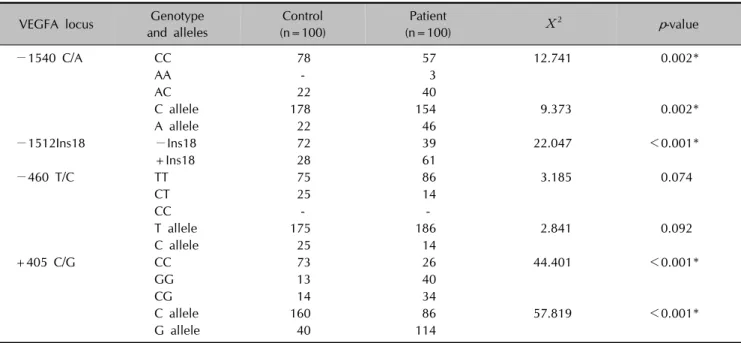
Genotype distribution and allele frequencies of the four VEGFA gene SNPs in psoriatic patients and controls are shown in Table 4. Significant differences were observed in the genotypic and allelic distribution of −1540 C/A, −1512 Ins18, and +405 C/G SNPs between psoriatic patients and controls.
The +405 GG and CG genotypes were significantly more frequent in psoriatic patients than controls (p<0.001).
Homozygotes (GG) and heterozygotes (CG) of the +405 C/G SNP increased the risk of developing psoriasis by ap- proximately nine- and seven-fold, respectively (ORs=9.40
and 7.02, respectively, p<0.001 for both; Table 5). The G and C alleles were found to be present at high frequencies in psoriatic patients and controls, respectively (p<0.001;
Table 4).
The 18-bp insertion at the −1512 locus was significantly more frequent in psoriatic patients compared to controls (p<0.001). The −1512 Ins18 SNP increased the risk of disease four-fold (OR=4.01, p<0.001; Table 5).
The −1540 CA genotype was significantly more frequent in patients with psoriasis compared to controls (p=0.002).
An approximately two-fold increased risk of psoriasis was observed in the heterozygote genotype of −1540 C/A SNP (OR=2.5, p=0.004; Table 5). The A allele frequency was higher in the patient group, whereas the C allele fre- quency was higher in the control group (p=0.002; Table 4).
The genotype and allele distributions of -460 T/C SNP did not significantly differ between patients and controls.
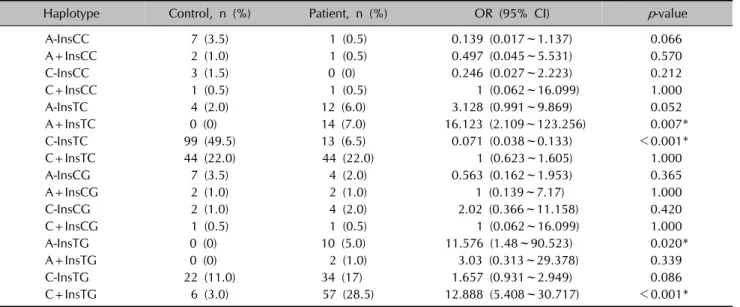
Regarding the four loci, all 16 potential haplotypes (com- binations of −1540 C/A, −1512 Ins18, −460 T/C, and
Table 6. Haplotype frequencies for VEGFA gene −1540 C/A, −1512Ins18, −460 T/C and +405 C/G SNPs in psoriatic patients and controls
Haplotype Control, n (%) Patient, n (%) OR (95% CI) p-value
A-InsCC 7 (3.5) 1 (0.5) 0.139 (0.017~1.137) 0.066
A+InsCC 2 (1.0) 1 (0.5) 0.497 (0.045~5.531) 0.570
C-InsCC 3 (1.5) 0 (0) 0.246 (0.027~2.223) 0.212
C+InsCC 1 (0.5) 1 (0.5) 1 (0.062~16.099) 1.000
A-InsTC 4 (2.0) 12 (6.0) 3.128 (0.991~9.869) 0.052
A+InsTC 0 (0) 14 (7.0) 16.123 (2.109~123.256) 0.007*
C-InsTC 99 (49.5) 13 (6.5) 0.071 (0.038~0.133) <0.001*
C+InsTC 44 (22.0) 44 (22.0) 1 (0.623~1.605) 1.000
A-InsCG 7 (3.5) 4 (2.0) 0.563 (0.162~1.953) 0.365
A+InsCG 2 (1.0) 2 (1.0) 1 (0.139~7.17) 1.000
C-InsCG 2 (1.0) 4 (2.0) 2.02 (0.366~11.158) 0.420
C+InsCG 1 (0.5) 1 (0.5) 1 (0.062~16.099) 1.000
A-InsTG 0 (0) 10 (5.0) 11.576 (1.48~90.523) 0.020*
A+InsTG 0 (0) 2 (1.0) 3.03 (0.313~29.378) 0.339
C-InsTG 22 (11.0) 34 (17) 1.657 (0.931~2.949) 0.086
C+InsTG 6 (3.0) 57 (28.5) 12.888 (5.408~30.717) <0.001*
VEGFA: vascular endothelial growth factor A, SNPs: single nucleotide polymorphisms, OR: odds ratio, CI: confidence interval.
*Statistically significant results.
Table 7. Correlation between family history and VEGF genotypes
VEGFA locus Genotype No family history (n=60) Positive family history (n=40) Χ2 p-value
−1540 C/A CC 34 (59.6) 23 (40.4) 0.976 0.614
AA 1 (33.3) 2 (66.7)
AC 25 (62.5) 15 (37.5)
−1512 Ins18 −Ins18 22 (56.4) 17 (43.6) 0.343 0.558
+Ins18 38 (62.3) 23 (37.7)
−460 T/C TT 51 (59.3) 35 (40.7) 0.003 0.953
CT 9 (64.3) 5 (35.7)
+405 C/G CC 18 (69.2) 8 (30.8) 6.261 0.044*
GG 18 (45.0) 22 (55.0)
CG 24 (70.6) 10 (29.4)
Values are presented as number (%). VEGF: vascular endothelial growth factor. *Statistically significant result.
+405 C/G) are presented in Table 6. There was a sig- nificant difference in haplotype distribution; the C-InsTC haplotype was significantly more frequent in controls (p
<0.001) and the C+InsTG, A+InsTC, and A-InsTG hap- lotypes were significantly more frequent in psoriatic pa- tients (p<0.001, 0.007, and 0.020, respectively). Haplotype analyses also revealed that the frequencies of the G allele at the +405 locus and 18-bp insertion at the −1512 lo- cus, as well as the A allele at the −1540 locus, were sig- nificantly higher in psoriatic patients.
Regarding other combinations of the four SNPs, the most common co-occurrences of genotypes in psoriatic patients were as follows: (+405 GG) homozygous+(−1512 +Ins18) (p<0.001); (+405 CG) heterozygous+(−1540 CA) heter- ozygous+(−1512 +Ins18) (p=0.013); (+405 CG) heter-
ozygous+(−1512 +Ins18) (p=0.002); (+405 GG) homo- zygous+(−1540 CA) heterozygous (p=0.002); (+405 CG) heterozygous+(−1540 CA) heterozygous (p=0.002).
Furthermore, the +405 GG genotype was more common in psoriatic patients with a positive family history (p<0.05;
Table 7). The moderate form of psoriasis (PASI=8∼12) was more frequent among C+InsTG haplotype carriers compared to other patients (OR=2.53, p=0.016). Although not significant, the C+InsTG haplotype was more frequent in patients with early-onset psoriasis (Type I, 31.4%) com- pared to those with late-onset psoriasis (Type II, 18.2%) (p=0.091).
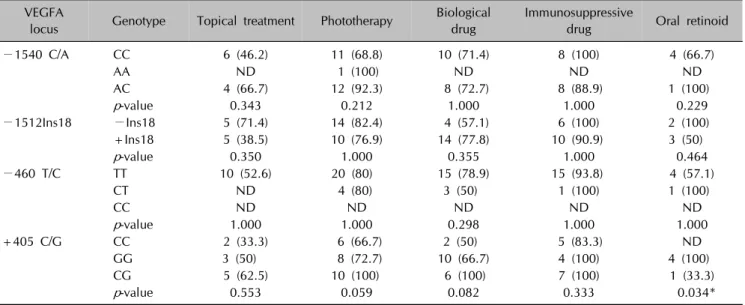
Differences in genotype frequencies between responders to each treatment groups are shown in Table 8. The +405 GG genotype was more often observed in patients who
Table 8. Relationship between genotypes and responders to treatment groups VEGFA
locus Genotype Topical treatment Phototherapy Biological drug
Immunosuppressive
drug Oral retinoid
−1540 C/A CC 6 (46.2) 11 (68.8) 10 (71.4) 8 (100) 4 (66.7)
AA ND 1 (100) ND ND ND
AC 4 (66.7) 12 (92.3) 8 (72.7) 8 (88.9) 1 (100)
p-value 0.343 0.212 1.000 1.000 0.229
−1512Ins18 −Ins18 5 (71.4) 14 (82.4) 4 (57.1) 6 (100) 2 (100)
+Ins18 5 (38.5) 10 (76.9) 14 (77.8) 10 (90.9) 3 (50)
p-value 0.350 1.000 0.355 1.000 0.464
−460 T/C TT 10 (52.6) 20 (80) 15 (78.9) 15 (93.8) 4 (57.1)
CT ND 4 (80) 3 (50) 1 (100) 1 (100)
CC ND ND ND ND ND
p-value 1.000 1.000 0.298 1.000 1.000
+405 C/G CC 2 (33.3) 6 (66.7) 2 (50) 5 (83.3) ND
GG 3 (50) 8 (72.7) 10 (66.7) 4 (100) 4 (100)
CG 5 (62.5) 10 (100) 6 (100) 7 (100) 1 (33.3)
p-value 0.553 0.059 0.082 0.333 0.034*
Values are presented as number (%). VEGFA: vascular endothelial growth factor A, ND: not detected. *Statistically significant result.
were responsive to oral retinoids (100%, p=0.034). When analyzed in relation to all therapies, the +405 GG and CG genotypes were observed more frequently in patients who respond to all therapies (72.5% and 85.3%, re- spectively, p=0.058) and the C+InsTC haplotype was more frequently observed in patients who did not respond to therapies (31.5%, p=0.052).
Serum VEGFA, VEGFR1/FLT1, and VEGFR2/KDR levels, and VEGFA genotypes
Significantly increased serum levels of VEGFA in psoriatic patients with the C-InsTC haplotype were observed when compared to healthy controls with the same haplotype.
Mean VEGFA serum levels were 307.6±108.6 pg⁄ml (range, 194.7∼411.2 pg/ml) in psoriatic patients and 148.5±50.2 pg/ml (range, 69.4∼213.6 pg/ml) in controls (p<0.05). When considered independently of haplotype, serum VEGFA, VEGFR1/FLT1, and VEGFR2/KDR levels did not show significant differences between psoriatic pa- tients and controls (data not shown). We also stratified based on other genotype combinations and did not ob- serve significant differences between psoriatic patients and controls (data not shown).
DISCUSSION
This study shows that the VEGFA gene +405 GG and CG,
−1512+Ins18, and −1540 CA genotypes are associated with an increased risk of psoriasis in Turkish population.
The +405 GG genotype also carries a significantly in- creased risk of developing psoriasis that becomes more
evident when patients with a positive family history are considered. Patient carriers of the C+InsTG haplotype show an approximately two-fold increased risk of develop- ing moderate (PASI=8∼12) in relation to mild (PASI <8) forms of psoriasis. The +405 GG genotype was more of- ten observed in patients who were responsive to oral retinoids. Our findings suggest that the G allele at the +405 locus and 18-bp insertion at the −1512 locus are risk factors for psoriasis, and that this risk is potentiated by the presence of the A allele at the −1540 locus. We found no evidence of an association between the −460 T/C SNP and psoriasis. These findings are consistent with previous reports of a possible critical role of VEGFA in ne- ovascularization and vascular changes as early pathophy- siological events in psoriasis34-42.
To date, only nine case-control studies have explored the linkage between VEGFA gene SNPs and the risk of psor- iasis34-42. The majority of these studies examined possible associations between −460 T/C and +405 C/G SNPs and psoriasis. This is the first study to address the role of the
−1540 C/A, −1512 Ins18, −460 T/C, and +405 C/G SNPs together in psoriasis susceptibility, as well as in Turkish population. Among the nine case-control studies, four were conducted in European populations; the other four were in Asian populations, plus one in Canadian pop- ulation34-42. Our results support all previous findings from Asian studies that the +405 GG genotype and G allele at the +405 locus are associated with psoriasis suscepti- bility38-41. In contrast, Young et al.35,36 and Zablotna et al.37 reported that the +405 CC genotype is associated with early-onset psoriasis in British and Polish populations,
respectively. Conversely, Barile et al.34 did not observe an association between the +405 C/G SNP and psoriasis in Italian population. In addition, no association was ob- served between this SNP and psoriatic arthritis in the Canadian population studied42. The results presented here suggest that VEGFA genotype distribution differs according to ethnicity; this is in agreement with Asian studies in which strong association has been observed with the +405 GG genotype and G allele and psoriasis risk. In the assessment of haplotype, risk haplotypes always contained the +405 G allele. Furthermore, we found the +405 GG genotype to be more common in psoriatic patients with a positive family history (p<0.05), which suggests that this genotype could be used to predict genetic susceptibility of psoriasis development. Wu et al.40 also reported a strong association between the +405 G allele and risk of psor- iasis in Asian populations by meta-analysis, while no sig- nificant relationship was detected in a European population.
However, heterogeneity in European studies should be noted, and Barile et al.34 explained this divergence by ei- ther a type 1 error in the British study (false-positive asso- ciation) or by the small number of patients included in the same category in their sample set (type 2 error – false neg- ative). Overall, we observed an approximately nine-fold increased risk of psoriasis with the +405 GG genotype, which was also observed in Asian studies. However, fur- ther studies on the +405 G/C genotype in European pop- ulations are required.
We demonstrated that the −1512+Ins18 genotype is strongly associated with psoriasis (OR=4.01, p<0.001).
In addition, the combination of C+InsTG and A+InsTC haplotypes was significantly more frequent in psoriatic pa- tients compared to other haplotypes. To our knowledge, only one other study has explored the −1512+Ins18 gen- otype in psoriasis, and the results were concordant with our findings that this genotype increases the risk of devel- oping psoriasis34. Furthermore, patient carriers of the C+InsTG haplotype in our study showed an approx- imately two-fold higher risk of developing a moderate compared with a mild form of psoriasis. This finding sug- gests that together with the +405 G allele, the −1512 Ins18 SNP affects psoriasis phenotype.
We also observed a significant correlation between the
−1540 CA genotype and the A allele at the same locus with psoriasis. Barile et al.34 found that haplotypes con- taining the −1540 AA genotype showed a significantly in- creased risk of developing psoriasis that becomes more evident when late-onset disease is considered. The A+InsTC and A-InsTG haplotypes, which carry the A al- lele, were more common in psoriatic patients than con- trols in our study.
Regarding the −460 T/C SNP, although the majority of studies have reported an association between haplotypes containing −460 T and psoriasis, we identified no associ- ation between this SNP and psoriasis. However, the C+InsTG, A+InsTC, and A-InsTG haplotypes were sig- nificantly more frequent in our psoriatic patients.
Furthermore, the stratification of the responsiveness ac- cording to each treatment groups by genotype was analyzed. The +405 GG genotype was more frequently observed in patients who were responsive to oral retinoids (100%, p=0.034). Genotypes and haplotypes in res- ponders versus non-responders to all therapies were also investigated in our study. There was an increased fre- quency of the +405 GG and CG genotypes in patients that responded to all therapies (72.5% and 85.3%, re- spectively) compared to those who did not (27.5% and 14.7%, respectively) (p=0.058). Following incubation of oral retinoids in epidermal keratinocytes from patients with the −405 G allele, VEGFA production was sig- nificantly downregulated35. Although no significant differ- ences in serum VEGFA levels between psoriatic patients and controls were found when stratified by genotype, pa- tients with +405 GG were found to be more responsive to oral retinoids (100%, p=0.034). There could therefore be a genotype-dependent likelihood of benefiting from treatment, which seemed to occur for the risk genotypes +405 GG and CG for psoriasis; however, this warrants further investigation. In addition, the C+InsTC haplotype, which contains the −460 T allele, was more frequent in patients that were non-responsive compared to those who were responsive to all therapies in our study (31.5%, p=0.052). Results by Young et el.35 imply that patients with the −460 TT genotype are almost twice as likely to fail therapies as to respond, which is consistent with our results. It is apparent that psoriasis is polygenic, and there- fore genetically distinct subsets could be characterized by differential treatment responses.
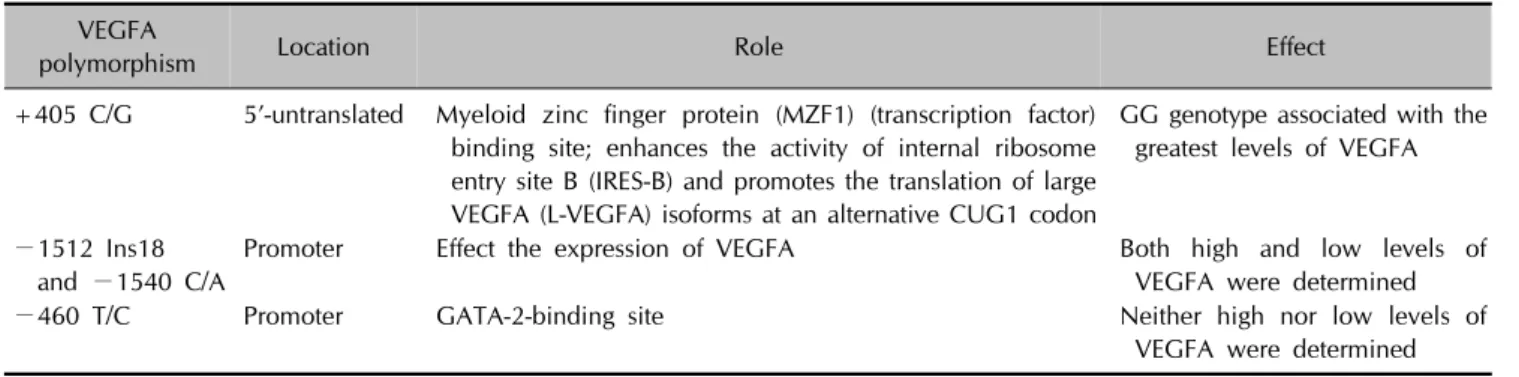
Previous studies have attempted to determine the mecha- nisms by which these VEGFA gene SNPs affect VEGFA production (Table 9). The +405 C/G SNP is located at the 5’-UTR and lies within a myeloid zinc finger protein (MZF1) binding site47. MZF1 is a transcription factor that regulates the transcription of myeloid-specific genes and affects VEGFA transcriptional activity in peripheral blood mononuclear cells48. The occurrence of the C allele is thought to reduce the binding specificity of MZF1 and VEGFA transcription factors47. Moreover, the +405 C/G SNP within the leader sequence of the VEGFA gene en- hances the activity of internal ribosome entry site B (IRES-B) and promotes the translation of large VEGFA (L-VEGFA) isoforms at an alternative CUG1 codon. These L-VEGFA
Table 9. Mechanisms by which VEGFA gene SNPs might affect VEGFA production VEGFA
polymorphism Location Role Effect
+405 C/G 5’-untranslated Myeloid zinc finger protein (MZF1) (transcription factor) binding site; enhances the activity of internal ribosome entry site B (IRES-B) and promotes the translation of large VEGFA (L-VEGFA) isoforms at an alternative CUG1 codon
GG genotype associated with the greatest levels of VEGFA
−1512 Ins18 and −1540 C/A
Promoter Effect the expression of VEGFA Both high and low levels of VEGFA were determined
−460 T/C Promoter GATA-2-binding site Neither high nor low levels of
VEGFA were determined VEGFA: vascular endothelial growth factor A, SNPs: single nucleotide polymorphisms.
isoforms are 205 amino acid residues longer than AUG-in- itiated VEGFA isoforms and appear to increase the intra- cellular VEGFA protein pool8. Stevens et al.32 reported the greatest levels of VEGFA protein production for the +405 GG genotype, intermediate levels for GC, and the lowest levels for the CC genotype. Other groups have also re- ported high VEGFA production with the +405 GG geno- type24, and it is possible that this genotype affects tran- scriptional activity. The other VEGFA gene SNPs at posi- tion −1540, −1512, and −460 are located within the promoter region and have been shown to affect the ex- pression of VEGFA. The −1540 SNP was predicted to be the GATA-2 binding site47; however, conflicting results have been reported. The −1540 AA and −1512 +Ins18 genotypes are associated with both high and low VEGFA production, while the −460 T/C SNP does not play a role in VEGFA production24,30-34. However, when we stratified based on genotype combination, we found no significant differences in serum VEGFA levels between psoriatic pa- tients and controls. No significant differences were ob- served in serum VEGFR1/FLT1 and VEGFR2/KDR levels between psoriatic patients and controls, nor with the hap- lotypes in both groups. We observed significantly in- creased serum levels of VEGFA in psoriatic patients with the C-InsTC haplotype compared to healthy controls with the same haplotype. It should be noted that many conflict- ing results have been reported on the relationship be- tween VEGFA haplotype and VEGFA levels, which may be due to small sample sizes when subclass is used to de- termine haplotype. Additionally, other confounding fac- tors and many different variables, such as environment, may influence circulating levels of VEGFA in patients. It is also possible that other SNPs within the VEGFA gene con- tribute to gene regulation as this gene is highly poly- morphic. Although SNPs that show a significant linkage disequilibrium were chosen in this study, we cannot ex- clude the possibility that additional SNPs to those inves-
tigated here affect serum VEGFA concentrations.
This here is the first case-control study to evaluate the VEGFA gene +405 C/G, −460 T/C, −1540 C/A, and
−1512 Ins18 SNP genotypes and haplotypes together in psoriasis. Two meta-analyses have provided a more con- clusive association between VEGFA gene SNPs and psoriasis. In a meta-analysis, case-control studies are iden- tified by searching electronic databases, used to resolve controversial hypotheses by combining results to obtain a more accurate estimation of the effect in question. However, further case-control studies in different populations are re- quired for a more conclusive evaluation of the association between SNPs and diseases for a meta-analytic approach.
Wu et al.40 used meta-analysis to provide evidence for an association between the +405 G allele and psoriasis, which supports our findings. The meta-analysis by Qi et al.43 supports the hypothesis that the +405 C/G SNP func- tions as a biological marker of psoriasis. The −460 T al- lele was associated with genetic susceptibility to psoriasis in the same meta-analysis, however, we did not find a cor- relation between this SNP and psoriatic patients. Nonethe- less, in any meta-analysis, a potential publication bias may exist because studies with negative results are not published. Therefore, statistical power in a meta-analysis can be increased by including case-control studies with both positive and negative results.
In conclusion, the VEGFA gene +405 GG and CG, −1512+
Ins18, and −1540 CA genotypes are associated with psor- iasis in Turkish population. The G allele at the +405 lo- cus and an 18-bp insertion at the −1512 locus are risk factors for psoriasis, and this risk is potentiated by the presence of the A allele at the −1540 locus. The final phenotype of psoriasis may result from the interaction of these psoriasis-susceptible gene polymorphisms with envi- ronmental factors, including known risk factors. Based on our results, VEGFA could be a therapeutic target for psoriasis. Identification of high-risk genotypes for psoriasis
may reveal novel treatment options that restore to normal or minimize the proangiogenic phenotype, suggesting a possible role for pharmacogenetics in predicting psoriasis treatment responses. Additional large and well-designed case-control studies in diverse ethnic groups with more detailed individual information that include well-matched controls concerning the effects of other SNPs and hap- lotypes on psoriasis are required to delineate associations between VEGFA gene SNPs with the risk of psoriasis.
ACKNOWLEDGMENT
This study was supported by a grant from Hacettepe University Scientific Research Projects Coordination Unit (Project no: 013D06101001), Ankara, Turkey.
REFERENCES
1. Elder JT. Psoriasis clinical registries, genetics, and geno- mics. Ann Rheum Dis 2005;64 Suppl 2:ii106-ii107.
2. Trembath RC, Clough RL, Rosbotham JL, Jones AB, Camp RD, Frodsham A, et al. Identification of a major suscep- tibility locus on chromosome 6p and evidence for further disease loci revealed by a two stage genome-wide search in psoriasis. Hum Mol Genet 1997;6:813-820.
3. Schön MP, Boehncke WH. Psoriasis. N Engl J Med 2005;352:1899-1912.
4. Burden AD, Javed S, Bailey M, Hodgins M, Connor M, Tillman D. Genetics of psoriasis: paternal inheritance and a locus on chromosome 6p. J Invest Dermatol 1998;110:
958-960.
5. Vincenti V, Cassano C, Rocchi M, Persico G. Assignment of the vascular endothelial growth factor gene to human chromosome 6p21.3. Circulation 1996;93:1493-1495.
6. Heidenreich R, Röcken M, Ghoreschi K. Angiogenesis drives psoriasis pathogenesis. Int J Exp Pathol 2009;
90:232-248.
7. Ribatti D. The crucial role of vascular permeability factor/
vascular endothelial growth factor in angiogenesis: a historical review. Br J Haematol 2005;128:303-309.
8. Detmar M. Evidence for vascular endothelial growth factor (VEGF) as a modifier gene in psoriasis. J Invest Dermatol 2004;122:xiv-xv.
9. Detmar M, Brown LF, Claffey KP, Yeo KT, Kocher O, Jackman RW, et al. Overexpression of vascular permeability factor/vascular endothelial growth factor and its receptors in psoriasis. J Exp Med 1994;180:1141-1146.
10. Man XY, Yang XH, Cai SQ, Bu ZY, Zheng M. Over- expression of vascular endothelial growth factor (VEGF) receptors on keratinocytes in psoriasis: regulated by calcium independent of VEGF. J Cell Mol Med 2008;
12:649-660.
11. Zhang Y, Matsuo H, Morita E. Vascular endothelial growth factor 121 is the predominant isoform in psoriatic scales.
Exp Dermatol 2005;14:758-764.
12. Bhushan M, McLaughlin B, Weiss JB, Griffiths CE. Levels of endothelial cell stimulating angiogenesis factor and vascular endothelial growth factor are elevated in psoriasis. Br J Dermatol 1999;141:1054-1060.
13. Creamer D, Allen M, Jaggar R, Stevens R, Bicknell R, Barker J. Mediation of systemic vascular hyperpermeability in severe psoriasis by circulating vascular endothelial growth factor. Arch Dermatol 2002;138:791-796.
14. Xia YP, Li B, Hylton D, Detmar M, Yancopoulos GD, Rudge JS. Transgenic delivery of VEGF to mouse skin leads to an inflammatory condition resembling human psoriasis. Blood 2003;102:161-168.
15. Bottomley MJ, Webb NJ, Watson CJ, Holt L, Bukhari M, Denton J, et al. Placenta growth factor (PlGF) induces vascular endothelial growth factor (VEGF) secretion from mononuclear cells and is co-expressed with VEGF in synovial fluid. Clin Exp Immunol 2000;119:182-188.
16. Murphy M, Kerr P, Grant-Kels JM. The histopathologic spectrum of psoriasis. Clin Dermatol 2007;25:524-528.
17. Creamer D, Sullivan D, Bicknell R, Barker J. Angiogenesis in psoriasis. Angiogenesis 2002;5:231-236.
18. Bos JD, Hulsebosch HJ, Krieg SR, Bakker PM, Cormane RH.
Immunocompetent cells in psoriasis. In situ immunophe- notyping by monoclonal antibodies. Arch Dermatol Res 1983;275:181-189.
19. Kneilling M, Hültner L, Pichler BJ, Mailhammer R, Mo- rawietz L, Solomon S, et al. Targeted mast cell silencing protects against joint destruction and angiogenesis in experimental arthritis in mice. Arthritis Rheum 2007;
56:1806-1816.
20. Miotla J, Maciewicz R, Kendrew J, Feldmann M, Paleolog E.
Treatment with soluble VEGF receptor reduces disease severity in murine collagen-induced arthritis. Lab Invest 2000;80:1195-1205.
21. Watanabe H, Mamelak AJ, Wang B, Howell BG, Freed I, Esche C, et al. Anti-vascular endothelial growth factor receptor-2 (Flk-1/KDR) antibody suppresses contact hyper- sensitivity. Exp Dermatol 2004;13:671-681.
22. Ruggiero D, Dalmasso C, Nutile T, Sorice R, Dionisi L, Aversano M, et al. Genetics of VEGF serum variation in human isolated populations of cilento: importance of VEGF polymorphisms. PLoS One 2011;6:e16982.
23. Brogan IJ, Khan N, Isaac K, Hutchinson JA, Pravica V, Hutchinson IV. Novel polymorphisms in the promoter and 5' UTR regions of the human vascular endothelial growth factor gene. Hum Immunol 1999;60:1245-1249.
24. Watson CJ, Webb NJ, Bottomley MJ, Brenchley PE. Iden- tification of polymorphisms within the vascular endothelial growth factor (VEGF) gene: correlation with variation in VEGF protein production. Cytokine 2000;12:1232-1235.
25. Jiménez-Sousa MA, Fernández-Rodríguez A, Heredia M, Tamayo E, Guzmán-Fulgencio M, Lajo C, et al. Genetic polymorphisms located in TGFB1, AGTR1, and VEGFA genes are associated to chronic renal allograft dysfunction.
Cytokine 2012;58:321-326.
26. Chen Y, Dawes PT, Mattey DL. Polymorphism in the vascular endothelial growth factor A (VEGFA) gene is
associated with serum VEGF-A level and disease activity in rheumatoid arthritis: differential effect of cigarette smoking.
Cytokine 2012;58:390-397.
27. Yang B, Cross DF, Ollerenshaw M, Millward BA, Demaine AG. Polymorphisms of the vascular endothelial growth factor and susceptibility to diabetic microvascular com- plications in patients with type 1 diabetes mellitus. J Diabetes Complications 2003;17:1-6.
28. Kamoun M, Houman MH, Hamzaoui A, Hamzaoui K.
Vascular endothelial growth factor gene polymorphisms and serum levels in Behçet's disease. Tissue Antigens 2008;72:581-587.
29. Breunis WB, Biezeveld MH, Geissler J, Ottenkamp J, Kuipers IM, Lam J, et al. Vascular endothelial growth factor gene haplotypes in Kawasaki disease. Arthritis Rheum 2006;54:1588-1594.
30. Lambrechts D, Storkebaum E, Morimoto M, Del-Favero J, Desmet F, Marklund SL, et al. VEGF is a modifier of amyotrophic lateral sclerosis in mice and humans and protects motoneurons against ischemic death. Nat Genet 2003;34:383-394.
31. Boiardi L, Casali B, Nicoli D, Farnetti E, Chen Q, Macchioni P, et al. Vascular endothelial growth factor gene poly- morphisms in giant cell arteritis. J Rheumatol 2003;30:
2160-2164.
32. Stevens A, Soden J, Brenchley PE, Ralph S, Ray DW.
Haplotype analysis of the polymorphic human vascular endothelial growth factor gene promoter. Cancer Res 2003;
63:812-816.
33. Awata T, Inoue K, Kurihara S, Ohkubo T, Watanabe M, Inukai K, et al. A common polymorphism in the 5'-untrans- lated region of the VEGF gene is associated with diabetic retinopathy in type 2 diabetes. Diabetes 2002;51:1635- 1639.
34. Barile S, Medda E, Nisticò L, Bordignon V, Cordiali-Fei P, Carducci M, et al. Vascular endothelial growth factor gene polymorphisms increase the risk to develop psoriasis. Exp Dermatol 2006;15:368-376.
35. Young HS, Summers AM, Read IR, Fairhurst DA, Plant DJ, Campalani E, et al. Interaction between genetic control of vascular endothelial growth factor production and retinoid responsiveness in psoriasis. J Invest Dermatol 2006;126:
453-459.
36. Young HS, Summers AM, Bhushan M, Brenchley PE, Griffiths CE. Single-nucleotide polymorphisms of vascular endothelial growth factor in psoriasis of early onset. J Invest
Dermatol 2004;122:209-215.
37. Zablotna M, Sobjanek M, Nedoszytko B, Lange M, Kozicka D, Glen J, et al. Association of psoriasis with the VEGF gene polymorphism in the northern Polish population. J Eur Acad Dermatol Venereol 2013;27:319-323.
38. Wongpiyabovorn J, Yooyongsatit S, Ruchusatsawat K, Avi- hingsanon Y, Hirankarn N. Association of the CTG (−2578/
−460/+405) haplotype within the vascular endothelial growth factor gene with early-onset psoriasis. Tissue Antigens 2008;72:458-463.
39. Wang Z, Liang W, Zhang B, Lv M, Wang J, Zhang L. Single nucleotide polymorphisms of VEGF gene and Psoriasis risk.
J Dermatol Sci 2008;49:263-265.
40. Wu J, Ren X, Zhang X, Li C, Li Y, Ma H, et al. The vascular endothelial growth factor +405 G/C polymorphism in psoriasis. J Dermatol Sci 2010;57:62-63.
41. Lee JH, Cho EY, Namkung JH, Kim E, Kim S, Shin ES, et al.
Single-nucleotide polymorphisms and haplotypes in the VEGF receptor 3 gene and the haplotype GC in the VEGFA gene are associated with psoriasis in Koreans. J Invest Dermatol 2008;128:1599-1603.
42. Butt C, Lim S, Greenwood C, Rahman P. VEGF, FGF1, FGF2 and EGF gene polymorphisms and psoriatic arthritis.
BMC Musculoskelet Disord 2007;8:1.
43. Qi M, Huang X, Zhou L, Zhang J. Four polymorphisms of VEGF (+405C>G, -460T>C, -2578C>A, and -1154G>A) in susceptibility to psoriasis: a meta-analysis. DNA Cell Biol 2014;33:234-244.
44. Stefanaki I, Dimisianos G, Antoniou C, Katsambas A, Stratigos A. Investigation of +405 and -460 polymorphisms of vascular endothelial growth factor in psoriasis and short-term responsiveness to efalizumab therapy. Der- matology 2008;217:201-202.
45. Bowes J, Ho P, Flynn E, Salah S, McHugh N, FitzGerald O, et al. Investigation of IL1, VEGF, PPARG and MEFV genes in psoriatic arthritis susceptibility. Ann Rheum Dis 2012;
71:313-314.
46. Carlström M, Ekman AK, Petersson S, Enerbäck C. Lack of evidence for association of VEGF polymorphisms in Swedish patients with psoriasis. J Invest Dermatol 2012;
132:1510-1513.
47. Lip GY, Chung I. Vascular endothelial growth factor and angiogenesis in heart failure. J Card Fail 2005;11:285-287.
48. Lenny N, Westendorf JJ, Hiebert SW. Transcriptional regulation during myelopoiesis. Mol Biol Rep 1997;
24:157-168.