Research Article Open Access
Effect of Weight Ball Throw Training on Weight Shifting of Lower Body, Head Speed of Club, and Driving Distance of Amateur Golfers
Woo-Jin Choi, PT⋅Tack-Hoon Kim, PT, PhD
1†⋅Dong-Sik Oh, PT, MS
1Dept. of Physical Therapy, Shinnae Sungmo Orthopedics Clinic
1
Dept. of Physical Therapy, Hanseo University
Received: July 24, 2017 / Revised: July 28, 2017 / Accepted: August 7, 2017
ⓒ 2017 J Korean Soc Phys Med
| Abstract |
1)PURPOSE: To determine the effect of weight ball throw training as a preparatory exercise before golf practice for 8 weeks on back muscle strength, weight shifting of lower body, head speed of club, and driving distance of amateur golfers.
METHODS: A total of 18 subjects were randomly assigned to the experimental group (n=9) and the control group (n=9), respectively. For the experimental group, Weight ball throw training was provided to the height of waist and shoulder similar to golf swing with the following schedule: 3 kg weight ball throw training from the first week to the 4th week; 5 kg weight ball throw training from the 5th week to the 8th week. Before and after 8 weeks of training, back muscle strength, weight shifting of lower body, head speed of club, and driving distance of subjects in the two groups were measured.
RESULTS: The experimental group showed significant differences in rotational back extension torque, weight shifting of lower body, head speed of club, and driving
† Corresponding Author : [email protected]
This is an Open Access article distributed under the terms of the Creative Commons Attribution Non-Commercial License (http://creativecommons.org/licenses/by-nc/3.0) which permits unrestricted non-commercial use, distribution, and reproduction in any medium, provided the original work is properly cited.
distance during golf swing (p<.05). However, the control group only showed significant difference in driving distance during golf swing (p<.05). Back extension torque, weight shifting of lower body, and head speed of club showed significant differences between the two groups during golf swing (p<.05).
CONCLUSION: Weight ball throw training can positively change rotational back muscle strength, weight shifting of lower body, head speed of club, and driving distance of amateur golfers. Therefore, it might be used as an effective warming up exercise for amateur golfers.
Key Words: Driving distance, Golf, Head speed, Weight ball, Weight shift
Ⅰ. Introduction
In golf swing, efficient swing posture and weight shift
are very important. A good shot by a good swing should
have speed, accuracy, and consistency. These three factors
are closely related to each other and play a complementary
role (So, 1997). Increased driving distance is one of the
most important factors in winning a golf competition
(Hetu et al., 1998). The most important factor that affects
the driving distance is head speed of the club (Fletcher
and Hartwell, 2004). To improve the speed of club head, the lower body of a golfer requires stable weight shift and muscle strength (Park, 2000). Balance in the standing position is closely related to the ability to move weight on one leg (Ko and Lee, 2017). Effective and proper weight transfer is essential to maintaining a good balance by naturally twisting the upper body and delivering the maximum momentum to the ball (Zumerchik, 2010).
To increase muscle strength and power by making muscle contraction and relaxation momentarily, exchanging and throwing a weight ball has been used because it can cause muscle contraction with a load equal to ground reaction by gravitational acceleration (Woo, 2001). The momentum with a throwing or striking motion can be maximized when it is transmitted in the same direction as the direction the projectile is aiming. Proper weight shifting is required to produce a large ground reaction force in order to transmit the projectile farther (Hume, 2005).
Read et al. (2013) have reported that the most effective way to increase club head speed is by squat jumping and side throwing training of weight ball during various plyometric movements. Through this training, various lower body weight movements are changed, thus increasing the club head speed. Throwing training of weight ball is a combination of weight training. It is included in plyometric training because it can improve driving distance and head speed of golf players (Park and Jung, 2007; Fletcher and Hartwell, 2004). In a training study using weight balls for ball games such as handball, baseball, and softball, Szymanski et al. (2010) have conducted a throwing training to male and female baseball by changing the weight of weight ball 3 days a week for 8 weeks. Their results showed that the swing speed of bat and the velocity of the ball hit on the bat were both increased regardless of ball type. Ignjatovic et al.
(2012) have reported that the use of weight ball in female handball players has resulted in significant increase in upper body strength and lower body mobility compared
to the control group.
Based on the previous studies in the ball game, the objective of this study was to determine the effect of weight ball throw training on rotation back extension torque, weight shift of the lower body, head speed of the club, and driving distance of amateur golfers.
Ⅱ. Methods
1. Subjects
The subjects were right-handed amateur golfers with a handicap 15 or more. They had less than 5 years of golf experience in S golf driving range in Seoul. A total of 18 subjects were randomly assigned to the experimental group (n=9) and the control group (n=9), respectively. They were selected as normal cognitive abilities without orthopedic problems. After explaining the purpose of this study to participants, they agreed to be enrolled in the experiment.
2. Experimental methods
In this study, subjects in the experimental group were given 20 minutes of weight ball throw training as preparatory exercise before golf practice. Subjects in the control group practiced golf for the same time without training.
Rotational back extension torque (kg), weight shifting of lower body (%), head speed of club (㎧), and driving distance (m) were measured before and after 8 weeks of training.
1) Weight ball throw training
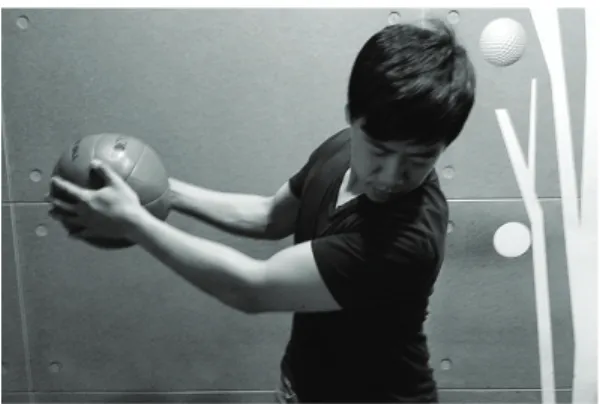
In the experimental group, the subjects held the weight
ball with both hands and stood straight. Then, threw the
weight ball from one side of the waist to the other side
of the shoulder, like a golf swing motion. Training was
carried out four to five times a minute, allowing weight
Fig. 1. Weight ball throw training
shift to the right foot before throwing, and weight shift to the left foot while throwing. To increase the effect of weight ball throw training, the shape of the golf swing was formed (Fig. 1). Waist height was formed in the shape of a 2/4 swing of golf swing while shoulder height was formed in the shape of a 3/4 swing. 3 kg of weight ball was lifted up and thrown to the waist height for the first two weeks (1
stand 2
ndweek). It was then shifted to shoulder height for the next two weeks (3
rdand 4
thweek). Then 5 kg of weight ball was lifted up to the waist height for two weeks (5
thand 6
thweek). It was then shifted to the shoulder height for the last two weeks (7
thand 8
thweek) before golf practice.
3. Measurement methods and tools
1) Rotational back extension torque
Rotational back extension torque was measured using a back force meter (BACK-D, T.K.K.5102, TAKEI, Japan).
Subjects in both experimental group and control group were measured before and after eight weeks of golf practice.
Regarding the measurement method, the height of the back force handle was adjusted so that the angle between the back force system and the upper body was 30 ° after tilting the upper body and grasping handle on the back force system with legs spreading about 15 ㎝ to measure back force.
2) Weight shifting of lower body, head speed of club, and driving distance
Head speed of club, driving distance, and weight shifting of lower body were measured using X-balance, a screen golf device. The X-balance (2CH X-BALANCE, RD-TEK, Korea) was used to analyze weight shift of legs loaded on the ground during golf swing as a percentage (%). It could simultaneously measure head speed of club (㎧) and driving distance (m) with an optical sensor. Head speed, driving distance, and weight shifting were calculated as the average of three performances minus the highest and lowest points of five attempts of participant using 7 iron club. Regarding weight shifting of lower body, the percentage of body weight (%) loaded on the left foot at the moment of hitting the golf ball was measured by subtracting the percentage of body weight loaded on the left foot from the peak of backswing.
4. Data analysis
SPSS ver. 21.0 was used for all data analyses. Mean and standard deviation of each measurement item were calculated for each group. Kolmogorov-Smirnov test was used to determine if there were significant differences in back extension torque, weight shifting of lower body, and head speed of club, and driving distance before and after training within the two groups. Independent t-test was used to compare results between the two groups. Statistical significance was set at p<.05.
Ⅲ. Results
1. General characteristics of subjects
Subjects were randomly assigned to 9 experimental and
control groups, respectively. There was no significant
difference in general characteristics between the two groups
(p>.05) (Table 1).
Experimental group (n=9) Control group (n=9)
Age 36.22±5.91
a35.83±9.01
Height ( ㎝) 174.4±5.72 173.02±6.54
Weight ( ㎏) 75.03±10.71 72.32±12.81
a
Mean±Standard deviation
Table 1. General characteristics of subjects (N=18)
Experimental Group (n=9) Control Group (n=9) t p
RBET Pre (kg) 134.11±32.24
a129.11±26.41 .86 .42
Post (kg) 152.22±36.95 131.11±26.10 3.95 .00*
t -4.29 -.60
p .00* .57
WSLB Pre (%) 33.00±6.40 33.44±9.32 -.17 .87
Post (%) 44.33±5.31 34.44±9.19 3.47 .01*
t -6.51 -1.90
p .00* .09
HSC Pre (m/s) 37.66±3.74 38.66±5.40 -.74 .48
Post (m/s) 43.66±4.03 39.22±4.96 4.16 .00*
t -8.49 -1.47
p .00* .18
DD Pre (m) 126.88±10.98 128.55±13.12 -0.55 .60
Post (m) 135.88±10.85 130.44±13.33 1.94 .09
t -7.88 -3.90
p .00* .01*
a