248 책임저자:홍성길, 200-944, 강원도 춘천시 퇴계동 859-2
(주)이롬 생명과학연구원
Tel: 033-248-8300, Fax: 033-248-8350 E-mail: [email protected]
접수일:2009년 8월 3일, 게재승인일:2009년 8월 17일
Correspondence to:Seong-Gil Hong
Erom R&D Center, 859-2, Toegye-dong, Chuncheon 200-944, Korea Tel: +82-33-248-8300, Fax: +82-33-248-8350
E-mail: [email protected]
Effect of Saengshik on Azoxymethane-induced Colon Carcinogenesis and Colonic Mucosa Inflammatory
Responses in F344 Rats
Hwa-Young Kim, Seong-Ae Lee, Joong-Hark Kim, Ji-Sang Chung, Mi-Hyoun Park, Sung-Joo Hwang and Seong-Gil Hong
Erom R&D Center, Chuncheon 200-944, Korea
This study was performed to investigate the preventive effect of the Saengshik on colorectal cancer using 4 week male F344 rats. To induce colon carcinogenesis, animals were injected with azoxymethane (AOM; 15 mg/kg b.w.) weekly for two weeks. All the rats were divided into control and experimental groups. Animals were fed the diet containing either 30% or 70% Saengshik for 11 weeks. On 11 week, all the rats were sacrificed to measure the formation of aberrant crypt foci (ACF). Showed that then the inflammatory responses in rat colonic mucosa and plasma were determined. Results the number of ACF in Saengshik groups were significantly lower than that in control groups (p<0.05). Also, colonic mucosa cyclooxygenase-2 (COX-2) mRNA expression and cyclooxygenase (COX) activity were decreased in both 30 and 70% Saengshik supplemented groups and plasma prostaglandin E2 (PGE2) level was reduced in 30% Saengshik supplemented group. However, the inducible nitric oxide synthase (iNOS) mRNA expression showed no difference among each groups. These results showed that Saengshik inhibits colon carcinogenesis through reducing of COX-2 mRNA expression. Further researches are necessary to find out mechanisms involved in anti-cancer effects of Saengshik. (Cancer Prev Res 14, 248-255, 2009) Key Words: Aberrant crypt foci, Saengshik, Raw food, Colon carcinogenesis, COX-2, PGE2
INTRODUCTION
According to a report from the Korea national statistical office, cancer is the leading cause of death in Korea. In particular, the incidence of colorectal cancer in males and females has increased by 184% and 164% since 1995, respectively.1) The incidence of colorectal cancer is influenced primarily by environmental factors, particularly by dietary habits. The representative dietary factors that increase the incidence of colorectal cancer are the increased intake of high calorie food and meat, and a decreased intake of vegetables and fruits.2)
According to several epidemiological studies, the incidence
of chronic diseases including cancer has been reported to be low in areas where the consumption of fruits or vegetables is high.3∼5) It appears that this apparent preventative effect may be due to physiologically active substances contained in vegetable foods, such as Vitamin C and E, selenium, folic acid, phytochemicals, fibers, protease inhibitor, etc. In addition, these substances are involved in inflammatory reactions in vivo and control the expression of a variety of proteins. Further more they suppress the development and progression of inflammatory reactions and play a protective role against cancer and other diseases.6,7)
Recently, several studies have reported that the use of non-steroid anti-inflammatory drugs (NSAIDs) decreases the risk of colorectal carcinogenensis. Accordingly, the association
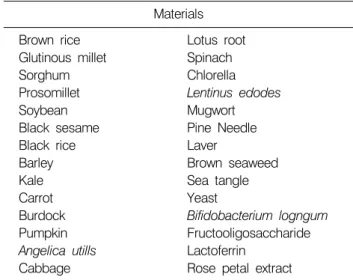
Table 1. Ingredients of Saengshik Materials
Brown rice Lotus root
Glutinous millet Spinach
Sorghum Chlorella
Prosomillet Lentinus edodes
Soybean Mugwort
Black sesame Pine Needle
Black rice Laver
Barley Brown seaweed
Kale Sea tangle
Carrot Yeast
Burdock Bifidobacterium logngum
Pumpkin Fructooligosaccharide
Angelica utills Lactoferrin
Cabbage Rose petal extract
between colon carcinogenesis and inflammation has received considerable attention. Moreover, studies on physiologically active substances inhibiting colorectal cancer through suppre- ssion of inflammation are ongoing.
It was reported that NSAIDs suppress inflammation and inhibit the early stages of colon carcinogenensis, such as adenomatous polyps. The representative mechanism of the anticancer effect has been reported to be the blocking of cyclooxygenase synthesis, a enzyme that produces prostaglandin and inducible nitiric oxide synthase.8,9)
Because colorectal diseases are closely associated with dietary factors, desirable dietary habits and a nutritionally balanced diet are very important for their prevention and management.
It appears that less overeating and more regular meals, as well as the consumption of whole grains, fresh fruits and fresh vegetables containing dietary fibers, vitamins and other antioxi- dants, chlorophyll, phytochemicals, etc. might help prevent and possibly treat colorectal diseases.10) Saengshik is a formulated health food consisting of freeze-dried and powdered whole grains, fruits, vegetables, and other diverse raw materials. In addition, it contains abundant fiber as well as physiologically active substances. Many studies on effects of Saengshik have reported its following properties: anti-diabetes, anti-hyper- lipidemia, anti-obesity, immune enhancement, antioxidation, detoxification, improvement of a fatty liver, and other diverse functions.11∼18) However, inhibitory effects of Saengshik against carcinogenesis are not completely understood. Therefore, this study evaluated the effects of Saengshik on azoxymethane (AOM)-induced colon carcinogenesis and colonic mucosa inflammatory responses. For the anti-cancer effect of Saengshik, the formation of ACF (aberrant crypt foci), a precancerous marker, was determined, and the cyclooxygenase (COX) activity and PGE2 (prostaglandin E2) content were measured.
In addition, the expression of cyclooxygenase-2 (COX-2) and inducible nitric oxide synthase (iNOS) mRNA in F344 rats was quantified.
MATERIALS AND METHODS
1. Animal maintenance and diet composition
Thirty two male Fisher 344 rats (4 weeks old) were obtained from Japan SLC (SLC, Tokyo, Japan). The rats were allowed one week to acclimatize and fed general animal feed during this period. The rats were divided randomly into 3 groups ;
8 animals in a control group, and 12 animals in each of the experiment groups. The experimental groups were divided in to two, those receiving a diet containing either 30% or 70%
Saengshik (30% S, 70% S, respectively). Their body weight at that time was 120∼145 g. The experimental diet was supplied for 11 weeks, and azoxymethane (AOM, Wako pure chemical industries, Ltd., Japan) was used as a the chemical carcinogen.
All were groups were received two AOM injection; one at 2 weeks after the initiation of experimental diet., 3 weeks. The AOM in saline was injected uppcptaneousdiett a concentration of 15 mg/kg body weight and total of 30 mg/kg was injected.
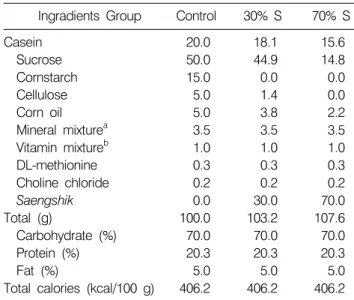
The Saengshik used in these experiments was supplied by Erom Co., Ltd (Country). Table 1 shows its compositions. experi- mental diets were based on the AIN-76 diet, and the com- positions of the animal diets were purchased from eurchased from Dyets Co. (Dyets INC., USA). In order to resolve the differences of nutrients in the control diet and the experimental diet containing Saengshik, the Saengshik used in this study was analyzed for its contents of carbohydrate, lipid, and protein. All diets were prepared to have an equivalent energy density (Table 2).
2. Sample collection
The rats were sacrificed 11 weeks after the experimental diet.
The colons were removed, washed with saline, and 5 animals from the control group and 8 animals from each experiment group were fixed in 10% buffered formalin in order to measure the ACF level. The colorectal mucosa was obtained from the remaining animals and stored at −80oC until used for the
Table 2. Composition of experimental diets
Ingradients Group Control 30% S 70% S
Casein 20.0 18.1 15.6
Sucrose 50.0 44.9 14.8
Cornstarch 15.0 0.0 0.0
Cellulose 5.0 1.4 0.0
Corn oil 5.0 3.8 2.2
Mineral mixturea 3.5 3.5 3.5
Vitamin mixtureb 1.0 1.0 1.0
DL-methionine 0.3 0.3 0.3
Choline chloride 0.2 0.2 0.2
Saengshik 0.0 30.0 70.0
Total (g) 100.0 103.2 107.6
Carbohydrate (%) 70.0 70.0 70.0
Protein (%) 20.3 20.3 20.3
Fat (%) 5.0 5.0 5.0
Total calories (kcal/100 g) 406.2 406.2 406.2
aMineral mix. (g/100 g): CaCO3 29.29, CaHPO4ㆍ2H2O 0.43, KH2PO4 34.31, NaCl 25.06, MgSO4ㆍ2H2O 9.98, Fe(C6H5O7) ㆍ6H2O 0.623, CuSO4ㆍ5H2O 0.156, MnSO4ㆍH2O 0.121, (NH4)6Mo7O24ㆍ4H2O 0.0025, Na2SeO3ㆍ5H2O 0.0015, ZnCl2
0.02, KI 0.005. bVitamin mix (mg/100 g): VD3 0.582, α-toco- pherol-acetate 1200.0, retinol-acetate 93.2, VK3 6.0, thiamin- HCl 59.0, VB12 0.2, VC 588.0, pyridoxine-HCl 29.0, D-biotin 1.0, folic acid 2.0, inositol 1176.0, Ca-pantothenate 235.0, riboflavin 59.0, nicotinic acid 294.0, sucrose 96257.017.
measurements of COX activity and the expression of COX-2 and iNOS mRNA. The blood samples were separated into plasma and kept at −80oC to measure the PGE2 level.
3. Measurement of aberrant crypt foci (ACF)
The number of ACF was measured using Bird’s method.17) Briefly, the prepared colon tissues were fixed in 10% buffered formalin for 24 hours. The colon was divided into 3 parts, and placed in a petri dish containing 0.2% methylene blue dissolved in a saline solution for 5∼15 minutes. The sample was placed mucosal side up on a glass microscope slide and examined by microscopy (×40). The number of ACF was counted.
4. COX activity in rat colorectal mucosa and PGE2 level in plasma
The colon mucosa COX activity and plasma PGE2 level were measured using an EIA kit (Cayman Co., Ltd., USA) according to the manual provided in the kit. As an indicator of the COX activity, the level of oxidized N,N,N,N,-tetramethyl-p-pheny- lenediamine (TMPD) was measured at 590 nm. For PGE2, the
sample, the standard, acetylcholine esterase-linked PGE2, and PGE2 antibody were added to 96-well plates coated with polyclonal goat anti-mouse IgG. The plates were reacted for 18 hours at 4oC and stained with Ellman’s reagent. The PGE2
level was quantified by reading the optical density at 415 nm using an ELISA reader.
5. Measurement of the expression of COX-2 and iNOS mRNA level in the colorectal mucosa
The level of COX-2 and iNOS mRNA expression was measured using the following procedure. The cells were collected by scraping the colon mucosa of rats, and total RNA was extracted using a QIAGEN RNeasy kit (Qiagen, Germany). The RNA was reverse-transcribed with oligo (dT) 18 primer using Super Script III reverse transcriptase (Invitrogen, Carlsbad, USA). PCR was performed. The amount of cDNA was normalized using the housekeeping gene, Beta-actin.
Cycling parameters were denaturation at 94oC for 15 s, annealing at 60oC for 30 s, and extension at 72oC for 30 s.
The primer sets were as follows: COX-2 (751 bp), sense primer 5’-TCTGCGATGCTCTTCCGAGCT-3’, reverse primer 5’-G ATACACCTCTCCACCGATGA-3’; iNOS (397 bp), sense pri- mer 5’-CCACAATAGTACAATACTACTTGG-3’, reverse pri- mer 5’-ACGAGGTGTTCAGCGTGCTCCACG-3’; Beta-actin, sense primer 5’-TCCCTGGAGAAGAGCTACGA-3’, reverse pri- mer 5’-ATCTGCTGGAAGGTGGACAG-3’.
6. Statistical analysis
Statistical analysis was carried out using the SPSS program.
All the results are expressed as the mean±S.D. The results comparing the effect of Saengshik supplementation on colon carcinogenesis were analyzed by ANOVA, and the significance between the means was determined using Duncan’s multiple range test.
RESULTS
1. The amount of food intake and the change of body weight
The change in body weight of the experimental animals is used as a marker representing their general condition. Fig. 1 showed the change in body weight over the 11 week experiment period. In this experiment, there was no significant
Fig 1. Body weight gain of rats in experimental 1 at wk 11.
All groups were treated colon carcinogen, AOM. Among each groups were not significantly different (p<0.05).
Table 3. Food intake and weight gain of rats fed different experimental diets
Groupa Food intake (g/d) Weight gain (g)
Control 13.2±0.39 167.6±11.1
30% S 12.4±0.04 158.8±15.2
70% S 12.2±0.40 165.1±17.9
Values are mean±S.D.
aControl: AIN-76 diet+AOM, 30% S: 30% Saengshik diet+
AOM, 70% S: 70% Saengshik diet+AOM.
Table 4. Effect of Saengshik on AOM-induced colonic ACF formation in F344 rats Experimental
group
Foci containinga Total ACF
incidence
1 crypt 2 crypts 3 crypts ≥4 crypts
Control 69.4±29.4a 54.6±21.0a 32.0±15.1a 33.2±10.4a 189.2±56.9a
30% S 48.6±19.6ab 40.5±8.0b 21.3±6.0b 18.0±5.2b 128.4±22.0b
70% S 31.9±11.8b 30.3±6.9b 18.1±4.9b 23.3±8.2b 102.3±24.1b
Values are mean±S.D. (n=5, control; n=8, Saengshik 30, 70%).
a,bNumbers with different superscripts in column are significantly different at p<0.05.
Table 5. Effect of Saengshik on total COX activity in colon mucosa and PGE2 level in plasma of AOM-induced rats
Marker AOM treatment
Control 30% S 70% S
Total COX activity (U/g) 29.5±4.8a 12.4±7.0a 15.4±9.1a
PGE2 (pg/ml) 366.2±112.3a 266.3±133.9a 352.1±166.2a
Values are mean±S.D.
All the measured variable were not significantly different (p<0.05).
difference in the diet consumption rate and body weight change in each group (Table 3). Therefore, it was determined that there were no physiological influences, such as a decrease in consumption, body weight changes, etc.
2. Formation of aberrant crypt foci
This study examined the effect of a supplemental diet containing 30% Saengshik and 70% Saengshik to rats with chemically induced carcinogenesis. ACF were not detected in the group without the AOM treatment. Table 4 show the number of the precancerous markers of colorectal cancer,
aberrant crypt foci (ACF), and the number of aberrant crypt (AC) in the colon/rectum of each group treated with AOM.
Even in the rats with <3 ACs, the Saengshik consumed group showed a significant reduction in ACF compared with the control group. In rats with >4 ACs, which have a high probability of tumor development, Saengshik consumption group showed significantly fewer ACF than the control group.
3. Measurement of the expression of iNOS, COX-2 mRNA, COX activity and PGE2 level
The effect of Saengshik on inflammatory reaction was measured using the representative colorectal cancer carcinogen, AOM, which initiates or deteriorates the inflammatory reaction by increasing the expression of the genes pertinent to an inflammatory reaction. The plasma PGE2 level and COX activity in the colon mucosa (Table 5), and the level of gene
Fig. 2. Expression of inducible nitric oxide syntahse (iNOS) and cyclooxygenase (COX-2) mRNA on colon mucosa of F344 rats. mRNA levels of iNOS and COX-2 in rat colon mucosa were determined by RT-PCR analysis as described under Experimental methods. The groups was divided 3 groups;
Control (AOM+AIN-76 diet), 30% S: (AOM+modified AIN-76 diet containing 30% Saengshik), 70% S (AOM+modified AIN-76 diet contatining 70% Saengshik). β-actin was used as a loading control for normalization.
expression were measured (Fig. 2). The activities of COX within the colorectal mucosa in the 30% Saengshik consumption group and the 70% Saengshik consumption group were decrea- sed by 57.9% and 47.8% compared with the control group, they were not significantly gshik cot. the plasma PGE2 level was reduced in 30% Saengshik consumption group with signi- ficance. And no effect was found with 70% Saenghik consumption group. In addition, the expression levels of the COX-2 gene in the colorectal mucosa from the Saengshik consumption groups were lower than the control. Moreover, there were 11.7% and 30.6% reduction observed in the 30 and 70% Saengshik groups compared with the control group, respectively, indicating a dose-dependent effect. However, the consumption of Saengshik did not reduce the level of iNOS mRNA expression compared with the control group (Fig. 2).
DISCUSSION
The AOM used in this study as a substance inducing colorectal cancer is a metabolite of the nitroso compounds from food, and appears to be metabolized in the liver, and delivered to the colon in the form of MAM (methyl azoxymethanol) via the blood.19) On the other hand, it may be delivered to the colon without passing through the liver and induce oxidative injury to the DNA. Hence, it is involved in the initiation of carcinogenensis.20) ACF induced by AOM is used as a marker for the precursors of colorectal cancer in humans and ani- mals.21,22) It is a colony of abnormal crypts with a pericryptal zone that is formed due to the hyperproliferation of normal
crypts that increase in size.23) ACF is formed by the accumula- tion of one or more AC, and it has been reported that the progression of ACF formed by the accumulation of more than one aberrant crypt focus to tumors is quite high.24) The study reported by Lee and Sung,25) colon cancer was induced in SD rats by AOM and the rats were fed sea mustard, reported a decrease in the ACF formation. Davies26) induced colon carcinogenesis in F344 rats and fed them rye, and reported a decrease in the rate of ACF development. In addition, the supply of the polyphenol chemicals, quercetin, which is one of the representative chemicals present in vegetables, fruits, etc.,27,28) and the isothiocyanates abundant in cabbages and other cruciferous vegetables,29) to rats with induced colon carcinogenesis was reported to reduce the number of ACF.
Therefore, it is believed that the components within Saengshik might help to suppress the formation of ACF. Vegetables and fruits contain abundant dietary fiber as well as nutrients, such as carotenoid, folic acid, vitamin C, and phytochemicals, such as flavonoid, etc. Dietary fiber prevents feces from remaining in the colon/rectum for a long time and thus decrease the time that the carcinogens in the feces come in contact with the gastrointestinal mucosa. Antioxidant vitamins suppress the production of radicals through several pathways in vivo and scavenge radicals in the body, thus helping prevent carcino- genesis.30) Therefore, it was expected that the ingredients in Saengshik would help to suppress ACF formation. In addition, a review of patient-control group studies showed that the consumption of fruits and vegetables reduces the risk of developing colorectal cancer. In particular, there was a strong association between the consumption of green vegetables including cruciferous vegetables and a reduced incidence of colon cancer.31∼33) Moreover, the consumption of raw vege- tables food had a particular protective effect.34) Liu35) reported that the consumption of a mixture of diverse fruits had a higher protective effect than the consumption of a single fruit.
A diet comprising of whole food with abundant fruits, vegetables, etc., provides more than several thousands of phytochemicals with diverse molecular weight, polarity, solu- bility, etc., which can play an useful role in maintaining health.
Therefore, the 30∼40 components contained in Saengshik act in combination to block carcinogenesis.
Generally, intestinal epithelial cells are regenerated every 48
∼72 hours. It has been reported that these cells are involved in the tumorigenesis of colorectal cancer by increasing the
factors associated with early inflammation after being exposed not only to nutrients but also to oxidants, mutagens, and carcinogens.36,37) iNOS and COX-2 are the representative factors involved in the early inflammatory reaction, iNOS is expressed as a response to early inflammatory stimulation in colon or epithelial cells, and produces a large amount of NO-, which is an important for signal transduction in inflammatory reactions.38) In addition, COX synthesizes prostaglandin, which is a precursor of inflammatory substances, and accelerates PGE2
synthesis. The paracrine effects of PGE2 secreted into the blood play an important role in the development of colorectal tumors.39) Therefore, suppressing iNOS expression and as PGE2
synthesis by inhibiting COX-2 expression is considered as a major target for blocking tumorigenesis.40) Several studies have examined this area. One study treated the colorectal cancer cell line, HCA-7, with tricin, apigenin, and quercetin, that are contained in grains, vegetables, and fruits, reported a decrease in COX activity and PGE2 content41) Brown et al.42) reported that flavonoids inhibit the cyclooxygenase and lipoxygenase pathways involved in inflammatory reactions, which are important causes of colorectal cancer. Several studies have suggested an interaction between COX-2 and iNOS. For example, an increase in COX-2 induced by NO increased the level of PGE2 synthesis in rat mesangial cells. In addition, NO has been reported to induce COX-2 expression in rat colorectal epithelial cells.43,44) However, in the present study, the level of COX-2 expression was decreased without altering the expression of iNOS. Hence, Saengshik does not affect the mechanism of NO synthesis induced by iNOS. Takahashi et al.45) has suggested that iNOS expression may act the dysplastic changes and that COX-2 expression is related to tumor growth. That is, COX-2 and iNOS may play an important role in colon carcinogenesis, independently or depen- dently. Also, the Sangshik was decreased the COX-2 mRNA expression, but not changed PGE2 production. COX-2 expre- ssion and PGE2 production may be not accompanied by proportional increases.46) It can be reasoned that the increased COX-2 possibly exert hyperproliferation and anti-apoptotic activity with or with changes in PGE2 levels. The dicrepancies in the COX-2 and PGE2 results may be partly explained by the factors regulating PGE2 production other than COX-2 as PGE2 syntase.47) Kim et al.'s48) study on black soy bean and yellow soy bean showed the results of our study similarly.
The consumption of Saengshik inhibits the tumorigenic
process of the colorectal mucosa induced by carcinogens, and decreases the expression of the COX-2 gene and COX activity, which suppresses the inflammatory reaction. Furthermore, Thease mechanisms plays an important role in the anticancer effect of Saengshik. However, more study on a variety of inflammatory factors will be needed to determine the mechanism for how anti-inflammatory reaction of Saengshik suppresses colon cancer.
REFERENCES
1) Korea national statistical office. Annual report on the cause of death statistics. 2003.
2) Doll R, Peto R. The causes of cancer. Quantitative estimates of avoidable risks of cancer in the United States today. J Natl Cancer Inst 66, 1191-1308, 1981.
3) Renaud S, de Lorgeril M. Wine, alcohol, platelets, and the French paradox for coronary heart disease. Lancet 339, 1523- 1526, 1992.
4) Hertog MG, Kromhout D, Aravanis C, Blackburn H, Buzina R, Fidanza F, Giampaoli S, Jansen A, Menotti A, Nedeljkovic S. Flavonoid intake and long-term risk of coronary heart disease and cancer in the seven countries study. Arch Intern Med 155, 381-386, 1995.
5) Steinmetz KA, Potter JD. Vegetables, fruit, and cancer prevention: a review. J Am Diet Assoc 96, 1027-1039, 1996.
6) Gilbert DL. Fifty years of radical ideas. Ann NY Acad Sci 899, 1-14, 2000.
7) Jackson MJ. An overview of methods for assessment of free radical activity in biology. Proc Nutr Soc 53, 1001-1006, 1999.
8) Hanif R, Pittas A, Feng Y, Koutsos MI, Qiao L, Staiano-Coico L, Shiff SI, Rigas B. Effects of nonsteroidal anti-inflammatory drugs on proliferation and on induction of apoptosis in colon cancer cells by a prostaglandin-independent pathway. Biochem Pharmacol 52, 237-245, 1996.
9) Michael J, Thun S, Jane H, Carlo P. Nonsteroidal anti-inflam- matory drugs as anticancer agent; mechanistic, pharmacologic, and clinical issue. J Natl Cnacer Inst 94, 252-256, 2002.
10) Bird RP. Observation and quantification of aberrant crypts in the murine colon treated with a colon carcinogen: preliminary findings. Cancer Lett 27, 147-151, 1987.
11) Kim MS, Kim ES, Park MH, Hwang SJ, Jeong YH.
Saengshik, a formulated health food, decreases blood glucose and increases survival rate in Streptozotocin-induced diabetic rats. J Med Food 7, 162-167, 2004.
12) Kang SM, Shim JY, Hwang SJ, Hong SG, Jang HE, Park MH. Effects of Saengshik supplementation on health improve- ment in diet-induced hypercholesterolemic rats. J Korean Soc Food Sci Nutr 32, 906-912, 2003.
13) Ha TY, Kim NY. The effects of uncooked grains and vegetables with mainly brown rice on weight control and
serum components in Korean overweight/obese female. Korean J Nutr 36, 183-190, 2003.
14) Song MK, Hong SG, Hwang SJ, Park OJ, Park MH. Improve effects of Saengshik on patient with fatty liver and hyperli- pidemia in murine. Korean J Nutr 36, 834-840, 2003.
15) Park SH, Ahn BY, Kim SH, Han JH. The effect of uncooked powdered food on the weight loss and the biochemical nutri- tional status in overweight and obese woman. J East Asian Soc Dietary Life 13, 39-55, 2003.
16) Park JY, Yang M, Jun HS, Lee JH, Bae HK, Park TS. Effect of raw brown rice and Job’s tear supplemented diet on serum and hepatic lipid concentrations, antioxidative system, and immune function of rats. J Korean Soc Food Sci Nutr 32, 197- 206, 2003.
17) Lee YJ, Lee HM, Park TS. Effects of uncooked powdered food on antioxidative system and serum mineral concentrations in rat fed unbalanced diet. Korean J Nutr 36, 898-907, 2003.
18) Oh YJ, Kim JM, Song SW, Ha HC, Kim HS. Protective effect of Saengshik supplementation on lead induced toxicity in rats. J Korean Soc Food Sci Nutr 34, 959-967, 2005.
19) Fiala ES, Caswell N, Sohn OS, Felder MR, McCoy GD, Weisburger JH. Non-alcohol dehydrogenase-mediated meta- bolism of methylazoxymethanol in the deer mouse, Peromy- scus maniculatus. Cancer Res 44, 2885-2891, 1984.
20) Rao CV, Tokomo K, Kelloff G, Reddy BS. Inhibition by dietary oltipraz of experimental intestinal carcinogenesis indu- ced by azoxymethane in male F344 rats. Carcinogenesis 12, 1051-1055, 1991.
21) Bird RP, Good CK. The significance of aberrant crypt foci in understanding the pathogenesis of colon cancer. Toxicol Lett 113, 395-402, 2000.
22) Takayama T, Katsuki S, Takahashi Y, Ohi M, Nojiri S, Sakamaki S, Kato J, Kogawa K, Miyake H, Niitsu Y.
Aberrant crypt foci of the colon as precursors of adenoma and cancer. N Engl J Med 339, 1277-1284, 1998.
23) Wali R, Bissonnette M, Nguyen L, Hart J, Skarosi S, Suh W, Sitrin M, Brasitus T. Chemopreventive agents, ursodeoxycho- late tumors. Gastroenterol 116, A526, 1999.
24) Roncucci L, Pedroni M, Scalmati A, Bormioli ML, Sassatelli R, Fante R, Losi L, Gregorio C, Petocchi B, Ponz de Leon M. Cell kinetics evaluation of colorectal tumors after in vivo administration of bromodeoxyuridine. Int J Cancer 52, 856- 861, 1992.
25) Lee EJ, Sung MK. Effect of fiber-rich sea mustard feeding on AOM-induced colon aberrant crypt formation and colonic cell proliferation in Sprague-Dawley rats. J Korean Soc Food Sci Nutr 30, 535-539, 2001.
26) Davies MJ, Bowey EA, Adlercreutz H, Rowland IR, Rumsby PC. Effects of soy or rye supplementation of high-fat diets on colon tumour development in azoxymethane-treated rats. Car- cinogenesis 20, 927-931, 1999.
27) Tanaka T, Kawabata K, Honjo S, Kohno H, Murakami M, Shimada R, Matsunaga K, Yamada Y, Shimizu M. Inhibition
of azoxymethane-induced aberrant crypt foci in rats by natural compounds, caffein, quercetin and morin. Oncol Rep 6, 1333- 1340, 1999.
28) Yoshizumi M, Hoyku N, Yusuke O, Takaushi M. Effect of quercetin and/or restraint stress on formation of aberrant crypt foci induced by methylazoxymethane in rat colons. Oncol 54, 118-121, 1997.
29) Chung FL, Conaway CC, Raw CV, Reddy BS. Chemopre- vention of colonic aberrant crypt foci in Fischer rats by sulforaphane and phenethyl isothiocyanate. Carcinogenensis 21, 2287-2291, 2000.
30) Lee SY, Choi KY, Kim KM, Kim MK, Lee JH, Meng KH, Lee WC. The relationship between intake of vegetables and fruits and colorectal adenoma-carcinoma sequence. Korean J Gastroenterolgy 45, 23-33, 2005.
31) Witte JS, Longnecker MP, Bird Cl. Relation of vegetable, fruit, and grain consumption to colorectal adenomatous polyps. Am J Epidemiol 144, 1015-1025, 1996.
32) Benito E, Cabeza E, Moreno V, Obrador A, Bosch FX. Diet and colorectal adenomas: a case-control study in Majorca. Int J Cancer 55, 213-219,1993.
33) Kato I, Tominaga S, Matsuura A, Y oshii Y, Shirai M, Bobayashi S. A comparative case-control study of colorectal cancer and adenoma. Jpn J Cancer Res 841, 1101-1108, 1990.
34) Voorips LE, Goldbohm RA, Van Poppel G, Sturmans F, Hermus RJ, van den Brandt PA. Vegetable and fruit con- sumption and risks of colon and rectal cancer in a prospective cohort study: the netherlands cohort study on diet and cancer.
Am J Epidemiol 152, 1081-1092, 2000.
35) Liu RH. Health benefits of fruit and vegetables are from additive and synergistic combinations of phytochemicals. Am J Clin Nutr 78, 517S-520S, 2003.
36) Ames B. Dietary carcinogens and anticarcinogens. Science 221, 1256-1263, 1983.
37) Grisham MB, Granger DN. Neutrophil-mediated mucosal injury. Role of reactive oxygen metabolites. Dig Dis Sci 33, 6S-15S, 1988.
38) Mayer B, Andrew P. Nitric oxide synthases: catalytic function and progress towards selective inhibition. Naunyn Schmiedebergs Arch Pharmacol 358, 127-133, 1998.
39) Al-Fayez M, Cai H, Tunstall R, Steward WP, Gescher AJ.
Differential modulation of cyclooxygenase-mediated prosta- glandin production by the putative cancer chemopreventive flavonoids tricin, apigenin and quercetin. Cancer Chemother Pharmacol 58, 816-825, 2006.
40) Brown JP. A review of the genetic effects of naturally occu- rring flavonoids, anthraquinones and related compounds. Mu- tat Res 75, 243-277, 1980.
41) Coffey RJ, Hawkey CJ, Damstrup L, Graves-Deal R, Daniel VC, Dempsey PJ, Chinery R, Kirkland SC, DuBois RN, Jetton TL, Morrow JD. Epidermal growth factor receptor activation induces nuclear targeting of cyclooxygenase-2, baso- lateral release of prostaglandins, and mitogenesis in polarizing
colon cancer cells. Proc Natl Acd Sci U.S.A. 94, 657-662, 1997.
42) Inaba A, Uchiyama T, Oka M. Role of prostaglandin E2 in rat colon carcinoma. Hepatogastroenterology 46, 2347-2351, 1999.
43) Tetsuka T, Baier LD, Morrison AR. Antioxidants inhibit interleukin-1-induced cyclooxygenase and nitric-oxide synthase expression in rat mesangial cells. Evidence for post-transcrip- tional regulation. J Biol Chem 271, 11689-11693, 1996.
44) Mei JM, Hord NG, Winterstein DF, Donald SP, Phang JM.
Expression of prostaglandin endoperoxide H synthase-2 indu- ced by nitric oxide in conditionally immortalized murine colo- nic epithelial cells. FASEB J 14, 1188-1201, 2000.
45) Takahashi M, Mutoh M, Kawamori T, Sugimura T, Wakabayashi K. Altered expression of β-catenin, inducible
nitric oxide synthase and cyclooxygenase-2 in azoxymethane- induced rat colon carcinogenesis. Carcinogenesis 21, 1319-1327, 2000.
46) O'Byrne KJ, Dalgleish AG. Chronic immune activation and inflammation as the cause of malignancy. British J Cancer 85, 473-483, 2001.
47) Jakobasson PJ, Thoren S, Morgenstern R, Samuelsson B.
Identification of human prostaglandin E synthase: a micro- somal, glutathione-dependent, inducible enzyme, constituting a potential novel drug target. Proc Natl Acad Sci U.S.A. 96, 7220-7225, 1999.
48) Kim JM, Kim JS, Yoo H, Choung MG, Sung MK. Effects of black soybean [Glycine max (L.) Merr.] seed coats and its anthocyanidins on colonic inflamationand cell proliferation in vitro and in vivo. J Agric Food Chem 56, 8427-8433, 2008.