D I A B E T E S & M E T A B O L I S M J O U R N A L
This is an Open Access article distributed under the terms of the Creative Commons At- tribution Non-Commercial License (http://creativecommons.org/licenses/by-nc/3.0/) which permits unrestricted non-commercial use, distribution, and reproduction in any medium, provided the original work is properly cited.
Current Status of Management in Type 2 Diabetes Mellitus at General Hospitals in South Korea
Jin-Hee Jung1,2,*, Jung-Hwa Lee2,3,*, Jin-Won Noh4, Jeong-Eun Park2,5, Hee-Sook Kim6, Joo-Wha Yoo2,7, Bok-Rye Song2,8, Jeong-rim Lee2,9, Myeong-Hee Hong2,10, Hyang-Mi Jang2,11, Young Na2,12, Hyun-Joo Lee2,13, Jeong-Mi Lee2,14, Yang-Gyo Kang2,15, Sun-Young Kim2,16, Kang-Hee Sim2,16
1Division of Diabetes Education Team, Department of Nursing, Seoul National University Bundang Hospital, Seoul National University College of Medicine, Seongnam,
2Korea Association of Diabetes Nurse Educators, Seoul,
3Division of Diabetes Education Team, Kyung Hee University Hospital at Gangdong, Kyung Hee University School of Medicine, Seoul,
4Department of Healthcare Management and Institute of Global Healthcare Research, Eulji University School of Medicine, Seongnam,
5Division of Diabetes Education Team, Cheil General Hospital & Women’s Healthcare Center, Dankook University College of Medicine, Seoul,
6Department of Nursing, Dongnam Health University, Suwon,
7Division of Diabetes Education Team, Seoul National University Hospital, Seoul National University College of Medicine, Seoul,
8Division of Diabetes Education Team , Seoul St. Mary’s Hospital, College of Medicine, The Catholic University of Korea, Seoul,
9Division of Diabetes Education Team, Asan Medical Center, University of Ulsan College of Medicine, Seoul,
10Division of Diabetes Education Team, Inje University Seoul Paik Hospital, Inje University College of Medicine, Seoul,
11Division of Diabetes Education Team, Gangnam Severance Hospital, Yonsei University College of Medicine, Seoul,
12Division of Diabetes Education Team, Yeouido St. Mary’s Hospital, College of Medicine, The Catholic University of Korea, Seoul,
13Division of Diabetes Education Team, Inje University Ilsan Paik Hospital, Inje University College of Medicine, Goyang,
14Division of Diabetes Education Team, Kwangmyung Sungae Hospital, Gwangmyeong,
15Division of Diabetes Education Team, Bucheon St. Mary’s Hospital, College of Medicine, The Catholic University of Korea, Bucheon,
16Diabetes Education Unit, Samsung Medical Center, Sungkyunkwan University School of Medicine, Seoul, Korea
Background: In Korea, the prevalence, complications, and mortality rate of diabetes are rapidly increasing. However, investiga- tions on the actual condition of diabetes management are very limited due to lack of nation-wide research or multicenter study.
Hence, we have minutely inquired the current status of diabetes management and achievement of glucose target goal in general hospital offering education program. That way, we are able to furnish data for policy making of diabetes education and draw up guideline which may allow us to reduce the morbidity and mortality of diabetes.
Methods: The subjects consisted of 2,610 patients with type 2 diabetes who visited the 13 general hospital in Seoul or Gyeonggi region from March 19 to May 29, 2013. General characteristics, associated diseases, complications, and management status were investigated.
Results: The mean age was 61.0±11.6 years, body mass index was 25.0±3.3 kg/m2, and family history of diabetes was 50.5%. The mean duration of diabetes was 10.7±7.9 years and 53% received education about diabetes. The prevalence of hypertension and dyslipidemia were 59.2% and 65.5%, respectively, and 18.3% of the subjects were accompanied by liver disease. Diabetic retinop- athy appeared in 31.6%, nephropathy in 28.1%, and neuropathy in 19.9% of the subjects. The mean glycosylated hemoglobin (HbA1c) level was 7.3%±1.3% and the achieving rate based on Korean Diabetes Association guideline (HbA1c <6.5%) was 24.8%, blood pressure (130/80 mm Hg or less) was 49.4%, and low density lipoprotein cholesterol (<100 mg/dL) was 63.6%. The reaching rate to the target level in four parameters (blood glucose, blood pressure, lipids, and body weight) was 7.8%.
Conclusion: The blood glucose control rate was lower than other parameters, and the implementation rate of diabetes education was only 53%. Thus more appropriate glucose control and systematic diabetes education are imperative.
Keywords: Achieving rate; Complication; Diabetes; Management status; Therapeutic goals
Corresponding author: Kang-Hee Sim
Diabetes Education Unit, Samsung Medical Center, Sungkyunkwan University School of Medicine, 81 Irwon-ro, Gangnam-gu, Seoul 06351, Korea
E-mail: [email protected]
*Jin-Hee Jung and Jung-Hwa Lee contributed equally to this study as first
http://dx.doi.org/10.4093/dmj.2015.39.4.307 pISSN 2233-6079 · eISSN 2233-6087
INTRODUCTION
Diabetes mellitus is a chronic disease whose prevalence is rap- idly increasing worldwide, with the number of diabetic patients being expected to increase from 360 million in 2011 to 550 mil- lion by 2030 [1]. This increase is especially faster in Asia includ- ing China, India, and Korea [2-9]. The increase in diabetic pa- tients also denotes an increase in the number of complications associated with diabetes. Diabetes is one of the top 5 causes of death in both developing and advanced countries including Korea; in Korea, diabetes ranked 5th in 2010 after cancer, cere- brovascular diseases, cardiovascular diseases, and suicide, whose prevalence increased by 5.6% since 2009 at a much faster rate compared with other diseases [10]. Diabetes patients usu- ally die of stroke, myocardial infarction, etc., and complications such as amputation of feet, blindness, renal failure, etc., serious- ly dampens the patients’ quality of life and add economic bur- dens due to treatments [11-14]. The cost for the management of diabetes is much higher than normal people, especially for dia- betes-associated complications, presenting management of dia- betes as an important personal and social problem [15-19].
The ultimate goal of diabetes management is to prevent com- plications by taking appropriate measures to improve diabetic patients’ quality of life and reduce economic burdens from treatments. It has been reported that diabetes can be managed by proper regulation of blood glucose, blood pressure, dyslipid- emia, etc. in order to reduce risks of complications [20-23];
thus, self-management by diabetic patients is of increasing im- portance with the help of guidelines for appropriate diabetes management and diabetes education [24-27]. In America, the Centers for Disease Control and prevention already recognizes the seriousness of diabetes and is continuing to check not only the prevalence of diabetes but also the diabetes-associated com- plications and the management status of diabetes, as well as running a prevention program [28]. However, not even the sta- tus of diabetes management is being systematically investigated in Korea, and the limited investigation that had been carried out only consists mainly of the data from health insurance and hospitals, revealing the lacking investigation state of diabetes management in Korea [29-32]. Furthermore, considering the importance of diabetes education and that diabetes education is mainly carried out in tertiary hospitals, it is necessary to deter- mine exactly how diabetes management is being achieved in those tertiary hospitals.
In this study we investigated the management status of type
2 diabetes patients in 13 tertiary hospitals in Seoul or Gyeong- gi region. We intend to apply our data to provide a basis to de- velop diabetes management guidelines for individual medical institutions as well as utilizing it as base evidence to prepare appropriate plans for diabetes management in Korea. Identify- ing the standard of diabetes management and prevalence of diabetes-associated complications that could arise from it will be necessary for the preparation and establishment of national policies for diabetes that prepares for the immediate rapid in- crease in diabetes patients.
METHODS
Study subjects
Of the patients who visited the 13 randomly chosen tertiary hospitals in Seoul or Gyeonggi region for blood glucose con- trol from 19th of March to 29th of May in 2013, 2,626 type 2 diabetes outpatients aged over 20 years that regularly visited these hospitals for more than 6 months for blood glucose con- trol were investigated. Of these patients, 16 patients whose blood glucose control schedule did not match that of type 1 diabetes patients were excluded, and the final 2,610 patients were chosen for this study.
During the investigation period, patients who matched this study’s criteria were continuously recruited until a total of 100 patients were recruited from each hospital, and since the num- ber of patients visiting each hospital was different, the registra- tion dates were varied. This study was approved by the Institu- tional Review Board of each hospital with the same protocol.
Study methods
The details of the study subjects’ demographical data, disease- related characteristics, blood test, prescribed medicine, associ- ated diseases, and complications were gathered from their medical records. Medical records questionnaire was made and used based on both domestic and foreign treatment guidelines.
To investigate the diabetes management status, the results of the blood glucose control indices, glycosylated hemoglobin (HbA1c); lipid; fasting glucose; 2-hour postprandial glucose;
microalbuminuria; and ophthalmography tests, were collected.
If no tests had been carried out during the previous 1 year, it was assumed that the tests were not performed.
Diabetes complication was assumed only when it appeared in the medical records. Retinopathy was assumed if there was any abnormality in the test results, regardless of diagnosis. It
was treated as ‘no records’ if the medical records had no histo- ry of any tests or diagnosis. The patients with albumin creati- nine ratio of less than 30 µg/mg, microalbuminuria of 30 to 299 µg/mg, albuminuria of more than 300 µg/mg were regard- ed as normal for nephropathy, or ‘no records’ if they had no re- cords. Renal complications were analyzed based on 8-hour, 24- hour microalbuminuria, albumin creatinine ratio, and medical records. The patients were assumed to have neurological com- plications if they were taking neuropathy medications or if they had previously been diagnosed with neurological compli- cations, even if they were not diagnosed with any. They pa- tients were assumed to have been educated for diabetes only if they had paid for and received one at a relevant center that provides the education at a fee; this was because the records of diabetes education from other centers were often missing and it is difficult to assess how well the patients were educated due to the varying standards of education from different centers.
The patients were assumed to have other associated diseases only if any appeared in the medical records. In case of hyper- tension and dyslipidemia, the patients were assumed to have these disease if they were on antihypertensive or dyslipidemia drugs regardless of their diagnosis. All types of cancer were re- corded. Fatty liver and liver cirrhosis were included in liver diseases, and both hyperthyroidism and hypothyroidism were included in thyroid diseases. The patients were analyzed after classifying them according to their diabetes treatment meth- ods into diet therapy, insulin only, and combined insulin and oral hypoglycemic agent treatment, and drug history was in- vestigated according to the patients’ usage of hypotensive, cho- lesterol-lowering agent, and anticoagulant drugs.
Blood glucose, blood pressure, and blood lipid modulation statuses were measured to assess the extent of metabolism con- trol. The target value for adjustment was set as: <6.5% HbA1c,
<130/80 mm Hg blood pressure, <100 mg/dL low density li- poprotein cholesterol (LDL-C), ≥50 and ≥40 mg/dL cholester- ol in men and women respectively, and <150 mg/dL triglycer- ide as per the Korean Diabetes Association guidelines.
Statistical analysis
Statistical analyses were performed using the SPSS version 18.0 (SPSS Inc., Chicago, IL, USA) with P values less than 0.05 being considered to have statistical significance. The frequency and percentage or the mean and standard deviation were obtained for all results. The general characteristics, the time of onset of diabetes, duration, blood glucose, blood pressure, and blood
lipid levels that could differ depending on gender were analyzed by t-test. Family history, treatment method, experience of dia- betes education, associated diseases, and complications that differed according to gender were analyzed by chi-square test.
RESULTS
The general characteristics of subjects
The total of 2,610 study subjects consisted of 1,460 males (55.9%) and 1,150 females (44.1%). The average age was 61 years with 62.7 for females and 59.7 for males. The average body mass in- dex (BMI) was 25 kg/m2 with 25.2 kg/m2 for females which was higher than the 24.9 kg/m2 of males (P=0.012). The average age at diagnosis of diabetes was 50.1±11.1 years, with the aver- age female age (51.5 years) being higher than that of males (49 years). The duration was on average 10.7 years. In terms of family history, 955 patients (36.7%) had no records, and of the 1,646 whose record was available, 50.5% did have family histo- ry with no differences according to gender. For the treatment of diabetes, 71.6% only took oral hypoglycemic drugs, 17.3%
took both oral hypoglycemic drugs and insulin, and 6.6% only took insulin; there were no differences according to gender. Of all subjects, 53.0% received education with a fee, and there were no differences in education frequency between males and fe- males (Table 1).
Associated diseases and diabetes complications
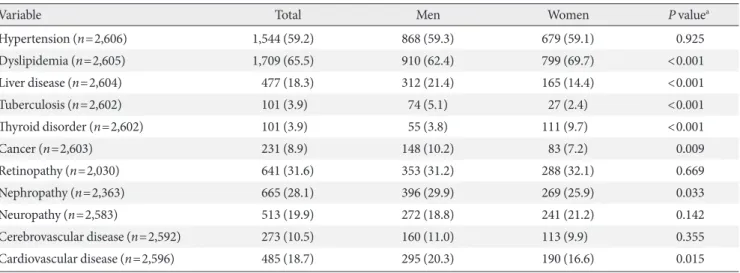
Of the study subjects, 59.2% had hypertension with a higher proportion in males compared with females but with no statis- tical significance. For dyslipidemia, 65.5% of subjects were suf- fering from this disease, where the females had a higher pro- portion with 69.7% compared with 62.4% in males (P<0.001).
The percentage of patients who had liver diseases was 18.3%
with a higher proportion in females compared with males (P<
0.001). The prevalence of tuberculosis and thyroid diseases were both 3.9%, with a higher prevalence in males for tubercu- losis (P<0.001) but vice versa for thyroid diseases (P<0.001).
Cancer was recorded in 8.9% of subjects consisting of 10.2% of males which was higher than the 7.2% of females (P=0.009) (Table 2).
Diabetic retinopathy was present in 31.6% (641 patients) of the 2,030 who had medical records with no differences between males and females. Microalbuminuria test was performed in 73.3% (1,914 patients), and diabetic nephropathy was present in 28.1% (665 patients) of 2,363 patients with a higher percent-
age in males compared with females (29.9% and 25.9%, respec- tively; P=0.033). Microalbuminuria and macroalbuminuria was present in 18.7% and 11.2% of males and in 17.7% and 8.2% of females, respectively. Diabetic neuropathy was record- ed in 19.9% of patients but there were no differences between males and females. Cerebrovascular diseases and cardiovascu- lar diseases were present in 10.5% and 18.7% of patients, re- spectively, and a higher ratio of females had cardiovascular dis-
eases compared with males (P=0.015) (Table 2).
Level of metabolism control
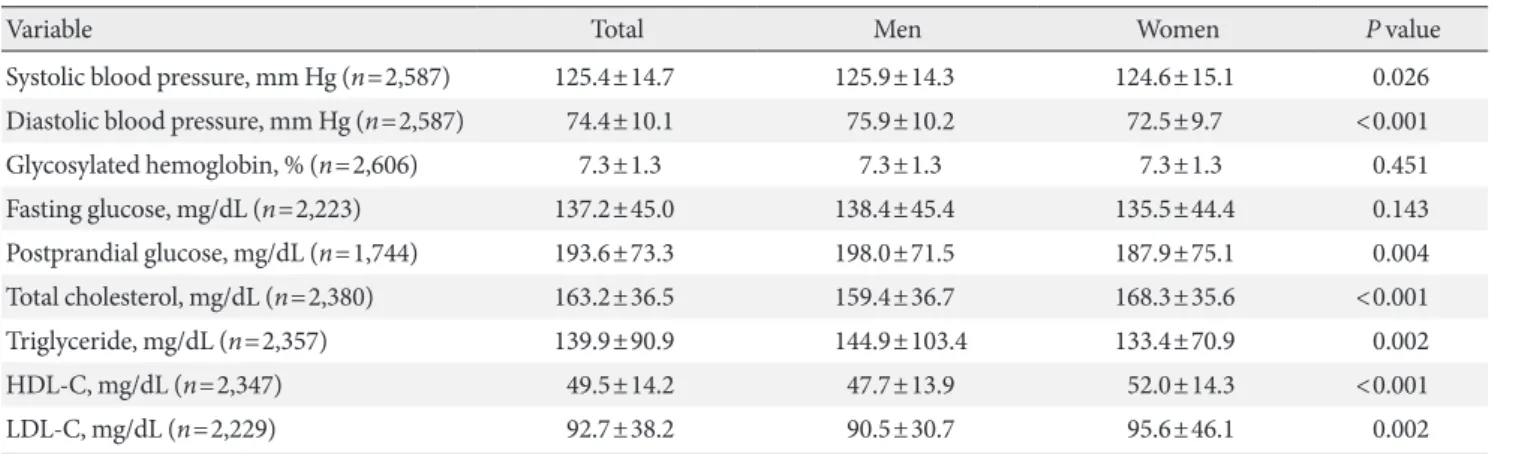
Medical record of systolic blood pressure was available for 2,587 patients showing an average of 125.4 mm Hg with a better reg- ulation in females than males (P=0.026); both groups were be- ing well controlled and within the normal range. HbA1c was tested in 99.8% of patients (2,606 patients) which showed that
Table 1. Clinical and disease-related characteristics
Characteristic Total Men Women P value
Number, % 2,610 1,460 (55.9) 1,150 (44.1)
Age, yr (n=2,609) 61.0±11.6 59.7±11.3 62.7±11.7 <0.001
Height, cm (n=2,435) 162.6±8.9 168.6±6.1 155.2±5.7 <0.001
Weight, kg (n=2,567) 66.6±11.3 71.1±10.6 60.9±9.5 <0.001
Body mass index, kg/m2 (n=2,423) 25.0±3.3 24.9±3.07 25.2±3.6 0.012
Diabetes mellitus onset, yr (n=2,398) 50.1±11.1 49.0±10.7 51.5±11.5 <0.001
Duration of diabetes, yr (n=2,398) 10.7±7.9 10.4±8.0 11.1±7.8 0.034
Family history of diabetes (n=1,646) 832 (50.5) 457 (49.7) 375 (51.5) 0.455a
Therapy of diabetes (n=2,597) 0.425a
Diet 116 (4.5) 69 (4.7) 47 (4.1)
Oral agent 1,860 (71.6) 1,052 (72.4) 808 (70.6)
Oral agent+insulin 448 (17.3) 237 (16.3) 212 (18.4)
Insulin 173 (6.6) 95 (6.5) 78 (6.8)
Education experience (n=2,609) 1,382 (53.0) 764 (52.3) 618 (53.8) 0.459a
Values are presented as number (%) or mean±standard deviation.
aP value from chi-square test.
Table 2. Comorbid diseases and diabetic complications (n=2,610)
Variable Total Men Women P valuea
Hypertension (n=2,606) 1,544 (59.2) 868 (59.3) 679 (59.1) 0.925
Dyslipidemia (n=2,605) 1,709 (65.5) 910 (62.4) 799 (69.7) <0.001
Liver disease (n=2,604) 477 (18.3) 312 (21.4) 165 (14.4) <0.001
Tuberculosis (n=2,602) 101 (3.9) 74 (5.1) 27 (2.4) <0.001
Thyroid disorder (n=2,602) 101 (3.9) 55 (3.8) 111 (9.7) <0.001
Cancer (n=2,603) 231 (8.9) 148 (10.2) 83 (7.2) 0.009
Retinopathy (n=2,030) 641 (31.6) 353 (31.2) 288 (32.1) 0.669
Nephropathy (n=2,363) 665 (28.1) 396 (29.9) 269 (25.9) 0.033
Neuropathy (n=2,583) 513 (19.9) 272 (18.8) 241 (21.2) 0.142
Cerebrovascular disease (n=2,592) 273 (10.5) 160 (11.0) 113 (9.9) 0.355
Cardiovascular disease (n=2,596) 485 (18.7) 295 (20.3) 190 (16.6) 0.015
Values are presented as number (%).
aP value from chi-square test.
the average HbA1c was 7.3%±1.3% with no differences accord- ing to gender. Medical records of fasting glucose and 2-hour postprandial glucose were available for 2,223 patients (85.2%) and 1,744 patients (66.8%), respectively. The average fasting glucose was 137.2±45.0 mg/dL with no differences between males and females, and the average 2-hour postprandial glu- cose was 193.6±73.3 mg/dL with a higher ratio in males than females (198.0±71.5 and 187.9±75.1 mg/dL for males and fe- males, respectively; P=0.004).
The average total cholesterol was 163.3±36.5 mg/dL with a higher ratio in females (159.4±36.7 and 168.3±35.6 mg/dL in males and females, respectively; P=0.001), and the average tri- glyceride was 139.9±90.9 mg/dL with a higher ratio in males than females (144.9±103.4 and 133.4±70.9 mg/dL in males and females, respectively; P<0.002), The average high density
lipoprotein cholesterol (HDL-C) was 49.5±14.2 mg/dL with a higher ratio in females (47.7±13.9 and 52.0±14.3 mg/dL for males and females, respectively; P<0.001), and the average LDL-C was 92.7±38.2 mg/dL which also had a higher ratio in females (90.5±30.7 and 95.6±46.1 mg/dL for males and fe- males, respectively; P=0.002) (Table 3).
Target achievement rate
The success rate of achieving the targets of <130/80 mm Hg,
<7.0% HbA1c, and <6.5% HbA1c were 49.9%, 45.8%, and 24.8%, respectively. Reducing fasting glucose to <130 mg/dL and 2-hour postprandial glucose to <180 mg/dL was achieved in 51.5% and 48.6%, respectively. Total cholesterol and triglyc- eride was reduced to <200 and <150 mg/dL by 84.8% and 68.3%, respectively. Of all subjects, 68.3% maintained their Table 3. Current level of metabolic parameters (n=2,610)
Variable Total Men Women P value
Systolic blood pressure, mm Hg (n=2,587) 125.4±14.7 125.9±14.3 124.6±15.1 0.026
Diastolic blood pressure, mm Hg (n=2,587) 74.4±10.1 75.9±10.2 72.5±9.7 <0.001
Glycosylated hemoglobin, % (n=2,606) 7.3±1.3 7.3±1.3 7.3±1.3 0.451
Fasting glucose, mg/dL (n=2,223) 137.2±45.0 138.4±45.4 135.5±44.4 0.143
Postprandial glucose, mg/dL (n=1,744) 193.6±73.3 198.0±71.5 187.9±75.1 0.004
Total cholesterol, mg/dL (n=2,380) 163.2±36.5 159.4±36.7 168.3±35.6 <0.001
Triglyceride, mg/dL (n=2,357) 139.9±90.9 144.9±103.4 133.4±70.9 0.002
HDL-C, mg/dL (n=2,347) 49.5±14.2 47.7±13.9 52.0±14.3 <0.001
LDL-C, mg/dL (n=2,229) 92.7±38.2 90.5±30.7 95.6±46.1 0.002
Values are presented as mean±standard deviation.
HDL-C, high density lipoprotein cholesterol; LDL-C, low density lipoprotein cholesterol.
Fig. 1. Achieving rate in metabolic targets. Four metabolic target achievement: HbA1c <7.0%, Blood pressure <130/80 mm Hg, LDL-C <100 mg/dL, BMI 18.5 to 24.9 kg/m2. HbA1c, glycosylated hemoglobin; HDL-C, high density lipoprotein cholesterol;
LDL-C, low density lipoprotein cholesterol; BMI, body mass index.
80 70 60 50 40 30 20 10 0
Achieving rate (%)
Blood pressure
<130/80 mm Hg HbA1c <7.0% HbA1c <6.5% Triglyceride
<150 mg/dL HDL-C men>40 mg/dL, women>50 mg/dL
LDL-C
<100 mg/dL BMI
18.5–24.9 kg/m2 4 Metabolic target achievement
49.9 45.8
24.8
68.3
59.1 63.6
51.8
7.8
Men Women Total
HDL-C level to ≥40 mg/dL for males and ≥50 mg/dL for fe- males, and 63.6% maintained their LDL-C to <100 mg/dL.
The percentage of subjects with 18.5 to 24.9 kg/m2 BMI which is the normal range was 51.8% with no differences between males and females. Of all subjects, 14.5% (13.8% and 15.4% for males and females, respectively) reached all three target levels for blood glucose, blood pressure, and lipid level with no dif- ferences between males and females. The percentage of pa- tients who successfully maintained all of blood glucose, blood pressure, lipid level, and weight management target levels was 7.8% (8.0% and 7.5% for males and females, respectively) with no differences between males and females (Fig. 1).
DISCUSSION
This study investigated the status of diabetes management in 2,610 outpatients with type 2 diabetes from 13 tertiary hospi- tals in Korea based on the guidelines provided by the Korean Diabetes Association.
Only 364 patients (14.5%; 13.8% of males and 15.4% of fe- males) managed to reach the target values for blood pressure, blood glucose, and lipid level. Although this is higher than the averages of Asia (4.7%), developing countries (3.6%), and Eu- rope (7.5%), it is lower than that of the United States (18.8%).
Furthermore, the percentage of patients who succeeded in man- aging their blood pressure, blood glucose, lipid level, and weight was 7.8% (8.0% of males and 7.5% of females), which is lower than the average of Western countries despite the relatively low- er rate of obesity, showing the necessity of a more active diabetes management. We also believe that this may be related to the fact that the people with abdominal obesity are more likely to have type 2 diabetes in Asia than in Western countries despite the lower BMI [2,6].
The average HbA1c level in this study was 7.3%±1.3% with- out significant differences between gender, and 45.8% success- fully regulated their HbA1c level to <7.0%. This percentage is higher than the 32.8% and 30.9% of the data from the Korean National Health and Nutrition Examination Surveys (KNHANES) and Health Insurance Data from 1998 and 2005, respectively, and it was also higher than the 30.9% and 36.7% of the study conducted in secondary and tertiary hospitals in 2001 and 2006, respectively [29,30,32]. However, although the blood glucose control rate is higher than the average of the developing coun- tries such as China, Eastern Europe, Asia, and Latin America, it remains lower than the United States, Europe, and Japan [33,34].
The prevalence of hypertension was 59.2% without significant differences between gender, and the rate of controlling blood pressure to <130/80 mm Hg was 49.9%, which is higher than the 36.4% of the average of developing countries, 15.8% to 37%
higher than the KNHANES, and similar to 51.1% of the United States. Moreover, it was similar to the 43.2% and 66.3% from a study based on Korean tertiary hospitals [26,31,32,35-37].
The prevalence of dyslipidemia was 65.5% with a significant- ly higher prevalence in females compared with males. This per- centage is far higher than the 14.1% from the National Health and Nutrition Survey performed in 2010, and also the preva- lence of dyslipidemia in diabetic patients was higher compared with the 30% to 50% of other studies [29,30,36]. We speculate this difference to be due to the average age of 61 years in this study which is higher than previous studies. The rate of con- trolling LDL-C to <100 mg/dL was 63.6%, which is higher than 25% to 50% of multiple other domestic and international stud- ies [29,31,36]. The lower rate of reaching the target for dyslipid- emia in females evidences the sharp changes in female hor- mone after menopause, suggesting that dyslipidemia, a major cause for diabetes complications, should be thoroughly man- aged.
The reason for the high control rate of blood pressure and LDL-C, despite the high average age and time from diagnosis of diabetes, is speculated to be due to the relatively high proportion of cardiovascular and cerebrovascular disease patients and the improved ability to adjust blood pressure and lipid level com- pared with the past. Nonetheless, since the major cause of death in diabetic patients is cardiovascular complications, a more thorough control of blood pressure and blood lipid is required.
The average BMI in this study was 25.2±3.3 kg/m2 with a higher average in females compared with males, and this was similar to the 25.2 kg/m2 of diabetic patients in the National Health and Nutrition Survey in 2010 and the 25.0 kg/m2 of the article published by Lim et al. [30], and lower than Europe or the United States [29,30,38,39].
The prevalence of retinal complications was 31.6% which is lower than the domestic tertiary hospitals, and the prevalence of renal complications was 28.1% which is similar to the 20% to 30% of previously reported studies. The prevalence of neural complications was 19.9% which is lower than a previous study which reported a prevalence of around 45% but higher than the 16.9% reported by tertiary hospitals. Except for retinal compli- cations, these prevalences are lower than the averages of devel- oping countries or Asia, while it is similar in part to the 24.5%
prevalence of microvascular complications in Europe. We be- lieve that the differences in the prevalence of neural complica- tions, even between other domestic studies, is because of the wide variety of methods to diagnose neural complications and because of the improper diagnosis by several clinicians [26,30, 31,36,40].
The prevalence of cardiovascular complications was 18.7%
with no differences between gender, while that of cerebrovas- cular complications was 10.5% with a higher prevalence in males than females. In this study, postprandial glucose, systolic blood pressure, and triglyceride level were higher in males than females; although these differences could have led to the higher prevalence of cerebrovascular complications, we cannot be certain since no differences were observed in the rate of car- diovascular complications. The prevalence of cardiovascular and cerebrovascular diseases was higher than other domestic studies and the Asian average. This may be related to the aver- age age and time from diagnosis of diabetes of our study sub- jects since the prevalence of macrovascular complications in- creases over time after getting diabetes [26,30,31,36,39].
As a method for treating diabetes, 71.6% only used oral hy- poglycemic agents, similarly to previous domestic studies [1,4,5], 17.3% combined the usage of oral hypoglycemic agents and insulin, and 23.9% received insulin treatment which is similar to the 24.1% of studies by domestic tertiary hospitals and 15% to 25% of Europe but lower than the 30% of the Unit- ed States. However, 6.6% only used insulin which higher than the 4.1% from the National Health and Nutrition Survey in 2005. This may be because this study was performed in a tertia- ry hospital and also related with the average age and time from diagnosis of diabetes of our study subjects [29,31,36,38,39].
Considering the speed at which the number of elderly popu- lation is increasing and that the age at which diabetes occurred was 50 years in our study, it is probable that the disease period of diabetes will also increase along with diabetes-related com- plications and become a social burden; hence, a more active treatment to control metabolism is required.
The percentage of subjects who received education regard- ing diabetes at a cost was 53.0% which is similar to the 54.6% of the United States. However, this is higher than the national av- erage of 40%; this difference is likely due to the fact that this study was conducted in tertiary hospitals within Seoul and Gyeonggi region. Nonetheless, further work should investigate the reason why sufficient education is not taking place even in hospitals with diabetes specialists. In this study, the level of ed-
ucation had no correlation with blood glucose control; we be- lieve that this is because diabetes education only takes place once and blood glucose is managed without any further educa- tion for the rest of a patient’s life. This shows the necessity of additional regular diabetes educations considering the charac- teristics of diabetes and the average time that a patient suffers from diabetes.
Since our data was collected from only 13 different tertiary hospitals within Seoul and Gyeonggi region, it is difficult to an- nounce that this represents the general management status of patients with type 2 diabetes. Therefore a further study with a larger cohort including diabetic patients from different medical centers over the country is needed and further continuous edu- cation and management is also required to keep blood glucose, blood pressure, lipid level, and weight within the target range.
Hence caution is advised to prevent exaggerating the results of this study and generalizing it. A repeat study with prognostic data collection method is needed.
In conclusion, the least well-managed between blood pres- sure, blood glucose, lipid level, and weight was blood glucose with more than 50% of subjects failing to reach the target. This represents the difficulty that patients are experiencing in regu- lating blood glucose which is the fundamental to diabetes man- agement and shows that it requires more effort by the patients than hypertension and dyslipidemia which can be controlled by medication. Our results again stress the importance of dia- betes education.
CONFLICTS OF INTEREST
No potential conflict of interest relevant to this article was re- ported.
ACKNOWLEDGMENTS
This study was supported by a grant (K.H.S., 2012) from the Korean Diabetes Association.
REFERENCES
1. Whiting DR, Guariguata L, Weil C, Shaw J. IDF diabetes atlas:
global estimates of the prevalence of diabetes for 2011 and 2030.
Diabetes Res Clin Pract 2011;94:311-21.
2. Yoon KH, Lee JH, Kim JW, Cho JH, Choi YH, Ko SH, Zimmet P, Son HY. Epidemic obesity and type 2 diabetes in Asia. Lan-
cet 2006;368:1681-8.
3. Chan JC, Malik V, Jia W, Kadowaki T, Yajnik CS, Yoon KH, Hu FB. Diabetes in Asia: epidemiology, risk factors, and pathophys- iology. JAMA 2009;301:2129-40.
4. Choi YJ, Kim HC, Kim HM, Park SW, Kim J, Kim DJ. Preva- lence and management of diabetes in Korean adults: Korea Na- tional Health and Nutrition Examination Surveys 1998-2005.
Diabetes Care 2009;32:2016-20.
5. Kim DJ. The epidemiology of diabetes in Korea. Diabetes Metab J 2011;35:303-8.
6. Ramachandran A, Snehalatha C, Shetty AS, Nanditha A. Trends in prevalence of diabetes in Asian countries. World J Diabetes 2012;3:110-7.
7. Xu Y, Wang L, He J, Bi Y, Li M, Wang T, Wang L, Jiang Y, Dai M, Lu J, Xu M, Li Y, Hu N, Li J, Mi S, Chen CS, Li G, Mu Y, Zhao J, Kong L, Chen J, Lai S, Wang W, Zhao W, Ning G; 2010 China Noncommunicable Disease Surveillance Group. Prevalence and control of diabetes in Chinese adults. JAMA 2013;310:
948-59.
8. Yang W, Lu J, Weng J, Jia W, Ji L, Xiao J, Shan Z, Liu J, Tian H, Ji Q, Zhu D, Ge J, Lin L, Chen L, Guo X, Zhao Z, Li Q, Zhou Z, Shan G, He J; China National Diabetes and Metabolic Disorders Study Group. Prevalence of diabetes among men and women in China. N Engl J Med 2010;362:1090-101.
9. Anjana RM, Pradeepa R, Deepa M, Datta M, Sudha V, Unni- krishnan R, Bhansali A, Joshi SR, Joshi PP, Yajnik CS, Dhandha- nia VK, Nath LM, Das AK, Rao PV, Madhu SV, Shukla DK, Kaur T, Priya M, Nirmal E, Parvathi SJ, Subhashini S, Subashini R, Ali MK, Mohan V; ICMR–INDIAB Collaborative Study Group. Prevalence of diabetes and prediabetes (impaired fasting glucose and/or impaired glucose tolerance) in urban and rural India: phase I results of the Indian Council of Medical Research- INdia DIABetes (ICMR-INDIAB) study. Diabetologia 2011;54:
3022-7.
10. Statistisc Korea: Cause of death statistics 2012. Available from:
http://kostat.go.kr/portal/korea/kor_nw/2/1/index.board?
bmode=read&aSeq=308559 (updated 2013 Nov 25).
11. Kim JH, Kim DJ, Jang HC, Choi SH. Epidemiology of micro- and macrovascular complications of type 2 diabetes in Korea.
Diabetes Metab J 2011;35:571-7.
12. Jin DC. Current status of dialysis therapy in Korea. Korean J Intern Med 2011;26:123-31.
13. Ko SH, Cha BY. Diabetic peripheral neuropathy in type 2 dia- betes mellitus in Korea. Diabetes Metab J 2012;36:6-12.
14. van Dieren S, Beulens JW, van der Schouw YT, Grobbee DE,
Neal B. The global burden of diabetes and its complications: an emerging pandemic. Eur J Cardiovasc Prev Rehabil 2010;17 Suppl 1:S3-8.
15. American Diabetes Association. Economic costs of diabetes in the U.S. in 2012. Diabetes Care 2013;36:1033-46.
16. Lee KW. Costs of diabetes mellitus in Korea. Diabetes Metab J 2011;35:567-70.
17. Kim TH, Chun KH, Kim HJ, Han SJ, Kim DJ, Kwak J, Kim YS, Woo JT, Park Y, Nam M, Baik SH, Ahn KJ, Lee KW. Direct medical costs for patients with type 2 diabetes and related com- plications: a prospective cohort study based on the Korean Na- tional Diabetes Program. J Korean Med Sci 2012;27:876-82.
18. Chang TJ, Jiang YD, Chang CH, Chung CH, Yu NC, Chuang LM. Accountability, utilization and providers for diabetes management in Taiwan, 2000-2009: an analysis of the National Health Insurance database. J Formos Med Assoc 2012;111:
605-16.
19. Reutens AT, Atkins RC. Epidemiology of diabetic nephropa- thy. Contrib Nephrol 2011;170:1-7.
20. Gaede P, Lund-Andersen H, Parving HH, Pedersen O. Effect of a multifactorial intervention on mortality in type 2 diabetes.
N Engl J Med 2008;358:580-91.
21. Stratton IM, Cull CA, Adler AI, Matthews DR, Neil HA, Hol- man RR. Additive effects of glycaemia and blood pressure ex- posure on risk of complications in type 2 diabetes: a prospec- tive observational study (UKPDS 75). Diabetologia 2006;49:
1761-9.
22. Shi L, Ye X, Lu M, Wu EQ, Sharma H, Thomason D, Fonseca VA. Clinical and economic benefits associated with the achieve- ment of both HbA1c and LDL cholesterol goals in veterans with type 2 diabetes. Diabetes Care 2013;36:3297-304.
23. ADVANCE Collaborative Group, Patel A, MacMahon S, Chalmers J, Neal B, Billot L, Woodward M, Marre M, Cooper M, Glasziou P, Grobbee D, Hamet P, Harrap S, Heller S, Liu L, Mancia G, Mogensen CE, Pan C, Poulter N, Rodgers A, Wil- liams B, Bompoint S, de Galan BE, Joshi R, Travert F. Intensive blood glucose control and vascular outcomes in patients with type 2 diabetes. N Engl J Med 2008;358:2560-72.
24. Korean Diabetes Association. Treatment guideline for diabetes.
4th ed. Seoul: Gold Planning and Development; 2011. p40-129.
25. Ko SH, Kim SR, Kim DJ, Oh SJ, Lee HJ, Shim KH, Woo MH, Kim JY, Kim NH, Kim JT, Kim CH, Kim HJ, Jeong IK, Hong EK, Cho JH, Mok JO, Yoon KH; Committee of Clinical Practice Guidelines, Korean Diabetes Association. 2011 Clinical practice guidelines for type 2 diabetes in Korea. Diabetes Metab J 2011;
35:431-6.
26. Chan JC, Gagliardino JJ, Baik SH, Chantelot JM, Ferreira SR, Hancu N, Ilkova H, Ramachandran A, Aschner P; IDMPS In- vestigators. Multifaceted determinants for achieving glycemic control: the International Diabetes Management Practice Study (IDMPS). Diabetes Care 2009;32:227-33.
27. Kim KS. Healthcare Benefit quality assessment of chronic dis- ease. Health Insur Rev Assess Serv 2012;6:14-20.
28. Albright AL, Gregg EW. Preventing type 2 diabetes in commu- nities across the U.S.: the National Diabetes Prevention Program.
Am J Prev Med 2013;44(4 Suppl 4):S346-51.
29. Park SW, Kim DJ, Min KW, Baik SH, Choi KM, Park IB, Park JH, Son HS, Ahn CW, Oh JY, Lee J, Chung CH, Kim J, Kim H.
Current status of diabetes management in Korea using National Health Insurance Database. J Korean Diabetes Assoc 2007;31:
362-7.
30. Lim S, Kim DJ, Jeong IK, Son HS, Chung CH, Koh G, Lee DH, Won KC, Park JH, Park TS, Ahn J, Kim J, Park KG, Ko SH, Ahn YB, Lee I. A nationwide survey about the current status of gly- cemic control and complications in diabetic patients in 2006:
the committee of the Korean diabetes association on the epide- miology of diabetes mellitus. Korean Diabetes J 2009;33:48-57.
31. Lee YS. The current status of type 2 diabetes management at a university hospital. Korean Diabetes J 2009;33:241-50.
32. Kim SA, Park WS, Ohrr HC, Kang HY, Lee DH, Yi SW, Kwak YH, Song JS. Prevalence and management status of diabetes mellitus in Korea. Korean J Med 2005;68:10-7.
33. Guo XH, Yuan L, Lou QQ, Shen L, Sun ZL, Zhao F, Dai X, Huang J, Yang HY; Chinese Diabetes Education Status Survey Study Group. A nationwide survey of diabetes education, self-
management and glycemic control in patients with type 2 dia- betes in China. Chin Med J (Engl) 2012;125:4175-80.
34. Pan C, Yang W, Jia W, Weng J, Tian H. Management of Chinese patients with type 2 diabetes, 1998-2006: the Diabcare-China surveys. Curr Med Res Opin 2009;25:39-45.
35. Stark Casagrande S, Fradkin JE, Saydah SH, Rust KF, Cowie CC. The prevalence of meeting A1C, blood pressure, and LDL goals among people with diabetes, 1988-2010. Diabetes Care 2013;36:2271-9.
36. Lim DJ, Kwon HS, Kim HS, Lee JH, Ko SH, Lee JM, Kim SR, Lee WC, Son HS, Cha BY, Lee KW, Son HY, Kang SK, Yoon KH. Clinical characteristics of the diabetic patients managed at the different medical institutions in Seoul and Gyeonggi prov- ince. Korean J Med 2006;71:173-81.
37. Korean Diabetes Association: Diabetes fact sheet 2012. Avail- able from: http://www.diabetes.or.kr/general/index.html (cited 2013 Sep 21).
38. Ali MK, Bullard KM, Saaddine JB, Cowie CC, Imperatore G, Gregg EW. Achievement of goals in U.S. diabetes care, 1999- 2010. N Engl J Med 2013;368:1613-24.
39. de Pablos-Velasco P, Parhofer KG, Bradley C, Eschwege E, Gonder-Frederick L, Maheux P, Wood I, Simon D. Current level of glycaemic control and its associated factors in patients with type 2 diabetes across Europe: data from the PANORAMA study. Clin Endocrinol (Oxf) 2014;80:47-56.
40. Chuang LM, Tsai ST, Huang BY, Tai TY; Diabcare-Asia 1998 Study Group. The status of diabetes control in Asia: a cross-sec- tional survey of 24 317 patients with diabetes mellitus in 1998.
Diabet Med 2002;19:978-85.