• 검색 결과가 없습니다.

한국간호과학회

N/A
N/A
Protected

Academic year: 2021

Share "한국간호과학회"

Copied!
12
0
0

로드 중.... (전체 텍스트 보기)

전체 글

(1)

INTRODUCTION

Statement of the Problem

Each human being is unique being composed of body, mind, and spirit, which are all inseparably interrelated one with the other. Thus, a change in any of these di- mensions affects the others. The spiritual dimension plays an important role, because it allows a mechanism of compensatory function to take place when an individ- ual experiences physical and psychological turmoil or threat (Fish & Shelly, 1978; Taylor, 2003).

According to Flankl (1959), humans are able to rise above or transcend self from physical, psychological, and

environmental conditions, and to experience the mean- ing as well as the value of life, due to the spiritual di- mension. Especially, patients who are going under crisis and stress in their lives begin to show their major con- cern on existential problems as well as spiritual in- quiries, and they are eventually willing to apply various spiritual activities and resources in facing crises and dis- eases (Carr & Morris, 1996).

The nursing profession has long prided itself in its holistic approach to care, in which the needs of the total person are recognized. In light of this focus on the total person, the noticeable absence of the spiritual dimension in nursing theory, research, and practice is a cause for concern.

Spirituality: Concept Analysis Based on Hybrid Model

Pok Ja Oh, RN, PhD, OCN

1

, Kyung Ah Kang, RN, PhD

2

Purpose. The purpose of this study was to obtain a clearer understanding of spirituality and examine the process of spirituality through defining the meaning and attributes of spirituality.

Method. Concept analysis was done in the three phases, theoretical phase, fieldwork phase, and analytical phase suggested in the Hybrid Model. Five people participated in the fieldwork phase.

Results. Spirituality is activated through self-awareness which occurs as spirit being activated through self-intro- spection, and through restoration of the relationship with Supreme Being. This interconnectedness with Supreme Being has an absolute impact on one’s harmonious interconnectedness with self and neighbors, thus leads all the critical attributes of spirituality to be revealed. The core energy of this harmonious inter- connectedness is love. When activated, it has a great impact on an individual as integrative energy, leads one to go beyond everyday experience as well as to have new perspectives, and to live a satisfactory life in every aspect.

Conclusion. The results of this study suggest that promotion of connectedness is the most important element in spiritual nursing interventions. The results can also be used effectively in developing spirituality assessment scales and theory.

Key Words : Spirituality, Concept Analysis, Hybrid Model

1. Professor, Nursing Department, Sahmyook University 2. Associate Professor, Nursing Department, Sahmyook University Supported by the 2004 Sahmyook University Research Fund

Corresponding author: Pok Ja Oh, RN, PhD, Nursing Department, Sahmyook University Chungryang P.O Box 118, Seoul 130-650, Korea.

Tel: 82-2-3399-3639 Fax: 82-2-3399-3647 E-mail: [email protected]

Received December 8, 2004 ; Accepted April 6, 2005

(2)

The highly abstract nature of spirituality, its frequent synonymous interchange with religiosity, the difficulty in articulating differences between psychosocial and spiri- tual domains and scientific skepticism have prevented adequate investigation and definition of this phenome- non (Elkins, James, Hughes, Andrew & Cherryl, 1988).

Without a precise theoretical definition and conceptual clarity of spirituality, it will remain difficult to recognize or to appreciate spiritual meaning and spiritual distress, and will result in nurses not providing appropriate nurs- ing interventions. The manner in which spirituality is conceptualized and defined has significant implications for professional nursing practice and for the further de- velopment of a body of nursing knowledge (Goddard, 1995).

In previous studies the concept of spirituality have been analyzed (Burkhandt, 1989; Howden, 1992;

Haase, Britt, Coward, Leidy & Penn, 1992), but most studies were done at the theoretical analysis stage and understanding the experienced attributes of spirituality was limited due to the lack of empirical observations.

Concept analysis is useful for refining ambiguous con- cepts and defining the relationships between relevant concepts ( Walker& Avant, 1995) and the Hybrid Model is used to identity, analyze, and refine concepts in the initial stage of theory development. As this model is used with theoretical analysis and empirical observa- tions, it is most applicable to nursing(Schwartz-Barcolt &

Kim, 1993) and as concepts are constantly changing and fluctuating in meaning with relation to time and con- text(Walker & Avant, 1995), it is appropriate to recon- sider spirituality with the Hybrid Model approach, com- bining theoretical analysis with empirical observation.

As there is no clear and consistent understanding of the concept of spirituality, which can serve as a basis for re- search and guide for practice. The aim of this research was to further clarify the concept.

Purpose of This Study

The purpose of this study was to obtain a clearer un- derstanding of spirituality and examine the process of spirituality through defining the meaning and attributes of spirituality. Specific aims were as follows:

1) Determines the critical attributes of spirituality 2) Identify antecedents, consequences, and empirical

referents of the attributes on spirituality.

3) Present a working definition of spirituality based on its attributes.

4) Presents characteristics of the spiritual process.

REVIEW OF LITERATURE: Theoretical phase

In analyzing the concept of spirituality, the researchers examined 65 recent studies related to spirituality, sorted them according to the concepts, spiritual needs, and spiritual intervention, and reviewed the literature espe- cially of concept-related studies. The review of the litera- ture revealed that the concept of spirit or spirituality is used in different ways by different authors and has evolved from a religious focus to a more inclusive exis- tential perspective (Taylor, 2002). However frequently, throughout the literature, spirituality is mistakenly inter- changed or used synonymously with religiosity. Religion is instutionalized and serves as merely one of many pos- sible means of spiritual expression (Emblen, 1992;

Taylor, 2002); also it reflects contemporary cultural val- ues, personal philosophies and is socially constructed.

Within the broader, holistic perspective, spirituality has been described as the central philosophy of life which guides peoples’ conduct (Ellen Rhorst-Ryan, 1985); as giving meaning to existence (Soeken & Carson, 1987);

as a force that impels humans forward into living (Bugental & Bugental, 1984) and integrates all dimen- sions (Reed, 1991) and gives a sense of connection with mystery, a Higher Being (Ellis, 1980).

To further clarify the concept of spirituality, it is im- portant to consider related terms.

The word spirit derives from the Latin word ‘spiritus’, which refer to breath, air or wind. The spirit thus, is

“that which gives life to or animates a person. According to the Oxford dictionary ‘spirit’ is defined as the vital principle; the soul; a breath of wind; essence; chief quali- ty; that which gives real meaning; the essential character;

supernatural.; animating body(MacDonald, 1972;

Burkhardt, 1989). Spirit/spiritual dimension has been described as a creative force to precipitate change; dy- namic force that keeps a person growing; unifying force within individuals integrating and transcending all other dimensions(Burkhardt, 1989); the part which strives for meaning and purpose in existence(Travelbee, 1971).

Spirituality is recognized as an inherent quality of all hu-

mans, and spiritual perspective has been described as a

highly individualized awareness of one’s spirituality and

its quality (Hasse et al., 1992). Spirituality has been de-

scribed as the central philosophy of life (Ellen Rhorst-

Ryan, 1985); a belief that relates a person to the world,

(3)

giving meaning to existence; an integrative energy that produces harmony of mind, body, and spirit (Goddard, 1995); a personal quest to find meaning and purpose in life; a transcendental relationship or sense of conception with the mystery of a Higher Being of God; as empow- ering individuals to be whole and to live life fully(Ferhring et al, 1987). In conclusion, ‘spirit’ refers to that non-corporeal and non mental dimension of the person that is the source of unity and meaning, and ‘spir- ituality’ refers to the concepts, attitudes and behaviors that derive from one’s experience of the dimension of spirit.

Spiritual needs are described as the deepest require- ments of self; any factors necessary to be in a dynamic relationship with God (Stallwood &Stoll, 1975;) and out of that relationship to experience forgiveness, love, hope, trust and meaning and purpose in life (Fish

&Shelly, 1978). The fifth National Conference of Nursing Diagnosis incorporated the five spiritual needs described by Stallwood and Stoll into the diagnostic cat- egory, ‘spiritual distress’. Kim, McFarland, and McLane (1987) define spiritual distress as a disruption in the cre- ative energy that harmoniously unites self, community, nature and a higher power, and transcends one’s biologi- cal and psychosocial nature.

Spiritual health is a condition in which one feels peaceful through proper connectedness with self, neigh- bors, and God; one also leads an active life with joy and peace, sets life goals, and desires to achieve them and is satisfied with them (Chapman, 1986). The behavioral manifestation of this spiritual health is called spiritual well-being (Stoll, 1989). The National Interfaith Coalition on Aging (NICA)(1975) defined spiritual well- being as the affirmation of life in a relationship with God, self, community and environment that nurtures and celebrates wholeness.

In the dimensions of spirituality, spirituality is present- ed as a multidimensional concept that consists of both a vertical dimension of connectedness, referring to relat- edness to a “Supreme Being”, and a horizontal dimen- sion, referring to relatedness to the social and physical environment (Stoll, 1989).

Attributes, consequences and empirical referents of spirituality from the review of literature can be summa- rized as follows;

“Harmonious interconnectedness”, “transcendence”,

‘integrative energy’, and ‘purpose and meaning in life’

emerged as critical attributes from a synthesis of fre-

quently repeated characteristics encountered in the liter- ature.

The first attribute ‘Harmonious interconnectedness’ is defined as a sense of relationship to all of life, a feeling of harmony with self, others, and Universe or Supreme Being. The definition of harmonious interconnectedness was drawn from the work of Burkhardt (1989). It has three categories, intrapersonal (self), interpersonal (in the context of others and natural environment), and transpersonal (referring to a sense relatedness to the Supreme Being. The second attribute was drawn from (1) the work of Frankle as the ability to rise above inflic- tions of the body or psyche; (2) of Reed who described transcendence as reflective of the human capacity to ex- tend the self beyond common boundaries of the imme- diate context and achieve new perspectives and experi- ences; (3) of Kuhn who described spirituality as a capaci- ty that enables a human being to rise above or transcen- dence experience at hand. The third attribute of spiritu- ality is ‘Integrative energy’ which integrates all of the di- mensions and acts as a creative, dynamic force that keeps a person growing and changing (Goddard, 1995;

Reed, 1991). Goddard (1995) who viewed spirituality as the energy producing harmony of mind, body, and spirit, a holistic perspective, defined integrative energy as an inner resource that gives a sense of empowerment.

The fourth attribute ‘Purpose and Meaning in Life’

represents a sense of connectedness with one’s inner val- ues, a greater purpose in life (Farran, Fitchett, Quiring, Enblen & Burck, 1989; Stallwood & Stoll, 1975) and demonstrates hope and a purposeful life. The description of the concept is generally based of the work of Frankl(1959) who proposed that the spiritual tasks of finding meaning in life through self-transcendence and connecting with others comprise the core of existence.

The antecedents of spirituality represented as “spirit”

and its potential enablers were ‘introspection/reflection’,

‘interconnectedness with all living things’ and ‘aware- ness of a Higher-Power’. These provide situations that serve as an impetus for developing spirituality.

The consequences of this concept may be described as

‘physical, psychosocial, and spiritual well-being’ and em- pirical referents are ‘purposeful life’, ‘self-worth’, ‘hope’,

‘love’, ‘service’, ‘forgiveness’, ‘trust/belief’, ‘self-realiza-

tion’, ‘religious practices’, ‘transformation’, ‘inner

strength’, ‘finding meaning’, ‘joy’, ‘self-healing’, ‘a sense

of connectedness’, ‘growth’, ‘moral behavior’, and ‘cop-

ing’.

(4)

Working definition

The definition of spirituality based on these critical at- tributes is that spirituality is a dynamic, integrative ener- gy based on a feeling of harmonious interconnectedness with self, others and a Higher power and through spiri- tuality one is enabled to transcend, be empowered and live with meaning and purpose in life.

METHODS

Analyzing the Concept

The analysis on the concept was done using the three phases suggested in the Hybrid Model by Schwartz- Barcolt and Kim (1993), The model involves steps used to identify, analyze, and refine concepts in the initial stage of theory development and is composed of three phases, the theoretical phase, fieldwork phase, and ana- lytical phase. As this model is used with theoretical analysis and empirical observation, it is applicable to ap- plied sciences in general and to nursing specifically.

Critical attributes of spirituality, antecedents, and con- sequences were identified in the theoretical phase through the literature, and from the attributes a working definition of spirituality was established. To determine the defining attributes of spirituality, the investigators made notes on characteristics of the concept that were frequently repeated in the literature. Antecedents are events or incidences, which must exist prior to the con- cept, consequence are events or incidents that occur as a result of the occurrence of the concept (Walker & Avant, 1995). The identification of antecedents and conse- quences are helpful in further refining the critical attrib- utes and also for identifying underlying assumptions about the concept (Walker & Avant, 1995)

The fieldwork phase aimed at refining the concept by extending and integrating analysis began in the first phase with ongoing empirical observations. The critical attributes, antecedents, and outcomes of spirituality were analyzed from data and from the process of spiritu- ality observed in the fieldwork, a combination of results from each participate. In the analytical phase, the rede- fined concept and process of spirituality were obtained through comparison with the critical attributes, an- tecedents, and outcomes of spirituality in the field, as well as through the literature.

Participants

In the hybrid model when the unit of analysis is at the

individual level, 3- 6 individuals are appropriate (Schwartz-Barcolt & Kim, 1993). Thus, five individuals were selected for the fieldwork phase. They were, partic- ipant 1, a patient with cancer expected to experience spiritual satisfaction, participant 2, a pastor serving at a spirituality training center, participant 3 and 4, two for- mer overseas missionaries, and , participant 5, a Korean- Chinese graduate student majoring in Theology.

Duration and Methods of Data Collection

Data were obtained from participant observation and in-depth interviews after obtaining informed consent.

Interviews were conducted by researchers who had ex- perience in qualitative research. One of researchers ana- lyzed the concept of suffering using the Hybrid Model in her doctoral dissertation, and therefore had intuition and ideas regarding the fieldwork phase. Interviews were tape recorded and transcribed verbatim. The notation system, observational record, theoretical record. and methodological record of Schatzman and Strauss’s(1973) were used for collecting, recording, and analyzing field- work data. As this system facilitates multiple observa- tions and in-depth reflection as well as probing dialogue with participants over time, it is especially helpful in defining and refining a single concept. Each participant was interviewed two or three times and the duration of each interview was one to two hours. Data collection was done in July and August, 2000.

The following questions were given to the participants.

1) Please share with me your spiritual experiences if there are any.

1) Would you describe your feeling, perspective, and thinking as you experienced them?

2) What could be the motivation of your spiritual ex- perience?

3) Has your spiritual experience influenced your life in any way?

4) What kind of changes did you go through while having a spiritual experience?

RESULTS: Fieldwork Phase

Selecting participants and General Characteristics of participants

Five individuals who had the possibility of spiritual ex-

perience were interviewed. The first was a pastor who

served as the director of a spirituality training center. He

was 37 years old, had two children, and was leading a

(5)

successful spiritual life while working in a training center for four years. He donated a kidney for his neighbors.

The second was a married woman who was diagnosed with cancer in its terminal stage. After being involved in a spiritual experience, she was actively fighting against her disease. The third and fourth were college students who had their spiritual experience while serving as mis- sionaries for one year in a remote area of the Philippines. The fifth was a Korean-Chinese student who had a spiritual experience while majoring in Theology in graduate school.

The average age of the participants was 31(range 23 to 45), and there were three women and two men. Two were married and three were single. One graduated from high school, three from college, and was one in graduate school. Four of them were Protestants and one, a Catholic.

The results from these five individuals are as follows:

The Antecedents and Enablers of Spirituality

The antecedent of spirituality in its theoretical phase was spirit, and the enablers of spirituality, self-introspec- tion/self-reflection, spiritual awareness, and intercon- nectedness. Each element was observed and confirmed in the fieldwork phase.

“I was terribly lonely when serving as a missionary. I prayed whenever I felt that way. God was the only One to whom I could talk in Korean.”

“I visited a spirituality training center. There, I began to see my real self and experience God’s deep love. The scene of the cross was revealed before me, and I could see God being deeply hurt.”

“It was the first time in my life to pray so sincerely, be- cause if I could not get through Korean customs with young antlers, I had no way to show my gratitude to those who invited me. To make things worse, the price was more than my father’s salary for a whole month. But it seemed that my prayer was answered.”

According to the statements mentioned above, active spirituality is derived from pivotal life events along with deep self-introspection and spiritual awareness, eventu- ally leading to connectedness with transpersonal being.

Also, the last statement implies that human beings are spiritual beings and the antecedent is spirit, seeing that spiritual awareness occurred at pivotal points in life re- gardless of religion.

Critical Attributes of Spirituality

The critical attributes of spirituality suggested in the review of literature-’harmonious interconnectedness,

‘integrative energy’, ‘transcendence’, and ‘purpose and meaning in life’-were actively observed in the fieldwork.

Harmonious Interconnectedness

Harmonious Interconnectedness is composed of three categories -transpersonal, interpersonal, and intraperson- al. The fieldwork revealed that harmonious interconnect- edness in transpersonal aspects determines spirituality in interpersonal and intrapersonal aspects. The intercon- nectedness with Supreme Being is maintained through reading the Bible, interacting with nature, praying, and receiving an answer for prayer.

“I came to experience the full conviction of forgive- ness and the deep love of God. I read the Bible because I want to see God. The heart of God is in there.

Spirituality has its root in relationship with God. The deeper spirituality grows, the more we become one with God. If I become one with God, He can fulfill His will and character through me. Everything is different for me now, because I relate to God. With God, I can find value and purpose in life.”

“I had this conviction that God is always with me when I saw the sunset. Once I did not receive a single penny for a whole month. but then I realized that God provided me with food.”

“My missionary partner seemed very selfish. So I prayed hard that we could have a better relationship.

Then we had many good times talking and working to- gether.”

“I realized God’s love towards people after my service as a missionary. Now I am able to treat each individual with care. I never imagined myself sympathizing with others this much. I even pray that I am willing to sacri- fice myself for others if necessary.”

“I suffered from terrible depression, but I began to val- ue myself after realizing that Jesus died for me and He loved me even before I was born. That means I am wor- thy in this world.”

The empirical referents of ‘harmonious interconnect-

edness’ in the transpersonal aspect were observed to be

trust and belief in Supreme Being, a sense of relatedness,

joy, happiness, love, Bible study, unity, prayer, and

searching for meaning. The interpersonal aspects of al-

truistic service, and reconciliation were observed and

self-esteem, change, growth, and self-actualization were

(6)

observed in intrapersonal aspects.

“When I was a missionary, I took a small boat to a re- mote island. Water began to pour into my boat since the sea was raging. I was very scared, but then I was com- forted somehow. The blowing wind in the sunset made me feel the guiding care of God.”

“I was terribly lonely during my service as a mission- ary. So I prayed. Then God made me very busy. Of course I was exhausted then, but I was happy.”

“I felt sorry for one of the deaconesses who had a bad kidney. I donated my kidney just to obey God’s calling for help. I am more than willing to do something good for others even if I suffer from it.”

“I feel so happy because something has filled my heart wholly. I find my self being more outgoing and active.”

Integrative Energy

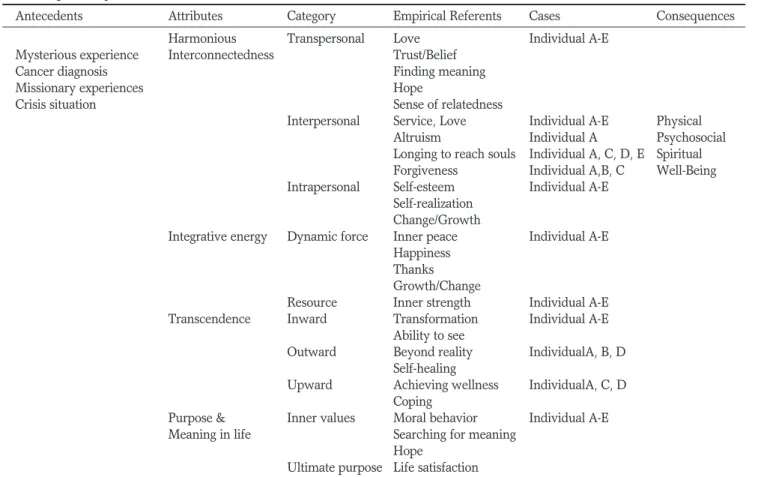
The ‘integrative energy’ of spirituality in the theoreti- cal phase has two categories, force and resource. The fol- lowing were observed during fieldwork:

Under the category of force, there is the force unifying physical, social, and mental areas, and the creative dy- namic force enhancing change and growth. These forces

were observed as enabling one to reconcile with partners in their social relationships, to maintain inner peace un- der difficult situations, and to adjust to unfamiliar envi- ronments when in a mission field. It also enables one to be thankful for even small things and to be mature and to develop as one prepares for the future.

The empirical referents observed in the integrative, creative and dynamic force of spirituality were inner peace, happiness, thankfulness, energy, growth and change.

Under the category of resource, the source of inner strength was shown to be trust/belief in the Supreme Being. Empirical referents were inner strength and ener- gy.

“I didn’t worry about anything though I had no money left. God took care of me until I finished my service as a missionary. With God, nothing was impossible as I con- fronted difficult problems or situations. My spirit was thankful after I served as a missionary. I can finish one bowl of rice with no other food but kimchi.”

“I would pray and feel comforted whenever I had a hard time adjusting to missionary life. I would not worry since I was sure God would provide me with every-

Table 1. Spirituality Attributes from Fieldwork

Antecedents Attributes Category Empirical Referents Cases Consequences

Harmonious Transpersonal Love Individual A-E

Mysterious experience Interconnectedness Trust/Belief

Cancer diagnosis Finding meaning

Missionary experiences Hope

Crisis situation Sense of relatedness

Interpersonal Service, Love Individual A-E Physical

Altruism Individual A Psychosocial

Longing to reach souls Individual A, C, D, E Spiritual Forgiveness Individual A,B, C Well-Being Intrapersonal Self-esteem Individual A-E

Self-realization Change/Growth

Integrative energy Dynamic force Inner peace Individual A-E Happiness

Thanks Growth/Change

Resource Inner strength Individual A-E

Transcendence Inward Transformation Individual A-E

Ability to see

Outward Beyond reality IndividualA, B, D Self-healing

Upward Achieving wellness IndividualA, C, D Coping

Purpose & Inner values Moral behavior Individual A-E

Meaning in life Searching for meaning

Hope

Ultimate purpose Life satisfaction

(7)

thing.”

“I would stumble because of my weak nature, but then I regain my strength whenever I thought of God’s suffer- ing. I am confident in doing my work.”

“I remember and rely on the word of God whenever I am in terrible situations. Nothing is impossible if God is on our side.”

Transcendence

For the category of ‘transcendence’, observations were of inward, outward and upward categories. Empirical referents were transformation, ability to see beyond real- ity, self-healing, ability to heal, forming a relationship with others, and coping as well as achieving wellness.

The critical attribute of transcendence in the inward category was re-evaluation of difficult situations and transcendence to positive definitions, which eventually lead to self-healing, coping, and wellness.

“It was truly a tragedy when I lost my child, but now I think that it allowed me to refine my nature and to sym- pathize with the problem of others. Joining God’s suffer- ing is indeed a blessing.”

“I suffered from a severe headache for a year when I changed my major to Theology. I prayed hard so that my pain would be gone. Then my headache gradually went away.”

“When I was under medical treatment, the thought of Jesus on the cross helped me through under those hard times.”

The critical attribute of transcendence in the outward category was looking at things from the viewpoint of others, and transcending the reality through examining and accepting the situation in a positive way.

“I am willing to ask forgiveness and see him whom I used to hate. I also pray that my enemy will be saved.”

“I used to be very jealous if others were complimented or praised. But then I began to appreciate their works.”

In the upward category, transcendence was observed as the ability of the Supreme Being to be revealed through an individual. Its empirical referents were build- ing up a relationship with others, the ability to commu- nicate, and the ability to heal. These critical attributes were shown when the Supreme Being answered an indi- vidual’s prayers as prayer is based on trust/faith in Supreme Being and the individual has harmonious inter- connectedness with the Supreme Being. Examples are meeting a future spouse according to one’s prayer list, being able to communicate with people in a mission field

with different languages and settings, and praying for healing power for other people’s health.

“While I was praying for a future spouse to do a mis- sion work together in China, God led me to meet the perfect girlfriend. Now I’m sure that nothing is impossi- ble for God.”

“I was struggling with English as I served as a mission- ary in the Philippines, but somehow I could communi- cate with people there. I felt the guiding hand of God helping me.”

“I once had a patient with skin problems, and I real- ized that the more I prayed to God mentioning his name, the better he got even though it was the same medicine.

So I realized that it was God who was healing him.”

“When we lived on a remote island. a neighborhood child had a severe stomachache and cried very hard.

When I prayed for him, I suddenly thought about giving him charcoal. Strangely, his stomachache was gone after that. Then I learned that with God, nothing is impossi- ble.”

Purpose and Meaning in Life

Another general characteristic of spiritual experience is discovering meaning and purpose in life. It also comes with hope and a change in one’s perspective.

Meaning and purpose in life enable one to set ultimate purposes and direction in life when the relationship with the Supreme Being is restored, love is experienced, and absolute trust and faith in the Supreme Being are firm. It also enables one to change perspective and to maintain moral behavior, recognizing the fact that an invisible be- ing is always present.

“I find value and purpose in life when I have a rela- tionship with God. My direction in life is to share God’s love with others.”

“I have to live my life because my family is in need of me. I hope to continually share love with my family and neighbors.”

“I am worthy in this world. That’s why I am willing to live and I don’t want to waste any more time. I guess my values in life have changed.”

“My view of this world, as well as my perspective, has changed. My brother is a professor, and I used to think he was much better off than me. But I realized that pur- suing money, fame, and power is useless in the sight of God. Now I am much happier than my brother.”

“Whenever I attempt to do something wrong, some-

body beside me does not allow me to do wrong.”

(8)

According to these statements, empirical referents of

‘purpose and meaning in life’ are searching for meaning, hope, purposeful life, life satisfaction, change in perspec- tive, and moral behavior.

Consequences of Spirituality

Empirical referents of the outcomes of spirituality in fieldwork were as follows:

The empirical referents from both the theoretical and fieldwork phases were trust and belief in transpersonal being, a sense of relatedness, religion practices, love, ser- vice, forgiveness, joy, self-esteem, self-actualization, or- gan donation, transformation, ability to see beyond reali- ty, self-healing, coping, inner peace, growth and change, health, inner strength, searching for meaning, hope, pur- poseful life, moral behavior, appreciation, and change of perspective. The empirical referents from fieldwork only were reconciliation, reaching for souls, influence, active attitude, satisfaction, clean heart, priority of God, atti- tude of respecting others, positive attitude, humbleness, respect for life, and life satisfaction.

“My priority used to be work, but it has changed to God. I felt like being touched and crying over even small things. I became more outgoing and active and learn to appreciate even small, things. I can enjoy rice only with kimchi, for instance. I am the happiest person in the world since I feel nothing is lacking.”

“I learned God’s love towards others after I worked as a missionary. Now every soul is precious to me. I sympa- thize with those souls. I just can’t disregard them.”

“I feel happier and more grateful than before. I need to let myself die and to listen to God’s gentle voice. I want to live for the glory of God.”

“Those with deep spirituality and those with deep love. Love is something which seeks the good of others, not self.”

“I began to ask forgiveness and see the one I used to hate. I also began to pray that my enemy would be saved.”

“I donated my kidney, thinking I am delivering God’s gift to others. I am happy God used to me as an instru- ment in service to others.”

“It’s living a life with positive attitudes.”

“I think I am willing to bear my problems if others are happy. It’s a miracle I’m thinking this way.”

“I built up my spirituality by praying and reading the word of God for two or three hours early every morn- ing.”

“I used to be very jealous of others if they were com- plimented or praised, but now I begin to appreciate them. I’m just thankful that they were able to reveal Jesus to others.”

“Now I learn to appreciate my life. I regret having said that I would like to die because of my problems.”

“My goal is to have a sound, beautiful, and child-like heart. I want to support my family, brothers, and neigh- bors mentally even though I can’t be of great help to them in material ways.”

According to the statements mentioned above, out- comes of spiritual experience lead one to a condition of well-being, physically, mentally, socially, and spiritually.

DISCUSSION: Final Analytical Phase

This study was done to identify the dimensions, an- tecedents, critical attributes, and consequences of spiri- tuality based on literature in the theoretical phase in or- der to analyze and clarify the concept of spirituality.

Fieldwork was done to observe how these characteristics appear in real life situations, observing spiritual dimen- sions. The vertical dimension showed critical attributes of spirituality resulted from a relationship with the Supreme Being, and the horizontal dimensions showed critical attributes of spirituality resulted from social and environmental relationships. One thing to note from the fieldwork is that horizontal dimensions appeared after vertical ones were activated.

In the antecedents and enablers of spirituality, the an- tecedent of spirituality in the theoretical phase was spir- it, and the enablers were self-introspection, spiritual awareness, and interconnectedness. In the fieldwork phase, self-introspection happened through pivotal life events such as diagnosis of cancer, missionary life in a remote island, spirituality training session and others.

When one has mysterious experiences like seeing the image of God, spiritual awareness deepens. Also, restor- ing one’s relationship with the Supreme Being becomes the enhancing factor of spirituality. Interconnectedness is another important element in maintaining spirituality.

Especially when individuals experience spiritual aware-

ness regardless of their religion, they are shown to be

spiritual beings, and the antecedent of spirituality is spir-

it. In a study by Reed(1987)regarding spirituality, a com-

parison of three groups-patients with cancer in the final

stage, healthy people, and general patients showed that

patients with cancer had the highest level of spirituality.

(9)

This result supports the results of this study that crisis sit- uations lead to spiritual awareness.

The critical attributes of spirituality in the theoretical phase—’harmonious interconnectedness’, ‘integrative energy’, ‘transcendence’, and ‘meaning and purpose in life’—were verified and confirmed through fieldwork.

Harmonious interconnectedness with the Supreme Being leads to harmonious interconnectedness with self, neighbor and nature and plays an important role in acti- vating other critical attributes. In other words, the restoration and activation of harmonious interconnected- ness with the Supreme Being lead to love of self, harmo- nious relationships with neighbors, and love and service for others. Harmonious relationships among the three key elements activate the critical attributes of spiritual transcendence, integral energy, and meaning and pur- pose. Therefore, the critical attributes of ‘harmonious in- terconnectedness’ are at the heart of spirituality(Ley and Corless, 1988). At the same time, they are key compo- nents of spiritual nursing care. Ley and Corless(1988) further state that spirituality is a state of connectedness to God, to one’s neighbor and to one’s inner self. The

‘harmonious interconnectedness’ with the Supreme Being is shown to be maintained through trust/faith in the Supreme Being, interaction with nature, and prayer and answers to prayer. The climax of harmonious inter- connectedness is that intellectuality, sensitivity, and be- havior of an individual are connected with the Supreme Being. Thus, one feels, sees, and behaves accordingly.

This result was not verified during the theoretical phase.

The empirical referents of ‘harmonious interconnected- ness’ with self were shown through love of self and self- actualization. The ‘harmonious interconnectedness’ with neighbors were shown through love for others and will- ingness to reach out for souls. Especially longing for souls was shown to be the climax of the Supreme Being revealed through an individual, the empirical referent, which again was not verified in the literature. Therefore, the core concept of ‘harmonious interconnectedness’ in these three categories was shown to be love.

‘Integrative energy’, the second critical attribute of spirituality, was observed as the force integrating all the dimensions of a person, the creative force, and the source of inner strengths (Goddard, 1995; Reed, 1991).

Among all the critical attributes, it is the one in which the trait of spirit is most clearly revealed. Because of this characteristic, many writers suggest the same definitions for spirit and spirituality. However, the result of this

study show that spirituality is the attitude and behavior revealed out of spirit. This critical attribute of integrative energy was observed to overlap with that of transcen- dence in spirituality. The reason is that the integrative energy of spirituality is activated and leads to revelation of the critical attribute of transcendence.

‘Transcendence’, the third critical attribute of spiritual- ity, is going beyond the present situation and having new perspectives when one has harmonious interconnected- ness with self, others, and the Supreme Being. It also ful- fills self-healing, sublimation, adjustment, and wellness.

While the category of transcendence was not completely verified in the theoretical phase, it was in the fieldwork phase. The inward category of transcendence (self tran- scendence) only was explained in the theoretical phase, while the outward and upward categories of transcen- dence were explained in the fieldwork phase. In this way, the concept of spirituality can be more clearly un- derstood. The inward aspect means going beyond one’s difficult situation, and the outward, transcendence to the viewpoint of others and re-evaluating it. Self-transcen- dence is facilitated through a transpersonal relationships grounded in the inseparable interconnectedeness among self, others, nature and the Supreme Being. Upward as- pect means the ability of the Supreme Being revealed through an individual. These results support statements by theologian, Jackson(1980), that ‘spirituality is some- thing that leads the self beyond itself, to live beyond it- self, to die beyond itself, and to be self-creative in diffi- cult situations.’

‘Meaning and purpose in life’, the fourth critical at- tribute of spirituality, are the rediscovery of value, meaning, and purpose in life when the critical attribute of harmonious interconnectedness of spirituality is acti- vated. It is also moral behavior out of love for people and God, and actualization of value in life. Meaning and purpose in life represents the existential well being from the horizontal dimension of spiritual well being (Eillison, 1983). It has been shown to be a result of the vertical di- mension of spiritual well being.

Frankl (1959) proposed that the spiritual tasks of find- ing meaning in life through self-transcendence and con- necting with others comprise the core of existence. A lack of meaning, thus, can lead to spiritual distress and feelings of emptiness and despair.

According to the results of this study, the empirical ref-

erents of spirituality reveal that the outcomes of spiritu-

ality reflect physical, mental, social, and spiritual well-

(10)

being.

CONCLUSIONS

The purpose of this study was to obtain a clear under- standing of spirituality and examine the process of spiri- tuality through defining the meaning and attributes of spirituality.

Using the three phases, theoretical, fieldwork, and an- alytical, the concept was analyzed as suggested in the Hybrid Model. Five people were selected for the field- work phase, the first, a patient with cancer and yet ex-

pected to experience spiritual satisfaction, second, a pas- tor serving at a spirituality training center, third and fourth, two former missionaries, and fifth, a Korean- Chinese graduate student majoring in Theology.

The results showed that the antecedent of spirituality in the theoretical phase was spirit, and the enablers of spirituality self-introspection / self-reflection, spiritual awareness, and interconnectedness. These elements were observed and confirmed especially in the fieldwork phase. It was found out that the enablers of spirituality were the results of pivotal life events, such as diagnosis of cancer, mysterious experience of religion, and mis-

Spirituality

Spirituality is a multi-dimensional concept integrating religious and existential meaning.

Through one’s harmonious interconnectedness with supreme being, one has harmonious in- terconnectedness with self and neighbors. The love resulting from this interconnectedness functions as dynamic and creative energy, leading one to experience something beyond reali- ty, and helping one to find meaning and purpose in existence as well as satisfactory living.

Metaphysical (vertical)

Antecedents (Enablers)

Spirit

(Introspection /Reflection)

(Spiritual Awareness)

(Interconnected ness)

Categories

Empirical Referents

Harmonious Interconnectedness

Intrapersonal Interpersonal Transpersonal

Intrapersonal Love of self self-esteem self-realization Interpersonal

love, service, reconciliation, forgiveness, altruism Longing to reach souls

Transpersonal hope, joy, finding meaning, religious practices, a sense of relatedness, trust/belief

Dynamic force Inner peace, happiness, health thanks, Growth/

Change

Resource Inner strength

Transformation ƒU Ability to see beyond the reality ƒU Self-healing ƒU Achieving

wellness ƒU Coping

Finding of meaning Hope Purposeful life Life satisfaction Moral behavior Integrative

energyess

Dynamic force

Resource

Transcendence

Inward Outward Upward

purpose &

meaning in Life

Inner Values

Ultimate Purpose

Attributes Consequen

ces

Physical, Psycho social, Spiritual Well- Being Existential

(horizontal)

(11)

sionary life.

The critical attributes of spirituality suggested in the review of literature—’harmonious interconnectedness,

‘integrative energy’, ‘transcendence’, and ‘purpose and meaning in life’—were actively observed in the field- work in both the vertical dimension and horizontal di- mension. The social aspect was observed through one’s relationship with self, others, friends, and neighborhood.

The environmental aspect was observed through mis- sionary life, critical situations, studying abroad, minister- ial work, and one’s life under medical treatment.

The empirical referents of the outcomes of spirituality were trust and belief in transpersonal being, a sense of relatedness, religion practices, love, service, forgiveness, reconciliation, joy, reaching for souls, self-esteem, self- actualization, organ donation, transformation, ability to see beyond reality, self-healing, coping, inner peace, growth and change, health, inner strength, searching for meaning, hope, purposeful life, moral behavior, life satis- faction, influence, activeness, appreciation, satisfaction, clean heart, priority of God, attitude of respecting oth- ers, positive attitude, humbleness, respect for life, and change of perspective. Some empirical referents from the fieldwork were not shown in the literature,

In conclusion, the processes of spirituality verified by the theoretical and fieldwork phases are as follows:

Spirituality is activated through self-awareness, which occurs as spirit being is activated through self-introspec- tion, and through the restoration of relationship with the Supreme Being. Harmonious interconnectedness with the Supreme Being is maintained through trust, faith, prayer and answers to prayer. This interconnectedness with the Supreme Being has an absolute impact on one’s harmonious interconnectedness with self and neighbors, thus leads all the critical attributes of spirituality to be revealed. The core energy of this harmonious intercon- nectedness is love. When activated, it has a great impact on an individual as integrative energy, leading one to go beyond everyday experience as well as to have new per- spectives, and to live a satisfactory life in its every as- pect.

The results of this study suggest a clearer definition of spirituality and a conceptual framework for spiritual nursing interventions. They also suggest that promoting connectedness is the most important intervention in spiritual nursing. The results can also be used effectively in developing spirituality assessment scales.

References

Bugental, E. & Bugental, J. (1984)Dispiritedness°™A new perspec- tive on a familiar state. J Human Psycho, 24 (1), 49-67.

Burkhardt, M.A. (1989). Spirituality: An analysis of the concept.

Holist Nurs Pract, 3(3), 69-77.

Carr, E.W.,& Morris, T.(1996). Spirituality and patients with ad- vanced cancer: A social work response. J Psycho Oncol, 14(1), 71-81.

Chapman, L.S.(1986). Spiritual health; A component missing from health promotion. Am J Health Prom, 1(1), 38-41.

Elkins, D.N., James H.L., Hughes, L.L., Andrew L.J, & Saunders, C.(1988). Toward a humanistic phenomenological spirituality.

J Human psycho, 28(4), 5-18.

Ellen Rhorst-Ryan, J. (1985). Selecting an instrument to measure spritual distress. Oncol Nurs Forum. 12(2), 93-99.

Ellis, D. (1980). “Whatever Happened to the Spiritual Dimension?”. Can Nurse, 76, 42-43.

Ellison, C.W. (1983). Spiritual well-being: Conceptualization and measurement. J Psycho Theol, 11(4), 330-340.

Emblen, J. D. ( 1992). Religion and spirituality defined according to current use in nursing literature. J Prof Nurs, 8(1), 41-47.

Farran, C. J., Fitchett, G. Quiring-Emblen, J. D., & Burck, J.

R.(1989). Development of a model for spiritual assessment and intervention. J Relig Health, 28, 185-194.

Fering, R.J., Brennan, P.F., & Keller, M.L.(1987). Psychological and spiritual well-being in college students. Res Nurs Health, 10, 391-398.

Fish, S., & Shelly, J.A. (1978). Spiritual care: The nurses’ role.

Illinois: Intervarsity Press.

Frankl, V.E. (1959). Man’s Search for meaning.: An Introduction to logotheraphy. New York: Washington Square Press.

Haase, J.E., Britt, T., Coward, D.D., Leidy, N.K., & Penn, P.E.(1992). Simultaneous concept analysis of spiritual perspec- tive, hope, acceptance and self-transcendence. Image J Nurs Sch, 24(2), 141-147.

Howden, J. W.(1992). Development & psychometric characteristics of the spiritual assessment scale. Unpublished doctoral disser- tation. Texas Woman’s University.

Kim,M.J., McFarland, G.K., & McLane, A.M. (1987). Pocket guide to nursing diagnosis(2nd ed.,pp.55-86). St. Louis, Mosby.

Levy, D., and Coreless, I. B.,(1998). Spirituality and hospice care.

Death Studies, 12(2), 101-110.

MacDonald, A.M.(Ed.). (1972).Chambers 20th Century Dictionary.

W.R. Chambers, Edinburgh.

Reed, P.G. (1987). Spirituality and well-being in terminally ill and healthy adults. Res Nurs Health, 10, 335-344.

Reed P.G. (1991) Spirituality and mental health in older adults:

Extant knowledge for nursing. Family and Community Health, 14(2), 14-25.

Schwartz-Barcott,D.,& Kim, H. S.(1993). An expansion and elabo- ration of the hybrid model of concept development. In B. L.

Rodgers, & K. A. Knaff(Eds), Concept development in nursing:

Foundation, technique and application. New York : W. B.

Saunders.

Soeken, K.L., & Car son, V.J.(1987). Responding to the spiritual needs of the chronically ill. Nurs Clin North Am, 22(3), 603- 611.

Stallwood,J., Stoll. R.I.(1975). Spiritual dimensions of nursing prac-

(12)

tice. In I.L. Beland & J. Passos(Eds.), Clinical Nursing (3rd ed, Chapter 19, part C, 1086-1098).

Stoll, R.I. (1989). The essence of spirituality. In V. B. Carson, Spiritual Dimension of Nursing Practice. 4-23, Philadelphia, : W.B Saunders.

Taylor. E. J. (2002). Spiritual care: Nursing theory, research, and practice. New Jersey: Prentice Hall.

Taylor, E. J.(2003). Spiritual care is elementary and functional to the heart. ONS News, 18(3), 1-4.

Travelbee, J.(1971). Interpersonal Aspects of Nursing, 2nd Ed, Philadelphia: F. A. Davis Company.

Walker, L.O. & Avant, K. C.(1995). Strategies for Theory

Construction in Nursing. Connecticut: Appleton & Lange.

수치

Table 1. Spirituality Attributes from Fieldwork

참조

관련 문서

• The supply and demand curves cross at the equilibrium price and quantity.. • You can read off approximate equilibrium values

In order to get the feature of pedestrian, a block-by-block histogram is created using the direction of the gradient based on HOG (Histogram of

근래에 연구되는 격자형 모델은 각 경계범위에서 각기 다른 변수의 영향을 정확 하게 산출하지 못하고 있으나 , 수용모델링을 병행하는 경우 높은 정확도를 추정할

 If we wish to develop a learning process based on

Moreover, based on the fact that nuclear localization of FoxO1 is regulated by SIRT1 deacetylase, we were further interested in whether a potent SIRT1 inhibitor, Amurensin

Economic Value Added (EVA), unlike the net income calculated accounting performances, is a measure of a firms’ financial profitability based on the

Just as we achieved good control with a joint-based controller that was based on a linearizing and decoupling model of the arm, we can do the same for the Cartesian case.

If Asian refiners' crude selection is purely based on price competitiveness, Asia is a kind of captive market from the point of view of Middle East