Introduction
Globally, 382 million individuals are estimated to have diabetes, and type 2 diabetes mellitus (DM) is expected to affect nearly 10% of the world’s population by 2035 [1]. More than 25% of the US population
aged 65 years has DM [2]. Aging of the overall population is a significant driver of the DM epidemic, and DM in older adults is linked to higher mortality, reduced functional status, and increased risk of institutional- ization [3].
The epidemic of type 2 DM is clearly linked to increasing overweight
한국 성인의 고 위험 당뇨에 대한 스트레스와 체질량 지수의 성별 차이
이혜순
한남대학교 간호학과
Sex Difference in the Effect of Body Mass Index and Stress on High-Risk Diabetes Mellitus in Korean Adults
Lee, Hea Shoon
Department of Nursing, College of Life Science and Nano Technology, Hannam University, Korea
Purpose: This study aimed to investigate sex differences in the effect of body mass index (BMI) and stress on high-risk diabetes melli- tus (DM). Methods: Secondary analysis of data from 4,271 male and female adults participating in the Sixth Korea National Health and Nutrition Examination Survey 2015 was performed. The participants were evaluated using questionnaires and blood tests. Data were analyzed using descriptive statistics, t-test, χ2-test, and multiple logistic regression analysis (SPSS 24.0). Results: To identify sex- specific effects, interaction variables were included. Hemoglobin A1c (HbA1c) level was higher in men than in women, and the risk of DM decreased 0.31 times in women compared to that in men. As age increased, the odds of risk DM increased 1.03. The risk of DM in- creased 1.99 times in overweight individuals and 2.79 times for obese individuals compared to that in individuals with normal weight. Stress levels were higher in women than in men, but stress is not an influential factor in high-risk DM. In age-sex interaction, the odds of risk DM increased 1.02 in women compared to that in men as age increased. Conclusion: HbA1c level was affected by age-sex interaction, and age and sex should be considered in the application of HbA1c in the diagnosis of DM.
Key Words: Adults; Body Mass Index; Sex; Hemoglobin A1c protein, human; Psychological stress 국문주요어: 성인, 체질량지수, 성별, 당화혈색소, 스트레스
Corresponding author: Lee, Hea Shoon
Department of Nursing, College of Life Science and Nano Technology, Hannam University, 70, Hannam-ro, Daedeok-gu, Daejeon 34430, Korea Tel: +82-42-629-8474 Fax: +82-42-629-8883 E-mail: [email protected]
* 이 연구는 2019년 한남대학교 연구 기금에서 지원 받았음.
* This work was supported by 2019 Hannam University Research Fund.
Received: March 31, 2019 Revised: May 26, 2019 Accepted: August 14, 2019
This is an Open Access article distributed under the terms of the Creative Commons Attribution Non-Commercial License (http://creativecommons.org/licenses/by-nc/4.0) which permits unrestricted non-commercial use, distribution, and reproduction in any medium, provided the original work is properly cited.
www.bionursingjournal.or.kr
https://doi.org/10.7586/jkbns.2019.21.3.224
Journal of Korean Biological Nursing Science 2019;21(3):224-230
and obesity rates in the US population [4]. Obesity is a condition in which fat tissue excessively accumulates in the body and causes chronic diseases such as type 2 DM, hypertension, dyslipidemia, and cardiovas- cular disease [5,6]. The association between visceral obesity and risk of type 2 DM differs by sex, age, and race, and various anthropometric in- dicators remain poorly understood [6]. It has been established that sub- jects with increased body mass index (BMI) are susceptible to type 2 DM [7]. Several factors contribute to DM pathogenesis, including psy- chological factors [8]. Moreover, the prevalence of DM substantially in- creased because of the epidemic of obesity [7].
Previous studies have reported that patients with DM are at least twice at risk of having depression, anxiety, and stress compared to the general population [9]. Stress level was higher in women than in men based on the hormone difference due to sex and difference in specific brain activa- tion that recognizes emotion [10]. DM and stress are significantly associ- ated with Hemoglobin A1c (HbA1c) [8]. Severe stressors were associated with poorer glycemic control [11]. This chronic stress affects obesity indi- cators such as body fat mass and abdominal obesity [12]. Furthermore, the clinical DM evaluation reported that the level of DM-related psycho- logical distress among patients with DM is >30% [13].
The data from previous studies have suggested that HbA1c helps in detecting undiagnosed DM, especially in high-risk subjects [14]. HbA1c is a form of hemoglobin that is measured to identify the average concen- tration of plasma glucose over the relatively long period of 2–3 months prior to the date of measurement [15]. In 2011, the World Health Orga- nization (WHO) and American Diabetes Association accepted the HbA1c level ≥6.5% as a diagnostic criterion for DM and HbA1c level of 5.7%–6.4% for high-risk DM [16].
An obesity-related advanced study based on the national health nutri- tion survey in our country examines mostly the change and trend in the obesity rate based on BMI [17]. Women had significantly lower BMI, more support and confidence in living with DM (22% of the variance) [18], and men have worse control conditions of blood lipid levels [19], so it is necessary to confirm according to sex.
Previous studies have included obesity and DM [6,7,14], stress, and DM in the evaluation [8,9,11,13]. However, there are limited studies on DM that combine physical factors such as obesity and emotional stress.
Particularly, there are few studies on the effect of obesity and stress on high-risk DM in Korean adults based on sex. Moreover, the Sixth Korea National Health and Nutrition Examination Survey 2015 (KNHANES
VI-3) collected representative, nationwide data and therefore presented a suitable sample to establish reference values in Korea adults. Thus, in this study, we attempted to identify sex differences in the effects of BMI and stress on high-risk DM (HbA1c level, 5.7%–6.4%). We would like to provide basic data on the prevention of DM.
Methods
1. Research design
This study is a descriptive survey study that includes a secondary analysis of KNHANES VI-3 raw data to investigate potential changes in HbA1c levels in BMI and stress in South Korean adults based on sex.
2. Samples and setting
Data of adult participants (>19 years of age) were extracted from KNHANES Ⅵ-3 conducted by the Ministry of Health and Welfare and the Korea Centers for Disease Control and Prevention, and those who were diagnosed with DM with missing data were excluded.
The 4,271 included participants were divided into groups based on sex: male (n=1840, 43.1%) and female participants (n=2431, 56.9%).
3. Analyzed parameters
In this study, general participant characteristics consisted of age, sex, education level, height, and weight.
1) BMI
Height and weight were measured after an overnight fast with partici- pants wearing light clothing. According to the definition of the WHO, a BMI >25 kg/m 2 is classified as overweight and that >30 kg/m 2 as obesi- ty [5]. Nevertheless, this classification is not appropriate for Asian indi- viduals as it was developed based on data obtained for the Western pop- ulation [20]. Instead, the BMI classification of the WHO Western Pacific regional office was employed in this study [21], which defines a BMI of
< 23 kg/m 2 as normal weight, 23–24.9 kg/m2 as overweight, and ≥ 25 kg/m 2 as obesity.
2) Stress
Stress level was classified based on the answers for the question “How
much stress do you feel in ordinary days?” The choices include “does not
feel much,” “feel a little,” “feel much,” and “feeling very much,”
3) Blood parameters
Blood samples were collected in the morning following an overnight fast (≥8 h), and blood was drawn from the median cubital vein using a vacutainer needle and collected in a vacuum tube. HbA1c level was measured using high-performance liquid chromatography (HLC- 723G7, Tosoh, Japan).
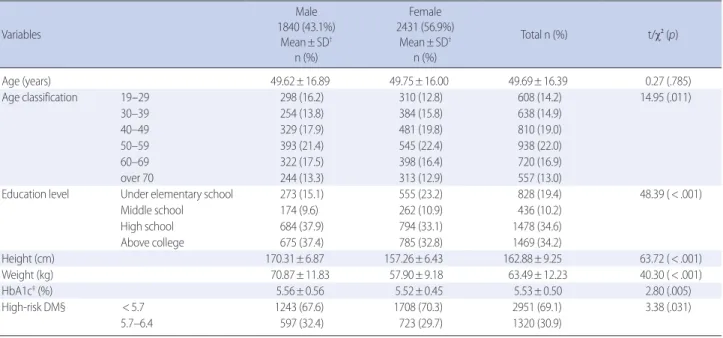
The high-risk DM group (HbA1c level, 5.7–6.4%) and normal group (HbA1c level <5.7%) were classified by HbA1c level [14]. In this study, 30.9% of the participants are assigned to the high-risk DM group and 69.1% in the normal group.
4. Ethical considerations
KNHANES VI-3 was reviewed by the Korea Centers for Disease Control and Prevention Institutional Review Boards (approval number of 117002). Anonymity and confidentiality of the participants were guaranteed by coding personal information with assigned serial num- bers. According to the raw data sharing regulation of the Korea Centers for Disease Control and Prevention, data from the national survey were provided after we were granted permission to use the data (June 3, 2018) and we subsequently initiated our assessments.
5. Data analysis
Data were analyzed using the Statistical Package for the Social Scienc-
es (SPSS, version 24.0, Chicago, IL, USA). General participant character- istics were analyzed with descriptive statistics. Differences in BMI and stress relative to sex were analyzed using t-test and χ 2 -test. The predictive variables for high-risk DM were determined by multiple logistic regres- sion analysis. We obtained 2-tailed significance levels for all statistical tests, and a P-value <0.05 was considered statistically significant.
Results
1. Sex differences in general characteristics
The average age of the participants was 49.6 years. The HbA1c level was higher in men than women (t=2.80, p =.005). The high-risk DM group included more men (32.4%) than women (29.7%) ( χ 2 =3.38, p=.031) (Table 1).
2. Sex differences in BMI and stress
In BMI, 27.2% and 38.4% of men were overweight and obese, respec- tively. Moreover, 21.2% and 29.7% of women were overweight and obese, respectively. The prevalence of overweight and obesity was higher in men than in women ( χ 2 =93.14, p<.001). The stress level was higher in women than in men ( χ 2 =18.21, p<.001) (Table 2).
Table 1. Sex differences in General characteristics (N=4,271)
Variables
Male 1840 (43.1%)
Mean± SD
†n (%)
Female 2431 (56.9%)
Mean± SD
†n (%)
Total n (%) t/χ2 (p)
Age (years) 49.62± 16.89 49.75± 16.00 49.69± 16.39 0.27 (.785)
Age classification 19–29 298 (16.2) 310 (12.8) 608 (14.2) 14.95 (.011)
30–39 254 (13.8) 384 (15.8) 638 (14.9)
40–49 329 (17.9) 481 (19.8) 810 (19.0)
50–59 393 (21.4) 545 (22.4) 938 (22.0)
60–69 322 (17.5) 398 (16.4) 720 (16.9)
over 70 244 (13.3) 313 (12.9) 557 (13.0)
Education level Under elementary school 273 (15.1) 555 (23.2) 828 (19.4) 48.39 (< .001)
Middle school 174 (9.6) 262 (10.9) 436 (10.2)
High school 684 (37.9) 794 (33.1) 1478 (34.6)
Above college 675 (37.4) 785 (32.8) 1469 (34.2)
Height (cm) 170.31± 6.87 157.26± 6.43 162.88± 9.25 63.72 (< .001)
Weight (kg) 70.87± 11.83 57.90± 9.18 63.49± 12.23 40.30 (< .001)
HbA1c
‡(%) 5.56± 0.56 5.52± 0.45 5.53± 0.50 2.80 (.005)
High-risk DM§ < 5.7 1243 (67.6) 1708 (70.3) 2951 (69.1) 3.38 (.031)
5.7–6.4 597 (32.4) 723 (29.7) 1320 (30.9)
†
SD= Standard deviation;
‡HbA1c= Hemoglobin A1c; §high-risk DM= high-risk diabetes mellitus.
3. Factors affecting high-risk DM
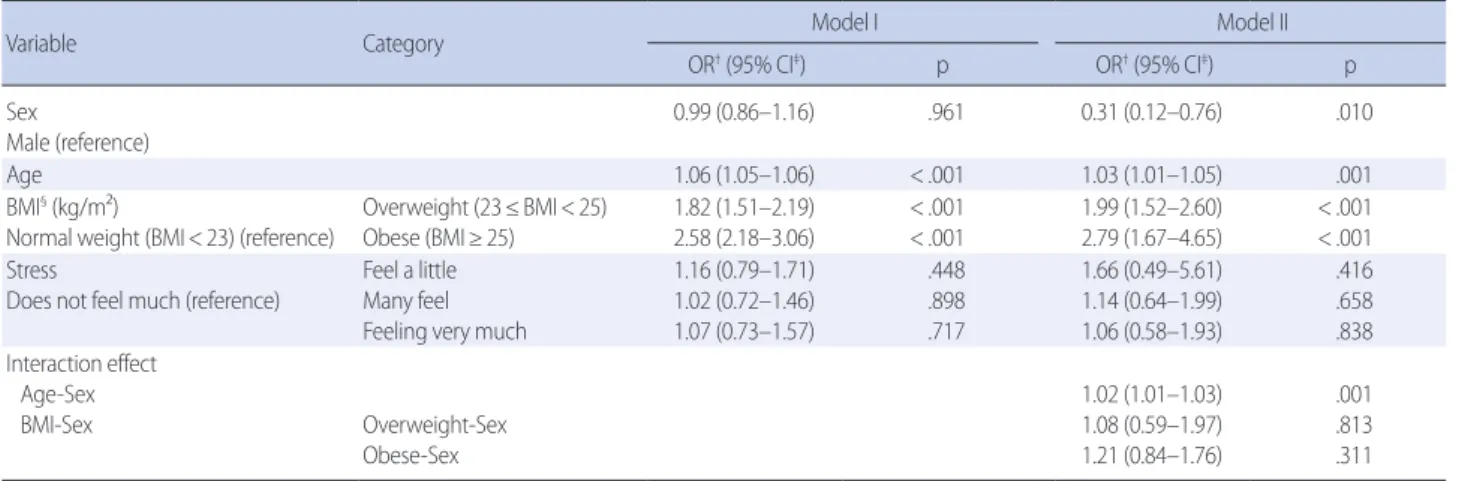
In Model I, multiple logistic regression analysis including sex, age, BMI, and stress were performed to identify the influencing factors of high-risk DM. As a result, age and BMI were influential factors. Specifically, as the age increased, the odds of risk DM increased 1.06 (95% CI, 1.05–1.06;
p<.001). In BMI, the risk of DM increased 1.82 times (95% CI, 1.51–2.19;
p<.001) in overweight individuals and 2.58 times (95% CI, 2.18–3.06;
p<.001) in obese individuals compared to that in individuals with normal weight. Stress and sex were not influential factors of high-risk DM.
In Model II, in order to identify sex-specific effects, the study focused on age and BMI, which are influential factors of high-risk DM in Model I. Interaction variables (age-sex and BMI-sex) were included in the mul- tiple logistic regression analysis. As a result, sex, age, BMI, and age-sex were considered influential factors. Specifically, based on sex, the risk of DM decreased 0.31 times (95% CI, 0.12–0.76; p =.001) in women com-
pared to that in men. As the age increased, the odds of risk DM in- creased 1.03 (95% CI, 1.01–1.05; p =.001). In BMI, the risk of DM in- creased 1.99 times (95% CI, 1.52–2.60; p<.001) in overweight individuals and 2.79 times (95% CI, 1.67–4.65; p<.001) in obese individuals com- pared to that in individuals with normal weight.
In the age-sex interaction, the odds of risk DM increased 1.02 (95%
CI, 1.01–1.03; p =.001) in women compared to that in men as age in- creased. There was no significant difference in the BMI-sex interaction.
In other words, as BMI increased, there was no difference in the effect on high-risk DM based on sex (Table 3).
Discussion
This study aimed to identify sex differences in the effect of BMI and stress on high-risk DM in Korean adults. To identify sex-specific effects,
Table 2. Sex differences in BMI and Stress (N= 4,271)
Variables
Male 1840 (43.1%)
Mean± SD
†n (%)
Female 2431 (56.9%)
Mean± SD
†n (%)
Total n (%) t/χ2 (p)
BMI
‡(kg/m
2) 24.36± 3.31 23.42± 3.53 23.83± 3.47 8.82 (< .001)
Normal weight (BMI< 23) 633 (34.4) 1195 (49.2) 1028 (42.8) 93.14 (< .001)
Overweight (23< BMI< 25) 500 (27.2) 515 (21.2) 1015 (23.8)
Obese (BMI≥ 25) 707 (38.4) 721 (29.7) 1428 (33.4)
Stress
Does not feel much 331 (18.0) 336 (13.8) 667 (15.6) 18.21 (< .001)
Feel a little 1049 (57.0) 1396 (57.4) 2445 (57.2)
Many feel 385 (20.9) 568 (23.4) 953 (22.3)
Feeling very much 75 (4.1) 131 (5.4) 206 (4.8)
†
SD=Standard deviation;
‡BMI=body mass index.
Table 3. Factors affecting high-risk DM (HbA1c 5.7–6.4%) (N= 4,271)
Variable Category Model I Model II
OR
†(95% CI
‡) p OR
†(95% CI
‡) p
Sex
Male (reference)
0.99 (0.86–1.16) .961 0.31 (0.12–0.76) .010
Age 1.06 (1.05–1.06) < .001 1.03 (1.01–1.05) .001
BMI
§(kg/m²)
Normal weight (BMI< 23) (reference)
Overweight (23≤ BMI< 25) Obese (BMI≥ 25)
1.82 (1.51–2.19) 2.58 (2.18–3.06)
< .001
< .001
1.99 (1.52–2.60) 2.79 (1.67–4.65)
< .001
< .001 Stress
Does not feel much (reference)
Feel a little Many feel Feeling very much
1.16 (0.79–1.71) 1.02 (0.72–1.46) 1.07 (0.73–1.57)
.448 .898 .717
1.66 (0.49–5.61) 1.14 (0.64–1.99) 1.06 (0.58–1.93)
.416 .658 .838 Interaction effect
Age-Sex
BMI-Sex Overweight-Sex
Obese-Sex
1.02 (1.01–1.03) 1.08 (0.59–1.97) 1.21 (0.84–1.76)
.001 .813 .311
†