서 론
1. 연구의 필요성
지방조직은 에너지원으로 지방을 축적할 뿐 아니라 생물활 성 단백질을 분비하는 내분비기관으로서 지방조직에서 분비 된 후 기타 기관에서 활성을 갖는 단백질을 아디포카인(adi- pokine) 또는 아디포사이토카인(adipocytokine)이라고 한다 (Funahashi et al., 1999). 아디포카인은 종양괴사인자-a
(tumor necrosis factor-a, TNF-a), 렙틴(leptin), 인터루킨- 6 (interleukin-6, IL-6), 레지스틴(resistin), 아디포넥틴(adi- tonectin) 등을 포함하고 있으며(Funahashi et al., 1999), 이 중 아디포넥틴은 1995년 Scherer, Williams, Fogliano, Bal- dini와 Lodish에 의해 인간의 혈장에서 처음 발견되었다.
아디포넥틴은 분비량이 감소되면 지방축적량이 증가되는 고유의 특성과 함께 혈중 지방산 농도 및 간과 근육에서 중성 지방 수치를 감소시켜 인슐린 감수성을 증가시키며, 혈관 내 피세포에 TNF-a 유발 단핵세포 유착을 감소시키고, 혈소판 을 억제하여 항염증과 항아테롬성 효과를 초래한다. 또한 근 에서는(acetyo AcA-carboxylase) ACC의 인산화, 지방산소 비, 혈당 섭취, 그리고 젖산(lactate) 생성을 자극하며, 간에서 는 ACC의 인산화 및 당신생 과정에 포함된 분자들을 감소시 킴으로써 혈당을 낮추는 역할을 한다(Yamauchi et al., 2002).
175
Purpose: The purpose of this study is to analyze the trend of research on intervention using adiponectin and to find the utilization in nursing. Methods: A systematic literature review was conducted. From 2005 to 2009, the articles were searched electronically using the data base with the key words of adiponectin. The criteria for inclusion in review were 1) an randomized clinical trial (RCT), 2) human, 3) English or Korean language. Finally, 89 articles (41 domestic studies, 48 foreign studies) were included in the review. Results: The major findings of this study were as follows: 1) In domes- tic studies, subjects of obesity were 80.5%, and the most frequently used intervention were exercise (95.1%). 2) In for- eign studies, there were interventions for subjects of obesity (55.1%), and diabetes (25.0%). 66.7% of studies were in medicine including 56.3% on medicine/hormone therapy. 3) Adiponectin was significantly increased in 31 domestic studies and 33 foreign studies. Conclusion: It needs to understand the influence of Adiponectin in nursing research and practice. The practical use of Adiponectin has to be considered in a sense that it may help determining the direc- tion of the nursing research to provide more objective evidence for nursing practice.
Key Words : Adiponectin; Adipokines 국문주요어:아디포넥틴, 아디포사이토카인
The analysis of Research about Adiponectin
Young Soon Byeon
Professor, Department of Nursing Science, Ewha Womans University, Seoul, Korea
아디포넥틴(adiponectin) 관련 연구논문 분석
변영순
이화여자대학교 건강과학대학 간호과학부 교수
Corresponding author :
Young Soon Byeon, Professor, Department of Nursing Science, Ewha Womans University, 11-1 Daehyeon-dong, Seodaemun-gu, Seoul 120-750, Korea
Tel: 82-2-3277-2884 Fax: 82-2-3277-2850 E-mail: [email protected]
투고일 : 2010년 10월 4일 심사의뢰일 : 2010년 10월 6일 게재확정일 : 2010년 12월 14일
즉, 아디포넥틴의 결핍은 일차적으로 체내 지방을 축적시켜 비만을 유발시키고 인슐린에 대한 민감성과 동맥경화에 직접 적으로 영향을 주어 인슐린 저항, 당뇨병, 동맥경화, 심혈관 질환 등을 유발함으로써(Kim, 2009) 궁극적으로는 대사증후 군 발병에 핵심적인 역할을 하게 된다(Lim & Jang, 2008)는 점에서 주목받고 있다.
이에 생명과학 분야에서는 아디포넥틴의 역할이나 기전 (Lim & Jang, 2008; Pischon, 2009; Yamauchi et al., 2002;
Yun et al., 2009)에 대한 연구들이 꾸준히 발표되어 왔으며, 아디포넥틴이 오메가-3 포함 불포화지방과 섬유소 섭취(Ross, Pedwell, & Rissanen, 1995), 규칙적인 운동, 금연, 금주 등 에 의해 생성이 증가된다는(Boudou, Sobngwi, Mauvais- Jarvis, Vexiau, & Gautier, 2003; Yatagai et al., 2003) 연 구결과와 함께 비만과 대사증후군 예방 및 관리 차원에서 아 디포넥틴 생성을 돕기 위한 실험중재연구가 활발히 보고되고 있다.
그러나 실무중심 학문으로 실험연구의 중재를 통한 경험적 지식체가 중요한 간호학에서는 아디포넥틴을 활용한 연구가 미미한 상태로 국내에서는 2편의 조사연구(Chang et al., 2007; Hur, Won, Ko, & Kim. 2009)만 발표된 상태이다. 타 당하고 신뢰성 있는 지식체에 근거하여 최상의 의료를 제공 해야 한다는 근거기반실무(Evidence based practice, EBP) 의 중요성이 강조되고 있는 현 시점에서 아디포넥틴에 대한 간호학적 관심과 이해는 인간의 반응에 초점을 두고 대상자 의 질병을 예방하고, 건강을 유지, 증진시키고자 하는 간호학 에서 폭넓게 활용될 수 있을 것으로 기대된다.
이에 본 연구에서는 국내외에서 선행되었던 아디포넥틴 관 련 실험연구의 중재 내용과 효과를 분석하여 아디포넥틴에 대한 이해와 관심을 증가시키고, 간호학에서 생리적 지표로 써 아디포넥틴의 활용방안을 제시하여 체계적이고 확고한 근 거중심 간호연구 발전에 기여하고자 한다.
2. 연구 목적
본 연구의 목적은 국내외에서 아디포넥틴 관련 실험연구의 중재 내용과 효과를 통하여 간호학에서 생리지표로서 아디포 넥틴을 활용하고자 함이며, 구체적인 목적은 다음과 같다.
1) 아디포넥틴 관련 실험연구의 일반적 특성을 확인한다.
2) 아디포넥틴 관련 실험연구의 중재 내용을 확인한다.
3) 아디포넥틴 관련 실험연구의 중재 효과를 확인한다.
연구 방법
1. 연구 설계
본 연구는 국내외에서 아디포넥틴을 사용한 실험연구의 중 재 내용과 효과를 분석한 서술적 조사연구이다.
2. 자료 수집 방법
본 연구에서는 국내외 학술지에 게재된 연구논문 중 아디포 넥틴과 관련되어 중재를 시도한 실험연구에 대한 분석을 위해 체계적 문헌고찰 가이드라인으로 2008년 제시된 Preferred reporting items for systematic reviews and meta-anal- ysis (PRISMA)의 체크리스트를 토대로 자료를 수집하였다 (Liberati et al., 2009). 국내 논문은 학술정보연구서비스 (http://www.riss.kr/), 한국학술정보(http://kiss.kstudy.
com/), DBpia (http://www.dbpia.co.kr/)에서 검색하였으 며, 국외 논문은 CINAHL (http://www.cinahl.com/)에서 검색하였다. 검색어로는 아디포넥틴 또는 adiponectin을 사 용하였으며, 2005년 1월부터 2009년 12월까지 5년간 발표된 논문을 검색 제한을 두지 않고 검색한 결과 총 821편(국내 194편, 국외 627편)의 논문이 검색되었다. 중복논문을 제외 한 후 검색된 749편(국내 125편, 국외 624편)의 논문 중 논문 의 언어가 영어나 한국어가 아닌 논문, 인간(human) 대상이 아닌 논문을 제외하여 478편(국내 92편, 국외 386편)의 논문 이 검색되었으며, 무작위 통제 연구(randomized controlled trial, RCT)를 선별하기 위해 연구자가 논문의 원본을 모두 확인한 후 총 89편(국내 41편, 국외 48편)이 최종 대상논문으 로 선정되었다.
3. 자료 분석 방법
본 연구에서는 선정된 89편의 논문을 체계적 문헌고찰 가 이드라인으로 2008년 제시된 PRISMA의 체크리스트를 토대 로 아디포넥틴에 대한 중재 방법 기준으로 정리한 후 연구자 가 분석하였다. 아디포넥틴 관련 연구의 일반적 특성으로는 아디포넥틴 관련 실험연구의 학문분야와 연도, 중재 내용으 로는 대상자 수, 대상자 연령대, 기저질환, 기저질환 진단기 준, 중재 기간, 중재 빈도, 구체적 중재방법, 중재 효과에서는 아디포넥틴과 비만, 당뇨, 심폐 및 기타 질환과 관련된 생리 적 지표에 대한 실험연구의 효과를 빈도와 퍼센트를 사용하 여 분석하였다.
연구 결과
1. 일반적 특성
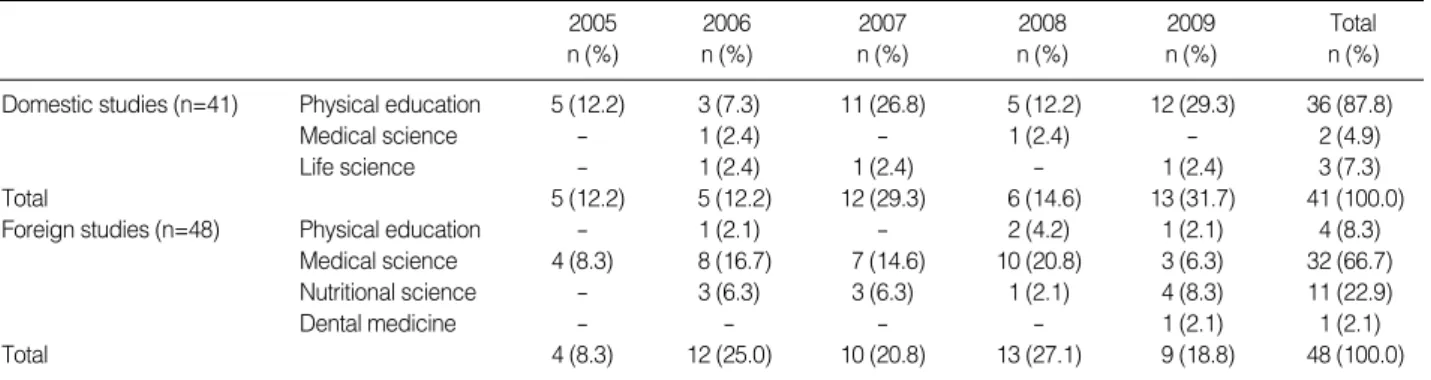
본 연구에서 분석된 국내 연구는 총 41편으로 체육학(36 편), 생명과학(3편), 의학(2편) 분야에서 연구되었으며, 2009 년(13편) 발표된 연구가 가장 많았다. 국외 연구는 총 48편으 로 의학(32편), 영양학(11편), 체육학(4편), 치의학(1편) 분야에 서 연구되었으며, 2008년에 발표된 연구가 13편으로 가장 많 았다(Table 1).
2. 중재 내용
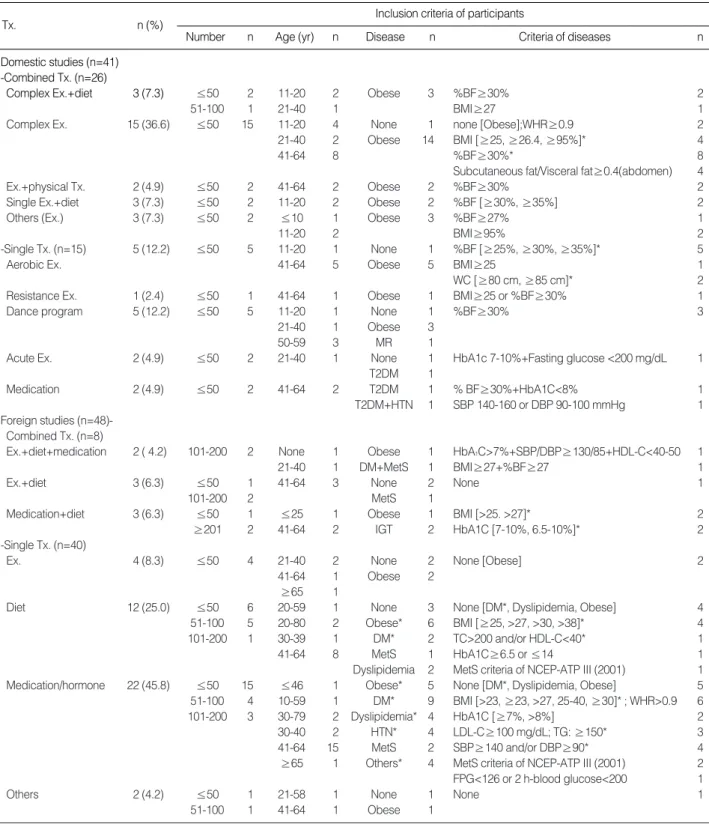
국내 연구에서 사용된 중재는 복합중재 5종류와 단일중재 5종류로 나눌 수 있으며, 유산소운동과 저항운동 등 2가지 종 류의 운동을 동시에 중재한 연구가 15편으로 가장 많았다. 피 험자는 최소 6명에서 최고 75명으로 연구 대상이 11-20명인 연구가 16편이었으며, 대상의 연령대는 40대(12편), 기저질환 은 비만(33편)인 대상자가 가장 많았다. 비만을 대상으로 한 논문에서 비만 진단을 위해 체지방률 30% 이상을 단일 기준 으로 한 논문이 15편이었으며, 체질량지수, 허리엉덩이둘레 비, 허리둘레와 함께 사용한 논문도 7편이었다(Table 2).
국외 연구에서 사용된 중재는 복합중재 3종류와 단일중재 4종류로 운동, 식이요법, 약물 및 호르몬요법, 치주관리 및 외과적 시술이 있었으며, 약물 및 호르몬요법을 사용한 연구가 22편으로 가장 많았다. 피험자는 최소 8명에서 최대 6,627명 으로, 연구 대상이 100명 이상인 연구가 10편이었으며, 대상 의 연령대는 50대(25편), 기저질환은 비만(16편)인 대상자가 가장 많았다. 비만을 대상으로 한 논문에서 비만 진단을 위해 체질량지수(10편)를 가장 많이 사용하였으며, 대상자 선정 기 준이 되는 체질량지수는 25에서 38까지 다양한 기준이 적용 되고 있었다(Table 2).
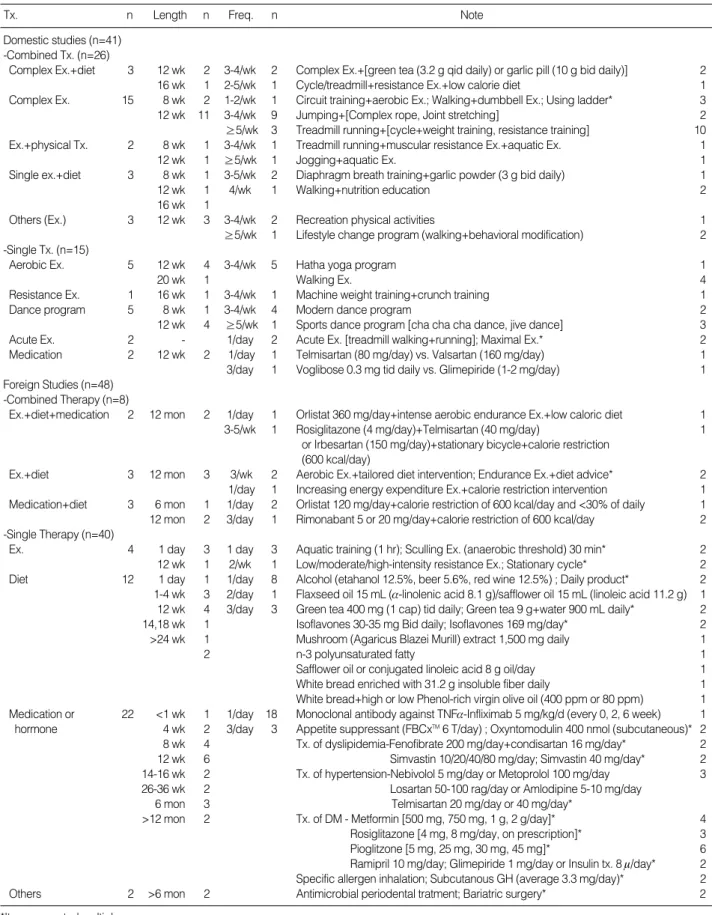
국내 연구의 중재기간은 8주부터 20주까지로 12주 동안 중 재한 연구가 28편이었으며, 중재횟수는 주당 3-4회가 25편, 1회 중재시간은 30-60분이 20편이었다. 국외 연구는 12주 동안 중재한 연구가 10편, 1년 동안 중재한 연구가 6편으로 33편에서 매일 중재를 시행한 것으로 나타났다(Table 3).
3. 중재의 효과
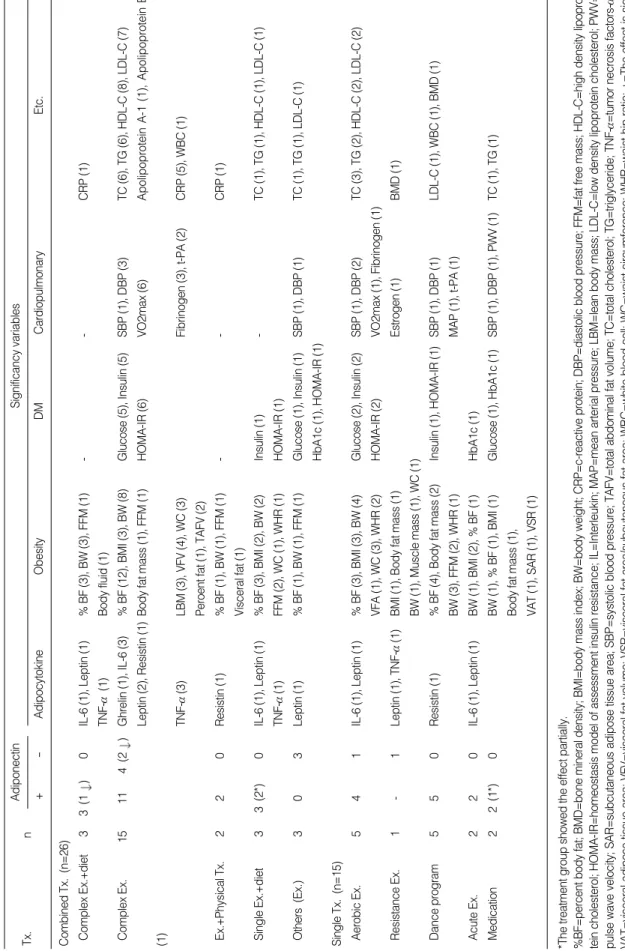
국내 연구에서 중재 효과를 살펴보면, 아디포넥틴은 32편 에서 유의하게 변화하였으며, 아디포넥틴이 유의하게 감소한 복합운동과 식이관리 연구 1편을 제외한 31편의 연구에서 중 재 후 아디포넥틴이 유의하게 증가하였다. 아디포싸이토카인 에서는 leptin 감소(8편), 비만지표에서는 체지방률 감소(29 편), 당뇨지표에서는 insulin 감소(10편), 심폐기능에서는 이 완기 혈압감소(8편), 지질지표에서는 총콜레스테롤 감소(12 편), 항염지표에서는 CRP 감소(7편)가 가장 많았다(Table 4).
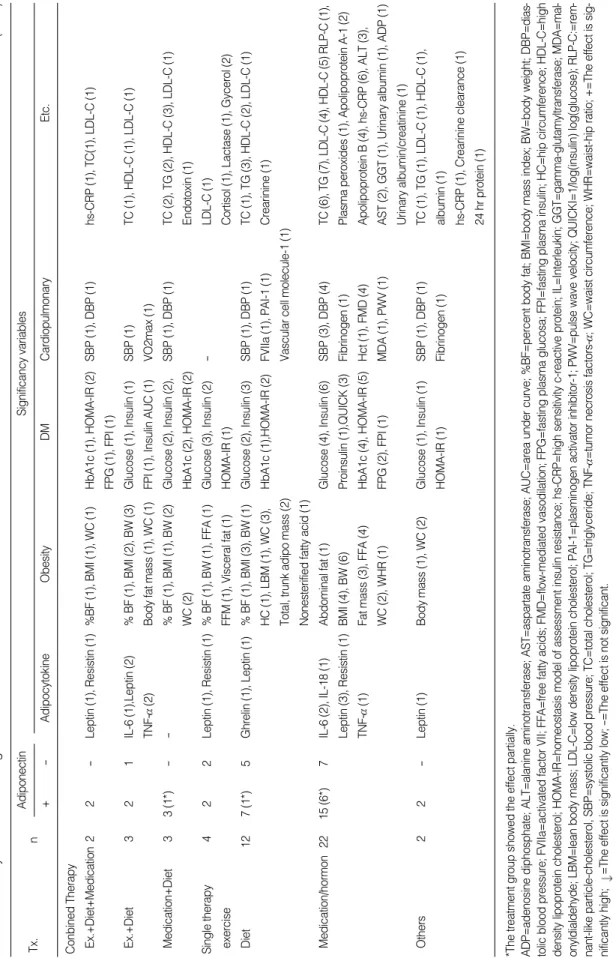
국외 연구에서 아디포넥틴은 33편에서 유의하게 증가한 것으로 나타났다. 아디포싸이토카인에서는 leptin 감소(9편), 비만지표에서는 체중 감소(13편), 당뇨지표에서는 insulin 감 소(15편), 심폐기능에서는 혈압 감소(8편), 지질지표에서는 중 성지방 감소(13편), 항염지표에서는 hs-CRP 감소(8편)가 가 장 많았다(Table 5).
논 의
지방세포에서 분비되는 사이토카인인 아디포넥틴은 세계 적인 건강문제로 예방 및 관리가 절실한 비만과 대사성 질환 발생에 영향을 주는 단백질로 밝혀지면서 생명과 건강을 다 루는 분야에서 그 활용에 대한 관심이 지속되고 있다. 이에 본 연구에서는 아디포넥틴에 대한 연구가 미미한 간호학에서 아디포넥틴에 대한 이해와 관심을 증가시키고, 비만 및 대사
2005 2006 2007 2008 2009 Total
n (%) n (%) n (%) n (%) n (%) n (%)
Domestic studies (n=41) Physical education 5 (12.2) 3 (7.3) 11 (26.8) 5 (12.2) 12 (29.3) 36 (87.8)
Medical science - 1 (2.4) - 1 (2.4) - 2 (4.9)
Life science - 1 (2.4) 1 (2.4) - 1 (2.4) 3 (7.3)
Total 5 (12.2) 5 (12.2) 12 (29.3) 6 (14.6) 13 (31.7) 41 (100.0)
Foreign studies (n=48) Physical education - 1 (2.1) - 2 (4.2) 1 (2.1) 4 (8.3)
Medical science 4 (8.3) 8 (16.7) 7 (14.6) 10 (20.8) 3 (6.3) 32 (66.7)
Nutritional science - 3 (6.3) 3 (6.3) 1 (2.1) 4 (8.3) 11 (22.9)
Dental medicine - - - - 1 (2.1) 1 (2.1)
Total 4 (8.3) 12 (25.0) 10 (20.8) 13 (27.1) 9 (18.8) 48 (100.0)
Table 1. Number of Articles about Adiponectin (N=89)
Inclusion criteria of participants
Tx. n (%)
Number n Age (yr) n Disease n Criteria of diseases n
Table 2. Summary of Study Characteristics (N=89)
*It were counted multiply.
%BF=percent body fat; BMI=body mass index; DBP=diastolic blood pressure; DM=diabetes mellitus; Ex.=exercise; FPG=fasting plasma glucose;
HDL-C=high density lipoprotein cholesterol; HTN=hypertension; IGT=impaired glucose tolerance; LDL-C=low density lipoprotein cholesterol; MetS=
metabolic syndrome; MR=mental retardation; SBP=systolic blood pressure; T2DM=type II diabetes mellitu; TC=total cholesterol; TG=triglyceride; Tx.=
therapy; WC=waist circumference; WHR=waist-hip ratio.
Domestic studies (n=41) -Combined Tx. (n=26)
Complex Ex.+diet 3 (7.3) ≤50 2 11-20 2 Obese 3 %BF≥30% 2
51-100 1 21-40 1 BMI≥27 1
Complex Ex. 15 (36.6) ≤50 15 11-20 4 None 1 none [Obese];WHR≥0.9 2
21-40 2 Obese 14 BMI [≥25, ≥26.4, ≥95%]* 4
41-64 8 %BF≥30%* 8
Subcutaneous fat/Visceral fat≥0.4(abdomen) 4
Ex.+physical Tx. 2 (4.9) ≤50 2 41-64 2 Obese 2 %BF≥30% 2
Single Ex.+diet 3 (7.3) ≤50 2 11-20 2 Obese 2 %BF [≥30%, ≥35%] 2
Others (Ex.) 3 (7.3) ≤50 2 ≤10 1 Obese 3 %BF≥27% 1
11-20 2 BMI≥95% 2
-Single Tx. (n=15) 5 (12.2) ≤50 5 11-20 1 None 1 %BF [≥25%, ≥30%, ≥35%]* 5
Aerobic Ex. 41-64 5 Obese 5 BMI≥25 1
WC [≥80 cm, ≥85 cm]* 2
Resistance Ex. 1 (2.4) ≤50 1 41-64 1 Obese 1 BMI≥25 or %BF≥30% 1
Dance program 5 (12.2) ≤50 5 11-20 1 None 1 %BF≥30% 3
21-40 1 Obese 3
50-59 3 MR 1
Acute Ex. 2 (4.9) ≤50 2 21-40 1 None 1 HbA1c 7-10%+Fasting glucose <200 mg/dL 1 T2DM 1
Medication 2 (4.9) ≤50 2 41-64 2 T2DM 1 % BF≥30%+HbA1C<8% 1
T2DM+HTN 1 SBP 140-160 or DBP 90-100 mmHg 1 Foreign studies (n=48)-
Combined Tx. (n=8)
Ex.+diet+medication 2 ( 4.2) 101-200 2 None 1 Obese 1 HbA1C>7%+SBP/DBP≥130/85+HDL-C<40-50 1
21-40 1 DM+MetS 1 BMI≥27+%BF≥27 1
Ex.+diet 3 (6.3) ≤50 1 41-64 3 None 2 None 1
101-200 2 MetS 1
Medication+diet 3 (6.3) ≤50 1 ≤25 1 Obese 1 BMI [>25. >27]* 2
≥201 2 41-64 2 IGT 2 HbA1C [7-10%, 6.5-10%]* 2
-Single Tx. (n=40)
Ex. 4 (8.3) ≤50 4 21-40 2 None 2 None [Obese] 2
41-64 1 Obese 2
≥65 1
Diet 12 (25.0) ≤50 6 20-59 1 None 3 None [DM*, Dyslipidemia, Obese] 4
51-100 5 20-80 2 Obese* 6 BMI [≥25, >27, >30, >38]* 4
101-200 1 30-39 1 DM* 2 TC>200 and/or HDL-C<40* 1
41-64 8 MetS 1 HbA1C≥6.5 or ≤14 1
Dyslipidemia 2 MetS criteria of NCEP-ATP III (2001) 1 Medication/hormone 22 (45.8) ≤50 15 ≤46 1 Obese* 5 None [DM*, Dyslipidemia, Obese] 5 51-100 4 10-59 1 DM* 9 BMI [>23, ≥23, >27, 25-40, ≥30]* ; WHR>0.9 6
101-200 3 30-79 2 Dyslipidemia* 4 HbA1C [≥7%, >8%] 2
30-40 2 HTN* 4 LDL-C≥100 mg/dL; TG: ≥150* 3
41-64 15 MetS 2 SBP≥140 and/or DBP≥90* 4
≥65 1 Others* 4 MetS criteria of NCEP-ATP III (2001) 2 FPG<126 or 2 h-blood glucose<200 1
Others 2 (4.2) ≤50 1 21-58 1 None 1 None 1
51-100 1 41-64 1 Obese 1
Tx. n Length n Freq. n Note Domestic studies (n=41)
-Combined Tx. (n=26)
Complex Ex.+diet 3 12 wk 2 3-4/wk 2 Complex Ex.+[green tea (3.2 g qid daily) or garlic pill (10 g bid daily)] 2
16 wk 1 2-5/wk 1 Cycle/treadmill+resistance Ex.+low calorie diet 1
Complex Ex. 15 8 wk 2 1-2/wk 1 Circuit training+aerobic Ex.; Walking+dumbbell Ex.; Using ladder* 3
12 wk 11 3-4/wk 9 Jumping+[Complex rope, Joint stretching] 2
≥5/wk 3 Treadmill running+[cycle+weight training, resistance training] 10 Ex.+physical Tx. 2 8 wk 1 3-4/wk 1 Treadmill running+muscular resistance Ex.+aquatic Ex. 1
12 wk 1 ≥5/wk 1 Jogging+aquatic Ex. 1
Single ex.+diet 3 8 wk 1 3-5/wk 2 Diaphragm breath training+garlic powder (3 g bid daily) 1
12 wk 1 4/wk 1 Walking+nutrition education 2
16 wk 1
Others (Ex.) 3 12 wk 3 3-4/wk 2 Recreation physical activities 1
≥5/wk 1 Lifestyle change program (walking+behavioral modification) 2 -Single Tx. (n=15)
Aerobic Ex. 5 12 wk 4 3-4/wk 5 Hatha yoga program 1
20 wk 1 Walking Ex. 4
Resistance Ex. 1 16 wk 1 3-4/wk 1 Machine weight training+crunch training 1
Dance program 5 8 wk 1 3-4/wk 4 Modern dance program 2
12 wk 4 ≥5/wk 1 Sports dance program [cha cha cha dance, jive dance] 3
Acute Ex. 2 - 1/day 2 Acute Ex. [treadmill walking+running]; Maximal Ex.* 2
Medication 2 12 wk 2 1/day 1 Telmisartan (80 mg/day) vs. Valsartan (160 mg/day) 1
3/day 1 Voglibose 0.3 mg tid daily vs. Glimepiride (1-2 mg/day) 1 Foreign Studies (n=48)
-Combined Therapy (n=8)
Ex.+diet+medication 2 12 mon 2 1/day 1 Orlistat 360 mg/day+intense aerobic endurance Ex.+low caloric diet 1
3-5/wk 1 Rosiglitazone (4 mg/day)+Telmisartan (40 mg/day) 1
or Irbesartan (150 mg/day)+stationary bicycle+calorie restriction (600 kcal/day)
Ex.+diet 3 12 mon 3 3/wk 2 Aerobic Ex.+tailored diet intervention; Endurance Ex.+diet advice* 2 1/day 1 Increasing energy expenditure Ex.+calorie restriction intervention 1 Medication+diet 3 6 mon 1 1/day 2 Orlistat 120 mg/day+calorie restriction of 600 kcal/day and <30% of daily 1 12 mon 2 3/day 1 Rimonabant 5 or 20 mg/day+calorie restriction of 600 kcal/day 2 -Single Therapy (n=40)
Ex. 4 1 day 3 1 day 3 Aquatic training (1 hr); Sculling Ex. (anaerobic threshold) 30 min* 2 12 wk 1 2/wk 1 Low/moderate/high-intensity resistance Ex.; Stationary cycle* 2 Diet 12 1 day 1 1/day 8 Alcohol (etahanol 12.5%, beer 5.6%, red wine 12.5%) ; Daily product* 2 1-4 wk 3 2/day 1 Flaxseed oil 15 mL (a-linolenic acid 8.1 g)/safflower oil 15 mL (linoleic acid 11.2 g) 1 12 wk 4 3/day 3 Green tea 400 mg (1 cap) tid daily; Green tea 9 g+water 900 mL daily* 2
14,18 wk 1 Isoflavones 30-35 mg Bid daily; Isoflavones 169 mg/day* 2
>24 wk 1 Mushroom (Agaricus Blazei Murill) extract 1,500 mg daily 1
2 n-3 polyunsaturated fatty 1
Safflower oil or conjugated linoleic acid 8 g oil/day 1 White bread enriched with 31.2 g insoluble fiber daily 1 White bread+high or low Phenol-rich virgin olive oil (400 ppm or 80 ppm) 1 Medication or 22 <1 wk 1 1/day 18 Monoclonal antibody against TNFa-Infliximab 5 mg/kg/d (every 0, 2, 6 week) 1 hormone 4 wk 2 3/day 3 Appetite suppressant (FBCxTM6 T/day) ; Oxyntomodulin 400 nmol (subcutaneous)* 2 8 wk 4 Tx. of dyslipidemia-Fenofibrate 200 mg/day+condisartan 16 mg/day* 2
12 wk 6 Simvastin 10/20/40/80 mg/day; Simvastin 40 mg/day* 2
14-16 wk 2 Tx. of hypertension-Nebivolol 5 mg/day or Metoprolol 100 mg/day 3
26-36 wk 2 Losartan 50-100 rag/day or Amlodipine 5-10 mg/day
6 mon 3 Telmisartan 20 mg/day or 40 mg/day*
>12 mon 2 Tx. of DM - Metformin [500 mg, 750 mg, 1 g, 2 g/day]* 4
Rosiglitazone [4 mg, 8 mg/day, on prescription]* 3
Pioglitzone [5 mg, 25 mg, 30 mg, 45 mg]* 6
Ramipril 10 mg/day; Glimepiride 1 mg/day or Insulin tx. 8 m/day* 2 Specific allergen inhalation; Subcutanous GH (average 3.3 mg/day)* 2
Others 2 >6 mon 2 Antimicrobial periodental tratment; Bariatric surgery* 2
Table 3. Summary of Intervention Program (N=89)
*It were counted multiply.
DM=diabetes mellitus; Ex.=exercise; GH=growth hormon; mon=month or months; Tx.=therapy; wk=week or weeks.
AdiponectinSignificancy variables Tx. n +-AdipocytokineObesityDMCardiopulmonaryEtc. Combined Tx. (n=26) Complex Ex.+diet 33 (1)0IL-6 (1), Leptin (1) % BF (3), BW (3), FFM (1)--CRP (1) TNF-a(1)Body fluid (1) Complex Ex.15114 (2)Ghrelin (1), IL-6 (3)% BF (12), BMI (3), BW (8)Glucose (5), Insulin (5)SBP (1), DBP (3)TC (6), TG (6), HDL-C (8), LDL-C (7) Leptin (2), Resistin (1)Body fat mass (1), FFM (1)HOMA-IR (6)VO2max (6)Apolipoprotein A-1 (1), Apolipoprotein B (1) TNF-a(3)LBM (3), VFV (4), WC (3)Fibrinogen (3), t-PA (2)CRP (5), WBC (1) Peroent fat (1), TAFV (2) Ex.+Physical Tx. 220Resistin (1)% BF (1), BW (1), FFM (1)--CRP (1) Visceral fat (1) Single Ex.+diet 33 (2*)0IL-6 (1), Leptin (1) % BF (3), BMI (2), BW (2)Insulin (1)-TC (1), TG (1), HDL-C (1), LDL-C (1) TNF-a(1)FFM (2), WC (1), WHR (1)HOMA-IR (1) Others (Ex.)303Leptin (1)% BF (1), BW (1), FFM (1)Glucose (1), Insulin (1)SBP (1), DBP (1)TC (1), TG (1), LDL-C (1) HbA1c (1), HOMA-IR (1) Single Tx. (n=15) Aerobic Ex.541IL-6 (1), Leptin (1)% BF (3), BMI (3), BW (4)Glucose (2), Insulin (2)SBP (1), DBP (2)TC (3), TG (2), HDL-C (2), LDL-C (2) VFA (1), WC (3), WHR (2)HOMA-IR (2)VO2max (1), Fibrinogen (1) Resistance Ex.1-1Leptin (1), TNF-a(1)BMI (1), Body fat mass (1)Estrogen (1)BMD (1) BW (1), Muscle mass (1), WC (1) Dance program550Resistin (1)% BF (4), Body fat mass (2)Insulin (1), HOMA-IR (1)SBP (1), DBP (1)LDL-C (1), WBC (1), BMD (1) BW (3), FFM (2), WHR (1)MAP (1), t-PA (1) Acute Ex. 220IL-6 (1), Leptin (1)BW (1), BMI (2), % BF (1)HbA1c (1) Medication22 (1*)0BW (1), % BF (1), BMI (1)Glucose (1), HbA1c (1)SBP (1), DBP (1), PWV (1)TC (1), TG (1) Body fat mass (1), VAT (1), SAR (1), VSR (1)
Table 4.Summary of Results in Domestic Studies(N=41) *The treatment group showed the effect partially. %BF=percent body fat; BMD=bone mineral density; BMI=body mass index; BW=body weight; CRP=c-reactive protein; DBP=diastolic blood pressure; FFM=fat free mass; HDL-C=high density lipopro- tein cholesterol; HOMA-IR=homeostasis model of assessment insulin resistance; IL=Interleukin; MAP=mean arterial pressure; LBM=lean body mass; LDL-C=low density lipoprotein cholesterol; PWV= pulse wave velocity; SAR=subcutaneous adipose tissue area; SBP=systolic blood pressure; TAFV=total abdominal fat volume; TC=total cholesterol; TG=triglyceride; TNF-a=tumor necrosis factors-a; VAT=visceral adipose tissue area; VFV=visceral fat volume; VSR=visceral fat area/subcutaneous fat area; WBC=white blood cell; WC=waist circumference; WHR=waist-hip ratio; +=The effect is sig- nificantly high; =The effect is significantly low; -=The effect is not significant.
AdiponectinSignificancy variables Tx.n +-AdipocytokineObesityDMCardiopulmonaryEtc. Conbined Therapy Ex.+Diet+Medication22-Leptin (1), Resistin (1)%BF (1), BMI (1), WC (1)HbA1c (1), HOMA-IR (2)SBP (1), DBP (1)hs-CRP (1), TC(1), LDL-C (1) FPG (1), FPI (1) Ex.+Diet321IL-6 (1),Leptin (2)% BF (1), BMI (2), BW (3)Glucose (1), Insulin (1)SBP (1)TC (1), HDL-C (1), LDL-C (1) TNF-a (2)Body fat mass (1), WC (1)FPI (1), Insulin AUC (1)VO2max (1) Medication+Diet33 (1*)--% BF (1), BMI (1), BW (2)Glucose (2), Insulin (2),SBP (1), DBP (1)TC (2), TG (2), HDL-C (3), LDL-C (1) WC (2)HbA1c (2), HOMA-IR (2)Endotoxin (1) Single therapy 422Leptin (1), Resistin (1)% BF (1), BW (1), FFA (1)Glucose (3), Insulin (2)-LDL-C (1) exerciseFFM (1), Visceral fat (1)HOMA-IR (1)Cortisol (1), Lactase (1), Gycerol (2) Diet127 (1*)5Ghrelin (1), Leptin (1)% BF (1), BMI (3), BW (1)Glucose (2), Insulin (3)SBP (1), DBP (1)TC (1), TG (3), HDL-C (2), LDL-C (1) HC (1), LBM (1), WC (3), HbA1c (1),HOMA-IR (2)FVIIa (1), PAI-1 (1)Crearinine (1) Total, trunk adipo mass (2)Vascular cell molecule-1 (1) Nonesterified fatty acid (1) Medication/hormon2215 (6*)7IL-6 (2), IL-18 (1)Abdominal fat (1)Glucose (4), Insulin (6)SBP (3), DBP (4)TC (6), TG (7), LDL-C (4), HDL-C (5) RLP-C (1), Leptin (3), Resistin (1)BMI (4), BW (6)Proinsulin (1),QUICK (3)Fibrinogen (1)Plasma peroxides (1), Apolipoprotein A-1 (2) TNF-a (1)Fat mass (3), FFA (4)HbA1c (4), HOMA-IR (5)Hct (1), FMD (4)Apolipoprotein B (4), hs-CRP (6), ALT (3), WC (2), WHR (1)FPG (2), FPI (1)MDA (1), PWV (1)AST (2), GGT (1), Urinary albumin (1), ADP (1) Urinary albumin/creatinine (1) Others22-Leptin (1)Body mass (1), WC (2)Glucose (1), Insulin (1)SBP (1), DBP (1)TC (1), TG (1), LDL-C (1), HDL-C (1), HOMA-IR (1)Fibrinogen (1)albumin (1) hs-CRP (1), Crearinine clearance (1) 24 hr protein (1)
Table 5.Summary of Results in Foreign Studies (N=48) *The treatment group showed the effect partially. ADP=adenosine diphosphate; ALT=alanine aminotransferase; AST=aspartate aminotransferase; AUC=area under curve; %BF=percent body fat; BMI=body mass index; BW=body weight; DBP=dias- tolicblood pressure; FVIIa=activated factor VII; FFA=free fatty acids; FMD=flow-mediated vasodilation; FPG=fasting plasma glucosa; FPI=fasting plasma insulin; HC=hip circumference; HDL-C=high density lipoprotein cholesterol; HOMA-IR=homeostasis model of assessment insulin resistance; hs-CRP=high sensitivity c-reactive protein; IL=Interleukin; GGT=gamma-glutamyltransferase; MDA=mal- onyldialdehyde;LBM=lean body mass; LDL-C=low density lipoprotein cholesterol; PAI-1=plasminogen activator inhibitor-1; PWV=pulse wave velocity; QUICKI=1/log(insulin) log(glucose); RLP-C:=rem- nant-likeparticle-cholesterol, SBP=systolic blood pressure; TC=total cholesterol; TG=triglyceride; TNF-a=tumor necrosis factors-a; WC=waist circumference; WHR=waist-hip ratio; +=The effect is sig- nificantly high; =The effect is significantly low; -=The effect is not significant.
증후군 간호에 생리적 지표로서 아디포넥틴을 활용하기 위해 국내외에서 선행되었던 아디포넥틴 관련 실험연구의 중재 내 용과 효과를 분석하였다.
본 연구에서 분석된 연구는 총 89편으로 2005년과 2009년 발표된 논문 수를 비교해보면, 2005년 9편(10.1%)에서 2009 년 22편(24.7%)으로 2배 이상 연구가 증가하여 아디포넥틴에 대한 관심이 증가되고 있는 추세임을 알 수 있었다. 그러나 이와 같은 관심의 증가에도 불구하고 국내에서는 체육학 (87.8%), 국외에서는 의학(66.7%)에 연구가 집중되는 경향을 보이고 있었으며, 간호학에서의 연구는 없는 것으로 나타났 다. Shin, Lee와 Jeong (2007)은 국내 간호학에서 사이토카 인을 활용한 연구가 사이토카인 관련 연구의 1.5%에 불과하다 고 보고하였으며, Kim 등(2006)은 국내 간호학회지에 게재 된 연구 중 생물학적 측정을 사용한 연구가 부족하며(13.3%), 사용된 생물학적 측정법에서는 신체조성, 활력징후 및 혈액 검사가 63.9%로 많이 연구되고 있음을 보고한 바 있다. 또한 양적 연구의 32.2%가 실험연구이지만 그중 순수실험연구가 차지하고 있는 비율(2.8%)이 매우 적은 국내 간호학분야의 연구경향(Shin et al., 2010)은 근거중심간호의정착을저해하 는요소로서 Oh, Kim, Hyun, Kang과 Bang (2007)은 본 연 구결과와 유사하게 무작위 통제에 의한 대사증후군 중재연구 가 초기단계로 국내외 간호학 분야에서 연구가 없음을 보고 하였다. 본 연구의 결과와 같이 간호학 분야에서 무작위화 된 아디포넥틴 관련 중재연구의 부재는 연구시설 및 기구를 갖 추어야 하는 고비용에 대한 문제와 비용 대비 결과의 효율성 이 낮은 점, 간호학에서순수실험연구와생리적 지표를 활용한 연구가 적다는 점(Kim et al., 2007; Shin et al., 2007) 및 아디포넥틴에 관한 중재연구가 초기단계라는 점에 기인하는 것으로 생각된다. 이에 일차적으로는 심근경색 발생의 위험 도를 현저히 낮게 하는 고민감성 혈청지표(Pischon, 2004)인 아디포넥틴의 다양한 기전에 대한 통합적 이해를 통해 간호 학 연구에서 객관적인 생리적 지표의 측정을 활성화하여 간 호 중재의 효과를 객관적으로 입증하고(Webb, 2003), 실무의 근거가 되는 연구를 활성화시키는 노력이 필요할 것으로 생각 된다.
연구 대상을 살펴보면, 국외에서는 전체 연구의 60.4%에 서 당뇨, 대사증후군, 고혈압, HIV, 천식, 염증성 장질환 등 다양한 대상자에게 중재를 적용하여 각각의 대상자들에서 아 디포넥틴 증가를 위한 중재의 효과를 확인하고 질환과 아디 포넥틴의 상관성에 대한 확실한 근거를 제시하고자 했던 것
에 비해 국내에서는 연구 대상이 비만인(82.9%)에 편중된 것 을 알 수 있었다. 추후 간호학에서는 기존의 타학문분야에서 의 연구결과를 다양한 대상자의 특성을 고려한 간호중재를 적용하여 효과를 검증하고 통합하여 아디포넥틴 증가를 위한 간호중재의 광범위한 활용이 가능할 것으로 생각한다.
본 연구에서 대상자 선정에서 사용된 진단 기준을 살펴보 면, 국내 연구에서는 비만 대상자 선정을 위해 체지방률, 체 질량지수(BMI), 허리엉덩이둘레비(WHR), 허리둘레(WC), 복 부지방률 등 다양한 기준을 적용하였으며, 국외 연구에서는 61.9%의 연구에서 체질량지수를 기준으로 하였으나 체질량 지수의 기준이 25에서 38까지 연구마다 다른 기준을 적용하 고 있었다. 또한 국내 연구에서는 비만(1편), 당뇨(1편), 국외 연구에서는 비만(5편), 당뇨(4편), 이상지혈증(3편), 대사증후 군(1편)에서 대상자 선정에 대한 기준을 제시하고 있지 않은 문제가 있다. 이는 Oh 등(2007)의 연구에서도 지적되었던 문 제로 추후 비만 및 대사증후군에 대한 표준 기준의 제시가 필 요할 것이다.
사용된 중재프로그램을 살펴보면, 국내 연구에서는 95.1%
가 운동 프로그램을, 국외 연구에서는 약물 및 호르몬요법 (56.3%)을 가장 많이 사용한 것을 알 수 있었다. 중재기간 및 중재횟수는 중재 프로그램의 종류에 따라 차이가 있었는데, 운동 중재가 많았던 국내 연구는 12주(68.3%), 약물 및 호르 몬 요법이 많았던 국외 연구는 1년 이상(20.8%) 적용한 연구 가 많았으며, 횟수는 국내 연구에서는 주 3-4회(61%), 국외 연구에서는 매일(68.8%) 적용한 연구가 많은 것으로 나타났 다. 이는 국내에서는 체육학을 기반으로 한 연구가 87.8%, 국 외에서는 의학 기반 연구가 66.7%이었던 것과 관련된 것으로 판단되며, 비만 및 대사증후군이 대상자의 특성을 고려한 운 동, 식이, 교육의 조화된 중재와 함께 자기감시와 체계적이고 지속적인 생활습관 관리에 영향을 받는다는 NCEP-ATP III (2002)의 지침 내용에 역점을 둔 포괄적이고 체계화된 간호 중재의 적용과 그 효과를 검증하여 간호중재의 탁월성과 객 관성을 확보해나갈 필요가 있을 것으로 사료된다.
본 연구에서 아디포넥틴에 대한 중재 효과를 살펴보면, 중 재 후 국내 연구의 75.6%, 국외 연구의 68.8%에서 아디포넥 틴이 유의하게 증가한 것으로 나타났다. 그러나 본 연구에서 분석한 논문의 38.2% (34편)에서 아디포넥틴에 대한 중재 효 과가 유의하지 않았거나 중재 후 아디포넥틴이 감소한 것으로 나타나 일관적이지 않은 분석결과에 대해 논의할 필요가 있 다고 본다. 먼저 아디포넥틴의 증가가 유의하지 않았던 연구
의 대상자를 보면 아동과 청소년 및 폐경기 전, 후 여성으로 연구 대상자들이 성장기이거나 성호르몬의 변화가 많은 시기 인 점을 공통적으로 찾을 수 있다. Arito 등(1999)은 아디포넥 틴이 성호르몬에 영향을 받는다는 점을 보고하였으며, 이에 Kim, Lee, Lee, Kim과 Choi (2009)는 성장기 아동과 청소 년에서 성호르몬과 성장호르몬 변인을 제한하지 못한 점을 연구의 문제점으로 지적한 바 있다. 따라서 간호학 분야에서 호르몬 변화와 아디포넥틴의 관계를 이해하고, 대상자 발달 단계에 따른 성호르몬의 변화를 고려한 구체적인 실험 설계 가 필요할 것으로 생각한다. 두 번째는 운동중재의 적용과 관 련된 것으로 운동 트레이닝에 의한 아디포넥틴의 효과가 일치 하지 않는다(Marcell, McAulley, Traustadottir, & Reaven, 2005)는 견해에 주목할 수 있다. 운동중재가 95.1%였던 국내 연구의 24.4%에서 아디포넥틴이 증가하였으나 나머지는 유 의하지 않았거나 유의하게 감소한 것으로 나타났는데, 이는 운동적용기간이 운동의 효과가 나타나는 최소 기간인 8주에 서 20주로 운동 기간이 짧아서 체지방 감소를 위한 신체의 적 응 기간이 부족했던 이유로 생각된다. Esposite 등(2003)은 비만여성을 대상으로 식이조절과 유산소운동을 2년간 실시 한 결과 체중감소와 함께 아디포넥틴 농도가 유의하게 증가 되었다고 하여 장기간의 운동이 아디포넥틴 증가에 영향을 주었음을 알 수 있다. 또한 분석된 논문에서 운동 중재의 종 류가 다양하여 연구 결과를 일반화하는 데 어려움이 있고, 운 동의 강도 또한 그 실효성에 대해 논의가 있어 반복 연구를 통하여 아디포넥틴 증가를 위한 적절한 운동 중재의 방향을 설정하고, 이를 활용하는 연구가 필요할 것으로 사료된다. 세 번째는 아디포넥틴에 대한 관심이 높아졌지만 관련 연구가 부족하다는 점이다. 본 연구에서 일관적이지 않은 연구결과 는 아디포넥틴이 혈중에 단일형이 아닌 동종형(isoform)인 trimer, hexamer, higher molecular weight form이 혼합 되어 존재하고, 아디포넥틴의 어떤 동종형이 아디포넥틴 수용 체에 결합하고 각 질환에서 어떤 형태가 중요한 활성을 나타 내는지에 대한 정확한 기전이 아직 알려지지 않았으며(Suk, Shin, & Lim, 2009), 중재를 적용한 후 체질량 지수 등 비만 관련 신체구성과 대사증후군 관련인자는 개선되었지만 아디 포넥틴 농도는 변화가 없는 결과를 통해 밝혀지지 않은 제3 의 인자가 존재할 가능성과 관계가 있을 것으로 생각된다. 아 디포넥틴이 비만과 대사증후군뿐 아니라 간질환, 항염증반응, 고혈압 발생(Kim et al., 2006; Marso et al., 2008; Toku- shige et al., 2009)에도 관여하며, 심혈관질환 발생위험 및
사망위험도에 독립적인 예측인자(Cavusoglu et al., 2006)임 을 감안해볼 때, 생명과학분야에서의 심층적인 연구가 지속 되어야 할 것이며, 간호학에서는 아디포넥틴에 대한 관심을 유지하고 새로운 기전을 지속적으로 확인하여 간호중재에서 아디포넥틴과 연계된 지식체를 활용하는 것이 필요할 것이다.
결론 및 제언
본 연구는 국내외에서 아디포넥틴의 분비 촉진 및 활성 증 가를 위한 중재를 적용하여 그 효과를 측정한 무작위 통제 실 험연구들을 대상으로 중재 내용과 효과를 분석하여 간호학에 서 아디포넥틴의 활용방안을 제시하고자 시도되었다. 대상 논문은 2005년부터 2009년까지 발표된 논문 중 무작위 실험 연구 및 인간을 대상으로 한 논문 총 89편(국내 41편, 국외 48편)이었으며, 구체적인 결과는 다음과 같다.
1) 국내 연구는 체육학(36편), 국외 연구는 의학(32편) 분야 가 가장 많았다.
2) 국내 연구에서 유산소운동과 저항운동을 동시에 중재한 연구가 15편이었으며, 연구 대상이 11-20명인 연구가 16편으 로 가장 많았다. 대상의 연령대는 40대(12편), 기저질환은 비 만(34편)인 대상자가 가장 많았다. 중재기간은 12주(28편), 한 주당 중재횟수는 주당 3-4회(25편), 1회 중재시간은 30- 60분(20편)이 가장 많았다. 국외 연구는 약물 및 호르몬요법 연구가 22편이었으며, 연구 대상이 100명 이상인 연구(10편) 가 가장 많았다. 연령대는 50대(25편), 기저질환은 비만(16 편), 당뇨(12편) 순이었으며, 중재는 1년(6편), 매일 중재한 연 구(33편)가 가장 많았다.
3) 아디포넥틴은 국내 연구에서 31편, 국외 연구 33편에서 유의하게 증가하였다. 국내 연구에서는 운동과 물리치료, 운 동과 식이를 병행한 복합중재와 댄스 프로그램, 일회성 운동, 약물요법의 단일중재, 국외 연구에서는 운동과 식이, 투약요 법을 병행한 복합중재와 치주관리, 비만치료를 위한 외과적 수술의 단일중재 후 아디포넥틴이 증가하였다.
이상의 결과를 토대로 다음과 같이 제언한다.
첫째, 심근경색 발생의 위험도를 현저히 낮게 하는 고민감 성 혈청지표(Pischon, 2004)인 아디포넥틴의 유용성을 인지 하고, 다양한 기전에 대한 통합적 이해를 통해 간호학적 관심 을 증가시켜야 할 것이다.
둘째, 간호연구 분야의 연구시설 확충 및 정책적, 재정적 지원루트 확보를 통해 실무의 근거가 되는 무작위 통제 연구
를 활성화시키고, 생리적 지표로써 아디포넥틴을 활용함으로 써 간호중재의 객관성을 확보해나갈 것을 제안한다.
셋째, 간호학에서 아디포넥틴을 활용한 연구를 할 경우 다 양한 질환자를 대상으로 한 연구, 대상자 발달 단계에 따른 성호르몬의 변화를 고려한 연구, 아디포넥틴 증가를 위한 운 동 중재 적용 시 장기간 적용의 필요성에 관한 연구 및 아디 포넥틴의 형태 등을 고려한 연구가 필요하다.
참고문헌
Arita, Y., Kihara, S., Ouchi, N., Takhashi, M., Maeda, K., Miyagawa, J., et al. (1999). Paradoxical decrease of an adipose-specific protein, adiponectin, in obesity. Biochemical and Biophysical Research Com- munications, 257, 79-83.
Boudou, P., Sobngwi, E., Mauvais-Jarvis, F., Vexiau, P., & Gautier, J.
F. (2003). Absence of exercise-induced variations in adiponectin lev- els despite decreased abdominal adiposity and improved insulin sen- sitivity in type 2 diabetic men. European Journal of Endocrinology, 149, 421-424.
Cavusoglu, E., Ruwende, C., Chopra, V., Yanamadala, S., Eng, C., Clark, L. T., et al. (2006). Adiponectin is an independent predictor of all-cause mortality, cardiac mortality, and myocardial infarction in patients presenting with chest pain. European Heart Journal, 27, 2300-2309.
Chang, S. A., Son, H. Y., Lee, J. M., Sohn, T. S., Kwon, H. S., Son, H. S., et al. (2007). The differences of circulating adiponectin levels and multimerization according to obesity in type 2 diabetes mellitus of men. Korean Diabetes Journal, 31, 243-252.
Esposito, K., Pontillo, A., Di., Palo, C., Giugliano, G., Masella, M., Marfella, R., et al. (2003). Effect of weight loss and lifestyle changes on vascular inflammatory markers in obese women: A randomized trial. The Journal of the American Medical Association, 289, 1799- 1804.
Funahashi, T., Nakamura, T., Shimomura, I., Maeda, K., Kuriyama, H., Takahashi, M., et al. (1999). Role of adipocytokines on the pa- thogenesis of atherosclerosis in visceral obesity. Internal Medicine, 38, 202-206.
Hur, K. H., Won, Y. L., Ko, K. S., & Kim, K. W. (2009). Effects of obesity on the physiological levels of adiponectin, leptin and diag- nostic indices of metabolic syndrome in male workers. Korean Jour- nal of Occupational Health Nursing, 18, 44-54.
Kim, D. M., Kim, B. Y., Kim, Y. K., Kim, I. J., Kim, T. J., Kim, T.
H., et al. (2006). Adiponectin and vascular disease. BioWave, 8(11), 1-8.
Kim, J., Choe, M. A., Kim, Y. Kim, J., Kim, H. S., Park, M. J., et al.
(2006). An analysis on the researches using biological measurement in major korean nursing journals. Journal of Korean Biological Nurs-
ing Science, 8(2), 61-72.
Kim, J. S. (2009). Effects of walking exercise and nutrition education on adipocytokine and metabolic hormone in obese juveniles. Unpublished doctoral dissertation, Chonbuk National University, Jeonju.
Kim, S. H., Lee, Y. M., Lee, J. M., Kim, T. Y., & Choi, S. W. (2009).
The effect of combined exercise on change of leptin, adiponectin and bloods lipids change of obese female middle school students. The Korean Journal of Growth and Development, 17, 221-226.
Liberati, A., Altman, D. G., Tetzlaff, J., Mulrow, C., Gøtzsche, P. C., Ioannidis, J. P., et al. (2009). The PRISMA statement for reporting systematic reviews and meta-analyses of studies that evaluate health care interventions: Explanation and elaboration. The British Medical Journal, 339, b2700.
Lim, S., & Jang, H. C. (2008). Clinical implication of adiponectin.
Korean Diabetes Journal, 32(2), 85-97.
Marcell, T. J., McAulley, K. A., Traustadottir, T., & Reaven, P. D.
(2005). Exercise training is not associated with improved levels of C- reactive protein or adiponectin. Metabolism: Clinical and Experimen- tal, 54, 533-541.
Marsor, S. P., Mehta, S. K., Frutkin, A., House, J. A., McCrary, J. R., Kulkarni, K. R., et al. (2008). Low adiponectin levels are associated with atherogenic dyslipidemia and lipid-rich plaque in nondiabetic coronary arteries. Diabetes Care, 31, 989-994.
National Cholesterol Education Program. (2002). Third report of the expert panel of detection, evaluation, and treatment of high blood choles- terol in adults (Adults Treatment Panel III). NIH Pub. No. 02-5215.
Bethesda, MD: National Heart, Lung, and Blood Institute.
Oh, E. G., Kim, S. H., Hyun, S. S., .Kang, M. S., & Bang, S. Y. (2007).
The analysis of intervention studies for patients with metabolic syn- drome. Journal of Korean Academy of Nursing, 37, 72-80.
Pischon, T. (2009). Use of obesity biomarkers in cardiovascular epi- demiology. Disease Markers, 26, 247-263.
Pischon, T., Girman, C. J., Hotamisligil, G. S., Rifai, N., Hu, F. B., &
Rimm, E. B. (2004). Plasma adiponectin levels and risk of myocar- dial infarction in men. The Journal of the American Medical Associa- tion, 291, 1730-1737.
Ross, R., Pedwell, H., & Rissanen, J. (1995). Effects of energy restric- tion and exercise on skeletal muscle and adipose tissue in women as measured by magnetic resonance imaging. The American Journal of Clinical Nutrition, 61, 1179-1185.
Scherer, P. E., Williams, S., Fogliano, M., Baldini, G., & Lodish, H.
F. (1995). A novel serum protein similar to C1q, produced exclu- sively in adipocytes. The Journal of Biological Chemistry, 270, 26746- 26749.
Shin, G. S., Lee, K. S., & Jeong, J. S. (2007). Review of cytokines for nursing research. Journal of Korean Biological Nursing Science, 9, 153- 158.
Shin, H. S., Hyun, M. S., Ku, M. O., Cho, M. O., Kim, S. Y., Jeong, J. S., et al. (2010). Analysis of research papers published in the jour-
nal of the korean academy of nursing-focused on research trends, in- tervention studies, and level of evidence in the research. Journal of Korean Academy of Nursing, 40, 139-149.
Suk, D. C., Shin, Y. A., & Lim, K. I. (2009). Effect of resistance train- ing on body composition, bone mineral density and adipocytokine in obese perimenopausal women. Korean Journal of Sport Science, 20, 693-703.
Tokushige, K., Hashimoto, E., Noto, H., Yatsuji, S., Taniai, M., Torii, N., et al. (2009). Influence of adiponectin gene polymorphisms in Japanese patients with non-alcoholic fatty liver disease. Journal of Gastroenterology, 44, 976-982.
Webb, C. (2003). An analysis of recent publications in JCN: Sources methods and topics. Journal of Clinical Nursing, 12, 931-934.
Yamauchi, T., Kamon, J., Minokoshi, Y., Ito, Y., Waki, H., Uchida, S., et al. (2002). Adiponectin stimulates glucose utilization and fatty- acid oxidation by activating AMP-activated protein kinase. Nature Medicine, 8, 1288-1295.
Yatagai, T., Nishida, Y., Nagasaka, S., Nakamura, T., Tokuyama, K., Shindo, M., et al. (2003). Relationship between exercise training- induced increase in insulin sensitivity and adiponectinemia in healthy men. Endocrine Journal, 50, 233-238.
Yun, J. E., Sull, J. W., Lee, H. Y., Park, E., Kim, S., Jo, J., et al. (2009).
Serum adiponectin as a useful marker for metabolic syndrome in type 2 diabetic patients. Diabetes Metabolism Research and Reviews, 25, 259-265.