• 검색 결과가 없습니다.

Journal of Korean Biological Nursing Science

N/A
N/A
Protected

Academic year: 2021

Share "Journal of Korean Biological Nursing Science"

Copied!
12
0
0

로드 중.... (전체 텍스트 보기)

전체 글

(1)

서  론

1. 연구의 필요성

고혈압의 유병률은 59.0%로 국내 만성질환 중 가장 많이 발생하 는 질환이며[1], 고혈압이 초기에 진단되어 적절히 관리되지 않는다 면 합병증 발생률이 증가된다. 생활습관 병이라고도 불리는 고혈압

의 관리를 위해 약물요법, 운동요법, 식이요법을 병용하는 것이 권 장되고 있지만, 이 중에서도 특히 운동요법이 가장 많이 추천되고 있고[2], 미국고혈압협회에서는 혈압조절과 심혈관질환 위험을 줄 이기 위해서는 여러 신체활동 중에서도 유산소 운동을 적극 실시 할 것을 권장하고 있다[2].

정상보다 높은 혈압은 혈관 내벽에 지속적으로 스트레스를 주고

유산소 운동이 고혈압 환자의 혈중지질, 체중 및

체질량지수에 미치는 효과: 체계적 문헌고찰 및 메타분석

채영란 ·이선희

강원대학교 간호대학

Effect of Aerobic Exercise on Serum Lipids, Weight and Body Mass Index in Patients with Hypertension: A Systematic Review and Meta-analysis

Chae, Young Ran·Lee, Sun Hee

College of Nursing, Kangwon National University, Chuncheon, Korea

Purpose: The purpose of this study was to evaluate the effect of aerobic exercise on serum lipids, body weight, and body mass index in adults with hypertension using a systematic review and meta-analysis. Methods: Six electronic databases (PubMed, EMBASE, Co- chrane library, CINAHL, PsycINFO, SPORTDiscus) and five domestic databases were searched for randomized controlled trials studies.

We used random effect models to derive weighted mean differences (WMD) and their 95% confidence intervals (CI) of aerobic exer- cise on serum lipids, body weight, and body mass index. Results: Nineteen studies met our inclusion criteria. In comparison with the control group, triglyceride level (TG) (-13.49 mg/dL, 95% CI: -26.74 to -0.24) and body weight (-0.62 kg, 95% CI: -1.08 to -0.16) differ- ence between follow-up and baseline was significantly reduced in the aerobic exercise group. However, no difference was found in total cholesterol (TC), low-density lipoprotein cholesterol (LDL-C), high-density lipoprotein cholesterol (HDL-C) and body mass index (BMI). Conclusion: Aerobic exercise is effective in reducing the TG level and body weight in adults with hypertension. In order to im- prove levels of serum TC, LDL-C and HDL-C of hypertensive patients, it’s needed to combine other intervention methods such as diet therapy.

Key Words: Hypertension; Exercise; Lipids; Body weight; Body mass index 국문주요어: 고혈압, 유산소 운동, 지질, 체중, 체질량지수

Corresponding author: Lee, Sun Hee

Musil-ipyeonhansesang Apartment 208- 202, 89 Mandaelo, Wonju 26386, Korea Tel: +82-33-250-8880 Fax: +82-33-259-5636 E-mail: [email protected] Received: December 31, 2019 Revised: February 5, 2020 Accepted: February 12, 2020

This is an Open Access article distributed under the terms of the Creative Commons Attribution Non-Commercial License (https://creativecommons.org/licenses/by-nc/4.0) which permits unrestricted non-commercial use, distribution, and reproduction in any medium, provided the original work is properly cited.

www.bionursingjournal.or.kr

https://doi.org/10.7586/jkbns.2020.22.1.11

Journal of Korean Biological Nursing Science 2020;22(1):11-22

(2)

혈관 내벽의 죽상경화증을 촉진시켜 심혈관질환, 뇌혈관질환, 말초 혈관질환, 신장질환과 안질환 등 다양한 합병증을 일으킨다[3]. 고 혈압은 동맥의 퇴화를 가속화 시키고, 이는 동맥의 탄성 섬유의 퇴 화와 내피세포 기능 장애를 가져오게 되어 동맥 경직도를 증가시키 며[4], 생리학적 혈관 운동 기능을 상실시킨다[5]. 혈중지질은 심혈관 질환과 높은 상관관계가 있으며, 이 중 저밀도 지단백 콜레스테롤 (low density lipoprotein cholesterol, LDL-C)이 감소할수록 허혈성 심 질환 발생률이 낮아지고[6], 고밀도 지단백 콜레스테롤(high density lipoprotein cholesterol, HDL-C)이 상승하면 심혈관계 고혈압의 발생 이 줄어든다고 하였다[7]. 규칙적인 유산소 운동은 지방 대사를 촉 진하여 혈중지질대사를 개선시키는데 효과적이라고 보고되고 있 다[8]. 선행 개별 연구에서 고혈압 환자에게 유산소 운동이 총콜레 스테롤(total cholesterol, TC), 중성지방(triglyceride, TG), HDL-C, LDL-C 등과 같은 혈중지질을 유의하게 개선시켰다고 보고한 연구 [9,A1]도 있었지만, 유의한 차이를 보이지 않은 연구도 보고되었다 [A2,A3].

비만은 고혈압과 같은 심혈관질환의 위험요인 중의 하나이다. 비 만의 지표로는 주로 체중과 체질량지수가 활용되고 있다. 특히 체 질량지수(body mass index, BMI)는 성인에서 과체중과 비만을 분류 하는데 흔히 사용되며 비만을 설명하기 위해 거의 보편적으로 사 용된다[10]. 비만은 전체 혈액량과 심박출량을 증가시켜 심장부하 를 가중시키며, 비만 환자의 심박출량 증가는 대부분 일회 박출량 의 증가에 따른 것으로 정상인에 비하여 고혈압이 발생하기 쉬워진 다[11]. 또한 비만은 동맥을 경직시켜 고혈압을 유발하며[A4], 고혈 압을 촉진시켜 직·간접적으로 심혈관질환에 영향을 미친다[12].

과체중이거나 비만한 성인은 혈중지질이 증가되어 있고 체중을 줄이면 혈압 및 혈중지질이 개선된다[13]. 고혈압 환자에게 유산소 운동 후 체중과 체질량지수를 보고한 개별 연구들이 다수 있지만, 체중 및 체질량지수에 유의한 효과를 보인 연구[A5,A6]가 있는 반 면에 유의하지 않은 결과를 보고한 연구[A7,A8]도 있어서 체중 및 체질량지수의 감소효과는 일관된 결과를 보이지 않고 있다.

이상지질혈증과 비만은 고혈압 및 심혈관질환과 매우 밀접한 관 련이 있는 것으로 알려져 있고 예방 및 관리를 위해 지속적인 연구 가 진행되고 있지만 개별 연구 결과가 일관되지 않고, 고혈압 환자 에게 유산소 운동 중재 후 혈중지질과 체중 및 체질량지수의 효과 를 규명하기 위한 메타 분석 연구는 거의 없는 실정이다. 따라서, 본 연구에서는 유산소 운동이 고혈압 환자의 혈중지질, 체중 및 체질 량지수에 미치는 효과를 연구한 개별 연구들을 종합하여 체계적 으로 분석하고 그 효과를 통합적으로 규명하고자 한다. 이러한 연 구결과는 혈중지질, 체중 및 체질량지수의 긍정적인 개선을 위해서

고혈압 환자에게 유산소 운동을 권고할 때 필요한 지침을 제공할 수 있을 것이다.

2. 연구의 목적

본 연구의 목적은 고혈압 환자에게 유산소 운동이 혈중지질(TC, TG, HDL-C, LDL-C), 체중 및 체질량지수에 미치는 효과를 보고한 무작위 실험 연구들을 체계적으로 고찰하고 메타분석을 통하여 효과크기를 파악하기 위함이다.

연구 방법

1. 연구 설계

본 연구는 국내외 고혈압 환자에게 유산소 운동을 수행한 연구 를 고찰하여 유산소 운동의 효과크기를 분석하기 위한 체계적 문 헌 고찰 및 메타분석 연구이다. 본 연구는 PRISMA (Preferred Re- porting Items for Systematic Review and Meta-analyses)[14]의 체계적 문헌고찰 보고 지침에 따라 수행하였다.

2. 문헌 선정기준

문헌 선정을 위한 구체적인 질문은 PICO-SD (Participants, Inter- vention, Comparisons, Outcomes, Timing, Study Design)를 포함하였 고 구체적 기준은 다음과 같았다. 1) 연구대상 (Participants)은 고혈 압 진단을 받은 18세 이상의 성인으로 하였고, 고혈압 환자가 아닌 대상자를 포함한 논문은 제외하였다. 2) 중재(Interventions)는 규칙 적으로 시행한 유산소 운동으로 하였고, 유산소 운동 이외의 중재 가 포함된 연구(eg, 근력운동. 식이요법, 무산소 운동)는 제외하였다.

3) 비교대상(Comparison)은 유산소 운동을 제공하지 않은 경우이 다. 4) 중재결과(Outcome)는 혈중지질(TC, TG, HDL-C, LDL-C)과 체 중, 체질량지수로 하였다. 5) 연구 유형(Study Designs)은 무작위 대조 군 실험연구(randomized controlled trial, RCT)만 포함하였고, 동료평 가를 받은 학술지 논문만을 포함하였다. 대조군이 없는 단일 실험 설계, 실험 설계가 아닌 연구(조사연구, 질적연구 등)는 제외하였다.

3. 자료검색 및 선정과정

문헌 검색은 출간연도에 제한을 두지 않고 검색하였으며 2019년 12월 11일까지의 문헌을 대상으로 하였다.

국내 데이터베이스는 한국의학논문 데이터베이스(Korean Medi-

cal Database, KMBase), Korean Studies Information Service System

(KISS), Research Information Sharing Service (RISS), 과학기술정보센

터(National Digital Science Library, NDSL), 과학기술학회마을(Korea

(3)

Institute of Science and Technology Information, KISTI)을 이용하였 고, 국외 데이터베이스로는 Pubmed, Embase, Cochrane library, Cu- mulative Index to Nursing and Allied Health Literature (CINAHL), PsycINFO, SPORTDiscus를 사용하였으며, 한국어와 영어로 발표된 논문을 대상으로 검색하였다.

국내 논문 검색어는 ‘고혈압’ and (‘운동’ OR ‘유산소 운동’ OR ‘자 전거’ OR ‘수영’ OR ’아쿠아로빅‘ OR ‘트레드밀’ OR ‘조깅’ OR ‘댄스’

OR ‘에어로빅’) 으로 하였다. 국외 논문의 검색어는 (‘hypertension’ or

‘high blood pressure’ or ‘hypertensive’) and (‘exercise’ or ‘physical activi- ty’ ‘physical fitness’ or ‘treadmill’, or ‘jogging’ or ‘walking’ or ‘running’ or

‘swimming’ or ‘aquatic’ or ‘bicycle’ or ‘cycling) and (’cholesterol’ or ‘tri- glyceride’ or ‘HDL’ or ‘LDL’ or ‘weight’ or ‘BMI’)로 하였다.

2명의 연구자가 각각 데이터베이스를 독립적으로 검색하고 문서 관리 프로그램인 EndNote X9와 Microsoft Excel 2016프로그램을 이 용하여 중복된 문헌을 삭제하였다. 그 다음 제목과 초록을 검토하 여 선정기준과 배제기준에 따라 해당 논문을 선별하였다.

4. 개별연구의 비뚤림 위험평가

선택된 문헌의 비뚤림 위험평가를 위해 무작위 대조군 실험연구 (RCT) 평가도구인 Revised Cochrane Risk-of-Bise tool (이하 RoB 2) [15]을 사용하였다.

RoB 2는 기존에 사용되고 있던 ROB을 2019년도에 수정 보완한 도구로 무작위 과정(randomization process), 의도된 중재(intended interventions), 누락된 결과(missing outcome data), 결과 측정(mea- surement of the outcome), 결과보고(reported result) 등 5개 영역(do- main)으로 구성되어 있다. 총 22개의 문항으로 구성되어 있으며, 기 준에 따라 ‘예(yes)’, ‘아마도 그렇다(probably yes)’, ‘아마도 아닐 것이 다(probably no)’, ‘아니다(no)’, ‘정보 없음(no information)’ 으로 평가 하게 된다. 문항별 평가결과를 바탕으로 ‘낮음(low risk)’, ‘일부 우려 가 있음(some concerns)’, ‘높음(high risk)’으로 각 영역별 비뚤림 편향 을 판단하게 된다. ‘일부 우려가 있음(some concerns)’ 결과는 세부항 목 중 우려가 제기되는 문항은 있지만 영역 전체가 편향될 위험이 높지 않다는 것을 의미한다.

5. 자료 추출과 분석 방법

체계적 문헌고찰을 위한 자료 추출 양식은 연구자들이 합의하여 항목을 결정하였으며, 이 양식에는 연구정보(저자, 출판년도, 연구 국가), 연구대상(연령, 성별, 총 참여자 수), 중재방법(중재집단 수, 운 동형태, 운동시간, 운동강도, 운동빈도), 연구결과 등을 포함하였다.

메타분석은 R 프로그램의 메타분석 패키지를 이용하였으며, 평

균 효과크기는 각 연구들의 연구 대상자, 개입방법, 연구 환경 등이 서로 다르기 때문에 무선효과모형을 적용하여 산출하였다. 효과크 기는 혈중지질, 체중 및 체질량지수는 결과변수별 척도가 동일한 연속형 변수인 점을 고려하여 가중평균차이(weight mean difference, WMD)와 95% 신뢰구간(95% Confidence Interval, CI)으로 기술하였 고, 95% 신뢰구간을 구한 후 하한값과 상한값 사이에 제로(0) 값이 포함되어 있는지의 여부를 통하여 효과크기의 유의성을 확인하였 다[16].

이질성(heterogeneity)은 시각적으로는 forest plot, 통계적 검정을 위해서는 연구 간 분산의 비율을 나타내는 I 2 값을 활용하였다. I 2이 75%가 넘으면 큰 크기의 이질성, 25%< I 2 ≤75%는 중간 수준의 이 질성, 25% 이하이면 작은 크기의 이질성이라 볼 수 있다[17]. 이질성 이 크게 나타날 경우 원인을 탐색하기 위해 메타 ANOVA를 시행하 였다. 출판 비뚤림(publication bias)을 검토하기 위해 시각적으로 funnel plot으로 확인하였으며 정확한 통계적 검증을 위해 Egger’s 회 귀분석을 실시하였다.

연구 결과

1. 문헌 선정

국내외 데이터베이스 검색을 통해 검색된 결과 중복된 연구를 제외한 논문은 3,399편이었다. 3,399편의 연구를 자료선정 및 제외 기준에 따라 제목과 초록을 중심으로 검토하여 3,328편이 제외되었 고 71편이 선정되었다. 이와 병행하여 선정된 논문의 참고문헌을 확 인하는 수기검색을 시행하였으나 본 연구에 적합한 추가 문헌이 검 색되지는 않았다. 선정된 71편의 문헌은 전문을 확인하였고, 그 중 에서 대상자가 부적합한 문헌 4편, 비교군이 부적합한 문헌 3편, 연 구 설계가 선정기준에 부적합한 문헌 24편, 운동중재 이외의 중재 가 추가된 문헌 1편, 영어나 한국어로 출판되지 않은 문헌 2편, 동료 평가가 이루어지지 않은 문헌 2편, 원본을 찾을 수 없는 문헌 1편, 부 적절한 결과를 제시한 문헌 15편 등 총 52편을 제외하고 19편의 문 헌이 최종 선정되었다(Figure 1, Appendix).

2. 선정된 문헌의 특성

최종 메타분석에 포함된 연구는 총 19편으로 분석대상 논문의

특성은 다음과 같다(Table 1). 연구 발표연도는 1985년부터 2018년도

까지 고루 분포되어 있었고, 2000년 이전에 수행된 연구가 5편

(26.3%) [A7,A9-A12], 2000년부터 2010년 이전에 발표된 연구가 3편

(15.8%) [A5,A13,A14], 2010년 이후 발표된 연구가 11편(57.9%) [A1-

A4,A6,A7,A15-A19]이었다. 연구가 진행된 국가는 한국 6편

(4)

[A1,A2,A6,A8,A16,A19], 미국 4편[A7,A9,A11,A12], 덴마크[A14,A15]

와 독일[A4,A5]이 각각 2편, 스위스[A13], 일본[A10], 브라질[A3], 나 이지리아[A17], 패로제도[A18]에서 각각 1편이었다. 연구 대상자는 남자만을 대상으로 한 연구가 8편(42.1%) [A2,A7,A9,A12-A15,A19], 여자만을 대상으로 한 연구가 6편(31.6%) [A1,A3,A6,A8,A16,A18], 남 녀 혼합 또는 제시하지 않은 연구는 5편 (26.3%)[A4,A5,A10,A11,A17]

이었다. 대상자의 나이는 30대부터 70대까지 고루 분포되어 있으며, 노인을 대상으로 한 연구는 5편(26.3%) [A1,A2,A5,A8,A11]을 차지하 였다.

유산소 운동중재 종류는 걷기 또는 달리기 그룹이 9편(47.4%), [A4-A6,A9,A11,A13-A15,A19] 수영, 아쿠아로빅, 물속에서 걷기와 같 은 수중 운동이 3편(15.8%) [A8,A16,A18], 자전거를 이용한 운동이 3 편(15.8%) [A7,A10,A12], 전통춤과 에어로빅과 같은 Dance가 3편 (15.8%) [A1,A2,A17], 수영과 자전거를 각각 대조군과 비교한 연구가 1 편(5.3%) [A3] 순 이었다. 운동중재 기간은 8주부터 37주까지 다양하 게 적용하였으며 12주 기간이 11편(57.9%) [A1,A3-A6,A13-A17,A19]으 로 가장 많았다. 주당 운동 횟수는 2회가 3편 (15.8%)[A2,A14,A15], 3 회가 13편(68.4%) [A1,A3-A5,A7,A9-A13,A16-A18], 3-4회가 1편(5.2%) [A8], 4회 이상이 2편(10.5%) [A6,A19]이었다. 운동강도의 기준은

%HRmax (maximal heart rate), % HRR (heart rate reserve), RPE (rating of perceived exertion), % VO 2 max (maximum oxygen consumption)로

다양하였고, 운동강도에 대한 기술이 없는 연구가 2편(10.5%) [A4,A5]이었다(Table 1).

3. 문헌의 비뚤림 위험 평가

본 연구에 포함된 19편의 연구를 RoB 2 도구를 이용하여 비뚤림 위험을 평가하였고, 코크란 그룹에서 제공하는 ‘Excel tool to imple- ment Rob 2’를 이용하여 분석하였다. 그 결과 첫 번째 영역인 무작위 배정 과정(randomization process)에서는 무작위 배정과정을 상세히 기술하고, 운동군과 통제군의 기준선의 차이가 없어 ‘low risk’로 판 단된 연구가 2편(10.5%), 무작위 과정에 대해 상세한 설명이 없지만 운동군과 통제군의 기준선이 다르지 않거나, 배정되기 전까지 은폐 에 대한 설명이 명확하여 ‘some concerns’으로 판단된 연구가 15편 (78.9%), 무작위 과정에 대한 상세 설명이 없고, 대상자에 대한 기준 치 또는 배정 비율이 달라 ‘high risk’로 판단된 연구가 2편(10.5%)이 었다.

의도된 중재(intended interventions) 영역에서는 의도된 중재로 탈 락한 대상자도 통계에 포함시키고, 배제한 경우 결과에 미칠 영향 이 적어 ‘low risk’로 판단한 연구가 10편(52.6%), 결과에 영향을 미칠 영향은 적지만 탈락한 대상자를 연구에 포함시키지 않아 ‘some concerns’으로 판단된 연구가 8편(42.1%), 탈락한 대상자를 통계에서 배제하여 연구 결과에 영향을 미칠 영향이 크다고 판단하여 ‘high Figure 1. PRISMA flow chart.

Records identified through domestic DB

(K= 322)

Records identified through intermational DB

(K= 4,308)

Records after duplicates removed (K= 3,399)

Records screened (K= 3,399)

Full-text articles assessed for eligibility (K= 71)

Studies included in qualitative synthesis (systemic review) (K= 19)

Studies included in qualitative synthesis (meta-analysis) (K= 19)

Records excluded on title & abstract review (K= 3,328)

Articles excluded (K= 52) - Inappropriate subject (K= 4) - Inappropriate comparison (K= 3) - Inappropriate study design (K= 24) - Additional intervention (K= 1) - Not in English or Korea (K= 2) - Not peered article (K= 2) - Not full-text article (K= 1) - Improper outcomes (K= 15)

Iden tifica tion Scr eening Elig ibilit y Included

(5)

Table 1. Char ac teristics of I ncluded S tudies No First author (y ear) Study coun try

Sample siz e(n) M: W Par ticipan ts In ter ven tion Out come var iable EG CG Type Dur ation (w eeks) Fr equenc y Time (min) In tensit y A1 Kim JH (2014) Kor ea 8 8 All w omen Age > 60 y ears w omen with BMI < 25 kg/m

2

Tr aditional danc e of Kor ea 12 3 60 40-60 (HR max) - T C, HDL -C, LDL -C A2 Kim NJ (2011) Kor ea 12 12 All men Elder ly h yper tension without an y metabolic disease Danc e 26 2 90 11-14 (RPE) - W eigh t, BMI - T C, T G, HDL -C A3a A3b Ar ca EA (2014a) Ar ca EA (2014b) Br azil 19 14 All w omen Post menopausal h yper tensiv e w omen D eep w at er running Sta tionar y c ycling 12 3 50 50-60 (HRR) - W eigh t, BMI - T C, T G, HDL -C, LDL -C A4 Dimeo F (2012) Ger man y 24 26 EG 11:13 CG 10:16 Resistan t h yper tension W alk ing 8-12 3 NA NA - W eigh t, BMI A5 W esthoff TH (2007) Ger man y 27 27 EG 14:13 CG 14:13 Age ≥ 60 y ears Tr eadmill ex er cise 12 3 30-36 NA - BMI A6 W ong A (2018A ) Kor ea 20 21 All w omen Age 49-67 y ears postmenopausal w omen Stair climbing 12 4 NA 11-13 (REF) - W eigh t, BMI A7 Kok kinos PF (1998) USA 17 19 All men Aged 35-76 y ears Sta tionar y c ycling 16 3 25-55 60-80 (HR max) - W eigh t, BMI - T C, T G, HDL -C, LDL -C A8 W ong A (2018B) Kor ea 52 48 All w omen Age 67-85 y ears , postmenopausal w omen Swimming 20 3-4 40-45 70-75 (HR max) -W eigh t, BMI A9 Duncan JJ (1985) USA 44 12 All men Aged 21-37 y ears W alk ing , jogg ing 16 3 60 70-80 (HR max) - W eigh t A10 Ur ata H (1987) Japan 10 10 EG 4:6 CG 4:6 Aged 32-60 y ears Bic ycle er gomet er 10 3 60 40-60 (VO

2

max) - W eigh t A11a A11b

Hagber g JM (1989a) Hagber g JM (1989b) USA 11 11 NA Aged 60-69 y ears W alk ing , jogg ing 37 3 50

50 (VO

2

max) 70-85 (VO

2

max)

- W eigh t A12 Kok kinos PF (1995) USA 23 23 All men M en of aged 35-76 y ears Cy cling 16 3 60 60-80 (HR max) - W eigh t, BMI A13a A13b

Knoepfli-L enzin C (2010a) Knoepfli-L enzin C (2010b)

Switz er land 15 17 All men Ac tiv e 25-45 y ears old men

Football Running 12 3 60 75-85 (HR max)

- W eigh t - T C, HDL -C, LDL -C A14 Andersen LJ (2010) D enmar k 13 9 All men M ales aged 31-54 y ears Football 12 2 60 80-90 (HR max) - T C, T G, HDL -C, LDL -C A15a A15b Krustrup P (2012a) Krustrup P (2012b) D enmar k 22 11 All men M ens aged 31-54 y ears Football 24 2 60 85 (HR max) - T C, T G, HDL -C, LDL -C A16 Kw on OS (2013) Kor ea 10 10 All w omen M iddle aged h yper tensiv e w omen Aquar obic 12 3 60 12-13 (RPE) - W eigh t A17 M aruf F A (2014) N iger ia 60 60 NA Ne wly- diag nosed adults (18 t o 65 y ears) Aer obic danc e 12 3 45 50-70 (HRR) - BMI, - T C, T G, HDL -C, LDL -C A18a A18b M ohr M (2014a) M ohr M (2014b) Far oe Island 21 21 20 20 All w omen Seden tar y pr emenopausal w omen Swimming 15 3 60 H igh M oder at e - W eigh t - T C, HDL -C, LDL -C A19 Hong SK (2018) Kor ea 7 7 All men Pa tien ts with essen tial h yper tension Fast w alk ing and running 12 4 60 60 (HR max) - W eigh t M = M en; W = W omen; EG = Exper imen tal g roup; C G = Con trol g roup; HR max = M aximal hear t r at e ;VO2max = M aximum o xy gen c onsumption; RPE = Ra ting of per ceiv ed ex er tion; HRR = Hear t r at e r eser ve; BMI = Body mass index; TC = Total cholest er ol; TG = Tr igly cer ide; HDL -C = H igh- densit y lipopr ot ein cholest er ol; LDL -C = Lo w- densit y lipopr ot ein cholest er ol

(6)

risk’ 연구가 1편(5.3%)이었다. 누락된 결과(missing outcome data), 결 과 측정(measurement of the outcome), 결과보고(reported result) 영역 에서는 비뚤림의 위험이 모두 낮다고 평가되었다(Figure 2).

4. 유산소 운동 중재 효과크기 1) 혈중지질(serum lipids)의 효과크기

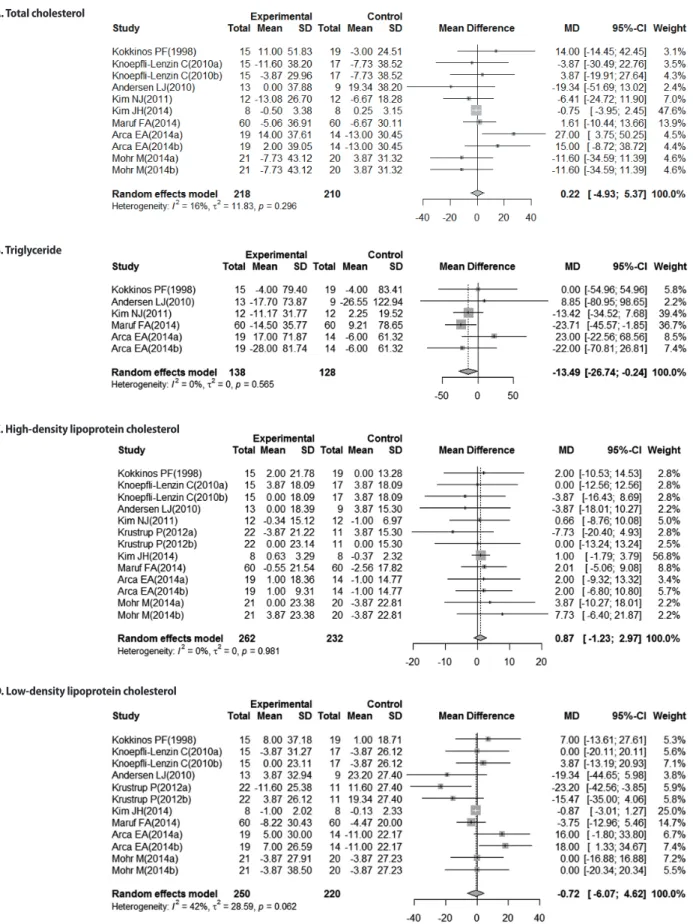
총 콜레스테롤(TC)의 효과크기 산출에 포함된 연구는 11개로 운 동군 218명, 통제군 210명 이었다. 유산소 운동에 대한 TC의 평균 효 과크기는 0.22 mg/dL (95% CI: -4.93–5.37)이었으며, 유산소 운동 중 재에 대한 TC의 효과는 통계적으로 유의하지 않았다(z = 0.08, p =.933). 총 콜레스테롤 연구는 I 2 =16% (p =.296)로 이질성이 낮은 것으로 나타났다(Figure 3A).

중성지방(TG)의 효과크기 산출에 포함된 연구는 6개로 운동군 138명, 통제군 128명이었다. 유산소 운동에 대한 중성지방의 평균 효과크기는 -13.49 mg/dL (95% CI: -26.74–-0.24)이었으며, 유산소 운 동에 대한 중성지방의 효과는 통계적으로 유의하였다(z =-2.00, p =.046). 중성지방은 I 2 = 0% (Q =3.89, p =.565)로 이질성이 없는 것 으로 나타났다(Figure 3B).

고밀도 지단백 콜레스테롤(high-density lipoprotein cholesterol, HDL-C)의 효과크기 산출에 포함된 연구는 13개로 운동군 262명, 통제군 232명 이었다. 유산소 운동에 대한 HDL-C의 전체 평균 효 과크기는 0.87 mg/dL (95% CI: -1.23–2.97)이었으며, 통계적으로 유의 하지 않았다(z= 0.81, p= 0.419). HDL-C은 I 2 = 0% (Q= 4.11, p=.981)로 이질성이 없는 것으로 나타났다(Figure 3C).

저밀도 지단백 콜레스테롤(LDL-C)의 효과크기 산출에 포함된 연구는 12개로 운동군 250명, 통제군 220명이었다. 유산소 운동에 대한 LDL-C의 전체 평균 효과크기는 -0.72 mg/dL (95% CI: -6.07–

4.62)이었으며, 유산소 운동 중재에 대해 LDL-C는 통계적으로 유의 하지 않았다(z =-0.27, p =.701). 본 연구에서 유산소 운동에 대한 LDL-C의 이질성은 I 2 = 42% (Q=18.93, p=.062)로 중간 정도의 이질성 을 보였다(Figure 3D).

2) 체중과 체질량지수의 효과크기

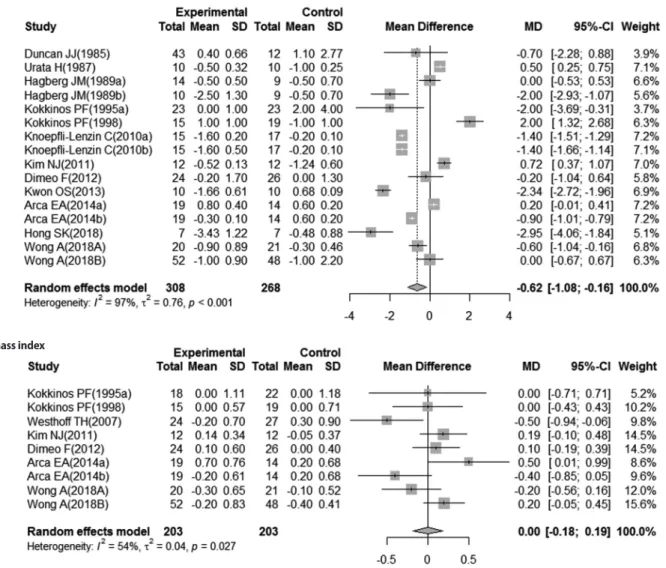
체중의 평균 효과크기 산출에 포함된 연구는 16개로 운동군 308 명, 통제군 268명이었다. 체중의 운동중재에 대한 효과는 -0.62 kg (95% CI: -1.08–-0.16)이였으며, 통계적으로 유의하였다(z =-2.63, Figure 2. Risk of bias in included studies

Low risk Some concerns High risk Study ID

Selection of the reported result Randomization process Kim JH (2014)

Kim NJ (2011) Ar ca EA (2011) Dimeo F (2012) W esthoff TH

(2007)

W ong A (2018A )

W ong A (2018B) Duncan JJ (1985) Ur ata H (1987) Hagber

g JM (1989)

Kok kinos PF (1998) Kok kinos PF (1995)

Knoepfli-L enzin C (2010) Andersen LJ (2010) Krustrup P (2012) Kw on OS (2013) M aruf F

A (2014) M ohr M (2014) Hong SK (2018)

Deviations from intended interventions Mising outcome data

Measurement of the outcome 2-B. Risk of bias graph

2-A. Risk of bias summary

Selection of the reported result Measurement of the outcome Mising outcome data Deviations from intended interventions

Randomization process

0 10 20 30 40 50 60 70 80 90 100 Low risk Some concerns High risk 100.0

100.0 100.0

52.6 42.1

78.9

5.3

10.5

10.5

(7)

Figure 3. The effect of aerobic exercise on serum lipids.

3-A. Total cholesterol

3-B. Triglyceride

3-C. High-density lipoprotein cholesterol

3-D. Low-density lipoprotein cholesterol

(8)

p=.009). 체중 연구는 I 2 =97% (Q=566.07, p<.001)로 매우 높은 이질 성을 보였다(Figure 4A). 이에 따라 이질성의 가능한 원인을 찾기 위 하여 체중을 포함한 연구의 주요 변인 중 운동형태, 운동기간, 운동 빈도, 운동강도를 조절변수로 하여 메타 ANOVA를 실시하였다. 메 타 ANOVA를 시행한 결과 운동형태(Q=5.40, df=3, p=.145), 운동기 간(Q=3.25, df=2, p=.197), 운동빈도(Q= 4.59, df=2, p=.101), 운동강 도(Q= 4.25, df=2, p=.120)는 평균 효과크기에 영향을 주지 않는 것 으로 나타났다.

체질량지수의 효과크기 산출에 포함된 연구는 9개로 운동군 203명, 통제군 203명이었다. 유산소 운동중재에 대한 체질량지수의 평균 효과크기는 0.00 kg/m 2 (95% CI: -0.18–0.19)이었으며, 통계적으 로 유의하지 않았다(z = 0.05, p =.962). 체질량지수 연구는 I 2 =54%

(Q=17.32, p<.027)로 중간정도의 이질성을 보였다(Figure 4B).

5. 출판 비뚤림 검정 결과

출판비뚤림은 시각적으로 funnel plot으로 대칭 정도를 확인하 고, 객관적으로 비대칭 정도가 통계적으로 유의한지를 Egger’s 회귀 분석을 통하여 확인하였다. 그 결과 TC, HDL-C, LDL-C, 체중은 육 안적으로 골고루 분포되어 대칭을 이루었다. 통계적으로 검증하기 위해 Egger’s 회귀분석을 시행한 결과 TC는 bias= 0.18 (t= 0.39, df=9, p=.708), HDL-C는 bias=-0.15 (t=-0.51, df=11, p=.621), LDL-C는 bias

=-0.02 (t=-0.04, df=10, p =.968), 체중은 bias=-2.26 (t= 0.96, df=14, p =.355)으로 비대칭 정도가 통계적으로 유의하지 않아 출판 비뚤 림이 없는 것으로 나타났다. 중성지방과 체질량지수를 포함한 연구 는 10편 미만으로 funnel plot과 Egger’s 회귀분석으로 시각적인 검토 를 수행하기에는 논문편수가 적어 시행하지 않았다.

Figure 4. The effect of aerobic exercise on body composition.

4-A. Weight

4-B. Body mass index

(9)

논  의

본 연구는 고혈압 환자를 대상으로 유산소운동을 실시한 RCT 연구만을 대상으로 체계적으로 고찰한 후 메타 분석을 실시하여 고혈압 환자의 혈중지질, 체중 및 체질량지수에 미치는 유산소 운 동의 효과를 규명하고자 시도되었다. 체계적 문헌고찰 및 메타분석 에 포함된 연구는 총 19편이었다. 고혈압 환자의 혈중 지질. 체중 및 체질량지수 관련 연구는 2000년 이전부터 현재까지 지속적으로 출 판되었지만 2010년 이후에 보고된 연구가 57.9%로 최근에 더 많은 연구가 이루어지고 있었다. 유산소 운동 종류로는 걷기나 달리기와 같은 일반적인 방법이 47.4%로 가장 많았으며, 이는 유산소 운동이 고혈압 환자의 혈압에 미치는 효과를 보고한 선행 메타분석 연구와 유사한 결과였다[18,19]. 이는 다양한 유산소 운동 중에 걷기와 달리 기와 같은 방법이 준비가 간단하고 누구나 쉽게 접근할 수 있기 때 문이라고 생각된다[20]. 운동중재 기간은 8주부터 37주까지 다양하 였으며, 12주로 적용한 연구가 57.9%로 가장 많았다. Börjesson 등[19]

의 유산소 운동이 혈압에 미치는 효과를 보고한 선행 연구에서도 연구기간이 4주부터 37주까지 보고되었으며, 이 연구에서도 12주가 가장 많았다. 주당 운동 회수는 3회가 68.4%로 가장 많았으며, 운동 시간도 30–60분이 가장 많아 이는 고혈압 환자에게 유산소 운동 중 재를 수행한 다른 메타분석 연구와 유사한 결과였다[18,19]. 운동강 도는 중간 강도가 63.2%로 가장 많았으며 이는 미국스포츠의학회 [21]에서는 고혈압 환자에게 고강도의 유산소 운동을 금기하지는 않 았지만, 일반적으로 중등도의 운동을 권고하고 있어 이를 기준으로 연구가 이루어지고 있기 때문인 것으로 생각되어진다.

본 연구에서 분석한 혈중지질의 효과크기 중에서 유산소 운동 후에 중성지방만 13.49 mg/dl 유의하게 감소하였고, TC, HDL-C, LDL-C는 통계적으로 유의한 변화가 없었다. 이와 같은 결과는 건강 한 성인을 대상으로 유산소 운동을 수행한 메타분석 연구결과[22]

와 유사하여 이 연구에서도 중성지방만 13.1 mg/dL 감소하였다. Kel- ley 등[23]의 메타분석 연구에서도 유산소 운동 후 중성지방만 유의 하게 감소되었다. 이러한 메타분석 연구들은 정상인을 대상으로 하 거나[22] 운동 뿐 아니라 식이요법 같은 중재의 효과도 함께 분석 [23]하고 있어서 본 연구 결과와 직접 비교하기에는 어려운 점이 있 지만 같은 맥락을 제공하고 있다.

고혈압 환자를 대상으로 유산소 운동이 혈중지질에 미치는 효과 를 연구한 개별 연구를 살펴보면 8주간 유산소운동 프로그램을 적 용한 연구에서 중성지방은 유의하게 감소하였고, 나머지 혈중지질 은 변화가 없는 연구와 유사하였다[24]. 에너지가 부족하게 되면 저 장되어 있던 중성지방이 일차적으로 분해되어 에너지원으로 사용

된다. 유산소 운동은 에너지 이용을 증가시키므로 유산소 운동에 가장 효과적으로 반응을 보이는 지질은 중성지방일 것으로 사료된 다. 고혈압 여성에게 10주간 유산소 운동을 시행한 연구에서 TC, HDL-C, LDL-C에서 유의한 변화가 없었고[A6], 고혈압 남성에게 장 기간 댄스운동을 시행한 연구에서 TC와 TG가 감소하기는 했지만 통계적으로 유의하지 않았다[A2], 많은 연구에서 유산소 운동은 혈 중지질을 개선시키고, 지방 대사를 활성화 시켜 TC, TG, LDL-C, HDL-C를 효과적으로 개선시킨다고 보고하였다[25,26]. 이와 같이 유산소 운동과 혈중지질과의 관계를 연구한 선행 연구를 보면 결과 가 일관되지 않는다. 유산소 운동 후에도 혈중지질이 효과적으로 개선되지 않은 연구들에서는 유산소 운동뿐 아니라 식이요법을 병 행할 때 혈중지질의 개선이 효과적이라고 주장하고 있다[23,27,28].

미국스포츠의학회에서도 운동은 이상지질혈증 치료를 위해 유용 하지만, 효과는 미비하고 일관된 효과를 보이지 않으며, 추가적으 로 식이요법과 체중 감량이 혈중지질을 낮추는데 효과적이라고 하 였다[21]. 따라서 고혈압 환자에게 혈중지질을 감소시킬 목적으로 운동중재를 처방할 때 식이요법 및 체중 감량과 같은 전반적인 생 활습관의 변화를 함께 권장해야 할 것이다.

유산소 운동이 체중에 미치는 결과를 보고한 문헌은 16편이었

다. 유산소 운동중재에 대한 체중의 평균 효과크기는 -0.62 kg으로

유산소 운동 수행 후 체중이 통계적으로 유의하게 감소하였지만 감

소량이 크지는 않았다. 유산소 운동이 체질량지수에 미치는 결과

를 보고한 문헌은 9편으로 유산소 운동중재에 대한 체질량지수의

평균 효과크기는 0.00 kg/m 2 로 통계적으로 유의하지 않아 유산소

운동이 체질량지수에 영향을 미치지 않는 것으로 나타났다. 고혈압

환자를 대상으로 체중 및 체질량지수를 연구한 개별연구는 다수

존재하나, 메타 분석 연구 중에 체중 및 체질량지수를 보고한 연구

는 거의 없는 실정이다. 고혈압 환자에게 유산소 운동 중재를 시행

한 개별 연구를 보면 고혈압을 진단받은 여성에게 계단 오르기 운

동을 시행한 결과 체중과 체질량지수 모두 감소하였고[A6], 고혈압

을 진단 받은 남자 환자에게 축구와 달리기 중재를 시행한 집단에

서 모두 체중이 유의하게 감소하였으며[A13]. 고혈압 진단을 받은

노인에게 트레드밀에서 걷기 운동을 12주 동안 시행한 연구에서도

체질량지수가 유의하게 감소하였다[A5]. 하지만 고혈압을 진단받은

갱년기 여성에게 20주 수영을 시행한 결과 체중과 체질량지수는 변

화가 없었고[A8], 수중운동을 시행한 연구에서는 체중과 체질량지

수가 증가한 연구도 보고되어[A3] 개별 연구들의 결과가 일관되지

않아 본 연구의 메타분석에서도 유산소운동이 체질량지수 감소에

효과가 없었던 것으로 보인다. 정상 성인을 대상으로 수중운동을

실시한 메타 분석 연구에서 체질량지수의 변화가 유의하지 않았으

(10)

며[29], 정상 혈압군과 고혈압 환자를 포함한 유산소 운동을 시행한 메타분석 연구에서도 체질량지수의 변화가 유의하지 않았다[30].

한편, 비만은 고혈압, 심장질환, 당뇨병, 암 등 각종 성인병의 직간접 적 원인으로 확인되고 있다[31]. 미국스포츠의학회에서[21]는 비만 환자들에게 체중 및 체질량지수의 효과적인 관리를 위해 주당 5–7 회 운동을 권장하고 있는데 본 연구에서 분석한 문헌은 주당 3–4회 가 적용된 경우가 대부분이다. 즉, 비만이 동반된 고혈압 환자의 체 중 및 체질량지수의 효과적 관리를 위해서는 주당 운동 수행 횟수 를 증가시켜야 할 것으로 보인다.

또한 선행 연구에서는 더 많은 체중 감소를 위해 식이요법과 운 동 프로그램이 병행되어야 한다고 하였다[27]. 일반적으로 식사 조 절 없이 6–12개월간 구조화된 유산소 운동으로 체중의 2–3% 만 감 량이 가능하다[32]. 따라서 고혈압 환자의 체중을 감소시킬 목적으 로 운동 중재를 처방할 때에는 혈압 하강을 목적으로 할 때와는 다 른 중재가 적용되어야 한다. 이를 뒷받침하는 연구로, 18세 이상 성 인에게 유산소 운동과 식이요법을 적용한 무작위 실험연구를 메타 분석한 선행 연구에서 체중이 0.8 kg 감소하였고, 식이를 제한 한 그 룹에서는 3.0 kg 감소하였으며, 유산소 운동과 식이제한을 함께한 그룹에서는 3.5 kg 감소하여 운동과 함께 식이 제한을 한 그룹에서 가장 크게 체중 감소효과가 있었다[23].

본 연구는 고혈압 환자에게 유산소 운동이 혈중지질과 체중 및 체질량지수에 미치는 효과를 보고한 개별적인 결과들을 체계적이 고 객관적으로 통합하여 과학적으로 검증한 측면에서 의의가 있다.

분석에 포함된 개별연구들의 비뚤림 위험 평가에서도 대부분 비뚤 림 위험이 낮았으며, RCT 연구만을 포함하여 연구 결과의 신뢰성이 높였다. 그러나 본 연구에서는 영어와 한국어로 보고된 연구만 포 함되었다는 제한점이 있다. 또한 고혈압 환자에게 유산소 운동 중 재의 효과를 검증하는 연구는 많이 이루어지고 있었지만 대부분 혈압에 대한 결과를 주요 결과로 보고하였고, 혈중지질과 체중 및 체질량지수에 대한 연구는 상대적으로 많지 않았다. 따라서 운동 형태, 운동기간, 주당 운동회수, 운동강도에 따라 혈중지질과 체중 및 체질량지수에 대한 하부 요인을 분석하기에는 한계가 있었다.

결  론

본 연구에서는 고혈압 환자를 대상으로 유산소 운동을 실시한 연구를 체계적으로 고찰하고 메타 분석을 시행하여 혈중지질과 체 중 및 체질량지수의 효과크기를 제공하였다. 유산소 운동 후 혈중 지질 중에는 TG만 유의하게 개선되었고, TC, HDL-C, LDL-C는 유 의하게 개선되지 않았다. 더불어 체중은 유의하게 감소하였으나 감

소량이 적었으며, 체질량지수의 변화는 나타나지 않았다. 따라서 유산소 운동만으로는 고혈압 환자의 혈중지질, 체중 및 체질량지수 를 개선하기 어려우며 식이요법 같은 부가적인 간호중재가 병행될 필요가 있다. 추후 고혈압 환자의 혈중지질 및 비만을 개선하기 위 한 적극적인 간호중재가 개발되어 적용될 필요가 있다.

CONFLICT OF INTEREST The authors declared no conflict of interest.

AUTHORSHIP

CYR and LSH contributed to the conception and design of this study;

CYR and LSH collected data; LSH performed the statistical analysis and interpretation; LSH drafted the manuscript; CYR and LSH critically re- vised the manuscript; CYR supervised the whole study process. All au- thors read and approved the final manuscript.

REFERENCES

1. Jung KH. 2017 National survey of older Koreans. Final repor. Sejong: Korea In- stitute for Health and Social Affairs; 2018. Report No.: Policy Report 2018-01.

2. Weber MA, Schiffrin EL, White WB, Samuel M, Lindholm LH, Kenerson JG, et al. Clinical practice guidelines for the management of hypertension in the community: a statement by the American Society of Hypertension and the In- ternational Society of Hypertension. The Journal of Clinical Hypertension.

2014;32(1):3-15. https://doi.org/10.1111/jch.12237

3. The Korean Society of Hypertension. The guidelines of treatment of hyperten- sion 2018. Seoul: The Korean Society of Hypertension; 2018 [cited 2019 Dec 1].

Available from: http://www.koreanhypertension.org/reference/guide?mode=

read&idno=4246.

4. Ates I, Ozkayar N, Ates H, Karakulak UN, Kursun O, Topcuoglu C, et al. Elevat- ed circulating sST2 associated with subclinical atherosclerosis in newly diag- nosed primary hypertension. Hypertension Research. 2016;39(7):513-518.

https://doi.org/10.1038/hr.2016.16

5. Halperin RO, Sesso HD, Ma J, Buring JE, Stampfer MJ, Gaziano JM. Dyslipid- emia and the risk of incident hypertension in men. Hypertension, 2006;47(1):

45-50. https://doi.org/10.1161/01.HYP.0000196306.42418.0e

6. Lewington S, Whitlock G, Clarke R, Sherliker P, Emberson J, Halsey J, et al.

Blood cholesterol and vascular mortality by age, sex, and blood pressure: a me- ta-analysis of individual data from 61 prospective studies with 55,000 vascular deaths. The Lancet. 2007;370(9602):1829-1839. https://doi.org/10.1016/S0140- 6736(07)61778-4

7. Aydin E, Ates I, Arikan MF, Yilmaz N, Dede F. The ratio of monocyte frequen-

cy to HDL cholesterol level as a predictor of asymptomatic organ damage in pa-

tients with primary hypertension. Hypertension Research. 2017;40(8):758-764.

(11)

https://doi.org/10.1038/hr.2017.36

8. Kim JW, Park CH, Kim TU. Effects of 12 weeks walking on metabolic syn- drome markers, growth hormone and IGF-I in obese girls. The Korean Journal of Growth and Development. 2008;16(1):9-17.

9. Lee CJ, Ko YH, Shin DS. Effect of combined treatment of aerobic exercise and resistance exercise on blood lipids and C-reactive protein in hypertensive pa- tients. Korean Journal of Sports Science. 2014;23(1):1077-1087.

10. Cook Z, Kirt S, Lawrenson S, Sandford S. Use of BMI in the assessement of un- dernutrition in older subject: reflecting on practice. Proceeding of the Nutrition Society. 2005;64(3):313-317. https://doi.org/10.1079/PNS2005437

11. Lavie CJ, Milani RV, Ventura HO. Obesity and cardiovascular disease: risk fac- tor, paradox, and impact of weight loss. Journal of the American College of Car- diology. 2009;53(21):1925-1932. https://doi.org/10.1016/j.jacc.2008.12.068 12. Safar ME, Czernichow S, Blacher J. Obesity, arterial stiffness, and cardiovascular

risk. Journal of the American Society of Nephrology. 2006;17(4 Suppl 2):S109- S111. https://doi.org/10.1681/ASN.2005121321

13. Jensen MD, Ryan DH, Aprovian CM, Ard JD, Comuzzie AG, Donato KA, et al.

2013 AHA/ACC/TOS guideline for the management of overweight and obesi- ty in adults: a report of the American College of Cardiology/American Heart Association Task Force on Practice Guidelines and The Obesity Society. Journal of the American College of Cardiology. 2014;63(25):2985-3023. https://doi.

org/10.1016/j.jacc.2013.11.004

14. Moher D, Liberati A, Tetzlaff J, Altman DG; PRISMA Group. Preferred report- ing items for systematic reviews and meta-analyses: the PRISMA statement. In- ternational Journal of Surgery. 2010;8(5):336-341. https://doi.org/10.1016/

j.ijsu.2010.02.007

15. Sterne JAC, Savović J, Page MJ, Elbers RG, Blencowe NS, Boutron I, et al. RoB 2:

a revised tool for assessing risk of bias in randomized trials. British Medical Journal. 2019;366:l4898. https://doi.org/10.1136/bmj.l4898

16. Kim SY, Park JE, Seo HJ, Lee YJ, Son HJ, Jang BH, et al. NECA’s guidance for undertaking systematic reviews and meta-analyses for intervention. Seoul: Na- tional Evidence-based Healthcare collaborating Agency; 2011. p. 1-165.

17. Higgins JPT, Green S. Cochrane handbook for systematic reviews of interven- tions version 5.1.0 [Internet]. London: The Cochrane Collaboration; 2011 [cit- ed 2019 Dec 1]. Available from: http://handbook-5-1.cochrane.org/.

18. Cornelissen VA, Smart NA. Exercise training for blood pressure: a systematic review and meta analysis. Journal of the American Heart Association. 2013;

2(1):1-9. https://doi.org/10.1161/JAHA.112.004473

19 Börjesson M, Onerup A, Lundqvist S, Dahlöf B. Physical activity and exercise lower blood pressure in individuals with hypertension: narrative review of 27 RCTs. British Journal of Sports Medicine. 2016;50(6):356-361. https://doi.

org/10.1136/bjsports-2015-095786

20. Son JU, Lee JH. The effect of the walking exercise on physiological index, physi-

cal fitness, self esteem, depression and life satisfaction in the institutionalized el- derly women. Journal of Korean Academy of Community Health Nursing.

2006;17(1):5-16.

21. Riebe D, Ehrman JK, Liguori G, Magal M. ACSM’s guidelines for exercise test- ing and prescription. 10th ed. Kim WS. et al. translator. Indianapolis, IN: Wolt- ers kluwer Health Inc.; 2018. 224-234.

22. Sarzynski MA, Burton J, Rankinen T, Blair SN, Church TS, Despres JP, et al. The effects of exercise on the lipoprotein subclass profile: a meta-analysis is 10 inter- ventions. Atherosclerosis. 2015;243(2):364-372. https://doi.org/10.1016/j.ath- erosclerosis.2015.10.018

23. Kelley GA, Kelley KS, Roberts S, Haskell W. Comparison of aerobic exercise, diet or both on lipids and lipoproteins in adults: a meta-analysis of randomized con- trolled trials. Clinical Nutrition. 2012;31(2):156-167. https://doi.org/10.1016/

j.clnu.2011.11.011

24. Lee HS. The effects of aerobic exercise for body composition, serum lipids, self- efficacy and life satisfaction in middle-aged women. Korean Journal of Health Promotion. 2007;7(3):196-204.

25. Farrel SW, Finley CE, Grundy SM. Cardiorespiratory fitness, LDL cholesterol, and CHD mortality in men. Medicine & Science in Sport & Exercise. 2012;

44(11):2132-2137. https://doi.org/10.1249/MSS.0b013e31826524be 26. Mann S, Beedie C, Jimenez A. Differential effects of aerobic exercise, resistance

training and combined exercise modalities on cholesterol and the lipid profile:

review, synthesis and recommendations. Sports Medicine. 2014;44(2):211-221.

https://doi.org/10.1007/s40279-013-0110-5

27. Wu T, Gao X, Chen M, Da V. Long-term effectiveness of diet-plus exercise in- terventions vs. diet-only interventions for weight loss: a meta-analysis. Obesity Review 2009;10(3):313-323. https://doi.org/10.1111/j.1467-789X.2008.00547.x 28. Pedersen BK, Saltin B. Exercise as medicine-evidence for prescribing exercise as therapy in 26 different chronic disease. Scandinavian Journal of Medicine &

Science in Sport. 2015;25(S3):1-72. https://doi.org/10.1111/sms.12581 29. Igarashi Y, Nogami Y. The effect of regular aquatic exercise on blood pressure: a

meta-analysis of randomized controlled trials. European Journal of Preventive Cardiology. 2018;25(2):190-199. http://doi.org/10.1177/2047487317731164 30. Whelton SP, Chin A, Xin X, He J. Effect of aerobic exercise on blood pressure: a

meta-analysis of randomized, controlled trials. Annals of Internal Medicine.

2002;136(7):493-503. https://doi.org/10.7326/0003-4819-136-7-200204020- 00006

31. Park SH, Kim CG. Impact of resistance training on obesity index, lipid index, blood pressure, pulse rate, and bone mineral densitometer in middle-aged women: a meta-analysis of randomized controlled trials. The Korean Journal of Rehabilitation Nursing. 2019;22(1):1-14. https://doi.org/10.7587/kjrehn.2019.1 32. Yang YJ. Evidence based exercise to control weight. Journal of the Korean Medical

Association. 2017;60(10):806-816. https://doi.org/10.5124/jkma.2017.60.10.806

(12)

Appendix 1. Studies included in Systematic  Review and Meta-analysis

A1. Kim JH. The Effect of dance program on the serum lipids and blood pressure and leptin of obese elderly women with hypertension. Official Journal of the Korean Society of Dance Science. 2014;31(3):83-93.

A2. Kim NJ. The effects of long term dance exercise program on body composi- tion and metabolic syndrome risk factors in elderly hypertension. Korean Journal of Sports Science. 2011;20(5):985-994.

A3. Arca EA, Martinelli B, Martin LC, Waisberg CB, Franco RJ. Aquatic exercise is as effective as dry land training to blood pressure reduction in postmeno- pausal hypertensive women. Physiotherapy Research International.

2014;19(2):93-98. https://doi.org/10.1002/pri.1565

A4. Dimeo F, Pagonas N, Seibert F, Arndit R, Zidek W, Westhoff TH. Aerobic ex- ercise reduces blood pressure in resistant hypertension. Hypertension. 2012;

60(3):653-658. https://doi.org/10.1161/HYPERTENSIONAHA.112.197780 A5. Westhoff TH, Franke N, Schmidt S, Vallbracht-Israng K, Meissner R, Yildirim H,

et al. Too old to benefit from sports? The cardiovascular effects of exercise train- ing in elderly subjects treated for isolated systolic hypertension. Kidney Blood Pressure Research. 2007;30(4):240-247. https://doi.org/10.1159/000104093 A6. Wong A, Figueroa A, Son WM, Chernykh O, Park SY. The effects of stair

climbing on arterial stiffness, blood pressure, and leg strength in postmeno- pausal women with stage 2 hypertension. Menopause. 2018;25(7):731-737.

https://doi.org/10.1097/GME.0000000000001072

A7. Kokkinos PF, Narayan P, Colleran J. Fletcher RD, Lakshman R, Papademetri- ou V. Effects of moderate intensity exercise on serum lipids in African-Amer- ican men with severe systemic hypertension. The American Journal of Cardi- ology. 1998;81(6):732-735. https://doi.org/10.1016/S0002-9149(97)01020-5 A8. Wong A, Kwak YS, Scott SD, Pekas EJ, Son WM, Kim JS, et al. The effects of

swimming training on arterial function, muscular strength, and cardiorespi- ratory capacity in postmenopausal women with stage 2 hypertension. Meno- pause. 2018;26(6):653-658. http://doi.org/10.1097/GME.0000000000001288 A9. Duncan JJ, Farr JE, Upton SJ, Hagan RD, Oglesby ME, Blair SN. The effects of

aerobic exercise on plasma catecholamines and blood pressure in patients with mild essential hypertension. JAMA. 1985;254(18):2609-2613. https://

doi.org/10.1001/jama.1985.03360180113036

A10. Urata H, Tanabe Y, Kiyonaga A, Ikeda M, Tanaka H, Shindo M, et al. Antihy- pertensive and volume-depleting effects of mild exercise on essential hyper-

tension. Hypertension. 1987;9(3):245-252. https://doi.org/10.1161/01.

hyp.9.3.245

A11. Hagberg JM, Montain SJ, Martin WH, Eshani AA. Effect of exercise training in 60- to 69-year-old persons with essential hypertension. The American Journal cardiology. 1987;64(5):348-353. https://doi.org/10.1016/0002-9149(89)90533- x

A12. Kokkinos PF, Narayan P, Colleran JA, Pittaras A, Notargiacomo A, Reda D, et al. Ef- fects of regular exercise on blood pressure and left ventricular hypertrophy in Afri- can-American men with severe hypertension. The New England Journal of Medi- cine. 1995;333(22):1462-1467. https://doi.org/10.1056/NEJM199511303332204 A13. Knoepfli-Lenzin C, Sennhauser C, Toigo M, Boutellier U, Bangsbo J, Krustrup

P, et al. Effects of a 12-week intervention period with football and running for habitually active men with mild hypertension. Scandinavian Journal of Medi- cine and Science in Sport. 2010;20(suppl.1):72-79. https://doi.org/10.1111/

j.1600-0838.2009.01089.x

A14. Andersen LJ, Randers MB, Westh K, Martone D, Hansen PR, Junge A, et al.

Football as a treatment for hypertension in untrained 30-55-year-old men: a prospective randomized study. Scandinavian Journal of Medicine and Science in Sport. 2010;20(S1):98-102. https://doi.org/10.1111/j.1600-0838.2010.01109.

x|

A15. Krustrup P, Randers MB, Andersen LJ, Jackman SR, Bangsbo J, Hansen PR.

Soccer improves fitness and attenuates cardiovascular risk factors in hyper- tensive men. Medicine & Science in Sports & Exercise. 2013;45(3):553-560.

https://doi.org/10.1249/MSS.0b013e3182777051

A16. Kwon OS, Kim JH, Lee SH. Effect of aquarobic training according to body composition, blood pressure on inflammatory markers in middle age hyper- tensive women. Korean Journal of Sport Science. 2013;22(5):1243-1256.

A17. Maruf FA, Akinpelu AO, Salako BL. A randomized controlled trial of the ef- fects of aerobic dance training on blood lipids among individuals with hyper- tension on a thiazide. High Blood Pressure & Cardiovascular Prevention.

2014; 21(4):275-283. https://doi.org/10.1007/s40292-014-0063-2

A18. Mohr M, Nordsborg NB, Lindenskov A, Steinholm H, Nielsen HP, Mortensen H, et al. High-intensity intermittent swimming improves cardio- vascular health status for women with mild hypertension. BioMed Research International. 2014;2014:728289. https://doi.org/10.1155/2014/728289 A19. Hong SK, Lee DG, Lee GC. Effect of Aerobic exercise on blood pressure and

arterial compliance in patients with essential hypertension. Journal of Exercise

Physiology Online. 2018;21(5):9-18.

수치

Table 1. Characteristics of Included Studies NoFirst author (year)Study  country
Figure 3. The effect of aerobic exercise on serum lipids.
Figure 4. The effect of aerobic exercise on body composition.

참조

관련 문서

Key Words: Ischemic stroke; Thrombectomy; Brain; Reperfusion injury 국문주요어: 허혈성 뇌졸중, 혈전제거술, 뇌재관류 손상.. Corresponding author:

Key Words: Chronic obstructive pulmonary disease; airflow obstruction; health status; COPD assessment test 국문주요어: 만성폐쇄성폐질환,

Factors Associated with Obstructive Sleep Apnea Risk in Patients with Metabolic Syndrome.. Jae Hee Kim 1 , Sang

Effects of Laughing and Music Therapy on Depression and Activities of the Autonomic Nervous System in the Elderly with Dementia..

The Effects of Relaxation on Stress and Blood Pressure Induced by Cognitive Distress Game among College Students.. Mi Ryeong Song 1 , Sung

T he fall prevention program (FPP), web- based instruction, nursing education, cardiopulmonary resuscitation, basic nursing sciences, exercise (2), exercise test,

Relation of the Blood Pressure, Lipids and Body Mass Index by Smoking Status Among Adolescents.. A Study on Health behavior in People with type

Purpose: This study was performed to identify the effects of dance sports programs on the parameters of health promotion (blood pressure, pulse, glucose, blood