Original Article Urogenit Tract Infect 2016;11(1):30-35
Clinical Data of Urine Culture and Antimicrobial Sensitivity Tests according to the Voiding Method over 15 Years in Patients with Spinal Cord Injury
Won Jun Lee, Sang Jin Kim, Jae Hyun Ryu, Yun Beom Kim, Seung Ok Yang, Jeong Ki Lee, Tae Young Jung Department of Urology, Veterans Health Service Medical Center, Seoul, Korea
Purpose: To analyze the results of urine cultures and antimicrobial sensitivity tests according to the voiding methods in patients with spinal cord injury (SCI) over a 15-year period.
Materials and Methods: A total of 1,579 urine culture samples, obtained from January 2000 to December 2014, for 73 SCI patients were analyzed according to the voiding method. We analyzed the following: positive urine culture rate, colony counts, isolated number of organism, major organisms, and antimicrobial sensitivity tests. The voiding methods were categorized into four methods: clean intermittent catheterization (CIC), suprapubic catheterization (SPC), urethral Foley catheter, and spontaneous voiding (SV).
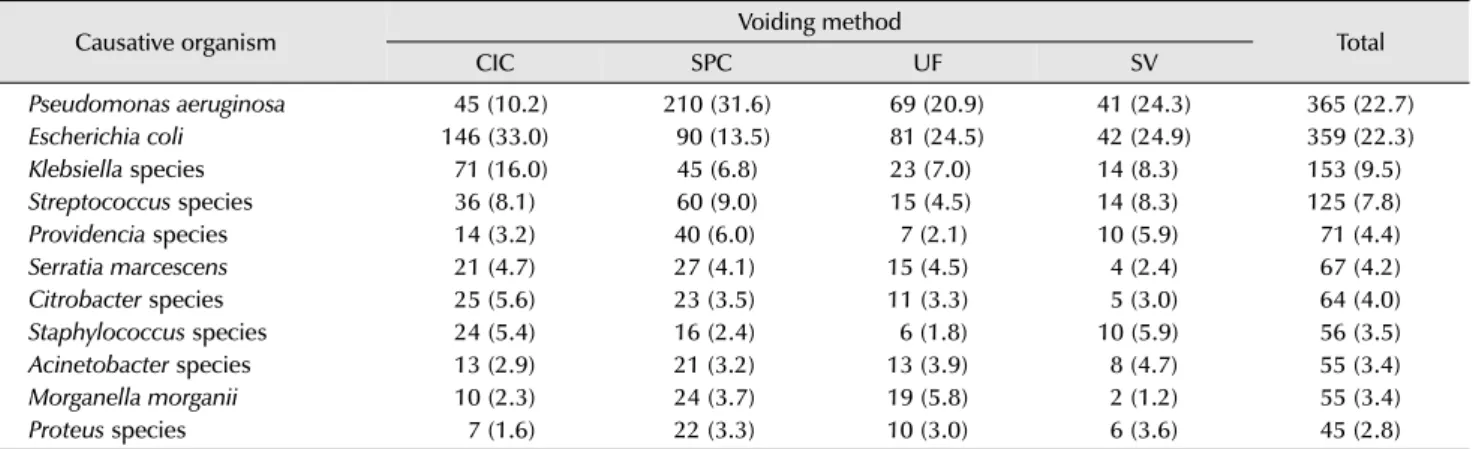
Results: Among the 1,579 urine samples, 1,250 (79.2%) were positive. The CIC group showed the lowest rate of bacteriuria (p<0.001), colony counts (p<0.001), and polymicrobial infection (p<0.001). Causative organisms were mostly gram-negative bacteria (86.7%). Pseudomonas aeruginosa (22.7%) was most common pathogen followed by Escherichia coli (22.3%), Klebsiella species (9.5%), Providencia species (4.4%), and Serratia marcescens (4.2%). Major pathogens and antimicrobial sensitivity tests were different according to the voiding method.
Conclusions: CIC is the best voiding method to reduce urinary tract infection (UTI) in SCI patients. To treat UTI in in SCI patients, empirical antibiotics can be chosen according to the voiding method based on the reference of our study prior to the availability of antimicrobial sensitivity results.
Keywords: Bacteriuria; Spinal cord injuries; Urinary tract infections
Copyright 2016, Korean Association of Urogenital Tract Infection and Inflammation. All rights reserved.
This is an open access article distributed under the terms of the Creative Commons Attribution Non-Commercial License (http://creativecommons.org/licenses/by-nc/4.0) which permits unrestricted non-commercial use, distribution, and reproduction in any medium, provided the original work is properly cited.
Received: 31 March, 2016 Revised: 11 April, 2016 Accepted: 18 April, 2016
Correspondence to: Tae Young Jung
http://orcid.org/0000-0002-4634-3370 Department of Urology, Veterans Health Service Center, 53, Jinhwangdo-ro 61-gil, Gangdong-gu, Seoul 05368, Korea
Tel: +82-2-2225-1739, Fax: +82-2-2225-4374 E-mail: [email protected]
INTRODUCTION
Although recent medical advances have greatly enhanced the long-term survival for individuals with spinal cord injury (SCI), SCI patients suffer from many urological complica- tions, like as urinary tract infection (UTI), urinary tract stones, hydronephrosis, and vesicoureteral reflux [1]. Most SCI patients have neurogenic lower urinary tract dysfunc- tion. As a result of impaired storage and voiding function,
patients often require catheters for bladder drainage; addi- tionally, UTI occur frequently in this group of patients [2].
Furthermore, UTI is the leading cause for septicemia in patients with SCI, which is associated with a significant increase in morbidity and mortality [3]. Therefore, prevention and proper management of UTI in SCI patients are crucial.
The optimal method of bladder management for SCI
patients remains controversial [4]. Many factors must be
considered when electing a specific bladder management,
Table 1. Positive urine cultures according to voiding method
Voiding method Sterile cultures Positive cultures Total p-value
a)Clean intermittent catheterization 146 (27.6) 383 (72.4) 529 (100) < 0.001
Suprapubic catheterization 82 (14.8) 473 (85.2) 555 (100)
Urethral Foley catheter 64 (19.9) 258 (80.1) 322 (100)
Spontaneous voiding 37 (21.4) 136 (78.6) 173 (100)
Values are presented as number (%).
a)
Analyzed by chi-square test.
including patient convenience, renal function preservation, and prevention of potential urological complications. Bladder management alternatives include clean intermittent cathe- terization (CIC), suprapubic catheterization (SPC), urethral Foley catheter (UF), and spontaneous voiding (SV).
As for using a catheter, catheter-associated UTI is often recurrent, and the bacterial strains are increasingly resistant to antibiotic treatment [5]. Moreover, the overuse and misuse of antimicrobial agents have contributed to increasing antibiotics resistance, making it even more difficult to choose an appropriate antibiotic.
We already reported the results of urine culture and antimicrobial sensitivity tests for SCI patients according to the voiding method over a period of 10 years [6]. In this study, we investigated the results of urine culture and antimicrobial sensitivity tests according to the method of bladder drainage used in SCI patients over the recent 15-year period.
MATERIALS AND METHODS
From January 2000 to December 2014, a retrospective chart review of 73 SCI patients was performed for analysis.
Some patients had a change of voiding method as a result of an inevitable situation. To minimize the impact of voiding method for UTI, urine culture samples obtained when keeping just one voiding method over a period of 6 months were analyzed. The number of included urine culture samples in these patients was 1,646. Among these samples, the results of “multiple species” samples (n=67) were excluded as these were considered contaminated. Finally, a total of 1,579 urine samples were analyzed. These urine culture samples were classified into four groups according to the voiding method used when the samples were obtained:
CIC (n=529), SPC (n=555), UF (n=322), and SV (n=173).
Urine samples were collected by aseptic catheterization or by using a clean catch technique for patients who were
able to void spontaneously. In patients who kept the catheter, urine samples were collected by aseptically aspirating the clamped and disinfected catheter with a sterile syringe after a catheter change. All culture specimens were examined in the laboratory, and minimum isolation for the diagnosis of bacteriuria was 10
3colony-forming units (CFU)/ml.
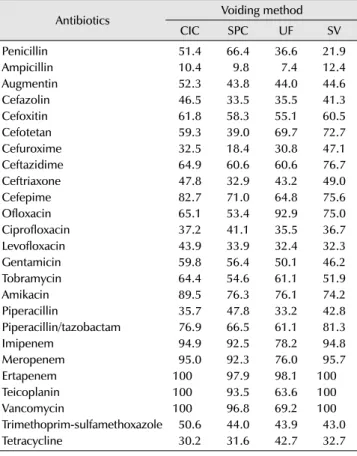
Antimicrobial sensitivity for cultured organisms was analyzed, and the results were stratified according to the voiding method. The antibiotics analyzed in our study were as follows: penicillin, ampicillin, augmentin, cefazolin, cefoxitin, cefotetan, cefuroxime, ceftazidime, ceftriaxone, cefepime, ofloxacin, ciprofloxaxin, levofloxacin, gentamycin, tobramycin, amikacin, piperacillin, piperacillin/tazobactam, imipenem, meropenem, ertapenem, teicoplanin, vancomy- cin, trimethoprim-sulfamethoxazole, and tetracycline.
Chi-square test (with Fisher’s exact test) was used for statistical analysis by PASW Statistics ver. 18.0 (IBM Co., Armonk, NY, USA). A p-value of <0.05 was considered to be statistically significant.
RESULTS
1. Results of Urine Cultures
1) Positive urine culture
Among the 1,579 urine culture samples, 1,250 (79.2%) showed a positive result. In the CIC group, 383 (72.4%) urine samples were positive, which was significantly lower than in the other groups (p<0.001; Table 1).
2) Colony counts
Table 2 showed the colony counts of the isolated bacteria.
The CIC group had lower colony counts than the other groups (p<0.001).
3) Isolated number of organism
Of all (1,250) positive urine cultures, multiple organisms
Table 2. Colony counts of the positive urine cultures
Voiding method Colony counts (CFU/ml)
p-value
a)10
3≤ <10
410
4≤ <10
510
5≤ <10
6≥10
6Total (%)
Clean intermittent catheterization 2 (0.5) 32 (8.4) 182 (47.5) 167 (43.6) 383 (100) < 0.001
Suprapubic catheterization 0 34 (7.2) 192 (40.6) 247 (52.2) 473 (100)
Urethral Foley catheter 0 25 (9.7) 118 (45.9) 115 (44.4) 258 (100)
Spontaneous voiding 0 6 (4.4) 58 (43.0) 72 (52.6) 136 (100)
Values are presented as number (%).
CFU: colony-forming units.
a)
Analyzed by chi-square test.
Table 3. Isolates of urine cultures according to voiding method
Voiding method Isolated number
p-value
a)1 2 3 Total
Clean intermittent catheterization 326 (85.1) 54 (14.1) 3 (0.8) 383 (100) < 0.001
Suprapubic catheterization 284 (60.0) 186 (39.3) 3 (0.6) 473 (100)
Urethral Foley catheter 188 (72.9) 68 (26.4) 2 (0.8) 258 (100)
Spontaneous voiding 106 (77.9) 27 (19.9) 3 (2.2) 136 (100)
Values are presented as number (%).
a)
Analyzed by chi-square test.
Table 4. Major causative organisms (top 1-10)
Causative organism Voiding method
Total
CIC SPC UF SV
Pseudomonas aeruginosa
45 (10.2) 210 (31.6) 69 (20.9) 41 (24.3) 365 (22.7)
Escherichia coli
146 (33.0) 90 (13.5) 81 (24.5) 42 (24.9) 359 (22.3)
Klebsiella species
71 (16.0) 45 (6.8) 23 (7.0) 14 (8.3) 153 (9.5)
Streptococcus species
36 (8.1) 60 (9.0) 15 (4.5) 14 (8.3) 125 (7.8)
Providencia species
14 (3.2) 40 (6.0) 7 (2.1) 10 (5.9) 71 (4.4)
Serratia marcescens
21 (4.7) 27 (4.1) 15 (4.5) 4 (2.4) 67 (4.2)
Citrobacter species
25 (5.6) 23 (3.5) 11 (3.3) 5 (3.0) 64 (4.0)
Staphylococcus species
24 (5.4) 16 (2.4) 6 (1.8) 10 (5.9) 56 (3.5)
Acinetobacter species
13 (2.9) 21 (3.2) 13 (3.9) 8 (4.7) 55 (3.4)
Morganella morganii
10 (2.3) 24 (3.7) 19 (5.8) 2 (1.2) 55 (3.4)
Proteus species