• 검색 결과가 없습니다.

The National Clinical Database as an Initiative for Quality Improvement in Japan

N/A
N/A
Protected

Academic year: 2021

Share "The National Clinical Database as an Initiative for Quality Improvement in Japan"

Copied!
7
0
0

로드 중.... (전체 텍스트 보기)

전체 글

(1)

1

Department of Cardiovascular Surgery, Gunma Children’s Medical Center,

2

Department of Cardiac Surgery, Graduate School of Medicine and Faculty of Medicine, The University of Tokyo,

3

Department of Cardiac Surgery, Sakura Hospital, Toho University,

4

Department of Health Quality Assessment, Graduate School of Medicine and Faculty of Medicine, The University of Tokyo,

5

Department of Pediatric Surgery, Graduate School of Medicine and Faculty of Medicine, The University of Tokyo,

6

The Mitsui Memorial Hospital

Received: July 22, 2014, Revised: August 21, 2014, Accepted: August 22, 2014, Published online: October 5, 2014

Corresponding author: Arata Murakami, Department of Cardiovascular Surgery, Gunma Children’s Medical Center, 779 Shimohakoda, Hokkitsu, Shibukawa, Gunma 377-8577, Japan

(Tel) 81-279-52-3551 (Fax) 81-279-52-2045 (E-mail) [email protected]

C

The Korean Society for Thoracic and Cardiovascular Surgery. 2014. All right reserved.

CC

This is an open access article distributed under the terms of the Creative Commons Attribution Non-Commercial License (http://creative- commons.org/licenses/by-nc/3.0) which permits unrestricted non-commercial use, distribution, and reproduction in any medium, provided the original work is properly cited.

Hiroaki Miyata, Ph.D.

4

, Tadashi Iwanaka, M.D., Ph.D.

5

, Shinichi Takamoto, M.D., Ph.D.

6

The JCVSD (Japan Cardiovascular Surgery Database) was organized in 2000 to improve the quality of cardiova- scular surgery in Japan. Web-based data harvesting on adult cardiac surgery was started (Japan Adult Cardiova- scular Surgery Database, JACVSD) in 2001, and on congenital heart surgery (Japan Congenital Cardiovascular Surgery Database, JCCVSD) in 2008. Both databases grew to become national databases by the end of 2013.

This was influenced by the success of the Society for Thoracic Surgeons’ National Database, which contains com- parable input items. In 2011, the Japanese Board of Cardiovascular Surgery announced that the JACVSD and JCCVSD data are to be used for board certification, which improved the quality of the first paperless and web-based board certification review undertaken in 2013. These changes led to a further step. In 2011, the National Clinical Database (NCD) was organized to investigate the feasibility of clinical databases in other medical fields, especially surgery. In the NCD, the board certification system of the Japan Surgical Society, the basic asso- ciation of surgery was set as the first level in the hierarchy of specialties, and nine associations and six board certification systems were set at the second level as subspecialties. The NCD grew rapidly, and now covers 95%

of total surgical procedures. The participating associations will release or have released risk models, and studies that use ‘big data’ from these databases have been published. The national databases have contributed to evi- dence-based medicine, to the accountability of medical professionals, and to quality assessment and quality im- provement of surgery in Japan.

Key words: 1. Clinical database

2. Quality improvement

3. Medical board

4. Patient safety

5. Medical expenditure

(2)

Fig. 1. The Society for Thoracic Sur- geons National Database: the Conge- nital Heart Surgery Database partici- pants (http://www.sts.org/sites/default/

files/documents/congenitalMap.pdf).

INTRODUCTION: THE SOCIETY FOR THORACIC SURGEONS NATIONAL

DATABASE

The first historical study of quality assessment in the medi- cal field was reported by Ernest Amory Codman, MD, of Massachusetts General Hospital in 1920. To support his ‘end results theory,’ he made public the results of the review of his own hospital in a privately published book, “A study in hospital efficiency,” in which he emphasized the importance of patient follow-up and quality assessment. He helped to found the Hospital Standardization Program, which eventually became the Joint Commission on Accreditation of Healthcare Organizations in 1987, and the Joint Commission in 2007, with the motto ‘Helping Health Care Organizations Help Patients.’

From the 1970s through the 1980s, the rapid increase in medical lawsuits and the medical malpractice insurance crisis promoted risk management of medical practices in the United States. In 1989, the Society for Thoracic Surgeons (STS) started to establish national databases [1] as an initiative to improve quality and patient safety among cardiothoracic sur- geons and to respond to strong public opinion about the im- portance of accountability. In 1997, an initiative was begun to

improve data quality and auditing, and staff were hired to support these efforts. In the STS Congenital Heart Surgery Database data specification, (http://www.sts.org/sites/default/

files/documents/CongenitalDataSpecsV3_22.pdf), the Patient National Identification (Social Security Number) is listed, but this field should be collected in compliance with state/local privacy laws. The STS National Database complies with the Health Insurance Portability and Accountability Act, and the federal government protects the STS National Database.

In 1998, the STS contracted with the Duke Clinical Research Institute (DCRI) for data warehousing and data analysis. In 1999, the Institute of Medicine published a report titled “To err is human: building a safe health system,” which stated that 44,000 to 98,000 persons die in hospitals as a re- sult of medical errors that could have been prevented. This report led worldwide health policy organizations to introduce initiatives for patient safety.

Today, the management of the National Database is one of the most important tasks of the STS. The database contains three components: adult cardiac surgery, general thoracic sur- gery and congenital heart surgery (Fig. 1).

The STS was the first professional organization to seek ap-

proval for its measures from the National Quality Forum

(NQF), a multi-stakeholder health policy organization head-

(3)

1998

1999

2000

2000

2001

2008

2011

2011 2013

2014

Database

Kick-off meeting for cardiovascular surgery database during the 7th annual meeting of the Asian Society of Thoracic and Cardiovascular Surgery in Singapore Report from the Institute of Medicine, ‘To err is

human’

Database ad hoc committee started under the Japanese Society for Cardiovascular Surgery, and the Japanese Association for Thoracic Surgery

Establishment of the Japan Cardiovascular Surgery Database

The beginning of the data harvest on Japan adult cardiovascular surgery database, JACVSD, by 5 units The beginning of data harvest on Japan congenital

cardiovascular surgery database, JCCVSD, by 7 units The JBCVS decided to adopt the reported data of the

JACVSD and the JCCVSD for board certification Establishment of National Clinical Database

The first “paper-less and web-based” board certification meeting of JBCVS

A new organization for medical board certification in Japan

JACVSD, Japan Adult Cardiovascular Surgery Database; JCCVSD, Japan Congenital Cardiovascular Surgery Database; JBCVS, Japan- ese Board of Cardiovascular Surgery.

quartered in Washington, DC. In this manner, the STS has gained a positive reputation with the government and with health policy organizations. In addition, in 2010, the STS started to publicly report isolated coronary artery bypass grafting (CABG) composite star ratings not only on its own website but also on a consumer report website (www.

consumerreportshealth.org) [2]. Later, public reporting of aort- ic valve surgery (AVR) and CABG+AVR began, and this year, will be extended to congenital heart surgery. The NQF has been releasing quality indicators in medical fields under the rubric of ‘NQF-Endorsed Standards’ (http://www.quality- forum.org/Home.aspx). For example, the standard measures of congenital heart surgery are ‘participation in the STS National Database,’ ‘operative mortality stratified by the five STS- EACTS (European Association for Cardiothoracic Surgery)

of the specialty [4,5].’

THE JAPAN CARDIOVASCULAR SURGERY DATABASE

In turn, in 1998, at the 7th Annual Meeting of the Asian Society for Cardiovascular and Thoracic Surgery in Singapore, the need for an Asian Cardiovascular Surgery Database was discussed. First, a database ad hoc committee was formed by the Japanese Society for Cardiovascular Surgery (JSCVS) and the Japanese Association for Thoracic Surgery (JATS) (Table 1).

Moreover, quality improvement of cardiovascular surgery has been discussed by the members of the board of JSCVS and JATS since early 2000. In pursuit of this goal, three committees were organized by the JSCVS and JATS among its academic groups: 1) a board certification committee, 2) a center aggregation committee, and 3) a nurse practitioner and physician assistant committee.

In 2000, before this movement, the Japan Cardiovascular Surgery Database (JCVSD) was established with close ties to the JSCVS and JATS. The JCVSD and JSCVS invited the founder of the STS National Database to discuss starting the construction of the database. The JCVSD established input items comparable to those of the STS National Database. In the Congenital Heart Surgery Database, the common termi- nologies and the definitions of congenital heart diseases pub- lished in the “Annals of thoracic surgery [6]” were adopted, and 193 input items were established in the Japan Congenital Cardiovascular Surgery Database (JCCVSD).

Thus, the Congenital Heart Surgery Databases in the

United States, Europe, and Japan were integrated by using

common language in these databases. As a result, interna-

tional comparisons became possible. Although the results

were not reported, for example, the discharge mortality in the

JCCVSD was 0.2%, 0.7%, 3.6%, 7%, and 17.6% for

RACHS-1 categories 1, 2, 3, 4, and 5/6, respectively, during

(4)

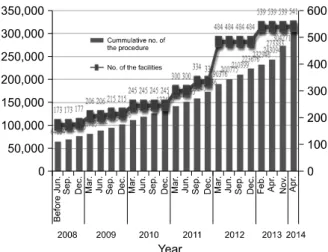
Fig. 3. The growth in the Japan Adult Cardiovascular Surgery Database, As of April 2014, the number of facilities were 541 and the cumulative number of procedures were 304,271.

Fig. 2. Discharge mortality in the Japan Congenital Cardiovascular Surgery Database according to the RACHS-1 categories. RACH-1, Risk Adjustment in Congenital Heart Surgery.

2008 to 2010 (Fig. 2). This result is comparable to that re- ported from the STS Congenital Heart Surgery Database [7].

Unlike the STS National Database, the JCVSD employed web-based data collection. Data on adult cardiac surgery (Japan Adult Cardiovascular Surgery Database [JACVSD]) were collected beginning in 2001 by five participating units and data on congenital heart surgery (JCCVSD) were col- lected beginning in 2008 by seven units. JCVSD required in- formed consent from each patient according to the ‘opt-in rule’ to comply with the Private Information Protection Law.

For Web-data transmission, high level secure socket layer was adopted for coding of the individual patient’s infor- mation.

The JACVSD and JCCVSD grew to become national data- bases by the end of 2013 (Fig. 3). The most recent annual number of submitted procedures are 49,507 in JACVSD and 10,835 in JCCVSD. Twenty frequently cited papers dealing with topics such as risk models of isolated coronary bypass surgery [8], thoracic aortic surgery [9], and valve surgery [10] have been published in indexed international journals.

The performance of the Congenital Heart Surgery risk model as measured by the C-index is over 0.8 [11].

On the basis of these risk models, a web-based risk calcu- lator called JapanSCORE was released. With this tool, adult cardiac surgeons can estimate the 30-day mortality rate, in-hospital mortality rate, and major complication rate after inputting the patient’s covariates before the surgical proce- dure. The estimated mortality rate is much lower than that derived by using EuroScore [12]. JapanSCORE contributes to obtaining adequate informed consent from the patients and the families, leading to increased satisfaction. In addition, benchmark reports have been released as support tools for quality improvement of participating institutions. In Japan,

many adult cardiac surgeons learn about the risks faced by their patients, as well as their own performance as a surgeon, through the risk-adjusted mortality and benchmark report.

To ensure fairness and transparency in evidence-based medicine (EBM), the JCVSD organized a data access and us- age working group. This working group meets twice a year, and requests 100% of their data during at least for the imme- diate 2-years. After the working group accepts an application, the Department of Health Quality Assessment (HQA) of the University of Tokyo [13,14] analyzes the newly submitted data. The role of the HQA is similar to that of the DCRI for the STS National Database.

The JCVSD places importance on auditing the reported data. Site visits have been carried out since 2004. A site visit working group was established by the JACVSD. The mem- bers of the working group include two to three adult cardiac surgeons; visits to 70 sites have been carried out so far.

Recently the HQA reported the details and outcomes of the site visits to the JCCVSD [15].

In 2011, the JCVSD started to collect a participation fee of 10,000 yen per year for each section in the JACVSD and the JCCVSD. The total number of sections was 658 (541 in the JACVSD, 117 in the JCCVSD) by the end of April 2014.

This participation fee is much lower than that required by the

STS National Database; however, it is an important financial

resource, especially for site visits.

(5)

red with the previously employed review method that relied on the submission of operation records, the web-based and paperless review method had higher quality, lower cost, and required less time.

THE NATIONAL CLINICAL DATABASE

In 2010, the JCVSD served as the basis for the establish- ment of the National Clinical Database (NCD) in Japan, which includes clinician-initiated databases reflecting all sur- gical fields. The NCD adopted to “Web-based” data collec- tion with the same security level of JCVSD as mentioned above to protect the individual patient’s information. Through the central institutional review board in the University of Tokyo, an ‘opt-out rule’ was adopted, and informed consent became unnecessary. The NCD is governed by a committee whose members are representatives of medical associations related to surgery, such as the Japan Surgical Society (JSS), JSCVS, JATS, the Japanese Association for Chest Surgery, the Japanese Society of Gastroenterological Surgery, the Japanese Society of Pediatric Surgeons, the Japanese Society of Vascular Surgery, the Japanese Society of Endocrine Surgery, the Japanese Society for Mammary Cancer, and the Japanese Thyroid Association. The NCD establishes the surgi- cal board certification system for the JSS, which requires 13 input items at the first level in the hierarchy of specialties.

Six board certification systems, including the JBCVS and the databases of nine academic associations, are set at the second level as subspecialties. The main server was transferred from the HQA to the University Hospital Medical Information Network (UMIN) with a mirror-image backup. The HQA fo- cused on data analysis and site visits, whereas the UMIN is responsible for data warehousing. The NCD uses cutting-edge statistical techniques to detect any trace of data inconsistency.

The participating associations have supported the NCD finan- cially and the database has grown rapidly; the total number of participating hospitals is 4105, and the number of cumu-

NATIONAL CLINICAL DATABASES AND HEALTH SERVICES

The administrative database, diagnosis procedure combina-

tion (DPC)/par-diem payment system (PDPS) was introduced

in Japan by the Japanese Ministry of Health, Labour and

Welfare (MHLW, a government agency) in April 2003 to

comprehensively assess fixed daily payments and to control

medical expenditure in the acute setting based on the quality

assessment. The number of participating hospitals by the end

of April 2014 was 1,585, including all advanced-treatment

hospitals, that is, university hospitals. In Japan, total health

care expenditures have been increasing by 1 trillion yen an-

nually, and health care expenditures make up 9.5% of the

Gross Domestic Product, which puts Japan in the 16th posi-

tion of the 34 member countries of the Organization for

Economic Cooperation and Development. On the other hand,

the population aging rate in Japan is over 24%, which is the

highest rate in the world. Changes in population makeup and

the growing proportion of elderly persons are the underlying

issues relating to rising health care expenditures, and succes-

sive Cabinet office members and the MHLW have set policy

directions to address this national issue. Quality improvement,

quality assessment, and the pay-for-performance system pro-

vide methods to control medical expenditures. The Quality

and Outcomes Framework (QOF), a system for the perform-

ance management and payment of genaral practitioners (GPs)

in the National Health Service in England, Wales, Scotland

and Northern Ireland was introduced as part of the new gen-

eral medical services contract in April 2004. The QOF re-

wards GPs for implementing “good practice” in their medical

practices. Participation in the QOF is voluntary for each part-

nership [19]. In contrast, in the United States, the Agency of

Healthcare Research and Quality (AHRQ) has defined ‘never

events’ or errors of medical care for which Medicare, the

government healthcare insurance for aged and disabled per-

(6)

sons, does not pay. In the C. Walton Lillehei Lecture of the 49th STS Annual Meeting, the director of the AHRQ empha- sized that the federal government will pay for the quality, not for the volume.

In Japan, the NCD and DPC/PDPS could play comple- mentary functions for quality assessment through adequate risk adjustment and the complete enumeration of procedures in various surgical fields. In the future, balancing professional autonomy and administrative leadership might be a recurrent issue for quality assessment and quality improvement in Japan.

PERSPECTIVES

Recently, the Japanese Association of Cardiovascular Intervention and Therapeutics proposed to the NCD a com- parative study between percutaneous coronary intervention and CABG that would use well-tested statistical methods such as propensity score matching. Thus, the participation of units from nonsurgical fields, such as medical therapy, inter- vention, radiation therapy, and chemotherapy, will facilitate risk stratification of each treatment modality, and will con- tribute to the search for the best management of diseases and patients. A longitudinal follow-up database is needed for the design of such studies, and it is under construction.

Recently, the Pharmaceutical and Medical Device Agency (PMDA), a consultative organization of the MHLW, sug- gested to enroll in the JACVSD and perform follow-ups on the use of artificial valves for trans-aortic valve implantation.

The PMDA recognized the completeness and reliability of the data of the JACVSD, and from a cost-performance point of view, the PMDA decided to outsource the post-market sur- veillance of newly covered medical devices in the car- diovascular surgical field. This demonstrates how the national database could contribute to the post-marketing surveillance of drugs and medical devices, and could help control random- ized trials and multicenter studies.

The NCD will start to collect fees from participating hospi- tals according to the total number of enrolled surgical proce- dures. Clerical assistants have been widely employed through- out the country, which has gradually lightened the data input workload of young surgeons. Governmental support and some

government funds are expected to be received for the con- tinued maintenance of the national database.

CONCLUSION

Clinicians are responsible for patient safety and quality im- provement, and the database will aid in achieving these goals.

As Reinertsen [20] stated, to truly improve quality, the sys- tem must, 1) eliminate unnecessary variation (standardize processes), and 2) achieve and document continuous improve- ment (in care processes and outcomes). In recent years, the importance of ‘certainty, not excellence’ of operations, and that of the concept of structure, process and outcome [21]

have been emphasized, and multiple approaches, for instance, postgraduate education systems, reporting systems of mal- practice to prevent recurrence, introduction of information technology, introduction of simulators, EBM, and other tech- niques, have been used for patient safety. The use of multiple strategies and teamwork are fundamental for patient safety.

Since it is methodologically based on the JCVSD, the NCD represents an interface between medical databases and board certification systems, which is its point of difference from the STS National Database. In 2014, a new organization for medical board certification was established in Japan that, beginning in 2017, will certify all medical boards in close collaboration with medical associations. This new organization will adopt the standards of the JCVSD and the NCD for evaluating the clinical practices of applicants. For the assess- ment of medical outcomes and quality, the JCVSD and the NCD will continue to be the sole reliable data source for sur- gical fields in Japan, where medical system reform will be implemented quickly and based on professional autonomy.

The national database is fundamental for quality improve- ment, patient safety, and the adequate control of medical ex- penditures in the country.

CONFLICT OF INTEREST

No potential conflict of interest relevant to this article was

reported.

(7)

the members of the society and Prof. Woong-Han Kim of Seoul National University, who invited me to this outstanding meeting.

REFERENCES

1. Grover FL, Shroyer AL, Hammermeister K, et al. A dec- ade’s experience with quality improvement in cardiac sur- gery using the Veterans Affairs and Society of Thoracic Surgeons national databases. Ann Surg 2001;234:464-72.

2. Ferris TG, Torchiana DF. Public release of clinical outcomes data: online CABG report cards. N Engl J Med 2010;363:

1593-5.

3. Jenkins KJ, Gauvreau K, Newburger JW, Spray TL, Moller JH, Iezzoni LI. Consensus-based method for risk adjustment for surgery for congenital heart disease. J Thorac Cardio- vasc Surg 2002;123:110-8.

4. Shahian DM, Edwards FH, Jacobs JP, et al. Public reporting of cardiac surgery performance: part 1--history, rationale, consequences. Ann Thorac Surg 2011;92(3 Suppl):S2-11.

5. Shahian DM, Edwards FH, Jacobs JP, et al. Public reporting of cardiac surgery performance: part 2--implementation. Ann Thorac Surg 2011;92(3 Suppl):S12-23.

6. Mavroudis C, Jacobs JP. Congenital Heart Surgery Nomen- clature and Database Project: overview and minimum dataset. Ann Thorac Surg 2000 Apr;69(4 Suppl):S2-17.

7. Jacobs JP, Jacobs ML, Lacour-Gayet FG, et al. Stratification of complexity improves the utility and accuracy of outcomes analysis in a Multi-Institutional Congenital Heart Surgery Database: Application of the Risk Adjustment in Congenital Heart Surgery (RACHS-1) and Aristotle Systems in the Society of Thoracic Surgeons (STS) Congenital Heart Surgery Database. Pediatr Cardiol 2009;30:1117-30.

8. Motomura N, Miyata H, Tsukihara H, Okada M, Takamoto S; Japan Cardiovascular Surgery Database Organization. First report on 30-day and operative mortality in risk model of isolated coronary artery bypass grafting in Japan. Ann Thorac Surg 2008;86:1866-72.

9. Motomura N, Miyata H, Tsukihara H, Takamoto S; Japan

gle-race population through a web-based data entry system:

the first report of 30-day and 30-day operative outcome risk models for thoracic aortic surgery. Circulation 2008;118(14 Suppl):S153-9.

11. Miyata H, Murakami A. The first report on risk models based on the Japan Congenital Cardiovascular Surgery Database. J Thorac Cardiovasc Surg 2014 Jan 15 [In press].

12. Roques F, Nashef SA, Michel P; EuroSCORE study group.

Risk factors for early mortality after valve surgery in Europe in the 1990s: lessons from the EuroSCORE pilot program. J Heart Valve Dis 2001;10:572-7.

13. Miyata H, Motomura N, Kondo MJ, Fushimi K, Ishikawa KB, Takamoto S. Toward quality improvement of car- diovascular surgery in Japan: an estimation of region- alization effects from a nationwide survey. Health Policy 2009;91:246-51.

14. Miyata H, Motomura N, Ueda Y, Tsukihara H, Tabayashi K, Takamoto S. Toward quality improvement of thoracic aortic surgery: estimating volume-outcome effect from nationwide survey. Eur J Cardiothorac Surg 2009;36:517-21.

15. Tomotaki A, Miyata H, Hashimoto H, Murakami A, Ono M.

Results of data verification of the Japan congenital car- diovascular database, 2008 to 2009. World J Pediatr Con- genit Heart Surg 2014;5:47-53.

16. Miyata H, Gotoh M, Hashimoto H, et al. Challenges and prospects of a clinical database linked to the board certifi- cation system. Surg Today 2014 May 23 [Epub].

17. Kenjo A, Miyata H, Gotoh M, et al. Risk stratification of 7,732 hepatectomy cases in 2011 from the National Clinical Database for Japan. J Am Coll Surg 2014;218:412-22.

18. Kobayashi H, Miyata H, Gotoh M, et al. Risk model for right hemicolectomy based on 19,070 Japanese patients in the National Clinical Database. J Gastroenterol 2014;49:

1047-55.

19. Roland M. Linking physician’s pay to the quality of care a major experiment in the United Kingdom. N Engl J Med 2004;351:1448-54.

20. Reinertsen JL. Zen and the art of physician autonomy main- tenance. Ann Intern Med 2003;138:992-5.

21. Donabedian A. Evaluating the quality of medical care.

Milbank Mem Fund Q 1966;44:Suppl:166-206.

수치

Fig. 1. The Society for Thoracic Sur- Sur-geons National Database: the  Conge-nital Heart Surgery Database  partici-pants (http://www.sts.org/sites/default/
Fig. 3. The growth in the Japan Adult Cardiovascular Surgery  Database, As of April 2014, the number of facilities were 541  and the cumulative number of procedures were 304,271.

참조

관련 문서

In order to analysis the perception this article examines ‘Kan statement’ and ‘Korea-Japan Agreement for Books’ through ‘Treaty on Basic Relations

13)

Patient had laparoscopic surgery on the adnexal tumor and excised tissue was removed through Douglas pouch incision by single surgeon.. Results: The mean age

Unlike Korea, in Japan, no positive effects of ownership concentration were found both on the accounting corporate performance such as profit margin, return

T0: Before surgery; T1: 2 months after surgery; T2: 6 months after surgery; T3: 1 year after surgery; Nph AP: Anteroposterior distance of nasopharynx; Oph AP:

(Congenital heart disease) 불완전한 일방향성의 판막..

Pathology, Internal Medicine, Neuroscience, Psychiatry, Pediatrics, Dermatology, Surgery, Thoracic and Cardiovascular Surgery, Neurosurgery, Orthopedic Surgery,

Linguoid bars in a flume in Tsukuba University, Japan: flow