• 검색 결과가 없습니다.

Novel Early Predictor of Acute Kidney Injury after Open Heart Surgery under Cadiopulmonary Bypass Using Plasma Neutrophil Gelatinase-Associated Lipocalin

N/A
N/A
Protected

Academic year: 2021

Share "Novel Early Predictor of Acute Kidney Injury after Open Heart Surgery under Cadiopulmonary Bypass Using Plasma Neutrophil Gelatinase-Associated Lipocalin"

Copied!
9
0
0

로드 중.... (전체 텍스트 보기)

전체 글

(1)

http://dx.doi.org/10.5090/kjtcs.2014.47.3.240 ISSN: 2233-601X (Print) ISSN: 2093-6516 (Online)

Department of Thoracic and Cardiovascular Surgery,

1

Konkuk University Seoul Hospital, Konkuk University School of Medicine,

2

Konkuk University Chungju Hospital, Konkuk University School of Medicine,

3

Department of Anesthesia and Pain Medicine, Konkuk University Chungju Hospital, Konkuk University School of Medicine

Received: October 10, 2013, Revised: November 20, 2013, Accepted: November 24, 2013, Published online: June 5, 2014

Corresponding author: Woo Surng Lee, Department of Thoracic and Cardiovascular Surgery, Konkuk University Chungju Hospital, Konkuk University School of Medicine, 82 Gugwon-daero, Chungju 380-951, Korea

(Tel) 82-43-840-8841 (Fax) 82-43-847-8665 (E-mail) [email protected]

C

The Korean Society for Thoracic and Cardiovascular Surgery. 2014. All right reserved.

CC

This is an open access article distributed under the terms of the Creative Commons Attribution Non-Commercial License (http://creative- commons.org/licenses/by-nc/3.0) which permits unrestricted non-commercial use, distribution, and reproduction in any medium, provided the original work is properly cited.

Novel Early Predictor of Acute Kidney Injury after Open Heart Surgery under Cadiopulmonary Bypass Using Plasma Neutrophil

Gelatinase-Associated Lipocalin

Jong Duk Kim, M.D.

1

, Hyun Keun Chee, M.D.

1

, Je Kyoun Shin, M.D.

1

, Jun Seok Kim, M.D.

1

, Song Am Lee, M.D.

1

, Yo Han Kim, M.D.

2

, Woo Surng Lee, M.D.

2

, Hye Young Kim, M.D.

3

Background: Open heart surgery using cardiopulmonary bypass (CPB) is considered one of the most frequent sur- gical procedures in which acute kidney injury (AKI) is a frequent and serious complication. The aim of the present study was to evaluate the efficiency of neutrophil gelatinase-associated lipocalin (NGAL) as an early AKI biomarker after CPB in cardiac surgery (CS). Methods: Thirty-seven adult patients undergoing CS with CPB were included in this retrospective study. They had normal preoperative renal function, as assessed by the creatinine (Cr) level, NGAL level, and estimated glomerular filtration rate. Serial evaluation of serum NGAL and Cr levels was performed before, immediately after, and 24 hours after the operation. Patients were divided into two groups: those who showed normal immediate postoperative serum NGAL levels (group A, n=30) and those who showed elevated im- mediate postoperative serum NGAL levels (group B, n=7). Statistical analysis was performed using Statistical Package for the Social Sciences version 18. Results: Of the 37 patients, 6 (6/37, 16.2%) were diagnosed with AKI. One patient belonged to group A (1/30, 3.3%), and 5 patients belonged to group B (5/7, 71.4%). Two pa- tients in group B (2/7, 28.5%) required further renal replacement therapy. Death occurred in only 1 patient (1/37, 2.7%), who belonged to group B. Conclusion: The results of this study suggest that postoperative plasma NGAL levels can be used as an early biomarker for the detection of AKI following CS using CPB. Further studies with a larger sample size are needed to confirm our results.

Key words: 1. Biological markers 2. Thoracic surgery 3. Cardiopulmonary bypass

4. Neutrophil gelatinase-associated lipocalin

INTRODUCTION

Acute kidney injury (AKI) is a common complication of cardiac surgery, particularly when using the cardiopulmonary bypass (CPB) system. AKI after open heart surgery is known

to be associated with increased postoperative mortality, mor-

bidity, and in-hospital costs; reduced postoperative survival

rate; and adverse patient outcomes [1]. Many attempts to re-

duce the development of AKI have been made, and several

biomarkers, including serum creatinine (Cr) level, have been

(2)

Table 1. Clinical characteristics of the patients

Characteristic Group A (n=30) Group B (n=7) p-value

Age (yr) 58.97±13.02 64.14±14.05 0.121

Male:female 20:10 6:1 0.185

Weight (kg) 68.27±12.33 62.57±8.46 0.257

Height (cm) 166.93±11.98 165.71±5.28 0.796

Body surface area (m

2

) 1.68±0.17 1.62±0.12 0.174

Underlying condition

Diabetes mellitus 10 (33.3) 3 (42.8) 0.163

Hypertension 14 (46.7) 4 (57.1) 0.423

Hyperlipidemia 10 (33.3) 2 (28.5) 0.385

Smoking 6 (20.0) 2 (28.5) 0.248

Operation time (min) 340.03±44.12 405.07±75.58 0.063

Cardiopulmonary bypass time (min) 170.73±27.79 177.57±45.93 0.610

Aortic cross clamp time (min) 111.70±24.27 116.00±48.15 0.733

Values are presented as mean±standard deviation or number (%).

used to detect AKI. Serum Cr levels have been used as the standard indicator of renal failure for several decades, but they have several limitations, such as low sensitivity for early detection of AKI. Even in patients with more than 50% dam- age to the kidney, serum Cr levels can be within the normal range. Hence, more elaborate and delicate detectors for car- diac surgery-associated (CSA) AKI are needed, and several reports have shown that neutrophil gelatinase-associated lip- ocalin (NGAL) might be an early and novel biomarker for the detection of CSA-AKI [2]. The aim of this study was to investigate whether increased serum NGAL levels could be a predictive biomarker of CSA-AKI.

METHODS 1) Patients

Thirty-seven consecutive patients who underwent elective open cardiac surgery under CPB between January 2010 and December 2012 were enrolled in this study. All of the pa- tients underwent aortic valve annuloplasty under general anes- thesia at our institution, and the operations were performed by the same surgical team. The operative approach was a standard median sternotomy, and CPB was initiated by can- nulation of the ascending aorta and superior/inferior vena cava in all patients. We excluded patients who had revision cardiac surgery, other combined valvular disease, coronary ar- tery bypass graft, off-pump cardiac surgery, severe hepatic or

pulmonary disease, left ventricular ejection fraction <40%, and pre-existing renal dysfunction (serum Cr level >1.5 mg/

dL). The following patients were also excluded from the study: (1) those aged ≥80 years of age, (2) those who had been treated with anti-thrombotic agents within 2 weeks of surgery, (3) those who had had three-vessel disease or other vascular diseases, including cerebral vascular accident, and (4) those with severe postoperative bleeding, need for reoper- ation, or long-standing ventilator care. We reviewed data on age, gender, height, weight, operation time, CPB time, aorta cross clamp (ACC) time, estimated glomerular filtration rate (eGFR), NGAL, and Cr levels (before, immediately after, and 24 hours after the operation); and on underlying diseases, in- cluding diabetes mellitus (DM), hypertension (HTN), hyper- lipidemia, and smoking collected from the electronic medical records. Preoperative evaluation of all patients, including re- nal function, was within the normal range. The average age of the patients at the time of surgery was 51.84±14.48 years (range, 24 to 78 years), and the male-to-female ratio was 26:11. The clinical characteristics of the patients are summar- ized in Table 1. Operative mortality was defined as death within 30 days of surgery or in-hospital death. On the basis of immediate postoperative NGAL levels, the patients were classified into either group A (n=30) or group B (n=7).

Group A had immediate postoperative serum NGAL levels

within the normal range, and group B had elevated immediate

postoperative serum NGAL levels. Demographic data were

(3)

obtained from the electronic medical records. Preoperative baseline and postoperative blood samples were analyzed for serum Cr and plasma NGAL. Postoperative samples were col- lected twice, at the intensive care unit (ICU) admission after completion of surgery, and on postoperative day 1. The post- operative NGAL level as a predictor of AKI after CPB was evaluated by multivariate logistic regression.

2) Plasma neutrophil gelatinase-associated lipocalin measurement

Plasma NGAL was measured by using the Triage NGAL Test point-of-care fluorescence immunoassay (Biosite Inc., San Diego, CA, USA) with a measureable range of 15 to 3,000 ng/mL. This kit was preserved in a cold area at 2

o

C to 8

o

C, and the upper normal limit of NGAL was 150 ng/mL.

Venous whole blood samples with ethylenediaminetetraacetic acid, an anticoagulant, were collected and were analyzed within 1 hour after sample collection.

3) Definition of acute kidney injury

On the basis of the definition of the Acute Kidney Injury Network (AKIN) for stage 1 AKI [3], AKI after CPB was de- fined as an increase of ≥0.3 mg/dL in serum Cr or a percent- age increase of ≥50% in serum Cr following CPB. Because of a confounding effect resulting from frequent diuretic use during the perioperative period, urine output was excluded from the criteria. The eGFR values were calculated using a body surface area-modified Cockroft-Gault equation. Baseline eGFR was stratified according to the guidelines of the National Kidney Foundation’s Kidney Disease Outcomes Qua- lity Initiative (NKF-KDOQI) [4]: eGFR>90 mL/min/1.73 m

2

as ‘normal renal function’; 60<eGFR<90 mL/min/1.73 m

2

as

‘mild decreased renal function’; 30<eGFR<60 mL/min/1.73 m

2

as ‘moderate decreased renal function’; 15<eGFR<30 mL/min/1.73 m

2

as ‘severe decreased renal function’; and eGFR<15 mL/min/1.73 m

2

as ‘kidney failure.’

4) Statistical analysis

Data were entered in a Microsoft Excel 2007 spreadsheet (Microsoft Co., Redmond, WA, USA) and transferred to PASW SPSS ver. 18.0 (SPSS Inc., Chicago, IL, USA) for da- ta description and analysis. Categorical variables are ex-

pressed as frequencies and percentages, and continuous varia- bles are expressed as mean±standard deviation. After testing for normality of distribution, continuous variables were com- pared using the Student unpaired t-test or the Mann-Whitney U-test. Categorical variables were compared using the chi-squared test or Fisher’s exact test. Univariate and multi- variate analyses were performed by linear regression analysis.

A p-value of <0.05 was considered to indicate statistical significance.

RESULTS

Patients were divided into two groups according to imme- diate postoperative NGAL levels. Group A (n=30) had imme- diate postoperative serum NGAL levels within the normal range, and group B (n=7) had elevated immediate post- operative serum NGAL levels. The median ages of groups A and B were 58.97±13.02 years and 64.14±14.05 years, re- spectively, and the gender ratio (male:female) of groups A and B were 20:10 and 6:1, respectively. The operation times (minutes) of groups A and B were 340.03±44.12 minutes and 405.07±75.58 minutes, respectively. The CPB times (minutes) of groups A and B were 170.73±27.79 minutes and 177.57±

45.93 minutes, respectively. The ACC times (minutes) of groups A and B were 111.70±24.27 minutes and 116.00±

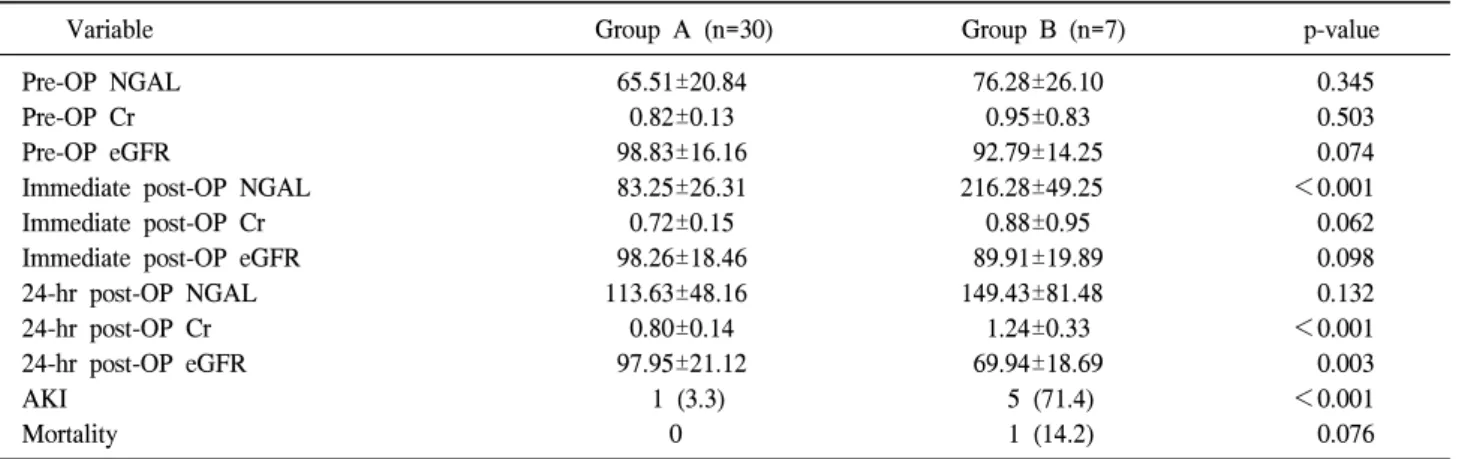
48.15 minutes, respectively. There were no statistically sig- nificant differences between the two groups in age, gender, weight, height, underlying condition, smoking, operation time, CPB time, and ACC time (Table 1). Further information re- garding NGAL, Cr levels, and AKI is presented in Table 2.

The preoperative serum NGAL levels of groups A and B

were 65.51±20.84 and 76.28±26.10, respectively, the pre-

operative serum Cr levels of groups A and B were 0.82±0.13

and 0.95±0.83, respectively, and the preoperative serum

eGFR levels of groups A and B were 98.83±16.16 and

92.79±14.25, respectively. There were no statistically sig-

nificant differences in preoperative serum NGAL and Cr lev-

els between the two groups (Table 2). However, the immedi-

ate postoperative NGAL levels of groups A and B were

83.25±26.31 and 216.28±49.25, respectively (p<0.01). The

24-hour postoperative Cr levels of groups A and B were

0.80±0.14 and 1.24±0.33, respectively (p<0.01). The 24-hour

(4)

Table 2. AKI-related data

Variable Group A (n=30) Group B (n=7) p-value

Pre-OP NGAL 65.51±20.84 76.28±26.10 0.345

Pre-OP Cr 0.82±0.13 0.95±0.83 0.503

Pre-OP eGFR 98.83±16.16 92.79±14.25 0.074

Immediate post-OP NGAL 83.25±26.31 216.28±49.25 <0.001

Immediate post-OP Cr 0.72±0.15 0.88±0.95 0.062

Immediate post-OP eGFR 98.26±18.46 89.91±19.89 0.098

24-hr post-OP NGAL 113.63±48.16 149.43±81.48 0.132

24-hr post-OP Cr 0.80±0.14 1.24±0.33 <0.001

24-hr post-OP eGFR 97.95±21.12 69.94±18.69 0.003

AKI 1 (3.3) 5 (71.4) <0.001

Mortality 0 1 (14.2) 0.076

Values are presented as mean±standard deviation or number (%).

AKI, acute kidney injury; OP, operation; NGAL, serum neutrophil gelatinase-associated lipocalin; Cr, serum creatinine; eGFR, estimated glomerular filtration rate.

postoperative eGFR levels of groups A and B were 97.93±21.12 and 69.94±18.69 (p=0.03), respectively. These were statistically significant differences between the two groups in 24-hour postoperative Cr and eGFR levels. The im- mediate postoperative Cr levels of groups A and B were 0.72±0.15 and 0.88±0.95, respectively, immediate post- operative eGFR levels of groups A and B were 98.26±18.46 and 89.91±19.89, respectively, and the 24-hour postoperative NGAL levels of groups A and B were 113.63±48.16 and 149.43±81.48, respectively. There were no statistically sig- nificant differences in immediate postoperative Cr levels, im- mediate postoperative eGFR levels, and 24-hour postoperative NGAL levels between the two groups (Table 2). It is thought that the immediate postoperative NGAL level has a sig- nificant relationship with the 24-hour postoperative Cr level.

Indeed, group B (n=7) was classified with the normal renal function, showed normal NGAL and Cr levels preoperatively, and showed elevated immediate postoperative NGAL level.

Despite the elevated immediate postoperative NGAL level, the immediate postoperative Cr level of group B was noted to be within the normal range. Five patients in group B showed elevated 24-hour postoperative Cr levels and were di- agnosed with AKI by a nephrologist, who received further meticulous and aggressive management to protect renal function. Despite appropriate renal protection and further management, four of these five patients showed continuously elevated serum Cr levels between days 4 and 8, and one

showed a normalized Cr level on postoperative day 3. Of these five patients, two required continuous renal replacement therapy (CRRT); one was diagnosed as having AKI with oli- guria on postoperative day 2, who subsequently improved af- ter 7-day CRRT, without a need for permanent renal replace- ment therapy; one patient was also diagnosed as having AKI on postoperative day and treated with CRRT on postoperative day 3, but expired on postoperative day 7 due to aspiration pneumonia and sepsis. Death occurred in only one patient (1/37, 2.7%) who belonged to group B. In group A, one pa- tient was diagnosed with AKI but did not require CRRT, and subsequently, improved by conservative management without sequelae. Of the 37 patients, six (6/37, 16.2%) were diag- nosed with AKI. One patient belonged to group A (1/30, 3.3%), and five patients belonged to group B (5/7, 71.4%).

Two patients in group B (2/7, 28.5%) required further renal replacement therapy. In patients with AKI (6/37, 16.2%), the postoperative NGAL levels on ICU arrival were significantly higher than the preoperative NGAL levels (208.83±78.47 vs.

75.50±11.10). Postoperative NGAL levels on ICU arrival were a significant independent predictor of AKI development and 24-hour postoperative Cr levels after cardiac surgery by multivariate logistic regression analysis with various clinical factors (age, gender, weight, height, underlying condition and smoking, operation time, CPB time, ACC time, and NGAL level) as covariates (p<0.01; odds ratio, 72.50; 95% CI).

Postoperative NGAL levels on ICU arrival and 24-hour post-

(5)

Fig. 1. Equation of immediate postoperative serum neutrophil ge- latinase-associated lipocalin (NGAL) levels and 24-hour post- operative serum creatinine (Cr) levels. Immediate postoperative NGAL level=-26.780+152.282×24-hour postoperative Cr level.

operative Cr levels after cardiac surgery were significant in- dependent predictors of AKI development. Immediate post- operative NGAL levels were significantly related to 24-hour postoperative Cr levels. Multivariate logistic regression analy- sis showed that 24-hour postoperative Cr levels are related to immediate postoperative NGAL levels through the following equation (Fig. 1).

Immediate postoperative NGAL level

=-26.780+152.282×24-hour postoperative Cr level

DISCUSSION

AKI reflects the entire spectrum of acute renal failure, a complex disorder that occurs in a wide variety of settings with clinical manifestations ranging from minimal elevation in serum Cr to anuric renal failure. In 2004, the standard defi- nition for AKI was proposed by the Acute Dialysis Quality Initiative on the basis of the Risk Injury Failure Loss End Stage (RIFLE) criteria [3,5]. AKI represents a significant problem in clinical medicine, with devastating immediate and long-term consequences [6,7]. The incidence of AKI varies from 5% of hospitalized patients to 30% of patients at ICUs.

AKI is a frequent and serious complication in about 30% to 50% of patients undergoing cardiac surgery under CPB per- formed worldwide [8]. AKI requiring dialysis accounts for up to 5% of all cases, in which the mortality rate reaches 80%

[9]. Diagnosis and management of AKI constitutes one of the most important roles of the cardiac surgeon after open heart surgery [10]. Recently, the standardized clinical definition of AKI has been implemented through the validation of the RIFLE and AKIN criteria [3,5]. This standardized clinical definition using RIFLE and AKIN criteria has shown that ir- respective of severity or stage, the true incidence of CSA-AKI is associated with prolonged treatment at the ICU, prolonged hospital stay, increased hospitalization cost, and in- creased patient morbidity/mortality [11].

Many studies have reported that cardiac surgery under CPB is closely associated with postoperative renal injury. Fischer et al. [12] reported that AKI after CPB occurs in about 8%

of adult cardiac surgical patients with some preoperative renal impairment and in about 3% to 4% of patients with normal preoperative renal function. However, the exact etiology and pathogenesis after cardiac surgery under CPB have not yet been fully understood, although several theories and risk fac- tors have been suspected. A plausible explanation for CSA-AKI is renal ischemia caused by hemodynamic in- stability and reperfusion injury during CPB. Other causes in- clude decreased renal flow, decreased pulsatile flow, hypo- thermia, atheroembolism, and generalized inflammatory re- sponse [13,14]. Many studies have reported that the triggering event for the CSA-AKI is often an extreme change in hemo- dynamics, which results in the low cardiac output state.

However, CPB alone may also lead to AKI in which the glo- merular filtration rate is decreased by 30% during CPB [15].

In addition to hypothermia, vasoconstriction, and exposure to

the microemboli generated by the activated cascades, struc-

tural and functional changes in the kidney may develop

quickly. These changes are initiated as mild cortical or me-

dullar edema and may proceed with the breakdown of tubular

cells and result in necrosis, which is manifested as clinical

symptoms and abnormal blood urea nitrogen and Cr levels as

a consequence of a 30% to 40% decrease in the number of

nephrons [16]. Others have also reported that the etiologies of

renal impairment related to cardiac surgery on CPB remain

unclear and that there have been only a few risk factors re-

ported, such as old age, arterial HTN, underlying DM, im-

paired left ventricular ejection fraction, underlying amyloi-

dosis, history of previous nephritic attacks, and long-term

(6)

CPB during cardiac surgery. Preoperative and intraoperative factors, such as age, previous level of Cr, DM, cardiac out- put, the duration of extracorporeal circulation, and the use of the intra-aortic balloon, have been identified as risk factors for the development of postoperative AKI in many studies [16]. In the current practice, AKI is typically diagnosed by measuring serum Cr, which is a standard, classical, and reli- able marker of renal function. Unfortunately, its constant and slow production leads to a slight increase in Cr concentration and late changes in patients with acute renal injury, and very low sensitivity for detecting early AKI. For these reasons, there remains the need for much earlier markers for AKI af- ter cardiac surgery under CPB [17]. Several studies have shown that novel biomarkers can detect acute tubular injury earlier than serum Cr in patients with AKI and that a ma- jority of patients for whom tubular injury is detected with these novel biomarkers do not develop clinical AKI because the early detection leads to early management of AKI.

Furthermore, most of the patients evaluated with these novel biomarkers who do go on to develop AKI experience a mild- er form of AKI with transient elevations in serum Cr and do not progress to more severe AKI stages or require acute dial- ysis [18-20].

NGAL is a protein of the lipocalin family that is highly expressed in various pathologic states and is an early bio- marker of AKI in various situations, such as cardiac surgery.

Compared with serum Cr, NGAL allows for earlier identi- fication of patients with AKI. Previous studies have demon- strated that urine and plasma NGAL levels reach their peak within 6 hours after adult cardiac surgery, which predicts the development of AKI during an early postoperative period.

Additionally, these biomarkers are associated with a longer hospitalization and ICU stay and higher risk of dialysis or in-hospital death. A previous study has described the role of these biomarkers in a Cr-based AKI diagnosis [21].

NGAL is a 25,000-dalton protein belonging to the lipocalin superfamily, which is composed of 8 beta-strands that form a beta-barrel enclosing a calyx that binds and transports low molecular weight chemicals [22]. In humans, NGAL is ex- pressed by neutrophils and various epithelial cells and is commonly found in human organs, including the uterus, pros- tate, salivary gland, lung, trachea, stomach, colon, and kidney

[23]. NGAL is generally expressed at very low concentrations in several human tissues and greatly elevated in patients with epithelial damage [24,25]. In healthy kidneys, it is barely de- tectable in either plasma or urine. However, in the setting of acute tubular injury, NGAL undergoes rapid and profound up-regulation with significant increases in both urine and plasma [11]. Numerous studies have recently shown that NGAL binds to siderophores (iron-chelating molecules se- creted by micro-organisms) and is highly expressed in various pathological states, particularly AKI. Several studies have suggested that NGAL is detected in first-stream urine and se- rum samples within 2 hours after ischemia and that the NGAL level correlates with the duration of renal ischemia [26]. The first clinical application of NGAL was the detection of inflammation and sepsis as a biomarker. Bacterial infection activates neutrophil secondary granules, which secrete NGAL into the blood stream. However, although NGAL is fre- quently detected in renal disease and neoplastic conditions, it has limited clinical use and low sensitivity as a biomarker for infection. For these reasons, sensitivity to infection is lower in NGAL than in C-reactive protein, and thus, NGAL has not been used in clinical practice [27,28]. Further studies have demonstrated that NGAL is one of the earliest and most ro- bustly induced proteins following renal ischemia and neph- rotoxic insults. NGAL can be measured in both plasma and urine samples, and both serum and urinary NGAL levels have been found to be reliable predictors of AKI in patients under- going cardiac surgery. NGAL measurements are probably more reflective of local renal injury because they are non- invasive and relatively free of interfering proteins [29].

NGAL is a small and ubiquitous protein of 178 amino

acids with a molecular mass of approximately 25 kDa and is

composed of eight beta sheets that form a calyx shaped

structure. It belongs to the family of lipocalins, which are

characterized by eight β-strands that form a β-barrel defining

a calyx. This calyx binds and transports a wide variety of

low molecular weight molecules, which are considered to de-

termine the biologic activity of each lipocalin. It has been

proven that these lipocalins are associated with many bio-

logical processes, such as inflammation, the transport of pher-

omones, and the synthesis of prostaglandins. Therefore,

NGAL represents a critical component of immunity to bacte-

(7)

rial infection. In fact, human NGAL was originally identified as a small protein covalently bound to the gelatinase from human neutrophils, where it represents one of the neutrophil secondary granule proteins. NGAL is expressed at very low levels in normal human tissues, including those of the kidney, trachea, lungs, stomach, uterus, salivary glands, and colon, and the expression of NGAL increases greatly in the presence of inflammation and injury to the epithelium. NGAL as a re- nal injury biomarker was first discovered in 2003, following experimental ischemic injury to the kidney in a mouse model.

Lipocalin was the gene with the earliest and highest rise in the mRNA and protein concentration in renal tissue, urine, and plasma. Expression of NGAL protein was detected pre- dominantly in proliferating proximal tubule cells [26]. In 2011, Paragas et al. [30] reported the correlation between the NGAL mRNA level produced by the kidney and the protein released from the kidney to the urine in real time. They proved that the timing and the intensity of NGAL mRNA and protein were correlated and dependent on the degree of kidney damage with renal ischemia models of mice. In addi- tion, they found that the detection of the urinary NGAL level using mice models with the renal injury was possible after 3 hours, whereas the serum Cr level rose after about 12 hours.

Further, they showed that NGAL was produced in the distal convoluted tubule and the collecting duct, while the proximal convoluted tubule was involved in the process of plasma NGAL reabsorption. Portilla et al. [31] highlighted the role of NGAL as a marker of proximal tubule damage in a pop- ulation of 40 children developing AKI after cardiac surgery.

In this study, they reported that the improper functioning of the proximal tubule is related to the level of NGAL and postulated that acute renal injury resulting from hypoxic con- ditions could cause disruption of megalin-dependent endocy- tosis in the renal proximal tubule, resulting in the loss of uri- nary NGAL and suggesting it as a marker of proximal injury.

Kuwabara et al. [32] reported that after kidney injury, the pri- mary source of urinary NGAL was the glomerular filtrate, and this is caused by the proximal tubule damage. Both plas- ma and urine NGALs are increased after a renal injury, and even though the kidney is considered the major source of ele- vated plasma lipocalin, there are other plausible explanations.

Several studies using human and animal models have demon-

strated that AKI results in an increased NGAL mRNA ex- pression in distant organs, particularly the liver and lungs, contributing to the increased serum levels of NGAL. This ef- fect may further increase urine levels as a result of in- sufficient reabsorption of NGAL at the proximal convulated tubule. Further, NGAL is an acute-phase reactant and may be released from neutrophils, macrophages, and other immune cells. Any decrease in GFR resulting from AKI would be ex- pected to decrease the renal clearance of NGAL, with sub- sequent accumulation in the systemic circulation [26,33].

Dehydrated situation ongoing prerenal azotemia, similar to other reasons reducing renal blood flow, the glomerular filtra- tion rate may be decreased and glomerular epithelial cells can be damaged. In this situation, injury of the brush border of proximal tubule cells is the earliest lesion in the prerenal stage, and during this early period, minimal acute tubular ne- crosis cannot be detected using routine laboratory inves- tigations such as serum Cr levels [34]. Dehydration as a form of prerenal AKI may be represented by tubular enzymuria and a concomitant increase in serum NGAL. Although NGAL is expressed only at very low levels in several human tissues, it is markedly induced in injured epithelial cells, including the kidney. NGAL is increased in urine very early after in- jury (within 2 hours), and hence, NGAL may be a sensitive biomarker for detecting minimal acute renal dysfunction in dehydrated patients. The higher urinary NGAL concentrations in patients with moderate dehydration than in the mildly de- hydrated ones in this study implied that the degree of dehy- dration affected the severity of acute kidney dysfunction [34,35].

The results of this study indicate that serum NGAL may be a better predictor for CSA-AKI than serum Cr. The lack of early biomarkers for AKI after cardiac surgery under CPB may lead to an unacceptable delay in timely treatment. This study demonstrated that NGAL could be used as an indicator for the diagnosis and prognosis of CSA-AKI. As mentioned above, we showed that the postoperative NGAL level, which is characterized by more rapid onset and higher sensitivity than Cr, has a significant advantage in the early detection of AKI. It is thought that the NGAL level can be used as an early predictor of CSA-AKI.

The results of this study are subject to some limitations.

(8)

First, to minimize the selection bias, this study enrolled only patients who underwent aortic valve annuloplasty by the same operative team at a single center; therefore, the number of patients was relatively small. A further study including vari- ous types of cardiac operations using CPB and a larger num- ber of patients enrolled in multiple centers is needed. Second, this was a retrospective study based on electronic medical records. Further studies on NGAL in CSA-AKI should be planned in a prospective manner. Third, this study included only patients with normal preoperative renal function, normal preoperative eGFR, NGAL, and Cr levels. Further studies on various preoperative renal conditions, e.g., normal, mild, mod- erate, severely decreased, and kidney failure according to the classification based on the guideline of NKF-KDOQI, is needed. Fourth, although numerous studies on patients with AKI have shown that both urine and plasma NGAL levels are significant independent predictors of AKI, these studies differ in the range for optimum utility of this test. Depending on the studies, urine and plasma NGAL level ranges from 10 to 550 ng/mL. Hence, there is no clear spectrum to offer the pertinent application of NGAL in AKI [36,37]. Therefore, a definite range for the application of both urine and plasma in CSA-AKI should be clarified, and the relationship between both urine and plasma should be established.

An elevated level of serum NGAL is associated with CSA-AKI. This biomarker shows a relatively high sensitivity and specificity in patients with CSA-AKI and provides rapid results (within 15 minutes). These results enable us to detect and manage a patient with AKI early, avoiding unnecessary administration of nephrotoxic materials, such as contrast me- dia and antibiotics.

In conclusion, the results of this study suggest that NGAL may be an early biomarker for CSA-AKI and thus, provide a basis for early interventional strategies for the prevention of CSA-AKI. Further studies with a larger sample size and a prospective design are needed to confirm our results.

CONFLICT OF INTEREST

No potential conflict of interest relevant to this article was reported.

REFERENCES

1. Wijeysundera DN, Karkouti K, Dupuis JY, et al. Derivation and validation of a simplified predictive index for renal re- placement therapy after cardiac surgery. JAMA 2007;297:

1801-9.

2. Fadel FI, Abdel Rahman AM, Mohamed MF, et al. Plasma neutrophil gelatinase-associated lipocalin as an early bio- marker for prediction of acute kidney injury after car- dio-pulmonary bypass in pediatric cardiac surgery. Arch Med Sci 2012;8:250-5.

3. Mehta RL, Kellum JA, Shah SV, et al. Acute Kidney Injury Network: report of an initiative to improve outcomes in acute kidney injury. Crit Care 2007;11:R31.

4. National Kidney Foundation. K/DOQI clinical practice guidelines for chronic kidney disease: evaluation, classi- fication, and stratification. Am J Kidney Dis 2002;39(2 Suppl 1):S1-266.

5. Bellomo R, Ronco C, Kellum JA, Mehta RL, Palevsky P;

Acute Dialysis Quality Initiative workgroup. Acute renal fail- ure - definition, outcome measures, animal models, fluid therapy and information technology needs: the Second International Consensus Conference of the Acute Dialysis Quality Initiative (ADQI) Group. Crit Care 2004;8:R204-12.

6. Liangos O, Wald R, O’Bell JW, Price L, Pereira BJ, Jaber BL. Epidemiology and outcomes of acute renal failure in hospitalized patients: a national survey. Clin J Am Soc Nephrol 2006;1:43-51.

7. Palevsky PM. Epidemiology of acute renal failure: the tip of the iceberg. Clin J Am Soc Nephrol 2006;1:6-7.

8. Haase M, Haase-Fielitz A, Bagshaw SM, Ronco C, Bellomo R. Cardiopulmonary bypass-associated acute kidney injury: a pigment nephropathy? Contrib Nephrol 2007;156:340-53.

9. Chertow GM, Levy EM, Hammermeister KE, Grover F, Daley J. Independent association between acute renal failure and mortality following cardiac surgery. Am J Med 1998;

104:343-8.

10. Hsu CW, Symons JM. Acute kidney injury: can we improve prognosis? Pediatr Nephrol 2010;25:2401-12.

11. McIlroy DR, Wagener G, Lee HT. Biomarkers of acute kid- ney injury: an evolving domain. Anesthesiology 2010;112:

998-1004.

12. Fischer UM, Weissenberger WK, Warters RD, Geissler HJ, Allen SJ, Mehlhorn U. Impact of cardiopulmonary bypass management on postcardiac surgery renal function. Perfusion 2002;17:401-6.

13. Chertow GM, Lazarus JM, Christiansen CL, et al. Preope- rative renal risk stratification. Circulation 1997;95:878-84.

14. Tuttle KR, Worrall NK, Dahlstrom LR, Nandagopal R,

Kausz AT, Davis CL. Predictors of ARF after cardiac surgi-

cal procedures. Am J Kidney Dis 2003;41:76-83.

(9)

15. Slogoff S, Reul GJ, Keats AS, et al. Role of perfusion pres- sure and flow in major organ dysfunction after cardiopulmo- nary bypass. Ann Thorac Surg 1990;50:911-8.

16. Bahar I, Akgul A, Ozatik MA, et al. Acute renal failure fol- lowing open heart surgery: risk factors and prognosis.

Perfusion 2005;20:317-22.

17. Boer DP, de Rijke YB, Hop WC, Cransberg K, Dorresteijn EM. Reference values for serum creatinine in children youn- ger than 1 year of age. Pediatr Nephrol 2010;25:2107-13.

18. Vaidya VS, Waikar SS, Ferguson MA, et al. Urinary bio- markers for sensitive and specific detection of acute kidney injury in humans. Clin Transl Sci 2008;1:200-8.

19. Koyner JL, Vaidya VS, Bennett MR, et al. Urinary bio- markers in the clinical prognosis and early detection of acute kidney injury. Clin J Am Soc Nephrol 2010;5:2154-65.

20. Zappitelli M, Krawczeski CD, Devarajan P, et al. Early postoperative serum cystatin C predicts severe acute kidney injury following pediatric cardiac surgery. Kidney Int 2011;

80:655-62.

21. Koyner JL, Garg AX, Coca SG, et al. Biomarkers predict progression of acute kidney injury after cardiac surgery. J Am Soc Nephrol 2012;23:905-14.

22. Flower DR, North AC, Sansom CE. The lipocalin protein family: structural and sequence overview. Biochim Biophys Acta 2000;1482:9-24.

23. Cowland JB, Borregaard N. Molecular characterization and pattern of tissue expression of the gene for neutrophil gelati- nase-associated lipocalin from humans. Genomics 1997;45:

17-23.

24. Schmidt-Ott KM, Mori K, Kalandadze A, et al. Neutrophil gelatinase-associated lipocalin-mediated iron traffic in kidney epithelia. Curr Opin Nephrol Hypertens 2006;15:442-9.

25. Zappitelli M, Washburn KK, Arikan AA, et al. Urine neu- trophil gelatinase-associated lipocalin is an early marker of acute kidney injury in critically ill children: a prospective cohort study. Crit Care 2007;11:R84.

26. Mishra J, Ma Q, Prada A, et al. Identification of neutrophil gelatinase-associated lipocalin as a novel early urinary bio- marker for ischemic renal injury. J Am Soc Nephrol 2003;14:2534-43.

27. Xu SY, Pauksen K, Venge P. Serum measurements of hu- man neutrophil lipocalin (HNL) discriminate between acute bacterial and viral infections. Scand J Clin Lab Invest

1995;55:125-31.

28. Yan L, Borregaard N, Kjeldsen L, Moses MA. The high mo- lecular weight urinary matrix metalloproteinase (MMP) ac- tivity is a complex of gelatinase B/MMP-9 and neutrophil gelatinase-associated lipocalin (NGAL): modulation of MMP-9 activity by NGAL. J Biol Chem 2001;276:37258-65.

29. Bignami E, Frati E, Ceriotti F, et al. Urinary neutrophil ge- latinase-associated lipocalin as an early predictor of pro- longed intensive care unit stay after cardiac surgery. Ann Card Anaesth 2012;15:13-7.

30. Paragas N, Qiu A, Zhang Q, et al. The Ngal reporter mouse detects the response of the kidney to injury in real time. Nat Med 2011;17:216-22.

31. Portilla D, Dent C, Sugaya T, et al. Liver fatty acid-binding protein as a biomarker of acute kidney injury after cardiac surgery. Kidney Int 2008;73:465-72.

32. Kuwabara T, Mori K, Mukoyama M, et al. Urinary neu- trophil gelatinase-associated lipocalin levels reflect damage to glomeruli, proximal tubules, and distal nephrons. Kidney Int 2009;75:285-94.

33. Grigoryev DN, Liu M, Hassoun HT, Cheadle C, Barnes KC, Rabb H. The local and systemic inflammatory transcriptome after acute kidney injury. J Am Soc Nephrol 2008;19:

547-58.

34. Celik T, Altekin E, Isguder R, Kenesari Y, Duman M, Arslan N. Evaluation of neutrophil gelatinase-associated lip- ocalin in pediatric patients with acute rotavirus gastro- enteritis and dehydration. Ital J Pediatr 2013;39:52.

35. Antonopoulos CN, Kalkanis A, Georgakopoulos G, Sergentanis TN, Rigopoulos DN. Neutrophil gelatinase-associated lip- ocalin in dehydrated patients: a preliminary report. BMC Res Notes 2011;4:435.

36. Prabhu A, Sujatha DI, Ninan B, Vijayalakshmi MA. Neutro- phil gelatinase associated lipocalin as a biomarker for acute kidney injury in patients undergoing coronary artery bypass grafting with cardiopulmonary bypass. Ann Vasc Surg 2010;24:525-31.

37. Haase M, Bellomo R, Devarajan P, Schlattmann P, Haase-

Fielitz A; NGAL Meta-analysis Investigator Group. Accuracy

of neutrophil gelatinase-associated lipocalin (NGAL) in diag-

nosis and prognosis in acute kidney injury: a systematic re-

view and meta-analysis. Am J Kidney Dis 2009;54:1012-24.

수치

Table 1. Clinical characteristics of the patients
Table 2.  AKI-related data
Fig. 1. Equation of immediate postoperative serum neutrophil ge- ge-latinase-associated lipocalin (NGAL) levels and 24-hour  post-operative serum creatinine (Cr) levels

참조

관련 문서

In the present paper, L-shaped curves are general- ized and it is shown that every knot in the minor subfamilies, called sporadic examples of Berge’s lens space surgery, is

Pathology, Internal Medicine, Neuroscience, Psychiatry, Pediatrics, Dermatology, Surgery, Thoracic and Cardiovascular Surgery, Neurosurgery, Orthopedic Surgery,

Postoperative adhesion formation and reproductive outcome using interceed ® after ovarian surgery: a randomized trial in the rabbit model.. Adhesion reformation

Therefore, cTnT is a recommended biomarker for use in the detection of myocardial infarction (MI) and in acute coronary syndromes.[8] Indeed, several authors

Using this leap motion, a surgeon can perform the virtual shoulder arthroscopic surgery skillfully and reduce mistakes in surgery.. The simulation using leap motion shows

US-guided FNAB diagnosis and corresponding histologic findings after thyroid surgery of infracentimetric nodule --- 16 Table 3..

In this study, it is showed that female and blood type O are the significant factors associated with prolonged C/Epi CT value despite of aspirin discontinuation more

For each of several tests, elastic, plastic, and total strain data points are plotted versus life, and fitted lines are also