Research Article Open Access
Effects of Virtual Reality Based Video game and Rehabilitation Exercise on the Balance and Activities of Daily Living of Chronic Stroke Patients
Hyun-min Lee, PT, PhD†
Department of Physical Therapy, Honam University
가상현실기반 비디오게임과 재활운동이 만성기 뇌졸중 환자의 균형 및 일상생활동작에 미치는 영향
이현민†
호남대학교 물리치료학과
Received: March 15, 2013 / Revised: March 27, 2013 / Accepted: April 17, 2013
ⓒ 2013 Journal of the Korean Society of Physical Medicine
| Abstract |
연구목적: 닌텐도 위를 이용한 가상현실기반 비디오 게임 프로그램을 만성기 뇌졸중 환자에게 적용하여 균 형능력 및 일상생활동작에 어떠한 영향을 미치는지 알 아보고, 뇌졸중 환자의 재활프로그램으로서 적용 가능 성이 있는지 알아보고자 한다.
연구방법: 만성기 뇌졸중 환자를 무작위로 가상현실 기반 비디오게임 프로그램을 적용한 실험군(n=7)과 적 용하지 않은 대조군(n=10)으로 구분하여 연구를 진행하 였다. 연구에 참여한 모든 대상자에게 30분의 Bobath therapy와 15분간의 FES 치료를 기본적으로 실시하였다.
이에 더하여 실험군은 가상현실기반 비디오게임 프로그 램을 1일 30분이내, 주 5회, 3주간 실시하였다. 대조군은
자전거 운동과 보행훈련으로 30분간 시행하였다. 실험
전⋅후 눈뜨고 외발서기(OLST; open leg standing test), Timed Up and Go(TUG) 검사, 10m 걷기 검사, Functional Independence Measure(FIM)를 측정하였다. 실험 전과 실 험 후 측정값의 차이를 비교하기 위해 Wilcoxon Signed Ranks Test를 실시하였다. 그리고 각 측정값의 변화량에
†Corresponding Author : [email protected]
대한 실험군과 대조군 사이의 차이를 알아보기 위해 Mann-Whitney U Test를 실시하였다.
연구결과: 실험결과는 다음과 같다. 1) 실험군에서는 FIM의 유의한 증가와 TUG, 10m 걷기 검사의 유의한 감 소를(p<.05) 보였다. 대조군에서는 OLST의 증가와 TUG, 10m walking test의 감소가 나타났지만 통계적으로 유의 하지 않았다. 오직 FIM에서만 유의한 증가가 나타났다 (p<.05). 2) 실험 전⋅후의 실험군과 대조군의 각 측정값 들의 평균차를 비교한 결과 실험군은 대조군보다 실험 전⋅후 OLST, TUG, 10m walking test 차이의 평균은 컸지 만 통계적으로 유의하지 않았다.
결론: 이상의 결과로부터 가상현실기반 비디오게임 이 만성기 뇌졸중 환자의 동적균형능력 및 일상생활동 작 향상에 효과가 있음을 알 수 있었다.
Key Words: 균형, 비디오게임, 일상생활동작
The majority of stroke patients are accompanied by hemiparalysis, and the symptoms include weakening, hardening and pain of muscle, and decrease in exercise ability by damage of sensory organ and sense of balance.
Such decrease in exercise ability causes restriction of basic activities like walking, climbing the staircase, standing up from the seat and turning around etc. which are required for independent everyday life(Sharp & Brouwe, 1997). Also with stroke patients, 61 to 81% of body weight is concentrated on non-paralyzed parts due to paralysis of one limb, and the ability to move body weight to paralyzed side is reduced(Sackley & Lincoln, 1997). The imbalance of weight between paralyzed side and non-paralyzed side keeps center of pressure concentrated on non-paralyzed side during physical activities, increasing tumult of posture, and subsequently brings problem to functional activity(Laufer et al., 2000).
Sense of balance is the ability to maintain center of body within basal plane through a complicated process where movement of body put through sensory organ enters central nervous system, is integrated and reacts properly through muscular skeletal system(Nashner, 1994). Stable balancing ability is an element essential in executing functional operation in everyday life, and also is highly related to such functional movements as walking and everyday life movements(Judge et al., 1995). The majority of stroke patients are bound to face significant difficulty in controlling balance, and during static balancing and dynamic balancing, lose the ability to move body weight to paralyzed side. For this reason, hemiparetic stroke patients feel significant inconvenience and hardship in conducting functional activities and everyday life.
Correction of improper posture and improvement of weight distributing ability of stroke patient are very important in raising living quality, and have been treatment goal in functional training process. For improvement of
problems of stroke in balancing and walking, various treatments of nerve system promotion concept such as neurodevelopmental therapy of Bobath concept, proprioceptive neuromuscular facilitation that uses spiral and diagnoal movement pattern, Brunnstrum approach that uses proprioceptive neuromuscular facilitation, and system theory based motor relearning program are used(Pollock et al., 2007). In comparison of treatments, no treatment is showing any definite advantage over others, and various methods for effective treatment are being studied (Langhammer & Stanghelle, 2000).
Recently, virtual reality which has been applied in various fields along with dramatic development of science is being introduced as mediation tool for evaluation of patients with various disabilities and improvement of function, and its functions and effectiveness are being studied extensively. Virtual reality has such advantages that it can provide the same environment as actual reality, offering regular visual, auditory and tactile feedback(Fung et al., 2006), and make voluntary participation and suggestion of goal task easy. Also virtual reality can be applied safely while promoting various physical activities of real situation(Waburton et al., 2007). In particular, as it becomes known that regeneration and mediation of virtual reality in appropriate forms of environment and motions is very effective for stroke patient, virtual reality is a major subject in the research in brain related diseases(Burdea, 2003).
The majority of virtual reality mediation methods used in preliminary studies, despite many advantages by using high-priced equipments or specialized programs, is limited in the use for stroke patients. Recently virtual reality based game devices like Nintendo Wii, Xbox and PlayStation are being supplied, and study on stroke and dementia patients with such devices shows positive effects(Kim et al., 2010; Lee et al., 2011). Therefore, in this study, the effects of application of Nintendo Wii a virtual reality based game device in various programs on stroke patients were observed, and its applicability for rehabilitation was examined.
Ⅱ. Materials and Methods
1. Study Subject
For this study, from among hospitalized patients who were diagnosed as stroke by cerebral infarction or intracerebral hemorrhage in MRI or CT in ○○ Hospital in Daegu metropolitan city from May 2011 to August, those who listened to description of the objective and meaning of this study, expressed willingness of voluntary participation and comply with the following selection criteria were chosen as study subjects from with effect variables controlled.
Selection criteria include individual without medical history of stroke recurrence, individual with no abnormality in visual and vestibular organ, individual with no medical history of orthopedic surgery disease, individual who can maintain standing posture independently, individual who can understand the contents that researcher instructs, and individual who received 19 points or more in MMSE-K among individuals who passed 6 months or more after being diagnosed as stroke. Finally 20 individuals excluding patients who do not comply with selection criteria were selected as study subjects. The 20 subjects were classified randomly to experiment group of 10 to which virtual reality based video game software was applied and control group of 10 where no virtual reality based video game software was applied to rule out bias of selection.
During study period, voluntary dropouts occurred, and with subjects who do not meet given conditions due to damage and deterioration taken as dropouts, subjects who participated in the study successfully were 7 in experiment group and 10 in control group. The general characteristics of subjects who participated in the study are as in Table 1.
Experiment al Group
Control
Group p
Age 55.5±13.8 62.3±8.7 .072 Height(㎝) 161.2±8.2 165.3±9.9 .175 Weight(㎏) 58.7±8.1 62.3±12.8 .082 Onset 10.86±4.60 8.5±2.07 .170
Sex(male/female) 4/3 7/3
lesion type
(infarction/hemorrhage) 4/3 5/5 lesion side(right/left) 3/4 4/6 Mean±SD.
Table 1. The general characteristics of subjects
2. Study Method
To all the subjects who participated in the study, 30 minutes of Bobath therapy and 15 minutes of FES treatment were done. In addition, experiment group performed virtual reality based video game software 30 minutes a day, 5 times a week for 3 weeks. Control group performed bicycle riding and walking training for 30 minutes. To maintain objectivity of evaluation of patients, physical therapist and work therapist with sufficient experience of 5 year or longer joined as study assistants.
3. Experimental method
Equipments for virtual reality based video game were Nintendo Wii game device(Nintendo Inc, Japan) and Nintendo Wii Sports software(Nintendo Inc, Japan). The video game software used in this study are bowling, boxing, baseball and tennis etc, and in performing game, subjects were instructed to perform motions that are done just the way in sports in practice by seizing remote controller in hand.
4. Measurement
1) OLST(one leg standing test)
To measure static balancing ability, subject stood on land with dominant foot with eyes open and arms folded on bare feet, and when he/she lifted up the other foot,
Experimental Group Control Group
pretest post-test Z p pretest post-test Z p
OLST 3.48±1.99 3.06±2.64 -3.14 .753 2.05±
1.8 2.37±1.63 -1.27 .203
TUG 15.29±2.44 13.31±1.47 -2.20 .028* 24.04±
10.65 22.17±11.95 -1.58 .114
10mWT 14.77±3.51 13.77±1.76 -2.20 .028* 21.33±12.35 19.51±12.29 -1.12 .262
FIM 91.57±14.56 90.8±6.83 -2.032 .042* 86.1±
17.75 95±14.46 -2.52 .012*
Mean±SD. * p<.05
OLST : Open Leg Standing Test, TUG : Timed Up and Go, 10mWT : 10m Walking Test, FIM : Functional Independence Measure Table 2. The comparison of variances between pretest and post-test for each group
stop watch began measuring the time. Once the subject lowers the foot that he/she lifted or moved the supporting foot, stop watch was stopped, and the time during which dominant foot was supporting was measured(Briggs et al., 1989).
2) TUG(timed up and go) test
To evaluate dynamic balancing ability, TUG test was done. Specifically subject sitting on a 50cm high chair with armrest was issued an order to ‘start’, and upon issuance of the order, he/she stood up from the chair, walked to 3m location at the front, and after returning, sat on the chair again. Here the time from standing up from the chair to sitting on it again was measured with stop watch three times, and average value was recorded(Podsiadlo &
Richardson, 1991).
3) 10m walking test
To evaluate walking ability, the time required to move 10m was measured. After preparing for the test by standing at 11m location, subject set out on order ‘to start’, and the time from the first step to end location at 10m distance was measured. After subject practiced once, the time was measured 3 times repetitively, and average value was taken(Suzuki et al., 1990).
4) FIM(functional independence measure)
To find out the effects on overall functions like everyday life motions, communication and social recognition area etc(Keith et al., 1987). FIM was measured by work therapist.
5. Treatment results and analysis
For all the statistical analysis in this study, SPSS 12.00 was used. To compare the difference of OLST, TUG and 10m walking test, and measured value before and after experiment of FIM between experiment group and control group, Wilcoxon Signed Ranks test was done. And to find out the difference of changed amount of each measured value between experiment group and control group, Mann-Whitney U test was done with significance level of α=.05.
Ⅲ. Results
1. Comparing the measured values before and after experiment using virtual reality based video game
Comparison of the average of each measured value of experiment group and control group before and after experiment using virtual reality based video game is shown in Table 2. Experiment group showed significant increase
in FIM(p<.05) and significant decrease in TUG and 10m walking test(p<.05), indicating overall improvement in dynamic balancing ability, walking ability and everyday life motion. Control group showed increase in OLST and decrease in TUG and 10m walking test, but the changes were not significant statistically. Only FIM showed significant increase.
2. Comparing the averages of measured values among groups
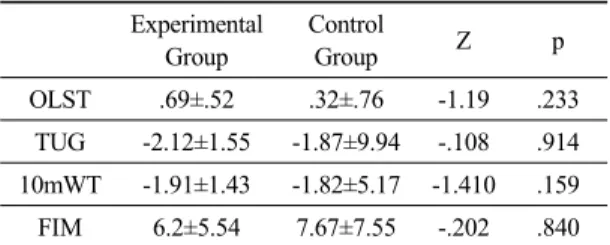
The averages of each measured values of experiment group and control group before and after experiment using virtual reality based video game were compared, and the results are shown in Table 3. Experiment group showed greater average in OLST, TUG and 10m walking test before and after experiment than control group, but the difference was not significant statistically.
Experimental Group
Control
Group Z p
OLST .69±.52 .32±.76 -1.19 .233 TUG -2.12±1.55 -1.87±9.94 -.108 .914 10mWT -1.91±1.43 -1.82±5.17 -1.410 .159 FIM 6.2±5.54 7.67±7.55 -.202 .840 Mean±SD.
OLST : Open Leg Standing Test, TUG : Timed Up and Go, 10mWT : 10m Walking Test, FIM : Functional Independence Measure
Table 3. The comparison of mean changes for variances between experimental group and control group for mean difference
Ⅳ. Discussion
For functional improvement of chronic stroke patients, various mediation methods have been attempted in physical therapy field, and examples include gymnastic treatment by physical therapist based on neurofacilitation model, task-oriented training method based on system model,
repetitive and intensive training based on exercise study, motivation and active participation, visual and auditory and tactile feedback, and purpose-driven training(Kim et al., 2010). Recently, virtual reality began to be used as treatment mediation tool to help patients with disability restore functions. Mediation method using virtual reality enables user to receive visual, auditory feedback while executing particular tasks, and as a result, adjust motions effectively. Also, this method promotes exercise study by stimulating brain, and produces effects by activating brain function and reorganizing brain(Park & Jang, 2009).
Preliminary studies using virtual reality provides evidences that this method is effective in various nervous system disease like cerebral palsy, Parkinsonism and stroke etc(Bryanton et al., 2006; Ferrarin et al., 2004; Henderson et al., 2007).
Hemiparalysis patient by stroke shows decrease in basic activities like walking, ascending and descending staircase and sitting on and standing up from chair due to weakening of muscle, decrease in balancing ability and damage of exercise ability. This means that stroke patients experience limitation in everyday life activities, and eventually deterioration in living quality. Therefore, for stroke patients, efforts to evaluate and restore balancing ability are important in rehabilitation aspect. In this study, rehabilitation exercise using virtual reality based video game showed no difference in OLST that evaluates static balancing ability of stroke patient. Preliminary studies also showed no statistically significant effects of static balancing. Also in the study by Kim(2005), results of experiment for 4 weeks using IREX indicated decrease in total moving distance and speed, but the decrease was not significant statistically. In this study, the method of using virtual reality based video game, which consists of dynamic motions that move the whole body, is judged as having no significant effects in evaluating static balancing.
As for the reason, it can be considered that since in stroke patients, static balancing is more effected by stiffening than
adjusting ability of major muscles, functional motion can hardly produce static balancing effect(Rietdyk et al., 1999).
On the other hand, experiment group showed significant increase in significant decrease in TUG that evaluates dynamic balancing ability, 10m walking test that evaluates walking ability and FIM that evaluates everyday life motion. All the subjects received 30 minutes of Bobath therapy and 15 minutes of FES treatment basically.
Nevertheless, control group did not show any significant increase in TUG, 10m walking test and FIM, and that is presumably because the basically provided physical therapy is focused on improving exercise functions and walking function. Subjects participating in experiment group could not execute video game easily initially, but as time went on, they grew accustomed to game pattern with scores increasing, and had greater excitement, and that is presumably because accumulated excitement and study affected the results of this study. The results of this study can be deemed as similar to various preliminary studies which consider that virtual reality program improved the balancing, exercise function and walking of stroke patient(Warburton et al., 2007; Kim et al., 2010; Shin &
Song, 2009).
The preliminary studies examined so far are composed of high-priced virtual reality instruments or specialized programs, and are focused on hospitals or experts group.
On the contrary, the virtual reality tool used in this study is Nintendo Wii a very affordable home game device that anyone can manipulate safely and easily, and could produce similar results to preliminary studies. The results of this study have verified the effects of exercise using virtual reality based video game on the dynamic balancing ability, walking ability and everyday life motions of stroke patients.
It is anticipated that the study results can be applied usefully by being proposed as the ground of the effectiveness of virtual reality based video game in composing the rehabilitation program for stroke patient. Also, it is judged that further study must be done to develop various virtual
reality based video game programs and make systematic approach to meet the objective of rehabilitation.
Ⅴ. Conclusion
In this study, the effects of rehabilitation exercise using virtual reality based video game for 3 weeks on the balancing ability, walking ability and everyday life motion of stroke patients were examined. Study results indicated that improvements were made in TUG that evaluated dynamic balancing ability, 10m walking test that evaluated walking ability and FIM that evaluated everyday life motion. Based on such results, it is judged that virtual reality may become a new alternative in rehabilitation treatment for stroke patients later on.
Acknowledgements
This study was supported by research fund from the Honam University, 2010.
References
Briggs RC, Gossman MR, Birch R et al. Balance performance among noninstitutionalized elderly women. Phys Ther. 1989;69(9):748-56.
Bryanton C, Bosse J, Brien M et al. Feasibility, motivation, and selective motor control: virtual reality compared to conventional home exercise in children with cerebral palsy. Cyberpsychol Behav. 2006;9(2):123-8.
Ferrarin M, Brambilla M, Garavello L et al. Microprocessor- controlled optical stimulating device to improve the gait of patients with Parkinson’s disease. Med Biol Eng Comput. 2004;42(3):328-32.
Fung J, Richard Cl, Malouin F et al. A treadmill and motion
coupled virtual reality system for gait training post-stroke. Cyberpsychol Behav. 2006;9(2):157-62.
Henderson A, Korner-Bitensky NLevin M. Virtual reality in stroke rehabilitation: a systematic review of its effectiveness for upper limb motor recovery. Top Stroke Rehabil. 2007;14(2):52-61.
Jack D, Boian R, Merians AS et al. Virtual reality-enhanced stroke rehabilitation. IEEE Trans Neural Syst Rehabil Eng. 2001;9(3):308-18.
Judge JO, King MB, Whipple R et al. Dynamic balance in older persons: effects of reduced visual and proprioceptive input. J Gerontol A Biol Sci Med Sci. 1995;50(5):263-70.
Keith RA, Granger CV, Hamilton BB et al. The functional independence measure: a new tool for rehabilitation.
Adv Clin Rehabil. 1987;1:6-18.
Kim EK, Kang JH, Lee HM. Effects of virtual reality based on game on balance and upper extremity function in chronic stroke patients. Journal of Special Education
& Rehabilitation Science. 2010;49(3):131-149.
Kim JH. Effects of virtual reality program on balance, gait and brain activation patterns in stroke patients. Daegu University. Dissertation of Doctor’s Degree. 2005.
Kwon MJ. The fall circumstance and related factors associated with fall in the stroke patients. J Kor Soc Phys Ther.
2008;20(3):19-28.
Langhammer B, Stanghelle JK. Bobath or motor relearning programme? A comparison of two different approaches of physiotherapy in stroke rehabilitation: A randomized controlled study. Clin Rehabil. 2000;14(4):361-9.
Laufer Y, Dickstein R, Resnik S et al. Weight-bearing shifts of hemiparetic and healthy adults upon stepping on stairs of various heights. Clin Rehabil. 2000;14(2):125-9.
Lee JH, Kang JH, Lee HM. Feasibility of using the Nintendo Wii game for dementia. The Korean Society of
Physical Medicine. 2011;6(2):225-33.
Park JW & Jang SH. The difference of cortical activation pattern according to motor learning in dominant and non-dominant hand: An fmri case study. J Kor Soc Phys Ther. 2009;21(1):81-8.
Podsiadlo D & Richardson S. The timed “Up & Go”: a test of basic functional mobility for frail elderly persons.
Journal of the American Geriatrics Society.
1991;39(2):142-8.
Pollock A, Baer G, Pomeroy V et al. Physiothrapy treatment approaches for the recovery of postural control and lower limb function following stroke. Cochrane Database Syst Rev. 2007(1):CD001920.
Rietdyk S, Patla AE, Winter DA et al. NACOB presentation CSB New Investigator Award. Balance recovery from medio-lateral perturbations of the upper body during standing. North American Congress on Biomechanics.
J Biomech. 1999;32(11):1149-58.
Sackley CMLincoln NB. Single blind randomized controlled trial of visual feedback after stroke: effects on stance symmetry and function. Disabil Rehabil. 1997;19(12):
536-46.
Sharp SA, Brouwer BJ. Isokinetic strength training of the hemiparetic knee: effects on function and spasticity.
Arch Phys Med Rehabil. 1997;78(11):1231-6.
Shin WS & Song CH. Effects of virtual reality-based exercise on static balance and gait abilities in chronic stroke.
J Kor Soc Phys Ther. 2009;21(3):33-40.
Suzuki K, Nakamura R, Yamada Y et al. Determinants of maximum walking speed in hemiparetic stroke patients. Tohoku J Exp Med. 1990;162(4):337-44.
Warburton DE, Bredin SS, Horita LT et al. The health benefits of interactive video game exercise. Appl Physiol Nutr Metab. 2007;32(4):655-63.