• 검색 결과가 없습니다.

Effects of Dual-Task Training with Cognitive Tasks on Cognitive Function and β-amyloid Levels in the Elderly with Mild Dementia

N/A
N/A
Protected

Academic year: 2021

Share "Effects of Dual-Task Training with Cognitive Tasks on Cognitive Function and β-amyloid Levels in the Elderly with Mild Dementia"

Copied!
8
0
0

로드 중.... (전체 텍스트 보기)

전체 글

(1)


| Abstract |

1)

PURPOSE: The purpose of this study was to examine the effects of dual-task training with cognitive tasks on cognitive functions and β-amyloid levels in the elderly with mild dementia.

METHODS: The subjects were 36 elderly inpatients diagnosed with mild dementia at S Hospital located in Gyeongsangbuk-do, South Korea. The patients were randomly divided into a dual-task training group (DTG; n = 18) or a single-task training group (STG; n = 18). DTG performed dual-task training with cognitive tasks while STG performed only exercise tasks. These groups performed their respective exercises during a 30-minute session occurring three times a week over an 8-week period. MMSE-K and GDS were used to measure the subjects’ cognitive function. To assess the subjects’ dementia-related factors, their β-amyloid levels were measured by blood analysis.

RESULTS: The results of the experiment were as follows:

†Corresponding Author : Seung-Min Nam

[email protected], https://orcid.org/0000-0002-9215-0545 This is an Open Access article distributed under the terms of the Creative Commons Attribution Non-Commercial License (http://creativecommons.org/licenses/by-nc/3.0) which permits unrestricted non-commercial use, distribution, and reproduction in any medium, provided the original work is properly cited.

DTG showed statistically significant differences between their MMSE-K scores and β-amyloid levels before and after training (p < .05), whereas they exhibited no statistically significant differences in their GDS scores. MMSE-K scores and β-amyloid levels were significantly different between DTG and STG after training.

CONCLUSION: The present study’s overall results indicate that dual-task training with cognitive tasks is more effective than single-task training in improving cognitive functions and β-amyloid levels in the elderly with mild dementia. In other words, regular dual-task training can be considered as effective in improving cognitive function and dementia-related factors in the elderly with mild dementia and thus may be suggested as an effective exercise method for the treatment and early prevention of dementia.

Key Words: Dual-Task Training, Cognitive function, β-amyloid, Mild dementia

Ⅰ. Introduction

Dementia is a representative chronic disease in which the normal brain is physically damaged or destroyed by ectogenic causes such as acquired trauma or disease, and it is generally accompanied by a decline in cognitive functions such as intelligence and learning, deterioration

Research Article Open Access

Effects of Dual-Task Training with Cognitive Tasks

on Cognitive Function and β-amyloid Levels in the Elderly with Mild Dementia

Do-Youn Lee, PT, PhD⋅Seung-Min Nam, PT, PhD

Department of Physical Therapy, Daegu University

Received: February 20, 2020 / Revised: March 11, 2020 / Accepted: March 25, 2020

ⓒ 2020 J Korean Soc Phys Med

(2)

of higher mental functions, and onset of behavioral disorders. It is also a complex clinical syndrome that causes difficulties in social life [1]. In the elderly aged 65 years or older, the prevalence of dementia is increased by about two-fold for every 4-year increase in age [2]. Considering Korea’s aging trend, the elderly dementia population is expected to increase further. Therefore, dementia is emerging as a social issue, not just an individual or family matter.

Alzheimer's dementia, the most common type of dementia, is when a protein called β-amyloid is deposited in the brain in large quantities, forming plaque. This plaque is toxic to brain cells and gradually causes necrosis of brain cells. It is a degenerative brain disease that causes dementia symptoms by eventually losing the function and atrophy of the brain due to poor signal transmission between cells [3,4]. As a result, Alzheimer's dementia is irreversible and currently impossible to cure. However, early diagnosis and treatment can slow the progression of dementia or improve symptoms [5].

A representative clinical symptom of dementia is reduction of cognitive function. Degradation of cognitive function generally implies partial impairments such as memory, persistence, attention, judgment, language, execution, and time and space classification [6]. In other words, the deterioration of cognitive ability in the elderly with dementia leads to a reduction in the ability to perform daily life functions and tasks, which in turn leads to deterioration of quality of life.

Currently, the main treatment for dementia is drug treatment, but recent studies have shown that non- pharmaceutical treatments such as cognitive rehabilitation, aerobic training, daily life movement training, and exercise therapy for the elderly with dementia are associated with improvements in cognitive function and performance of daily living activities [7]. Regular exercise facilitates the supply of oxygen and nutrients to the brain of the elderly with dementia. It also increases blood flow, improving brain

function. In particular, it increases the production of nerve cells in the hippocampus area and the frontal lobe area, which are responsible for memory and learning, thereby improving cognitive function [8]. However, a meta-analysis of patients with mild dementia found that single-task training did not clearly improve dementia [10]. In addition, the criteria in that study, such as the type and frequency of single-task training, were not clear, and the patient’s motivation and interest levels were low, which resulted in a poor treatment prognosis [10].

Recent studies have suggested dual-task training as a new exercise method for dementia rather than single-task training [11]. Dual-task training means performing another task at the same time when performing one task. In other words, cognitive ability and concentration are required by performing tasks at the same time, which is reported to be effective in improving brain function and cognitive function [12]. Studies have shown that dual-task exercise training involving cognitive tasks such as calculations as well as word matching dual-task training can improve cognitive ability, balance ability, and walking ability in the normal elderly, stroke patients, and Parkinson’s disease patients. It has also been reported to have a significant effect on improving daily living performance [13,14].

Dual-task exercise-based training with cognitive tasks has been reported to be effective in improving cognitive function and functional ability in neurologically impaired patients as well as the elderly [15]. Additional studies on effective prevention and exercise methods for dementia are needed, specifically studies that prove the effectiveness of dual-task training with cognitive tasks for the demented elderly. Therefore, the purpose of this study was to evaluate the effects of dual-task training with cognitive tasks on cognitive functions and β-amyloid levels, which cause Alzheimer's disease, in the elderly with mild dementia.

In addition, dual-task training was assessed as being more

effective in improving cognitive function and β-amyloid

levels in the elderly with dementia than single-task training.

(3)

Ⅱ. Methods

1. Subjects

This study was carried out on 40 elderly patients aged 65 years or older who were hospitalized after being diagnosed with dementia by a specialist at S nursing hospital in Gyeongsangbuk-do. In order to determine the appropriate number of subjects, the program G-power 3.1.9.2 was used. Based on previous studies, 20 subjects were calculated for each group by calculating the effect size .5, significance level .05, and power (80%). Using a drawing lots program, the subjects were randomly assigned to a dual-task training group (DTG, n = 20) or single-task training group (STG, n = 20), with final numbers of 18 in each group after four dropouts during the experiment. Considering that the subjects were dementia patients, the purpose of the study and the contents of the experiment had been previously explained to all guardians of the subjects. Voluntary participation was obtained (1040621-201711-HRBR-004-002) according to the procedure. The criteria for the selection of subjects were elderly people over 65 years of age who had been diagnosed with dementia by doctors according to the following criteria: Korean version of the Mini-Mental State Examination (MMSE-K) based on 18–23 points, Global Deterioration Scale (GDS) based on 4-5 points, standing or walking independently, or using orthosis. Exclusion

criteria were bed-rest elderly and those who had participated in other exercise programs.

2. Experimental Procedures

1) Dual-task Training

Dual-task training with cognitive tasks requires attention when both tasks are performed simultaneously, and exercise tasks are designed to be as simple as possible so that selective attention can be given to cognitive tasks. The dual-task training applied to the elderly with mild dementia was revised and supplemented in accordance with the purpose of this study, based on previous studies. Dual-task training with cognitive tasks based on exercise tasks consisted of aerobic, balance, and strength strengthening exercises, and the cognitive tasks consisted of cognitive stimulation training using numbers, words, and pictures [16,17]. Specific training methods are shown in Table 1.

2) Single-task Training

Single-task training consisted of aerobic, balance, and strength training exercises. The specific training method consisted of standing up on the bed, in a standing posture stretch your arms in many directions, lifting the heels while in a standing posture, putting one foot on the wall with alternating tolerance, walking on a flat surface, and stationary bikes. The training was conducted three times

Exercise Additional Cognitive Task

Standing up on the Bed (5 minutes) (1) Counting numbers without sound

Ex) 100, 99, 98, 97 ...

(2) Simple arithmetic Ex) 2 + 3, 9 - 4 (3) Word association

Say a word starting with a consonant (4) Matching the proposed picture Ex) Things, places, animals, etc.

(5) Pictures, letters, objects, etc. presented;

Remember and answer In a Standing Posture Stretch your Arms in Many Directions (5 minutes)

In a Standing Posture Lifting the Heels (5 minutes) One Foot on the Wall Alternating Tolerance (5 minutes) Walking on Flat (5 minutes)

Stationary Bikes (5 minutes)

Table 1. Dual-Task Training

(4)

a week for a total of 8 weeks. One training session was 30 minutes. During the training, the therapist verbally instructed the subject to be in the correct posture, and the subject performed the training while maintaining correct posture. In addition, when subjects complained of fatigue, discomfort, or pain during training, they were allowed to rest.

3. Measurement

1) Korean version Mini-Mental State Examination (MMSE-K)

The Korean version of the Mini-Mental State Examination (MMSE-K) is the most widely used dementia screening tool in Korea and has the advantage of being able to easily assess the intellectual condition and cognitive function of the subject in a short time. The Korean version of the MMSE-K consists of 12 questions, including five points of orientation relating to time, five points of orientation relating to place, three points pertaining to memory registration, three points to memory recall ability, five points to attention and computation, and nine points to understanding, judgment, and language. The test has a total of 30 points. The MMSE-K reliability is .99 and the validity is -.78 [18,19].

2) Global Deterioration Scale (GDS)

The Global Deterioration Scale (GDS) is a comprehensive assessment of the cognitive, social, and daily life functions of patients with suspected dementia and those diagnosed with dementia. It is a measure of the severity of dementia in a single measure. The GDS is very useful in understanding how the patient’s condition changes over time in response to a treatment and has the advantage of being easy to apply. The overall degeneration scale consists of seven stages that distinguish the severity of dementia symptoms: GDS 1 (no cognitive impairment), GDS 2 (very mild cognitive impairment) GDS 3 (mild cognitive

impairment), GDS 4 (moderate cognitive impairment), GDS 5 (early severe cognitive impairment), GDS 6 (severe cognitive impairment), and GDS 7 (late severe cognitive impairment). GDS 4-5 is considered to be mild dementia, and GDS 6-7 is moderate and severe dementia. The GDS reliability is .93-1.00, and the validity is .80-.99 [20].

3) Blood Analysis

Blood assays were performed to assess β-amyloid levels.

For the blood analysis, 10 ml of blood was collected before and after 8 weeks of exercise. Specifically, the subjects fasted for 12 hours, and blood was collected from the anterocubital vein using a disposable syringe between 6 and 7 am. Blood collection was performed by nurses with more than 10 years of experience. The collected blood was stored at room temperature for 30 minutes or more, followed by centrifugation at 3000 rpm for 10 minutes.

The separated serum was stored at -20 ° C or lower for analysis. In this study, a blood analysis device (Infinite M200Pro ELISA Reader, Austria) was used, and blood analysis was performed by the Enzyme Immuno Assay (EIA) method.

4. Statistical Analyses

A Shapiro-Wilk test was conducted to determine the

normal distribution of each measurement item, and all items

were normally distributed. The experimental data of this

study were described as the mean ± standard deviation

(Mean ± SD), and general characteristics of the subjects

were analyzed using descriptive statistics and Independent

t-test. Paired t-test was performed to compare the effects

of pre-training and post-training in the dual-task and

single-task training groups. Independent t-test was

performed for comparison between the dual-task and

single-task training groups. Data collected in this study

were statistically processed using SPSS 23.0 for Windows,

and the statistical significance level (p) was set to .05.

(5)

Ⅲ. Results

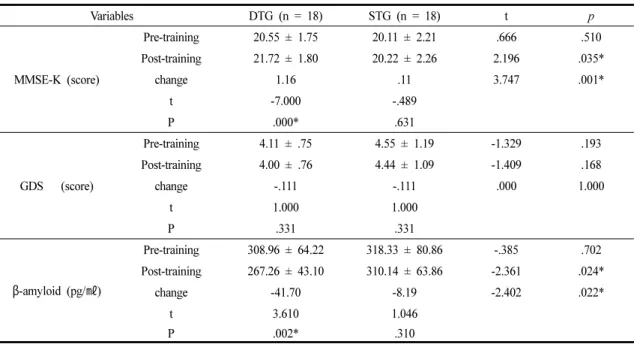
The homogeneity test of the subjects showed there was no statistical difference between the groups (p > .05) (Table 2). The MMSE-K scores and β-amyloid levels showed significant differences after training in the dual-task training group (p < .05), but not in the single-task training group (p > .05). When comparing the variation between the dual-task and single-task training groups, there was a significant difference in the MMSE-K scores and β -amyloid levels (p < .05). There was no significant difference as a result of comparing the variation in GDS scores between the groups (p > .05).

Ⅳ. Discussion

The purpose of this study was to provide basic data in order to develop an effective exercise method for the prevention of dementia as well as investigate the effect of dual-task training with cognitive tasks on the elderly with mild dementia. In order to evaluate the effect of training, cognitive function and β-amyloid levels were evaluated.

According to the results, the MMSE-K scores significantly increased after training in the dual-task training group, whereas there was no significant difference after exercise in the single-task training group. After

training, there was a significant difference in the comparison of variation in MMSE-K scores between the dual-task and single-task training groups. These findings are consistent with the prior results of a combined program based on cognitive training and exercise in the elderly in which MMSE-K scores improved [21]. Another report found that a dual-task exercise and cognitive program significantly improved overall cognitive function in the elderly with mild cognitive impairment [22]. Moreover, memory significantly improved, and about 80% of the dual-task experimental groups showed improved cognitive function [23]. As dementia progresses, degenerative changes occur in various parts of the cerebral cortex, resulting in cognitive degradation in various areas.

Therefore, dual-task training is more effective than single task training that acts on specific functions of the brain, so cognitive function, execution function, concentration, etc. are required at the same time to improve the overall cognitive function of the elderly with dementia [24]. Also, performing complex and diverse tasks in daily life requires cognitive coordination on various tasks [25]. It is believed to be practiced through dual-task training.

GDS scores were not significantly different between the single-task and dual-task training groups. Specifically, after training, there was no significant difference in the comparison of variation in GDS scores between the dual-task and single-task training groups. Unlike the

DTG (n = 18) STG (n = 18) x

2

/t p

Gender (M / F) 4 / 14 3 / 15 .177 .674

Age (year) 79.94 ± 8.37 79.61 ± 7.45 .126 .900

Height (cm) 154.94 ± 10.66 153.33 ± 8.99 .490 .627

Weight (kg) 52.33 ± 11.77 46.22 ± 11.71 1.561 .128

*p < .05

Mean ± SD : Mean ± Standard Deviation M : Male, F : Female

DTG : Dual-Task Training Group STG : Single-Task Training Group

Table 2. General Characteristics of Subjects (unit)

(6)

MMSE-K, which consists of multiple questions, the overall degeneration scale test evaluates cognitive function, social activity, and daily life functions as well as classifies the severity of dementia symptoms into seven levels according to the characteristics of each step. Therefore, the dual-task training program did not significantly alter the general degeneration scale of the elderly with mild dementia.

Previous studies have also reported that long-term exercise is effective in improving the cognitive function of dementia patients [26]. However, in this study, a short exercise period of 8 weeks was not sufficient to alter the overall severity of dementia symptoms. In other words, long-term dual task training may be effective in improving cognitive function and alleviating dementia symptoms in elderly people with dementia.

The study also found that β-amyloid levels in the

dual-task training group significantly decreased after training, whereas there was no significant difference after exercise in the single-task training group. After training, there was a significant difference in the comparison of variation in β-amyloid levels between the dual-task and single-task training groups. These results were consistent with previous results in which dual-task training in the elderly showed a significant effect on β-amyloid reduction compared to single-task training and aerobic exercise [27].

In addition, dual-task training for the elderly with mild cognitive impairment has been reported to be effective in improving overall cognitive function by increasing the intensity of EEG responsible for attention and memory [28]. It has been reported that wider areas of the brain are activated by exercise, as synaptic plasticity involved in cognitive function is improved and β-amyloid levels

Variables DTG (n = 18) STG (n = 18) t p

MMSE-K (score)

Pre-training 20.55 ± 1.75 20.11 ± 2.21 .666 .510

Post-training 21.72 ± 1.80 20.22 ± 2.26 2.196 .035*

change 1.16 .11 3.747 .001*

t -7.000 -.489

P .000* .631

GDS (score)

Pre-training 4.11 ± .75 4.55 ± 1.19 -1.329 .193

Post-training 4.00 ± .76 4.44 ± 1.09 -1.409 .168

change -.111 -.111 .000 1.000

t 1.000 1.000

P .331 .331

β-amyloid (pg/㎖)

Pre-training 308.96 ± 64.22 318.33 ± 80.86 -.385 .702

Post-training 267.26 ± 43.10 310.14 ± 63.86 -2.361 .024*

change -41.70 -8.19 -2.402 .022*

t 3.610 1.046

P .002* .310

*p < .05

Mean ± SD : mean ± Standard Deviation DTG : Dual-Task Training Group STG : Single-Task Training Group

MMSE-K : Korean Version Mini-Mental State Examination GDS : Global Deterioration Scale

Table 3. Comparison of Cognitive Function and Body Function for Each Group (unit)

(7)

are elevated by increasing blood flow to the brain [29].

In this study, dual-task training resulted in a reduction in β-amyloid levels among the elderly with mild dementia, which seemed to improve overall cognitive function. In other words, dual-task training is an effective exercise method to reduce the risk of dementia.

As a limitation of this study the first, only the elderly with mild dementia who are hospitalized at nursing hospitals were selected as eligible. Further research is needed to investigate the effects of exercise according to the specific types and severity of dementia. Second, a retention test was not conducted. In a future study, we will examine whether or not the effectiveness of training persists through retention tests.

Ⅴ. Conclusion

Based on the results of this study, in order to improve cognitive function and dementia-related β-amyloid levels in patients with mild dementia, dual-task training is more effective training than single-task training. In other words, regular dual-task training may be suggested as an effective exercise method for non-pharmaceutical treatment and early prevention of dementia.

References

[1] McDowell I. Alzheimer’s disease: insights from epidemiology. Aging Clin Exp Res. 2001;13(3):143-62.

[2] Ritchie K, Lovestone S. The dementias. The Lancet.

2002;360(9347):1759-66.

[3] Borroni B, Colciaghi F, Archetti S, et al. Predicting cognitive decline in Alzheimer disease: Role of platelet amyloid precursor protein. Alz Dis Assoc Dis. 2004;

18(1):32-4.

[4] Pietrzik C, Behl C. Concepts for the treatment of Alzheimer’s disease: molecular mechanisms and clinical application. Int J Exp Pathol. 2005;86(3):173-85.

[5] Thomas VS, Hageman PA. A preliminary study on the reliability of physical performance measures in older day-care center clients with dementia. Int Psychoger.

2002;14(1):17-23.

[6] Fratiglioni L, Launer LJ, Andersen K, et al. Incidence of dementia and major subtypes in Europe: A collaborative study of population-based cohorts. Neurologic Diseases in the Elderly Research Group. Neurology. 2000;54(11 Suppl 5):10-5

[7] Olazarán J, Reisberg B, Clare L, et al. Nonpharmacological therapies in Alzheimer’s disease: a systematic review of efficacy. Dement Geriatr Cogn Disord. 2010;30(2):

161-78.

[8] Barnes DE, Yaffe K, Satariano WA, et al. A longitudinal study of cardiorespiratory fitness and cognitive function in healthy older adults. J Am Geriatr Soc. 2003;51(4):

459-65.

[9] Gates N, Singh MAF, Sachdev PS, et al. The effect of exercise training on cognitive function in older adults with mild cognitive impairment: a meta-analysis of randomized controlled trials. Am J Geriatr Psychiatry.

2013;21(11):1086-97.

[10] Forkan R, Pumper B, Smyth N, et al. Exercise adherence following physical therapy intervention in older adults with impaired balance. Phys Ther. 2006;86(3):401-10.

[11] Holtzer R, Mahoney JR, Izzetoglu M, et al. fNIRS study of walking and walking while talking in young and old individuals. J Gerontol A Biol Sci Med Sci. 2001;66(8):

879-87.

[12] Woollacott M, Shumway-Cook A. Attention and the control of posture and gait: a review of an emerging area of research. Gait Posture. 2002;16(1):1-14.

[13] Yang YR, Chen YC. Lee CS, et al. Dual-task-related gait changes in individuals with stroke. Gait Posture.

2007;25(2):185-90.

[14] O'Shea S, Morris ME, Iansek R. Dual task interference

during gait in people with Parkinson disease: effects of

motor versus cognitive secondary tasks. Phys Ther.

(8)

2002;82(9):888-97.

[15] Dean CM, Richards CL, Malouin F. Task-related circuit training improves performance of locomotor tasks in chronic stroke: a randomized, controlled pilot trial. Arch Phys Med Rehabil. 2000;81(4):409-17.

[16] Hollman JH, Kovash FM, Kubik JJ, et al. Age-related differences in spatiotemporal markers of gait stability during dual task walking. Gait Posture. 2007;26(1):113-9.

[17] Pellecchia GL. Dual-task training reduces impact of cognitive task on postural sway. J Mot Behav. 2005;

37(3):239-46.

[18] Kwon YC. Korean version of mini-mental state examination (MMSE-K). J Korean Neurol Assoc. 1989;1:

123-35.

[19] Kang Y, Na DL, Hahn S. A validity study on the Korean Mini-Mental State Examination (K-MMSE) in dementia patients. J Korean Neurol Assoc. 1997;15(2):300.

[20] Choi SH, Na DL, Lee BH, et al. The validity of the Korean version of Global Deterioration Scale. J Korean Neurol Assoc. 2002;20(6):612.

[21] Park KS, Jeong HY, So SY, et al. The effects of the activity program for preventing dementia against depression, cognitive function, and quality of life for the elderly. JON. 2013;24(4):353-62.

[22] Kim K, Kim O. The effects of exercise-cognitive combined dual-task program on cognitive function and depression in elderly with mild cognitive impairment. Korean J Adult Nurs. 2015;27(6):707-17.

[23] You JH, Shetty A, Jones T, et al. Effects of dual-task cognitive-gait intervention on memory and gait dynamics in older adults with a history of falls: a preliminary investigation. NeuroRehabilitation. 2009;24(2):193-8.

[24] Silsupadol P, Siu KC, Shumway-Cook A, et al. Training of balance under single-and dual-task conditions in older adults with balance impairment. Phys Ther. 2006;86(2):

269-81.

[25] Michel JA, Mateer CA. Attention rehabilitation following stroke and traumatic brain injury: a review. Eur J Phys Rehabil Med. 2006;42(1):59.

[26] Netz Y, Jacob T. Exercise and the psychological state of institutionalized elderly: a review. Percept Mot Skills.

1994;79(3):1107-18.

[27] Yokoyama H, Okazaki K, Imai D, et al. The effect of cognitive-motor dual-task training on cognitive function and plasma amyloid β peptide 42/40 ratio in healthy elderly persons: a randomized controlled trial. BMC Geriatr. 2015;15(1):60.

[28] Hwang JH. The effect of dual task-virtual reality program on the cognitive function, balance and EEG for seniors with mild cognitive impairment. Doctor’s Degree. Daegu University. 2017.

[29] Erickson KI, Colcombe SJ, Wadhwa R, et al. Training- induced functional activation changes in dual-task processing: an FMRI study. Cereb Cortex, 2006;17(1):

192-204. 

수치

Table 2. General Characteristics of Subjects                                                                  (unit)
Table 3. Comparison of Cognitive Function and Body Function for Each Group                                  (unit)

참조

관련 문서

The research tasks for achieving this purpose are: a) the experimental group's self concept will be significantly improved compared with the control group,

Conclusion: We found that aroma foot reflex massage enhance on sleep, reduce depression levels in elderly with dementia patients. therefore this intervention can be utilized

To solve this problem, a prototype of dental assistant robot that can effectively block aerosols from the patient’s mouth and replace simple tasks of the

Secondly, when the competitive-state anxiety level of the sailors with different sailing classes were compared, the cognitive, physical anxieties

The committee chose them as part of its new tasks and decided to discuss them at the 99th MSC conference under the support of the majority of its

– 대부분의 clipping algorithm들은 view volume 이 normalize 되어야 작동. – reduce the

To investigate this, we run MAML and ProtoNets on tasks generated via CACTUs (CACTUs-MAML, CACTUs-ProtoNets). We compare to five alternate algorithms, with four

aSystem design performs many design tasks at different levels of abstraction.. `Requirements, Specifications, Architecture, Coding,