KOREAN JOURNAL OF ENGLISH LANGUAGE AND LINGUISTICS
ISSN: 1598-1398 / e-ISSN 2586-7474 http://journal.kasell.or.kr
The Effect of L2 Proficiency, L1 Congruency, and Collocation Frequency on L2 Collocation Processing: An Experimental Study of Korean EFL Learners
*Shinwoong Lee (Hanyang University)
This is an open-access article distributed under the terms of the Creative Commons License, which permits unrestricted non-commercial use, distribution, and reproduction in any medium, provided the original work is properly cited.
ABSTRACT
Lee, Shinwoong. 2021. The effect of L2 proficiency, L1 congruency, and collocation frequency on L2 collocation processing: An experimental study of Korean EFL learners. Korean Journal of English Language and Linguistics 21, 1060-1084.
The purpose of the current study was to examine how L2 proficiency, L1 congruency, and collocation frequency influenced the processing of English collocations and to see whether there existed interaction effects among the variables. Fifty Korean EFL university students and twenty native speakers of English in Korea participated in the current study. An acceptability judgment task was utilized in the experiment in which the participants were asked to decide whether the English expressions given were appropriate or not, and their error rates on and reaction times to the collocations were measured. It was revealed that there existed a significant effect of collocation frequency, L2 proficiency, and L1 congruency on the processing of the English collocations. It was also found that L1 influence on the error rate and the reaction time appears to wane as the level of English proficiency enhances and the collocation frequency increases. The findings suggested that EFL learners may be able to develop the intralexical knowledge of L2 collocations departing from L1 mediation as their English proficiency enhances and they are exposed to more L2 input.
Received: October 09, 2021 Revised: October 20, 2021 Accepted: October 28, 2021
Shinwoong Lee
Professor, Dept. of English Language and Literature, Hanyang University 222 Wangsimni-ro,
Seongdong-gu, Seoul 04763, Korea
* This work was supported by the Hanyang Research Fund (2020). I am truly grateful to anonymous reviewers for their insightful comments on an earlier version of this paper.
KEYWORDS
L2 collocation processing, frequency effect, L1 influence, L2 proficiency, reaction time, error rate, acceptability judgement task
Shinwoong Lee The effect of L2 proficiency, L1 congruency, and collocation frequency on L2 collocation processing: An experimental study of Korean EFL learners
1. Introduction
It has been found consistently that lexical chunks or clusters are widespread both in spoken and written language (Erman and Warren 2000, Foster 2001, Nattinger and DeCarrico 1992) and argued that high-frequency word chunks may be stored as an independent representation in the long-term memory (Hoey 2005, Ellis 2001, Wray 2002). According to the pattern- or usage-based language model (Hoey 2005, Wray 2002), human beings are prone to processing language in chunks, and lexical chunking or patterning can contribute to the efficiency of language processing significantly in a sense that word chunks as a unit of storing and retrieving language rather than a single word can expedite language processing profoundly. This recognition has inspired language researchers (e.g., Conklin and Schmitt 2008, Durrant and Doherty 2010, Ellis, Simpson-Vlach and Maynard 2008, Jiang and Nekrasova 2007) to examine whether such word clusters truly exist in human minds, and they mostly found such word chunks seemed to exist and they can facilitate language processing in general.
As the knowledge of word chunks also known as collocations, formulaic sequences, and lexical bundles has been recognized and emphasized in language processing (Nation 2013, Pawley and Syder 1983, Schmitt and Carter 2004), some of the L2 researchers (e.g., Kim and Cho 2010, Kim and Ma 2011, Park and Lee 2011) have tried to examine how L2 collocation knowledge is related to L2 proficiency. They mostly found that L2 collocation knowledge is positively associated with L2 proficiency and its development, and suggested that L2 language professionals should pay an immediate attention to instructing L2 collocations in L2 classrooms. Provided that L2 collocation knowledge plays a pivotal role in the development of L2 proficiency, L2 researchers also investigated what factors can influence the use of L2 collocation by analyzing L2 learner’s writings (e.g., Hsu 2007, Nesselhauf 2003) and utilizing L2 collocations tests (e.g., Chon and Lee 2015, Shokouhi and Mirsalari 2010). The results of the studies revealed that a relatively large number of errors in the use of L2 collocations were rooted from learners’
L1.
Meanwhile, there have also been a series of psycholinguistic attempts to delve into L2 collocation processing in experimental settings drawing on acceptability judgement tasks (e.g., Lee 2016, Yamashita and Jiang 2010) and priming experiments (e.g., Wolter and Gyllstad 2011), and they mostly found that L1 significantly influenced L2 collocation processing in general. However, those studies primarily focused on L1 influence on L2 collocation processing and somewhat neglected to examine such presumably essential factors as the proficiency level of EFL learners and collocation frequency, all of which would affect L2 collocation processing significantly. Besides, only a few studies were conducted in Korean EFL contexts.
In this sense, the purpose of the current study was to examine the effect of L2 proficiency, collocation frequency, L1 congruency, and their interaction effects on L2 collocation processing in Korean EFL contexts. In so doing, it is expected that not only the main effects of those three variables, but also how each variable affects the level of the other variables can be revealed, which would shed more light on L2 collocation processing in EFL context.
2. Literature Review
2.1 L2 Proficiency and Collocation Knowledge
It has been argued that if learners have a large number of ready-made word sequences stored in their long-term memory, then a basic unit of language processing becomes multi-word units rather than an individual word (Schmitt and Carter 2004), and this kind of association or chunking can occur even at such levels as morphemes or phonemes moving toward the next higher levels, words and phrases, saving cognitive resources to be used in the following processes (Conklin and Schmitt 2012, Ellis, Simpson-Vlach and Maynard 2008, Schmitt and Carter 2004). It has also been robustly contended that L2 collocation knowledge can help L2 learners comprehend and produce L2 more fluently and have native-like word selection (Nation 2013, Pawley and Syder 1983). As such, L2 collocations have become an increasingly crucial topic in the field of second language acquisition and pedagogy, and there is now converging evidence that L2 collocation knowledge is indeed a critical component of L2 proficiency. Chon and Lee (2015) examined the relationship between L2 collocation knowledge and L2 writing proficiency of Korean EFL learners, and they found that even after controlling for the contribution of L2 vocabulary knowledge to L2 writing proficiency, collocation knowledge made a significant contribution to the EFL learners’
writing proficiency. The findings suggested that collocation knowledge is essential for L2 writing enhancement and thus English collocations should be taught explicitly in EFL classrooms, and more attention should be paid to the collocations that are unpredictable from L1.
In a similar vein, Lee (2015) attempted to investigate the relationship between the productive collocation knowledge of university students and their writing proficiency in English, and it was found that the students’ productive collocation knowledge was positively correlated with their writing scores in general.
Furthermore, drawing on a multiple hierarchical regression analysis, it was attempted to see whether the EFL learners productive collocation knowledge could account for their writing proficiency significantly even after controlling for their grammatical and productive vocabulary knowledge. The findings suggested that productive collocation knowledge has its unique contribution to L2 writing proficiency.
Meanwhile, some of the researchers analyzed L2 writings of EFL learners and tried to find out the relationship between the number of collocations used in the learners’ writings and their L2 proficiency. In a study of Taiwanese EFL learners, Hsu (2007) found that the number of collocations used in the learners’
writings was positively correlated with the learners’ writing scores. Similarly, Chon and Shin (2009) reported that there existed a significantly positive correlation between the number of collocations that learners used in their writings and their writing scores.
There have also been the studies that examined the effect of collocation-centered instruction on L2 proficiency improvement. Kim and Ma (2011) investigated the effect of collocation-driven instruction on the high school students’ vocabulary learning, and the results of the study revealed that both the learners’
vocabulary knowledge and their interest in learning English were substantially enhanced through the collocation-centered instruction. Particularly relevant to L2 collocation knowledge and L2 writing
proficiency, Park and Lee (2011) reported that the high school students with collocation-based instruction enhanced their L2 writing proficiency significantly. To sum, a relatively large number of the studies investigated the relationship between L2 proficiency and collocation knowledge along with the effect of collocation-driven instruction on L2 proficiency, and most of the studies suggested that there existed a significantly positive relationship between L2 collocation knowledge and L2 proficiency in general.
2.2 L1 Influence on L2 Collocation Processing and Acquisition
Drawing on the revised hierarchical model (Kroll and Stewart 1994, Kroll, Michael, Tokowicz and Dufour 2002) and the research that inquired into L2 lexical representation and development (Jiang 2000, 2002), Jiang (2004) proposed the stages and processes of adult L2 vocabulary acquisition, according to which L2 forms cannot be directly linked to their concepts especially at the beginning stage of L2 vocabulary development. Jiang (2002) argued that because L2 learners are not adequately exposed to contextualized L2 input in general, the meanings of L2 words are often mediated by L1 translation equivalents which are firmly linked to their concepts. Consequently, L2 forms are often activated with their L1 translation equivalents which have lemma information, and as this kind of co-activation occurs repeatedly, L2 forms are connected to the lemma of L1 translation equivalents. At this stage, L2 learners typically have a hybrid form of mental lexicon in which L2 forms(lexeme) and L1 lemma coexist (See Figure 1 below) and this kind of hybrid form-meaning mapping is often fossilized in the case of EFL learners since they are typically not exposed to sufficient L2 input.
L2 forms (written & spoken) L2 morphology
L1 semantics (meaning) L1 syntax
lexeme lemma
Figure 1. Mental Representation of L2 Lexical Knowledge of Adults L2 Learners [Adapted from Jiang (2004), p. 418]
In relation to Jiang’s model of L2 lexical knowledge, Lee (2016) argued that although Jiang’s model deals with the acquisition of individual L2 words, it can be applied into multi-word units. In other words, L1 lemma information may include which word combinations are possible or not in L1 (i.e., intralexical knowledge of L1) and this information based on L1 lemma can influence L2 learner’s perceptions about what kinds of collocations (words combinations) are possible or not in L2 and can affect L2 collocation processing ultimately.
As the influence of L1 on L2 lexical knowledge has been highlighted, a relatively large number of
studies have probed into L1 influence on L2 collocation acquisition and learning (Fan 2009, Kim 2012, Kim and Yoon 2008, Laufer and Waldman 2011, Lee 2016, Nesselhauf 2003, Phoocharoensil 2013, Sadeghi 2009) and they primarily found that there existed a significant effect of L1 on L2 collocation learning and processing. Nesselhauf (2003) analyzed the essays written by German EFL university students, which were the part of the German sub-corpus of the International Corpus of Learner English (ICLE), focusing on verb-noun collocations. He found that L1 influence on the use L2 collocations was far beyond what previous studies predicted and suggested that L1-L2 differences in the use of collocations should be explicitly contrasted and instructed in L2 classrooms.
With Korean EFL learners, Kim and Yoon (2008) examined the knowledge of L2 collocations centering on L1 predictability and they found that Korean EFL learners had inadequate knowledge of English collocations and a large number of the errors on the use of English collocations are stemmed from their L1. Along the same lines, Kim (2012) reported that Korean EFL learners often found the incongruent English collocations that were not predictable from their L1 more difficult to learn than the congruent ones.
2.3 Psycholinguistic Reality of L2 Collocation Processing
There has also been a series of studies that attempted to explore psycholinguistic reality of L2 collocation processing. Yamashita and Jiang (2010) investigated the influence of L1 on the acquisition of L2 collocations with Japanese ESL and EFL learners drawing on a phrase-acceptability judgment task, and they found that L1 congruency and the degree of L2 exposure significantly affect the acquisition of L2 collocations and concluded that even with a substantial amount of exposure to English input, Japanese ESL leaners had difficulty in acquiring incongruent L2 collocations. Drawing on priming experiments with Swedish learners of English, Wolter and Gyllstad (2011) measured the reaction time to the English collocations, and they found that Swedish non-native speakers of English processed the collocations that were predictable from L1 faster than those that were not predictable from L1, and suggested that there existed a strong effect of L1 on L2 collocation processing. Similarly, Lee (2016) examined the influence of L1 on the processing of L2 collocations, and found that Korean EFL learners processed congruent L2 collocations faster than incongruent ones and their error rate of incongruent L2 collocations was higher than that of congruent ones, which echoed the results of previous studies.
There has been two studies of L2 collocation processing in which frequency and L1 predictability were taken into account together. Wolter and Gyllstad (2013) investigated the effect of frequency and congruency of the collocations with advanced Swedish EFL learners. The results revealed that Swedish English learners are sensitive to frequency of the collocations, and L1 influence on L2 collocation processing appeared persistent even with the advanced learners of English. Most relevant to the current study, Wolter and Yamashita (2018) investigated the effect of collocation frequency, L1 congruency, and L2 proficiency with two groups of Japanese EFL learners (intermediate and advanced) and one group of native speakers of English. They found that two groups of Japanese EFL learners processed congruent L2
collocations faster than incongruent ones suggesting that there existed L1 influence on L2 collocation processing. Meanwhile, both groups of Japanese EFL learners were sensitive to the frequency of the collocations in processing them.
2.4 The Current Study
To the author’s knowledge, there exists only a few studies (e.g., Wolter and Yamashita 2018) that examined the effect of collocation frequency, L1 congruency, and English proficiency together on L2 collocation processing in EFL context, and little research has been conducted in Korean EFL context. Thus, the purpose of the current study was to examine how collocation frequency, L2 proficiency, and L1 congruency influenced the collocation processing of Korean EFL learners, and to see whether there existed interaction effects among the variables. The following research questions guided the current study.
1) What are the effects of L2 proficiency, L1 congruency, and collocation frequency on L2 collocation processing?
2) What are the interaction effects among the three variables (L2 proficiency, L1 congruency, and collocation frequency) in processing L2 collocations?
3. Methods
3.1 Participants and Settings
The participants of the current study included twenty native speakers of English and fifty Korean EFL learners. Thirteen native speakers were the instructors at a university, teaching English speaking and composition courses, and the rest were the teachers at private language institutes in Seoul, Korea. All of the native speakers had a bachelor’s degree and nine of them had a master’s degree in diverse fields. The EFL learners were the volunteers from the seven different departments (English Language and Literature, History, English Education, Philosophy, German Language and Literature, Mathematics, Mechanical Engineering) at a university located in Seoul. In order to control the degree of exposure to English input, those learners who had lived in English-speaking countries for more than one year were excluded and only those who received the formal English Education from elementary to high school in Korea were included in the current study. Then, the Korean EFL learners were divided into two groups according to their TOEIC scores. Drawing on the ETS guidelines, which detailed the ranges of the scores and their corresponding proficiency level in English, 18 EFL learners who had the scores above 910 were grouped as advanced leaners. According the ETS guideline, they are supposedly able to communicate effectively and efficiently in any type of situations. On the other hand, 22 EFL learners who had the scores between 700 and 800 were classified as intermediate English learners and according to ETS guideline, they are
presumed to be able to meet social demands and work requirements in general.
The TOEIC scores of the advanced EFL learners ranged from 910 to 985, and their average score was 950, meanwhile the average TOEIC score of the intermediate EFL learners was 755, ranging from 725 to 790. The age of the participants ranged from 20 to 25 (average: 22.6), and male and female participants made up 45 (18 students) and 55 (22 students) percent of the participants respectively.
3.2 Item Development
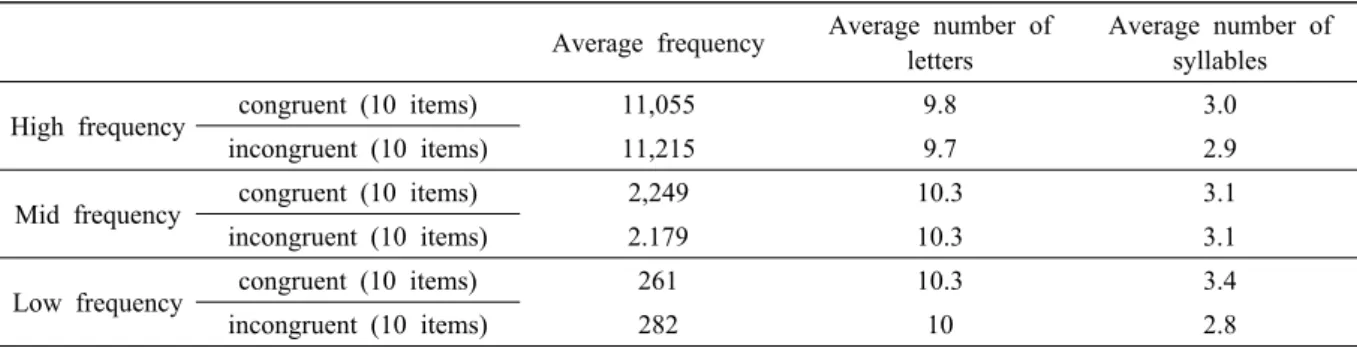
For a phrase-acceptability judgement task, 30 congruent collocations (i.e., collocations predictable from L1), 30 incongruent collocations (i.e., collocations unpredictable from L1), and 60 semantically and collocationally infeasible word combinations (e.g., hungry mountains) were used in the current study. Each collocation group (i.e., congruent and incongruent collocations) has 15 verb-noun and 15 adjective-noun collocations, and they were also divided into three groups according to their frequency (i.e., high, mid, and low frequency). Consequently, six groups of collocations by L1 predictability and frequency were created and utilized in the experiment.
The collocations used in the current study were chosen in accordance with the following procedures.
First, about 200 verb-noun and adjective-noun collocations were selected from the previous studies (e.g., Chon and Lee 2015, Kim 2012) and the collocation dictionaries such as Macmillan Collocations Dictionary for Learners of English and Oxford Collocations Dictionary for Students of English. Once about 200 collocations were chosen, each word that comprises the collocations was shown to the five native speakers of Korean with high English proficiency whose TOEIC scores were above 900, and they were prompted to come up with two or three viable translations of each word as quickly as possible. Then, the translation of each word that at least four of the Korean native speakers agreed upon was used to translate the collocations. Finally, the translations of the collocations as a whole were presented to another group of five native speakers of Koreans who were majoring in Korean Language and Literature at the university, and they were asked to decide whether the translations of the collocations were possible Korean expressions or not. If four or five of them considered the translations plausible in Korean, they were classified as congruent collocations, whereas if four or five of them judged the translations as implausible, they were labelled as incongruent collocations. The translations of the collocations were also cross-checked using two Korean portal websites, Naver and Daum to see whether there existed a L1 translation equivalent to each English collocation.
In computing the frequency of the collocations, Corpus of Contemporary American English (COCA, hereafter), one of the most comprehensive English corpora, was utilized. When searching for the verb-noun collocations, one word was allowed between a verb and a noun to include the cases of the insertion of an article between them. Most of the individual words of the collocations were within the most frequent 1,000 words in the New General Service List (Browne, Culligan and Philips 2013).
In investigating the effect of congruency and frequency of the collocations on the error rate and the reaction time, the collocations selected were divided into three groups according to their frequencies, and
then two groups according to their congruency within each frequency level. Also, the congruent and incongruent collocations at each frequency level were matched as closely as possible regarding the number of letters and syllables of the collocations. Consequently, twenty items consisting of 10 congruent and 10 incongruent collocations at each frequency level were included, and 60 collocations, in total, were selected for the experiment (see Table 1 and Appendix). Meanwhile, 60 semantically implausible word combinations (e.g., angry desk) were also created to serve as fillers.
Table 1. Frequency and Number of Letters and Syllables of the Collocations Average frequency Average number of
letters
Average number of syllables
High frequency congruent (10 items) 11,055 9.8 3.0
incongruent (10 items) 11,215 9.7 2.9
Mid frequency congruent (10 items) 2,249 10.3 3.1
incongruent (10 items) 2.179 10.3 3.1
Low frequency congruent (10 items) 261 10.3 3.4
incongruent (10 items) 282 10 2.8
3.3 Experiment Procedures and Data Analysis
The experiment was conducted in the researcher’s office room individually at a quiet time. At the beginning, in order to minimize the influence of individual words that comprised the collocations, the participants had an opportunity to be exposed to the individual words that comprise the collocations before the experiment for 5 minutes. It was found that all of the participants knew the individual words of the collocations, and as aforementioned, most of the individual words that comprised the collocations were within the most frequent 1,000 words. This procedure was to minimize the influence of the knowledge of individual words on the processing of the collocations in the experiment as much as possible.
Then, each participant was given an instruction about how the experiment would proceed and had a practice session with 25 practice items provided in the same format of the experiment. The test items were presented one at a time in the middle of the computer screen and the participants were asked to judge whether an English expression on the screen was acceptable or unacceptable. They were asked to respond as fast as they could when clicking ‘yes’ and ‘no’ on the keyboard. During the experiment, a total of 120 items (60 test items and 60 fillers) were presented randomly and a fixation point was presented between each item for 500 milliseconds.
After the experiment, all of the participants were interviewed for about ten minutes. They were given a list of collocations tested, and questioned if they really knew the meanings of the collocations to which they answered ‘yes.’ There were some cases that they mistakenly hit the wrong key or hit ‘yes’ assuming that they knew the meaning of the collocations presented when their perceived meaning of the collocation was actually incorrect. There were eight such cases and they were excluded in the analysis.
‘Psychopy,’ a program designed for psycholinguistic experiments was utilized to measure the
participants’ reaction time to the collocations. Microsoft Excel was also used to obtain an average reaction time and error rate for each item in each group. As Yamashita and Jiang (2010) suggested, the incorrect answers and any reaction time that was 2.5 standard deviation away from each participant’s mean score was excluded in the analysis. With regards to the analysis, a 3 x 2 x 3 repeated analysis of variance (ANOVA) was performed and the effects of three main factors and the interaction among the variables on error rate and reaction time were examined. In the analysis, English proficiency (native speakers of English, advanced EFL learners, and intermediate EFL learners) was entered as a between-subject factor, and collocation type (congruent vs. incongruent) and collocation frequency (high, mid, and low) as within-subject factors. In addition, one-way ANOVAs and follow-up procedures (Bonferroni) were performed for pairwise comparisons. Paired t-tests for the within-subject variable were also conducted when necessary for the further analyses.
4. Results
4.1 Error Rates
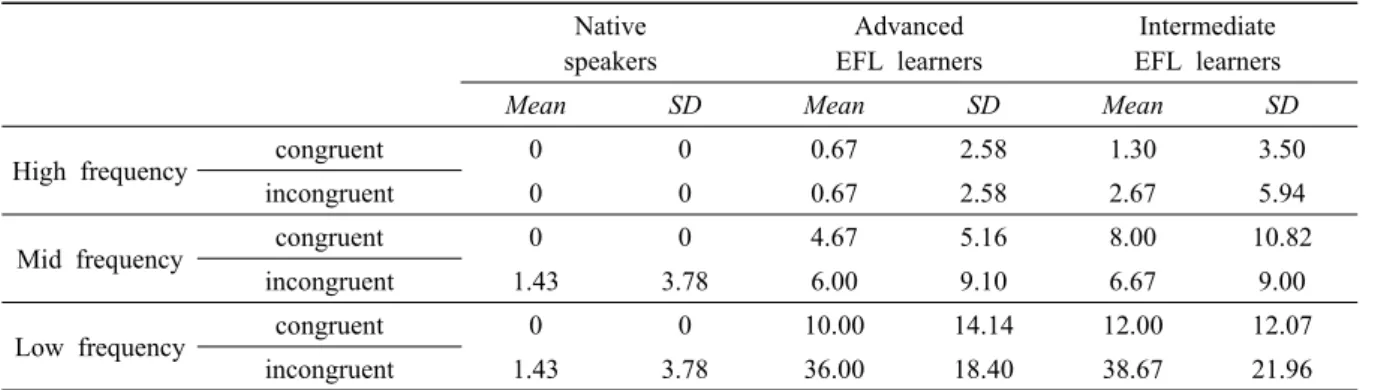
As shown in Table 2, the means and the standard deviations of the error rates of the three groups (i.e., native speakers, the advanced EFL learners, and the intermediate EFL learners) were calculated according to collocation frequency and L1 congruency. The results revealed that the native speakers had the lowest error rates with both the congruent and incongruent collocations at each frequency level followed by the advanced EFL learners, and the intermediate EFL learners showed the highest error rates with both types of collocations at each frequency level.
Table 2. Error Rate (%) Native
speakers
Advanced EFL learners
Intermediate EFL learners
Mean SD Mean SD Mean SD
High frequency congruent 0 0 0.67 2.58 1.30 3.50
incongruent 0 0 0.67 2.58 2.67 5.94
Mid frequency congruent 0 0 4.67 5.16 8.00 10.82
incongruent 1.43 3.78 6.00 9.10 6.67 9.00
Low frequency congruent 0 0 10.00 14.14 12.00 12.07
incongruent 1.43 3.78 36.00 18.40 38.67 21.96
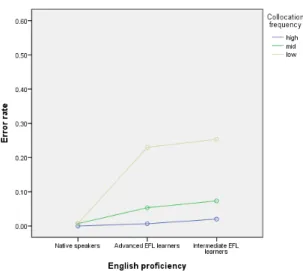
Figure 2 below presents the error rates of the three groups at each frequency level and it appeared that the frequency effect on the error rates was apparent for the EFL learners since their error rates notably increased as the collocation frequency decreased especially at low-frequency level. Meanwhile the native speakers showed little difference in the error rates among the three frequency levels.
Figure 2. Error Rate by English Proficiency and Collocation Frequency
Regarding L1 congruency, as displayed in Figure 3, the error rates of the advanced and the intermediate EFL learners with the incongruent collocations were higher than those with the congruent collocations in general, and this suggests that there may exist some congruency effects on the error rate both with the advanced and the intermediate EFL learners. However, little difference in error rates was observed between congruent and incongruent collocations with the native speakers. Overall, the congruency effect appears apparent for both the advanced and the intermediate EFL learners especially at low-frequency level.
Figure 3. Error Rate by English Proficiency and L1 Congruency
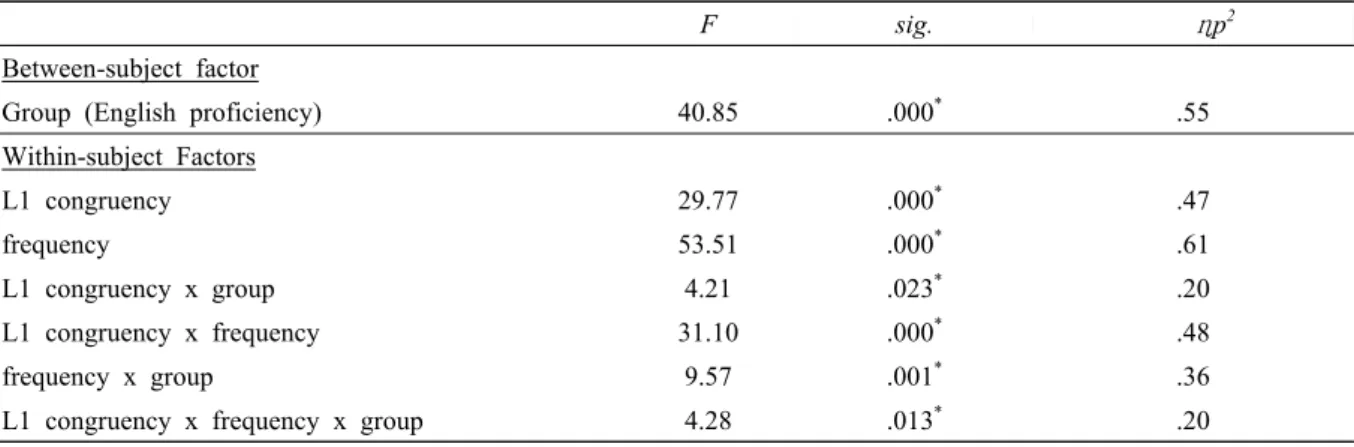
In order to examine the observed mean differences statistically and thereby to explore the effects of English proficiency, L1 congruency, and collocation frequency on the error rates, a 3 x 2 x 3 repeated ANOVA was conducted. As aforementioned, English proficiency (group) was entered as a between-subject
factor, and L1 congruency (congruent vs. incongruent) and collocation frequency (high, mid, and low) as within-subject factors. The results of the analysis are detailed in Table 3 below.
F sig. ηp2
Between-subject factor
Group (English proficiency) 40.85 .000* .55
Within-subject Factors
L1 congruency 29.77 .000* .47
frequency 53.51 .000* .61
L1 congruency x group 4.21 .023* .20
L1 congruency x frequency 31.10 .000* .48
frequency x group 9.57 .001* .36
L1 congruency x frequency x group 4.28 .013* .20
Table 3. Results of a 3 x 2 x 3 Repeated ANOVA (Error Rate)
* p < .05
As presented in Table 3, it was revealed that there existed significant main effects of English proficiency, L1 congruency, and collocation frequency on the error rate. The effect size of frequency factor was the highest followed by English proficiency (group) and L1 congruency, implying that the collocation frequency was the strongest factor influencing the error rate among the three variables. Additionally, significant interaction effects among the variables were also identified (e.g., L1 congruency and group, L1 congruency and frequency). They suggested that the effect of L1 congruency on the error rate was conditional upon the level of English proficiency and collocation frequency.
As a follow-up procedure, a series of one-way ANOVAs were performed between the groups at each level of two within-subject factors (i.e., L1 congruency and collocation frequency) and the results are shown in Table 4 below.
Table 4. Results of ANOVAs Between Groups at Each Level of L1 Congruency and Frequency (Error Rate)
*p < .05
Concerning the group difference in the error rate at each level of congruency, it was significant both under congruent and incongruent condition, and regarding the group difference at each frequency level, it
F sig. ηp2
L1 congruency
Congruent 4.42 .020* .206
Incongruent 6.37 .004* .273
Frequency
High 2.17 .130 .110
Mid 2.56 .092 .131
Low 9.46 .001* .357
was significant only at low-frequency level and not significant at high- and mid-frequency level. A post-hoc procedure (Bonferroni) further revealed that under congruent condition, a significant mean difference was found only between native speakers and intermediate EFL learners (p < .05) and no significant difference was found in the other pairs. In addition, under incongruent condition, a significant mean difference was found between the native speakers and both the advanced and the intermediate EFL learners (p < .05 and p < .01 respectively), but no significant difference was found between the advanced and the intermediate EFL learners.
As for the group difference in the error rate at each frequency level, a significant mean difference was found between the native speakers and both the advanced and the intermediate EFL learners at low-frequency level (p < .01 and p < .01 respectively), but no significant difference between the groups was found at high- and mid-frequency level. The results indicated that a significant group difference in the error rate existed both in congruent and incongruent condition, and the difference was larger under incongruent condition than under congruent one, and the difference in the error rate between the groups (especially between the native speakers and the EFL learners) primarily existed in the low-frequency collocations in general.
In addition, in an attempt to examine the congruency and frequency effect on the error rate within group, paired sample t-tests and one-way repeated ANOVAs were conducted (See Table 5 and 6). As shown in Table 5, there was no significant effect of congruency on the error rate with the native speakers whereas there existed a significant congruency effect with the EFL learners in general. This clearly showed that L1 predictability significantly influenced the error rates of Korean EFL learners.
Table 5. Results of Paired Sample t-tests Between Congruent and Incongruent Collocations Within Group (Error Rate)
* p < .01
With regards to collocation frequency, similar to the pattern found in congruency, there was no significant effect of frequency on the error rate with the native speakers whereas there existed a significant frequency effect with both the advanced and the intermediate EFL learners (see Table 6 below). As a follow-up procedure, paired sample t-tests were conducted and it was revealed that the mean difference was significant in all of the pairs for the advanced EFL learners (high vs. mid, p < .01; mid vs. low, p < .01) and the intermediate EFL learners (high vs. mid, p < .01; mid vs. low, p < .01). To sum, the congruency and frequency effect on the error rate was significant with both the advanced and intermediate EFL learners in general, but not significant with the native speakers.
L1 congruency (congruent vs. incongruent) t sig.
Native speakers 1.00 .36
Advanced EFL learners 6.21 .000*
Intermediate EFL learners 3.60 .003*
Table 6. Results of Repeated ANOVAs among Different Frequencies Within Group (Error Rate)
*p < .01
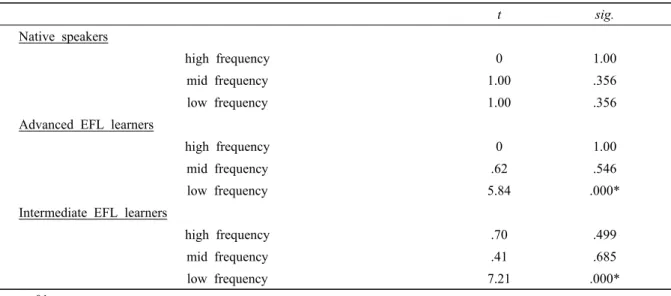
Meanwhile, in order to have a finer analysis on the interaction among the group, collocation frequency and congruency factors, a series of paired sample t-tests were conducted, comparing the average error rate of congruent and incongruent collocations at each level of frequency in each group. As shown in Table 7 below, the native speakers showed no significant difference in error rate between congruent and incongruent collocations at any frequency level. Meanwhile, both the advanced and the intermediate EFL learners showed a significant mean difference in the error rate between the congruent and the incongruent collocations at low-frequency level, but not at any other frequency levels. The result indicated that the congruency effect was conditional upon the level of collocation frequency for the EFL learners and in fact the difference in their error rates between congruent and incongruent collocations was largely due to the difference existed at low-frequency level.
* p < .01
To recapitulate the results of the analyses of the error rates, there existed a significant main effect of English proficiency, collocation frequency, and L1 congruency on the error rate, and collocation frequency was found to be the strongest factor influencing the error rate followed by English proficiency and L1 congruency. In addition, although a significant difference in the error rate between the congruent and incongruent collocations was found with the EFL learners in general, it existed only at low-frequency level
t sig.
Native speakers
high frequency 0 1.00
mid frequency 1.00 .356
low frequency 1.00 .356
Advanced EFL learners
high frequency 0 1.00
mid frequency .62 .546
low frequency 5.84 .000*
Intermediate EFL learners
high frequency .70 .499
mid frequency .41 .685
low frequency 7.21 .000*
Table 7. Paired Sample t-tests Between Congruent and Incongruent Collocations at Each Frequency Level Within Group (Error Rate)
Collocation frequency (high vs. mid vs. low) F sig. ηp2
Native speakers 1.00 .40 .14
Advanced EFL learners 39.21 .000* .74
Intermediate EFL learners 41.88 .000* .75
but neither at high-frequency nor at mid-frequency level. Overall, the level of the EFL learners’
collocational knowledge was significantly lower than that of the native speakers, and the gap appeared conspicuous with the low-frequent and incongruent collocations.
4.2 Reaction Time
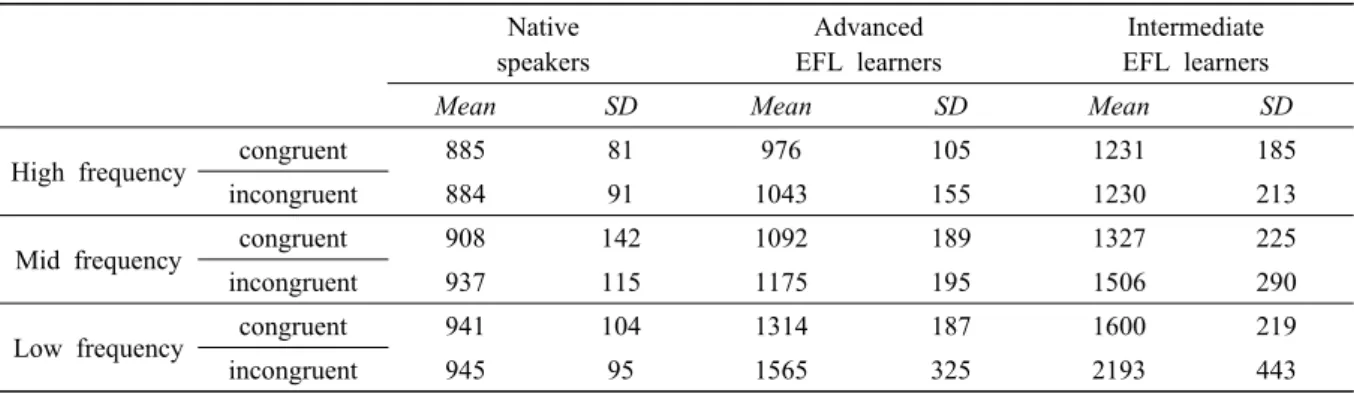
Table 8 below presents the means and the standard deviations of the reaction time to the collocations by collocation frequency and L1 congruency. Similar to the results of the error rates on the collocations, the native speakers showed the fastest reaction time to both the congruent and incongruent collocations at each frequency level followed by the advanced EFL learners and the intermediate EFL learners.
Table 8. Reaction Time (in milliseconds) Native
speakers
Advanced EFL learners
Intermediate EFL learners
Mean SD Mean SD Mean SD
High frequency congruent 885 81 976 105 1231 185
incongruent 884 91 1043 155 1230 213
Mid frequency congruent 908 142 1092 189 1327 225
incongruent 937 115 1175 195 1506 290
Low frequency congruent 941 104 1314 187 1600 219
incongruent 945 95 1565 325 2193 443
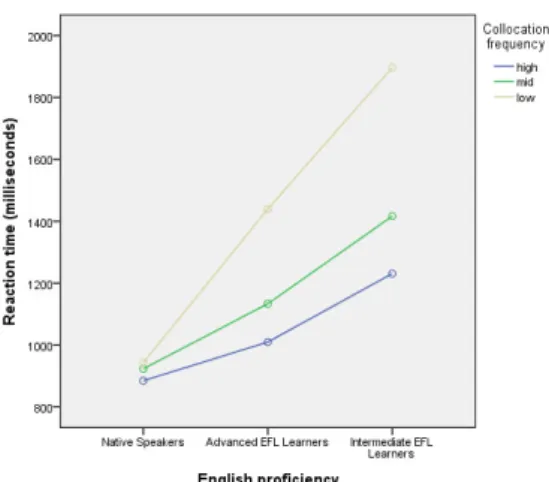
As displayed in Figure 4, the frequency effect on reaction time appears notable for both the advanced and the intermediate EFL learners while little frequency effect was observed with the native speakers.
Regarding L1 congruency, as shown in Figure 5, the reaction time to the congruent collocations was faster than to the incongruent collocations with the EFL learners in general. Meanwhile, the difference in reaction time between the congruent and incongruent collocations appears more apparent with the intermediate EFL learners than with the advanced EFL learners. The result indicated that there may exist a stronger L1 congruency effect on reaction time with the intermediate EFL learners than the advanced EFL learners.
Figure 4. Reaction Time by English Proficiency and Collocation Frequency
Figure 5. Reaction Time by English Proficiency and L1 Congruency
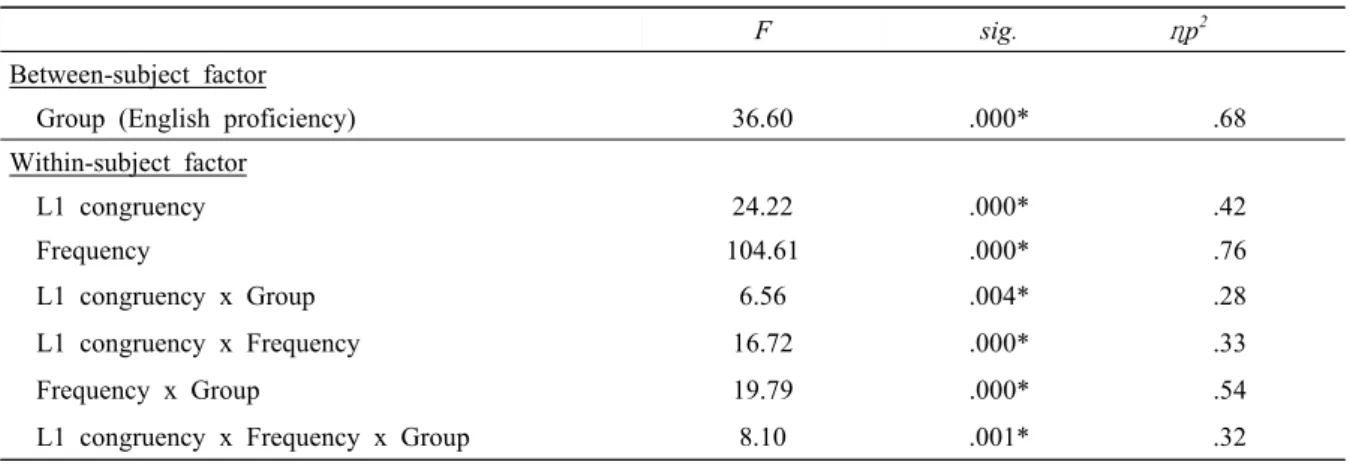
In order to examine the effect of English proficiency, L1 congruency, and collocation frequency on reaction time statistically a 3 x 2 x 3 repeated ANOVA was conducted. As in the case of error rate, English proficiency was entered as a between-subject factor and L1 congruency and collocation frequency as within-subject factors. The results of the analyses are shown in Table 9 below.
F sig. ηp2 Between-subject factor
Group (English proficiency) 36.60 .000* .68
Within-subject factor
L1 congruency 24.22 .000* .42
Frequency 104.61 .000* .76
L1 congruency x Group 6.56 .004* .28
L1 congruency x Frequency 16.72 .000* .33
Frequency x Group 19.79 .000* .54
L1 congruency x Frequency x Group 8.10 .001* .32
Table 9. Results of 3 x 2 x 3 Repeated ANOVA (Reaction Time)
* p < .01
It was found that there existed a significant main effect of English proficiency, L1 congruency, and collocation frequency on reaction time, and collocation frequency had the highest effect size followed by English proficiency and L1 congruency, indicating that collocation frequency was the strongest factor influencing reaction time among the three variables. A significant interaction effect was also found among the variables suggesting that the effect of L1 congruency on reaction time was contingent upon the level of English proficiency (F = 6.56, p < .01) and collocation frequency (F = 16.72, p < .01). Overall, the findings in reaction time were similar to those in the error rate in that all of the main factors had significant effects on reaction time and the congruency effect was conditional upon the level of collocation frequency and L2 proficiency.
In order to examine the group differences at each level of congruency and collocation frequency, a series of one-way ANOVAs (between-groups) were performed and the results are displayed in Table 10 below.
Table 10. Results of ANOVAs Between Groups at Each Level of L1 Congruency and Frequency (Reaction Time)
F sig. ηp2
L1 Congruency
Congruent 27.17 .000* .615
Incongruent 30.01 .000* .639
Frequency
High 17.17 .000* .503
Mid 21.30 .000* .560
Low 33.38 .000* .663
* p < .01
It was found that there existed a significant group difference in reaction time both under congruent and incongruent condition and the group difference was significant at all of the frequency levels as well. The
results were somewhat different from those of error rate in that a significant mean difference existed only at low-frequency level in the case of error rate, but it existed at all of the frequency levels as for reaction time. The results implied that the groups differences in the reaction time was more noticeable than in the error rate in general.
A follow-up post hoc procedure (Bonferroni) revealed that under congruent condition, a significant mean difference was found in all of the pairs of the groups (native speakers vs. advanced EFL learners, p < .05 and advanced EFL learners vs. intermediate EFL learners, p < .01). Similarly, a significant mean difference was found in all of the pairs of the groups under incongruent condition as well (native speakers vs.
advanced EFL learners, p<.01; advanced EFL learners vs. intermediate EFL learners, p < .01).
As to the group difference in reaction time at each frequency level, a significant mean difference was found at high-frequency level between the native speakers and the intermediate EFL learners (p < .01) and the advanced EFL learners and the intermediate EFL learners (p < .01), but no significant difference was found between the native speakers and the advanced EFL learners. Similarly, at mid-frequency level, a significant mean difference was found between the native speakers and the intermediate EFL learners (p < .01) and the advanced EFL learners and the intermediate EFL learners (p < .01), but no significant difference was found between the native speakers and the advanced EFL learners. Meanwhile, there existed a significant mean difference in all of the pairs at low-frequency level (native speakers vs. advanced EFL learners, p < .01; advanced EFL learners vs. intermediate EFL learners, p < .01).
To sum, the group difference existed under both congruent and incongruent condition and at each level of frequency, and it appeared more conspicuous under incongruent condition than congruent one and at low-frequency level than mid- and high-frequency level. In particular, the group difference at high- and mid-frequency level was largely due to the difference between the native speakers and the intermediate EFL learners since there existed no significant difference between the native speakers and the advanced EFL learners at high- and mid-frequency level. It should be also noted that regarding error rate, there was no significant difference between the native speakers and the advanced EFL learners under congruent condition, but as to reaction time, there existed a significant difference between them under congruent condition.
Additionally, in an attempt to investigate the effect of L1 congruency and collocation frequency on the reaction time within group, pared sample t-tests and one-way repeated ANOVAs were conducted. The results of paired sample t-tests indicated that there was no significant effect of L1 congruency on reaction time with the native speakers whereas there existed a significant effect of L1 congruency with both the advanced and the intermediate EFL learners in general (see Table 11 below). As for the frequency effect on reaction time within group, similar to the pattern found in congruency, there was no significant effect of frequency on reaction time with the native speakers whereas there existed a significant frequency effect with both the advanced and the intermediate EFL learners (see Table 12 below). As a follow-up post-hoc procedure, paired sample t-tests were conducted, and it was revealed that the mean difference was significant in all of the pairs for the advanced EFL learners (high vs. mid, p < .01; mid vs. low, p < .01) and the intermediate EFL learners (high vs. mid, p < .01; mid vs. low, p < .01). To sum, the congruency
and frequency effect on reaction time was significant with both the advanced and the intermediate EFL learners, but not significant with the native speakers. The results implied that L1 congruency and collocation frequency had a significant influence on the processing of L2 collocations by the EFL learners.
Table 11. Results of Paired Sample t-tests Between Congruent and Incongruent Collocations Within Group (Reaction Time)
Congruency (congruent vs. incongruent) t sig.
Native speakers 1.47 .193
Advanced EFL learners 4.38 .001*
Intermediate EFL learners 3.80 .002*
* p < .01
Table 12. Results of Repeated ANOVAs among Different Frequencies Within Group (Reaction Time)
Frequency (high, mid, and low) F sig. ηp2
Native speakers 2.21 .135 .14
Advanced EFL learners 53.95 .000* .78
Intermediate EFL learners 59.49 .000* .82
* p < .01
Finally, in order to examine the congruency effect within group at each level of frequency, a series of paired sample t-tests were conducted and Table 13 below presents the results the tests. It was revealed that with the advanced EFL learners the mean difference in reaction time between the congruent and the incongruent collocations was significant only at low-frequency level, whereas it was significant both at low- and mid-frequency levels with the intermediate EFL learners. On the other hand, the native speakers showed no significant difference in reaction time between congruent and incongruent collocations at any level of frequency. The results implied that the congruency effect on reaction time becomes weaker as the level of English proficiency enhances and the collocation frequency increases, implying the interaction effect among the variables.
t sig.
Native speakers
High frequency .03 .976
Mid frequency .65 .539
Low frequency .32 .759
Advanced EFL learners
High frequency 1.89 .081
Mid frequency 1.97 .071
Low frequency 4.89 .000*
Intermediate EFL learners
High frequency .02 .987
Mid frequency 3.41 .004*
Low frequency 5.56 .000*
Table 13. Paired Sample t-tests Between Congruent and Incongruent Collocations Within Group at Each Frequency Level (Reaction Time)
* p < .01
To summarize the findings, it was revealed that there existed a significant main effect of collocation frequency, L2 proficiency, and L1 congruency on the reaction time, and collocation frequency was the strongest factor influencing the reaction time followed by L2 proficiency and L1 congruency. Concerning the group difference in the reaction time, there existed a significant difference under both congruent and incongruent condition, and it was also significant at all of the frequency levels. The results were somewhat different from those of the error rate in that a significant group difference existed only at low-frequency level in the case of error rate, but it existed at all of the frequency levels as to the reaction time.
It was also found that there existed a significant effect of L1 congruency and collocation frequency on reaction time with both the advanced and the intermediate EFL learners, but not with the native speakers.
Regarding the interaction effect between L1 congruency and collocation frequency on the reaction time, the difference between the congruent and the incongruent collocations was significant only at low-frequency level with the advanced EFL learners, whereas it was significant both at low- and mid-frequency levels with the intermediate EFL learners. The results suggested that the congruency effect on reaction time appears to wane as the level of English proficiency and the collocation frequency increase.
5. Discussion
Overall, the findings of the current study are consistent with the results of previous studies on L2 lexical processing (e.g., Durrant and Schmitt 2010, Wolter and Gyllstad 2013) and appear to support the usage-based language model in a sense that they can process high-frequency collocations faster with lower error rates than mid- and low-frequency collocations. The Korean EFL learners in the current study were
indeed sensitive to the frequency of English collocations. This finding, in particular, seems to challenge Wray’s (2002) accounts of L2 processing and acquisition, according to whom L2 learners tend to have an analytic approach to the acquisition and processing of L2, and thus they tend to rely more on word-level processing, limiting their ability to process L2 formulaic sequences holistically. Wray’s accounts may be true for beginner L2 learners, who normally have a limited number of word chunks stored in their long-term memory so that they can hardly process word chunks holistically. However, it appears that as L2 learners are exposed to more L2 input and their proficiency enhances, the number of multi-word units they can readily and holistically perceive and produce can increase, expediting L2 collocation processing in general.
Interestingly, there existed some significant differences in the error rate and the reaction time between the native speakers and the EFL learners even under congruent condition. The results are somewhat different from those of previous studies (e.g., Wolter and Gyllstad 2011, Yamashita and Jiang 2010) in which no significant difference in reaction time was found between the native speakers and the advanced EFL learners under congruent condition. According to Wolter and Gyllstad (2011) and Yamashita and Jiang (2010), with L2 learners, L1 intralexical (collocational) knowledge is typically copied into L2 lexical entries at a lemma level and this would facilitate the rapid recognition of congruent L2 collocations.
However, in line with Wolter and Yamashita’s study (2018), the result of the current study did not seem to fully support the facilitative effect of the existence of L1 equivalents since a significant difference in the reaction time and the error rate between the native speakers and the EFL learners was found even under the congruent condition. As Kellerman (1979) suggested, it is possible that L2 learners doubt whether L2 expressions given truly coincide with their L1 counterparts especially when they are quite similar, and accordingly, they could be hesitant in utilizing L1 intralexical knowledge in processing L2 collocations.
Along the same lines, Yamashita and Jiang (2010) argued that learners’ perception of the gap between L1 and L2 may affect whether L2 learners transfers L1 forms or functions to those of L2. This being the case, regardless of whether collocations are predictable from L1 or not, it may be a necessary step for EFL learners to notice English collocations through sufficient input or explicit instructions in which they can learn L2 collocations deliberately.
Even though frequency was found to be the strongest factor influencing L2 collocation processing, it was also shown that L1 has a profound impact on L2 collocation processing in the current study. Indeed, there existed a significant influence of L1 intralexical knowledge on L2 collocation processing, resulting in slower reaction time to and higher error rate on the incongruent collocations in both EFL groups in general. Overall, the results of the current study echo the findings of previous studies on L2 collocation processing (Lee 2016, Yamashita and Jiang 2010, Wolter and Gyllstad 2011, 2013, Wolter and Yamashita 2018) in that L1 plays a significant role in L2 collocation processing. This being the case, there should be an immediate attention to incongruent L2 collocations in L2 classrooms. According to Revised Hierarchical Model (RHM; Kroll and Stewart 1994), L2 learning is initially mediated by L1 translation for accessing meaning since L1 has a stronger connection with concepts (meanings) than L2. As Lee (2016) argued, L1 lemma information may include which words can be combined together or not in L1, and this kind of L1
intralexcal knowledge can affect L2 learner’s perceptions about which word combinations are possible in L2, resulting in inappropriate use of L2 collocations.
Meanwhile, given the findings that the L1 influence on the error rate was significant only at low-frequency level with both EFL groups and that the L1 influence on the reaction time was significant at low-frequency level for the advanced EFL learners and at mid- and low-frequency level for the intermediate EFL learners, L1 influence on L2 collocation processing appears to decrease as their English proficiency enhances, and ultimately they may be able to develop the intralexical knowledge of L2 collocations gradually departing from L1 mediation. The findings are somewhat different from Jiang’s (2004) expectation about L2 lexical acquisition and development of adult EFL learners. According to him, L1 lemma mediation often becomes a steady state of lexical processing even with advanced EFL learners.
In other words, L2 lexical development of the adults tends to be fossilized once they reach a certain level of L2 lexical development especially when they are situated in EFL contexts. However, as suggested in the current study, adult EFL learners may be able to move toward the next stage of L2 lexical development in which they can develop L2-specific meanings independently of L1 mediation. This may be partially related to the fact that more and more English input, whether it is spoken or written, is available online through the Internet, and consequently, EFL learners’ accessibility to English input has increased dramatically for the past decades. For example, such streaming TV and movie services as Netflix, Goole Play Movie, and Apple TV are widely available online around the world. In addition, online language databases such as Corpus of Contemporary American English (COCA) have enabled English learners to see whether the English expressions that they use are appropriate or not and even to check whether they are typical or atypical, all of which were not easy to figure out without the help of native speakers of English before. In short, EFL learners are exposed to increasingly more English input with the help of online technology, and this may reduce the gap between the amount of input EFL learners are typically exposed to and that of ESL learners who are situated in English-speaking environments.
6. Conclusion
The current study investigated the influence of collocation frequency, L1 congruency, and English proficiency on L2 collocation processing, and it was found that collocation frequency had the strongest effect on L2 collocation processing followed by English proficiency and L1 congruency with the Korean EFL learners. There also existed significant interaction effects among the variables suggesting that L1 influence on L2 collocation processing may wane as the EFL learners’ L2 proficiency enhances and they are exposed to L2 collocations more often.
There exist some limitations to be noted in the current study. First, the frequency data of the English collocations collected from the Corpus of Contemporary American English (COCA) may not adequately represent Korean EFL learners’ degree of exposure to the English collocations. Presumably, Korean EFL learners are supposed to be affected by the linguistic and cultural environments of Korea, in which
particular kinds of input are prone to be more highlighted (Chon and Shin 2009, Lee 2016). For example, some of the collocations used in the current study might be used in the textbooks so they become more salient, which may ultimately facilitate the processing of those collocations.
Also, even though the influence of the frequency of the individual words that comprised the collocations was controlled to some extent by including the words mostly from the most frequent 1,000 words in English and by exposing them to the participants before the experiment, it would have been much more rigorous to match the words of congruent and incongruent collocations in pairs to minimize the influence of individual words. In the future research, it seems essential to take theses limitations into consideration to have more valid and reliable results. Furthermore, in order to have a more comprehensive understanding of L2 collocation processing of EFL learners, more research should be conducted with diverse EFL learners from different linguistic and cultural backgrounds.
References
Browne, C., B. Culligan and J. Philips. 2013. The new general service list. Retrieved from http://www.newgeneralservicelist.org
Chon, Y. and D. Shin. 2009. Collocations in L2 writing and rater’s perceived writing proficiency.
Korean Journal of Applied Linguistics 25(1), 101-129.
Chon, Y. and S. Lee. 2015. L2 collocational knowledge by congruency and writing proficiency of EFL university learners. English Language and Literature Teaching 21(1), 49-74.
Conklin, K. and N. Schmitt. 2008. Formulaic sequences: Are they processed more quickly than nonformulaic language by native and nonnative speakers? Applied Linguistics 29(1), 72-89.
Conklin, K. and N. Schmitt. 2012. The processing of formulaic language. Annual Review of Applied Linguistics, 32, 4-61.
Durrant, P. and A. Doherty. 2010. Are high-frequency collocations psychologically real?: Investigating the thesis of collocational priming. Corpus Linguistics and Linguistic Theory 6(2), 125-155.
Durrant P. and N. Schmitt. 2010. Adult learners’ retention of collocations from exposure. Second Language Research, 16(2), 163-188.
Ellis, N. 2001. Memory for language. In P. Robinson, ed., Cognition and Second Lnguage Instruction, 38-68. Cambridge: Cambridge University Press.
Ellis, N., R. Simpson-Vlach and C. Maynard. 2008. Formulaic language in native and second-language speakers: Psycholinguistics, corpus linguistics, and TESOL. TESOL Quarterly, 41(3), 375-396.
Erman, B. and B. Warren. 2000. The idiom principle and the open-choice principle. Text 20, 29-62.
Fan, M. 2009. An exploratory study of collocational use by ESL students: A task-based approach.
System (37), 110-123.
Foster, P. 2001. Rules and routines: A consideration of their role in the task-based language production of native and non-native speakers. In B. Martin, P. Skehan and M. Swain eds., Researching
Pedagogic Tasks: Second Language Learning, Teaching and Testing, 145-160. Oxford: Oxford University Press.
Hoey, M. 2005. Lexical Priming: A New Theory of Words and Language. London: Routledge.
Hsu, J. 2007. Lexical collocations and their relations to the online writing of Taiwanese college English majors and non-English majors. Electronic Journal of Foreign Language Teaching 4(2), 192-209.
Jiang, N. 2000. Lexical representation and development in a second language. Applied Linguistics 21(1), 47-77.
Jiang, N. 2002. Form-meaning mapping in vocabulary acquisition in a second language. Studies in Second Language Acquisition 24, 617-637.
Jiang, N. 2004. Semantic transfer and its implications for vocabulary teaching in a second language.
The Modern Language Journal 88(3), 416-432.
Jiang, N and N. Tatiana. 2007. The processing of formulaic sequences by second language speakers.
The Modern Language Journal 91(3), 433-445.
Kroll, J., E. Michael, N. Tokowicz and R. Dufour. 2002. The development of lexical fluency in a second language. 2002. Second Language Research 18(2), 137-171.
Kellerman, E. 1979. Transfer and non-transfer: Where we are now. Studies in Second Language Acquisition 2(1), 37-57.
Kim, H. and H. Yoon. 2008. Effect of predictability in L1 on the use of the L2 verb-noun collocations. English Teaching 63(2), 237-259.
Kim, J. and Y. Cho. 2010. A study of the relationship between collocational knowledge and lexical knowledge/general English proficiency: Focus on synonyms of verbs and adjectives. Korean Journal of English Language and Linguistics 10(3), 447-471.
Kim, K. 2012. L1 influence on L2 collocational knowledge: By level of receptive vocabulary knowledge and general language proficiency. Korean Journal of Applied Linguistics 28(3), 1-38.
Kim, Y. and J. Ma. 2011. The effect of collocation-based instruction on L1 Korean high school students’ English vocabulary acquisition. English Language and Literature Teaching 17(3), 141-159.
Kroll, J. and E. Stewart. 1994. Category interference in translation and picture naming: Evidence for asymmetric connections between bilingual memory representations. Journal of Memory and Language 33, 149-174.
Kroll, J., E. Michael, N. Tokowicz and R. Dufour. 2002. The development of lexical fluency in a second language. Second Language Research 18(2), 137-171.
Laufer, B. and T. Waldman. 2011. Verb-noun collocations in second language writing: A corpus analysis of learners’ English. Language Learning 61(2), 647-672.
Lee, S. 2015. Korean EFL learners’ productive collocation knowledge and its relationship to their writing proficiency. English Language and Literature Teaching 21(4), 59-84.
Lee, S. 2016. L1 influence on the processing of L2 collocation: An experimental study of Korean EFL leaners. Linguistic Research 33(special edition), 137-163.
Nation, P. 2013. Learning Vocabulary in Another Language. Cambridge: Cambridge University Press.
Nattinger, J. and J. DeCarrico, 1992. Lexical Phrases and Language Teaching. Oxford: Oxford University Press.
Nesselhauf, N. 2003. The use of collocations by advanced learners of English and some implications for teaching. Applied Linguistics 24(2), 223-242.
Park, S. and J. Lee. 2011. Effects of collocation-based vocabulary instruction on high school students’
writing ability. The Journal of Studies in Language 27(3), 445-466.
Pawley, A. and F. Syder. 1983. Two puzzles for linguistic theory: Nativelike selection and nativelike fluency. In J. Richards and R. Schmidt, eds., Language and Communication, 191-225. London:
Longman.
Phoocharoensil, S. 2013. Cross-linguistic influence: Its impact on L2 English collocation production.
English Language Teaching 6(1), 1-10.
Sadeghi, K. 2009. Collocational differences between L1 and L2: Implications for EFL learners and teachers. TESL Canada Journal 26(2), 100-124.
Schmitt, N. and R. Carter. 2004. Formulaic sequences in action: An introduction. In N. Schmitt, ed., Formulaic Sequences: Acquisition, Processing and Use, 1-22. Amsterdam: John Benjamins.
Shokouhi, H. and G. Mirsalari. 2010. Collocational knowledge versus general linguistic knowledge among Iranian EFL learners. Teaching English as a Second or Foreign Language 13(4), 1-24.
Wolter, B. and H. Gyllstad. 2011. Collocational links in the L2 mental lexicon and the influence of L1 intralexical knowledge. Applied Linguistics 32(4), 430-449.
Wolter, B. and H. Gyllstad. 2013. Frequency of input and L2 collocational processing. Studies in Second Language Acquisition 35, 451-482.
Wolter, B. and J. Yamashita. 2018. Word frequency, collocational frequency, L1 congruency, and proficiency in L2 collocational processing. Studies in Second Language Acquisition 40, 395-416.
Wray, A. 2002. Formulaic Language and the Lexicon. Cambridge: Cambridge University Press.
Yamashita, J. and N. Jiang. 2010. L1 influence on the acquisition of L2 collocations: Japanese ESL users and EFL learners acquiring English collocations. TESOL Quarterly 44(4), 647-668.