• 검색 결과가 없습니다.

Non-atypical endometrial hyperplasia: risk factors for occult endometrial atypia and malignancy in patients managed with hysterectomy

N/A
N/A
Protected

Academic year: 2022

Share "Non-atypical endometrial hyperplasia: risk factors for occult endometrial atypia and malignancy in patients managed with hysterectomy"

Copied!
9
0
0

로드 중.... (전체 텍스트 보기)

전체 글

(1)

Introduction

Endometrial hyperplasia (EH) was classified by the World Health Organization in 2014 into two categories based on the presence of cytological atypia [1]. Approximately, 200,000 new cases of EH are diagnosed annually in devel- oped countries [2,3]. EH is of significant clinical importance, given that it is the precursor of endometrial carcinoma [4], the most common gynecological cancer in developed coun- tries [5]. The risk of progression to carcinoma is less than 5%

Non-atypical endometrial hyperplasia: risk factors for occult endometrial atypia and malignancy in patients managed with hysterectomy

Lee Shi Hui, MBBS 1 , Selina Hui Men Chin, MBBS 1 , Charissa Goh, MBBS 1 , Lin Xiao Hui, MBBS 2 , Manisha Mathur, MBBS, MRCOG, FRCOG 1 , Timothy Lim Yong Kuei, MBBS, MRCOG, FRCOG 2 , Felicia Chin Hui Xian, MBBS, MRCOG, MMed 2

1

Department of Obstetrics & Gynecology,

2

Department of Gynaecological Oncology, KK Women’s and Children’s Hospital, Singapore

Objective

To determine the risk factors for occult endometrial atypia and malignancy in patients diagnosed with non-atypical endometrial hyperplasia (NEH) on endometrial biopsy.

Methods

All new cases of NEH diagnosed between April 2015 and March 2016 at KK Women’s and Children’s Hospital, who underwent hysterectomy as first-line treatment, were included in the study. Patients with a history of endometrial hyperplasia or malignancy were excluded from the study. Patient demographics (e.g., age, parity, body mass index [BMI]), medical history, and clinical presentation were obtained for analysis.

Results

In total, 262 patients were diagnosed with NEH, of which 18.3% (n=48) underwent hysterectomy as first-line management. The average time to surgery was 77.0±35.7 days. All cases were diagnosed by dilation and curettage, and hysteroscopy. The mean age was 51 years, and the mean BMI was 26.9±5.8 kg/m

2

. Histology from the hysterectomy specimen showed 9 (18.8%) patients with atypical hyperplasia and 2 (4.2%) with grade 1, stage 1A endometrioid adenocarcinoma. Patients with higher grade final pathology had significantly lower median parity (1 vs. 2, P=0.039), higher mean BMI (30.1±6.5 vs. 25.9±5.3 kg/m

2

, P=0.033), and BMI ≥30 kg/m

2

(54.5% vs. 13.5%, P=0.008, odds ratio 7.68), compared to patients whose final histology showed NEH or no residual hyperplasia.

Conclusion

Occult endometrial atypia and malignancy were found in 18.8% and 4.2% of patients with an initial diagnosis of NEH, respectively. High BMI and low parity were identified as significant risk factors for high-grade endometrial lesions in patients with NEH.

Keywords: Endometrial hyperplasia; Endometrial neoplasms; Dilation and curettage

Received: 2020.09.29. Revised: 2020.12.07. Accepted: 2021.02.21.

Corresponding author: Lee Shi Hui, MBBS

Department of Obstetrics & Gynecology, KK Women’s and Children’s Hospital, 100 Bukit Timah Road, Singapore 229899, Singapore

E-mail: [email protected] https://orcid.org/0000-0001-8369-9336

Articles published in Obstet Gynecol Sci are open-access, distributed under the terms of the Creative Commons Attribution Non-Commercial License (http://creativecommons.

org/licenses/by-nc/3.0/) which permits unrestricted non-commercial use, distribution, and reproduction in any medium, provided the original work is properly cited.

Copyright © 2021 Korean Society of Obstetrics and Gynecology https://doi.org/10.5468/ogs.20294

eISSN 2287-8580

(2)

for non-atypical endometrial hyperplasia (NEH) and up to 30% in atypical hyperplasia (AH) [4,6].

A diagnosis of EH requires histological analysis of endo- metrial tissue via endometrial biopsy, which can be obtained from outpatient endometrial sampling or endometrial curet- tage. A comparison of histology from these methods to the corresponding hysterectomy specimen has found a concor- dance rate ranging from 60% to 70% [7-9] for outpatient endometrial sampling and approximately 70% [8,9] for dila- tion and curettage (D&C).

The first-line treatment for NEH is medical therapy with oral or local intrauterine progestins. Successful regression rates with different forms of progestins vary, with reported regression rates ranging from 69% to 92% [10]. Surgery for NEH is generally reserved for patients who have progression or persistence despite medical management or relapse of hy- perplasia on follow-up [11]. Some patients undergo surgery as first-line management upon diagnosis of NEH due to con- traindications to progestins, other gynecological indications for surgery, or patient preferences.

Patients with an initial diagnosis of NEH may be diagnosed with AH or endometrial malignancy from their final hyster- ectomy specimen. The risk of high-grade lesions in patients with NEH has not been well established. The aim of this study was to determine the risk of concurrent atypia and en- dometrial malignancy in patients with NEH and to establish the risk factors for higher grade final pathology.

Materials and methods

This retrospective study was conducted at a single tertiary hospital in Singapore. All new cases of NEH diagnosed by histopathological analysis of endometrial biopsy conducted between April 2015 and March 2016 were considered for inclusion. Patients with a history of EH or malignancy were excluded. Only patients who underwent hysterectomy as a first-line treatment were included in the analysis. All preop- erative and postoperative histological slides were assessed by gynecology pathologists at our tertiary institution.

Patient demographics (e.g., age, ethnicity, parity, body mass index [BMI], and menopausal status), medical history, and use of tamoxifen were obtained. Their clinical presenta- tion, method of diagnosis of NEH (e.g., outpatient endome- trial sampling vs. D&C with hysteroscopy), ultrasound and

hysteroscopic findings, and subtype of NEH (e.g., simple vs.

complex) were obtained. We also collected data on the indi- cations and routes of surgery, as well as postoperative com- plications.

Continuous data were presented as mean±standard devia- tion, or median and data range. The independent samples t-test or independent-samples Mann-Whitney U test were used for comparisons of continuous variables between the groups. Categorical data were presented as counts and per- centages, and comparisons were performed using the Pear- son χ

2

test or Fisher’s exact test, as appropriate. Simple logis- tic regression analysis was applied to screen several clinical parameters, including age, menopausal status, parity, BMI, diabetes, use of tamoxifen, and ultrasound or hysteroscopic findings of a thickened endometrium. Statistical significance

Table 1. Demographics and clinical presentation of study group Value Demographics

Age at diagnosis (yr) 51±7.3

Ethnicity

Chinese 38 (79.2)

Malay 6 (12.5)

Indian 4 (8.3)

Gravidity 2 (0-8)

Parity 2 (0-5)

Body mass index (kg/m

2

) 26.9±5.8

Menopausal status

Premenopausal 32 (66.7)

Postmenopausal 16 (33.3)

Clinical presentation

Abnormal uterine bleeding or postmenopausal bleeding

35 (72.9)

Thickened endometrium 21 (43.8)

Endometrial/endocervical polyp 8 (16.7) Abnormal cervical screening test-Endometrial

cells/Atypical glandular cells of uncertain significance

3 (6.3)

Hysteroscopic findings

Thickened endometrium 24 (50.0)

a)

Endometrial polyp 22 (45.8)

a)

Normal hysteroscopy 6 (12.5)

Values are presented as mean±standard deviation or number (%).

a)
Four patients had hysteroscopic findings of both thickened endo-

metrium and endometrial polyp.

(3)

was set at a two-sided P-value of <0.05. All statistical analy- ses were performed using SPSS 19 software (IBM Corp., Armonk, NY, USA).

Results

A total of 262 patients were diagnosed with non-atypical simple and/or complex hyperplasia over a one-year study pe- riod. Of these, 48 patients (18.3%) underwent hysterectomy as first-line management. All 48 patients were diagnosed by means of a D&C with hysteroscopy, of which 39 patients (81.3%) had complex hyperplasia without atypia and the re- maining patients had simple hyperplasia without atypia. The mean age at diagnosis was 51 years (range, 38-78 years). In our study population, 38 patients (79.1%) were of Chinese ethnicity. The median parity was 2 (range, 0-5) and the mean BMI was 26.9±5.8 kg/m

2

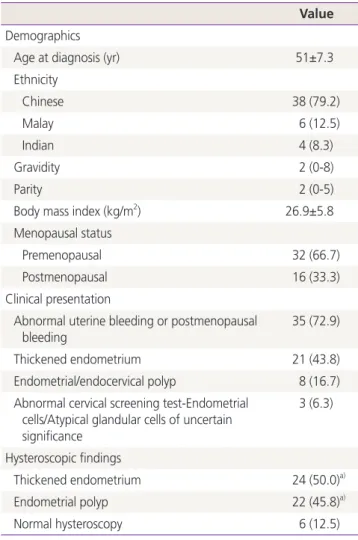
. A total of 35 patients (72.9%) presented with abnormal uterine bleeding (AUB) or post- menopausal bleeding. The demographics, clinical presenta- tion, and hysteroscopic findings of our study population are presented in Table 1.

The risk factors for EH among our patients are presented in Table 2. Of note, 50% of our patients (n=24) had at least one risk factor for EH, with the most common being nul- liparity (n=12, 25.0%) and obesity (n=11, 22.9%), defined as BMI ≥30 kg/m

2

. A total of 18.7% (n=9) of patients had diabetes mellitus, and 6.3% (n=3) were receiving hormone therapy with tamoxifen for breast cancer treatment. One patient had polycystic ovarian syndrome with associated complications of obesity and diabetes mellitus. One patient underwent laparoscopic salpingo-oophorectomy and D&C

with hysteroscopy for a known ovarian cyst and endometrial polyp, revealing complex EH without atypia and an ovarian granulosa cell tumor on histology.

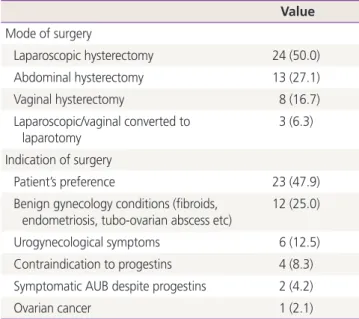
The average time to surgery was 77.0±35.7 days, with half of the patients undergoing laparoscopic hysterectomy (n=24) as the mode of surgery. Table 3 shows the mode and indica- tions for surgery. A total of 25 patients (52.1%) opted for surgical management as they had concurrent indications for surgery, such as fibroids, urogynecological symptoms, con- traindication to progestins, or symptomatic AUB despite the use of progestin prior to diagnosis of EH. The mean length of hospital stay was 2.9±1.2 days.

Two patients had operative complications. One patient with a history of three previous Caesarean sections underwent ab- dominal hysterectomy and sustained a 1.5 cm bladder dome injury due to dense bladder adhesions. The postoperative re- covery was uneventful, and the patient was discharged two days later. Another patient with severe pelvic endometriosis, obliteration of the pouch of Douglas, and dense adhesions over the bilateral adnexa underwent a laparoscopic hyster- ectomy. She was readmitted twelve days post-surgery with abdominal pain and was found to have a urinoma secondary to distal ureteric injury. She was referred to the urology de- partment and underwent drainage and ureteric stenting. The ureteric stent was removed, and she was discharged from the urology follow-up.

Table 2. Risk factors for endometrial hyperplasia

Risk factor Value (n=48)

Nulliparous 12 (25.0)

Obesity (BMI ≥30 kg/m

2

) 11 (22.9)

Diabetes mellitus 9 (18.7)

Use of tamoxifen 3 (6.3)

Polycystic ovarian syndrome 1 (2.1)

Granulosa cell tumor 1 (2.1)

At least 1 risk factor 24 (50.0)

Values are presented as number (%).

BMI, body mass index.

Table 3. Mode and indication of surgery

Value Mode of surgery

Laparoscopic hysterectomy 24 (50.0)

Abdominal hysterectomy 13 (27.1)

Vaginal hysterectomy 8 (16.7)

Laparoscopic/vaginal converted to

laparotomy 3 (6.3)

Indication of surgery

Patient’s preference 23 (47.9)

Benign gynecology conditions (fibroids, endometriosis, tubo-ovarian abscess etc)

12 (25.0)

Urogynecological symptoms 6 (12.5)

Contraindication to progestins 4 (8.3) Symptomatic AUB despite progestins 2 (4.2)

Ovarian cancer 1 (2.1)

Values are presented as number (%).

AUB, abnormal uterine bleeding.

(4)

Table 4. Char acteristics of patients with higher gr ade pathology of the final hysterectomy specimen Number of patients Age (yr) Menopausal Parity BMI Pr esentation Other risk factors Initial histology (type of NEH) Other indications for surgery Route of surgery Final histology 1 47 No 0 26.4 AUB No Complex Fibr oid Abdominal CAH 2 48 No 0 34.7 AUB, thickened ET No Complex Fibr oid Abdominal SAH 3 67 Ye s 1 21.7 Thickened ET Tamoxifen use Complex Contraindication to pr ogestins Abdominal CAH 4 60 Ye s 0 37.6 PMB, thickened ET DM Complex No Lapar oscopic CAH 5 49 No 1 30.1 Endometrial cells on pap smear No Complex Str ess urinary incontinence Abdominal CAH 6 53 No 0 21.1 AUB No Complex No Lapar oscopic Car cinoma

a)

7 42 Ye s 0 31.6 PMB, thickened ET DM Simple No Lapar oscopic CAH 8 38 No 1 29.5 AUB No Simple No Vaginal Car cinoma

a)

9 57 Ye s 2 42.2 Thickened ET DM, tamoxifen use Complex Contraindication to pr ogestins Lapar oscopic CAH 10 47 No 2 24.5 AUB No Complex No Abdominal CAH 11 60 Ye s 2 31.8 Thickened ET No Complex No Vaginal converted lapar oscopic

CAH BMI, body mass index; NEH, non-atypical endometrial hyperplasia; AUB, abnormal uterine bleeding; CAH, complex atypical hyperplasia; ET , endometrial thickness; SAH, simple atypical hyperplasia; PMB, post-menopausal bleeding; DM, diabetes mellitus.

a)

Both patients, grade 1; stage 1A endometrioid adenocar cinoma.

(5)

In the final histology of the hysterectomy specimen, 11 of 48 patients (22.9%) were found to have higher grade pa- thology, of which 9 patients (18.8%) were diagnosed with AH and 2 patients (4.2%) with endometrial carcinoma. The remaining 20 patients (41.7%) had NEH, and 17 patients (35.4%) had no residual hyperplasia. Two patients diagnosed with carcinoma were found to have grade 1, stage 1A en- dometrioid adenocarcinoma. The characteristics of the 11 patients are shown in Table 4.

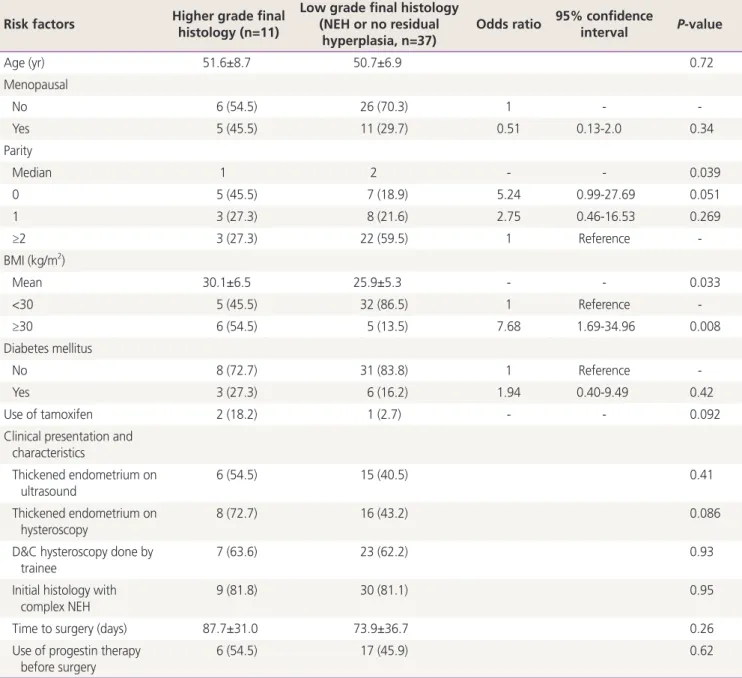
The patients with higher grade pathology on final histol- ogy (AH and endometrial carcinoma) were found to have significantly lower median parity (1 vs. 2, P=0.039) compared to the patients whose final histology showed NEH or no re- sidual hyperplasia (Table 5). Nulliparous patients were found to have a higher likelihood of having higher grade final pa- thology compared to patients with ≥2 previous pregnancies (41.7% [5 in 13 cases] vs. 12.0% [3 in 25 cases], P=0.051, odds ratio 5.24) (Table 5). Also, patients with higher grade

Table 5. Predictive factors for higher grade final histology Risk factors Higher grade final

histology (n=11)

Low grade final histology (NEH or no residual

hyperplasia, n=37)

Odds ratio 95% confidence

interval P-value

Age (yr) 51.6±8.7 50.7±6.9 0.72

Menopausal

No 6 (54.5) 26 (70.3) 1 - -

Yes 5 (45.5) 11 (29.7) 0.51 0.13-2.0 0.34

Parity

Median 1 2 - - 0.039

0 5 (45.5) 7 (18.9) 5.24 0.99-27.69 0.051

1 3 (27.3) 8 (21.6) 2.75 0.46-16.53 0.269

≥2 3 (27.3) 22 (59.5) 1 Reference -

BMI (kg/m

2

)

Mean 30.1±6.5 25.9±5.3 - - 0.033

<30 5 (45.5) 32 (86.5) 1 Reference -

≥30 6 (54.5) 5 (13.5) 7.68 1.69-34.96 0.008

Diabetes mellitus

No 8 (72.7) 31 (83.8) 1 Reference -

Yes 3 (27.3) 6 (16.2) 1.94 0.40-9.49 0.42

Use of tamoxifen 2 (18.2) 1 (2.7) - - 0.092

Clinical presentation and characteristics

Thickened endometrium on ultrasound

6 (54.5) 15 (40.5) 0.41

Thickened endometrium on

hysteroscopy 8 (72.7) 16 (43.2) 0.086

D&C hysteroscopy done by trainee

7 (63.6) 23 (62.2) 0.93

Initial histology with

complex NEH 9 (81.8) 30 (81.1) 0.95

Time to surgery (days) 87.7±31.0 73.9±36.7 0.26

Use of progestin therapy before surgery

6 (54.5) 17 (45.9) 0.62

Values are presented as mean±standard deviation or number (%).

NEH, non-atypical endometrial hyperplasia; BMI, body mass index; D&C, dilation and curettage.

(6)

final histology had significantly higher mean BMI (30.1±6.5 vs. 25.9±5.3 kg/m

2

, P=0.033). There was a statistically signifi- cant difference between the two groups when comparing a BMI of ≥30 kg/m

2

(54.5% [6 in 11 cases] vs. 13.5% [5 in 37 cases], P=0.008, odds ratio 7.68).

No significant difference was noted between the two groups for the remaining risk factors, such as age, meno- pausal status, diabetes, or use of tamoxifen. There was also no significant difference between the two groups for ultra- sound or hysteroscopic findings of a thickened endometrium, and among the experience of the surgeon performing the D&C with hysteroscopy (trainee vs. specialist). The initial his- tology showing simple vs. complex NEH and time to surgery between the two groups was also not significantly different.

Other risk factors, such as polycystic ovarian syndrome and granulosa cell tumors, were not used for statistical compari- son, as only one patient was diagnosed with each of these risk factors.

There were 23 patients who received progestin therapy for the management of AUB or for interim treatment of NEH while awaiting surgery. The type of progestin used included norethisterone, medroxyprogesterone, and megestrol ace- tate. The dose ranged from 10-30 mg/day for patients given norethisterone and medroxyprogesterone, and 80-160 mg/

day for patients given megestrol acetate. The use of proges- tin therapy before surgery was not found to be significantly associated with the grade of the final histology (Table 5).

Discussion

EH is diagnosed via histological analysis of endometrial tissue obtained from outpatient endometrial sampling or endome- trial curettage. D&C has traditionally been considered the gold standard procedure for the investigation of endome- trial pathologies. In our study, all patients were diagnosed with NEH using D&C with hysteroscopy. However, 4.2% of patients had a final diagnosis of endometrial cancer from hysterectomy specimens. These results are similar to those of previous studies where 1.1% to 13.7% of patients initially diagnosed with NEH were found to have endometrial cancer in the final hysterectomy specimen [12-16]. Our study also found that 18.8% of patients with an initial diagnosis of NEH had a final histology of AH from the hysterectomy specimen.

Previous studies have found a wide range of misdiagnoses of

atypia between endometrial biopsy and hysterectomy speci- mens, ranging from 1.1% to 50% [12,17-19]. The limitation of endometrial curettage is thought to be due to endometrial pathologies in focal lesions, and other authors have recom- mended that patients with a diagnosis of NEH require close follow-up or further investigations, such as targeted hystero- scopic biopsy of the endometrium in addition to curettage, especially if AUB persists [18,20-22].

In our study, when patients with lower and higher final grade histology were compared, high BMI, especially BMI

≥30 kg/m

2

, and lower parity were identified as significant risk factors for higher grade final histology (Table 5). Prior stud- ies that identified risk factors for higher grade final histology mostly included both NEH and AH patients. Only one other study included patients with NEH undergoing hysterectomy.

Lee et al. [23] found that 12.1% and 3.2% of patients with NEH had occult AEH or endometrial carcinoma in hyster- ectomy specimens, respectively, and identified age (odds ratio=1.09, P<0.01) and complex subtype (odds ratio=3.34, P<0.01) as independent risk factors for higher grade final histology. Other studies that included patients with both NEH and AH at initial diagnosis had similar outcomes to ours.

Dolanbay et al. [13] reviewed 82 women with NEH and AH diagnosed by endometrial sampling or D&C. In this study,13.7% of patients with NEH and 66.6% of patients with AH had endometrial carcinoma in their final hysterecto- my specimen. Similar to our study, it was found that patients with a final histology of endometrial cancer had significantly higher BMI (28.75±4.08 vs. 32.42±3.4, P<0.05). They also identified age, mean weight, and diabetes as factors that were significantly higher in patients with a final diagnosis of endometrial cancer [13]. Kadirogullari et al. [19] reviewed 158 patients diagnosed with NEH or AH and found that 15 patients had endometrial cancer on final hysterectomy specimen. Two patients were diagnosed with NEH on initial biopsy, and the other 13 patients were diagnosed with AH.

Similar to our study, patients with endometrial carcinoma in the final hysterectomy specimen had significantly lower par- ity (3.11±1.62 vs. 1.93±1.79, P<0.05). They also found age, postmenopausal status, and endometrial thickness as predic- tive risk factors for endometrial cancer in the final histology specimen.

The NEH group had a high spontaneous regression rate.

Our study found that 35.4% of the patients had no residual

hyperplasia on the final histology. This is similar to previous

(7)

studies, with results ranging from 37.4% to 59.49% [12,17].

Given the high spontaneous regression rate of NEH and high success rate with treatment with progestins, current guide- lines by the Royal College of Obstetricians and Gynecologists recommend conservative treatment as first-line management [11]. However, caution must be exercised for patients who are managed conservatively, as in patients with NEH who were found to have complete regression after progestin treatment; long-term follow-up noted a relapse rate ranging from 12.7-41% [24,25]. Gallos et al. [26] found that in pa- tients treated with the levonorgestrel-releasing intrauterine system for complex NEH, 32.6% of those with a BMI ≥35 kg/

m

2

experienced relapse compared to only 3.3% of women with a BMI <35 kg/m

2

(P<0.001) over a 9 years study period.

Hence, patients managed conservatively need to be aware of the high risk of relapse, especially in those with a high BMI, and this should be considered when formulating a manage- ment plan.

Moreover, there remains a risk of progression to AH and endometrial cancer. Iversen and Dueholm [27] found that, in patients with complex NEH, the 5-year risk of developing endometrial cancer or atypia was 20%. While most of the endometrial cancers were diagnosed in the first year, indicat- ing the possibility of missed diagnosis at the time of baseline sample, they also noted a significant risk of progression to atypia or endometrial cancer of 9% after one year, and a 30% risk of hysterectomy within five years. A long-term study of postmenopausal women with NEH had higher rates of progression to type 1 endometrial cancer (8.2% vs. 0.8%, P<0.0001), persistent EH (21.9% vs. 0.7%, P<0.0001), fu- ture surgical intervention (50.7% vs. 15.4%, P<0.0001), and future hysterectomy (34.3% vs. 9.6%, P<0.0001), compared to postmenopausal women with atrophic endometrium [28].

1. Strengths and limitations

Patients with an initial diagnosis of NEH whose hysterectomy specimen reveals higher-grade pathology are not commonly reviewed. To our knowledge, this is the second study to investigate the risk factors for concurrent atypia and malig- nancy in patients with NEH. In addition, we present a unique group of patients who were all diagnosed by D&C with hys- teroscopy. All preoperative and postoperative histology slides were assessed by gynecology pathologists in our tertiary institution, where cases with challenging histopathological diagnoses are discussed in the departmental multidisciplinary

team to achieve a consensus. However, this study was limited by the small sample size of 48 patients. Our study outcome grouped patients with a final histological diagnosis of low- vs. higher-grade lesions, as subgroup analysis to predict risk factors separately for patients with atypia and endometrial cancer were not significant due to the small sample size.

2. Conclusion

The current guidelines recommend conservative therapy for NEH, given its high spontaneous regression rate and high treatment success rate [11], although the optimal duration and frequency for follow-up are yet to be determined. The limitations of curettage must be acknowledged, with 22.9%

of patients in our study with an initial diagnosis of NEH hav- ing higher grade final pathologies, including 4.2% diagnosed with endometrial cancer. Our study identified high BMI and low parity as significant risk factors for the presence of high- grade endometrial lesions in patients with NEH. Larger stud- ies will be useful in confirming these study findings and help guide future clinicians in deciding the optimal management of NEH. In view of the possibility of underdiagnosis in the initial sample, as well as a high risk of relapse and progres- sion to higher grade lesions in patients with risk factors, the diagnosis of NEH should not be taken lightly. Perhaps not all patients with NEH should be managed the same; patients with risk factors may benefit from closer follow-up, with hys- terectomy as a management option, especially if conservative management has failed.

Conflict of interest

No potential conflict of interest relevant to this article was reported.

Ethical approval

Ethics approval for this study was obtained from the Sing-

health Centralized Institution Review Board. The study was

performed in accordance with the principles of the Declara-

tion of Helsinki.

(8)

Patient consent

Written informed consent and the use of images from pa- tients are not required for the publication.

Funding information

None.

References

1. Emons G, Beckmann MW, Schmidt D, Mallmann P; Uter- us commission of the Gynecological Oncology Working Group (AGO). New WHO classification of endometrial hyperplasias. Geburtshilfe Frauenheilkd 2015;75:135-6.

2. Vereide AB, Arnes M, Strame B, Maltau JM, Ørbo A.

Nuclear morphometric changes and therapy monitoring inpatients with endometrial hyperplasia: a study com- paring effects of intrauterine levonorgestrel and systemic medroxyprogesterone. Gynecol Oncol 2003;91:526-33.

3. Ozdegirmenci O, Kayikcioglu F, Bozkurt U, Akgul MA, Haberal A. Comparison of the efficacy of three proges- tins in the treatment of simple endometrial hyperplasia without atypia. Gynecol Obstet Invest 2011;72:10-4.

4. Kurman RJ, Kaminski PF, Norris HJ. The behavior of en- dometrial hyperplasia. A long-term study of “untreated”

hyperplasia in 170 patients. Cancer 1985;56:403-12.

5. Amant F, Mirza MR, Koskas M, Creutzberg CL. Cancer of the corpus uteri. Int J Gynecol Obstet 2018;143(Suppl 2):37-50.

6. Lacey JV Jr, Sherman ME, Rush BB, Ronnett BM, Ioffe OB, Duggan MA, et al. Absolute risk of endometrial car- cinoma during 20-year follow-up among women with endometrial hyperplasia. J Clin Oncol 2010;28:788-92.

7. Ilavarasi CR, Jyothi GS, Alva NK. Study of the efficacy of pipelle biopsy technique to diagnose endometrial diseases in abnormal uterine bleeding. J Midlife Health 2019;10:75-80.

8. Demirkiran F, Yavuz E, Erenel H, Bese T, Arvas M, Sanio- glu C. Which is the best technique for endometrial sam- pling? Aspiration (Pipelle) versus dilatation and curettage (D&C). Arch Gynecol Obstet 2012;286:1277-82.

9. Gungorduk K, Asicioglu O, Ertas IE, Ozdemir IA, Ulker

MM, Yildirim G, et al. Comparison of the histopatholog- ical diagnoses of preoperative dilatation and curettage and Pipelle biopsy. Eur J Gynaecol Oncol 2014;35:539- 43.

10. Gallos ID, Shehmar M, Thangaratinam S, Papapostolou TK, Coomarasamy A, Gupta JK. Oral progestogens vs levonorgestrel-releasing intrauterine system for endome- trial hyperplasia: a systematic review and metaanalysis.

Am J Obstet Gynecol 2010;203:547.e1-10.

11. Royal College of Obstetricians & Gynaecologists. Man- agement of Endometrial Hyperplasia [Internet]. London (UK): Royal College of Obstetricians & Gynaecologists;

c2016 [cited 2021 Jan 31]. Available from: https://www.

rcog.org.uk/globalassets/documents/guidelines/green- top-guidelines/gtg_67_endometrial_hyperplasia.pdf.

12. Gundem G, Sendag F, Kazandi M, Akercan F, Mgoyi L, Terek MC, et al. Preoperative and postoperative correla- tion of histopathological findings in cases of endometrial hyperplasia. Eur J Gynaecol Oncol 2003;24:330-3.

13. Dolanbay M, Kutuk MS, Uludag S, Bulut AN, Ozgun MT, Ozcelik B, et al. Concurrent endometrial carcinoma in hysterectomy specimens in patients with histopathologi- cal diagnosis of endometrial hyperplasia in curettage specimens. Ginekol Pol 2015;86:753-8.

14. Çakmak Y, Öge T, Uslu E, Kavak Cömert D, Aydin to- sun Ö. Evaluation of concurrent endometrial cancer in patients with endometrial hyperplasia; 10 years ex- perience as a tertiary center. Zeynep Kamil Tıp Bülteni 2019;50:222-6.

15. Chen YL, Wang KL, Chen MY, Yu MH, Wu CH, Ke YM, et al. Risk factor analysis of coexisting endometrial carci- noma in patients with endometrial hyperplasia: a retro- spective observational study of Taiwanese Gynecologic Oncology Group. J Gynecol Oncol 2013;24:14-20.

16. Travaglino A, Raffone A, Saccone G, D’Alessandro P, Arduino B, de Placido G, et al. Significant risk of occult cancer in complex non-atypical endometrial hyperplasia.

Arch Gynecol Obstet 2019;300:1147-54.

17. Kleebkaow P, Maneetab S, Somboonporn W, Seejornj K, Thinkhamrop J, Kamwilaisak R. Preoperative and postoperative agreement of histopathological findings in cases of endometrial hyperplasia. Asian Pac J Cancer Prev 2008;9:89-91.

18. Saygili H. Histopathologic correlation of dilatation and

currettage and hysterectomy specimens in patients

(9)

with postmenopausal bleeding. Eur J Gynaecol Oncol 2006;27:182-4.

19. Kadirogullari P, Atalay CR, Ozdemir O, Sari ME. Preva- lence of co-existing endometrial carcinoma in patients with preoperative diagnosis of endometrial hyperplasia.

J Clin Diagn Res 2015;9;QC10-4.

20. Epstein E, Ramirez A, Skoog L, Valentin L. Dilatation and curettage fails to detect most focal lesions in the uterine cavity in women with postmenopausal bleeding. Acta Obstet Gynecol Scand 2001;80:1131-6.

21. Lee DO, Jung MH, Kim HY. Prospective comparison of biopsy results from curettage and hysteroscopy in post- menopausal uterine bleeding. J Obstet Gynaecol Res 2011;37:1423-6.

22. Barut A, Barut F, Arikan I, Harma M, Harma MI, Ozmen Bayar U. Comparison of the histopathological diagnoses of preoperative dilatation and curettage and hysterec- tomy specimens. J Obstet Gynaecol Res 2012;38:16-22.

23. Lee N, Lee KB, Kim K, Hong JH, Yim GW, Seong SJ, et al.

Risk of occult atypical hyperplasia or cancer in women with nonatypical endometrial hyperplasia. J Obstet Gyn- aecol Res 2020 Sep 17 [Epub]. https://doi.org/10.1111/

jog.14474.

24. Gallos ID, Krishan P, Shehmar M, Ganesan R, Gupta JK.

Relapse of endometrial hyperplasia after conservative treatment: a cohort study with long-term follow-up.

Hum Reprod 2013;28:1231-6.

25. Ørbo A, Arnes M, Vereide AB, Straume B. Relapse risk of endometrial hyperplasia after treatment with the levonorgestrel-impregnated intrauterine system or oral progestogens. BJOG 2016;123:1512-9.

26. Gallos ID, Ganesan R, Gupta JK. Prediction of regression and relapse of endometrial hyperplasia with conservative therapy. Obstet Gynecol 2013;121:1165-71.

27. Iversen ML, Dueholm M. Complex non atypical hyper- plasia and the subsequent risk of carcinoma, atypia and hysterectomy during the following 9-14 years. Eur J Ob- stet Gynecol Reprod Biol 2018;222:171-5.

28. Rotenberg O, Fridman D, Doulaveris G, Renz M, Kaplan

J, Gebb J, et al. Long-term outcome of postmenopausal

women with non-atypical endometrial hyperplasia

on endometrial sampling. Ultrasound Obstet Gynecol

2019;55:546-51.

수치

Table 1. Demographics and clinical presentation of study group Value Demographics
Table 2. Risk factors for endometrial hyperplasia
Table 4.Characteristics of patients with higher grade pathology of the final hysterectomy specimen Number of   patients  Age (yr)MenopausalParityBMIPresentationOther risk factorsInitial histology (type of NEH)Other indications for surgeryRoute of surgeryFi
Table 5. Predictive factors for higher grade final histology  Risk factors Higher grade final

참조

관련 문서

Thermal balloon ablation versus endometrial resection for the treatment of abnormal uterine bleeding. Thermal balloon ablation in myoma-induced menorrhagia

period was prolonged unavoidably, (3) by explaining the risk factors associated with the failure to patients honestly, and subsequently performing

Plasmakinetic TUERP for large volume benign prostatic hyperplasia is associated with greater resection chip weight and resection ratio, more improvement in

The purpose of this study was to identify the frequency and related factors of advanced airway management for patients with cardiac arrest by the

Undiagnosed malignancy in patients with deep vein thrombosis: incidence, risk indicators, and diagnosis.. Monreal M, Fernandez-Llamazares J, Perandreu

A Retrospective Study of Prevalence and Risk factors for Neonatal Occipital

The HbA1c level is correlated with cardiovascular risk factor in non diabetic elderly population and we suggest that HbA1c may predict cardiovascular risk as

Serum uric acid levels and risk for vascular disease in patients with metabolic syndrome... Prevalence if the metabolic syndrome in a Turkish