ABSTRACT
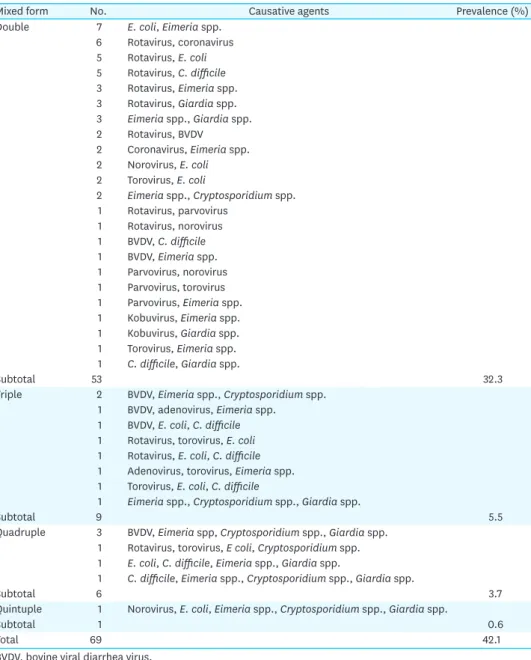
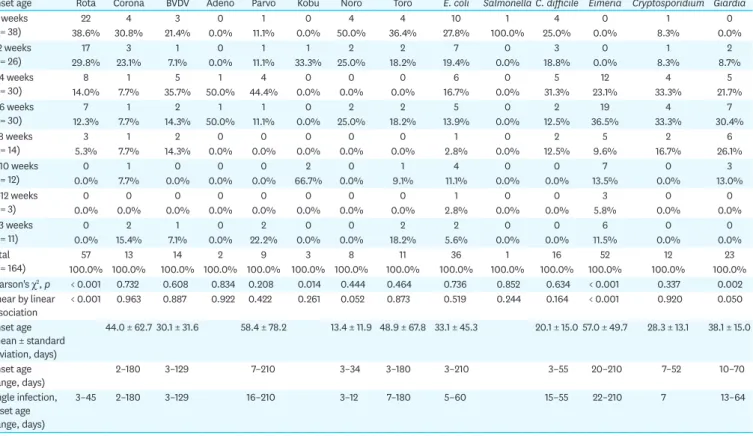
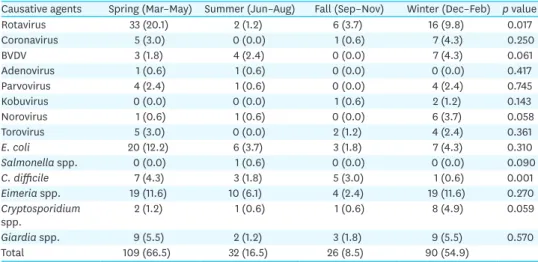
Calf diarrhea caused by infectious agents is associated with economic losses in the cattle industry. The purpose of this study was to identify the causative agents and epidemiological characteristics of diarrhea in Korean native calves (KNC). In total, 207 diarrheal KNC aged less than 7 months were investigated. Fecal samples collected from the rectum were examined for causative agents using polymerase chain reaction (PCR) or real-time PCR and the number of oocysts were counted. Fourteen causative agents were detected from 164 of the 207 diarrheal KNC. Rotavirus was the most common agent (34.8%), followed by Eimeria spp. (31.7%), Escherichia coli (22.0%), Giardia spp. (14.0%), Clostridium difficile (9.8%), bovine viral diarrhea virus (8.5%), coronavirus (7.9%), Cryptosporidium spp. (7.3%), torovirus (6.7%), parvovirus (5.5%), norovirus (4.9%), kobuvirus (1.8%), adenovirus (1.2%), and Salmonella spp. (0.6%). About 95 (57.9%) of 164 calves were infected with a single causative agent and 42.1% were infected by multiple agents. No significant difference was observed in mortality between calves infected with a single agent and multiple agents. The occurrence of diarrhea caused by rotavirus, Eimeria spp., kobuvirus, and Giardia spp. was significantly different based on onset age, and the prevalence of diarrhea caused by rotavirus or C. difficile was significantly different between seasons. This study help the understanding of KNC diarrhea for the development of an effective strategy for disease prevention and control, especially in Eastern provinces of South Korea.
Keywords: Diarrhea; calf; Korean native calves; causative agents; prevalence
INTRODUCTION
Calf diarrhea caused by infectious agents is associated with enormous economic losses in the cattle industry, owing to calf death, growth retardation, and treatment costs [1]. Calf diarrhea is related to diverse and complex factors such as individual health conditions, management practice, rearing environment, as well as infectious causative agents. More than 50% of mortality in preweaned calves has been related to diarrhea, and most cases have occurred in calves less than 1 month of age [2].
Original Article
Received: Jul 5, 2019 Revised: Sep 3, 2019 Accepted: Sep 15, 2019
*Corresponding authors:
Eun Wha Choi
Department of Veterinary Clinical Pathology, College of Veterinary Medicine & Institute of Veterinary Science, Kangwon National University, 1 Kangwondaehak-gil, Chuncheon 24341, Korea.
E-mail: [email protected] Doo Kim
Laboratory of Large Animal Medicine, College of Veterinary Medicine & Institute of Veterinary Science, Kangwon National University, 1 Kangwondaehak-gil, Chuncheon 24341, Korea.
E-mail: [email protected]
© 2019 The Korean Society of Veterinary Science
This is an Open Access article distributed under the terms of the Creative Commons Attribution Non-Commercial License (https://
creativecommons.org/licenses/by-nc/4.0) which permits unrestricted non-commercial use, distribution, and reproduction in any medium, provided the original work is properly cited.
ORCID iDs Sung-Hwan Lee
https://orcid.org/0000-0002-5135-068X Ha-Young Kim
https://orcid.org/0000-0002-1332-3832 Eun Wha Choi
https://orcid.org/0000-0001-7213-695X Doo Kim
https://orcid.org/0000-0003-4741-1352
Sung-Hwan Lee 1 , Ha-Young Kim 2 , Eun Wha Choi 3,* , Doo Kim 1,*
1
Laboratory of Large Animal Medicine, College of Veterinary Medicine & Institute of Veterinary Science, Kangwon National University, Chuncheon 24341, Korea
2
Animal Disease Diagnostic Division, Animal and Plant Quarantine Agency, Gimcheon 39660, Korea
3