Lab Anim Res 2017: 33(3), 195-201 https://doi.org/10.5625/lar.2017.33.3.195
ISSN 2233-7660 (Online)
Antibacterial activity of essential oil from lavender (Lavandula angustifolia) against pet turtle-borne pathogenic bacteria
Sabrina Hossain, Honghoi Heo, B.C.J. De Silva, S.H.M.P. Wimalasena, H.N.K.S. Pathirana, Gang-Joon Heo*
Veterinary Medical Center and College of Veterinary Medicine, Chungbuk National University, Cheongju, Korea
Pet turtles are well-known to harbor an array of bacterial pathogens which can cause zoonotic infections in humans as well as opportunistic infections in the turtles itself. Essential oils are the natural plant extracts which have been traditionally used for disease treatment. In the present study, the essential oil of lavender (EOL) was examined for its antibacterial activity against thirty-eight strains of turtle-borne pathogenic bacteria belonging to seven species; Aeromonas hydrophila, A. caviae, A. dhakensis, Citrobacter freundii, Proteus mirabilis, Salmonella enterica and Pseudomonas aeruginosa. Antibacterial activity of EOL was tested by means of disk diffusion, minimum inhibitory concentration (MIC), and minimum bactericidal concentration (MBC) tests. In addition, the antimicrobial susceptibility pattern of 11 commonly used antimicrobials was examined and the multiple antibiotic resistance (MAR) index was calculated. The results revealed that EOL was active against all tested turtle-borne pathogenic bacteria except P. aeruginosa. The range of MIC and MBC values of EOL against isolates except P. aeruginosa were recorded as 0.5-1% (V/V) and 0.5-2% (V/V), respectively. The MBC/MIC ratio was detected as <4, revealing that the tested EOL was bactericidal. Besides, most of the isolates were resistant to different antimicrobials in antimicrobial disk diffusion test. MAR index values of the tested strains were ranging from 0.27 to 0.91. The outcomes indicate that EOL has a potential to be used as an antibacterial agent against pathogenic bacteria isolated from pet turtles.
Keywords: Essential oil of lavender, antibacterial activity, pathogenic bacteria, pet turtles
Received 12 April 2017; Revised version received 30 August 2017; Accepted 1 September 2017
Synthetic antimicrobials and antibiotics have been used for a long time against different infectious diseases both in human and animals. The main drawback in antimicrobial chemotherapy is the growing antimicrobial resistance which makes the treatments less effective [1].
Therefore, the recent studies had given emphasize on the use of alternative natural products, especially which are obtained from plants [2,3].
Plants and plant extracts have been used as traditional medications for many centuries. Volatile compounds of plant extracts, particularly essential oils (EOs) are known as a secondary plant metabolite which had been used primarily in aromatherapy, cosmetics and medicinal purposes [4]. Various essential oils of different plants
such as thyme, oregano, mint, cinnamon, cumin, salvia, clove, and eucalyptus have been observed to possess strong antimicrobial properties [5].
Essential oil of lavender (EOL) is known as one of the most popular essential oils which can be extracted from several lavender plant species. There are four major species of lavender namely; Lavandula latifolia, Lavandula angustifolia, Lavandula stoechas and Lavandula x intermedia (a sterile cross between L. latifolia and L.
angustifolia) [6]. Among them, Lavandula angustifolia is the most extensively cultured species which is commonly recognized as commercial lavender. EOL is primarily composed of monoterpenoids and sesquiterpenoids where linalool and linalyl acetate are the most dominant.
*Corresponding author: Gang-Joon Heo, Laboratory of Aquatic Animal Medicine, Veterinary Medical Center and College of Veterinary Medicine, Chungbuk National University, Chungdae-ro 1, Seowon-gu, Cheongju, Chungbuk 28644, Korea
Tel: +82-43-261-2617; Fax: +82-43-267-3150; E-mail: [email protected]
This is an Open Access article distributed under the terms of the Creative Commons Attribution Non-Commercial License (http://creativecommons.org/licenses/
by-nc/3.0) which permits unrestricted non-commercial use, distribution, and reproduction in any medium, provided the original work is properly cited.
Lavandulyl acetate, terpinen-4-ol, and lavandulol are the medium level components while camphor and 1,8-cineole are contained in low to moderate in composition [7].
EOL itself and two major constituents of EOL, linalool and linalyl acetate are used in aromatherapy. Linalool and linalyl acetate have been detected as strong antimicrobial agents against foodborne bacteria such as Escherichia coli and Enterobacter cloacae [8]. Some other EOL compounds such as limonene, α-pinene, and β-pinene have antibacterial activity against different human pathogenic bacteria [9]. EOL was observed to have in vitro effect against methicillin-resistant Staphylococcus aureus and vancomycin-resistant Enterococcus faecium [10].
Turtles are popular reptilian species which are being used as pets worldwide. Meanwhile, pet turtles are known as a reservoir of different species of bacteria [11-13].
Antimicrobials are used for the treatment of different kinds of bacterial infection in pet turtle industry, but it caused the rise of resistance in their normal microflora [14]. Recently, the antimicrobial resistance determinants of several pet turtle-borne bacteria were investigated [15,16]. Pet turtles can transmit pathogenic bacteria by physical contact of turtles or contaminated cage environment if the pet owner is unaware of proper hygiene and sanitation. In the meantime, EOL has been recommended to treat lesions, conjunctivitis, constipation, skin and shell diseases of turtles and tortoises [17]. However, there were no previous reports about the antibacterial activity of EOL against turtle-borne bacteria.
Therefore, the present study was conducted to determine the antibacterial activity of EOL against pathogenic bacteria isolated from three popular pet turtle species through disk diffusion, minimum inhibitory concentration (MIC) and minimum bactericidal concentration (MBC) tests for better understanding of the efficacy of EOL against turtle-borne bacteria.
Materials and Methods
Essential oil
EOL manufactured by EuroAroma
®, Germany was purchased for the study. The EOL had been extracted from the flower of Lavandula angustifolia grown in Bulgaria and purified by steam distillation. The quality of the oil was determined as 100% pure.
Target organisms
In total, thirty-eight isolates belonging to seven bacterial species including 5 Aeromonas hydrophila, 3 A. caviae, 2 A. dhakensis, 11 Citrobacter freundii, 5 Pseudomonas aeruginosa, 6 Salmonella enterica and 6 Proteus mirabilis were isolated from three popular pet turtle species in Korea such as Chinese stripe-necked turtle (Ocadia sinensis), river cooter (Pseudemys concinna concinna) and yellow-bellied sliders (Trachemys scripta scripta) which were reared under laboratory condition.
Disk diffusion test
Disk diffusion test of EOL was performed using a 24 h cultured bacteria at 37
oC in tryptic soy agar (TSA) (MBcell Ltd., Seoul, Korea). The bacterial cultures were accustomed to 0.5 McFarland standard with sterile saline. The bacterial suspensions were spread over Mueller-Hinton agar (MHA) (MBcell Ltd., Seoul, Korea) plates using a sterile cotton swab. Different concentrations (1:1, 1:2, 1:4 and 1:10) of EOL were prepared using ethanol as the diluting agent. Sterilized paper discs ( ϕ6 mm) were impregnated with 20 μL of different concentrations of EOL and placed on the inoculated agar plates. The plates were sealed with a sterile plastic wrap to avoid evaporation and incubated at 37
oC for 24 h. Finally, the diameter of inhibition zone was measured in mm.
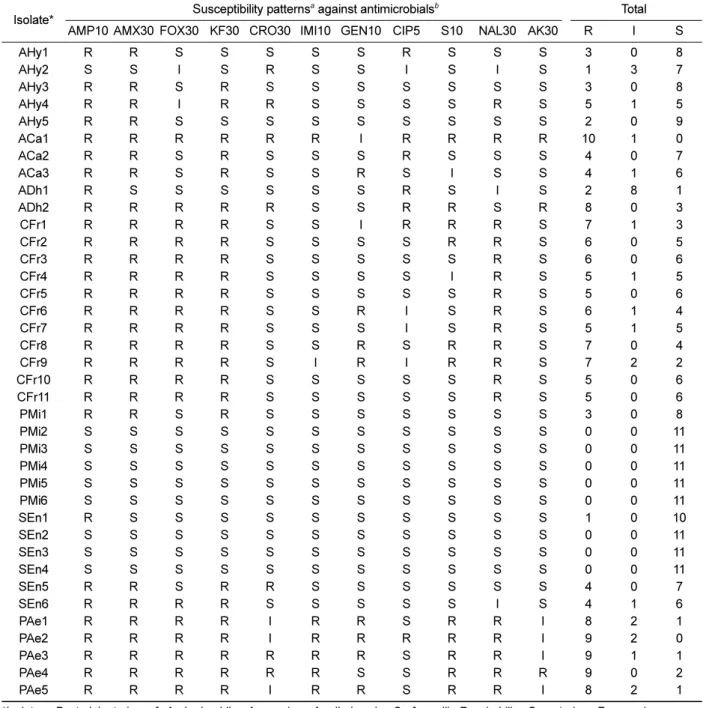
Antimicrobial disks of the different antimicrobial group were used as controls against EOL. Amoxicillin (30 μg), ampicillin (10 μg), nalidixic acid (30 μg), amikacin (30 μg), cefoxitin (30 μg), ceftriaxone (30 μg), cephalothin (30 μg), ciprofloxacin (5 μg), imipenem (10 μg), gentamicin (10 μg), and streptomycin (10 μg) disks were used in antimicrobial disk diffusion test. The disk diffusion test and measurement of inhibition zone were executed according to the standards of the Clinical and Laboratory Standards Institute [18].
Multiple Antibiotic Resistance (MAR) index
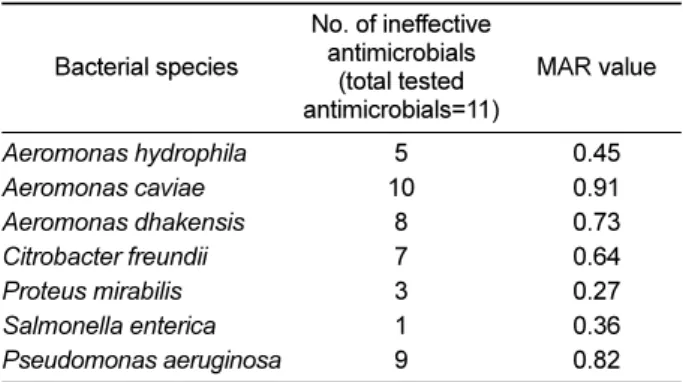
Following the antimicrobial disk diffusion test results, one strain from each species showing the strongest resistance was selected for calculating the MAR index.
MAR index was calculated as the ratio of number of
resistant antimicrobials to total number of antimicrobials
to which the strains were exposed.
Minimum Inhibitory Concentration (MIC) and Minimum Bactericidal Concentration (MBC) tests
The MIC test was performed by means of broth dilution method in a 96-well microtiter plate [19]. A portion of 100 μL of double strength Mueller-Hinton broth (MBcell Ltd., Seoul, Korea) containing 5%
dimethyl sulfoxide (DMSO) (OCI Company Ltd, Seoul, Korea) was added to wells of 96-well microtiter plates.
A series of two-fold dilution of EOL as 2, 1, 0.5, 0.25,
0.125, 0.063, 0.31, and 0.016% (V/V) was dispersed in the columns of wells. Finally, one hundred microliters (100 μL) of bacterial suspension prepared equivalent to 0.5 McFarland units with sterile saline was added to each well and incubated at 37
oC for 24 h.
For observing MBC, 10 μL of the medium from wells with no visible growth was transferred to a TSA plate and incubated at 37
oC for overnight. The MBC was determined as the lowest concentration that establishes a
Table 1. Antibacterial activity of EOL against pet turtle-borne bacteria
Isolate* Inhibition zone
a(mm) with different EOL concentrations MIC (%) (V/V)
MBC (%)
b(V/V) MBC/MIC
1:1 1:2 1:4 1:10
AHy1 15 12 11 10 0.5 1 2
AHy2 9 8 7 7 1 1 1
AHy3 13.5 10.5 10 9.5 1 1 1
AHy4 12 9 7 6.5 1 2 2
AHy5 16 13 11 8 0.5 0.5 1
ACa1 11 10 8 7 1 1 1
ACa2 10 7 6.5 NA 1 1 1
ACa3 10 9 8 6.5 1 2 2
ADh1 25 15 14 11 0.5 1 2
ADh2 14 11 8 7 1 2 2
CFr1 9 8 7 NA 0.5 2 3
CFr2 9 7 NA NA 0.5 1 2
CFr3 9 7 6.5 NA 0.5 2 3
CFr4 11.5 8 7 6.5 1 2 2
CFr5 11 9 7 6.5 1 2 2
CFr6 12 10 9 7 0.5 2 3
CFr7 9 7 6.5 NA 1 1 1
CFr8 11 9 8.5 7.5 0.5 2 3
CFr9 11 8 7 NA 1 2 2
CFr10 10 7.5 6.5 NA 1 2 2
CFr11 10 8 7.5 NA 0.5 0.5 1
PMi1 9 7.5 NA NA 1 1 1
PMi2 11 NA NA NA 1 1 1
PMi3 10 NA NA NA 0.5 0.5 1
PMi4 9 NA NA NA 0.5 1 2
PMi5 9 6.5 NA NA 1 1 1
PMi6 10 NA NA NA 1 1 1
SEn1 7 6.5 NA NA 0.5 0.5 1
SEn2 8 6.5 NA NA 1 1 1
SEn3 7 NA NA NA 1 2 2
SEn4 8 6.5 NA NA 0.5 1 2
SEn5 9 7 7 6.5 1 2 2
SEn6 8 8 7.5 7 1 2 2
PAe1 NA NA NA NA >2 ND ND
PAe2 NA NA NA NA >2 ND ND
PAe3 NA NA NA NA >2 ND ND
PAe4 NA NA NA NA >2 ND ND
PAe5 NA NA NA NA >2 ND ND
*Isolates: Bacterial strains of A. hydrophila, A. carviae, A. dhakensis, C. freundii, P. mirabilis, S. enterica, P. aeruginosa were designated as AHy, ACa, ADh, CFr, PMi, SEn and PAe, respectively.
a
Inhibition zone: NA=No growth inhibition
b
MBC: ND=not done
pre-determined reduction of bacteria (99.9%) in CFU/
mL.
Results
Disk diffusion test
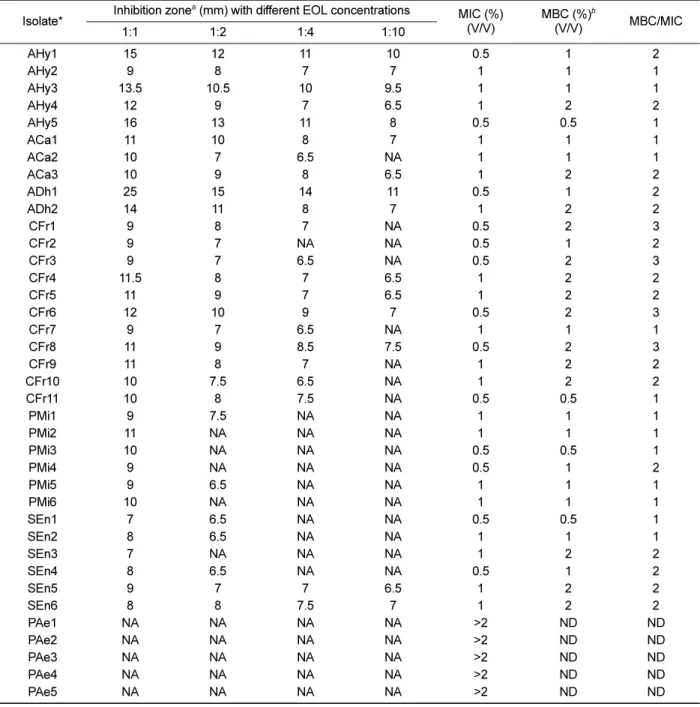
Disk diffusion test result of EOL against pet turtle-
borne bacteria is shown in Table 1. According to the result, a similar pattern of antimicrobial activity was observed in all of the isolates except P. aeruginosa. All P. aeruginosa isolates were resistant even to the highest concentration of EOL. The highest activity of EOL was observed at 1:1 dilution for other bacterial isolates.
Bacterial sensitivity to EOL was found in the pattern of
Table 2. Susceptibility patterns of turtle-borne bacteria against antimicrobials in disk diffusion test
Isolate* Susceptibility patterns
aagainst antimicrobials
bTotal
AMP10 AMX30 FOX30 KF30 CRO30 IMI10 GEN10 CIP5 S10 NAL30 AK30 R I S
AHy1 R R S S S S S R S S S 3 0 8
AHy2 S S I S R S S I S I S 1 3 7
AHy3 R R S R S S S S S S S 3 0 8
AHy4 R R I R R S S S S R S 5 1 5
AHy5 R R S S S S S S S S S 2 0 9
ACa1 R R R R R R I R R R R 10 1 0
ACa2 R R S R S S S R S S S 4 0 7
ACa3 R R S R S S R S I S S 4 1 6
ADh1 R S S S S S S R S I S 2 8 1
ADh2 R R R R R S S R R S R 8 0 3
CFr1 R R R R S S I R R R S 7 1 3
CFr2 R R R R S S S S R R S 6 0 5
CFr3 R R R R S S S S S R S 6 0 6
CFr4 R R R R S S S S I R S 5 1 5
CFr5 R R R R S S S S S R S 5 0 6
CFr6 R R R R S S R I S R S 6 1 4
CFr7 R R R R S S S I S R S 5 1 5
CFr8 R R R R S S R S R R S 7 0 4
CFr9 R R R R S I R I R R S 7 2 2
CFr10 R R R R S S S S S R S 5 0 6
CFr11 R R R R S S S S S R S 5 0 6
PMi1 R R S R S S S S S S S 3 0 8
PMi2 S S S S S S S S S S S 0 0 11
PMi3 S S S S S S S S S S S 0 0 11
PMi4 S S S S S S S S S S S 0 0 11
PMi5 S S S S S S S S S S S 0 0 11
PMi6 S S S S S S S S S S S 0 0 11
SEn1 R S S S S S S S S S S 1 0 10
SEn2 S S S S S S S S S S S 0 0 11
SEn3 S S S S S S S S S S S 0 0 11
SEn4 S S S S S S S S S S S 0 0 11
SEn5 R R S R R S S S S S S 4 0 7
SEn6 R R R R S S S S S I S 4 1 6
PAe1 R R R R I R R S R R I 8 2 1
PAe2 R R R R I R R R R R I 9 2 0
PAe3 R R R R R R R S R R I 9 1 1
PAe4 R R R R R R S S R R R 9 0 2
PAe5 R R R R I R R S R R I 8 2 1
*Isolates: Bacterial strains of A. hydrophila, A. carviae, A. dhakensis, C. freundii, P. mirabilis, S. enterica, P. aeruginosa were designated as AHy, ACa, ADh, CFr, PMi, SEn and PAe, respectively.
a
Susceptibility patterns: R=resistant, I=intermediate and S=susceptible were designated using breakpoint described by the Clinical Laboratory Standards Institute [18].
b