• 검색 결과가 없습니다.

Anti-inflammatory and Anti-bacterial Effects of Aloe vera MAP against Multidrug-resistant Bacteria

N/A
N/A
Protected

Academic year: 2022

Share "Anti-inflammatory and Anti-bacterial Effects of Aloe vera MAP against Multidrug-resistant Bacteria"

Copied!
5
0
0

로드 중.... (전체 텍스트 보기)

전체 글

(1)

23(4) : 286-290 (2017)

https://doi.org/10.20307/nps.2017.23.4.286

286

Anti-inflammatory and Anti-bacterial Effects of Aloe vera MAP against Multidrug-resistant Bacteria

Sang Hwa Choi and Hea Soon Shin*

College of Pharmacy, Duksung Women’s University, Seoul 01369, Republic of Korea

Abstract − Multidrug-resistant Acinetobacter baumannii and Pseudomonas aeruginosa are highly dangerous nosocomial pathogens, cause the symptoms of skin infections, pressure sores, sepsis, blood stream and wound infections. Unfortunately, these pathogens are immune to the most common antibiotics, such as, carbapenem, aminoglycoside and fluoroquinolone. Therefore, it is imperative that new and effective antibiotics be developed.

In the present study, the antimicrobial effects of Aloe vera MAP (modified Aloe polysaccharide) on Staphylococcus aureus and Bacillus subtilis, Escherichia coli and Enterobacter aerogenes, and clinical Pseudomonas aeruginosa and clinical Acinetobacter baumannii were comprehensibly investigated. Prior to the growth inhibition effect measurement and antibiotic disc diffusion assay on gram-positive and gram-negative bacteria and selected multidrug- resistant Pseudomonas aeruginosa and Acinetobacter baumannii, antimicrobial resistance screening was performed for the multidrug-resistant bacteria obtained from clinical isolates. The results for showed the Aloe vera MAP had a concentration-dependent effect on all of examined bacteria, particularly on Pseudomonas aeruginosa.

Anti-inflammatory and anti-oxidant experiments were also performed dose dependently effects to confirm the beneficial physiological effects of Aloe vera MAP.

Keywords − Aloe vera MAP, Multidrug-resistant bacteria, Anti-inflammatory, Anti-bacterial effect

Introduction

More effective antibiotics have been developed but demands are ever-increasing. Furthermore, long-term treatment or abuse of antibiotics has increased the number of antibiotics resistant bacteria, such as, Acinetobacter baumannii and Pseudomonas aeruginosa, which clinically important as they are responsible for nosocomial pneu- monia, urinary and wound infections and sepsis.

1

In fact, these are regarded life-threatening nosocomial pathogens and are resistant to major clinical antibiotics, including carbapenems, aminoglycosides and fluoroquinolones. Such multidrug resistant bacteria are widespread nowadays and are transmitted by personal contact, environmental exposure, or by nosocomial infection.

2,3

Although they may not be hazardous to healthy people, immune depressed, diabetes, and chronic obstructive pulmonary disease (COPD)) patients and especially patients hospitalized long term are highly susceptible to infections caused by such multidrug-resistant resistant bacteria.

4

Multidrug-resistant Pseudomonas aeruginosa (MDRPA) is

a particular concern it is a component of normal body flora but has the inherent ability to causes self-infections.

5

The major symptoms of such infections include skin infections, bedsores, sepsis, pneumonia, and bloodstream and wound infections, though these vary widely on an individual basis.

6

Those infections are usually treated with antibiotics identified by sensitivity tests. However, it is difficult to treat MDRPA infections due to its immunity to ordinary antibiotics.

7,8

Aloe is a well-known plant, which is used worldwide in folk remedies and traditional medicine, such as, to improve skin and bowel health, and for antibiosis and immune potentiation.

9,10

Recent scientific studies have revealed that Aloe vera contains 11 bioactive substances, which include the aloesin, 8-C-glucosyl-7-O-methyl-(S)- aloesol, and neoaloesin A. These three compounds have been extensively studied and are known to have for effective antibiotic and antitumor properties.

11-13

The present study was undertaken to confirm the antimicrobial effects of Aloe vera MAP on Pseudomonas aeruginosa, Acinetobacter Baumannii, and four species of gram positive and negative bacteria isolated in condensed form from clinical environments. The anti-oxidant and anti-inflammatory effects of Aloe vera MAP was also

*Author for correspondence

Hea Soon Shin, College of Pharmacy, Duksung Women's Univer- sity, Seoul 01369, Republic of Korea.

Tel: +82-2-901-8398; E-mail: [email protected]

(2)

investigated to identify beneficial effect of DPPH, NO, MCP chemokine level.

Experimental

Aloe vera MAP − Aloe samples were supplied by Univera, Co., Ltd. (Korea) and were extracted from Aloe vera MAP cultivated in Hainan, China. MAP (Modified Aloe Polysaccharide) was prepared by dialysis of MAXP (Modified Aloe X Polysaccharide) through a 3.5 kDa Spetra/por

TM

membrane, which effectively removed low molecular weight polysaccharide. MAP thus prepared was dissolved in the distilled water (DW) and then lyophilized, as previously described Qiu.

14,15

The MAP sample was dissolved in DW (medically certified sterili- zation grade) at concentrations of 1000, 500, 200, 100, 50, 20, 10 or 5 µg/ml stored at −20

o

C until required.

Bacterial strains − Staphylococcus aureus (ATCC 65389), Bacillus subtillis (ATCC 6633), Escherichia coli (ATCC 35922) and Enterobacter aerogenes (ATCC 3975) were purchased from the American Type Culture Collection (ATCC, Manassas, VA, USA) and cultured in Luria Bertani (LB) broth. The LB broth was prepared using commercially available Trypton, yeast, NaCl and sterilized DW. Pseudomonas aeruginosa and Acinetobacter baumannii were supplied by Sahmyook University Hospital and were pre-screened to confirm antibiotic resistance.

16

P. aeruginosa and A. baumannii were separately cultured in a nutrient broth, which was prepared with peptone (DIFCO), beef extract (BD Bioscience) and the sterili- zation grade DW.

Cell strains − Raw 264.7 cells were purchased from the Korea Cell Strain Bank. Raw 264.7 cells were cultured in Dulbeco’s Modified Eagle’s Medium containing 10%

fetal bovine serum (FBS), mixed with 1% penicillin (10,000 U/ml) and streptomycin (10,000 U/ml), autoclaved at 121

o

C for 20 minutes before culturing for 24 hours, and then cultured in incubator at 37

o

C, 5% CO

2

. The cell strains, culture medium, and other antibiotics were of commercial grades.

MTT assay − Raw 264.7 cells were seeded in a 96 well plate at 2 × 10

4

cells/well and cultured for 24 hours.

They were then treated with Aloe vera MAP concentra- tions of 1000, 500, 200, 100, 50, 20, 10 or 5 µg/ml concentrations and further cultured for 24 hours, when the supernatant fraction was removed and 100 µl/well of MTT (3-(4,5-dimethylthiazol-2-yl)-2,5-diphenyltetrazolium bromide, Sigma Aldrich) was added. Mixtures were then placed in a 5% CO

2

incubator 150 mins at 37

o

C. DMSO (100 µl/well) was then added and homogenized for

5 minutes. Optical densities of solutions were measured at 540 nm using an ELISA (enzyme-linked immunosorbent assay) microplate reader. Optical densities expressed as percentages of the non-treated control.

Measurement of minimum inhibitory concentrations

− The bacterial strain S. aureus and multidrug resistant P.

aeruginosa and A. baumannii were tested minimum inhibitory concentration of five antibiotics, gentamicin (Sigma, USA), meropenem (Yuhan, Republic of Korea) tobramycin (Daewoong, Korea), tigecycline (Wyrth-Ayerst, USA), ciprofloxacin (Ildong, Korea), and AVE (Aloe vera MAP extract, 2 mg/ml). The MICs were measured by the agar dilution method based on the guidelines established on the Clinical Laboratory and Standards Institute (CLSI 2012).

Growth inhibition effect − The same bacterial strains of the previous sections were cultured in Mueller-Hinton broth for 20 hrs cultured in an incubator at 37

o

C. The number of cells was counted as per 0.5 McFarland Standard.

Growth inhibition effect measurement was performed by introducing 20 µl of 1 mg/ml concentrated Aloe vera MAP into the 180 µl of Muller-Hinton broth, which was twice diluted into the final bacterial concentration of 1 × 10

6

CFU/ml. Upon completion of 24 hrs culturing, turbidity of the test broth was measured in terms of optical density with variation of dilution. When the optical density values for each dilution of the Aloe vera MAP extracts test broth and the pure bacterial culture medium were nearly identical, the minimum concentration of the Aloe vera MAP test broth was taken as MIC.

NO assay − The murine macrophage Raw 264.7 cells (2 × 10

4

cells/well) were seeded on 96 well plates. After 24 hrs incubation, cells were stimulated with lipopoly- saccharide (LPS, Sigma). Upon completion of the reaction, Aloe vera MAP of 1000, 500, 200, 100, 50, 20, 10 or 5 µg/ml concentrations was then added with LPS 1 µl/ml as a negative control or only DMEM treated as a positive control. After culture for 24 hrs in 5% CO

2

at 37

o

C, supernatant (70 µl/well) were added to the wells of 96- well plate with 70 µl/well Griess Reagent (Sigma Aldrich).

Finally, these mixtures were shaken for 10 minutes at room temperature and optical densities were measured at 540 nm using an ELISA micro plate reader.

MCP-1 assay − To confirm the immune potentiation

effects of Aloe vera MAP, such as, MCP-1(monocyte

chemo-attractant protein-1) induction. 100 µl/well of the

Aloe vera MAP solution was placed on the prepared

coated MCP-1 first antibody and further reacted for 2

hours at room temperature, then washed with wash buffer

for 5 times. Upon completion of second antibody reaction,

(3)

the test solution was again washed with buffer before the 100 µl/well of the substrate solution was added to it, for another 30 minutes reaction in a dark room. Then stop solution of were added each well to finish the reaction and optical densities were measured at 450 nm. Induction of MCP-1 value was quantified using the MCP-1 standard and with 1 µl/ml of LPS as a negative control or only DMEM-treated as a positive control.

DPPH assay − 100 µl of Aloe vera MAP of 1000, 500, 200, 100, 50, 20, 10 or 5 µg/ml concentrations were placed in a 96 well plate with 100 µl of 0.2 mM DPPH (2, 2-diphenyl-1-picrylhydrazyl) for subsequent reaction for 30 minutes at room temperature. Optical densities were measured at 517 nm to determine antioxidant characteristics using the ascorbic acid as a standard antioxidant.

Result and Discussion

The infectious disease of multidrug resistant bacteria causes various symptoms depending on the type of infection. Diversity of infectious disease treatment utilizes certain antibiotics that have susceptibility based on anti- microbial susceptibility test. However, development of new substances is important as multidrug resistant bacteria that have antimicrobial resistance to common antibiotics make treatment difficult. As antimicrobial resistance highly grows, the need for antibiotics that can solve this problem rises.

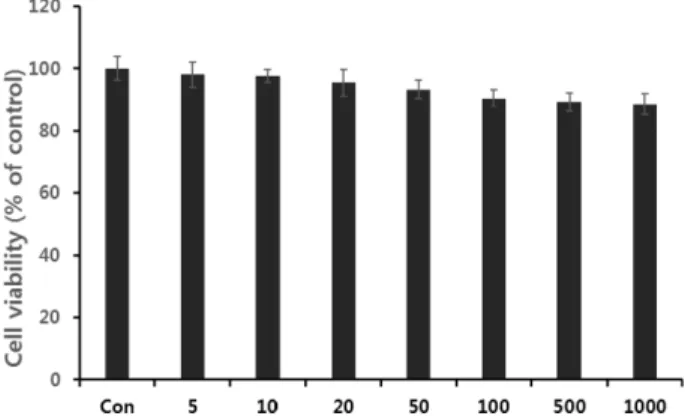
Cytotoxicity assessment − Cytotoxicity of Aloe vera MAP at each concentration was examined by MTT assay using Raw 264.7 cells of white mouse macrophages as illustrated in Fig. 1, Raw 264.7 cells treated with 5 µg/ml and 1000 µg/ml of extract showed cell viabilities of 88.6 ± 3.0% and 98.03 ± 3.3%, respectively. Overall, higher than 90% viability was observed, which was approximated by the 88.6% cell viability obtained using 1000 µg/ml of Aloe vera MAP (Fig. 1).

Measurement of minimum inhibitory concentrations

− The MICs test of five antibiotics (gentamicin, mero- penem, tobramycin, tigecycline, ciprofloxacin) against

fore bacterial strains are shown in Table 1. S. aureus exhibited high-level susceptibility to all of antibiotics tested, respectively. However, AVE 1 mg/ml showed weakly resistance against S. aureus. P. aeruginosa exhibited high-level resistance to all of antibiotics tested (MIC >128 µg/ml), respectively. Also, A. baumanii exhibited resis- tance to all of antibiotics tested include tigecycline and meropenem.

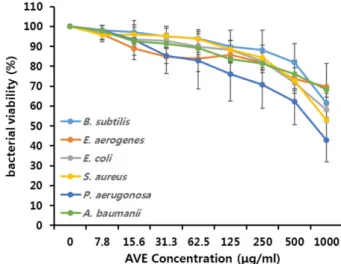
Growth inhibition effect − Growth inhibition effect performed to determine the anti-bacterial effects of the Aloe vera MAP at various concentrations confirmed the survival rates of the gram positive bacteria B. subtilis and S. aureus as 61.45% and 53.12%, respectively, with 1000 µg/ml of Aloe vera MAP. On the other hand, the gram negative bacteria E. coli and E. aerogenes showed survival rates of 58.09% and 69.76%, respectively. Concentration of the Aloe vera MAP had varying antibiotic effects on the multidrug resistant bacteria P. aeruginosa, resulting in survival rates of 62.3% and 42.9% for 500 µg/ml and 1000 µg/ml of Aloe vera MAP (former is the highest antibiotic effect while the latter is the highest concen- tration effect). Lastly, survival rates of 75.99% and 68.34% were observed for 500 µg/ml and 1000 µg/ml of Aloe vera MAP with A. baumannii (Fig. 2).

Table 1. The minimum inhibitory concentrations test (MICs) of five antibiotics and AVE (mg/ml) against bacterial strains S. aureus, multidrug-resistant bacteria P. aeruginosa, and A. baumanii

Strains MIC ( µg/ml)

GEN MEM TOB TIG CIP AVE (mg/ml)

S. aureus 0.2 0.8 0.8 0.4 0.1 32

P. aeruginosa >128 >128 >128 64 64 128

A. baumanii >128 16 >128 4 >128 >128

GEN, gentamicin; MEM, meropenem; TOB, tobramycin; TIG, tigecycline; CIP, ciprofloxacin; AVE, Aloe vera MAP extract (mg/ml) Fig. 1. Cytotoxicity of the Raw 264.7 cells were treated with Aloe vera MAP extracts. Experiments were performed by means of an MTT enzyme assay. Data are measured as percentage of the control. Error bars represent the mean ± standard deviation (*P <

0.05).

(4)

Production of NO measurement − Fig. 3, shows the effects of Aloe vera MAP treatment on inhibition of production of NO, which is released as a result of inflammation. For this, Raw 264.7 cells were stimulated with LPS and then treated with an ineffective concentration of Aloe vera MAP to generate the control group; level of ineffective Aloe vera MAP concentration was experi- mentally determined based on the previous MTT assay test.

The NO outputs of the control group and cell group were compared by setting the control group as 100%;

control group was treated with LPS only and was cultured without sample while the cell group was treated with Aloe vera MAP. NO formation (41.39%) was observed at the highest concentration when cells were treated only with

media compared with the control group. Treatment with the highest Aloe vera MAP concentration (1000 µg/ml) resulted in 81.63% NO production, which was equivalent to 18.37% NO inhibition. On the other hand, 95.03% NO formation was equivalent to 5% NO inhibition obtained for 5 µg/ml of Aloe vera MAP, confirming an inverse proportional relationship between Aloe vera MAP con- centration and NO formation (Fig. 3).

MCP induction measurement − MCP-1 (monocyte chemoattractant protein-1) level was measured to examine the effect of Aloe vera MAP concentration on induction of chemokine. Raw 264.7 cells were treated as detailed in the previous NO assay section, and the MCP-1 formation results are compared in Fig. 4. MCP-1 generated by the control group (182.5 ± 0.4 pg/ml) was far greater than that generated by 5 µg/ml of Aloe vera MAP treatment (118 ± 0.6 pg/ml). A total of 62.5 ± 0.5 pg/ml of MCP-1 was observed for the highest Aloe vera MAP concentration (1000 µg/ml), effectively proving that Aloe vera MAP could inhibit MCP-1 induction (Fig. 4). Therefore, most of all concentrations of Aloe vera MAP extract reduced MCP-1 formation and the reductions increased concentra- tion dependently, as an inflammatory responses with chemokine expression.

DPPH activity measurement − Fig. 5, shows the effects of Aloe vera MAP of the anti-oxidative activity.

DPPH assay was used to optically identify the free radical removability of Aloe vera MAP, as detailed in the Experimental section. Free radical removability was proportional to the Aloe vera MAP concentration. One thing is noteworthy in that the highest concentration of Aloe vera MAP resulted in the antioxidant activity similarly to 2000 µg/ml concentration of ascorbic acid Fig. 2. Growth inhibition effect of Aloe vera MAP extract (AVE)

in a variety of bacteria including multidrug-resistant resistant bacteria. Data was measured as a percentage of the control, i.e., the bacteria cultured in the pure medium without Aloe vera MAP extracts (*P < 0.001, *P < 0.004, *P < 0.019).

Fig. 3. Effect of Aloe vera MAP extract (AVE) on inhibitory of Nitric oxide (NO) production in LPS-stimulated Raw 264.7 cells.

Data are measured as percentage of the control treated only with LPS. Error bars represent the mean ± standard deviation (*P <

0.05).

Fig. 4. Induction of MCP-1 (monocyte chemoattractant protein 1)

in Raw 264.7 cells treated Aloe vera MAP extracts (AVE). Data

are presented as mean ± standard deviations of three independent

experiments (*P < 0.05).

(5)

which is a strong antioxidant.

In present study, growth inhibition effect and disc diffusion assay were conducted using Staphylococcus aureus and Bacillus subtilis, Escherichia coli and Entero- bacter aerogenes, and clinical Pseudomonas aeruginosa and clinical Acinetobacter baumannii to test the antimi- crobial effects against standard gram positive and gram negative bacteria as well as multidrug resistant bacteria.

Growth inhibition effect and disc diffusion assay confirmed that survival rate of group treated with Aloe vera MAP decreased dose-dependent at all levels of concentration. Some studies have found that bioactive component of Aloe extract, polyphenol of anthraquinone such as Aloe emodin, emodin, aloin cause such desirable effects of the Aloe. These studies have discovered that phenolic component of Aloe vera have effects of anti- microbial and anti-tumor. Phenolic component of Aloe vera have been reported to have potent anti-lipid peroxidation inhibitory effects in the livers and brains of mice.

12,11,10

Pugh et al., identified that these with lower molecular- weight have greater anti-inflammatory activity while those with higher molecular-weight have greater immune stimula- tory activity from commercial Aloe vera.

17

This study has also come to conclusions that support such findings of lower results on the NO formation compare to the MCP-1 cytokine formation based on experimental evidence.

In light of the urgent need to develop efficient antibiotics for multidrug-resistant nosocomial bacteria such as P.

aeruginosa and A. baumanii, which are immune to several contemporary antibiotics, the antibiotic effects of the Aloe vera in the present study may have beneficial potential.

The beneficial effects of the Aloe vera on multidrug- resistant bacteria combined with their anti-inflammatory and antioxidant effects suggest their promising pharma- ceutical and clinical efficacy for development as new antibiotics. Therefore, the present study is expected to contribute to fundamental research on the antibiotic effects of Aloe vera. However further identification of the active compound of Aloe vera and more antimicrobial effect in clinical studies are needed.

Acknowledgements

The present study was supported by the Duksung Women’s University Research Grants of 2015.

References

(1) Gaynes, R.; Edwards, J. R.; Clin. Infect. Dis. 2005, 41, 848-854.

(2) Doring, G.; Horz, M.; Ortelt, J.; Grupp, H.; Wolz, C. Epidemiol.

Infect. 1993, 110, 427-436.

(3) Goudarzi, M.; Fazeli, M.; Azad, M.; Seyedjavadi, S. S.; Mousavi, R.

Chemother Res Prac 2015, 2015, 1-5.

(4) Falagas, M. E.; Koletsi, P. K.; Bliziotis, I. A. J. Med. Microbiol.

2006, 55, 1619-1629.

(5) Pankuch, G. A.; Seifert, H.; Appelbaum, P. C. Diagn. Microbiol.

Infect. Dis. 2010, 67, 191-197.

(6) Vidal, F.; Mensa, J.; Almela, M.; Martinez, J. A.; Marco, F.; Casals, C.; Gatell, J. M.; Soriano, E.; Jimenez de Anta, M. T. Arch. Intern. Med.

1996, 156, 2121-2126.

(7) Kuo, L. C.; Teng, L. J.; Yu, C. J.; Ho, S. W.; Hsueh, P. R. J. Clin.

Microbiol. 2004, 42, 1759-1763.

(8) Deplano, A.; Denis, O.; poriel, L. Hocquet, D.; Nonhoff, C. Byl, B.;

Nordmann, P.; Vincent, J. L.; Struelens, M. J. J. Clin. Microbiol. 2005, 43, 1198-1204.

(9) Ahluwalia, B.; Magnusson, M. K.; Isaksson, S.; Larsson, F.; Öhman, LJ. Ethnopharmacol. 2016, 179, 301-309.

(10) Vijayalakshmi, D.; Dhandapani, R.; Jayaveni, S.; Jithendra, P. S.;

Rose, C.; Mandal, A. B. J. Ethnopharmacol. 2012, 141, 542-546.

(11) Rathor, N.; Mehta, A. K.; Sharma, A. K.; Mediratta, P. K.; Sharma, K. K. Inflammation 2012, 35, 1900-1903.

(12) Kim, M. U.; Cho, Y. J.; Lee, S. Y. J Appl. Biol. Chem. 2013, 56, 157-163.

(13) Habeeb, F.; Shakir, E.; Bradbury, F.; Cameron, P.; Taravati, M. R.;

Drummond, A. J.; Gray A. I.; Ferro, V. A. Methods 2007, 42, 315-320.

(14) Qiu, Z.; Jones, K.; Wylie, M.; Jia, Q.; Orndorff, S. Planta. Med.

2000, 66, 152-156.

(15) Im, S. A.; Oh, S. T.; Song, S.; Kim, M. R.; Kim, D. S.; Woo, S. S.;

Jo, T. H.; Park, Y. I.; Lee, C. K. Int. Immunopharmacol. 2005, 5, 271-279.

(16) Lee, D. K.; Kim, M. J.; Kang, J. Y.; Park, J. E.; Shin, H. S.; Ha, N.

J. Kor. J. Microbiology 2013, 49, 245-252.

(17) Pugh, N.; Ross, S. A.; ElSohly, M. A.; Pasco, D. S. J. Agric. Food Chem. 2001, 49, 1030-1034.

Received July 25, 2017 Revised September 30, 2017 Accepted September 30, 2017 Fig. 5. Inhibitory effect of the Ascorbic acid and Aloe vera MAP

on DPPH free radicals. Data was measured as a percentage of the control. Error bars represent the mean ± standard deviation (*P <

0.05).

수치

Table 1. The minimum inhibitory concentrations test (MICs) of five antibiotics and AVE (mg/ml) against bacterial strains S
Fig. 4. Induction of MCP-1 (monocyte chemoattractant protein 1) in Raw 264.7 cells treated Aloe vera MAP extracts (AVE)

참조

관련 문서

양성 환자에서 CNS (Coagulase-Negative Staphylococcus)균을 제외하고, Type1 환자 5명에서 Staphylococcus aureus, Escherichia coli, Acinetobacter Baumannii,

In this study, two experiments were conducted to understand the effects of additional charge on the detailed growth mechanism of Alq 3 and to determine the effect of

Pro-allergic cytokines were important mediators of allergic inflammation, cell recruitment and allergenic response decided to further investigate the

paper disc FDV-3 Staphylococcus aureus, Escherichia coli, Listeria monocytogenes, Pseudomonas aeruginosa, Salmonella typhimurium, Yersinia enterocolitica 와 Lodderomyces

This study researched the possibility of using natural products for hair growth agents and hair loss prevention materials based on the test for the antioxidant and

The aim of this study was to examine the effects and mechanisms of the new metformin derivative HL156A in human multidrug-resistant cancer cell lines (FADU/PTX,

It is the purpose of this study to investigate the anti microbacterial Activity and anti inflammatory Effects of water extract Rhododendron brachycarpum

% reduction rate against Staphylococcus aureus and Klebsiella pneumoniae were exhibited for both of cotton and nylon/PU knit undergone more than 10 %(owf) of