479 http://dx.doi.org/10.4196/kjpp.2013.17.6.479
ABBREVIATIONS: NAT, N-acetyltransferase; CYP, cytochrome P450; UGT, uridine diphosphate glucuronosyl transferase; SNP, single-nucleotide polymorphism; HWE, Hardy-Weinberg equili- brium; LD, linkage disequilibrium.
Received February 14, 2013, Revised May 16, 2013, Accepted November 10, 2013
Corresponding to: Hyoung Doo Shin, Department of Life Science, Sogang University, 1 Shinsu-dong, Mapo-gu, Seoul 121-742, Korea.
(Tel) 82-2-3273-1671, (Fax) 82-2-3273-1680, (E-mail) hdshin@sogang.
ac.kr
This is an Open Access article distributed under the terms of the Creative Commons Attribution Non-Commercial License (http://
creativecommons.org/licenses/by-nc/3.0) which permits unrestricted non-commercial use, distribution, and reproduction in any medium, provided the original work is properly cited.
Screening of Genetic Polymorphisms of CYP3A4 and CYP3A5 Genes
Jin Sol Lee1, Hyun Sub Cheong2, Lyoung Hyo Kim2, Ji On Kim2, Doo Won Seo3, Young Hoon Kim3, Myeon Woo Chung3, Soon Young Han4, and Hyoung Doo Shin1,2
1Department of Life Science, Sogang University, 2Department of Genetic Epidemiology, SNP Genetics, Inc., Seoul 121-742, 3Clinical Research Division, Toxicological Evaluation and Research Department, National Institute of Food and Drug Safety Evaluation, Osong Health Technology Administration Complex, 4Toxicological Evaluation and Research Department, National Institute of Food and Drug Safety Evaluation, Osong Health Technology Administration Complex, Osong 363-700, Korea
Given the CYP3A4 and CYP3A5’s impact on the efficacy of drugs, the genetic backgrounds of individuals and populations are regarded as an important factor to be considered in the prescription of personalized medicine. However, genetic studies with Korean population are relatively scarce compared to those with other populations. In this study, we aimed to identify CYP3A4/5 polymorphisms and compare the genotype distributions among five ethnicities. To identify CYP3A4/5 SNPs, we first performed direct sequencing with 288 DNA samples which consisted of 96 Koreans, 48 European- Americans, 48 African-Americans, 48 Han Chinese, and 48 Japanese. The direct sequencing identified 15 novel SNPs, as well as 42 known polymorphisms. W e defined the genotype distributions, and compared the allele frequencies among five ethnicities. The results showed that minor allele frequencies of Korean population were similar with those of the Japanese and Han Chinese populations, whereas there were distinct differences from European-Americans or African-Americans. Among the phar- macogenetic markers, frequencies of CYP3A4*1B (rs2740574) and CYP3A5*3C (rs776742) in Asian groups were different from those in other populations. In addition, minor allele frequency of CYP3A4*18 (rs28371759) was the highest in Korean population. Additional in silico analysis predicted that two novel non-synonymous SNPs in CYP3A5 (+27256C> T, P389S and +31546T> G, I488S) could alter protein structure. The frequency distributions of the identified polymorphisms in the present study may contribute to the expansion of pharmacogenetic knowledge.
Key Words: CYP3A4, CYP3A5, Cytochrome P450, Pharmacogenetics, SNP
INTRODUCTION
Given that genetic differences between individuals or populations can impact the efficacy of drugs, defining phar- macogenetic differences is regarded as an important factor to consider in the treatment of diseases and conditions with personalized medicine. Therefore, to enhance the prediction of efficacy and toxicity of drugs in individuals, recent phar- macogenetic studies have focused on phase I and phase II drug-metabolism related genes such as the N-acetyltrans- ferase (NAT) family, the Cytochrome P450 (CYP) family, and the Uridine diphosphate glucuronosyl transferase (UGT) family [1-3].
The CYP3A family is a well-known phase I metabolism-
related gene family and consists of four genes, CYP3A4, CYP3A5, CYP3A7, and CYP3A43, all of which are located in the 231-kb region of chromosome 7q21.1 [4]. It has been demonstrated that the CYP enzymes account for approx- imately 75% of metabolic reactions [5]. The CYP3A4 and CYP3A5 genes are known to perform a mono-oxygenase re- action, which is involved in several drug-related reactions such as bio-activation of medicines, excretion of drug com- pounds, and deactivation of drug compounds [6]. According to previous reports, approximately 30% of CYP enzymes showed a high expression level in the liver and intestine, and activities of CYP3A4 and CYP3A5 constituted approx- imately 36% of all CYP3A activity [7-9]. It was also re- ported that CYP3A4 and CYP3A5 polymorphisms affected the treatment of various diseases by changing the balance of drug metabolism [10-12]. In addition, it was demon- strated that the CYP enzymes showed genetic variation across individuals, with deficiencies occurring in 1 to 30%
of populations, depending on ethnicity [13]. Therefore, a large number of studies were conducted to validate the ef- fect of single-nucleotide polymorphisms (SNPs) of CYP3A4
Gene Polymorphism Star nomenclature
Allele
change Position Amino acid change
Minor allele frequency
Korean (n=92)
Han Chinese
(n=48)
Japanese (n=48)
African- American
(n=48)
European- American (n=48)
CYP3A4 rs36231117 . C>T Promoter . - - - 0.010 -
-1887T>C† . T>C Promoter . 0.005 - - - -
rs28907269 . C>T Promoter . - - - 0.021 -
-1258A>C† . A>C Promoter . - - - - 0.011
rs12114000 . C>T Promoter . - - - 0.281 -
rs1851426 . C>T Promoter . - - - 0.229 0.043
rs11773597 . C>G Promoter . - - - - 0.062
rs28988569 . A>G Promoter . - 0.010 - - -
rs2740574 *1B A>G Promoter . - - - 0.271 0.042
rs4986908 . C>T Exon6 D174N - 0.010 - - -
rs12721623 . T>G Intron6 . - - - - 0.021
rs12721624 . C>T Intron8 . - - - 0.01 -
rs56153749 . A>- Intron9 . 0.021 0.021 - 0.01 -
rs28371759 *18 T>C Exon10 L293P 0.026 - 0.010 - -
+20157A>G† . A>G Exon10 V318V - 0.010 - - -
rs2242480 . G>A Intron10 . 0.219 0.271 0.260 0.219 0.083
rs4986911 . G>C Intron10 . - - - 0.042 -
rs4986909 *13 G>A Exon11 P416L - 0.011 - - -
rs4986910 *3 A>G Exon12 M445T - - - - 0.021
rs4986913 *19 G>A Exon12 P467S - 0.011 - - -
rs28988604 . C>T 3'-UTR . - - - 0.052 0.021
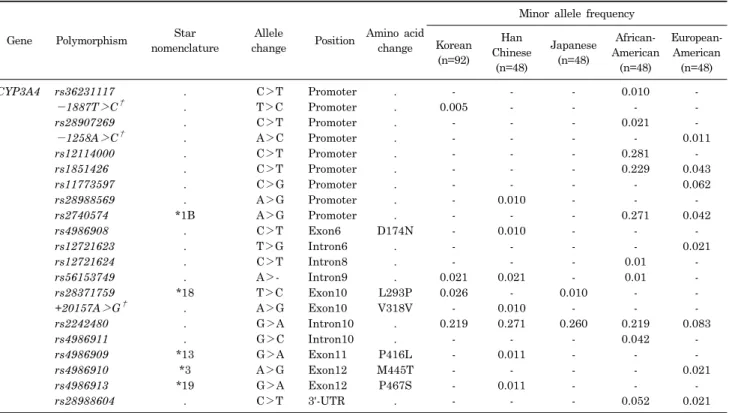
Table 1. Results from direct sequencing of CYP3A4 and CYP3A5 with five different ethnic groups and CYP3A5 on these polymorphic expressions and the risk
of various diseases [14-16].
Previously, 22 and 11 types of pharmacogenetic markers were identified in CYP3A4 and CYP3A5, respectively (reviewed in [17]). Also, it is well-known that frequency dif- ferences of the genetic polymorphisms are responsible for diverse gene expressions which are related with various drug responses. For example, the high frequency of CYP3A5*3 allele in Caucasian led to a high area under curve value for cyclosporine metabolism [18]. Moreover, it was also demonstrated that the CYP3A5*6 and *7 alleles, which were responsible for loss of the protein synthesis, showed frequencies of 10 to 20% in African but were not found in other ethnicities [19].
A number of previous studies showed that the frequencies of the CYP3A4 and CYP3A5 polymorphisms were different based on ethnicities. However, genetic studies of the two genes with Korean population are insufficient. Therefore, we performed direct sequencing of CYP3A4 and CYP3A5 to define the genotype frequencies for known genetic poly- morphisms and identify novel polymorphisms in a Korean population. Following this, we compared allele distributions in five different ethnic groups comprising 96 Koreans, 48 Japanese, 48 Han Chinese, 48 African-Americans, and 48 European-Americans.
METHODS Study subjects
DNA samples were obtained from a total of 288 subjects consisting of 96 Koreans, 48 African-Americans, 48 Euro- pean-Americans, 48 Japanese, and 48 Han Chinese. DNA
samples from 96 unrelated Korean individuals were pro- vided by the Center for Genome Science, Korea Centers for Disease Control and Prevention. DNA samples from other ethnic groups were obtained from a large panel of anony- mous, unrelated DNA samples from the Human Variation Panels available at the Coriell Institute (Camden, NJ, USA).
Sequencing analysis of CYP3A4/ 5 genes
The promoter, all exons, and exon-intron boundaries (±50 bp) were PCR-amplified and directly sequenced using the ABI PRISM 3730 genetic analyzer (Applied Biosystems, Foster City, CA, USA). Primers for the amplification and sequencing analysis were designed using Primer3 software [20] based on the GenBank sequence of respective genes (Ref. genome seq.: NG_008421.1 and NG_007938.1 for CYP3A4 and CYP3A5, respectively). The sequences of pri- mers are displayed in Supplementary Table 1. Sequence variants were verified by chromatograms using SeqMan software (Supplementary Fig. 1).
Statistical analysis
The χ2 tests were used to determine whether individual variants were in Hardy-Weinberg equilibrium (HWE) at each locus in each population. HaploView software was used for obtaining linkage disequilibrium (LD) blocks of each gene [21,22]. The Helical Wheel project, web-based software (http://cti.itc.virginia.edu/~cmg/Demo/wheel/
wheelApp.html), was used to predict the functional role of novel SNPs.
Gene Polymorphism Star nomenclature
Allele
change Position Amino acid change
Minor allele frequency
Korean (n=92)
Han Chinese
(n=48)
Japanese (n=48)
African- American
(n=48)
European- American (n=48)
CYP3A5 rs115450823 . T>A Promoter . - - - 0.094 -
-1308C>T† . C>T Promoter . - - - 0.094 -
rs36231118 . A>C Promoter . - - - 0.115 0.010
rs3823812 . T>A Promoter . 0.237 0.312 0.229 0.052 0.010
rs28365073 . T>C Promoter . - - - 0.021 -
rs28365079 . C>A Promoter . - - - 0.117 0.010
-352A>G† . A>G Promoter . - 0.010 - - -
-344A>G† . A>G Promoter . - 0.010 - - -
rs28365095 *1B G>A 5’UTR . - - - - 0.031
rs28371764 *1C C>T 5’UTR . - 0.010 - 0.01 0.062
+3626T>A† . T>A Intron1 . 0.010 - - - -
rs28365067 . C>T Intron2 . 0.021 0.021 0.032 - 0.062
rs41301652 . G>A Intron2 . - - - 0.01 -
rs28969392 . T>A Intron3 . - - - 0.011 -
rs776746 *3C T>C Intron3 . 0.255 0.344 0.260 0.198 0.085
+7070T>A† . T>A Intron3 . - 0.011 - - 0.010
+7074G>A† . G>A Intron3 . - - 0.022 - -
+7078T>A† . T>A Intron3 . - - - 0.01 -
+7080G>A† . G>A Intron3 . - 0.032 - - -
rs28365078 . C>A Intron3 . - - 0.011 - -
rs8175345 . C>T Intron3 . - - - 0.042 0.010
+7355T>C† . T>C Intron4 . - - - 0.010 -
+12801T>C† . T>C Intron4 . - - - - 0.010
rs55965422 . T>C Intron5 . 0.016 0.011 - - -
rs10264272 *6 C>T Exon7 K208K - 0.010 - 0.188 -
rs28383472 . A>G Exon7 P218P - - - 0.073 -
rs41303322 . A>G Intron7 . - - - 0.100 -
rs28383478 . C>T Intron9 . - - - - 0.010
rs4646453 . G>T Intron9 . 0.234 0.302 0.240 0.042 0.010
rs28383479 *9 G>A Exon10 A337T - - - - 0.010
rs28365094 . A>G Intron10 . - - 0.010 0.011 0.083
rs41303343 *7 A>- Exon11 . - - - 0.146 -
+27256C>T† . C>T Exon11 P389S 0.005 - - - -
rs28365069 . T>C Intron12 . - - - 0.031 -
+31546T>G† . T>G Exon13 I488S 0.005 0.021 - - -
rs15524 . T>C 3'UTR . 0.247 0.323 0.281 0.365 0.031
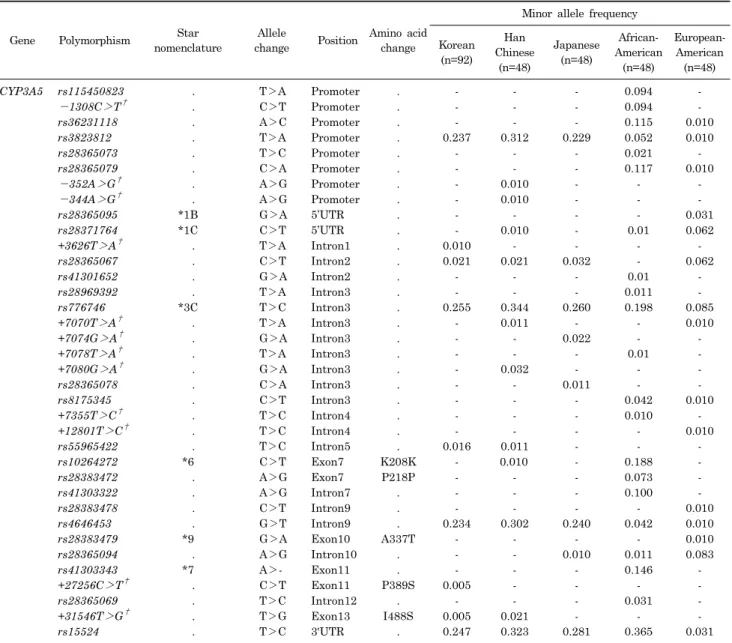
Variants which are monomorphic in all ethnicities are not shown in the Table. A hyphen (-) indicates that the variant was mono- morphic in the particular ethnicity. Data not applicable are marked with a dot (.).
†These polymorphisms were newly identified in this study.
Table 1. Continued
RESULTS
In the present study, we identified the CYP3A4/5 poly- morphisms in five ethnicities using direct sequencing, and compared the genotype distributions among ethnicities.
The direct sequencing of CYP3A4/5 was performed in a to- tal of 288 healthy subjects consisting of 96 Koreans, 48 European-Americans, 48 African-Americans, 48 Han Chi- nese, and 48 Japanese.
From the direct sequencing, we obtained a total of 15 nov- el polymorphisms which consist of 3 CYP3A4 SNPs (-1887T
>C, -1258A>C, and +20157A>G (V318V) and 12 CYP3A5 variants (-1308C>T, -352A>G, -344A>G, +3626T>A, +7070T>A, +7074G>A, +7078T>A, +7080G
>A, +7355T>C, +12801T>C, +27256C>T (P389S), and
+31546T>G (I488S) (Table 1). Also, we observed 18 and 24 previously reported SNPs in CYP3A4/5 genes, re- spectively (Table 1). Locations of the polymorphisms are shown in each physical gene map along with their minor allele frequencies (MAFs) (Fig. 1).
Most of the CYP3A4 and CYP3A5 polymorphisms showed low frequencies or monomorphic genotypes. In general, the MAFs of CYP3A4 polymorphisms were similar across the Asian populations, whereas MAFs of African-American and European-American populations differed from those of Asians. Among the pharmacogenetic markers, MAFs of CYP3A4*1B (rs2740574) were detected in European- Americans (0.042) and African-Americans (0.271), whereas the polymorphism was not detected in any Asian popu- lations. On the other hand, rs2242480 was identified with
Fig. 1. (A) A physical map of CYP3A4 with minor allele frequen- cies using results from Korean, Afri- can-American, European-American, Han Chinese, and Japanese popu- lations. Novel SNPs are labeled with their locations and allele changes.
(B) A physical map of CYP3A5 with minor allele frequencies using re- sults from Korean, African-Ame- rican, European-American, Han Chi- nese, and Japanese populations. No- vel SNPs are labeled with their locations and allele changes.
a low frequency in the European-American population (0.083) compared to other ethnicities (>0.200), and three SNPs (rs12114000, rs1851426, and rs2740574) were identi- fied as having high frequencies among African-Americans (0.281, 0.229, and 0.271, respectively), but was almost mon- omorphic in other populations. Detailed information re- garding SNPs in CYP3A4 is displayed in Table 1.
In CYP3A5, CYP3A5*3C (rs776746) showed higher MAFs in Asian populations (0.255, Korean; 0.344, Han Chinese;
0.260, Japanese) than in other ethnic groups (0.198, African-American; 0.085, European-American). Other two polymorphisms (rs3823812 and rs4646453) were also de- tected that had higher MAFs among Asians (>0.200) com- pared to other populations (<0.060). On the other hand, the MAF of rs15524 was lowest in European-Americans (0.031), while the frequencies in other populations were higher than 0.200. CYP3A5*6 (rs10264272) and CYP3A5*7 (rs41303343) were detected with high as having MAFs in African-Americans (0.188 and 0.146, respectively), but was almost monomorphic in other populations. Detailed in- formation regarding SNPs in CYP3A5 is displayed in Table 1.
p-values for Hardy-Weinberg equilibrium of each poly- morphism were calculated for the five ethnic groups (Supplementary Table 2). All of CYP3A4 alleles were in Hardy-Weinberg equilibrium. However, in CYP3A5, p-val- ues of rs28365067 in Japanese and +7080G>A in Han Chinese were not in Hardy-Weinberg equilibrium.
LD structures of CYP3A4 and CYP4A5 in five ethnicities were calculated by using SNPs which were identified in more than two ethnicities, and the results were displayed in Supplementary Fig. 2. However, LD structures were not clearly constructed due to the SNPs with low or mono-
morphic frequencies.
DISCUSSION
CYP3A4 and CYP3A5 enzymes are regarded as im- portant markers in the development of the personalized medicine due to the enzymes’ impact on efficacy of drugs based on genetic background of individuals or populations.
Therefore, we conducted the present study to compare ge- netic differences in the CYP3A4 and CYP3A5 genes among five ethnicities. The sequencing results showed that many pharmacogenetic markers in CYP3A4 and CYP3A5 were ei- ther monomorphic or had low frequencies. This trend was consistent with previous observations in which a large number of CYP3A polymorphisms exhibited low frequencies (reviewed in [23]). This indicates that a larger sample size may be needed to detect the polymorphisms.
Among the pharmacogenetic markers in CYP3A4, CYP3A4*
1B (rs2740574) is known to be the polymorphism that in- creases expression by changing the transcription factor binding affinity [24]. Recently, it was demonstrated that CYP3A4*1B carriers showed higher drug clearance for an- ti-cancer agents, such as docetaxel and cyclophosphamide, than wild type subjects [25-27]. However, although CYP3A4*
1B plays an important role in the enzyme activity, the marker has not been detected in Asian populations in pre- vious studies [28-30]. Our results also showed that CYP3A4*1B was not detected in Asians, including a Korean population. These observations suggest that the alteration of metabolism of docetaxel and cyclophosphamide by CYP3A4*1B might be difficult to find in Asian populations.
The other pharmacogenetic marker, CYP3A4*18 (rs28371759)
has been reported as the polymorphism that accounts for bidirectional enzyme activity. Previous studies showed that the polymorphism increased the turnover rate of testoster- one and chlorpyrifos, but decreased the metabolic turnover rate of midazolam and nifedipine [31-35]. In addition, pre- vious studies reported that CYP3A4*18 was frequently identified in Asian populations such as Chinese (frequency, 0.008∼0.01), Japanese (frequency, 0.013), Koreans (fre- quency, 0.012∼0.017) and Malaysians (frequency, 0.021) [33,36-40]. The result of the present study also showed that the polymorphism was detected in two Asian populations (Korean, 0.021 and Japanese, 0.010), while other pop- ulations showed monomorphic genotypes. Therefore, Asian populations may have more genetic protection against tox- icity of chlorpyrifos than other populations. Moreover, Asian populations tend to experience an effective dose with lower amounts of midazolam and nifedipine for treatment of seizure and cardiac/circulatory disorders.
A recent study reported that the CYP3A4*22 (rs35599367) allele played an important role in the hepatic CYP3A4 ex- pression and CYP3A4 activity, as well as alteration of sta- tin, tacrolimus and cyclosporine metabolism [17]. This SNP was not found in our subjects. According to the NCBI data- base, the polymorphism had a frequency of around 0.025 in only Caucasian population. Therefore, no detection of the polymorphisms in the present study may occur due to the low frequency of the allele.
In CYP3A5, CYP3A5*3C (rs776746) is well known as the polymorphism that causes severe decrease of enzyme activ- ity by a splicing defect [41]. It has been reported that in- dividuals with CYP3A5*3C show a lower clearance rate of drugs such as carbamazepine, vincristine, and ifosfamide, which are used for treatment using anticonvulsants, mood- stabilizers, and anti-cancer agents [42-45]. In the present study, we observed that the frequency of the CYP3A5*3C polymorphism was relatively higher in Asian populations than in other populations (Korean, 0.255; Han Chinese, 0.344; Japanese, 0.260 vs. African-American, 0.198; Euro- pean-American, 0.085). Therefore, identifying the CYP3A5*
3C genotype could be important for application of carbama- zepine, vincristine, and ifosfamide in treating Asian epi- lepsy, bipolar disorder, trigeminal neuralgia, and cancer patients.
Due to the important roles of non-synonymous SNPs in protein functions, we selected exonic variants that cause amino acid change (+27256C>T, P389S and +31546T>G, I488S in CYP3A5) so as to predict the functional role of the SNPs using web-based software. Results from the anal- ysis showed that the amino acid substitutions by the poly- morphisms could change the charge of residues from non- polar to polar. These alterations of amino acid properties can cause a change in protein structure [46]. Therefore, the two polymorphisms may affect enzyme activity through the modification of protein structure, although further func- tional studies would be required to confirm the result.
Conclusively, we performed direct sequencing of the CYP3A4/5 in five ethnicities to identify SNPs, and com- pared the frequency differences of the polymorphisms among ethnicities. From the analysis, we obtained a total of 57 SNPs composed of 15 novel polymorphisms and 42 known variants. Our results indicated that genotype fre- quencies of Asian populations were different from those of other ethnic groups. Additional in silico analysis revealed that two novel non-synonymous SNPs could cause alter- ation of protein folding. Although our LD structures were
not accurately calculated due to the low frequencies of the SNPs, there appears to be no linkage between novel poly- morphisms and known pharmacogenetic marker. Further studies with large scale sample may be required to obtain reliable results, as well as exact p-values for Hardy- Weinberg equilibrium. The results of the present study may be helpful for further understanding of pharmacogenetics.
SUPPLEMENTARY MATERIALS
Supplementary data including one figure can be found with this article online at http://pdf.medrang.co.kr/paper/
pdf/Kjpp/Kjpp017-06-01-s001.pdf.
ACKNOWLEDGEMENT
This work was supported by a grant from the Korean National Institute of Food and Drug Safety Evaluation (NIFDS) funded by the Korea Food and Drug Administrat- ion (KFDA).
REFERENCES
1. Sim SC, Ingelman-Sundberg M. Pharmacogenomic biomarkers:
new tools in current and future drug therapy. Trends Phar- macol Sci. 2011;32:72-81.
2. Savonarola A, Palmirotta R, Guadagni F, Silvestris F. Phar- macogenetics and pharmacogenomics: role of mutational ana- lysis in anti-cancer targeted therapy. Pharmacogenomics J.
2012;12:277-286.
3. Kristyanto H, Utomo AR. Pharmacogenetic application in personalized cancer treatment. Acta Med Indones. 2010;42:
109-115.
4. Gellner K, Eiselt R, Hustert E, Arnold H, Koch I, Haberl M, Deglmann CJ, Burk O, Buntefuss D, Escher S, Bishop C, Koebe HG, Brinkmann U, Klenk HP, Kleine K, Meyer UA, Wojnowski L. Genomic organization of the human CYP3A locus: iden- tification of a new, inducible CYP3A gene. Pharmacogenetics.
2001;11:111-121.
5. Guengerich FP. Cytochrome p450 and chemical toxicology.
Chem Res Toxicol. 2008;21:70-83.
6. Sun H, Bessire AJ, Vaz A. Dirlotapide as a model substrate to refine structure-based drug design strategies on CYP3A4- catalyzed metabolism. Bioorg Med Chem Lett. 2012;22:371-376.
7. Wrighton SA, Stevens JC. The human hepatic cytochromes P450 involved in drug metabolism. Crit Rev Toxicol. 1992;22:
1-21.
8. Hall SD, Thummel KE, Watkins PB, Lown KS, Benet LZ, Paine MF, Mayo RR, Turgeon DK, Bailey DG, Fontana RJ, Wrighton SA. Molecular and physical mechanisms of first-pass extrac- tion. Drug Metab Dispos. 1999;27:161-166.
9. Wacher VJ, Wu CY, Benet LZ. Overlapping substrate speci- ficities and tissue distribution of cytochrome P450 3A and P-glycoprotein: implications for drug delivery and activity in cancer chemotherapy. Mol Carcinog. 1995;13:129-134.
10. Ozdemir V, Kalow W, Tang BK, Paterson AD, Walker SE, Endrenyi L, Kashuba AD. Evaluation of the genetic component of variability in CYP3A4 activity: a repeated drug administra- tion method. Pharmacogenetics. 2000;10:373-388.
11. Wrighton SA, Brian WR, Sari MA, Iwasaki M, Guengerich FP, Raucy JL, Molowa DT, Vandenbranden M. Studies on the expression and metabolic capabilities of human liver cyto- chrome P450IIIA5 (HLp3). Mol Pharmacol. 1990;38:207-213.
12. Hustert E, Haberl M, Burk O, Wolbold R, He YQ, Klein K, Nuessler AC, Neuhaus P, Klattig J, Eiselt R, Koch I, Zibat A, Brockmöller J, Halpert JR, Zanger UM, Wojnowski L. The
genetic determinants of the CYP3A5 polymorphism. Phar- macogenetics. 2001;11:773-779.
13. Rostami-Hodjegan A, Tucker GT. Simulation and prediction of in vivo drug metabolism in human populations from in vitro data. Nat Rev Drug Discov. 2007;6:140-148.
14. Lee AJ, Mills LH, Kosh JW, Conney AH, Zhu BT. NADPH- dependent metabolism of estrone by human liver microsomes.
J Pharmacol Exp Ther. 2002;300:838-849.
15. Lee AJ, Kosh JW, Conney AH, Zhu BT. Characterization of the NADPH-dependent metabolism of 17beta-estradiol to multiple metabolites by human liver microsomes and selectively expres- sed human cytochrome P450 3A4 and 3A5. J Pharmacol Exp Ther. 2001;298:420-432.
16. Huang Z, Guengerich FP, Kaminsky LS. 16Alpha-hydro- xylation of estrone by human cytochrome P4503A4/5. Carcino- genesis. 1998;19:867-872.
17. Elens L, van Gelder T, Hesselink DA, Haufroid V, van Schaik RH. CYP3A4*22: promising newly identified CYP3A4 variant allele for personalizing pharmacotherapy. Pharmacogenomics.
2013;14:47-62.
18. Min DI, Ellingrod VL, Marsh S, McLeod H. CYP3A5 poly- morphism and the ethnic differences in cyclosporine pharma- cokinetics in healthy subjects. Ther Drug Monit. 2004;26:524- 19. MacPhee IA. Pharmacogenetic biomarkers: cytochrome P450 528.
3A5. Clin Chim Acta. 2012;413:1312-1317.
20. Rozen S, Skaletsky H. Primer3 on the WWW for general users and for biologist programmers. Methods Mol Biol. 2000;132:
365-386.
21. Devlin B, Risch N. A comparison of linkage disequilibrium measures for fine-scale mapping. Genomics. 1995;29:311-322.
22. Barrett JC, Fry B, Maller J, Daly MJ. Haploview: analysis and visualization of LD and haplotype maps. Bioinformatics. 2005;
21:263-265.
23. Lamba JK, Lin YS, Schuetz EG, Thummel KE. Genetic contribution to variable human CYP3A-mediated metabolism.
Adv Drug Deliv Rev. 2012;64:256-269.
24. Amirimani B, Ning B, Deitz AC, Weber BL, Kadlubar FF, Rebbeck TR. Increased transcriptional activity of the CYP3A4*
1B promoter variant. Environ Mol Mutagen. 2003;42:299-305.
25. Hesselink DA, van Gelder T, van Schaik RH, Balk AH, van der Heiden IP, van Dam T, van der Werf M, Weimar W, Mathot RA. Population pharmacokinetics of cyclosporine in kidney and heart transplant recipients and the influence of ethnicity and genetic polymorphisms in the MDR-1, CYP3A4, and CYP3A5 genes. Clin Pharmacol Ther. 2004;76:545-556.
26. Tran A, Jullien V, Alexandre J, Rey E, Rabillon F, Girre V, Dieras V, Pons G, Goldwasser F, Tréluyer JM. Pharma- cokinetics and toxicity of docetaxel: role of CYP3A, MDR1, and GST polymorphisms. Clin Pharmacol Ther. 2006;79:570-580.
27. Petros WP, Hopkins PJ, Spruill S, Broadwater G, Vredenburgh JJ, Colvin OM, Peters WP, Jones RB, Hall J, Marks JR.
Associations between drug metabolism genotype, chemotherapy pharmacokinetics, and overall survival in patients with breast cancer. J Clin Oncol. 2005;23:6117-6125.
28. Walker AH, Jaffe JM, Gunasegaram S, Cummings SA, Huang CS, Chern HD, Olopade OI, Weber BL, Rebbeck TR. Charac- terization of an allelic variant in the nifedipine-specific element of CYP3A4: ethnic distribution and implications for prostate cancer risk. Mutations in brief no. 191. Online. Hum Mutat.
1998;12:289.
29. Hsieh KP, Lin YY, Cheng CL, Lai ML, Lin MS, Siest JP, Huang JD. Novel mutations of CYP3A4 in Chinese. Drug Metab Dispos. 2001;29:268-273.
30. Ball SE, Scatina J, Kao J, Ferron GM, Fruncillo R, Mayer P, Weinryb I, Guida M, Hopkins PJ, Warner N, Hall J. Population distribution and effects on drug metabolism of a genetic variant
in the 5' promoter region of CYP3A4. Clin Pharmacol Ther.
1999;66:288-294.
31. Watkins PB. Noninvasive tests of CYP3A enzymes. Pharma- cogenetics. 1994;4:171-184.
32. Streetman DS, Bertino JS Jr, Nafziger AN. Phenotyping of drug-metabolizing enzymes in adults: a review of in-vivo cytochrome P450 phenotyping probes. Pharmacogenetics. 2000;
10:187-216.
33. Kang YS, Park SY, Yim CH, Kwak HS, Gajendrarao P, Krishnamoorthy N, Yun SC, Lee KW, Han KO. The CYP3A4*
18 genotype in the cytochrome P450 3A4 gene, a rapid meta- bolizer of sex steroids, is associated with low bone mineral density. Clin Pharmacol Ther. 2009;85:312-318.
34. Dai D, Tang J, Rose R, Hodgson E, Bienstock RJ, Mohrenweiser HW, Goldstein JA. Identification of variants of CYP3A4 and characterization of their abilities to metabolize testosterone and chlorpyrifos. J Pharmacol Exp Ther. 2001;299:825-831.
35. Lee SJ, Bell DA, Coulter SJ, Ghanayem B, Goldstein JA.
Recombinant CYP3A4*17 is defective in metabolizing the hypertensive drug nifedipine, and the CYP3A4*17 allele may occur on the same chromosome as CYP3A5*3, representing a new putative defective CYP3A haplotype. J Pharmacol Exp Ther. 2005;313:302-309.
36. Lee SJ, Lee SS, Jeong HE, Shon JH, Ryu JY, Sunwoo YE, Liu KH, Kang W, Park YJ, Shin CM, Shin JG. The CYP3A4*18 allele, the most frequent coding variant in asian populations, does not significantly affect the midazolam disposition in heterozygous individuals. Drug Metab Dispos. 2007;35:2095- 2101.
37. Wen S, Wang H, Ding Y, Liang H, Wang S. Screening of 12 SNPs of CYP3A4 in a Chinese population using oligonucleotide microarray. Genet Test. 2004;8:411-416.
38. Hu YF, He J, Chen GL, Wang D, Liu ZQ, Zhang C, Duan LF, Zhou HH. CYP3A5*3 and CYP3A4*18 single nucleotide polymorphisms in a Chinese population. Clin Chim Acta. 2005;
353:187-192.
39. Ruzilawati AB, Suhaimi AW, Gan SH. Genetic polymorphisms of CYP3A4: CYP3A4*18 allele is found in five healthy Malaysian subjects. Clin Chim Acta. 2007;383:158-162.
40. Yamamoto T, Nagafuchi N, Ozeki T, Kubota T, Ishikawa H, Ogawa S, Yamada Y, Hirai H, Iga T. CYP3A4*18: it is not rare allele in Japanese population. Drug Metab Pharmacokinet.
2003;18:267-268.
41. Kuehl P, Zhang J, Lin Y, Lamba J, Assem M, Schuetz J, Watkins PB, Daly A, Wrighton SA, Hall SD, Maurel P, Relling M, Brimer C, Yasuda K, Venkataramanan R, Strom S, Thummel K, Boguski MS, Schuetz E. Sequence diversity in CYP3A promoters and characterization of the genetic basis of polymorphic CYP3A5 expression. Nat Genet. 2001;27:383-391.
42. Park PW, Seo YH, Ahn JY, Kim KA, Park JY. Effect of CYP3A5*3 genotype on serum carbamazepine concentrations at steady-state in Korean epileptic patients. J Clin Pharm Ther. 2009;34:569-574.
43. Seo T, Nakada N, Ueda N, Hagiwara T, Hashimoto N, Nakagawa K, Ishitsu T. Effect of CYP3A5*3 on carbamazepine pharmacokinetics in Japanese patients with epilepsy. Clin Pharmacol Ther. 2006;79:509-510.
44. Dennison JB, Kulanthaivel P, Barbuch RJ, Renbarger JL, Ehlhardt WJ, Hall SD. Selective metabolism of vincristine in vitro by CYP3A5. Drug Metab Dispos. 2006;34:1317-1327.
45. McCune JS, Risler LJ, Phillips BR, Thummel KE, Blough D, Shen DD. Contribution of CYP3A5 to hepatic and renal ifosfamide N-dechloroethylation. Drug Metab Dispos. 2005;33:
1074-1081.
46. Weinshilboum R, Wang L. Pharmacogenomics: bench to bed- side. Nat Rev Drug Discov. 2004;3:739-748.