INTRODUCTION
Non-erosive reflux disease (NERD) is defined as the presence of the classical symptoms of gastroesophageal reflux disease (GERD) without esophageal mucosal injury determined by upper gastrointestinal endoscopy.1 It is regarded as one of the
two main phenotypes of GERD, the other being erosive esoph- agitis, in which mucosal injury such as erosion or ulceration is obvious during endoscopy. GERD is a common disorder, and the prevalence of at least weekly heartburn and/or acid regurgita- tion is 9–28% in Western countries.2-5 Although GERD is less prev- alent in Asian countries and Korea, occurring in only 2.5–8.2%
of people,5-10 however, it is emerging as a leading digestive dis- order and has a negative impact on quality of life. Most cases of GERD are of the NERD phenotype, and the proportion of patients with NERD is estimated as 50–85% of the GERD population.11-13
The increasing prevalence of GERD appears to be related to that of obesity. Obesity is common in the Western world, and is becoming increasingly common in Asian countries as well. In Korea, the prevalence of obesity [defined as a body mass index (BMI) ≥25 kg/m2 according to the Korean Society for the Study of Obesity] is increasing, and was reported as 26.9% in 1998
Central Obesity as a Risk Factor for Non-Erosive Reflux Disease
Ki Ju Kim1,2 and Ban Seok Lee3,4
1Department of Internal Medicine, Kyungpook National University School of Medicine, Daegu;
2Digestive Disease Center, Department of Internal Medicine, Gumi CHA Hospital, Gumi;
3Department of Internal Medicine, Kang-Il Hospital, Gimhae;
4Digestive Disease Center, Department of Internal Medicine, Cheju Halla General Hospital, Jeju, Korea.
Purpose: Although central obesity is a risk factor for erosive esophagitis, information regarding the association between central obesity and non-erosive reflux disease (NERD) is still scarce. The purpose of this study was to investigate the risk factors for NERD by comparing NERD patients and healthy controls.
Materials and Methods: Comprehensive clinical data from 378 patients who underwent esophagogastroduodenoscopy from De- cember 2012 to May 2013 and had no visible esophageal mucosal breakage were analyzed. The Korean version of GerdQ question- naire was used to diagnose NERD. The association between central obesity and NERD was assessed after matching subjects ac- cording to propensity scores.
Results: There were 119 NERD patients and 259 controls. In multivariate analysis, central obesity, female gender, and younger age were significantly associated with NERD [odds ratio (OR)=2.55, 1.93, and 1.80; p=0.001, 0.005, and 0.011, respectively]. After adjust- ing for 12 clinical variables using propensity score matching, 114 NERD patients were matched to 114 controls. All variables were well balanced between the two groups (average D before matching: 0.248, after matching: 0.066). Patients with NERD were more likely to have central obesity than healthy controls (28.1% vs. 7.9%). After adjusting for propensity scores and all covariates in mul- tivariable logistic regression analyses, central obesity was still found to be a significant risk factor for NERD (OR=4.55, p<0.001).
Conclusion: Central obesity appears to be an independent risk factor for NERD. This result supports the presence of an association between GERD and central obesity, even in the absence of esophageal erosion (NERD).
Key Words: Central obesity, gastroesophageal reflux, risk factor
pISSN: 0513-5796 · eISSN: 1976-2437
Received: November 24, 2016 Revised: March 19, 2017 Accepted: March 29, 2017
Corresponding author: Dr. Ban Seok Lee, Department of Internal Medicine, Kang-Il Hospital, 359 Garak-ro, Gimhae 50905, Korea.
Tel: 82-55-336-7701, Fax: 82-55-334-7701, E-mail: [email protected]
•The authors have no financial conflicts of interest.
© Copyright: Yonsei University College of Medicine 2017
This is an Open Access article distributed under the terms of the Creative Com- mons Attribution Non-Commercial License (http://creativecommons.org/licenses/
by-nc/4.0) which permits unrestricted non-commercial use, distribution, and repro- duction in any medium, provided the original work is properly cited.
Yonsei Med J 2017 Jul;58(4):743-748 https://doi.org/10.3349/ymj.2017.58.4.743
and in 32% in 2011.14,15 Population-based studies have shown that overweight or obesity are both positively associated with GERD symptoms.16-19 Many studies have also found a positive correlation between obesity and GERD-associated esophageal erosion (e.g., erosive esophagitis, Barrett’s esophagus).6,18,20,21 However, information regarding the relationship between obe- sity and NERD is still scarce and inconsistent. One population- based study compared patients with NERD to people from a normal control population, and identified a number of risk factors for NERD.9 Low BMI (<23) was one of the risk factors for NERD. Contrary to the above, however, an another study showed reverse results and a positive correlation between NERD and central obesity.22
With the above in mind, we aimed to investigate the risk fac- tors for NERD by comparing people with the disease to healthy controls from a homogeneous Korean population, and ana- lyzed the associations between BMI/waist circumference (as markers of obesity and central obesity, respectively) and NERD after adjusting for several confounding factors.
MATERIALS AND METHODS
Study design and population
This was a case-control study. We included the participants who had visited the Digestive Disease Center of the Cheju Halla General Hospital for a medical check-up from December 2012 to May 2013. The general medical check-up program included esophagogastroduodenoscopy, abdominal ultrasonography and/or contrast-enhanced computed tomography, and labora- tory tests. We excluded subjects who had esophageal erosion or ulceration: i.e., erosive esophagitis (n=26), Barrett’s esopha- gus (n=4), hiatal hernia (n=26), and active mucosal lesions in- cluding peptic ulcers (n=12). Subjects with a history of gastric surgery (n=4), proton pump inhibitor/histamine-2 receptor an- tagonist/aspirin or non-steroidal anti-inflammatory drug ther- apy during the previous week (n=6), diabetes mellitus (n=31), achalasia (n=1), end-stage renal or liver disease (n=11), or ma- lignancy (n=14) were excluded because of the possibility for these issues to confound the results. Finally, a total of 378 sub- jects were enrolled in this study. Informed consent was ob- tained from all participants, and the study was approved by the Institutional Review Board of Cheju Halla General Hospital.
Data collection
Demographic data (age, gender, smoking status, alcohol con- sumption, medical or surgical history, and history of medica- tion) were obtained before the endoscopic procedure. All sub- jects were offered a Korean version of questionnaire, the GerdQ,23 which probed the onset, frequency, and severity of classical GERD symptoms (heartburn, acid regurgitation) experienced over the past year as well as atypical symptoms (non-cardiac chest pain, hoarseness, chronic cough, and chronic sore throat).
GERD was considered to be present if the total score was ≥8, or
≥3 for the high impact questions according to the GerdQ scor- ing system. All subjects underwent upper endoscopy, abdom- inal computed tomography and/or ultrasonography, and lab- oratory tests during the routine check-up.
Height was measured using a portable stadiometer, and weight was measured using a calibrated balance scale. BMI was calculated as the ratio of weight to the square of height (kg/m2).
Obesity was defined as a BMI ≥25 kg/m2 according to the Ko- rean Society for the Study of Obesity.14 Moreover, waist circum- ference was measured at the midpoint between the lower bor- der of the rib cage and the iliac crest by trained personnel.
Central obesity was defined as a waist circumference of ≥90 cm in men and ≥85 cm in women according to the Korean Soci- ety for the Study of Obesity.24
Endoscopic procedures were carried out using an upper en- doscope (GIF H260, Olympus Optical Co., Ltd., Tokyo, Japan) after pharyngeal anesthesia by an endoscopist with a specialty certificate who was blinded to the results of the GerdQ ques- tionnaire. The severity of esophagitis was classified into four grades according to the Los Angeles classification.25 However, minimal changes (erythema, blurring, friability, mucosal ede- ma, increased vascularity) were not considered as erosive esoph- agitis. Gastroduodenal lesions, hiatal hernia, and Barrett’s esoph- agus (a pink salmon colored esophageal lining that extends a distance up to the esophagus from the gastroesophageal junc- tion) observed during endoscopy were also recorded. GERD was classified as either erosive esophagitis or NERD according to the presence or absence of esophageal erosions or ulcerations.
Statistical analysis
Categorical variables were expressed using numbers with pro- portions (%), and continuous variables were expressed using means and standard deviations. Pearson’s chi-square test with Fisher’s exact test was used to compare the categorical vari- ables between the NERD and non-NERD groups, while the Mann-Whitney U-test was used to compare the continuous vari- ables. The variables tested were age, gender, smoking status, alcohol consumption status, chronic gastritis, impaired glucose tolerance, hypertension, fatty liver, biliary disease, cerebrovas- cular accident, azotemia, hyperlipidemia, BMI, and waist cir- cumference. Univariate and multivariate analyses of the fac- tors associated with NERD were performed using a logistic regression model. For each factor, an odds ratio (OR) with 95%
confidence interval (CI) was estimated. These results were also confirmed using a propensity-scoring model. Propensity score- matching analysis was carried out using logistic regression to establish propensity scores for patients in the NERD and non- NERD groups. All variables were included in the propensity models except for the outcome variables (BMI and waist cir- cumference). The model was then used to provide a one-to-one match between the two groups using the nearest-neighbor method.26 Multiple logistic regression analyses with matched
data were then repeated to assess the association between obe- sity/central obesity and NERD after adjusting for propensity scores and all covariates. A p value<0.05 was considered statis- tically significant. All statistical analyses were performed with
SPSS software package, version 21 (SPSS Inc., Chicago, IL, USA).
RESULTS
Demographics and clinical characteristics
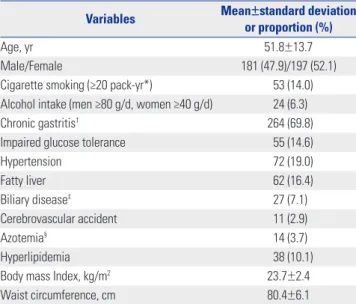
A total of 378 subjects, including 119 NERD patients and 259 controls, were included in this study. The demographic and clini- cal characteristics of the included subjects are summarized in Table 1. Their mean age was 51.8±13.7 years, the proportion of men was 47.9%, mean BMI was 23.7±2.4 kg/m2, and mean waist circumference was 80.4±6.1 cm. The prevalence of obesity was 17.0% (19.3 and 15.8 with or without NERD, respectively; p=
0.400), and the prevalence of central obesity was 19.3% (27.7 and 15.4 with or without NERD, respectively; p=0.005) (Table 2).
Univariate and multivariate analyses of factors associated with NERD
Univariate analysis showed that younger age, female gender, and central obesity were significantly associated with NERD (p=0.020, 0.015, and 0.005, respectively) (Table 3). Smoking sta- tus (heavy smokers vs. others) and drinking status (heavy drink- ers vs. others) were not significantly associated with NERD (p=0.591 and 0.840, respectively). Other variables including obe- sity or biliary disease did not show significant associations with NERD. When only gallbladder stone was included in univari- Table 1. Baseline Characteristics of the Study Populations (n=378)
Variables Mean±standard deviation or proportion (%)
Age, yr 51.8±13.7
Male/Female 181 (47.9)/197 (52.1)
Cigarette smoking (≥20 pack-yr*) 053 (14.0) Alcohol intake (men ≥80 g/d, women ≥40 g/d) 24 (6.3)
Chronic gastritis† 264 (69.8)
Impaired glucose tolerance 55 (14.6)
Hypertension 072 (19.0)
Fatty liver 62 (16.4)
Biliary disease‡ 027 (7.1)
Cerebrovascular accident 11 (2.9)
Azotemia§ 014 (3.7)
Hyperlipidemia 38 (10.1)
Body mass Index, kg/m2 23.7±2.4
Waist circumference, cm 80.4±6.1
*One pack-year=1 pack per day for a year, †Chronic gastritis included atrophic gastritis, superficial gastritis, and erosive gastritis, ‡Biliary diseases include gall bladder polyps and biliary stones, §Azotemia was defined as a creatinine level
≥1.4 mg/dL.
Table 2. Clinical Characteristics of Patients with NERD and without NERD before and after Matching with Propensity Scores
Variables Before matching After matching
NERD (n=119) Non-NERD (n=259) p value D NERD (n=114) Non-NERD (n=114) p value D Matching variable
Older age (>50 yr), n (%) 54 (45.4) 151 (58.3) 0.019 0.287 53 (46.5) 53 (46.5) 0.999 0.000
Male/Female, n 46/73 135/124 0.015 0.302 43/71 43/71 0.999 0.000
Cigarette smoking (≥20 pack-yr*),
n (%) 15 (12.6) 38 (14.7) 0.591 0.097 13 (11.4) 13 (11.4) 0.999 0.000
Alcohol intake (men ≥80 g/d,
women ≥40 g/d), n (%) 08 (6.7) 16 (6.2)0 0.840 0.050 05 (4.4) 04 (3.5) 0.999 0.128
Chronic gastritis†, n (%) 77 (64.7) 187 (72.2) 0.140 0.182 74 (64.9) 74 (64.9) 0.999 0.000
Impaired glucose tolerance, n (%) 11 (9.2) 44 (17.0) 0.047 0.385 11 (9.6) 06 (5.3) 0.207 0.360
Hypertension, n (%) 20 (16.8) 52 (20.1) 0.452 0.120 19 (16.7) 19 (16.7) 0.999 0.000
Fatty liver, n (%) 16 (13.4) 46 (17.8) 0.293 0.182 16 (14.0) 17 (14.9) 0.851 0.039
Biliary disease‡, n (%) 7 (5.9) 20 (7.7) 0.519 0.161 7 (6.1) 9 (7.9) 0.604 0.149
CVA, n (%) 01 (0.8) 10 (3.9)0 0.184 0.858 01 (0.9) 01 (0.9) 0.999 0.000
Azotemia (Cr ≥1.4), n (%) 6 (5.0) 8 (3.1) 0.384 0.281 4 (3.5) 4 (3.5) 0.999 0.000
Hyperlipidemia, n (%) 13 (10.9) 25 (9.7)0 0.703 0.076 12 (10.5) 10 (8.8) 0.654 0.111
Outcome variable, n (%)
Obesity§ 23 (19.3) 41 (15.8) 0.400 22 (19.3) 13 (11.4) 0.098
Central obesity (men ≥90 cm,
women ≥85 cm) 33 (27.7) 40 (15.4) 0.005 32 (28.1) 9 (7.9) <0.001
NERD, non-erosive reflux disease; CVA, cerebrovascular accident; Cr, creatinine.
The variables were compared with the chi-square (Fisher’s exact) test for unmatched data or the Cochran-Mantel-Haenszel test adjusting for the matched pairs.
D=standardized difference, expressed as log odds ratios by multiplying by 1.814.
*One pack-year=1 pack per day for a year, †Chronic gastritis included atrophic gastritis, superficial gastritis, and erosive gastritis, ‡Biliary diseases included gall bladder polyps and biliary stone, §Obesity was defined as a body mass index ≥25 kg/m2 according to the Korean Society for the Study of Obesity.
ate analysis, there was also no association between gallbladder stone and NERD (OR=1.242, p=0.121). Multiple logistic regres- sion analyses adjusting for age, gender, smoking status, alcohol consumption status, chronic gastritis, impaired glucose toler- ance, hypertension, fatty liver, biliary disease, cerebrovascular accidents, azotemia, hyperlipidemia, obesity, and central obe- sity were performed. In the analysis, obesity was not a determi- nant of NERD. However, the correlation between central obesi- ty and NERD was still observed after adjusting for clinical variables (OR=2.546, 95% CI 1.472–4.405, p=0.001). Female gender (OR=1.928, 95% CI 1.217–3.056, p=0.005) and younger age (OR=1.798, 95% CI 1.146–2.824, p=0.011) were also indepen- dent risk factors for NERD.
Propensity score-matching analysis
Table 2 presents the clinical characteristics of the subjects with and without NERD before and after matching using propensi- ty scores. Propensity score matching was employed to adjust the baseline demographics and clinical characteristics between the NERD and non-NERD groups, and to confirm the results of the previous analyses. After adjusting for 12 clinical variables, 114 patients with NERD were matched to 114 healthy controls.
All variables were well balanced between the two groups. The average standardized difference was 0.248 before matching, and decreased to 0.066 after matching. Patients with NERD also presented with a higher prevalence of central obesity than healthy controls (28.1% vs. 7.9%). In multiple logistic regression analyses performed after adjusting for propensity scores and all covariates, obesity was not associated with NERD. Howev- er, central obesity remained an independent and significant risk factor for NERD (OR=4.553, 95% CI 2.508–10.071, p<0.001) in the propensity score-matching analysis.
DISCUSSION
In this cohort of patients who presented for medical check-ups, we found a positive association between central obesity and NERD after adjusting for several potential confounding fac- tors including age, gender, smoking status, and alcohol con- sumption. This association remained significant even after adjusting for propensity scores and all covariates (4.5-fold in- crease). However, obesity was not associated with NERD after adjusting for confounding factors. Other risk factors for NERD included female gender and younger age.
Previous studies have demonstrated significant associations between GERD and obesity/central obesity. However, data con- cerning the risk factors for NERD are scarce. Only one study22 from Korea reported a positive association between NERD and central obesity, but the results were not derived from a prospec- tive investigation. Although this was not a prospective trial, our present study was conducted using a propensity score-match- ing method. Considering different sequelae or the natural cours- es of obesity and central obesity, the present findings are valu- able and provide additional information concerning the risk factor of NERD.
In this study, central obesity but not obesity itself was related with NERD. The mechanism of how central obesity can increase the risk of gastroesophageal reflux symptoms is still specula- tive and maybe multifactorial. Several hypotheses could be suggested to explain the association. One of the possible mech- anism is impaired function of the lower esophageal sphincter (LES). The LES acts as a physiological barrier to prevent gas- tric contents from refluxing to the esophagus. The impaired function of LES have been observed to be more common in pa- tients with central obesity.27,28 Intra-abdominal pressure is an Table 3. Univariate and Multivariate Analyses of Factors Associated with Non-Erosive Reflux Disease
Variables Univariate
OR (95% CI) p value Multivariate
OR (95% CI) p value
Older age (>50 yr) 0.594 (0.384–0.920) 0.020 0.556 (0.354–0.872) 0.011
Female sex 1.728 (1.110–2.689) 0.015 1.928 (1.217–3.056) 0.005
Cigarette smoking (≥20 pack-yr) 1.192 (0.628–2.264) 0.591
Alcohol intake (men ≥80 g/d, women ≥40 g/d) 1.095 (0.455–2.633) 0.840
Chronic gastritis 0.706 (0.444–1.123) 0.141
Impaired glucose tolerance 0.498 (0.247–1.002) 0.051
Hypertension 0.804 (0.455–1.420) 0.453
Fatty liver 0.719 (0.389–1.331) 0.294
Biliary disease 0.747 (0.307–1.818) 0.520
Cerebrovascular accident 0.211 (0.027–1.668) 0.140
Azotemia 1.666 (0.565–4.913) 0.355
Hyperlipidemia 1.148 (0.565–2.331) 0.703
Obesity* 1.274 (0.725–2.240) 0.400
Central obesity† 2.101 (1.244–3.548) 0.005 2.546 (1.472–4.405) 0.001
OR, odds ratio; CI, confidence interval.
*Obesity was defined as a body mass index ≥25 kg/m2 according to the Korean Society for the Study of Obesity, †Central obesity was defined as a waist circum- ference ≥90 cm in men and ≥85 cm in women.
another possible explanation. Mechanical effect of adipose tissue within the abdominal cavity and elevated intra-abdom- inal pressure may lead the relaxation of the LES and the con- sequent reflux of acid. Some authors suggested that hormonal factors related to visceral adipose tissue, including adiponec- tin, leptin, tumor necrosis factor-alpha, or others, are also im- portant in the pathogenesis of symptoms of NERD.29 Various kinds of adipocytokines may act systemically, and also influ- ence integration of gastroesophageal junction and enhance gastric secretory function.30-32 Future studies need to focus on the association between these factors and the etiology of NERD.
In the present study, we evaluated the association between BMI or waist circumference and NERD. Waist circumference is a simple, widely advocated marker of central obesity.33 We measured waist circumference at the midpoint between the lower border of the rib cage and the iliac crest according to the World Health Organization recommendations, because the inter- and intra-observer reliability and reproducibility were found to be high at this point.34 Our study revealed that the in- creased prevalence of NERD was not associated with BMI (a marker of obesity), but was associated with waist circumference (a marker of central obesity). Recent studies have suggested that the distribution of body fat, especially the visceral fat, is a more significant factor in terms of obesity. One study found that abdominal diameter rather than BMI was associated with frequent gastroesophageal reflux symptoms.35 Furthermore, based on the measurement of abdominal fat tissue by comput- ed tomography, several studies have demonstrated a signifi- cant association between visceral fat and gastroesophageal re- flux symptoms.21,36 Further studies are needed to explain the main underlying mechanism of the relationship between cen- tral obesity and NERD.
The results of this study showed that female gender and young- er age were also related with NERD, and this finding was con- sistent with those of previous reports.4,9,20,37-39 The different per- ceptions of gastric sensations according to gender/age may have played a role in the different reflux symptoms observed. Hor- monal or physical factors may be associated with differences in the prevalence of NERD between men and women, or be- tween younger and older patients.
This study had several limitations. First, false positivity or neg- ativity is possible when defining GERD symptoms using the GerdQ questionnaire (65% sensitivity and 71% specificity).23 In addition, the Korean version of the GerdQ used in our study has not been officially validated in Korea. It is important to find out whether diagnostic threshold scores for GERD are appropri- ate for Korean patients. Thus, further studies should be need- ed to validate GerdQ for Korean patients. Second, the issue is whether these patients with symptoms and negative endos- copy truly have NERD or functional heartburn. This requires the use of objective measures of esophageal acid exposure. How- ever, this study was health check-up based study. Therefore, we did not measure esophageal pH nor exclude esophageal hy-
persensitivity. Third, the study participants were self-motivat- ed to attend screening medical check-ups, and selection bias might therefore be present. The members of the study popula- tion, who could afford the costs of the check-up program, were more likely to be from the higher socioeconomic group. Fourth, the proportion of NERD patients in our study, about 31%, is too high. Study subjects included not only person under health in- surance-medical check-up program, but also volunteer who would like to receive medical check-up examination such as CT or/and endoscopy due to their symptom. This point could lead to a selection bias. Fifth, Helicobacter pylori infection and the effect of the participants’ diets, which could be potential confounding factors, were not considered in the analyses.
In conclusion, our results showed that central obesity is an independent risk factor for NERD. These findings support the presence of an association between central obesity and reflux disease, even in the absence of esophageal erosion (NERD).
Our findings will have important implications for the preven- tion and management of NERD, and future studies should be built on these findings to explore potential therapeutic and preventative measures related to NERD.
REFERENCES
1. An evidence-based appraisal of reflux disease management--the Genval Workshop Report. Gut 1999;44 Suppl 2:S1-16.
2. Locke GR 3rd, Talley NJ, Fett SL, Zinsmeister AR, Melton LJ 3rd.
Prevalence and clinical spectrum of gastroesophageal reflux: a population-based study in Olmsted County, Minnesota. Gastro- enterology 1997;112:1448-56.
3. Moayyedi P, Talley NJ. Gastro-oesophageal reflux disease. Lancet 2006;367:2086-100.
4. El-Serag HB, Petersen NJ, Carter J, Graham DY, Richardson P, Genta RM, et al. Gastroesophageal reflux among different racial groups in the United States. Gastroenterology 2004;126:1692-9.
5. El-Serag HB, Sweet S, Winchester CC, Dent J. Update on the epide- miology of gastro-oesophageal reflux disease: a systematic review.
Gut 2014;63:871-80.
6. Kang MS, Park DI, Oh SY, Yoo TW, Ryu SH, Park JH, et al. Abdomi- nal obesity is an independent risk factor for erosive esophagitis in a Korean population. J Gastroenterol Hepatol 2007;22:1656-61.
7. Cho YS, Choi MG, Jeong JJ, Chung WC, Lee IS, Kim SW, et al. Prev- alence and clinical spectrum of gastroesophageal reflux: a popula- tion-based study in Asan-si, Korea. Am J Gastroenterol 2005;100:
747-53.
8. Wong WM, Lai KC, Lam KF, Hui WM, Hu WH, Lam CL, et al. Prev- alence, clinical spectrum and health care utilization of gastro-oe- sophageal reflux disease in a Chinese population: a population- based study. Aliment Pharmacol Ther 2003;18:595-604.
9. Kim N, Lee SW, Cho SI, Park CG, Yang CH, Kim HS, et al. The prev- alence of and risk factors for erosive oesophagitis and non-erosive reflux disease: a nationwide multicentre prospective study in Ko- rea. Aliment Pharmacol Ther 2008;27:173-85.
10. Kim KM, Cho YK, Bae SJ, Kim DS, Shim KN, Kim JH, et al. Preva- lence of gastroesophageal reflux disease in Korea and associated health-care utilization: a national population-based study. J Gas- troenterol Hepatol 2012;27:741-5.
11. Tack J, Caenepeel P, Arts J, Lee KJ, Sifrim D, Janssens J. Prevalence
of acid reflux in functional dyspepsia and its association with symptom profile. Gut 2005;54:1370-6.
12. El-Serag HB. Epidemiology of non-erosive reflux disease. Digestion 2008;78 Suppl 1:6-10.
13. Zagari RM, Fuccio L, Wallander MA, Johansson S, Fiocca R, Casa- nova S, et al. Gastro-oesophageal reflux symptoms, oesophagitis and Barrett’s oesophagus in the general population: the Loiano- Monghidoro study. Gut 2008;57:1354-9.
14. Oh SW, Shin SA, Yun YH, Yoo T, Huh BY. Cut-off point of BMI and obesity-related comorbidities and mortality in middle-aged Ko- reans. Obes Res 2004;12:2031-40.
15. Kim CS, Ko SH, Kwon HS, Kim NH, Kim JH, Lim S, et al. Prevalence, awareness, and management of obesity in Korea: data from the Korea national health and nutrition examination survey (1998- 2011). Diabetes Metab J 2014;38:35-43.
16. Nilsson M, Johnsen R, Ye W, Hveem K, Lagergren J. Obesity and es- trogen as risk factors for gastroesophageal reflux symptoms. JAMA 2003;290:66-72.
17. Delgado-Aros S, Locke GR 3rd, Camilleri M, Talley NJ, Fett S, Zins- meister AR, et al. Obesity is associated with increased risk of gas- trointestinal symptoms: a population-based study. Am J Gastroen- terol 2004;99:1801-6.
18. El-Serag HB, Graham DY, Satia JA, Rabeneck L. Obesity is an inde- pendent risk factor for GERD symptoms and erosive esophagitis.
Am J Gastroenterol 2005;100:1243-50.
19. El-Serag HB, Ergun GA, Pandolfino J, Fitzgerald S, Tran T, Kramer JR. Obesity increases oesophageal acid exposure. Gut 2007;56:749- 55.
20. Labenz J, Jaspersen D, Kulig M, Leodolter A, Lind T, Meyer-Sabellek W, et al. Risk factors for erosive esophagitis: a multivariate analysis based on the ProGERD study initiative. Am J Gastroenterol 2004;99:
1652-6.
21. Nam SY, Choi IJ, Ryu KH, Park BJ, Kim HB, Nam BH. Abdominal visceral adipose tissue volume is associated with increased risk of erosive esophagitis in men and women. Gastroenterology 2010;139:
1902-11.
22. Nam SY, Ryu KH, Park BJ. Irritable bowel syndrome is associated with gastroesophageal reflux symptom but not erosive esophagi- tis. J Neurogastroenterol Motil 2013;19:521-31.
23. Jones R, Junghard O, Dent J, Vakil N, Halling K, Wernersson B, et al.
Development of the GerdQ, a tool for the diagnosis and manage- ment of gastro-oesophageal reflux disease in primary care. Aliment Pharmacol Ther 2009;30:1030-8.
24. Lee SY, Park HS, Kim DJ, Han JH, Kim SM, Cho GJ, et al. Appropri- ate waist circumference cutoff points for central obesity in Korean adults. Diabetes Res Clin Pract 2007;75:72-80.
25. Armstrong D, Bennett JR, Blum AL, Dent J, De Dombal FT, Galmi- che JP, et al. The endoscopic assessment of esophagitis: a progress report on observer agreement. Gastroenterology 1996;111:85-92.
26. D’Agostino RB Jr. Propensity score methods for bias reduction in the comparison of a treatment to a non-randomized control group.
Stat Med 1998;17:2265-81.
27. Fisher BL, Pennathur A, Mutnick JL, Little AG. Obesity correlates with gastroesophageal reflux. Dig Dis Sci 1999;44:2290-4.
28. Kahrilas PJ, Shi G, Manka M, Joehl RJ. Increased frequency of tran- sient lower esophageal sphincter relaxation induced by gastric distention in reflux patients with hiatal hernia. Gastroenterology 2000;118:688-95.
29. Jacobson BC, Somers SC, Fuchs CS, Kelly CP, Camargo CA Jr. Body- mass index and symptoms of gastroesophageal reflux in women.
N Engl J Med 2006;354:2340-8.
30. Beales IL, Post L, Calam J, Yamada T, Delvalle J. Tumour necrosis factor alpha stimulates gastrin release from canine and human an- tral G cells: possible mechanism of the Helicobacter pylori-gastrin link. Eur J Clin Invest 1996;26:609-11.
31. Endo Y, Kumagai K. Induction by interleukin-1, tumor necrosis fac- tor and lipopolysaccharides of histidine decarboxylase in the stom- ach and prolonged accumulation of gastric acid. Br J Pharmacol 1998;125:842-8.
32. Tilg H, Moschen AR. Visceral adipose tissue attacks beyond the liv- er: esophagogastric junction as a new target. Gastroenterology 2010;
139:1823-6.
33. Taylor RW, Keil D, Gold EJ, Williams SM, Goulding A. Body mass index, waist girth, and waist-to-hip ratio as indexes of total and re- gional adiposity in women: evaluation using receiver operating characteristic curves. Am J Clin Nutr 1998;67:44-9.
34. Mason C, Katzmarzyk PT. Variability in waist circumference mea- surements according to anatomic measurement site. Obesity (Sil- ver Spring) 2009;17:1789-95.
35. Corley DA, Kubo A, Zhao W. Abdominal obesity, ethnicity and gas- tro-oesophageal reflux symptoms. Gut 2007;56:756-62.
36. Lee HL, Eun CS, Lee OY, Jeon YC, Han DS, Yoon BC, et al. Associa- tion between erosive esophagitis and visceral fat accumulation quantified by abdominal CT scan. J Clin Gastroenterol 2009;43:
240-3.
37. Ang TL, Fock KM, Ng TM, Teo EK, Chua TS, Tan J. A comparison of the clinical, demographic and psychiatric profiles among patients with erosive and non-erosive reflux disease in a multi-ethnic Asian country. World J Gastroenterol 2005;11:3558-61.
38. Mishima I, Adachi K, Arima N, Amano K, Takashima T, Moritani M, et al. Prevalence of endoscopically negative and positive gastro- esophageal reflux disease in the Japanese. Scand J Gastroenterol 2005;40:1005-9.
39. Rosaida MS, Goh KL. Gastro-oesophageal reflux disease, reflux oesophagitis and non-erosive reflux disease in a multiracial Asian population: a prospective, endoscopy based study. Eur J Gastro- enterol Hepatol 2004;16:495-501.