| Abstract |
Purpose: Balance and gait dysfunction caused by aging affect elderly individuals’ independent life, which, in turn, can reduce their overall quality of life. The purpose of this study is to compare the differences in the vestibular function of healthy elderly and young adults based on the subjective visual vertical (SVV) test as well as to compare and analyze the gait ability between these two groups to study the differences and association between vestibular, dizziness, and balance ability.
Methods: The subjects were 18 young and 16 elderly adults with no neurological or musculoskeletal damage. To evaluate vestibular function, a subjective visual vertical test was performed. To evaluate the gait function, the step time, step length, stride length, stance phase ratio, and swing phase ratio were measured. Balance was evaluated using the Berg Balance Scale (BBS), and dizziness was evaluated using a dizziness handicap inventory (DHI).
Results: There were significant differences in the SVV, BBS, and DHI between the young and elderly adults (p < 0.05). The gait variables of the older adults were all significantly different (except for the swing phase ratio) than those of the young adults (p < 0.05). As the result of correlation analysis, the SVV values of the young adults showed a significant negative correlation with step length and stride length (p < 0.05), while the SVV values of the elderly adults only showed a significant positive correlation with the DHI (p < 0.05).
Conclusion: The elderly appeared to show a decrease in vestibular function when compared to the young adults, and it is thought that walking and balance function declined, while dizziness increased. Moreover, it is believed that these results can be used as basic data for vestibular rehabilitation in the future.
Key Words: Aging, Dizziness, Vestibular system, Balance
†Corresponding Author : Sang-Seok Yeo ([email protected])
Original Article Open Access
노인과 젊은 성인의 주관적 시수직의 차이와 그에 따른 균형, 어지럼증 및 보행 변화 연구
권중원⋅여상석†1)
단국대학교 보건복지대학 물리치료학과
A Study of the Differences in Subjective Visual Vertical Between the Elderly and Young Adults and Balance, Dizziness, and Gait Changes
Jung-Won Kwon, P.T., Ph.D.⋅Sang-Seok Yeo, P.T., Ph.D.†
Department of Physical Therapy, College of Health and Welfare, Dankook University Received: August 11, 2020 / Revised: August 31, 2020 / Accepted: August 31, 2020
ⓒ 2020 Journal of Korea Proprioceptive Neuromuscular Facilitation Association
This is an Open Access article distributed under the terms of the Creative Commons Attribution Non-Commercial License (http://creativecommons.org/licenses/by-nc/3.0) which permits unrestricted non-commercial use, distribution, and reproduction in any medium, provided the original work is properly cited.
Ⅰ. 서 론
노화에 따른 균형 및 보행 기능 장애는 노인의 독립 적 생활에 영향을 미치고 그로 인해 전반적인 삶의 질이 저하될 수 있다(Bogle Thorbahn & Newton, 1996;
Duckrow et al., 1999). 노인의 균형 및 보행 기능 장애는 낙상에 의한 골절로 이어질 수 있으며(El Haber et al., 2008), 65세부터 74세까지 보행 장애의 유병률이 급격 히 증가하는 것으로 알려져 있다(Ricci et al., 2016).
노인의 독립적이고 건강한 신체 기능 유지를 위해서 는 안전하고 효율적인 보행과 좋은 균형 유지 능력이 필요하다(El Haber et al., 2008). 75세 이상의 노인들 중 36% 이상에서 자세 유지 및 균형 능력의 어려움이 나타나고 65세에서 69세 사이의 13%, 85세 이상의 46%가 걷는 동안 균형을 잡는데 어려움을 호소한다고 보고하였다(Alexander, 1994).
균형 능력의 유지에는 시각, 전정, 고유수용성 감각 등의 기여를 요구하며 세 감각의 통합은 사람의 자세 균형 유지에 필수적인 요소이다(Gaerlan, 2012; Sturnieks et al., 2008). 노화에 따른 시각기능의 변화는 일반적으 로 50세 이후 점차적으로 진행되고, 시력 저하와 더불 어 시각 정보의 처리 능력 감소와 관련된 생리적 변화 를 유발한다(Gittings & Fozard, 1986). 고유수용성 감각 의 변화는 근육, 힘줄, 관절 수용체의 구조적 및 기능적 변화로 인하여 관절 위치감각, 움직임 및 촉각 등의 정보 전달에 문제를 일으켜 자세 불안정성을 초래한 다(Fitzpatrick & McCloskey, 1994). 또한, 전정 기능의 노화에 따라 전정안반사(Vestibulo–ocular reflex) 기능 이 감소하는 것으로 알려져 있으며, 특히 75세 이상의 노인에서 상당한 감소가 발생하는 것으로 보고되었다 (Schubert & Migliaccio, 2019). 전정 기능의 감소는 공 간에 대한 이해와 기억의 감소를 유발하고 결과적으 로 균형 능력의 저하를 유발하게 된다(Agrawal et al., 2019; Agrawal et al., 2020). 노화에 따른 균형 기능 장애의 또다른 원인으로는 말초 혹은 중추 전정 기능 과 그와 관련된 균형 신호의 처리 능력 저하, 전정 피질의 효율성 감소가 있다(Allen et al., 2017). 전정기
관은 속귀에 반고리관 이석기관과 작은 구조물들로 이루어져있으며, 반고리관에서 머리의 각 속도를 변 환하고 이석기관으로부터 오는 신호인 선의 가속도를 변환한다(Allen et al., 2017). 따라서 이 구조물들은 머 리의 회전과 중력 방향으로의 이동을 감지하게 된다 (Kim, 2015). 속귀의 전정 기관에서 받아들인 머리의 움직임에 대한 정보는 전정신경을 통해 뇌간의 전정 신경핵으로 전달된 후, 전정 척수반사와 전정 안반사 를 통해 자세 및 시선 유지에 관여한다(Kim, 2015).
노인의 어지럼증의 원인에는 여러가지 요인이 복합적 으로 작용하지만 그 중 전정 기능의 저하나 장애가 가장 주요한 원인으로 보고되고 있다(Iwasaki &
Yamasoba, 2015).
임상에서 사용되는 전정기능의 평가 방법은 매우 다양하며 대상자의 특성에 따라 다양한방법으로 적용 되고 있다(Agrawal et al., 2012; Maes et al., 2010). 각각 의 전정 검사에는 특정 장단점이 있습니다. 온도 안진 검사(caloric test)는 임상에서 가장 많이 사용되는 전정 검사이며 수평 반고리관(horizontal semicircular canal) 의 기능을 평가하는데 사용된다(Agrawal et al., 2020).
하지만, 오른쪽과 왼쪽 사이의 상대 기능 만을 측정할 수 있으며, 양측의 절대적 전정 기능을 측정하지 못하 는 단점이 있다(Agrawal et al., 2020). 회전식 의자 검사 는 재현성이 좋은 또 다른 검사이지만 수평 반고리관 만 측정 가능하고 오른쪽 및 왼쪽 전정 손상을 명확히 할 수 없다는 문제가 있다(Rambold, 2017). 전정유발 근전위검사(Vestibular-evoked myogenic potential tests) 는 이석 기능 검사에 많이 사용되지만 평가자 간 신뢰 도와 재현성이 낮다는 문제를 가지고 있다(Rosengren et al., 2019). 임상에서 사용되는 전전 기능의 평가는 매우 다양하며 각각의 장단점을 가지고 있다. 따라서, 본 연구는 건강한 노인과 젊은 성인에서 Subjective visual vertical(SVV) 검사 결과를 기반으로 전정 기능 의 차이를 비교하고, 두 그룹 간 보행 능력을 비교 분석하여 전정, 어지럼증, 균형능력 간의 차이와 연관 성을 연구하고자 하였다.
Ⅱ. 연구 방법
1. 연구 대상
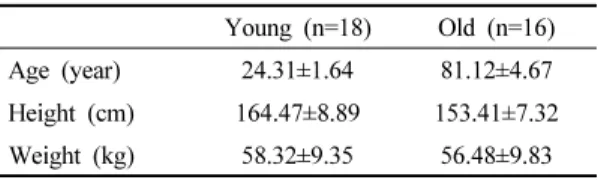
본 연구는 건강한 젊은 성인과 노인을 대상으로 전정기능, 어지럼증 및 보행기능 사이의 상관관계를 알아보기 위해 진행되었다. 참가자는 20대 성인 18명 과 70-80대 노인 16명으로, 균형능력과 관련된 신경학 적 및 근골격계 장애가 없고 일상생활에 지장에 없는 사람으로 구성되었다(Table 1). 모든 참가자는 연구의 취지 및 목적에 대한 설명을 들은 뒤, 자발적 동의를 한 후 연구에 참가하였다.
Young (n=18) Old (n=16) Age (year) 24.31±1.64 81.12±4.67 Height (cm) 164.47±8.89 153.41±7.32 Weight (kg) 58.32±9.35 56.48±9.83 Mean±Standard Deviation
Table 1. General characteristics of subjects
2. 실험 방법
1) Dizziness handicap inventory (DHI)
DHI는 전정 질환의 영향을 평가하기 위한 설문지로 25개 항목으로 구성되어 있다. 각 항목에 대해 “항상”
은 4점, “가끔”은 2점, “없다”는 0점을 부여한다. DHI 에서 가능한 점수의 범위는 0점에서 100점까지로 100 점은 가장 큰 장애를 나타낸다(Nola et al., 2010). 설문 지는 2004년 대한평형의학회에서 한국어로 번역한 DHI를 사용하였다(Han et al., 2004). 이 DHI는 회전검 사 또는 안진 검사로는 알 수 없는 환자의 주관적 어지 러움 증상과 불편함을 객관적으로 정량화 하고 더 나 아가 치료결과를 객관적으로 평가할 수 있는 설문지 다(Kim et al., 2009). 따라서 대상자들의 주관적인 어지 러움 증상에 대해 알아보고자 사용하였고 대상자가 직접 작성하도록 하였으며, 글을 읽는데 어려움이 있
는 노인은 실험자가 옆에서 읽어주고 해당되는 항목 을 점검함으로써 평가하였다.
2) Berg balance scale (BBS)
BBS는 앉기, 서기, 자세변화 총 3가지 항목으로 구 분되며 앉은 자세에서 일어나기, 잡지 않고 서있기, 등받이에 기대지 않고 바른 자세로 앉기, 선 자세에서 앉기, 의자에서 의자로 이동하기, 두 눈을 감고 잡지 않고 서있기, 두발을 붙이고 잡지 않고 서있기, 선 자세 에서 앞으로 팔을 뻗쳐 내밀기, 바닥에 있는 물건을 잡아 올리기, 왼쪽과 오른쪽 돌아보기, 제자리에서 360도 회전하기, 발판 위에 발을 교대로 놓기, 한 발 앞에 다른 발을 일자로 두고 서있기, 한 다리로 서있기 로 총 14개 항목이며, 최소 0점에서 최대 4점으로 적용 하여 총점은 56점이다(Smith et al., 2004). 41-56점은 낮은 낙상위험도, 21-40점은 중도의 낙상위험도, 그리 고 0-20점은 높은 낙상 위험도이며(King et al., 2012), 평가시간은 10분 내외로 소요되었다. BBS는 검사자 내 신뢰도와 측정자 간 신뢰도가 각각 r=0.99, r=0.98로 서 높은 신뢰도와 내적 타당도를 가지고 있다(Whitney et al., 2003).
3) Subjective visual vertical (SVV)
대상자들의 전정감각과 시각에 관련된 균형을 정 적으로 평가하기 위해 SVV 검사를 사용하였다. SVV 검사는 속귀 내 타원주머니(utricle)의 이석 기능을 평 가하는 도구로, 비정상적인 주관적 기울임을 찾는 것 을 목적으로 한다(Pereira et al., 2015). 중추신경계 혹은 말초신경계 손상으로 인해 균형 능력에 문제가 발생 할 경우 SVV 검사 결과에 영향을 미치는 것으로 보고 되고 있다(Pereira et al., 2015). SVV 검사 도구는 검은 원형통 안에 정확한 편차를 알아보기 위한 스마트폰 기반 SVV측정 프로그램(Visual Vertical Lite, Clear Health Media, Melbourne, Australia)을 사용하였다 (Gandor et al., 2016)(Fig. 1). 검사자는 의자에 앉은 대상
자에게 시야가 차단될 정도로 원형통을 얼굴 가까이 에 위치시켰다. 검사자는 원형통을 시계방향, 반시계 방향으로 교대로 회전시킨 후, 원형통 안에 표시해 놓은 수직선에 따라 대상자가 스스로 느끼는 수직적 위치에 원형통을 회전시키도록 지시하였다. 설정 각 은 선행 연구를 바탕으로 왼쪽 및 오른쪽 각 45도로 설정하였다(Michelson et al., 2018). 대상자의 주관적 수직 위치 값을 절대 값으로 기록하였고 시계방향 측 정 절대 값과 반시계방향 측정 절대 값을 뺀 값을 차이 값으로 정리하였다. 각각의 방향에서 3회 측정하고 차이 값들의 평균을 구하였다(Beck & Petrak, 2017).
4) 보행 분석
보행 분석을 위한 OptoGait 시스템(OptoGait, Microgate SrI, Bolzano, Italy)은 송신, 수신 바에 적외선 LED 다이오드를 포함하고 있어 두 측정막대 사이의 통신을 가능하게 하고 보행을 통하여 피사체가 양쪽 막대 사이를 통과할 때, 시스템은 움직임에 의해 발생 하는 방해물을 양쪽 측정막대 사이에서 감지하고 지 속시간과 위치를 계산하였다(Lee et al., 2014).
1m 길이의 송, 수신바를 한 쪽에 각각 3개씩 이어 길이 3m, 폭은 1.5m로 양 쪽에 평행하게 위치시키고 대상자의 보행 분석의 정확성을 높이고자 웹캠을 보 행 하는 앞쪽에 설치하였다. 검사에 앞서 대상자는
평소 자신들의 보행 속도로 걷는 것을 안내 받았고 총 3회 실시하였다. 첫 번째 바에 들어가기 전 대상자 의 gait cycle의 정확한 측정을 위해 2걸음 뒤에 위치시 켜 3m 보행 분석 바를 통과 하도록 하였고, 통과 후 2걸음 더 걸은 후에 정지하도록 하였다. 측정 된 데이 터에서 첫 걸음과 마지막 걸음을 제외하고 중간 데이 터 값으로 평균값을 구하였다. 두 명의 검사자가 키와 몸무게를 포함한 일반 정보를 기록 후 보행 매개 변수 데이터 수집을 하였다.
보행 분석 프로그램에서 보행의 시간공간 변수 중 한발짝 시간(step time), 한발짝 길이(step length), 한걸 음 길이(stride length), 디딤기 비율(stance phase ratio), 흔듦기 비율(swing phase ratio)을 측정하였다.
3. 자료 분석
본 연구에서는 IBM SPSS statistics 20.0(SPSS Inc, Chicago, lL, USA) 통계프로그램을 사용하여 분석하였 다. 연구대상자의 일반적인 특성은 기술 통계량을 이 용하였다. 수집된 자료는 Shapiro-Wilk 검정을 통해 변수의 정규성 검정을 시행하였고, 검정 결과 모든 자료가 정규 분포함을 확인하였다. 건강한 성인 그룹 과 노인 그룹의 보행의 시공간 변수, BBS, SVV, DHI 값을 비교하기 위해 독립 표본 t 검정(independent t-test) 을 시행하였다. 그룹 간 SVV값과 보행의 시공간 변수, Fig. 1. Application of subjective visual vertical test.
BBS, DHI와의 상관관계를 알아보기 위하여 Spearman 상관분석을 사용하였다. 본 연구의 통계학적 유의수 준은 α=0.05로 설정하였다.
Ⅲ. 연구 결과
BBS 점수는 건강한 성인보다 노인에서 유의하게 낮은 결과를 보였으며(p<0.05), SVV결과는 노인이 젊
은 성인 보다 유의하게 높게 나타났다(p<0.05). DHI 점수는 건강한 성인보다 노인에서 높은 점수를 보였 으며 유의한 차이를 보였다(p<0.05)(Table 2).
노인들의 보행은 건강한 성인에 비해서 한 걸음 시간과 디딤기 비율에서 유의하게 높았고(p<0.05), 한 걸음 거리와 한발짝 거리는 유의하게 낮은 결과를 보 였다(p<0.05). 반면, 보행 중 흔듦기 비율은 두 그룹 간 유의한 차이를 보이지 않았다(p>0.05)(Table 3).
젊은 성인에서의 SVV 측정 값과 다른 변수들 간의 상관관계 분석 결과 SVV와 한걸음 거리, 보폭 사이에 유의한 음의 상관관계를 보였다(p<0.05), 나머지 변수 들과는 유의한 상관관계를 보이지 않았다(p>0.05). 노 인의 SVV 측정값은 DHI 점수와 유의한 양의 상관관 계를 보였으며 보행관련 변수 및 BBS 간의 유의한 상관관계는 보이지 않았다(p>0.05)(Table 4).
Ⅳ. 고 찰
본 연구의 목적은 젊은 성인과 노인을 대상으로 BBS (score) SVV (°) DHI (score)
Young group
(n=18) 55.67±1.41 0.81±0.39 1.78±3.35 Old group
(n=16) 48.13±3.56 2.93±2.53 8.36±12.60
p 0.00* 0.00* 0.03*
*p<0.05.
Mean value±standard deviation, BBS: Berg balance scale, SVV: subjective visual vertical, DHI: dizziness handicap inventory
Table 2. Comparison of balance, vestibular and dizziness test between young and old group
Step time (s) Step length (cm) Stride length
(cm) Stance (%) Swing (%)
Rt. Lt. Rt. Lt.
Young group (n=18) 0.53±0.03 0.54±0.02 60.49±4.98 61.03±4.15 122.40±8.98 64.71±1.58 35.30±1.57 Old group (n=16) 0.74±0.30 0.66±0.21 47.73±5.67 48.73±6.51 97.12±12.60 71.50±7.54 31.90±8.81
p 0.01* 0.03* 0.00* 0.00* 0.00* 0.00* 0.15
*p<0.05
Mean value±Standard Deviation
Table 3. Comparison of spatiotemporal parameters between young and old group
Step time Step length Stride
length Stance Swing DHI BBS
Rt. Lt. Rt. Lt.
Young SVV (n=18) r 0.11 0.36 -0.48* -0.50* -0.51* 0.20 -0.11 0.19 -0.12
p 0.68 0.15 0.04 0.03 0.03 0.44 0.66 0.45 0.64
Old SVV (n=16) r -0.10 -0.23 -0.11 -0.06 -0.11 -0.04 -0.28 0.57* -0.32
p 0.72 0.39 0.68 0.83 0.69 0.87 0.29 0.02 0.23
* p<0.05.
BBS: Berg balance scale, SVV: subjective visual vertical, DHI: dizziness handicap inventory
Table 4. Correlation of subjective visual vertical test with gait parameters, dizziness, and balance ability
하여 전정, 균형, 보행 기능의 차이를 알아보고, 전정기 능 평가와 관련된 SVV 검사 결과에 따른 보행 변수와 균형 기능, 어지럼증과의 상관관계를 알아보고자 하 였다. 실험결과 노인의 BBS 점수는 젊은 성인과 비교 하여 낮은 점수를 보였고, SVV와 DHI 점수는 높은 결과를 보였다. 노인의 시공간적 보행 변수 중 한걸음 시간과 디딤기 비율은 젊은 성인과 비교하여 유의하 게 높은 결과를 보였고 한 발짝 거리와 한 걸음 거리는 유의하게 낮은 결과를 보였다. SVV 결과와의 상관관 계 분석결과 젊은 성인은 한 발짝 거리, 한걸음 거리와 중등도 수준의 음의 상관관계를 보였고, 노인의 경우 DHI 결과와 중등도 수준의 양의 상관관계를 보였다.
결과적으로 노인의 보행 능력, 균형, 전정 및 어지럼증 과 관련된 변수에서 젊은 성인과 비교하여 노화에 따 른 많은 변화가 있음을 보여주었다.
일반적으로 노화에 따른 보행 기능의 저하는 골격 계의 퇴행성 변화와 근력의 저하로 인해 발생하는 것 으로 잘 알려져 있다(Benvenuti et al., 1995; Menz et al., 2005; Zacharias et al., 2019). 특히 균형 또는 전정 기능에 문제가 있는 노인의 경우 보행 기능에 더욱 많은 영향을 받는 것으로 알려져 있다(Borel et al., 2004; Marchetti et al., 2008). Marchetti 등(2008)의 연구 에서 20대에서 90대 까지의 성인을 대상으로 하여 Dynamic gait index를 사용하여 보행 기능을 평가하였 고, 분석 결과 전정 기능 장애가 있는 대상자들의 보행 변수 중 한 걸음 거리가 감소하였고 보폭이 증가하는 양상을 보고하였다(Marchetti et al., 2008). 또한 노인의 보행 기능 저하는 인지기능의 저하와도 관련이 있다 는 보고가 많으며 특히 초고령자의 경우 인지 기능저 하가 보행 속도 저하와 밀접한 관련이 있다고 알려져 있다(Öhlin et al., 2020). 본 연구 결과에서 노인의 보행 변수 중 한 발짝 시간과 디딤기 비율이 높게, 한 발짝과 한 걸음 거리가 낮게 나타났으며 이는 노화에 따른 균형 능력의 저하로 생각된다. 특히, 한발짝 시간과 디딤기 비율이 높게 나타난 것은 보행 중 발생할 수 있는 낙상과 균형의 무너짐을 방지하기 위한 보상 작 용으로 생각된다 (Pirker & Katzenschlager, 2017). 반면,
한발짝과 한걸음 거리의 감소는 근력의 저하 혹은 골 격계의 퇴행성 변화에 의한 보행 효율의 감소에 의한 변화로 생각된다 (Pirker & Katzenschlager, 2017).
SVV에 대한 기존 연구결과에 따르면 건강한 성인 의 SVV 결과는 평균적으로 2°범위 이내이며 2.5°를 넘어서는 경우 주관적 시수직에 문제가 있다고 판단 할 수 있다(Beck & Petrak, 2017). 본 실험 결과에서 젊은 성인에 비하여 노인의 SVV 검사 결과 정상 범위 보다 높은 수준을 보였으며, 이는 노화에 따른 말초 혹은 중추 전정계의 기능적 저하로 볼 수 있다. 노인의 SVV결과와 어지럼증을 나타내는 DHI 검사 결과와 유의한 상관관계를 보였다. 이는 노화에 따른 전정 기능의 병리학적 손실이 현기증 증상 및 낙상 위험의 증가시킨다는 기존의 연구 결과와 일치한다고 볼 수 있다(Herdman et al., 2007). 또한 전정 재활 훈련이 노인 의 현기증, 균형 자신감 및 이동성의 증상이 크게 개선 됐다는 결과를 보여주었다(Hall et al., 2010). 반면, 노 인의 SVV 결과와 보행의 시공간적 변수 및 균형 검사 결과와는 유의한 상관관계를 보이지 않았다. 이는 연 령 증가에 따른 보행 및 균형 기능의 문제는 전정 기능 의 저하로만 발생하지 않으며, 근골격계, 고유수용성 감각, 인지나 심리적 요인 등이 부가적으로 영향을 미쳤을 것이라 사료된다(Haber et al., 2008; Pirker &
Katzenschlager, 2017; Shaffer & Harrison, 2007).
젊은 성인에서 SVV 결과와 보행의 시공간적 변수 중 한 발짝과 한 걸음 거리와 유의한 음의 상관관계를 보였다. 이는 SVV 값이 높은 대상자 일수록 한 발짝과 한 걸음의 거리가 짧아졌다는 것을 의미한다. 일반적 으로 젊은 성인의 보행은 노인 혹은 신경학적 질환이 있는 환자들의 보행과 비교하여 한 발짝 혹은 한 걸음 거리가 길게 나타난다(Chen et al., 2007; Ostrosky et al., 1994). 따라서, 건강한 젊은 성인에서 한 발짝 혹은 한 걸음 거리의 감소는 보행 기능의 저하 혹은 낙상 방지를 위한 보상 작용을 의미한다고 할 수 있으며, 이는 전정 기능과 밀접한 관련이 있다고 할 수 있다 (Francis et al., 2015). 다시 말해, 일상생활에 문제가 없는 건강한 젊은 성인에서도 전정 기능의 변화는 균
형 및 보행 기능에 문제를 야기할 수 있다고 볼 수 있다. 반면, 젊은 성인의 SVV 결과는 DHI, BBS 결과 값과 유의한 상관관계를 보이지 않았다. 젊은 성인의 DHI와 BBS 측정 결과는 어지럼증이나 균형 기능의 저하가 있다고 볼 수 없을 정도의 점수였으며, SVV 결과 역시 정상 범위 이내로 관찰되었다. 따라서 말초 혹은 중추의 전정기능 장애로 볼 수 없는 수준이었으 며(Beck & Petrak, 2017), 어지럼증과 균형 문제를 유발 할 정도의 전정 기능 저하 역시 없었던 것으로 보여진 다. 또한, 젊은 성인의 자세 균형 유지에 전정 감각뿐만 아니라 고유수용성 감각과 시각의 기여 역시 크게 작 용하며 단순 SVV 결과 값으로 균형과 어지럼증의 요 소들을 모두 파악할 수는 없었던 것으로 사료된다 (Gaerlan et al., 2012).
결과적으로 젊은 성인에 비해 노인의 전정기능이 저하된 것으로 관찰되었으며 그에 따른 보행의 시공 간적 변수에도 영향을 미친 것으로 보인다. 또한 젊은 성인의 경우에도 전정 기능에 일정부분 감소가 발행 하는 경우 보행에 영향을 미치는 것으로 생각되며, 노인의 경우 전정 기능저하가 어지럼증의 증가와 밀 접한 관련이 있을 것으로 판단된다. 본 연구의 제한점 은 다음과 같다. 첫째, 노인과 건강한 성인을 대상으로 하였으나 표본의 크기가 작아 연구 결과를 일반화하 기에 한계가 있다. 둘째, 본 연구에서는 보행 변수 중에 서 시공간적 변수만을 측정하였으며 추후 연구에서는 운동 형상학적 보행평가 등이 필요할 것이라 사료된 다. 셋째, 노인과 젊은 성인에 있어 불균형과 어지럼증 이 어느 한 가지 척도나 측정을 통해 밝혀질 수 없기 때문에 다양한 접근을 통한 다각적인 평가와 측정이 필요할 것이다.
Ⅴ. 결 론
본 연구는 젊은 성인과 노인에게 SVV 검사 결과에 따른 전정 기능의 차이를 알아보고, 보행을 비교 분석 하여 그에 따른 보행 변수, 어지러움, 균형 능력 간의
차이와 연관성을 알아보고자 하였다. 실험의 결과 젊 은 성인은 SVV와 보행 변수에서 유의한 음의 상관관 계를 보였으며, 노인은 SVV와 DHI 간의 결과에서 유 의한 양의 상관관계를 보였다. 이러한 연구 결과는 노화에 따른 전정기능의 평가와 전정재활의 치료적 중재를 위한 기초가 자료가 될 수 있을 것으로 생각된 다. 향후 연구에서는 20대뿐만 아니라 30-40대를 포함 한 다양한 연령대를 대상으로 연구가 필요하고 전정 감각과 시각과 관련한 다양한 검사를 보행과 비교 분 석하는 연구와 더불어 전정감각과 보행 기능을 향상 시킬 수 있는 치료적 접근에 대한 전향적 연구가 필요 할 것으로 생각된다.
References
Agrawal Y, Zuniga MG, Davalos-Bichara M, et al. Decline in semicircular canal and otolith function with age.
Otology & neurotology. 2012;33(5):832–839.
Agrawal Y, Smith PF, Rosenberg PB. Vestibular impairment, cognitive decline and Alzheimer’s disease: balancing the evidence. Aging & Mental Health. 2019;24(5):
705-708.
Agrawal Y, Merfeld DM, Horak FB. Aging, vestibular function, and balance: proceedings of a national institute on aging/national institute on deafness and other communication disorders workshop. The Journals of Gerontology Series A Biological Sciences and Medical Sciences. 2020;75(12):2471-2480.
Alexander NB. Postural control in older adults. Journal of American Geriatrics Society. 1994;42(1):93-108.
Allen D, Ribeiro L, Arshad Q, et al. Age-related vestibular loss: current understanding and future research directions. Frontiers in neurology. 2017;7(1):231.
Batuecas-Caletrio A, Santacruz-Ruiz S, Muñoz-Herrera A, et al. Vestibular compensation after vestibular schwannoma surgery: normalization of the subjective
visual vertical and disability. Acta Oto Laryngologica.
2013;133(5):475-480.
Beck DL, Petrak MR. Subjective visual vertical (SVV) and the dizzy patient. Hearing Review. 2017;24(11):30-32.
Benvenuti F, Ferrucci L, Guralnik JM, et al. Foot pain and disability in older persons: an epidemiologic survey.
Journal of the American Geriatrics Society. 1995;
43(5):479-484.
Bogle Thorbahn LD, Newton RA. Use of the berg balance test to predict falls in elderly persons. Physical Therapy. 1996;76(6):576-583.
Borel L, Harlay F, Lopez C, et al. Walking performance of vestibular-defective patients before and after unilateral vestibular neurotomy. Behavioural Brain Research.
2004;150(1-2):191-200.
Chen G, Patten C, Kothari DH, et al. Gait differences between individuals with post-stroke hemiparesis and non-disabled controls at matched speeds. Gait &
posture. 2005;22(1):51-56.
Duckrow R, Abu-Hasaballah K, Whipple R, et al. Stance perturbation-evoked potentials in old people with poor gait and balance. Clinical Neurophysiology. 1999;110 (12):2026-2032.
El Haber N, Erbas B, Hill KD, et al. Relationship between age and measures of balance, strength and gait: Linear and non-linear analyses. Clinical Science. 2008a;
114(12):719-727.
Fitzpatrick R, McCloskey D. Proprioceptive, visual and vestibular thresholds for the perception of sway during standing in humans. The Journal of Physiology.
1994;478(1):173-186.
Francis CA, Franz JR, O’Connor SM, et al. Gait variability in healthy old adults is more affected by a visual perturbation than by a cognitive or narrow step placement demand. Gait & posture. 2015;42(3):
380-385.
Gandor F, Basta D, Gruber D, et al. Subjective visual vertical
in pd patients with lateral trunk flexion. Parkinson’s Disease. 2016;2016:1-4.
Gill J, Allum JH, Carpenter MG, et al. Trunk sway measures of postural stability during clinical balance tests:
effects of age. The Journals of Gerontology Series A: Biological Sciences and Medical Sciences.
2001;56(7):M438-447.
Gittings NS, Fozard JL. Age related changes in visual acuity.
Experimental gerontology. 1986;21(4-5):423-433.
Gaerlan MG, Alpert PT, Cross C, et al. Postural balance in young adults: the role of visual, vestibular and somatosensory systems. Journal of the American Academy of Nurse Practitioners. 2012;24(6):375-381.
Hall CD, Heusel-Gillig L, Tusa RJ, et al. Efficacy of gaze stability exercises in older adults with dizziness.
Journal of Neurologic Physical Therapy. 2010;34(2):
64-69.
Han G, Lee E, Lee J, et al. The study of standardization for a Korean adaptation of self-report measures of dizziness. Journal of the Korean Balance Society.
2004;3(2):307-325.
Herdman SJ, Hall CD, Schubert MC, et al. Recovery of dynamic visual acuity in bilateral vestibular hypofunction.
Archives of Otolaryngology–Head & Neck Surgery.
2007;133(4):383-389.
Iwasaki S, Yamasoba T. Dizziness and imbalance in the elderly:
age-related decline in the vestibular system. Aging and disease. 2015;6(1):38.
Jahn K, Kressig RW, Bridenbaugh SA, et al. Dizziness and unstable gait in old age: etiology, diagnosis and treatment. Deutsches Ärzteblatt International. 2015;
112(23):387-393.
Kantner RM, Rubin AM, Armstrong CW, et al. Stabilometry in balance assessment of dizzy and normal subjects.
American Journal of Otolaryngology. 1991;12(4):
196-204.
Keller K, Engelhardt M. Strength and muscle mass loss with
aging process. Age and strength loss. Muscles Ligaments and Tendons Journal. 2013;3(4):346-350.
Kerber KA, Baloh RW. The evaluation of a patient with dizziness. Neurology: clinical practice. 2011;1(1):24- 33.
Kim JS. Dizziness in the elderly. Journal of the Korean Neurological Association. 2015;33(1):1-7.
Kim JY, Hur DG, Jeon SY, et al. Assessment of subjective symptoms using dizziness handicap inventory in patients with vestibular neuritis. Research in Vestibular Science. 2009;8(1):27-31.
King LA, Priest KC, Salarian A, et al. Comparing the mini-bestest with the berg balance scale to evaluate balance disorders in Parkinson’s disease. Parkinson’s Disease.
2012;2012:1-7.
Lacour M, Bernard-Demanze L. Interaction between vestibular compensation mechanisms and vestibular rehabilitation therapy: 10 recommendations for optimal functional recovery. Frontiers in neurology. 2015;5(1):285.
Lee MM, Song CH, Lee KJ, et al. Concurrent validity and test-retest reliability of the optogait photoelectric cell system for the assessment of spatio-temporal parameters of the gait of young adults. Journal of physical therapy science. 2014;26(1):81-85.
Lundin-Olsson L, Nyberg L, Gustafson Y. “Stops walking when talking” as a predictor of falls in elderly people.
Lancet. 1997;349(9052):617.
Maes L, Dhooge I, D’haenens W, et al. The effect of age on the sinusoidal harmonic acceleration test, pseudorandom rotation test, velocity step test, caloric test, and vestibular-evoked myogenic potential test.
Ear Hear. 2010;31(1):84–94.
Marchetti GF, Whitney SL, Blatt PJ, et al. Temporal and spatial characteristics of gait during performance of the dynamic gait index in people with and people without balance or vestibular disorders. Physical therapy.
2008;88(5):640-651.
Menz, HB, Lord SR. Gait instability in older people with hallux valgus. Foot & ankle international. 2005;26(6):
483-489
Michelson PL, McCaslin DL, Jacobson GP, et al. Assessment of subjective visual vertical (svv) using the “bucket test” and the virtual svv system. American journal of audiology. 2018;27(3):249-259.
Nola G, Mostardini C, Salvi C, et al. Validity of italian adaptation of the dizziness handicap inventory (dhi) and evaluation of the quality of life in patients with acute dizziness. Acta Otorhinolaryngologica Italica. 2010;
30(4):190.
Öhlin J, Ahlgren A, Folkesson R, et al. The association between cognition and gait in a representative sample of very old people–the influence of dementia and walking aid use. BMC geriatrics. 2020;20(1): 34.
Ostrosky KM, VanSwearingen JM, Burdett RG, et al. A comparison of gait characteristics in young and old subjects. Physical therapy. 1994;74(7):637-644.
Pereira CB, Kanashiro AK, Maia FM, et al. Correlation of impaired subjective visual vertical and postural instability in Parkinson’s disease. Journal of the neurological sciences. 2014;346(1-2):60-65.
Pirker W, Katzenschlager R. Gait disorders in adults and the elderly: a clinical guide. Wien Klin Wochenschr.
2017;129(3-4):81-95.
Rambold H. Clinical value of rotational-chair testing in vestibular disease. Clinical Otorhinolaryngology.
2017;1(1):013.
Ricci NA, Aratani MC, Caovilla HH, et al. Effects of vestibular rehabilitation on balance control in older people with chronic dizziness: A randomized clinical trial.
American journal of physical medicine &
rehabilitation. 2016;95(4):256-269.
Rosengren SM, Colebatch JG, Young AS, et al. Vestibular evoked myogenic potentials in practice: Methods, pitfalls and clinical applications, Clinical Neurophysiology
Practice. 2019; 4(1):47-68.
Schubert MC, Migliaccio AA. New advances regarding adaptation of the vestibulo-ocular reflex. J Neurophysiol. 2019;122(2):644–658.
Shaffer SW, Harrison AL. Aging of the somatosensory system:
a translational perspective. Physical therapy. 2007;
87(2):193-207.
Smith PS, Hembree JA, Thompson ME. Berg balance scale and functional reach: determining the best clinical tool for individuals post acute stroke. Clinical rehabilitation. 2004;18(7):811-818.
Sturnieks DL, St George R, Lord SR. Balance disorders in the elderly. Neurophysiologie Clinique/Clinical Neurophysiology. 2008;38(6):467-478.
Whitney S, Wrisley D, Furman J. Concurrent validity of the
berg balance scale and the dynamic gait index in people with vestibular dysfunction. Physiotherapy Research International. 2003;8(4):178-186.
Wiesmeier IK, Dalin D, Maurer C. Elderly use proprioception rather than visual and vestibular cues for postural motor control. Frontiers in Aging Neuroscience.
2015;7:97.
Yang YA. The responding strategies of musculorskeletal disease in aging society. Journal of the Ergonomics Society of Korea. 2010;29(4):505-511.
Zacharias A, Pizzari T, Semciw A, et al. Comparison of gluteus medius and minimus activity during gait in people with hip osteoarthritis and matched controls.
Scandinavian journal of medicine & science in sports.
2019;29(5):696-705.