논문접수일 : 2013년 12월 17일 심사완료일 : 2014년 2월 10일 논문게재일 : 2014년 3월 31일
*교신저자 : Eng Gee Lim ([email protected])
Wireless capsule endoscopy Locomotion
Zhao Wang, Eng Gee Lim
*, Mark Leach Tianqi Xia and Sanghyuk Lee
Department of Electrical and Electronic Engineering Xi’an Jiaotong-Liverpool University,
Suzhou, China [email protected]
요 약 무선 캡슐 내시경 (WCE)은 세기 초에 개발 될 수 있는 가장 영향력 있는 바이오 의료 전자 기술 중 하나였다.
기존의 내시경 진단과 비교하여,이 응용 프로그램은 이에 훨씬 더 사용자 친화적인 방식으로 전체 위장관 (GI) 트랙 을 검사하기 위한 새로운 대안을 가진 외과 의사를 제공하는 비 침습 및 저 위험이 특징이다. 그 이외에도 일반 하드 웨어 업그레이드에서 WCE 연구의 국경은 기본적으로 캡슐의 소형화 및 활성화 운동에 있다. 운동은 일반적으로 자연적인 연동 운동의 함수이다 현재 상용화 WCE 제품의 본질적인 결점을 극복하기 위해, 활성 운동력 효과적으로 다른 장기에 장치를 탐색 대상으로 인간 내 치료 기능을 수행하기 위해 사용되는 전략의 시리즈로서 제안 조직과 연구의 측면에 대한 몇 가지 새로운 디자인의 리뷰는 이 문서에서 논의 될 것이다.
Abstract Wireless capsule endoscopy (WCE) was one of the most influential bio-medical electronic technologies to be developed at the beginning of the century. In comparison to traditional endoscopic diagnosis, this application is characterized as non-invasive and low-risk, thereby providing surgeons with a new alternative for inspecting the entire gastrointestinal (GI) track in a much more user friendly way. Apart from regular hardware upgrades, the frontier of WCE research basically lies in the miniaturization of the capsule and in active locomotion. In order to overcome the intrinsic drawback of current commercialized WCE products, which is that locomotion is generally a function of natural peristalsis, active locomotion is proposed as a series of strategies used to effectively navigate the device into different organs and conduct therapeutic functions within targeted human tissues. Reviews of several novel designs with respect to this aspect of research will be discussed in this article.
Key Words :
Wireless capsule endoscopy, gastrointestinal, surgeon
1. Introduction
The idea of wireless capsule endoscopy (WCE) was first proposed in 2000 in Nature, which depicted a new assistant in the diagnosis of gastrointestinal (GI) tract diseases, including cancers, ulcers and bleeding [1].
This new technology can visualize the entire GI tract
in a non-invasive way and thus overcomes the intrinsic
drawbacks of traditional examination approaches, for
example, gastroscopy and colonoscopy, which are
normally torturous and incapable of detecting small
intestine problems [2]. The great innovation and
feasibility of WCE immediately captured huge interest
amongst medical manufacturers and in 2000, Given
Fig. 1. the framework of WCE [5]
important role in the international market [4].
Unlike traditional wireless capsule endoscopies which are moved passively by natural peristalsis, devices featuring active locomotion are capable of being remote controlled and orientated. Generally two different designs have been investigated in this area:
internal locomotion, which is based on the on-board integration of a miniaturized locomotion system, and external locomotion, which is actuated by the interplay between internal and external magnetic fields. Both of these approaches have been partly adopted or proposed for development in the current and future generations of capsule endoscopy [4].
2. WCE systems
A wireless capsule endoscopy system, as shown in Figure 1, comprises 3 hardware components: an electronic capsule, which is used as the image recorder and transmitter; a receiving box outside human body, and an image processing station including specialised
always one of the major concerns of researchers. In the
current stage, most lenses merely have a fixed focal
length which is definitely not sufficient to deal with the
complicated environment and various human tissues
[4]. CMOS and charge coupled devices are 2
mainstream technologies applied in most image
sensors. They are selected accordingly to balance
between obtaining high-fidelity images and enhancing
high-cost performance. Also, since there is no light
source inside the human body, a design that can
provide the minimal light requirements is imperative
[6]. Unlike traditional endoscopy which utilizes optical
fibers for light delivery, flashing LEDs are adopted in
WCE systems. The batteries used in the WCE
basically have 2 properties: high energy and small size,
hence, current WCE’s are developed on lithium ion
polymer technology, 3-D thin film battery technology
and miniaturization [4]. A future power system solution
currently under investigation is to use wireless power
transmission via magnetic field induction.
Fig. 2. a novel anchoring design for wireless capsule endoscopy [7]
Fig. 3. connections among different modules in the submersible WCE
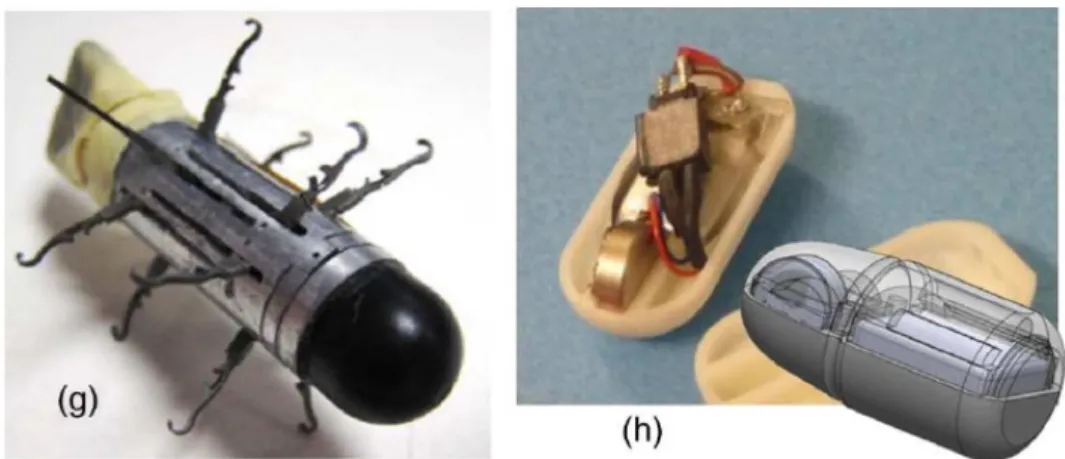
Fig. 4. WCE with SMA legs and WCE with vibratory actuator
3. Internal locomotion
As a WCE passes through the esophageal tract, it is propelled by gravity and natural peristalsis. This
happens rapidly, often too rapidly for high quality
images to be captured. Consequently, it is important to
be able to slow this movement down and provide
sufficient time for images capture. Increasing frame
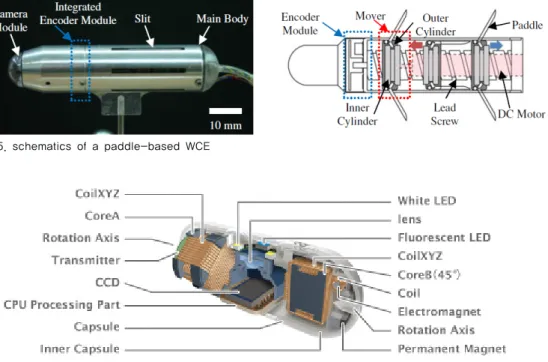
Fig. 6. RF System Lab-Sayaka
capture rate aids in this; however, that places more restrictions on the camera design and hence on the entire design, including size, cost and even working principles. [4]
An innovative stopping mechanism reported by Tognarelli, et al. offers a different solution to this issue.
As illustrated in figure 2, to fight against the peristaltic forces of the esophagus, 3 flexible flaps made of Shape Memory Alloy (SMA) are positioned around the capsule shell to offer controllable friction. Moreover, strain gage-based force sensors and an electromagnetic direct current brushless motor is added to complete the whole system. The dimensions of the device are larger than some others with a diameter of around 11 mm and a length of 31 mm, but still of ingestible size [7].
Stomach inspection had been the dead corner of traditional capsule endoscopy for a long time due to the complex liquid-filled environment of the stomach. An impressive miniaturised submarine system proposed by Carta, et al. offers a potential solution to this problem.
The device is powered via a wireless supply utilising
a magnetic inductive connection between the power source within the capsule and the external supply. The received power is amplified and used to drive the operation of the locomotion system, as depicted in Figure 3 [8].
The active locomotion module of the system comprises 4 adjustable DC motors. The operators can maneuver the capsule within the stomach by controlling the working state and rotating speed of the motors. The prototype used at the research level is 15 mm in diameter and 40 mm in length, where more than half of the overall volume is required to house the power receiving and locomotion modules. Despite of the size limitations, the conditions on power consumption are acceptable at under 400 mW. The liquid used for testing was polyethylene glycol (PEG) which has a density of 1105 kg/m3 to provide neutral buoyancy.
Additionally, this liquid also has a positive collateral
effect to ease the pain of the patients. For practical
considerations, the weight of the device needs to be
chosen dependant on the properties of the liquid, this
Fig. 7. an overview of the inner mechanism
![Fig. 1. the framework of WCE [5]](https://thumb-ap.123doks.com/thumbv2/123dokinfo/5250728.628622/2.799.425.684.818.982/fig-the-framework-of-wce.webp)