1)
책임저자 전종근 경상남도 양산시 금오로: , 20 부산대학교병원 어린이병원 소아청소년과 Tel.: 055)360-3158, Fax: 055)360-2181 E-mail: [email protected]
Introduction
Mucopolysaccharidosis type II (MPS II or Hunter syndrome) is an X-linked recessive disease caused
제 형 뮤코다당증의 임상적 스펙트럼과 2 효소대치요법의 단기간 효과
부산대학교 의과대학 부산대어린이병원 소아청소년과학 유전대사과1
타이완 의과대학 타이완국립대학병원 소아청소년과학 유전의학과2
전종근1ㆍ휴우리앙2
Clinical Spectrum and Short-term Effects of Enzyme Replacement Therapy for Mucopolysaccharidosis Type II
Chong Kun Cheon
1, Wuh-Liang Hwu
2 Division of Pediatric Genetics1, Department of Pediatrics,Pusan National University Children s Hospital,’
Pusan National University School of Medicine, Yangsan, South Korea
Department of Pediatrics and Medical Genetics2, National Taiwan University Hospital and National Taiwan University College of Medicine, Taipei, Taiwan
Purpose: We aimed to delineate clinical spectrum and short-term effects after enzyme replacement therapy (ERT) for 5 mucopolysaccharidosis type II (MPS II).
Methods: Five patients were diagnosed with MPS II by clinical findings, enzyme activity, and genetic testing. Idursulfase was administered by intravenous infusion at a dose of 0.5 mg/kg every week. Ob- servational chart analysis of patients, who underwent systematic investigations more than 12 months after initiation of ERT was done retrospectively.
Results: Three patients were classified as having the attenuated type, and 2 patients were classified as having the severe type. The median age at the diagnosis was 9.6 years (range 3.4-26 years). Four different mutations in 5 Korean patients (4 families) with MPS II were identified, among which two were novel mutations (1 small insertion mutation: p.Thr409Hisfs*22, and 1 missense mutation: p.Gly134Glu).
Two severe type sibling patients with the same mutation had different clinical manifestation. Urinary glycosaminoglycan excretion decreased within the twelve months of ERT ( P =0.043). Liver and spleen volumes showed reductions that were maintained in all patients ( P =0.043 and P =0.043, respectively).
Improvements were also noted in left ventricular mass index ( P =0.042), shoulder flexion ( P =0.043), shoulder abduction ( P =0.039), knee flexion ( P =0.043), elbow flexion ( P =0.042), and respiratory distress index ( P =0.041).
Conclusion: This study demonstrates that Korean patients with MPS II are clinically heterogeneous and indicates that idursulfase is relatively effective in several clinical parameters including heart size and respiratory distress index without infusion-related reactions in patients with MPS II.
Key words: Mucopolysaccharidosis type II, Clinical spectrum, Idursulfase
by a deficiency of the lysosomal enzyme iduro- nate-2-sulfatase (IDS), which catalyses the de- gradations of the glycosaminoglycan (GAG) der- matan sulfate and heparan sulphate
1,2). The re- sulting lysosomal accumulation of upstream meta- bolites affects a variety of organ systems, in- cluding the visceral organs, skeleton, connective tissue, and the central nervous system
3,4). MPS II occurs worldwide with an incidence of about 1 per 162,000 births
5). Its common clinical manife- stations are; coarse facial features, upper airway obstruction, cardiac valve regurgitation, restrictive lung disease, hepatosplenomegaly, hernias, joint contractures, and reduced quality of life
6). More than 400 different genotypic variations have been documented in the IDS gene, which is located at Xq28.16. Variation in mutations type of IDS gene results in differences in symptoms within patients
7)
. Recombinant human IDS (Idursulfase, Elaprase
®) was approved for the treatment of MPS II by the Korea Ministry of Food and Drug Safety in 2009.
Our goals in this study were to investigate the clinical manifestation and short-term clinical ef- ficacy and safety of ERT for 5 patients with Korean patients with MPS II in a single center.
Patients and Methods
1. Patients
Five male patients from four unrelated Korean families were diagnosed to have MPS II at the Pusan National University Children s Hospital. ’ The diagnosis of MPS II was confirmed by reduced or undetectable IDS enzyme activity in leukocyte and genetic testing. Mutation analysis and clinical review of these patients were approved by the institutional review board at Yangan Pusan Na- tional Hospital (IRB Number: 05-2013-073). Five
patients were treated with idursulfase (Elaprase
®), at a dosage of 0.5 mg/kg weekly, for more than 12 months. Comparison of efficacy changes bet- ween before and after 12 months of treatment with idursulfase was performed, including urinary GAG, liver/spleen volume, 6-Min Walk Test, left ventricular mass index (LVMI), Forced vital ca- pacity, respiratory distress index (RDI), passive joint range of motion, and growth velocity. The change from baseline was analyzed with a Wil- coxon signed-rank test. All statistical calculations were performed with SPSS version 21.0.
2. Molecular genetic analysis
Genomic DNA was isolated from peripheral blood leukocytes of each patient using the PUREGENE DNA isolation kit (Gentra, Minneapolis, MN, USA).
All 9 coding exons and exon-intron boundaries of the IDS gene were amplified by PCR on a ther- mal cycle (Applied Biosystems, Foster city, CA, USA) with primer pairs by the authors. Direct se- quencing was performed with the BigDye Ter- minator V3.0 Cycle Sequencing Ready Reaction kit (Applied Biosystems) on an ABI Prism 3130 Genetic Analyzer (Applied Biosystems). The se- quences were analyzed using the with SeqScape v.2.5 (Applied Biosystems) and were compared to the reference sequence. Sequence variation was described according to the recommendations of the Human Genome Variation Society (www.hgvs.
org/mutnomen) using a reference sequence (NM_
000202.5). The pathogenic probability for each
sequence variation of novel mutations in the IDS
gene was predicted automatically by software Mu-
tationTaster (http://www. mutationtaster.org/).
Results
1. Clinical and molecular characteristics
We identified five Korean patients (3 attenuated type and 2 severe type) with MPS II. The median patient age at the diagnosis was 9.6 years (range 3.4-26 years). The median age of the patient at
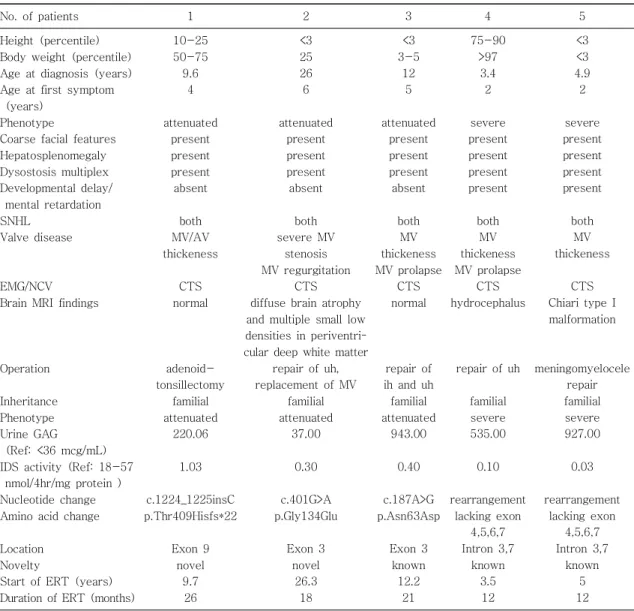
assessment was 9 years (range 3-25 years). Bio- chemical analysis results, genotype, and phenotype characterization of all patients were summarized in Table 1. Patient 1-3 were diagnosed with at- tenuated type MPS II without neurologic involve- ment. Patient 1 presented with stunted growth at 9 years of age. He had episodes of recurrent acute otitis media after 3 years. At 4 years of age he
Table 1. Summary of Clinical and Genotypic Characteristics of 5 Korean Patients with MPS II
No. of patients 1 2 3 4 5
Height (percentile) Body weight (percentile) Age at diagnosis (years) Age at first symptom
(years) Phenotype
Coarse facial features Hepatosplenomegaly Dysostosis multiplex Developmental delay/
mental retardation SNHL
Valve disease
EMG/NCV Brain MRI findings
Operation
Inheritance Phenotype Urine GAG
(Ref: <36 mcg/mL) IDS activity (Ref: 18-57
nmol/4hr/mg protein ) Nucleotide change Amino acid change
Location Novelty
Start of ERT (years) Duration of ERT (months)
10-25 50-75 9.6
4
attenuated present present present absent
both MV/AV thickeness
CTS normal
adenoid- tonsillectomy
familial attenuated
220.06
1.03
c.1224_1225insC p.Thr409Hisfs*22
Exon 9 novel
9.7 26
<3 25 26 6
attenuated present present present absent
both severe MV
stenosis MV regurgitation
CTS diffuse brain atrophy and multiple small low densities in periventri- cular deep white matter
repair of uh, replacement of MV
familial attenuated
37.00
0.30
c.401G>A p.Gly134Glu
Exon 3 novel
26.3 18
<3 3-5
12 5
attenuated present present present absent
both MV thickeness MV prolapse
CTS normal
repair of ih and uh familial attenuated
943.00
0.40
c.187A>G p.Asn63Asp
Exon 3 known
12.2 21
75-90
>97 3.4 2
severe present present present present
both MV thickeness MV prolapse
CTS hydrocephalus
repair of uh
familial severe 535.00
0.10
rearrangement lacking exon
4,5,6,7 Intron 3,7
known 3.5 12
<3
<3 4.9 2
severe present present present present
both MV thickeness
CTS Chiari type I malformation
meningomyelocele repair familial severe 927.00
0.03
rearrangement lacking exon
4,5,6,7 Intron 3,7
known 5 12 Abbreviations: GAG, glycosaminoglycan; IDS, iduronate-2-sulfatase; ERT, Enzyme replacement therapy; m, months;
SNHL, Sensorineural hearing loss; Mitral valve, MV; Aortic valve, AV; Carpal tunnel syndrome, CTS; PPN, peripheral neuropathy; inguinal hernia, ih; umbilical hernia, uh.
underwent adenoid-tonsillectomy. Coarse facial features, including macrocephaly were noted. His height was between the 10th and 25th percentiles.
He had hepatosplenomegaly and dysostosis mul- tiplex. In addition, he had high tone sensorineural hearing loss, reduced pulmonary function, and carpal tunnel syndrome (CTS). He showed high intelligence (IQ score 140). He showed elevated urinary GAG level (220.06 mcg/mL; reference range (RR), <36 mcg/mL) and decreased IDS enzyme activity (1.03 nmol/4hr/mg protein; RR, 18-57 nmol/4hr/mg protein) in leukocyte. Mutation analysis revealed a 1-bp small insertion mutation, c.1224_1225insC (p.Thr409Hisfs*22) in exon 9, which caused frameshifts starting from codon 409 with a premature stop codon. This hemizygous mutation was derived from his mother (p.Thr409 Hisfs*22) and has not been reported previously.
Patient 2 complained of dyspnea due to severe mitral valve stenosis and pulmonary hypertension at 26 years of age. At 2 years of age he under- went umbilical hernia operation. He had a profound short stature, hepatosplenomegaly and dysostosis multiplex. He had undergone mitral valve replace- ment. He showed normal intelligence (IQ score 115). He had a slightly elevated urinary GAG level (37.0 mcg/mL; RR, <36 mcg/mL) and showed decreased IDS enzyme activity (0.3 nmol/4hr/mg protein; RR, 18-57 nmol/4hr/mg protein) in leuko- cyte. DNA studies revealed a missense mutation, c.401G>A (p.Gly134Glu) in exon3, which was novel mutation and derived from his mother (p.
Gly134Glu). This novel variant identified in the patient, is expected to be a mutation by in silico analysis. Patient 3 complained of a profound short stature. He had coarse facial features, CTS, and joint contracture; and had previously undergone surgery for an inguinal and umbilical hernia at 6 years of age. He showed high intelligence (IQ
score 135). He had an elevated urinary GAG level (120 mcg/mL; RR, <36 mcg/mL) and diminished IDS enzyme activity (0.4 nmol/4hr/mg protein;
RR, 18-57 nmol/4hr/mg protein) in leukocyte. A known missense mutation, c.187A>G (p.Asn63 Asp) in exon 3, was detected in this patient. Pa- tients 4 and 5 were siblings and diagnosed with severe type MPS II with neurologic involvement.
Patient 4 complained of intellectual disability (second grade level) at 3 years of age. He had hepatosplenomegaly, dysostosis multiplex and Mongolian spots. He had undergone an umbilical hernia operation at two years of age, and had markedly elevated urinary GAG level (535.0 mcg/
mL; RR, <36 mcg/mL) and reduced IDS enzyme activity (0.1 nmol/4hr/mg protein; RR, 18-57 nmol/
4hr/mg protein) in leukocyte. DNA studies re- vealed an IDS-IDS2 recombination mutation. Pa- tient 5 complained of intellectual disability (first grade level) at 3 years of age. He had a profound short stature, hepatosplenomegaly, and dysos- tosis multiplex. He underwent a meningomyelo- cele operation at age three years, and showed a highly elevated urinary GAG level (927.0 mcg/mL;
RR, <36 mcg/mL) and reduced IDS enzyme ac- tivity (0.03 nmol/4hr/mg protein; RR, 18-57 nmol/4hr/mg protein). He had the same mutation as his sibling. He showed severe cognitive im- pairment (IQ score 40) at the age of 5 year old.
2. Efficacy and safety of enzyme replacement therapy
Five male patients, ages 3-26 years, received
weekly intravenous infusions of 0.5 mg/kg idur-
sulfase for 12 months. Most patients, including an
adult with MPS II, showed several clinical impro-
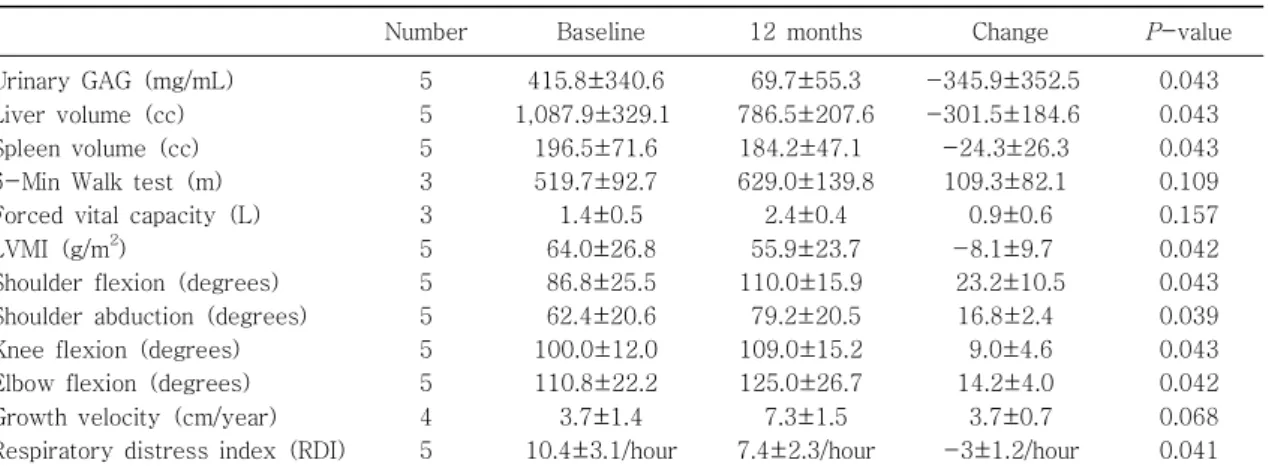
vements during the study (Table 2). Urinary GAG
excretion decreased rapidly within the twelve
months of treatment (P=0.043). Liver and spleen volumes also showed reductions that were main- tained in all patients by 12 months (P=0.043 and P=0.043, respectively). Improvements were also noted in LVMI (P=0.042), shoulder flexion (de- grees) (P=0.043), shoulder abduction (P=0.039), knee flexion (degrees) (P=0.043), elbow flexion (degrees) (P=0.042), and RDI (P=0.041). How- ever, two severe type patients with MPS II did not show improvement of neurological deficit and the neurological imaging findings did not show marked improvement in attenuated and severe type patients with MPS II. No infusion-related reactions occurred in all patients.
Discussion
This study was performed to investigate the clinical spectrum and short-term clinical efficacy and safety of ERT in Korean patients with MPS II. Clinically, MPS II should be regarded as a con- tinuum between the two extreme forms of the disease (severe and attenuated)
8). In the present study, three patients were classified as having the
attenuated type, and 2 patients were classified as having the severe type. However, two sibling pa- tients (patient 4 and 5) with the same mutation had different clinical manifestation: Patient 5 had a profound short stature and underwent a menin- gomyelocele surgery. However, patient 4 had a normal stature and severe Mongolian spots on whole body and underwent an umbilical hernia.
This result suggested the clinical heterogeneity of MPS II. Although the phenotype of MPS II depends on the mutation types and deletions at the IDS gene
8-10), no strict relationship between genotype and clinical phenotype has been establi- shed
11). In MPS II patients, more than 400 diffe- rent genotypic variations have been documented in the IDS gene, which is approximately 24 kb in length with 9 exons
7). Furthermore, it has been estimated that 55% to 57% of these are missense variations, 21% are nonsense variations, 14% to 20% are small deletions (20 bp), and 4% to 10%
are major structural alterations such as large de- letions (<20 bp) and rearrangements
10-12). In this study, we reported 4 mutations in 5 Korean pa- tients (4 families) with MPS II, that is, 2 missense
Table 2. Comparison of Efficacy Changes between before and after 12 Months of Treatment with Idursulfase
Number Baseline 12 months Change
P
-valueUrinary GAG (mg/mL) Liver volume (cc) Spleen volume (cc) 6-Min Walk test (m) Forced vital capacity (L) LVMI (g/m2)
Shoulder flexion (degrees) Shoulder abduction (degrees) Knee flexion (degrees) Elbow flexion (degrees) Growth velocity (cm/year) Respiratory distress index (RDI)
5 5 5 3 3 5 5 5 5 5 4 5
415.8 340.6± 1,087.9 329.1±
196.5 71.6± 519.7 92.7± 1.4 0.5± 64.0 26.8± 86.8 25.5± 62.4 20.6± 100.0 12.0± 110.8 22.2± 3.7 1.4± 10.4 3.1/hour±
69.7 55.3± 786.5 207.6± 184.2 47.1± 629.0 139.8±
2.4 0.4± 55.9 23.7± 110.0 15.9± 79.2 20.5± 109.0 15.2± 125.0 26.7± 7.3 1.5± 7.4 2.3/hour±
-345.9 352.5± -301.5 184.6± -24.3 26.3± 109.3 82.1± 0.9 0.6± -8.1 9.7± 23.2 10.5± 16.8 2.4±
9.0 4.6± 14.2 4.0± 3.7 0.7± -3 1.2/hour±
0.043 0.043 0.043 0.109 0.157 0.042 0.043 0.039 0.043 0.042 0.068 0.041 Abbreviations: GAG, glycosaminoglycan; m, meters; Left ventricular mass index, LVMI; NA, not applicable.
Note: All values are the observed means SEM. The change from baseline was analyzed with a Wilcoxon signed-± rank test.
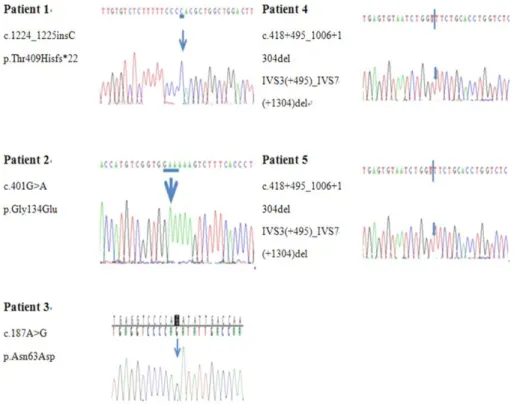
mutations, one small insertion mutation, and two IDS-IDS2 recombination mutations (Fig. 1). Of these mutations, 2 are novel (1 small insertion mutation: p.Thr409Hisfs*22, and 1 missense mu- tation: p.Gly134Glu). Even if In vitro functional analysis for a novel missense variant could not be performed in this study, this novel variant has not been detected in more than 100 control alleles and found in dbSNP [http://evs.gs.washington.edu/
EVS/]. Conserved sequence elements of glycine residues at position 134 was observed (Fig. 2).
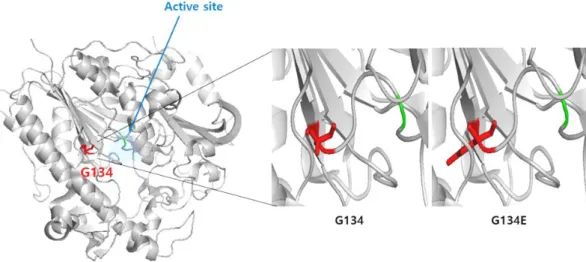
The 3D structure of IDS containing 134 amino acid residues was determined by X-Ray cryst- allography at a resolution of 2.0Å (PDB ID:5FQL).
The Gly134 residue is close to active site (Fig.
3), suggesting that this mutation might affect elec- trostatics and catalytic activity. Therefore, it could be assumed that this novel variant is likely to be
pathogenic. In patients with the attenuated pheno- type (2 of the 3 patients), missense mutations were identified. Two patients with the IDS-IDS2 recombination mutation in this study had severe MPS II phenotypes which was consistent with previous study
13). The rearrangement mutation identified in our patients involves homologous re- combination between intron 3, 7 of the IDS gene and the homologous region of its closely related
Fig. 2. Conserved sequence elements of glycine residues at position 134 was observed.
Fig. 1. Partial sequences of
IDS
gene (Patient 1-5) showing the mutations detected in this study.pseudogene (IDS2), and leads to the loss of exons 4, 5, 6, and 7 in genomic DNA. In terms of clinical effectiveness of ERT in patients with MPS II, it has been demonstrated that ERT is helpful in re- lation to liver and spleen volumes, functional ca- pacity (distance walked in six minutes and forced vital capacity), and urine GAG excretion in pa- tients with MPS II compared with placebo
14). However, there is no available evidence in the literature on outcomes such as improvement in cardiac function, sleep apnea, quality of life and mortality
14). In the present study, significant im- provements were noted in LVMI and sleep apnea.
On the other hand, ERT may have limited effects on the central nervous system (CNS) and skeletal system because of limited enzyme uptake across the blood-brain barrier
15). The brain atrophy in patient 2 does not show significant progression through the different MR examination, suggesting that ERT therapy does not seems to improve the appearance of neurological imaging findings. Brain atrophy usually develops earlier in MPS II, be- coming visible during the first few years of life.
A strong correlation was found between severity
of brain atrophy and cognitive impairment in MPS
16,17)
, whereas other authors did not find the same correlation
18). Also, patients 4 and 5 with severe forms of the disease did not show improvement of neurological deficit in spite of 12 months of ERT. Sohn et al.
19)reported that continuous intra- thecal infusion of the deficient enzyme was effec- tive in improving CNS defects in the MPS II mice.
Additional study on the continuous intrathecal in- fusion of the drugs in clinical settings is required.
In conclusion, several clinical improvements in patients with MPS after 12 months of ERT, inclu- ding liver and spleen volumes, LVMI, RDI, ROM, and urine GAG excretion, were observed without infusion-related complications. Further researches are needed to acquire more information on the long-term effectiveness and safety of ERT due to the short-term period and small numbers in this cohort.
Acknowledgments
We thank the Korean Society of Inherited Me- tabolic Disease for financial support.
Fig. 3. The 3D structure of IDS containing 134 amino acid residues was determined by X-Ray crystallography at a resolution of 2.0 (PDB ID:5FQL). The Gly134 residue (red color) is close to active site (blue triangle). Conformational change was shown by the p.Gly134 Glu mutation.
요 약
목적: 명의 제 형 뮤코다당증 환자들의 임상적 스 5 2 펙트럼과 효소대치요법의 단기간 치료 효과에 관해 알 아 보고하고자 하였다.
방법: 5 명의 환자들은 임상적 소견 효소활성화 및 , 유전자검사에 의해 제 형 뮤코다당증으로 진단되었다 2 . 이두설파제는 일주일 간격으로 0.5 mg/kg 의 용량으로
정맥주사 주입을 하였으며 효소대치요법 시작 전 후 ,
개월 이상 전신평가를 하였으며 의무기록을 후향적
12 ,
으로 분석하였다.
결과: 명의 환자들은 경증 유형 3 , 2 명의 환자들은 중 증 유형의 제 형 뮤코다당증으로 진단되었다 진단 시 2 . 중위연령은 9.6 ( 세 범위 3.4-26 ) 세 였다 네 가계 중 다 . 섯 명의 환자에서 개의 서로 다른 유전자변이가 확인 4 되었으며 이중 두 개의 변이는 새로운 돌연변이였다 , (1 개의 작은 삽입돌연변이 : p.Thr409Hisfs*22, 1 개의 과오돌연변이 : p.Gly134Glu). 이중 동일한 유전자돌연 변이를 지닌 두 명의 중중 유형의 형제 환자들은 서로 다른 임상적 특징들을 보였다 . 12 개월 간의 효소대치 요법 후 소변 글리코사미노글리칸 배출은 유의하게 감 소하였다(P =0.043). 간 및 비장의 용적은 모든 환자 에서 유의하게 감소하였다 각각 ( P=0.043, P=0.043).
이외에도 좌심실질량지수(P =0.042), 어깨관절굽힘각 도(P =0.043), 어깨관절벌림각도 (P =0.039), 무릎관절 굽힘각도(P =0.043), 팔꿉관절굽힘각도 (P =0.042), 호 흡장애지수(P =0.041) 가 모두 호전된 소견을 보였다 . 결론: 한국인 제 형 뮤코다당증 환자들은 임상적으 2 로 다양한 특징을 보이며 단기간의 이두설파제 치료는 ,
주사주입관련 이상반응 없이 심장크기 호흡장애지수를 ,
포함한 여러 임상적 지표들의 호전에 효과적이었다.
References
1) Glamuzina E, Fettes E, Bainbridge K, Crook V, Fin- negan N, Abulhoul L, et al. Treatment of mucopoly- saccharidosis type II (Hunter syndrome) with idursul- fase: the relevance of clinical trial end points. J Inherit Metab Dis 2012;34:749-54.
2) Muenzer J, Beck M, Eng CM, Giugliani R, Harmatz
P, Martin R, et al. Long-term, open-labeled extension study of idursulfase in the treatment of Hunter synd- rome. Genet Med 2011;13:95-101.
3) Holt J, Poe MD, Escolar ML. Early clinical markers of central nervous system involvement in mucopolysa- ccharidosis type II. J Pediatr 2011;159:320-6.
4) Wraith JE, Scarpa M, Beck M, Bodamer OA, Meirleir LD, Guffon N, et al. Mucopolysaccharidosis type II (Hunter syndrome): a clinical review and recommen- dations for treatment in the era of enzyme replace- ment therapy. Eur J Pediatr 2008;167:267-77.
5) Burton BK, Whiteman DA; HOS Investigators. Inci- dence and timing of infusion-related reactions in patients with mucopolysaccharidosis type II (Hunter syndrome) on idursulfase therapy in the real-world setting: a perspective from the Hunter Outcome Survey (HOS). Mol Genet Metab 2011;103:113-20.
6) Tajima G, Sakura N, Kosuga M, Okuyama T, Koba- yashi M. Effects of idursulfase enzyme replacement therapy for Mucopolysaccharidosis type II when started in early infancy: Comparison in two siblings. Mol Genet Metab 2013;108:172-7.
7) Christianto A, Watanabe H, Nakajima T, Inazu T.
Idursulfase enzyme replacement therapy in an adult patient with severe Hunter syndrome having a novel mutation of iduronate-2-sulfatase gene. Clin Chim Acta 2013;423:66-8.
8) Brusius Facchin AC, Moura De Souza CF, Schwartz‐ IV, Riegel M, Melaragno MI, et al. Severe phenotype in MPS II patients associated with a large deletion including contiguous genes. Am J Med Genet A 2012;
158:1055-9.
9) Schulze-Frenking G, Jones SA, Roberts J, Beck M, Wraith JE. Effects of enzyme replacement therapy on growth in patients with mucopolysaccharidosis type II. J Inherit Metab Dis 2011;34:203-8.
10) Holt JB, Poe MD, Escolar ML. Natural progression of neurological disease in mucopolysaccharidosis type II. Pediatrics 2011;127:e1258-65.
11) Keeratichamroen S, Ketudat Cairns JR, Wattanasiri- chaigoon D, Wasant P, Ngiwsara L, Suwannarat P, et al. Molecular analysis of the iduronate-2-sulfatase gene in Thai patients with Hunter syndrome. J Inherit Metab Dis 2008;suppl2:S303-311.
12) Chkioua L, Khedhiri S, Ferchichi S, Tcheng R, Chahed H, Froissart R, et al. Molecular analysis of iduronate -2- sulfatase gene in Tunisian patients with muco- polysaccharidosis type II. Diagn Pathol 2011;6:42.
13) Sohn YB, Ki CS, Kim CH, Ko AR, Yook YJ, Lee SJ, et al. Identification of 11 novel mutations in 49 Korean patients with mucopolysaccharidosis type II. Clin Genet 2012;81:185-90.
14) da Silva EM, Strufaldi MW, Andriolo RB, Silva LA.
Enzyme replacement therapy with idursulfase for mu- copolysaccharidosis type II (Hunter syndrome). Co- chrane Database Syst Rev 2014;CD008185.
15) Al Sawaf S, Mayatepek E, Hoffmann B. Neurological findings in Hunter disease: pathology and possible the- rapeutic effects reviewed. J Inherit Metab Dis 2008;
31:473-80.
16) Manara R, Priante E, Grimaldi M, Santoro L, Astarita L, Barone R, et al. Brain and spine MRI features of Hunter disease: frequency, natural evolution and res- ponse to therapy. J Inherit Metab Dis 2011;34:763-80.
17) Vedolin L, Schwartz IV, Komlos M, Schuch A, Puga AC, Pinto LL, et al. Correlation of MR imaging and
MR spectroscopy findings with cognitive impairment in mucopolysaccharidosis II. AJNR Am J Neuroradiol 2007;28:1029-33.
18) Gabrielli O, Polonara G, Regnicolo L, Petroni V, Sca- rabino T, Coppa GV, et al. Correlation between cere- bral MRI abnormalities and mental retardation in pa- tients with mucopolysaccharidoses. Am J Med Genet A 2004;125:224-31.
19) Sohn YB, Lee J, Cho SY, Kim SJ, Ko AR, Nam MH, et al. Improvement of CNS defects via continuous intrathecal enzyme replacement by osmotic pump in mucopolysaccharidosis type II mice. Am J Med Genet A 2013;161:1036-43.