I형 뮤코다당증 환자들에서
효소 보충 요법이 성장에 미치는 영향
성균관대학교 의과대학 소아과학교실1, 한양대학교 의과대학 소아과학교실2, 명지병원 소아과학교실3
아주대학교 의학유전학과4, 관동대학교 의과대학 제일병원 소아과학교실5
허림1ㆍ조성윤2ㆍ장미선1ㆍ이지은1ㆍ권영희1ㆍ김수진3ㆍ손영배4 박성원5ㆍ맹세현1ㆍ권은경1ㆍ한선주1ㆍ정주연1ㆍ진동규1
Effect of Enzyme Replacement Therapy on Growth in Korean Patients with Mucopolysaccharidosis Type I
Rimm Huh
1, Sung Yoon Cho
2, Mi Sun Chang
1, Jieun Lee
1, Younghee Kwun
1, Su Jin Kim
3, Young Bae Sohn
4, Sung Won Park
5, Se Hyun Maeng
1Eun-Kyung Kwon
1, Sun Ju Han
1, Jooyoun Jung
1, Dong-Kyu Jin
1 Department of Pediatrics1, Samsung Medical Center,Sungkyunkwan University School of Medicine, Seoul, Republic of Korea Department of Pediatrics2, Hanyang University Guri Hopistal, Hanyang University College of Medicine, Guri, Republic of Korea ; Department of Pediatrics3, Myongji Hospital, Goyang, Republic of Korea
Department of Medical Genetics4, Ajou University Hospital, Ajou University School of Medicine, Suwon, Republic of Korea;
Department of Pediatrics5, Kwandong University College of Medicine, Cheil General Hospital & Women’s Healthcare Center, Seoul, Republic of Korea
Purpose: Mucopolysaccharidosis type I (MPS I) is a lysosomal storage disorder caused by deficiency of the enzyme α-L-iduronidase, which leads to a broad spectrum of multisystemic manifestations.
Short stature and decreased growth velocity are prominent features of MPS I. The aim of the present study was to evaluate the effect of enzyme replacement therapy (ERT) on growth of Korean MPS I patients from a single center.
Methods: Height data were obtained by retrospective chart review of 10 Korean patients with MPS I who had received ERT for a minimum of 3 years. Height was expressed as standard deviation scores (SDS) based on normative data. Annual growth rates were calculated before and during ERT.
A piecewise regression model was used to analyze height z-scores before and after treatment.
Individual analysis was performed for impact of phenotype [(severe (Hurler) versus attenuated (Hurler-Scheie, Scheie)] on growth.
Results: Annual growth was 3.3 cm (z-score= -0.21) in the year before ERT and 6.2 cm (z-score=
0.17), 5.8 cm (z-score= 0.07), and 3.8 cm (z-score= -0.4) in the first, second, and third years of ERT, respectively. Regression analysis showed improvement in the slope after ERT (difference= 0.04;
P =0.022). Estimated slope differences between severe and attenuated phenotypes were statistically significant before ( P =0.001) and after treatment ( P <0.0001), although no significant difference was noted when stratified by phenotype.
6)
책임저자: 진동규, 서울시 강남구 일원로 81 성균관대학교 의과대학 삼성서울병원 소아청소년과
Tel: 02)3410-3525, Fax: 02)3410-0043, E-mail: [email protected]
Conclusion: ERT with aldurazyme appears to have a positive impact on linear growth in patients with MPS I.
Kew words: Mucopolysaccharidosis type I, Hurler, Scheie, Enzyme replacement therapy, Aldurazyme, Growth
Introduction
Mucopolysaccharidosis type I (MPS I) is an autosomal recessive lysosomal storage disorder caused by deficiency of the enzyme a-L-iduro- nidase (IDUA), which is responsible for degrada- tion of the glycosaminoglycans (GAGs) dermatan sulfate and heparan sulfate within cells
1). Lyso- somal accumulation of GAGs leads to a chronic, multisystemic disease characterized by progres- sive organ dysfunction
1). The clinical course and features of MPS I show considerable variety
1). Historically, the broad clinical spectrum of MPS I has been categorized into three phenotypes: Hurler (early onset, rapid progression, cognitive impair- ment), Scheie (later onset, slower progression, preservation of cognition), and Hurler-Scheie (intermediate onset and progression, mild or ab- sent cognitive impairment)
2, 3). More recently, the preferred classification is two broader groups:
severe (Hurler syndrome) and attenuated (Hurler- Scheie and Scheie syndrome)
4, 5).
The involvement of bone and joints in MPS I leads to disruption of the normal growth and joint development in affected patients
6, 7). Disorders of bone and cartilage formation lead to abnormalities related to skeletal dysplasia (dysostosis multiplex) including gibbus deformity, scoliosis, degenerative joint disease, and marked short stature
5, 8). Short stature is a consistent feature, with linear growth ceasing by the age of 3 years in the severe Hurler phenotype
8).
Enzyme replacement therapy (ERT) with aldu- razyme
®(laronidase, Biomarin Pharmaceutical Inc., Novato, CA, USA and Genzyme Corporation, Cam- bridge, MA, USA) has been available for MPS I patients since 2003 in the United States and the European Union, and since 2004 in Korea. The effectiveness of ERT has been observed in the form of significant and sustained reductions in urinary GAG excretion and liver and spleen volume
4, 9-12)
. Improvements in pulmonary function and functional capacity have also been reported in several studies
4, 10, 11, 13).
To date, only a few studies have examined the effects of ERT on growth in patients with MPS I
9, 11, 12, 14, 15). To our knowledge, no data are pre- sently available for Asian MPS I patients. The objective of this retrospective study was to ana- lyze the effect of ERT on growth patterns in 10 Korean MPS I patients with different phenotypes and to assess differences in growth at the time prior to ERT and after a minimum of 3 years of treatment with aldurazyme.
Materials and Methods
1. Patient population
Participants were recruited from the Department
of Pediatrics, Samsung Medical Center. The Insti-
tute Review Board Committee at the Samsung
Medical Center approved this study and patients,
parents, or legal guardians provided informed
consent. Data were obtained from clinical records
reviewed retrospectively.
All patients enrolled in this study were diag- nosed with MPS I by biochemical determination of deficiency in IDUA enzyme activity in skin fi- broblasts or peripheral blood leukocytes. In addi- tion, molecular analysis of the IDUA gene was performed. This study included patients who had started ERT with aldurazyme between the ages of 2 and 15 years. Patients received weekly in- travenous infusions of aldurazyme at 100 U/kg (0.58 mg/kg).
Height measurements were made with standard techniques using a stadiometer (accuracy to 1 mm). Initiation of treatment ±1 month was defined as “Start of ERT.” Patients included in the analysis had more than one height measurement in the 24 month period before and after treatment. The final study population consisted of 10 patients; 6 males and 4 females.
Clinical phenotypes of Hurler, Hurler-Scheie and Scheie were divided into two groups - severe (Hurler) and attenuated (Hurler-Scheie and Scheie) - for evaluation of differences in growth patterns between different phenotypes. The type of mutation in the IDUA gene was based on amino acid changes and/or genomic sequences.
Two patients (P1, P2) in our study received recombinant human growth hormone (hGH) the–
rapy. Their height data included in the analysis were restricted to measurements obtained during the period prior to initiation of hGH.
2. Statistical analysis
The raw height data of patients were plotted against normal height references for Korean boys and girls. Height data were standardized using published 2007 Korean growth charts and calcu–
lated values were presented as the standard devia- tion score (SDS). Z-scores stand for the number of standard deviations from the mean; a z-score of <-2 is generally indicative of short stature.
Further calculations included mean changes in the patients’ heights and z-scores (±SD) from baseline and annual growth velocity from the year before ERT to 3 years after ERT.
Standardized height data (z-scores) from 24 months before and after the start of ERT were analyzed using a piecewise regression and a mixed model. The patients were individually analyzed to assess the impact of clinical phenotype (severe versus attenuated) on growth.
Results
1. Patients
All 10 patients were born at term and were diagnosed as having MPS I at the median age of 4.4 years. All patients presented with typical clinical characteristics of MPS I, such as corneal clouding, joint stiffness, and coarse facial features.
Of the 10 patients, 6 were male and 4 were fe- male. Three patients were classified as Hurler, 6 as Hurler-Scheie, and 1 as Scheie.
The patients started ERT between the ages of 2 years 3 months and 14 years 10 months (median age of starting ERT was 7.7 years). Table 1 lists the demographic information, molecular charac- teristics, and clinical phenotypes of the patients.
2. Effect of ERT on Growth in patients with MPS I
For the whole sample (n=10; age range at start
of ERT, 2 years 3 months-14 years 10 months),
Table 1. Demographic Information, Molecular Characteristics, and Clinical Phenotypes of 10 Korean Patients with MPS Type I
Patient Sex Age (year) at diagnosis
Age (year) at
starting ERT
Current age (year)
Total laronidase
exposure (weeks)
Phenotype
Type of mutation in IDUA
Exon cDNA change Amino acid change
P1 P2 P3
P4
P5 P6 P7 P8 P9 P10
M M F
M
M M M F F F
6.5 4.1 3.4
10.9
4.8 2.3 6.10 9.11 2.9 2.2
10.11 7.9 7.6
14
3.11 2.4 11.10 14.10 3 2.3
19.4 16.11
16.9
22.5
11.8 9.11 20.2 23.2 8.9 5.11
436 476 480
436
400 392 432 432 348 188
Hurler-Scheie Hurler-Scheie Hurler-Scheie
Scheie
Hurler-Scheie Hurler-Scheie Hurler-Scheie
Hurler Hurler Hurler
Missense Missense Insertion
Missense Missense Nonsense NA NA Missense Missense Missense Missense Duplication
Deletion 8 8 6
8 2 11 NA NA 8 8 2 14
6 6
c.1037T>G c.1037T>G c.704_705insC
TGCT c.1037T>G
c.265C>T c.1601C>A
NA NA c.1037T>G c.1037T>G c.236C>T c.1882C>T c.613_617dup
c.683delC
p.Leu346Arg p.Leu346Arg p.Trp235Cysfs*84
p.Leu346Arg p.Arg89Trp
p.Ser534*
NA NA p.Leu346Arg p.Leu346Arg p.Ala79Val
p.Arg628 p.E207AfsX29
p.P228HfsX6
Abbreviations: P, patient; M, male; F, female; ERT, enzyme replacement therapy; IDUA, α-L-iduronidase; NA, notavailable.
Fig. 1. Growth charts for MPS I patients. Growth before enzyme replacement therapy (ERT) is denoted as dotted lines; growth after ERT is shown as continuous lines. The shaded area indicates the height data (3rd to 97th percentile) of the normal population of children in Korea. The red lines represent patients with the Hurler phenotype, green lines are patients with Hurler-Scheie, and the blue lines show those with Scheie. The 2 arrows indicate the initiation of recombinant human growth hormone (hGH) in 2 patients. (A) Growth charts for boys with MPS I. (B) Growth charts for girls with MPS I.
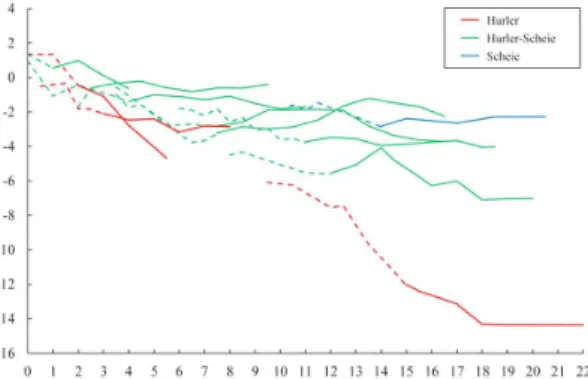
the height at initiation of ERT ranged from 85 to 142.6 cm (median, 100.5 cm). The mean height SDS at the start of ERT was -2.82±3.36. The mean increase in height during 3 years of ERT was 16±5.6 cm. At the start of ERT, 3 boys and 3 girls had z-scores of < -2, indicative of short stature. The growth charts and the z-scores are shown in Figs. 1A, 1B, and 2. The arrows shown in Fig. 1 indicate the initiation of growth hormone therapy in two patients (P1, P2).
Annual changes in growth velocity were calcu-
lated in 8 out of a total of 10 patients. Two pa-
tients (P6, P10) who had started ERT before the
age of 3 years (2 years 4 months and 2 years 3
months, respectively) were excluded due to diffe-
rent growth patterns in the growth spurt following
birth; height data used in the analysis were re-
stricted to the measurements obtained before in-
itiation of hGH in one patient (P1) who received
hGH therapy during the third year of ERT. The
Fig. 2. Height z-scores in MPS I patients. Growth before enzyme replacement therapy (ERT) is denoted as dotted lines; growth after ERT is shown as continuous lines. The red lines represent patients with the Hurler phenotype, green lines are pa- tients with Hurler-Scheie, and the blue lines indicate those with Scheie.
Fig. 3. Annual growth velocity and z-score changes in patients with MPS I who were more than 3 years old at the start of enzyme replacement therapy (ERT). (A) Annual growth velocity. (B) Z-score change.
Fig. 4. Regression plot showing height z-scores before and after the start of enzyme replacement therapy (ERT). Gray lines indicate individual regression lines for each patient. The slope of regression was significantly increased after treatment com- pared with before treatment (difference in the slope, 0.04;
P
=0.022).increase in height was 3.3 cm (z-score=-0.21) the year before commencement of ERT, compared with 6.2 cm (z-score=0.17), 5.8 cm (z-score=
0.07), and 3.8 cm (z-score=-0.4) in the first, second, and third years of the ERT, respectively (Figs. 3A and 3B).
1) Height z-score analysis
Overall analysis was performed with height z- scores of the 10 patients. The analysis showed that the slope of the regression after treatment was significantly different when compared with
the slope before treatment (the estimated slopes before and after treatment were -0.037 and 0.004, respectively: difference in the slope, 0.04; P=
0.022) (Fig. 4).
2) Impact of phenotype (severe versus at- tenuated) on growth
Before treatment, the estimated slope difference
between the severe and attenuated groups was
-0.072 (P=0.001), and it was -0.068 (P<0.0001)
after treatment. No statistically significant diffe-
rences were noted between groups when stratified
according to phenotype (severe versus attenuated)
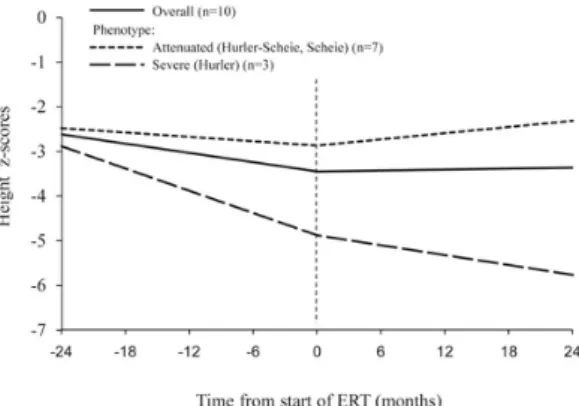
Fig. 5. Regression plot showing height z-scores before and after the start of enzyme replacement therapy (ERT) in groups stratified by phenotype (severe versus attenuated).
(P=0.361). No significant difference was observed for height deficit at the start of treatment in terms of z-scores between the two groups (difference in z-score at the start of ERT, 1.97; P=0.641) (Fig. 5).
Discussion
This is the first study to report the impact of ERT on linear growth in Asian patients with MPS I. The data evaluated in this study represent the patient population from a single center and the same height measuring methods were applied to all patients; thus, the height changes recorded for the patients should be relatively accurate. All the patients are of the same ethnicity, so the data are unlikely to be confounded by ethnic differences.
When compared with the healthy population, MPS I patients show significantly different growth patterns. During the first 2 years of life, MPS I patients tend to grow faster than their age- matched normal peers
12). After 2 years, MPS I patients grow significantly slower, with the dif- ference between affected and healthy children increasing with age
8, 12). Fig. 1A, 1B, and 2 reflect
these characteristics in our patients. A longitudinal study with height data from pre and post-ERT allowed us to investigate the linear growth of chil- dren with MPS I. The patients’ pre-ERT data could be interpreted as natural growth patterns in the absence of treatment. The individual growth curves of the raw height data and standardized height z-score data indicate that growth was retarded compared with the normal population as our pa- tients grew older.
The impact of ERT with aldurazyme on growth in MPS I patients has been reported in a few studies. Wraith et al. noted that 7 patients who were younger than 5 years at initiation of ERT showed a net increase in height-for-age z-score after 52 weeks of treatment
12). Kakkis et al. re- ported six prepubertal patients with an increase of 85 percent in height with a mean rate of in- crease from 2.80 cm per year to 5.17 cm per year at 52 weeks of ERT
9). Sifuentes et al. reported a substantial increase in growth rate of 27% over baseline at the 1-year assessment in prepubertal patients and continuation of growth during the pu- bertal years
11). The data from these studies show an increase in growth velocity after ERT that seems consistent with the results of our analysis.
In our study, height z-score analysis showed
an overall increase in growth rate in the 2 year
period after starting ERT, when compared with
the 2 year period prior to treatment. (Fig. 4) Im-
provements in annual growth velocity and z-score
change were evident, although some slowing down
occurred in the 2
ndand 3
rdyear compared with
the 1
styear on ERT. (Fig. 3) Two patients in our
analysis (P4, P8) commenced ERT after pubertal
age (14 years and 14 years 10 months, respec-
tively). P4, who was diagnosed with Scheie syn-
drome, had a height SDS of -2.83 at the start of
ERT which was improved to -2.64 after 3 years of ERT. Height and z-scores gradually increased after ERT, even though the patient had started ERT at an older age. (Fig. 1B, 2) P8 was diag- nosed with Hurler syndrome. She developed heart failure with moderate mitral and aortic valve regurgitation and was started on an angiotensin converting enzyme inhibitor. No significant pro- gression of heart failure has occurred while the patient has been receiving ERT. The patient’s height has been stationary during the years of ERT; the underlying cardiac complication may possibly have had an influence on the growth pat- tern of this patient. (Fig. 1B, 2) The 8 patients who started ERT in the prepubertal age had a mean SDS of -2.48±1.71 at the start of ERT, and a mean SDS of -2.37±1.27 2 years after ERT.
The patients showed an overall improvement in growth after ERT, although phenotypic differences were seen. (Fig. 1A, 1B, 2)
In this study, 3 patients were classified as se- vere (Hurler) and 7 patients were classified as attenuated (Hurler-Scheie or Scheie). As shown in Fig. 5, the effect of ERT on linear growth was not favorable for the 3 patients with the severe phenotype. Statistical analysis did not indicate a significant difference when comparing the z-scores at the start of ERT between the 2 groups; how- ever, the small sample sizes probably contributed to this lack of statistical significance and acted as a confounding factor. Estimated slopes of re- gression for pre and post treatment of both groups showed significant differences, with height deficit in the severe group more pronounced both before and after treatment, when compared with the at- tenuated group. The impact of ERT on growth in patients with the severe phenotype is likely to be diminished due to their more severe skeletal
dysplasia with earlier bone and joint deformities and the further progression of their multiorgan dysfunction when compared with the patients with the attenuated phenotype
5).
Two brothers (P1, P2) were treated with re- combinant hGH. Peak GH determined by the L- dopa-clonidine stimulation testing was normal, at 10.17 µg/L for P1 and 13.76 µg/L for P2, but hGH treatment was started due to stress associated with short stature and parental desire for treat- ment. P1 started ERT at the age of 10 years 11 months and received hGH treatment between the ages of 12 years 11 months and 17 years 4 months, at a dose of 0.033 mg/kg/day. Height SDS at the start of ERT was -3.73; at the time of initiation of hGH treatment after 2 years of ERT was -3.55, and was -4.05 at the time of cessation after 4 years and 5 months of hGH treatment. P2 had started ERT when he was 7 years 9 months old.
His hGH treatment was initiated at the age of 10 years 7 months, at 0.033 mg/kg/day, and he is still receiving treatment at 16 years and 9 months of age. Height SDS at the time of ERT was -3.22;
height SDS prior to hGH treatment after 3 years of ERT was -2.87; and his current height SDS after 6 years 2 months of hGH treatment at the age of 16 years and 9 months is -2.24. P2 was not diagnosed as GHD, but the hGH therapy seems to have had a moderate influence on growth velo- city based on raw height data and changes in height SDS when compared with those of P1 as shown in Fig. 1A and 2. The fact that P2, who is the younger brother, started both ERT and hGH at a younger age than P1 should be taken into consideration.
Histologic examinations of a bone and cartilage
biopsy in a patient with Hurler syndrome and a
feline MPS I model have revealed disruption of
growth plate structure and defects in the orien- tation of chondrocytes, which are probably asso- ciated with GAG accumulation
16, 17). This defect may in part interrupt proper skeletal formation, which in turn can contribute to the typical skeletal dysplasia of MPS I and cause inhibition of growth.
ERT with aldurazyme is assumed to have little to no effect on the skeletal problems related to MPS I.
7, 18). Several clinical studies have demonstrated improvements in joint mobility, respiratory func- tion, and physical capacity after aldurazyme treat- ment
4, 10, 11, 13). Overall improvements such as these probably had a positive effect on the improved growth rates observed in this current study. Three of 10 patients in our study received physiotherapy, which can be useful in ameliorating joint contrac- tures and can result in an obvious increase in height.
A limitation of this study was its small number of patients analyzed - a consequence of the rarity of this disease. The small study number comprised phenotypes ranging from severe to attenuated, thereby giving a broad spectrum of individual data.
The mean increases in the measured parameters also did not differ significantly between male and female patients during the first 3 years of life, and because our sample size was small, we did not perform any analyses by gender. Natural growth patterns for MPS I patients which are also important in evaluating the effect of ERT on growth, are difficult to obtain due to the rare in- cidence of the disease and ethical factors related with treatment initiation after diagnosis of MPS I.
In conclusion, the present data show an overall increase in growth after the initiation of ERT with aldurazyme. This indicates a positive impact of ERT on growth in patients with MPS I who without ERT would otherwise have shown more marked
growth retardation. This is the first published report of the effect of ERT on growth in Asian patients with MPS I. Further long-term analyses in larger groups of patients will be needed for a more accurate evaluation.
Acknowledgments
This study was supported by a grant from Samsung Medical Center (#GFO1130061).
한 글 요 약
목적: I형 뮤코다당증 (MPS I)은 α-L-iduronidase 효소의 결핍으로 인하여 발생하는 리소좀 축적 질환으 로, 광범위한 양상으로 다기관에 영향을 미친다. 저신 장과 성장 속도의 감소는 MPS I의 중요한 특징이다.
본 연구에서는 효소 보충 요법이 MPS I 환자들의 성 장에 미치는 효과에 대해 알아보기 위하여 단일 기관 의 환자들을 대상으로 분석하였다.
방법: 2세에서 15세 사이에 효소 보충 요법을 시작 하여 최소 3년 이상의 치료를 시행 받은 10명의 한국 MPS I 환자들의 키 측정치를 후향적으로 분석하였다.
효소 보충 요법 시작시의 평균 나이는 7년 7개월 이였 으며, 남아는 6명, 여아는 4명 이였다. 키는 표준 편차 (SDS)로 표현되었다. 효소 보충 요법 전과 후의 연간 성장 속도를 계산하였으며, 구분회귀모델을 이용하여 치료 전과 후의 키 z-score를 분석하였다. 표현형[(중 증(Hurler) versus 경증(Hurler-Scheie, Scheie)]
이 성장에 미치는 영향에 대해서는 개별 분석을 시행 하였다.
결과: 효소 보충 요법 전 1년 동안의 연간 성장은 3.3 cm (z-score=-0.21) 였으며, 효소 보충 요법 후 1년, 2년, 3년에서는 각각 6.2 cm (z-score=0.17), 5.8 cm (z-score=0.07), 3.8 cm (z-score=-0.4) 이였다. 회귀분석 결과, 효소 보충 요법 전에 비하여 치료 후 기울기에 유의한 호전을 보였다(기울기 차이
=0.04; P=0.022). 중증과 경증 표현형 간의 치료 전
(P=0.001)과 후(P<0.0001)의 기울기 차이는 통계적 으로 유의하였으나, 표현형에 따라 분석하였을 때 통계 적으로 유의한 차이는 보이지 않았다.
결론: MPS I 환자들의 키 성장에 있어 aldurazyme 효소 보충 요법이 긍정적인 효과를 미치는 것으로 보 인다.
참 고 문 헌
1) Neufeld EF, Muenzer J. The mucopolysaccharidoses.
In: Scriver CR, Beaudet AL, Sly WS, Valle D, Childs R, Kinzler KW, editors. The metabolic and mole- cular bases of inherited diseases. New York: Mc- Graw Hill, 2001:3421-52.
2) Pastores GM, Arn P, Beck M, Clarke JT, Guffon N, Kaplan P, et al. The MPS I registry: design, methodology, and early findings of a global disease registry for monitoring patients with Mucopolysac- charidosis Type I. Mol Genet Metab 2007;91:37- 47.
3) D'Aco K, Underhill L, Rangachari L, Arn P, Cox GF, Giugliani R, et al. Diagnosis and treatment trends in mucopolysaccharidosis I: findings from the MPS I Registry. Eur J Pediatr 2012;171:911-9.
4) Clarke LA, Wraith JE, Beck M, Kolodny EH, Pa- stores GM, Muenzer J, et al. Long-term efficacy and safety of laronidase in the treatment of muco- polysaccharidosis I. Pediatrics 2009;123:229-40.
5) Muenzer J, Wraith JE, Clarke LA, International Consensus Panel on M, Treatment of Mucopolysac- charidosis I. Mucopolysaccharidosis I: management and treatment guidelines. Pediatrics 2009;123:19- 29.
6) Hinek A, Wilson SE. Impaired elastogenesis in Hur- ler disease: dermatan sulfate accumulation linked to deficiency in elastin-binding protein and elastic fiber assembly. Am J Pathol 2000;156:925-38.
7) Pastores GM, Meere PA. Musculoskeletal compli- cations associated with lysosomal storage disorders:
Gaucher disease and Hurler-Scheie syndrome (mu- copolysaccharidosis type I). Curr Opin Rheumatol 2005;17:70-8.
8) Wraith JE. The first 5 years of clinical experience with laronidase enzyme replacement therapy for mucopolysaccharidosis I. Expert Opin Pharmacother 2005;6:489-506.
9) Kakkis ED, Muenzer J, Tiller GE, Waber L, Bel- mont J, Passage M, et al. Enzyme-replacement the- rapy in mucopolysaccharidosis I. N Engl J Med 2001;344:182-8.
10) Tokic V, Barisic I, Huzjak N, Petkovic G, Fumic K, Paschke E. Enzyme replacement therapy in two patients with an advanced severe (Hurler) pheno- type of mucopolysaccharidosis I. Eur J Pediatr 2007;166:727-32.
11) Sifuentes M, Doroshow R, Hoft R, Mason G, Walot I, Diament M, et al. A follow-up study of MPS I patients treated with laronidase enzyme re- placement therapy for 6 years. Mol Genet Metab 2007;90:171-80.
12) Wraith JE, Beck M, Lane R, van der Ploeg A, Sha- piro E, Xue Y, et al. Enzyme replacement therapy in patients who have mucopolysaccharidosis I and are younger than 5 years: results of a multinational study of recombinant human alpha-L-iduronidase (laronidase). Pediatrics 2007;120:e37-46.
13) Wraith JE, Clarke LA, Beck M, Kolodny EH, Pa- stores GM, Muenzer J, et al. Enzyme replacement therapy for mucopolysaccharidosis I: a randomized, double-blinded, placebo-controlled, multinational study of recombinant human alpha-L-iduronidase (laronidase). J Pediatr 2004;144:581-8.
14) Tylki-Szymanska A, Rozdzynska A, Jurecka A, Marucha J, Czartoryska B. Anthropometric data of 14 patients with mucopolysaccharidosis I: retro- spective analysis and efficacy of recombinant human alpha-L-iduronidase (laronidase). Mol Genet Metab 2010;99:10-7.
15) Jurecka A, Marucha J, Jurkiewicz E, Rozdzynska- Swiatkowska A, Tylki-Szymanska A. Enzyme re- placement therapy in an attenuated case of muco- polysaccharidosis type I (Scheie syndrome): a 6.5- year detailed follow-up. Pediatr Neurol 2012;47:
461-5.
16) Silveri CP, Kaplan FS, Fallon MD, Bayever E, August CS. Hurler syndrome with special reference to histologic abnormalities of the growth plate. Clin Orthop Relat Res 1991:305-11.
17) Haskins ME, Aguirre GD, Jezyk PF, Desnick RJ, Patterson DF. The pathology of the feline model of mucopolysaccharidosis I. Am J Pathol 1983;112:
27-36.
18) Pastores GM. Laronidase (Aldurazyme): enzyme replacement therapy for mucopolysaccharidosis type I. Expert Opin Biol Ther 2008;8:1003-9.