JOURNAL OF THE KOREAN DENTAL SOCIETY OF ANESTHESIOLOGY 2013 Mar ; 13(1) : 19-22 19
JKDSA 2013 ; 13(1) : 19-22 Case Report
Low Dose Propofol with Dexmedetomidine is Effective for Monitored Anesthesia Care in Outpatients Undergoing Invasive Oral Surgery
Do-Won Lee*, Ji-Uk Yoon*, Young-Min Ok*, Gyeong-Jo Byeon*, Cheul-Hong Kim, Ji-Young Yoon
*Department of Anesthesia and Pain Medicine School of Medicine,
Department of Dental Anesthesia and Pain Medicine, Pusan National University School of Dentistry, Busan, Korea
Certain oral surgery can be performed safely under monitored anesthesia care (MAC) with local anesthesia. Several drugs, such as propofol, benzodiazepine, and opioids have been used for MAC either alone or in combination. Benzodiazepine may cause excessive sedation and confusion, and propofol can also result in disorientation and excessive sedation. Low dose propofol anesthesia with the concomitant use of dexmedetomidine is an effective technique for MAC in patients who are scheduled for intraoral surgery.
Key Words: Propofol; Dexmedetomidine; Monitored anesthesia care
Received: 2013. 3. 12.•Revised: 2013. 4. 1.•Accepted: 2013. 4. 1.
Corresponding Author: Ji Young Yoon, Department of Dental Anesthesia and Pain Medicine, School of Dentistry, Pusan National University, Beomeo-ri, Mulgeu-eup, Yangsan-si, Gyung-sangnam-do 626-787, Korea
Tel: +82.55.360.5379 Fax: +82.51.242.7466 email: [email protected]
* This work was supported by a 2-Year Research Grant of Pusan National University 2011.
According to the American Society of Anesthesiologists (ASA), a monitored anesthesia care (MAC) is a planned procedure during which the patient undergoes local anesthesia together with sedation and analgesia. Actually MAC is the first choice in oral surgical procedures. The 3 basic elements and aim of a conscious sedation during a MAC are a safe sedation, the control of the patient anxiety and the pain control. The patients undergoing conscious sedation for oral surgery are able to answer to orders appropriately and to protect airways. Another purpose of any MAC is to get the patient appropriately satisfied, allowing him to get his discharge as faster as possible.
In oral and maxillofacial surgery, sharing the airway with a surgeon can present challenges to the anesthesio- logist. Although general anesthesia with endotracheal intubation might provide excellent airway control and ablation of the psychological stress reaction during invasive oral procedure, it excludes the patient’s partici- pation and airway management is often challenging
during the intubation and extubation periods [1].
Conscious sedation is able to achieve a balance between controlled regional anesthesia for surgical intervention, patient comfort, and an alert mental status for spontaneous ventilation.
Many intravenous anesthetics have been reported for MAC including midazolam, ketamine, propofol, fentanyl, remifentanil and dexmedetomidine [2]. The development of target controlled infusion (TCI) technology has increased the potential for propofol sedation in clinical practice. TCI can provide consistent pharmacodynamic effects leading to a predictable level of sedation to avoid complications related to deep sedation [3]. Dexmede- tomidine is an α2-adrenoceptor agonist with unique properties of sedation and analgesia and with a low propensity to depress respiration. Thus, dexmedeto-
Do-Won Lee, et al : Propofol and Dexmedetomidine for Monitored Anesthesia Care
20 대한치과마취과학회지 제13권 제1호 19-22
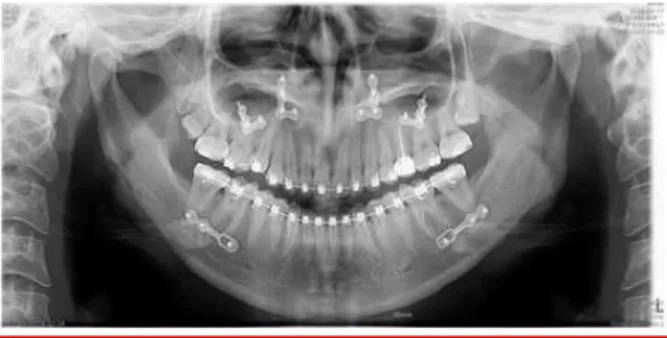
Fig. 1. Radiograph after Le Fort I osteotomy with differential reduction and mandibular setback sagittal split ramus osteotomy with angle reduction.
midine is a suitable drug for MAC in patients undergoing oral surgery [4]. It reduces anesthetic requirements, makes early recovery, and blunts the sympathetic nervous system [5]. Low dose propofol with dexme- detomidine as a combination agents for MAC in a patient undergoing oral procedure for plate removal is presented. Patients’ permission was obtained to publish this case report.
CASE REPORT
A 24-year-old, 55 kg, 162 cm woman was scheduled for plate and screw removal. She had undergone Le Fort I osteotomy with differential reduction and mandibular setback sagittal split ramus osteotomy with angle reduction (Fig. 1). The baseline arterial blood pressure, peripheral oxygen saturation, electrocardiogram and end-tidal CO2 measurements were obtained for all patients using standard monitoring equipment. Dexme- detomidine was initiated with an intravenous (IV) loading dose of 1 mcg/kg delivered over 10 minutes, followed by an infusion rate of 1 mcg/kg/hr. Subsequently, a target-controlled infusion (TCI) of propofol with an effect-site concentration (Ce) of 2 μg/ml was started to induce sedation. The TCI of propofol was titrated according to sedation depth with Ce of 1~3 μg/ml and stoped when the main part of the procedure was
completed.
The patient was then prepped and draped in a standard fashion for an orthognathic surgical procedure.
The patient's oropharynx was thoroughly irrigated and suctioned free of debris. 10 mL of 2% lidocaine with 1:100,000 epinephrine was infiltrated into the maxillary vestibule in the areas of the LeFort 1 ostetomy and then, 8 mL of 2% lidocaine with 1:100,000 epinephrine was next infiltrated into the mandibular vestibules bilaterally in the areas of the BSSO and angle reduction. Lidocaine infiltration and removal of Lefort 1 osteotomy plate induced severe pain. So during this period, propofol infused at Ce of 2~3 μg/ml and followed by an infusion 0.4~1 mcg/kg/hr.
The patient maintained spontaneous respiration while breathing O2 at 2 L/min. Arterial oxygen saturation, as measured by pulse oximetry, was maintained between 98% and100%, and her endtidal CO2 was stable. In the beginning, her blood pressure gradually inclined from 100/60 mmHg to 120/90 mmHg. Blood pressure then stabilized around 110/70 mmHg after the dexme- detomidine infusion was discontinued. Her heart rate (HR) remained at approximately 60~70 beats per minute (bpm). Total surgery time was 2 hours. The patient was then admitted to the recovery room in stable condition and observed in the hospital over the next 24 hours.
DISCUSSION
Dexmedetomidine enables the patient to convert easily between sedative and cooperative state; therefore, cooperative sedation makes patients more comfortable during the cataract surgery. When propofol and remifentanil were used, immediate interactions with the surgeon did not go smoothly due to the patients’ sedated state and inadequate sedation would lead to patient discomfort. In this case, property of cooperative sedation
Do-Won Lee, et al : Propofol and Dexmedetomidine for Monitored Anesthesia Care
JOURNAL OF THE KOREAN DENTAL SOCIETY OF ANESTHESIOLOGY 2013 Mar ; 13(1) : 19-22 21 with low dose propofol and dexmedetomidine may
enable the surgeon to perform surgery more efficiently.
Dexmedetomidine reduced the amount of adjuvant propofol needed to achieve a cooperative sedation without compromising postoperative recovery. This result is consistent with previous studies showing a 30~50% reduction in the propofol requirement with concomitant use of dexmedetomidine in adolescent patients and healthy volunteers [4,6,7].
The sedative effect of dexmedetomidine is mediated through the locus ceruleus in the brain stem, where dexmedetomidine decreases sympathetic outflow and increases parasympathetic outflow [8]. Because mecha- nism of dexmedetomidine is not mediated by the γ -aminobutyric acid system, dexmedetomidine is unique in that it does not cause respiratory depression [9]. In addition to this singular property of dexmedetomidine, less use of rescue sedative or analgesic drugs might also contribute to less respiratory depression. Most of the patients for plate removal were outpatients, thus we suggest that dexmedetomidine has more advantages over other commonly used sedatives. The different mecha- nisms for producing a sedative effect between dex- medetomidine and propofol suggest a possible synergism upon combined administration with respect to their sedative effects.
Dexmedetomidine shows complex hemodynamic effects, as it produces not only vasodilation by activating pre-synaptic α2-receptors on sympathetic and post- synaptic α2-receptors of the central nervous system, but also vasoconstriction through post-synaptic α2-receptors on vascular smooth muscle cells [10]. Furthermore, the overall effect of dexmedetomidine on MAP and HR is biphasic and dose-dependent [11], characterized by an initial short-term increase in BP followed by a longer lasting reduction in BP and HR. Despite this variability, most previous investigations have shown the cardio-
vascular depressive effects of dexmedetomidine, which increases the incidence of hypotension and bradycardia [12,13]. Previous investigations commented that propofol anesthesia with the concomitant use of dexmedetomidine delay the recovery from anesthesia, probably due to its quite long duration of action [13,14]. However, there is no compromises in prolongation of recovery profiles were observed in this case. The reason for this result might be associated with Ce of propofol: the Ce of propofol at the end of surgery (1.0 μg/ml) was already lower than the usual Ce of propofol for awakening when used alone (~1.5 μg/ml) [15]. The propofol-sparing effect of dxmedetomidine may be beneficial for reducing the propofol dosage and avoiding adverse effects caused by prolonged and large-dose administration of propofol [16].
We suggest that sedation with low dose propofol with dexmedetomidine is an effective technique for MAC in patients who are scheduled for intraoral surgery which meets the goals of minimum anesthetic intervention with maximum safety.
REFERENCES
1. Siyam MA, Benhamou D: Difficult endotracheal intubation in patients with sleep apnea syndrome. Anesth Analg 2002;
95: 1098-102, table of contents.
2. Goktay O, Satilmis T, Garip H, Gonul O, Goker K: A comparison of the effects of midazolam/fentanyl and midazolam/tramadol for conscious intravenous sedation during third molar extraction. J Oral Maxillofac Surg 2011;
69: 1594-9.
3. Egan TD: Target-controlled drug delivery: Progress toward an intravenous “vaporizer” and automated anesthe- tic administration. Anesthesiology 2003; 99: 1214-9.
4. Candiotti KA, Bergese SD, Bokesch PM, Feldman MA, Wisemandle W, Bekker AY, et al: Monitored anesthesia care with dexmedetomidine: A prospective, randomized,
Do-Won Lee, et al : Propofol and Dexmedetomidine for Monitored Anesthesia Care
22 대한치과마취과학회지 제13권 제1호 19-22
double-blind, multicenter trial. Anesth Analg 2010; 110:
47-56.
5. Aantaa R, Kanto J, Scheinin M, Kallio A, Scheinin H:
Dexmedetomidine, an alpha 2-adrenoceptor agonist, reduces anesthetic requirements for patients undergoing minor gynecologic surgery. Anesthesiology 1990; 73:
230-5.
6. Dutta S, Karol MD, Cohen T, Jones RM, Mant T: Effect of dexmedetomidine on propofol requirements in healthy subjects. J Pharm Sci 2001; 90: 172-81.
7. Ngwenyama NE, Anderson J, Hoernschemeyer DG, Tobias JD: Effects of dexmedetomidine on propofol and remi- fentanil infusion rates during total intravenous anesthesia for spine surgery in adolescents. Paediatr Anaesth 2008;
18: 1190-5.
8. Kamibayashi T, Maze M: Clinical uses of alpha2- adrenergic agonists. Anesthesiology 2000; 93: 1345-9.
9. Gerlach AT, Dasta JF: Dexmedetomidine: An updated review. Ann Pharmacother 2007; 41: 245-52.
10. Snapir A, Posti J, Kentala E, Koskenvuo J, Sundell J, Tuunanen H, et al: Effects of low and high plasma concentrations of dexmedetomidine on myocardial per- fusion and cardiac function in healthy male subjects.
Anesthesiology 2006; 105(5): 902-10; quiz 1069-70.
11. Arcangeli A, D'Alo C, Gaspari R: Dexmedetomidine use in general anaesthesia. Curr Drug Targets 2009; 10: 687-95.
12. Bloor BC, Ward DS, Belleville JP, Maze M: Effects of intravenous dexmedetomidine in humans. II. hemody- namic changes. Anesthesiology 1992; 77: 1134-42.
13. Tufanogullari B, White PF, Peixoto MP, Kianpour D, Lacour T, Griffin J, et al: Dexmedetomidine infusion during laparoscopic bariatric surgery: The effect on recovery outcome variables. Anesth Analg 2008; 106:
1741-8.
14. Ohtani N, Kida K, Shoji K, Yasui Y, Masaki E: Recovery profiles from dexmedetomidine as a general anesthetic adjuvant in patients undergoing lower abdominal surgery.
Anesth Analg 2008; 107: 1871-4.
15. Iwakiri H, Nagata O, Matsukawa T, Ozaki M, Sessler DI:
Effect-site concentration of propofol for recovery of consciousness is virtually independent of fentanyl effect- site concentration. Anesth Analg 2003; 96: 1651-5, table of contents.
16. Merz TM, Regli B, Rothen HU, Felleiter P: Propofol infusion syndrome--a fatal case at a low infusion rate.
Anesth Analg 2006; 103: 1050.