Surgical Outcome of Biventricular Repair for Double-outlet Right Ventricle:
A 18-Year Experience
Background: We reviewed our 18-year surgical experience of biventricular repair for double-outlet right ventricle.
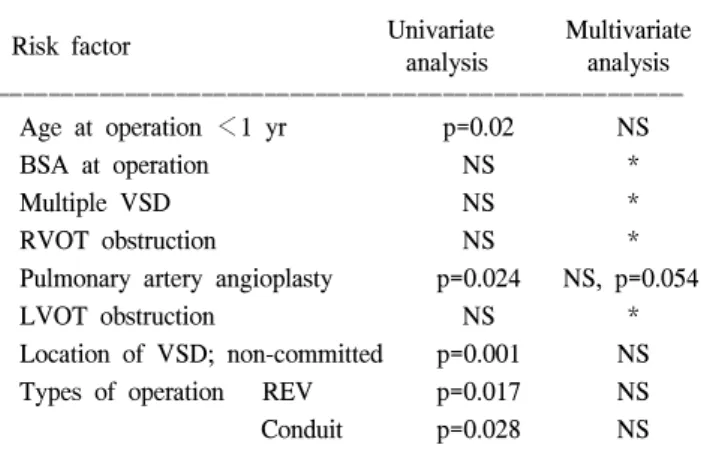
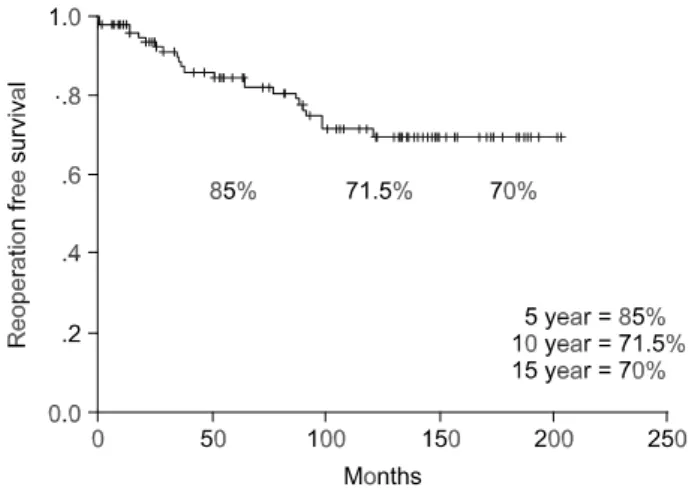
Material and Method: One hundred twelve consecutive patients (80 males and 32 females) who underwent biventricular repair for double-outlet right ventricle between May 1986 and September 2002 were included. We assessed risk factors for early mortality and reoperation. Reoperation-free survival rate and actual survival rate were analysed. Result: Most common type of ventricular septal defect was subaortic (n=58, 52%) and non-committed type was second most common (n=32, 29%). Four different surgical methods were used: intraventricular baffle repair (n=71, 63%); right ventricle to pulmonary artery conduit interposition or REV with left ventricle to aorta baffle repair (n=24, 21.4%); arterial switch operation with left ventricle to pulmonary artery baffle (n=14, 12.5%); Senning atrial switch operation with left ventricle to pulmonary artery baffle (n=3, 2.7%). Thirty four patients(30%) underwent palliative procedures before definite repair. Twenty three patients (21%) required reoperations. There were 12 (10.7%) early deaths and 4 late deaths. Age younger than 3 months at repair (p=0.003), cardiopulmonary bypass and aortic cross clamp time (p=0.015, p=0.067), type of operation (arterial switch operation) (p 0.001) and type of ventricular septal defect (subpulmonic type) (p=0.002) were revealed as risk factors for early death in univariate analysis, while age under 3 months was the only significant risk factor in multivariate analysis. Patients younger than 1 year of age (p=0.02), pulmonary artery angioplasty at definitive repair (p=0.024), type of ventricular septal defect (non-committed) (p=0.001), type of operation (right ventricle to pulmonary artery conduit interposition and REV operation) (p=0.028, p=0.017) were risk factors for reoperation in univariate analysis but there was no significant risk factor in multivariate analysis. Follow-up was available on 91 survivals with a mean duration of 110.8±56.4 (2 201) months. 5, 10 and 15 year survival rates were 86.5%, 85% and 85% and reoperation free survival were 85%, 71.5%, 70%. Conclusion: Age under 3 months at repair, subpulmonic ventricular septal defect and arterial switch operation were significant risk factors for early mortality. Patients with non-committed ventricular septal defect and who underwent conduit interposition or REV operation were risk factors for reoperation. With careful attention to chose best timing and surgical approach depending on morphologic characteristics, biventricular repair
양대혈관우심실기시증에 대한 양심실 교정의 수술 성적 : 18년 치험
for double outlet right ventricle can be achieved with good long-term outcome.
(Korean J Thorac Cardiovasc Surg 2003;36:566-575) Key words
:1. Congenital heart disease
2. Double outlet right ventricle
Table 1. Types of VSD
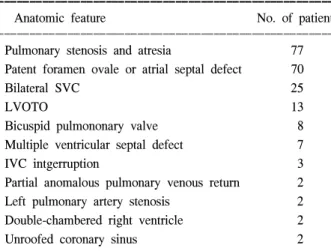
Table 2. Associated anomalies
Table 3. Previous palliative procedures
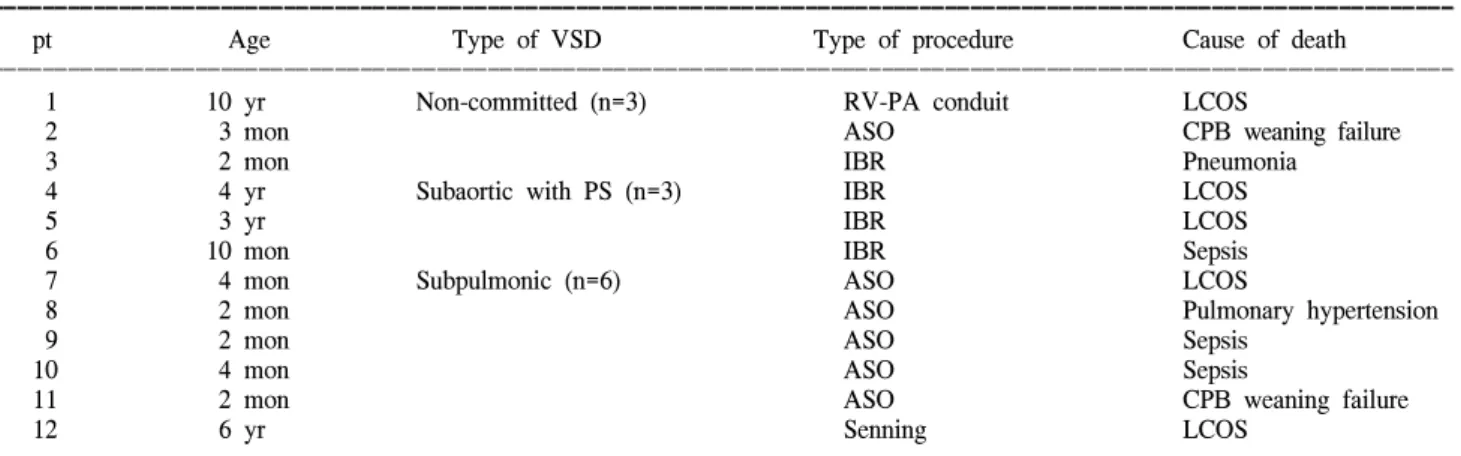
Table 5. Summary of hospital deaths
Table 4. Types of operation based on the types of VSD
Table 6. Analysis of risk factors for early death
Table 8. Reoperations based on the types of VSD Table 7. Casues of late death
Table 9. Reoperative procedures based on the types of operation
Table 10. Analysis of risk factors for reoperation
FIg. 1. Actuarial survival curve. Fig. 2. Actuarial reoperation-free survival.
=국문 초록=
배경:
대상 및 방법:
결과:
결론:
중심 단어