Prevalence of Atopic Dermatitis in Korea: Analysis by Using National Statistics
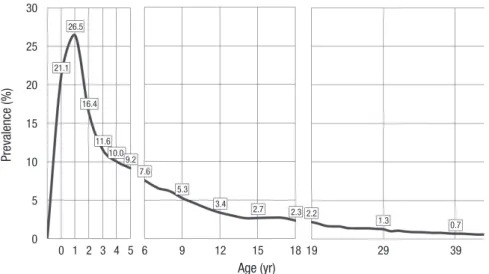
We attempted to investigate the prevalence of atopic dermatitis (AD) in Korea by using national statistics. Data on AD patients who received medical service at least once a year from 2003 through 2008 were collected from health insurance research team of National Health Insurance Corporation. Data of estimated populations during the same period were obtained from the Statistics Korea. In 2008, the prevalence of AD was 26.5% in aged 12- 23 months and decreased substantially to 7.6% at age 6 yr, 3.4% at age 12 yr and to 2.4%
at age 18 yr. In males, the prevalence was higher than females until 2 yr of age, while the opposite was shown in children aged 2 yr or older. In children aged less than 24 months, the prevalence of AD has increased from 19.8% to 23.8% between the years 2003 and 2008, while the prevalence showed no increase in the older age group. In conclusion, the prevalence of AD in 2008 peaked during infancy up to 26.5% and decreased thereafter.
Our findings also suggest that increasing prevalence of AD in children less than 24 months might be responsible for the recent increase in the prevalence of AD in Korean children.
Key Words: Prevalence; Dermatitis, Atopic; Korea Jung-Seok Yu1,2, Chang-Jong Lee3,
Ho-Seok Lee1,2, Jihyun Kim1,2, Youngshin Han1,2, Kangmo Ahn1,2, and Sang-Il Lee1,2
1Department of Pediatrics, Samsung Medical Center, Sungkyunkwan University School of Medicine, Seoul; 2Environmental Health Center for Atopic Diseases, Samsung Medical Center, Seoul; 3Health Insurance Policy Research Institute, National Health Insurance Corporation, Seoul, Korea
Received: 8 November 2011 Accepted: 23 February 2012 Address for Correspondence:
Kangmo Ahn, MD
Department of Pediatrics, Samsung Medical Center, Sungkyunkwan University School of Medicine, 81 Irwon-ro, Gangnam-gu, Seoul 135-710, Korea
Tel: +82.2-3410-3530, Fax: +82.2-3410-0043 E-mail: [email protected]
This article was financially supported by Ministry of Environment, Republic of Korea.
http://dx.doi.org/10.3346/jkms.2012.27.6.681 • J Korean Med Sci 2012; 27: 681-685 Dermatology
INTRODUCTION
Atopic dermatitis (AD) has already become a social concern because it lowers quality of life in the affected families and also increases economic burden. Therefore, it is necessary to assess the prevalence and to attempt to establish a proper strategy for management at a society level. The prevalence of AD among children and adolescents is known to be increased worldwide (1-5). In Korea, nationwide surveys were conducted among ele- mentary and middle school students in 1995 and 2000 to inves- tigate the prevalence of allergic diseases using the ISAAC (Inter- national Study of Asthma and Allergies in Childhood) question- naires (6). Unfortunately, these surveys did not include all age groups, although most of AD appears in infancy and early child- hood (7, 8). In addition, the prevalence of AD varies according to different methodologies (9-12).
In Korea, the National Health Insurance Corporation (NHIC) has covered all parts of medical fees for the whole population as a compulsory social insurance system (13). Objective and reli- able data are available in the NHIC because patient’s clinical information is accumulated for reimbursing health care services covered. Using these national statistics, we can obtain objective data on AD patients from infants to adults. In this study, we at-
tempted to investigate the prevalence of AD according to the age and gender in all age groups by using Korean national sta- tistics and examine the prevalence change from 2003 through 2008.
MATERIALS AND METHODS
We asked health insurance research team of the NHIC for data on AD (base code L20 of the International Classification of Dis- eases-Tenth Revision) by age and gender from 2003 through 2008. The data were collected with a standard of principle diag- nosis out of claims which clinics and hospitals made to NHIC after examining patients. The clinics and hospitals included de- partment of pediatrics, internal medicine, dermatology, otolar- yngology, and oriental medicine. The number of patients was determined by the number of diseased patients among benefi- ciaries tallied for the current year and actually examined by phy- sicians. Those who visited either medical care institutions or pharmacies more than once a year were counted as ‘one num- ber of patient’ in this study. Estimated population data from 2003 through 2008 were collected from the homepage of the Statis- tics Korea (http://www.kostat.go.kr). The total estimated popu- lation in 2008 was 48,606,787 (24,415,883 males and 24,190,904
females) and the estimated population of children and adoles- cents aged 18 yr or younger was 11,119,894 (5,843,178 males and 5,279,716 females). The prevalence of AD by age and gen- der was calculated by dividing the number of patients with the estimated population in each age group. The main results of this study were 1) the point prevalence of AD by age and gender in 2008 and 2) changes in the prevalence of AD in children and adolescents from 2003 through 2008.
RESULTS
The number of patients with AD in 2008
The total number of AD patients in 2008 was 1,086,982 (516,785 [47.5%] males and 570,197 [52.5%] females). The number of female patients was more than male patients by 53,412 (4.9%).
The number of patients aged less than 12 months was 94,253 (50,258 [53.3%] males and 43,995 [46.7%] females) and the num- ber of male patients was more than female patients by 6,263 (6.6%). The number of patients aged 12-23 months was 117,988 (63,912 [54.2%] males and 54,076 [45.8%] females) and the num- ber of male patients outnumbered female patients by 9,836 (8.3%).
This age group accounted for the highest number of patients by age among all age groups. The number of patients at age 2, 3, 4 and 5 yr were 71,856, 51,879, 47,640, and 44,805, respectively and it decreased with age. The number of male patients at the age of 9 yr or younger was higher than for female patients, but by the age of 10 yr or older, female patients outnumbered male patients until middle age (Fig. 1). The number of patients aged 18 yr or younger was 764,569 and they accounted for 70.3% of the total number of patients with AD in 2008.
Number of patients (person)
Age (yr)
Male Female
0 2 4 6 8 10 12 14 16 18 20 22 24 26 28 30 32 34 36 38 40 42 44 46 48 50 52 54 56 58 60 62 64 66 68 70 72 74 76 78 120,000
100,000
80,000
60,000
40,000
20,000
0
Fig. 1. The number of patients with AD by age and gender in Korea in 2008.
Prevalence (%)
Age (yr) 30
25 20 15 10 5
0 0 1 2 3 4 5 6 9 12 15 18 19 29 39
1.3 0.7 2.32.2
3.4 2.7 5.3 7.6 10.09.2 11.6 16.4 21.1
26.5
Fig. 2. The prevalence of AD by age in Korea in 2008.
The prevalence of AD by age and gender in 2008
The total prevalence of AD in Korean children and adults in 2008 was 2.2% (males, 2.1%; females, 2.4%). The prevalence of chil- dren and adolescents was 6.9% and the prevalence among fe- males (7.2%) was higher than that of males (6.6%). The preva- lence of AD aged less than 12 months was 21.1%. The highest prevalence of AD by age was 26.5% in the age group of 12-23 months. The cumulative prevalence of AD aged less than 24 months was 23.8%. Thereafter, the prevalence decreased sub- stantially to 7.6% at age 6 yr, 3.4% at age 12 yr and to 2.4% at age 18 (Fig. 2).
In children aged less than 24 months, the prevalence of AD in males was higher than that of females, while the opposite re- sults were found in children aged 2 yr or older. The difference in the prevalence by gender became more significant with age so that the prevalence of males and females at age 18 yr were 1.9%
and 2.9%, respectively. The prevalence at pre-school age (5 yr or younger) was 15.6% (males, 15.8%; females, 15.4%) and the prev- alence at elementary (6-12 yr of age), middle (12-15 yr of age) and high (15-18 yr of age) school ages were estimated as 5.3%
(males, 5.0%; females, 5.6%), 2.9% (males, 2.6%; females 3.4%) and 2.6% (males, 2.2%; females 3.2%), respectively (Table 1).
Changes in the prevalence of AD with children and adolescents from 2003 through 2008
The prevalence of AD in Korean children and adolescents aged under 18 yr slightly decreased from 7.2% in 2003 to 6.9% in 2008.
After the patients were divided into 3 different age groups (less
than 24 months, 2-5 yr, 6-18 yr), we analyzed the prevalence change in each age group. The estimated populations aged less than 24 months were 1,025,850 in 2003, 973,142 in 2004, 932,113 in 2005, 893,334 in 2006, 888,667 in 2007 and 892,534 in 2008.
The number of patients was 202,846, 206,568, 197,427, 186,187, 204,083, and 212,241, respectively, from 2003 through 2008. When comparing years 2003 and 2008, the estimated population aged less than 24 months decreased by 133,316 (13.0%), but the AD prevalence of this age group increased significantly from 19.8%
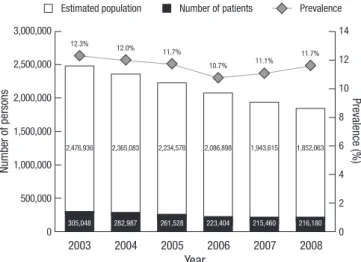
to 23.8% (Fig. 3). In contrast, the prevalence was slightly de- creased from 12.3% to 11.7% in children aged 2-5 yr (Fig. 4), and
Year
2003 2004 2005 2006 2007 2008 Estimated population Number of patients
1,200,000
1,000,000
800,000
600,000
400,000
200,000
0
30
25
20
15
10
5
0
Number of persons Prevalence (%)
1,025,850 973,142 932,113 893,334 888,667 892,534
19.8%
21.2% 21.2%
23.0% 23.8%
202,846 206,568 197,427 186,187 204,083 212,241
Fig. 3. The number of patients, estimated population and prevalence of AD in children aged less than 24 months from 2003 through 2008.
Prevalence
20.8%
Table 1. The prevalence of children and adolescents with AD by age and gender in 2008
Age (yr) Number of patients (person) Estimated population (person) Prevalence (%)
Total Male Female Total Male Female Total Male Female
0 94,253 50,258 43,995 446,738 231,719 215,019 21.1 21.7 20.5
1 117,988 63,912 54,076 445,796 231,349 214,447 26.5 27.6 25.2
2 71,856 37,014 34,842 438,576 227,279 211,297 16.4 16.3 16.5
3 51,879 26,233 25,646 448,625 232,459 216,166 11.6 11.3 11.9
4 47,640 24,427 23,213 475,449 247,039 228,410 10.0 9.9 10.2
5 44,805 22,935 21,870 489,413 255,024 234,389 9.2 9.0 9.3
6 39,872 20,293 19,579 526,480 274,875 251,605 7.6 7.4 7.8
7 38,708 19,362 19,346 587,646 306,395 281,251 6.6 6.3 6.9
8 38,152 19,189 18,963 618,004 323,097 297,907 6.2 5.9 6.4
9 32,420 16,049 16,371 616,016 323,231 292,785 5.3 5.0 5.6
10 29,186 14,452 14,734 635,360 331,589 303,771 4.6 4.4 4.9
11 25,832 12,444 13,388 659,297 344,657 314,640 3.9 3.6 4.3
12 22,915 11,061 11,854 679,424 359,103 320,321 3.4 3.1 3.7
13 20,757 9,723 11,034 692,760 368,587 324,173 3.0 2.6 3.4
14 18,595 8,477 10,118 698,514 373,061 325,453 2.7 2.3 3.1
15 18,676 8,300 10,376 696,402 370,780 325,622 2.7 2.2 3.2
16 18,555 8,049 10,506 681,074 360,373 320,701 2.7 2.2 3.3
17 17,699 7,627 10,072 654,960 347,214 307,746 2.7 2.2 3.3
18 14,781 6,376 8,405 629,360 335,347 294,013 2.4 1.9 2.9
≤ 18 764,569 386,181 378,388 11,119,894 5,843,178 5,279,716 6.9 6.6 7.2
> 18 322,413 130,604 191,809 37,486,893 18,572,705 18,911,188 0.9 0.7 1.0
Total 1,086,982 516,785 570,197 48,606,787 24,415,883 24,190,904 2.2 2.1 2.4
also slightly decreased from 4.2% to 4.0% in children and ado- lescents aged 6-18 yr old (Fig. 5).
DISCUSSION
In this study, the prevalence of AD was calculated by using the number of AD patients from data obtained from the NHIC and the estimated population from data of the Statistics Korea. Com- pared with questionnaire surveys depending on the parental report, this study has some advantages. We could collect data on the patients with physician-diagnosed AD and consequently avoid the recall bias. In addition, sampling error was excluded because these data include the whole population of Korea and little financial support was needed for investigation. In this re- gard, our study suggests that the analysis by using the data from national statistics could be useful to investigate annual preva- lence of AD.
According to a birth cohort study where 562 children were followed from birth to age 6 yr, the point-prevalence peaked at 18 months of age (10%) and decreased at 36 and 72 months to slightly below 7%, while boys had earlier onset of AD than girls (14). Another birth cohort study in Germany showed that the cumulative prevalence of AD in the first 2 yr of life was 21.5%
and of these children with early AD, 43.2% were in complete remission by age 3 yr (15). In our study, the prevalence of AD by age in 2008 reached 21.1% in children aged less than 12 months and 26.5% in children between 12-23 months. The cumulative prevalence of AD in the first 2 yr of age was 23.8%, and thereaf- ter, the prevalence decreased with age, especially within the pre- school period. This finding suggests that AD developed during infancy in most of cases and disappeared spontaneously over time, which is consistent with previous studies (14, 15).
In the questionnaire surveys using the ISAAC protocol in school children in Korea (5) and other countries (16-19), the prevalence
Year
2003 2004 2005 2006 2007 2008 Estimated population Number of patients
10,000,000 9,000,000 8,000,000 7,000,000 6,000,000 5,000,000 4,000,000 3,000,000 2,000,000 1,000,000 0
5
4
3
2
1
0 Number of persons Prevalence (%)8,637,623 8,604,253 8,562,233 8,535,043 8,488,498 8,375,297
4.2% 4.4% 4.4%
4.2% 4.2%
4.0%
364,608 375,925 375,419 358,778 354,303 336,148
Fig. 5. The number of patients, estimated population and prevalence of AD in children aged 6-18 yr from 2003 through 2008.
Prevalence
Year
2003 2004 2005 2006 2007 2008 Estimated population Number of patients
3,000,000
2,500,000
2,000,000
1,500,000
1,000,000
500,000
0
14
12
10
8
6
4
2
0 Number of persons Prevalence (%)2,476,936 2,365,083 2,234,578 2,086,898 1,943,615 1,852,063
12.3% 12.0% 11.7%
10.7% 11.1% 11.7%
305,048 282,987 261,528 223,404 215,460 216,180
Fig. 4. The number of patients, estimated population and prevalence of AD in children aged 2-5 yr from 2003 through 2008.
Prevalence
of females was higher than that of males. In contrast, boys are more likely to develop atopic dermatitis in early childhood (15, 20). In the present study where infants and preschoolers were included, we also found that the prevalence in males was higher than females aged less than 24 months, while this sex differnece changed over time. Although the exact mechanism remains un- clear, sex hormones, different gene-environment interactions, or possibly misclassification of irritant contact dermatitis or aller- gic contact dermatitis, which could be more common in adoles- cent girls, has been suggested as possible explanations (21-24).
We found that the prevalence of AD in Korean children and adolescents under 18 yr old was slightly decreased from 2003 through 2008, but was significantly increased in infants aged less than 24 months. Increased prevalence of AD in early childhood might be due to exposure to environmental irritants, develop- ment of food allergies or increased awareness of the disease. In order to reduce the development of AD in Korean children, it seems to be important to elucidate the causative factor for the development of AD in children less than 2 yr.
Some limitations need to be considered in this study. Although the number of AD patients who were diagnosed by physicians was counted in national statistics, there is a concern of diagnos- tic accuracy because of the inter-observer variability in diagnos- ing AD. Clearly national statistics provide more objective data on AD rather than questionnaire surveys. However, this figure might be underestimated because those who do not use medi- cal facilities were not included. Further studies are needed to evaluate the prevalence by comparing different methodologies.
In conclusion, the prevalence of AD in 2008 peaked during infancy up to 26.5% and decreased thereafter. Our findings also suggest that increasing prevalence of AD in children younger than 24 months might be responsible for the recent increase in the prevalence of AD in Korean children.
REFERENCES
1. Williams H, Stewart A, von Mutius E, Cookson W, Anderson HR; Inter- national Study of Asthma and Allergies in Childhood (ISAAC) Phase One and Three Study Groups. Is eczema really on the increase world- wide? J Allergy Clin Immunol 2008; 121: 947-54.
2. Tozzi AE, Armenio L, Bernardini R, Boner A, Calvani M, Cardinale F, Cavagni G, Dondi A, Duse M, Fiocchi A, et al. Pediatric allergy and im- munology in Italy. Pediatr Allergy Immunol 2011; 22: 267-76.
3. Celik G, Bakirtas A, Sackesen C, Reisli I, Tuncer A. Pediatric allergy and immunology in Turkey. Pediatr Allergy Immunol 2011; 22: 440-8.
4. Hwang CY, Chen YJ, Lin MW, Chen TJ, Chu SY, Chen CC, Lee DD, Chang YT, Wang WJ, Liu HN. Prevalence of atopic dermatitis, allergic rhinitis and asthma in Taiwan: a national study 2000 to 2007. Acta Derm Vene- reol 2010; 90: 589-94.
5. Lee SI, Shin MH, Lee HB, Lee JS, Son BK, Koh YY, Kim KE, Ahn YO. Prev- alences of symptoms of asthma and other allergic diseases in Korean chil- dren: a nationwide questionnaire survey. J Korean Med Sci 2001; 16:
155-64.
6. Oh JW, Pyun BY, Choung JT, Ahn KM, Kim CH, Song SW, Son JA, Lee SY, Lee SI. Epidemiological change of atopic dermatitis and food allergy in school-aged children in Korea between 1995 and 2000. J Korean Med Sci 2004; 19: 716-23.
7. Spergel JM. Epidemiology of atopic dermatitis and atopic march in chil- dren. Immunol Allergy Clin North Am 2010; 30: 269-80.
8. Spergel JM, Paller AS. Atopic dermatitis and the atopic march. J Allergy Clin Immunol 2003; 112: S118-27.
9. Ellwood P, Asher MI, Stewart AW; ISAAC Phase III study Group. The impact of the method of consent on response rates in the ISAAC time trends study. Int J Tuberc Lung Dis 2010; 14: 1059-65.
10. Haileamlak A, Lewis SA, Britton J, Venn AJ, Woldemariam D, Hubbard R, Williams HC. Validation of the International Study of Asthma and Allergies in Children (ISAAC) and U.K. criteria for atopic eczema in Ethiopian children. Br J Dermatol 2005; 152: 735-41.
11. Flohr C, Weinmayr G, Weiland SK, Addo-Yobo E, Annesi-Maesano I, Björkstén B, Bråbäck L, Buchele G, Chico M, Cooper P, et al. How well do questionnaires perform compared with physical examination in de- tecting flexural eczema? Findings from the International Study of Asth- ma and Allergies in Childhood (ISAAC) Phase Two. Br J Dermatol 2009;
161: 846-53.
12. Chan HH, Pei A, Van Krevel C, Wong GW, Lai CK. Validation of the Chi- nese translated version of ISAAC core questions for atopic eczema. Clin Exp Allergy 2001; 31: 903-7.
13. Kim CY, Park HW, Ko SK, Chang SI, Moon HB, Kim YY, Cho SH. The fi- nancial burden of asthma: a nationwide comprehensive survey conduct- ed in the Republic of Korea. Allergy Asthma Immunol Res 2011; 3: 34-8.
14. Eller E, Kjaer HF, Høst A, Andersen KE, Bindslev-Jensen C. Development of atopic dermatitis in the DARC birth cohort. Pediatr Allergy Immunol 2010; 21: 307-14.
15. Harris JM, Cullinan P, Williams HC, Mills P, Moffat S, White C, Newman Taylor AJ. Environmental associations with eczema in early life. Br J Der- matol 2001; 144: 795-802.
16. Tay YK, Kong KH, Khoo L, Goh CL, Giam YC. The prevalence and de- scriptive epidemiology of atopic dermatitis in Singapore school children.
Br J Dermatol 2002; 146: 101-6.
17. Martin Fernández-Mayoralas D, Martin Caballero JM, Garcia-Marcos Alvarez L. Prevalence of atopic dermatitis in schoolchildren from Carta- gena (Spain) and relationship with sex and pollution. An Pediatr (Barc) 2004; 60: 555-60.
18. Hugg T, Ruotsalainen R, Jaakkola MS, Pushkarev V, Jaakkola JJ. Compar- ison of allergic diseases, symptoms and respiratory infections between Finnish and Russian school children. Eur J Epidemiol 2008; 23: 123-33.
19. Miyake Y, Yura A, Iki M. Cross-sectional study of allergic disorders in re- lation to familial factors in Japanese adolescents. Acta Paediatr 2004;
93: 380-5.
20. Halkjaer LB, Loland L, Buchvald FF, Agner T, Skov L, Strand M, Bisgaard H. Development of atopic dermatitis during the first 3 years of life: the Copenhagen prospective study on asthma in childhood cohort study in high-risk children. Arch Dermatol 2006; 142: 561-6.
21. Mortz CG, Lauritsen JM, Bindslev-Jensen C, Andersen KE. Prevalence of atopic dermatitis, asthma, allergic rhinitis, and hand and contact der- matitis in adolescents. The Odense Adolescence Cohort Study on Atopic Diseases and Dermatitis. Br J Dermatol 2001; 144: 523-32.
22. Ebata T, Itamura R, Aizawa H, Niimura M. Serum sex hormone levels in adult patients with atopic dermatitis. J Dermatol 1996; 23: 603-5.
23. Dotterud LK, Falk ES. Contact allergy in relation to hand eczema and atopic diseases in north Norwegian schoolchildren. Acta Paediatr 1995;
84: 402-6.
24. Tokura Y. Extrinsic and intrinsic types of atopic dermatitis. J Dermatol Sci 2010; 58: 1-7.