158
©The Korean Society of Food Science and Technology
원주산과 옥천산 참옻나무의 부위별 flavonoid 및 urushiol 함량 비교
이원재·강지은·최지호·정석태·김명곤
1·최한석*
농촌진흥청 국립농업과학원 발효식품과, 1전북대학교 식품공학과
Comparison of the Flavonoid and Urushiol Content in Different Parts of
Rhus verniciflua Stokes Grown in Wonju and Okcheon
Won-Jae Lee, Ji-Eun Kang, Ji-Ho Choi, Seok-Tae Jeong, Myung-Kon Kim1, and Han-Seok Choi* Fermented Food Science Division, National Academy of Agricultural Science, RDA
1Department of Food Science and Technology, Chonbuk National University
Abstract Fustin comprised >98 and 73.0-86.7% of the total flavonoid content in the bark, and the stems and lignum of Rhus verniciflua, respectively. The butein, fisetin, and sulfuretin content varied between 0.31-2.17, 0.27-3.32, and 0.15-0.80 mg/g on a dry weight basis, respectively, in different parts of Rhus verniciflua. The urushiol content was 5.09-6.29, 55.05-56.30, and 0.38-0.39 mg/100 g on a dry weight basis in the stems, bark, and lignum, respectively. This showed that the bark of the tree had the highest urushiol content. C15:3 (pentadecatrienyl catechol), C15:1 (pentadecenyl catechol), and C15:2 (pentadecadienyl catechol) comprised 63, 33-35, and 2-3% of urushiol congeners in the tree bark, respectively. Keywords: Rhus verniciflua, lacquer tree, flavonoid, urushiol, phenol
서
론
우리나라에서 옻의 식·의약 사용에 대한 기록은 고려중기 향 약구급방에 최초로 나타나며 혈액순환 촉진, 위장질환, 심장질환, 부인과 질환 등의 치료를 목적으로 근현대에 이르기까지 광범위 하게 사용되어 왔다(1,2). 2000년 이후 소비자의 웰빙에 대한 관 심이 높아지면서 옻에 대한 수요가 증가했고 알레르기 유발물질 인 urushiol이 검출되지 않는 제품에 한하여 옻닭 및 옻오리 조 리용으로 판매할 수 있게 되었다(3). 현재 옻 추출물 생산 공장 이 전국에 만들어 있고 온·오프라인에서 다양한 종류의 제품이 팔리면서 옻 산업은 1차 산업에서 3차 산업으로 변모되고 있다. 한편 옻 재배농가의 수익구조도 식·의약품 원료용으로 판매되 는 비중이 2002년 48.2%에서 2007년 64%, 2012년 67.3%로 증가 하였다(4,5). 더불어 2012년 12월 장수버섯(Fomitella fraxinea)으로 발효한 옻 추출물에 대해서는 장류, 발효식초, 일부 주류까지 사 용가능 하게 되면서(6) 옻의 식·의약 사용량은 더욱 늘어날 전 망이다. 지금까지 옻나무로부터 다양한 phenolic 성분과 flavonoid 화합 물들이 분리되어 왔고 이들 성분이 항산화, 항돌연변이, 항염증, 항균 및 혈당조절 등에 다양한 효과가 있는 것으로 보고되고 있 다(7). 그러나 이들 성분의 함량자료가 없어 원료 및 옻 가공식 품의 품질평가 등에 어려움이 있다. 또한 옻은 수포, 발진, 가려 움 등을 동반한 접촉성 피부염을 일으키는 화합물질을 가지고 있 기 때문에(8) 그 사용에 주의를 기울여야 됨에도 불구하고 urushiol 함량에 대한 기초자료도 없는 실정이다. 따라서 옻 산업특구로 지정되어있고 옻 생산량이 비교적 많은 강원도 원주시와 충청북 도 옥천군에서 재배되어 추출물 제조에 이용되고 있는 옻을 대 상으로 부위별 flavonoid 함량과 urushiol 함량을 조사하였다. 또 한, 수확시기에 따른 성분변화를 검토하기 위하여 채취시기를 달 리하여 살펴보았다.재료 및 방법
시료 본 시험에 사용된 원료는 시중에 유통되는 것을 대상으로 하 였다. 원주산 옻나무는 산에서 재배된 것으로 수령은 8년생이며 11월에 수확해서 건조시킨 것을 원주옻 식품(Otfood, Wonju, Korea)에서 구입하였다. 옥천산은 산에서 자란 10년생 옻나무를 8월에 수확하여 건조시킨 것을 참옻들(Charmots, Okcheon, Korea) 에서 구입하였다. 이때 시료는 껍질을 벗기지 않은 줄기전체, 껍 질, 껍질을 벗긴 목질부의 3개 부위로 구분하여 분쇄된 것을 100 kg씩 구매한 후 무작위로 선별하여 분석에 사용하였다. 총 phenol 및 flavonoid 함량 각 부위별 원료 1 g에 methanol 200 mL를 붓고 상온에서 30분 간 shaking (150 rpm)하여 추출하였으며, 3회 반복하였다. 추출물 을 filter paper (No. 2)로 여과하고 methanol을 사용하여 전량을 1 L로 한 다음 분석시료로 사용하였다.총 phenol 함량은 Folin-Ciocalteu’s 발색법(9)으로 측정하였다. 각각의 부위별 추출물 0.5 mL에 2% Na2CO3 5 mL를 넣고 충분
*Corresponding author: Han-Seok Choi, Fermented Food Science Division, National Academy of Agricultural Science, RDA, Wanju, Jeonbuk 565-851, Korea
Tel: 82-63-238-3618 Fax: 82-63-238-3843 E-mail: [email protected]
Received November 11, 2014; revised January 22, 2015; accepted February 12, 2015
히 혼합한 다음 2분간 방치하였다. 이 후 50% Folin-Ciocalteu’s reagent (Sigma-Aldrich Co., Louis, MO, USA) 0.5 mL를 넣고 30분간 방치한 후 750 nm에서 흡광도를 측정하였다. 이때 표준 곡선은 gallic acid를 사용하였고 data는 gallic acid 함량으로 표현 하였다.
총 flavonoid 함량은 Davis 방법(10)에 따라 측정하였다. 각 부 위별 추출물 1 mL에 diethylene glycol (Sigma-Aldrich Co.) 10 mL를 가하여 잘 혼합한 다음 1 N NaOH 0.1 mL 넣고 잘 섞어주 었다. 그런 후 37oC의 수조에서 1시간 동안 반응시킨 다음 420 nm에서 흡광도를 측정하였다. Blank는 시료용액 대신에 추출용 매로 하였고 이때 표준곡선 작성에는 quercetin (Sigma-Aldrich Co.)을 사용하였다. Flavonoid 분석
Flavonoid는 HPLC (Waters Co., Milford, MA, USA)를 이용하 여 분석하였다. 각 부위별 시료를 분쇄한 다음 1 g을 취해 methanol 40 mL을 넣고 30분 동안 초음파 처리 후 원심분리(4oC, 3000 rpm, 15 min) 하여 상층액을 회수하였다. 위의 과정을 3반복하여 얻어진 상등액을 모두 합한 다음 45oC 이하의 온도에서 감압농
축 하였다. 농축물을 90% methanol 4 mL에 용해시킨 후 mem-brane filter (0.2µm)로 여과하여 분석용 시료로 사용하였다. Col-umn은 YMC-Pack pro C18 RS (4.6×250 mm, 5 µm, YMC Co., Kyoto, Japan)를 사용하였고, 성분분리는 gradient mode로 분석하 였다. 이동상 A는 0.1% formic acid in water, 이동상 B는 0.1% formic acid in 90% acetonitrile을 사용하여 기울기 용리 조건에서 분리하였다. 기울기 용리 조건은 0-4 min, 10% B; 4-20 min, 60% B linear gradient; 20-23 min, 10% B linear gradient; 23-30 min 10% B로 하였다. 분석은 상온에서 실시하였으며 flow rate는 0.8 mL/min, UV 검출기 파장은 310 nm로 하여 분석하였다. 표준품 으로 사용된 butein, fisetin, fustin, sulfuretin은 Extrasynthese (Genay, France)에서 구입하여 사용하였다.
Urushiol 분석
Urushiol은 HPLC (Waters Co.)를 이용하여 분석하였다. 분쇄된 각 부위별 시료 1 g에 n-hexane 40 mL을 넣고 30분간 초음파 처 리 후 원심분리(4oC, 3,000 rpm, 15 min) 하여 상층액을 취하였다.
위의 과정을 3반복하여 얻어진 상등액을 모두 합한 다음 45oC이
하의 온도에서 감압농축 하였다. 농축물을 85% methanol용액 4 mL에 재 용해시킨 후 membrane filter (0.2 µm)로 여과한 다음 분 석용 시료로 사용하였다. HPLC 조건으로 column은 Halo column (4.6×100 mm, 2.7 µm, Advanced Materials Technology Co., Wilmington, DE, USA)을 사용하였고, 성분분리는 85% methanol 을 이동상으로 사용하였다. 분석은 상온에서 실시하였으며 flow rate는 0.5 mL/min, UV 검출기의 파장은 203 nm에서 분석하였다. 표준품으로 사용된 C15:3 (pentadecatrienyl catechol), C15:2
(pen-tadecadienyl catechol), C15:1 (pentadecenyl catechol)은 Phyto-Lab GmbH & Co. KG (Vestenbergsgreuth, Germany)에서 구입하 여 사용하였다.
통계처리
통계처리는 유의수준 5% (p<0.05)로 설정하여 one way ANOVA분석을 하였으며 Minitab 16 (Minitab Inc., State College, PA, USA) 프로그램을 사용하였다.
결과 및 고찰
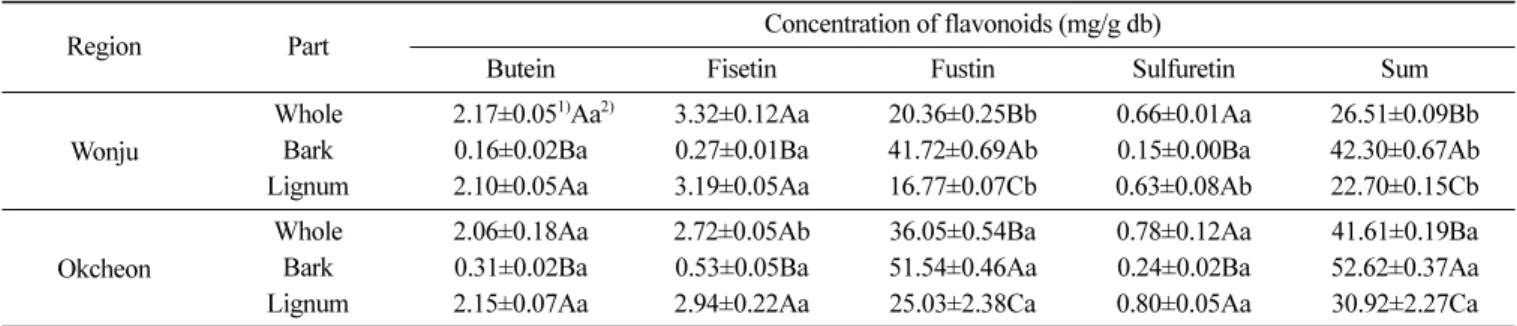
총 phenol 및 flavonoid 함량 참옻나무의 줄기전체, 껍질, 목질부위의 총 phenol 함량을 Table 1에 나타내었다. 원주산은 각각 15.73, 13.29, 13.21 mg gallic acid/g dry base (db)로 줄기부위의 함량이 유의적으로 높게 나타났다. 옥천산은 각각 16.14, 16.63, 14.81 mg gallic acid/g db로 줄기와 껍질부위의 함량이 높았으나 통계적 유의성은 없었다. 산지별로 함량을 비교해 보면 옥천산이 원주산보다 각 부위에서 2.58, 25.07, 12.15% 높은 함량을 가지고 있었으나 껍질 부위에서만 유의적인 차이가 확인되었다. 총 flavonoid 함량(Table 1)은 원주산이 각각 32.04, 15.16, 31.05 mg quercetin/g db, 옥천산이 45.51, 22.09, 43.48 mg quercetin/g db로 옥천산이 원주산보다 42.03, 45.68, 40.04% 높은 함량을 가지고 있었다. 각 부위별 총 flavonoid 함 량은 줄기와 목질부위의 함량이 껍질에 비하여 원주산은 2.05-2.11배, 옥천산은 1.97-2.06배 높은 것으로 나타났다. Park 등(11) 은 열수추출로 옥천산 원료에서 각각 47.82, 42.06, 47.49 mg gallic acid/g의 phenol 화합물과 8.04, 5.53, 7.29 mg catechin/g의 flavonoid 화합물을 얻을 수 있다고 보고하여 총 phenol 화합물의 함량은 부위별로 유사한 결과를 보였다. 총 flavonoid 함량은 줄 기와 목질에 많이 함유되어 있다는 경향은 유사하였으나 그 함 유량에서는 차이가 있었다. 옻나무에 함유된 phenolic acid로는 gallic, caffeic, chlorogenic, p-coumaric, protocatechuic acid가 알려 져 있고 flavonoid 화합물로는 butein, butin, fisetin, fustin, gar-banzol, kaempferol, kaempferol-O-glucoside, mollisacasidin, sul-furetin 등이 동정되었으며 이들 화합물이 항산화, 항염, 항돌연변 이 등의 생리활성에 많은 영향을 미치는 것으로 알려져 있다(12-19). Flavonoid 함량 Flavonoid 성분들의 부위별 함량 분포를 조사한 결과(Table 2, Fig. 1) fustin이 원주산은 각각 20.36, 41.72, 16.77 mg/g db, 옥천 산은 36.05, 51.54, 25.03 mg/g db로, 껍질에서는 총 성분량의 98% 이상, 줄기와 목질에서는 73.0-86.7%를 차지하는 주요성분 으로 확인되었다. Fustin은 뇌세포사멸 방지(20), 항산화 작용(12), 면역반응 증진(17), 물고기 바이러스에 대한 항바이러스 효과(21) 등이 있는 것으로 알려져 있다. Kim 등(18)은 원주산 옻나무 목 Table 1. Contents of total phenolics and flavonoids in different parts of Rhus verniciflua stem obtained from Wonju and OkcheonRegion Part
Phenolics (mg gallic acid/g db) Flavonoids (mg quercetin/g db)
Wonju Okcheon Wonju Okcheon
Whole ---15.73±1.231)Aa2) 16.14±1.14Aa 32.04±4.08Ba 45.51±8.78Aa
Bark 13.29±0.73Bb 16.63±1.47Aa 15.16±3.12Bb 22.09±2.64Ab
Lignum 13.21±1.33Ab 14.81±1.41Aa 31.05±1.62Ba 43.48±4.14Aa
1)Values represent means±standard deviations.
2)Within-the-column values indicated by capital letters (A,B) and the row values indicated by lowercase letters (a,b) are significantly different
질부중 심재에는 16.96 mg/g, 변재에는 0.94 mg/g, 껍질부에는 1.51 mg/g의 fustin 함유되어 있다고 보고하고 있어 목질부가 껍 질부보다 10배 이상 많은 것으로 조사되었다. 그러나 본 시험에 서는 껍질부가 목질부 보다 원주산은 2.5배, 옥천산은 2.1배 높게 나타났다. 산지나 재배환경에 따라서 함량에 차이가 있을 것으로 생각되어지고 있으나 이에 대한 연구는 아직 없다. 산지별로는 옥천산이 원주산보다 각 부위에서 77.05, 23.53, 49.22% 높은 것 으로 확인되었다.
Butein은 유방암세포의 증식을 억제하고(22,23), nitric oxide로부 터 췌장의 β세포를 보호하며(24), α-tocopherol보다 강력한 항산 화력(25)을 가지고 있는 것으로 알려져 있다. Butein의 함량은 원 주산이 각각 2.17, 0.16, 2.10 mg/g db, 옥천산이 2.06, 0.31, 2.15 mg/g db씩 함유 되어있는 것으로 나타나 목질이 껍질보다 6.9-13.2배 높은 것으로 확인되었다. Fisetin은 원주산이 3.32, 0.27, 3.19 mg/g db, 옥천산이 2.72, 0.53, 2.94 mg/g db으로 butein과 유 사하게 껍질보다 목질의 함유량이 높았다. 산지별로는 목질부의 경우 원주산이 옥천산보다 fisetin의 함량이 8.66% 높았던 반면 껍질에서는 옥천산의 함량이 더욱 높게 나타났다. Fisetin은 옻나 무 이외에 아카시아 나무(Acacia greggii, Acacia berlandieri), 앵 무새 나무(Butea frondosa) 및 딸기, 양파, 감에도 2-160 µg/g 정도 함유되어 있고 항산화, 항염, 항암효과 뿐만 아니라, 당뇨, 심혈 관질환 및 콜레스테롤 조절 등에도 효과가 있는 것으로 알려지 고 있다(26). Sulfuretin은 원주산이 0.66, 0.15, 0.63 mg/g db, 옥천 산이 0.78, 0.24, 0.80 mg/g db로 다른 flavonoid 화합물에 비하여 Fig. 1. HPLC chromatogram of flavonoid compounds in different parts of Rhus verniciflua stem from Wonju (A) and Okcheon (B). Compounds-1, fusitin; 2, fisetin; 3, sulfuretin; 4, butein
Table 2. Contents of flavonoids in different parts of Rhus verniciflua stem obtained from Wonju and Okcheon Region Part Concentration of flavonoids (mg/g db)
Butein Fisetin Fustin Sulfuretin Sum
Wonju
Whole 002.17±0.051)Aa2) 3.32±0.12Aa 20.36±0.25Bb 0.66±0.01Aa 26.51±0.09Bb Bark 0.16±0.02Ba 0.27±0.01Ba 41.72±0.69Ab 0.15±0.00Ba 42.30±0.67Ab Lignum 2.10±0.05Aa 3.19±0.05Aa 16.77±0.07Cb 0.63±0.08Ab 22.70±0.15Cb
Okcheon
Whole 2.06±0.18Aa 2.72±0.05Ab 36.05±0.54Ba 0.78±0.12Aa 41.61±0.19Ba Bark 0.31±0.02Ba 0.53±0.05Ba 51.54±0.46Aa 0.24±0.02Ba 52.62±0.37Aa Lignum 2.15±0.07Aa 2.94±0.22Aa 25.03±2.38Ca 0.80±0.05Aa 30.92±2.27Ca 1)Values represent means±standard deviations.
2)Within-the-column values indicated by capital letters (A,B) and the row values indicated by lowercase letters (a,b) are significantly different
비교적 낮은 함량으로 분포하고 있었다. Sulfuretin 화합물은 아직 많은 연구가 진행되지 않고 있으나 당뇨, 항암, 류머티스성 관절 염의 위험을 낮추어 주고 뇌신경세포의 보호효과가 있는 것으로 보고되고 있다(27).
Urushiol 함량
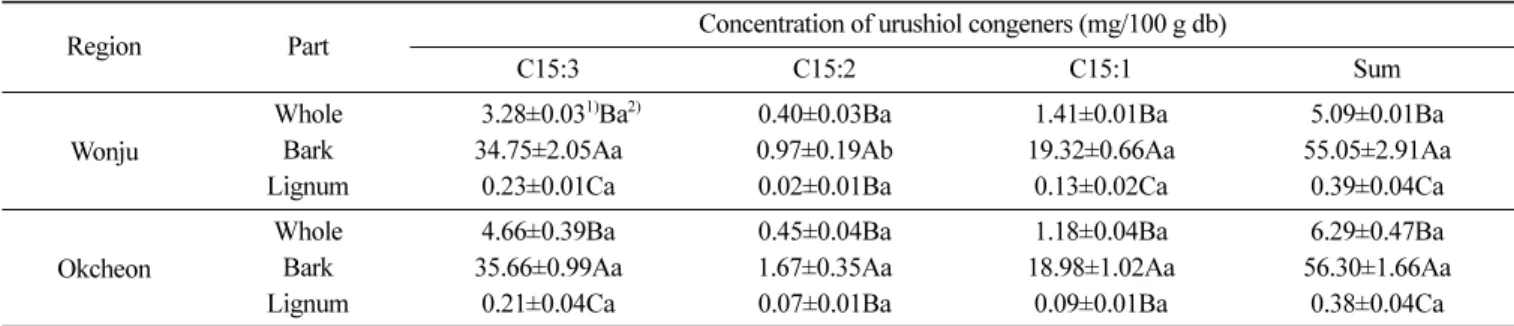
각 부위별 urushiol 함량의 합계는(Table 3, Fig. 2) 원주산이 각 각 5.09, 55.05, 0.39 mg/100 g db, 옥천산이 6.29, 56.30, 0.38 mg/100 g db로 껍질부위에 urushiol이 다량 분포되어 있는 것으 로 나타났다. 껍질에 함유된 urushiol congener들의 성분비(C15:3 : C15:2 : C15:1)는 원주산이 34.75:0.97:19.32, 옥천산이 35.66:1.67: 18.98로 C15:3이 63%, C15:1이 33-35%, C15:2가 2-3%가량 함유 되어 있는 것으로 확인되었다. Urushiol은 catechol 화합물의 유도 체로서 C3위치에 side chain으로 탄소 15 또는 17개가 직쇄상으 로 결합된 지용성 화합물로 이중결합수와 위치에 따라 13개의 congener들이 존재하는 것으로 알려져 있다(28). 옻나무의 부위별 urushiol 함량을 조사한 자료는 많지 않으나 원주에서 구입한 옻 나무의 껍질에 함유된 urushiol congener들의 함량비율은 95.70: Table 3. Contents of urushiol analogues in different parts of Rhus verniciflua stem obtained from Wonju and Okcheon
Region Part Concentration of urushiol congeners (mg/100 g db)
C15:3 C15:2 C15:1 Sum
Wonju
Whole 003.28±0.031)Ba2) 0.40±0.03Ba 1.41±0.01Ba 5.09±0.01Ba Bark 34.75±2.05Aa 0.97±0.19Ab 19.32±0.66Aa 55.05±2.91Aa Lignum 0.23±0.01Ca 0.02±0.01Ba 0.13±0.02Ca 0.39±0.04Ca
Okcheon
Whole 4.66±0.39Ba 0.45±0.04Ba 1.18±0.04Ba 6.29±0.47Ba Bark 35.66±0.99Aa 1.67±0.35Aa 18.98±1.02Aa 56.30±1.66Aa Lignum 0.21±0.04Ca 0.07±0.01Ba 0.09±0.01Ba 0.38±0.04Ca 1)Values represent means±standard deviations.
2)Within-the-column values indicated by capital letters (A,B) and the row values indicated by lowercase letters (a,b) are significantly different
(p<0.05) in the different parts of Rhus verniciflua and different geographical regions.
Fig. 2. HPLC chromatogram of urushiol congeners in different parts of Rhus verniciflua stem from Wonju (A) and Okcheon (B). Compounds-C15:3, pentadecatrienyl catechol; C15:2, pentadecadienyl catechol; C15:1, pentadecenyl catechol
9.09:42.57로(29) C15:3과 C15:1이 가장 많이 함유되어 있었고 urushiol 총량은 154.15 mg/100 g이었다. 하지만 4월 옥천에서 채 취한 옻나무 껍질에는 1045.3 mg/100 g의 urushiol이 함유되어 있 는 것으로 나타나(30) 함량에 많은 차이가 있었다. 따라서 옻나 무 껍질의 urushiol 함량은 계절적인 영향을 많이 받는 것으로 이 해된다. Urushiol은 옻나무에 상처가 났을 때 외부오염으로부터 방어하기 위하여 내놓는 물질로서 옻순이 피기 시작하는 봄에 많 이 생성되었다가 가을 이후 낙엽이 지는 시기에는 함량이 낮아 지는 것으로 생각된다. 또한 8월과 11월에 채취한 시료에서 flavonoid 화합물의 총량(Table 2)과 urushiol 함량의 총량(Table 4) 이 차이가 없게 나타남에 따라 특정 계절 이외에는 재배환경이 옻나무의 성분에 미치는 영향은 비교적 적었던 것으로 생각된다. 한편, 우리나라에서 상업적으로 판매되고 있는 옻닭 및 옻오리 조리용 국물의 제조용 원료는 대부분 옻나무의 목질부를 사용하 는데, 목질부에도 0.38 mg/100 g db 정도의 urushiol이 함유되어 있는 것으로 나타나 사용에 주의가 요구된다. 지금까지 옻나무의 목질부에 대한 연구는 대부분 phenolic 화합물들의 생리활성을 밝 히는데 많은 비중을 두고 있으나 urushiol은 매우 낮은 농도로도 알레르기 반응을 유발시키는 것으로 알려져 있기 때문에(31) 옻 의 이용을 확대하기 위해서는 urushiol 제어에 대한 연구도 필요 할 것으로 생각된다.
요 약
참옻나무의 줄기전체, 껍질, 목질부위에 함유되어있는 총 phenol 함량은 원주산이 각각 15.73, 13.29, 13.21, 옥천산이 16.14, 16.63, 14.81 mg gallic acid/g db이었다. 총 flavonoid 함량은 원주산이 32.04, 15.16, 31.05, 옥천산이 45.51, 22.09, 43.48 mg quercetin/g db로 나타났다. Flavonoid 성분 중 fustin이 껍질 부위에서는 성분 합계양의 98%이상, 줄기와 목질에서는 73.0-86.7%를 차지하는 주 요성분이었다. Butein은 부위별로 0.31-2.17, fisetin은 0.27-3.32, sulfuretin은 0.15-0.80 mg/g db 함유되어 있었다. 각 부위별 urush-iol 함량의 합계는 각각 5.09-6.29, 55.05-56.30, 0.38-0.39 mg/100 g dry base로 껍질에 다량함유 되어 있었다. 껍질에 함유된 urush-iol congener들의 분포는 C15:3 (pentadecatrienyl catechol)이 63%, C15:1 (pentadecenyl catechol)이 33-35%, C15:2 (pentadecadie-nyl catechol)가 2-3% 함유되어 있었다.감사의 글
본 연구는 국립농업과학원 농업과학기술 연구개발사업(과제번 호: PJ008600)의 지원에 의해 이루어진 것입니다.
문 헌
1. Eom SK, Kim KS. On estimation of indication, property and pro-cessing of Rhus verniciflua Stokes. J. Korean Med. Classics 21: 29-37 (2008)
2. Namba T. Coloured illustrations of Wakan-Yaku. Hoikusha Pub-lishing Co., Osaka, Japan. p. 215 (1980)
3. Ministry of Food and Drug Safety. Korea food and drug adminis-tration notice 2006-55. Available from: http://www.mfds.go.kr/ index.do?mid=686&pageNo=102&seq=1923. Accessed Apr. 3, 2015.
4. Korean Forest Service. 2007 Imupkyungyeong Siltaejosa (investi-gation of forestry management of Korea) II. Korea Forest Ser-vice. Daejeon, Korea. p. 42 (2008)
5. Korea Forest Service. 2012 the investigation of forestry
manage-ment of Korea II (Administration Publications Number 11-140000-000168-10). Korea Forest Service. Daejeon, Korea. p. 44 (2013)
6. Ministry of Food and Drug Safety. Korea food and drug adminis-tration notice 2012-128. Available from: http://www.mfds.go.kr/ index.do?mid=686&pageNo=102&seq=6042. Accessed Apr. 3, 2015.
7. Park MH, Kim IS, Kim SA, Na CS, Hong CY, Dong MS, Yoo HH. Inhibitory effect of Rhus verniciflua Stokes extract on human aromatase activity; Butin is its major bioactive compo-nent. Bioorg. Med. Chem. Lett. 24: 1730-1733 (2014)
8. Epstein WL. Poison oak and poison ivy dermatitis as an occupa-tional problem. Cutis 13: 544-548 (1974)
9. Dewanto V, Wu X, Adom KK, Liu RH. Thermal processing enhances the nutritional value of tomatoes by increasing total antioxidant activity. J. Agr. Food Chem. 50: 3010-3014 (2002) 10. Chang CC, Yang MH, Wen HM, Chern JC. Estimation of total
flavonoid content in propolis by two complementary colorimetric methods. J. Food Drug Anal. 10: 178-182 (2002)
11. Park HJ, Yoon GM, Lee SH, Jang GY, Kim MY, Meishan L, Lee JS, Jeong HS. Effects of extraction temperature and time on anti-oxidant activities of Rhus verniciflua extract. J. Korean Soc. Food Sci. Nutr. 42: 1776-1782 (2013)
12. Lee JC, Lim KT, Jang YS. Identification of Rhus verniciflua Stokes compounds that exhibit free radical scavenging and anti-apoptotic properties. Bba-Gen. Subjects 1570: 181-191 (2002) 13. Park KY, Jung GO, Lee KT, Choi JW, Choi MY, Kim GT, Jung
HJ, Park HJ. Antimutagenic activity of flavonoids from the heart-wood of Rhus verniciflua. J. Ethnopharmacol. 90: 73-79 (2004) 14. Son YO, Lee KY, Lee JC, Jang HS, Kim JG, Jeon YM, Jang YS.
Selective antiproliferative and apoptotic effects of flavonoids puri-fied from Rhus verniciflua Stokes on normal versus transformed hepatic cell lines. Toxicol. Lett. 155: 115-125 (2005)
15. Jung CH, Jun CY, Lee S, Park CH, Cho K, Ko SG. Rhus vernici-flua Stokes extract: radical scavenging activities and protective effects on H2O2-Induced cytotoxicity in macrophage RAW 264.7 cell lines. Biol. Pharm. Bull. 29: 1603-1607 (2006)
16. Jeon WK, Lee JH, Kim HK, Lee AY, Lee SO, Kim YS, Ryu SY, Kim SY, Lee YJ, Ko BS. Anti-platelet effects of bioactive com-pounds isolated from the bark of Rhus verniciflua Stokes. J. Eth-nopharmacol. 106: 62-69 (2006)
17. Jung CH, Kim JH, Hong MH, Seog HM, Oh SH, Lee PJ, Kim GJ, Kim HM, Um JY, Ko SG. Phenolic-rich fraction from Rhus verniciflua Stokes (RVS) suppress inflammatory response via NF-κB and JNK pathway in lipopolysaccharide-induced RAW 264.7 macrophages. J. Ethnopharmacol. 110: 490-497 (2007)
18. Kim MY, Chung IM, Choi DC, Park HJ. Quantitative analysis of fustin and sulfuretin in the inner and outer heartwoods and stem bark of Rhus verniciflua. Nat. Prod. Sci. 15: 208-212 (2009) 19. Kim JS, Kwon YS, Chun WJ, Kim TY, Sun J, Yu CY, Kim MJ.
Rhus verniciflua Stokes flavonoid extracts have oxidant, anti-microbial and α-glucosidase inhibitory effect. Food Chem. 120: 539-543 (2010)
20. Park BC, Lee YS, Park HJ, Kwak MK, Yoo BK, Kim JY, Kim JA. Protective effects of fustin, a flavonoid from Rhus verniciflua Stokes, on 6-hydroxydopamine-induced neuronal cell death. Exp. Mol. Med. 39: 316-326 (2007)
21. Kang SY, Kang JY, Oh MJ. Antiviral activities of flavonoids iso-lated from the bark of Rhus verniciflua Stokes against fish patho-genic viruses in vitro. J. Microbiol. 50: 293-300 (2012)
22. Samoszuk M, Tan J, Chorn G. The chalcone butein from Rhus verniciflua Stokes inhibits clonogenic growth of human breast cancer cells co-cultured with fibroblasts. BMC Complem. Altern. M. 5: 5 (2005)
23. Wang Y, Chan FL, Chen S, Leung LK. The plant polyphenol butein inhibits testosterone-induced proliferation in breast cancer cells expressing aromatase. Life Sci. 77: 39-51 (2005)
24. Jeong GS, Lee DS, Song MY, Park BH, Kang DG, Lee HS, Kwon KB, Kim YC. Butein from Rhus verniciflua protects pan-creatic β cells against cytokine-induced toxicity mediated by inhi-bition of nitric oxide formation. Biol. Pharm. Bull. 34: 97-102 (2011)
25. Chen WJ, Song JR, Guo P, Wen ZY. Butein, a more effective antioxidant than α-tocopherol. J. Mol. Struc.-Theochem 763: 161-164 (2006)
26. Prasath GS, Pillai SI, Subramanian SP. Fisetin improves glucose homeostasis through the inhibition of gluconeogenic enzymes in hepatic tissues of streptozotocin induced diabetic rats. Eur. J. Pharmacol. 740: 248-254 (2014)
27. Kwon SH, Ma SX, Lee SY, Jang CG. Sulfuretin inhibits 6-hydroxydopamine-induced neuronal cell death via reactive oxygen species-dependent mechanisms in human neuroblastoma SH-SY5Y cells. Neurochem. Int. 74: 53-64 (2014)
28. Du Y, Oshima R, Kumanotani J. Reversed-phase liquid chromato-graphic separation and identification of constituents of urushiol in the sap of lac tree, Rhus vernicifera. J. Chromatogr. A 284:
463-473 (1984)
29. Choi HS, Kim MK, Park HS, Yun SE, Mun SP, Kim JS, Sapkota K, Kim S, Kim TY, Kim SJ. Biological detoxification of lacquer tree (Rhus verniciflua Stokes) stem bark by mushroom species. Food Sci. Biotechnol. 16: 935-942 (2007)
30. Choi HS, Yeo SH, Jeong ST, Choi JH, Park HS, Kim MK. Prep-aration and characterization of urushiol free fermented Rhus ver-niciflua stem bark (FRVSB) extracts. Korean J. Food Sci. Technol. 44: 173-178 (2012)
31. Draper WM, Wijekoon D, Makinney M, Behniwal P, Perera SK, Flessel CP. Atmospheric pressure ionization LC-MS-MS determi-nation of urushiol congeners. J. Agr. Food Chem. 50: 1852-1858 (2002)