INTRODUCTION
Asthma is a chronic inflammatory disorder of the airways characterized by bronchial hyperresponsiveness, reversible airflow limitation, and respiratory symptoms (1, 2). Interna- tionally, the prevalence of asthma has increased over the last 3 decades (3-5), and in the Asia-Pacific region asthma caus- es considerable morbidity, with 15% of teenagers troubled by exercise-induced symptoms during the past 12 months (6). Furthermore, asthma mortality rates in more affluent areas, such as Hong Kong and Japan, are similar to those reported in Western countries (6). Studies in Korea also bear witness to these increasing trends (7, 8). The reported preva- lence of asthma in Korea ranges from 2 to 13% (9-18). How- ever, its prevalence in the elderly has been reported to be very high, at 12.7% in those aged 65 or more (15). Indeed, with a population estimated at more than 48 million, and a life expectancy of 72.0 yr for males and 79.5 yr for females (19), Korea faces an important public health challenge in terms of dealing with chronic diseases such as asthma.
In addition to its increasing prevalence, the economic impact of asthma is also substantial and continues to grow. The total cost of the disease in the United States was estimated to be U$4.5 billion in the mid-1980s, whereas in the first half of the 1990s, this estimate had increased to between U$6.2 and U$10.7 billion (20-22). In Korea, where health insurance is mandatory and the cost of medical care is only covered in part by health insurance, the importance of economic out-
comes also continues to grow although little data is current- ly available.
The purpose of this review is to present an overview of the current disease status with respect to the prevalence, mor- tality rate, socioeconomic burden, quality of life and the treat- ment patterns of asthma in Korea, to identify barriers to improvements in asthma care and to provide recommenda- tions for action at the national, organizational and individu- al levels. For this, all relevant English and Korean language articles were retrieved using PubMed (www.ncbi.nlm.nih.gov/
entrez/query.fcgi) and KoreaMed (www.koreamed.com) from November 2004 to January 2005. Results were limited to the articles published between 1990 and 2004. In addition, various online resources through internet search engines were used.
PREVALENCE AND ASSOCIATED RISK FACTORS
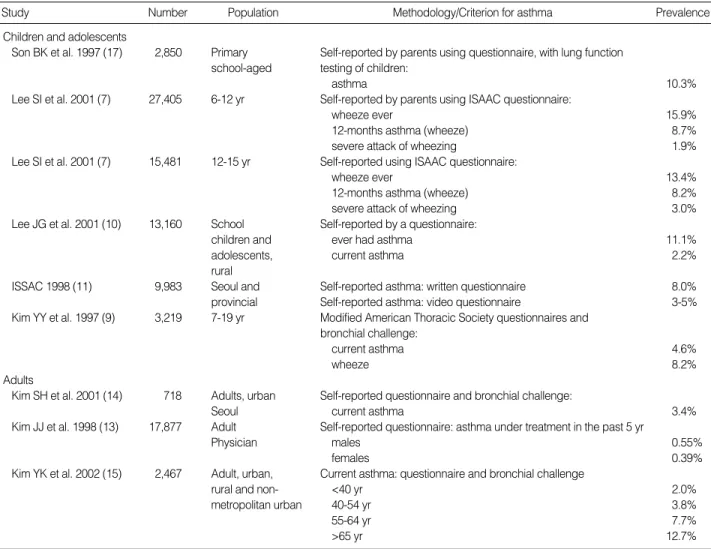
Recently, several large-scale studies of different population in Korea (9-17) have reported asthma prevalence ranging from 2 to 13% (Table 1). These differences are probably ascrib- able to different case definitions, methodologies, and a ten- dency to survey children rather than adults due to the rela- tive ease of implementing studies in a school environment.
According to the latest summary issued by the global bur- den of asthma by the Global Initiative for Asthma (GINA) program, the prevalence of clinical asthma in Korea is esti-
Sang-Heon Cho, Heung-Woo Park, Daniel M Rosenberg*
Department of Internal Medicine, Seoul National University College of Medicine, Seoul, Korea; Director, Asia Pacific Epidemiology*, GlaxoSmithKline Asia Pacific, Singapore
Address for correspondence Sang Heon Cho, M.D.
Department of Internal Medicine, Seoul National University College of Medicine, 28 Yongon-dong, Chongno-gu, Seoul 110-744, Korea
Tel : +82.2-2072-2971, Fax : +82.2-742-2912 E-mail : [email protected]
*This work was supported by grants from GlaxoSmithK- line Korea.
181
The Current Status of Asthma in Korea
A systematic review of English and Korean articles published between 1990 and 2004 and a search of database and various online resources was conducted to determine the prevalences, mortality rates, socioeconomic burden, quality of life, and treatment pattern of asthma in Korean adults and children. Asthma morbidity and mortality in Korea are steadily increasing. The prevalence of asthma in Korea is estimated to be 3.9% and its severity is often underestimated by both physicians and patients. Mortality resulting from chronic lower respiratory diseases including asthma increased from 12.9 to 22.6 deaths per 100,000 of the population between 1992 and 2002. Disease severity, level of control, and symptom state were all found to negatively impact the quality of life of asthmatics. Although international and Korean asthma management guidelines are available, familiarity with and implementation of these guidelines by primary care physicians remain poor.
Key Words : Asthma; Prevalence; Mortality; Cost of Illness; Quality of Life; Korea
Received : 31 August 2005 Accepted : 17 November 2005
� REVIEW�
mated to be 3.9% (23). The prevalence of asthma tended to be higher in children than in adults and was found to depend significantly on their place of residence, for example, it was found to be higher in Seoul than in provincial cities (7). Accord- ing to 1998 data (11), childhood asthma was less prevalent in Korea than in other developed countries. However, among the elderly (aged 65 yr or older), its prevalence was found to be high at 12.7% in 2001 (15), which is about three times higher than among English or US elderly (24, 25). Although estimations of asthma prevalence in older age groups differ greatly between countries because of overlapping diagnoses, and poor patient perception of symptoms (24), this rate is unexpectedly high. In the elderly, asthma is an important problem because it is usually underdiagnosed and hence inad- equately treated (24-26). Interestingly, Korean adults and children appear to have a later average age of asthma onset than other Asian populations (12) (Fig. 1). This is likely to be due to the underdiagnosis of early stage asthma by general physicians. Some investigators have reported that an under- diagnosis rate by general physicians was 21% (27). Another contributable factor may be that a high proportion of Kore-
an people, at least initially, turn to traditional medicine for medical help (28-30), which delays the diagnosis until they are referred to hospitals or emergency department with severe symptoms. Finally, racial differences may be a consideration.
Age, sex, affluence, genetic predisposition, climate, out- door air quality and cigarette smoking have all been found to be associated with asthma (7, 12, 15, 31-33). Studies sug- gest a higher incidence of asthma in children than in adults (9-15, 17, 34), and male asthmatic patients were found to be more often hospitalized or treated at a tertiary medical centers than their female counterparts (34, 35). In a regres- sion analysis of the Asthma Insights and Reality in Asia- Pacific (AIRIAP) data for the eight areas of Asia-Pacific coun- tries including Korea, it was found that a low household income is significantly associated with the likelihood of hav- ing moderate or severe persistent asthma symptoms (p=0.002 compared with a high income status) (12).
It has been reported that the genetic variations of the chemo- kine (C-X-C motif) receptor 3 (CXCR3) (36), the signal trans- ducer and activator of transcription 4 (STAT4) (37), a disin- tegrin and metalloprotease 33 (ADAM33) (38), and Tumor
Study Number Population Methodology/Criterion for asthma
Children and adolescents
Son BK et al. 1997 (17) 2,850 Primary Self-reported by parents using questionnaire, with lung function school-aged testing of children:
asthma 10.3%
Lee SI et al. 2001 (7) 27,405 6-12 yr Self-reported by parents using ISAAC questionnaire:
wheeze ever 15.9%
12-months asthma (wheeze) 8.7%
severe attack of wheezing 1.9%
Lee SI et al. 2001 (7) 15,481 12-15 yr Self-reported using ISAAC questionnaire:
wheeze ever 13.4%
12-months asthma (wheeze) 8.2%
severe attack of wheezing 3.0%
Lee JG et al. 2001 (10) 13,160 School Self-reported by a questionnaire:
children and ever had asthma 11.1%
adolescents, current asthma 2.2%
rural
ISSAC 1998 (11) 9,983 Seoul and Self-reported asthma: written questionnaire 8.0%
provincial Self-reported asthma: video questionnaire 3-5%
Kim YY et al. 1997 (9) 3,219 7-19 yr Modified American Thoracic Society questionnaires and bronchial challenge:
current asthma 4.6%
wheeze 8.2%
Adults
Kim SH et al. 2001 (14) 718 Adults, urban Self-reported questionnaire and bronchial challenge:
Seoul current asthma 3.4%
Kim JJ et al. 1998 (13) 17,877 Adult Self-reported questionnaire: asthma under treatment in the past 5 yr
Physician males 0.55%
females 0.39%
Kim YK et al. 2002 (15) 2,467 Adult, urban, Current asthma: questionnaire and bronchial challenge
rural and non- <40 yr 2.0%
metropolitan urban 40-54 yr 3.8%
55-64 yr 7.7%
>65 yr 12.7%
Table 1.Summary of studies documenting the prevalence of asthma and wheeze in Korea
Prevalence
necrosis factor-alpha (TNF- ) (39) are associated with the susceptibilities to the development of asthma and its inter- mediate phenotypes in the Korean population. The IL-4 cytokine gene cluster and/or the T cell receptor / gene complex are believed to be associated with the expression of bronchial responsiveness to methacholone in nuclear families (40), and a polymorphism in exon 7 of chromosome 11q13 was found to be significantly associated with histamine release from basophile to anti-IgE stimuli in 80 randomly recruited asthmatic children (41). Specific environmental allergens also play important roles in asthma development in Koreans.
Spider mites (Citrus red mite) (42, 43), the European red mite (Panonychus ulmi), (44) and the two-spotted spider mite (Tet- ranychus urtcae) (44), have been identified as important aller- gens in the development of work-related asthma and rhini- tis symptoms and toluene diisocyanate has been most com- monly implicated allergen in occupational asthma in Korea (45). A number of studies have documented an association between air pollution and asthma-related morbidity in Korean cities and have linked active smoking with asthma prevalence and severity (15, 28, 29, 46-48).
MORTALITY
The accurate determination of the asthma mortality in Korea is difficult. Because large-scale medical databases tend to group asthma data along with those of other disease states, or to group it with less specific group diagnoses such as ‘Chro- nic lower respiratory diseases’ (49). According to the Korea National Statistical Office data, the death rate from chronic lower respiratory diseases (including asthma) between 1992 and 2002 increased from 12.9 to 22.6 deaths per 100,000 of the population (50). In 1992, chronic lower respiratory diseases were ranked as the eighth leading cause of death in
Korea, and in 2002, this had risen to fifth place proceeded only by diabetes mellitus, heart disease, cerebrovascular dis- ease, and cancer (50) (Fig. 2). According to the latest GINA estimates, there are 4.9 asthma related deaths per 100,000 asthmatics each year in Korea (23). Globally, respiratory dis- eases are responsible for 6.3% of all death and asthma for 0.4% (51). Several risk factors of asthma mortality have been identified in the Korean population. These include cigarette smoking, chronic asthma severity, frequent hospitalization, the duration of recent asthma exacerbations, age and a female sex (28, 52, 53).
COST OF ILLNESS
At present, little data is available on the economic burden posed by asthma in Korea. However, indirect estimates may be made based on the market shares of asthma medications in Korea. According to the data from the pharmaceutical industry (54), from 2001 to 2004, the annual gross value of drugs sold in Korea increased by nearly 50% (from U$3.48 to U$5.21 billion) and the proportion shared by drugs for asthma treatment in respiratory drug market increased by approxi- mately 36% (from U$51.8 to U$70.6 million). Research in this area is underway, with a large-scale analysis being per- formed using data from Health Insurance Review Agency (HIRA), the 1998 National Survey on Health and Nutrition in Korea, and an ongoing patient survey. Results are expect- ed to be published soon.
QUALITY OF LIFE
To adequately account for cultural and behavioral factors, a quality of life questionnaire for adult Korean asthmatics (QLQAKA) was developed (55), and in a multicenter study using QLQAKS, it was found that dyspnea (87%), difficul-
5 4 3 2 1 0
Age of onset-children (yr)
China Hong Kong
Korea
Malaysia Philippines Singapore Taiwan Vietnam
Fig. 1.Age of onset of asthma in children (A) and adults (B) in eight urban areas in the Asia-Pacific region, including Korea (12).
Fig. 2.Comparison of leading causes of death in 1992 and 2002 in Korea (50).
A
4.1
3.6 4
2.8
4.1 4.2
2.9 4.3
40 30 20 10 0
Age of onset-adults (yr)
China Hong Kong
Korea Malaysia
Philippines Singapore Taiwan Vietnam B
30.3
18.8 17.9 19.9 18.1
30.4 22.8 36
Deaths per 100,000 population
100
50
0
1992 2002
Year
110.7
130.7 Cancer
80.3 77.2 Cerebrovascular
desease
43.0 37.2 Heart disease
12.9
22.6 Chr. lower respiratory disease
13.5
25.1 Diabetes mellitus 31.6
22.0 Disease of the liver 34.4
19.1 Transport accidents
ty in sputum discharge or throat clearing (87%), strenuous activity limitation (84%), and coughing (82.4%) were most frequently complained about by adult asthmatics (55). The AIRIAP study revealed that approximately one-third of all Korean asthmatic patients felt restricted in terms of their abilities to perform the routine activities of daily living such as, exercise, social activities, or sleeping (12). This survey also reported that 52% of asthmatic patients had experienced daytime symptoms during 4 weeks prior to completing the questionnaires, and that 41% of patients with asthma had been woken at night by their symptoms (12). Another study conducted to assess the quality of life of 189 patients showed that running, walking, and hurried movements appeared to be the most impaired daily activities (56). The characteris- tics that significantly impaired an individual’s quality of life score were disease severity, level of asthma control and symp- tom attacks during the previous 3 months (all p<0.001) (56).
Interestingly, a discrepancy was identified between perceived and actual asthma control in a substantial number of asth- ma patients. According to AIRIAP data, about one-fifth of Korean asthmatic patients with severe persistent symptoms considered that their asthma was adequately controlled, despite their current symptoms suggesting otherwise (12) (Fig. 3).
This is due in part to the fact that some asthmatics have poor symptom perception (57-59) and partly because asthmatics in Korea are not adequately educated about the practical and theoretical aspects of asthma management (60, 61).
TREATMENT PATTERNS
No national guidelines concerning best management prac- tice of asthma have been issued in Korea, although three academic associations have published separate guidelines (62-64). However, almost half of the physicians (43%) in 325 Korean clinics surveyed by the HIRA either did not use or were unfamiliar with these guidelines (65). Therefore, few
asthma patients used or were prescribed inhaled corticosteroid by their physicians to prevent symptoms (65) (Fig. 4). The reasons for this reluctance to prescribing inhaled corticosteroid as cited by physicians in the HIRA survey were, in decreas- ing order; lack of patient education concerning inhaler use, high cost, patient refusal to use, and side effects (65). In addi- tion, according to the AIRIAP survey, 65% of patients with asthma in Korea have never undergone a lung function test, and only 32% of patients reported that they had undergone a lung function test during the previous year (12). Moreover, although 6% of patients owned a peak flow meter for self- monitoring, only 20% of them used it daily, whereas another 20% used it on a symptomatic basis (12). Another survey found that patients who used a nebulizer at home were not properly instructed as to how to use it, and did not follow equipment maintenance procedures (66). However, paradoxi- cally, most Korean asthmatics were satisfied with their treat- ment, although many expressed a need for more information on the disease (12). This ‘disconnect’ from the guidelines by physicians has had a major impact on the management of asthma patients. To reduce this gap, an ‘Easy Asthma Man- agement’ study is currently underway in Korea. The purpose of this study may provide a simple stereotyped algorithm using a computer based program to allow clinicians to easily diag- nose asthma and implement its correct management.
In December 2004, it was estimated that 11.9 million Koreans had access to the World Wide Web (WWW) and the number of allocated IP addresses allocated in Korea ranked eighth worldwide (67). Nowadays, computer-based educa- tional programs available on the WWW are believed to be an effective alternative as they overcome the cost and time barriers that prevent implementation of education programs for asthmatics (68). However studies have shown that asth- ma educational material on the web sites is highly variable in quality and content, lacks detail of the core concepts essen-
Percentage of patients who perceive their asthma is controlled 100
80
60
40
20
0
Mild intermittent (n=201)
Mild persistent (n=83)
Moderate persistent (n=75)
Severe persistent
(n=42) Objective asthma severity
Completely controlled
Fig. 3.Patients’ perception of adequate disease control versus their objective severity assessment results, according to the AIRI- AP study (12).
Fig. 4.Prescription patterns reported by 325 internal medicine clinics in Seoul, for patients with mild or severe asthma (65).
BA, 2 agonist; LABA, Long acting 2 agonist; SABA, Short act- ing 2 agonist; IC, Inhaled corticosteroids.
Well controlled Somewhat controlled
0 20 40 60 80 100
53 63
Prescription Rate (%)
Oral BA
54
Inhaled SABA 16
Injected theophylline 16
26
Oral steroid 60
Injected steroid 27
16
IC 24
21
IC+BA 32
Inhaled LABA 14
71
Oral theophylline 80
Mild asthma Severe asthma
tial for asthma education, and fails to meet patients needs (69, 70).
SUMMARY
This review showed that the prevalence of asthma in Korea ranges from 2 to 13%, and that physicians and patients often underestimate its severity. Mortality from chronic lower res- piratory diseases including asthma increased from 12.9 to 22.6 deaths per 100,000 of the population between 1992 and 2002. Disease severity, level of control, and symptom state were all found to negatively impact the quality of life of asthmatics. Moreover, although international and Korean asthma management guidelines are available, primary care physicians are largely unfamiliar with or fail to implement them.
REFERENCES
1. Sugita M, Kuribayashi K, Nakagomi T, Miyata S, Matsuyama T, Kitada O. Allergic bronchial asthma: airway inflammation and hyper- responsiveness. Intern Med 2003; 42: 636-43.
2. Global Strategy for Asthma Management and Prevention. GINA Workshop Report. Available at: www.ginasthma.com [accessed 7 Jan 2005].
3. Upton MN, McConnachie A, McSharry C, Hart CL, Smith GD, Gillis CR, Watt GC. Intergenerational 20 year trends in the prevalence of asthma and hay fever in adults: the Midspan family study surveys of parents and offspring. BMJ 2000; 321: 88-92.
4. Ninan TK, Russell G. Respiratory symptoms and atopy in Aberdeen schoolchildren: evidences from two survey 25 years apart. BMJ 1992;
304: 873-75.
5. Yunginger JW, Reed CE, O’Connell EJ, Melton LJ III, O’Fallon WM, Silverstein MD. A community-based study of the epidemiolo- gy of asthma. Incidence rates, 1964-1983. Am Rev Respir Dis 1992;
146: 888-94.
6. Lai CK, de Guia TS, Kim YY, Kuo SH, Mukhopadhyay A, Soriano JB, Trung PL, Zhong NS, Zainudin N, Zainudin BM. Asthma con- trol in the Asia-Pacific region: The asthma insight and reality in Asia-Pacific study. J Allergy Clin Immunol 2003; 111: 263-8.
7. Lee SI, Shin MH, Lee HB, Son BK, Koh YY, Kim KE, Ahn YO.
Prevalence of symptoms of asthma and other allergic diseases in Korean children: a nationwide questionnaire survey. J Korean Med Sci 2001; 16: 155-64.
8. Lee MH, Hong SC, Kim SH, Bahn JW, Kim TB, Kim YK, Cho SH, Min KU, Kim YY. Prevalence of asthma and atopy in children living in rural area of Cheju Island for an interval of three years. J Asthma Allergy Clin Immunol 2002; 22: 85-91.
9. Kim YY, Cho SH, Kim WK, Park JK, Song SH, Kim YK, Jee YK, Ha MN, Ahn YO, Lee SI, Min KU. Prevalence of childhood asthma based on questionnaires and methacholine bronchial provocation test in Korea. Clin Exp Allergy 1997; 27: 761-8.
10. Lee JG, Moon HJ, Kim KS, Yoon JH, Kim SS, Park IY. Epidemio- logical study for allergic disease of school-aged children and ado- lescence in rural area of Korea. Korean J Otolaryngol-Head Neck Surg 1998; 41: 1156-63.
11. International Study of Asthma and Allergies in Childhood (ISAAC) Steering Committee. Worldwide variation in prevalence of symptoms of asthma, allergic rhinoconjunctivitis and atopic eczema: ISAAC.
Lancet 1998; 351: 1225-32.
12. Isis Research/GlaxoSmithKline. Asthma Insights and Reality in Asia Pacific (AIRIAP) Korea: Executive Summary 2002.
13. Kim JJ, Kim SD, Meng KH, Ahn YO, Yum YT, Oh HC, Lee DB, Lee SI, Chun BY, Choi JS. Prevalence and disease experience rates in Korean physicians. J Korean Med Sci 1998; 13: 247-62.
14. Kim SH, Lee JY, Son SW Chang YS, Jung JW, Kim YK, Cho SH, Min KU, Kim YY. Prevalence of adult asthma based on question- naires and methacholine bronchial provocation test in Seoul. J Asth- ma Allergy Clin Immunol 2001; 21: 618-27.
15. Kim YK, Kim SH, Tak YJ, Jee YK, Lee BJ, Kim SH, Park HW, Jung JW, Bahn JW, Chang YS, Choi DC, Chang SI, Min KU, Kim YY, Cho SH. High prevalence of current asthma and active smok- ing effect among the elderly. Clin Exp Allergy 2002; 32: 1706-12.
16. Korea Institute for Health and Social Affairs (KIHASA). Prevalence of asthma like symptoms in Korean adult population. Korean J Med 2001; 60: 196-205.
17. Son BK, Lim DH, Kim JH, Jun YH, Kim SK. Prevalence of allergic disease and asthma related conditions in primary school-aged chil- dren and comparison of pulmonary function test between normal and children with condition related with asthma. Pediatr Allergy Respir Dis 1997; 7: 198-206.
18. International Study of Asthma and Allergies in Childhood (ISAAC) Steering Committee. Worldwide variations in the prevalence of asth- ma symptom: International Study of Asthma and Allergies in Child- hood (ISAAC) Eur Respir J 1998; 12: 315-35.
19. Central Intelligence Agency. The World Factbook 2004 - Korea, South. Available at: www.cia.gov/cia/publications/factbook/geos/
ks.html [accessed: 15 Jan 2005].
20. Weiss KB, Gergen PJ, Hodgson TA. An economic evaluation of asth- ma in the United States. N Engl J Med 1992; 326: 862-6.
21. Smith DH, Malone DC, Lawson KA, Okamoto LJ, Battista C, Saun- ders WB. A national estimate of the economic costs of asthma. Am J Respir Crit Care Med 1997; 156: 787-93.
22. Weiss KB, Sullivan SD, Lyttle CS. Trends in the cost of illness for asthma in the United States, 1985-1994. J Allergy Clin Immunol 2000; 106: 493-9.
23. Masoli M, Fabian D, Holt S, Beasley R; Global Initiative for Asthma (GINA) Program. The global burden of asthma: executive summary of the GINA Dissemination Committee report. Allergy 2004; 59: 469- 78.
24. Enright PL, McClelland R, Newman AB, Gottlieb DJ, Lebowitz MD.
Underdiagnosis and undertreatment of asthma in the elderly. Cardi- ovascular Health Study Research Group. Chest 1999; 116: 603-13.
25. Parameswaran K, Hildreth AJ, Chadha D, Keaney NP, Taylor IK, Bansal SK. Asthma in the elderly: underperceived, underdiagnosed, and undertreated: a community survey. Respir Med 1998; 92: 573-7.
26. Enlight PL. The diagnosis and management of asthma is much tougher in older patients. Curr Opin Allergy Clin Immunol 2002; 2: 175-81.
27. Van Schayck CP, van Der Heijden FM, van Den Boom G, Tirimanna PR, van Herwaarden CL. Underdiagnosis of asthma: is the doctor or the patient to blame? The DIMCA project. Thorax 2000; 55: 562-5.
28. Kim OJ, Hoon CS. A clinical analysis on the patients of orient-med- ical therapies in emergency department. J Korean Soc Emerg Med 1997; 8: 553-8.
29. Kang SD, Jeong JW, Moon BS, Kim JM. Current epidemiological status of cerebrovascular disease. J Korean Neurosurg Soc 1999;
28: 509-3.
30. Cho HJ, Shim JY, Lee HR, Lee SH. Factors associated with posses- sion of regular doctor in Korea. J Korean Acad Fam Med 2001; 22:
1612-21.
31. Choi H, Lim DH, Kim JH, Son BK, Lim JW. Study on the interrela- tionship of air pollution and respiratory diseases in Inchon City via children who visited the emergency room of Inha University Hospi- tal. J Korean Pediatr Soc 2000; 43: 1372-9.
32. Kim KW, Choi IS, Park SC, Jang AS, Lim H. Risk factors of near- fatal asthma. Korean J Med 1999; 57: 52-9.
33. Koh YY, Lee MH, Kim CK, Min YG, Kim YK, Min KU, Kim YY.
A familial predisposition in bronchial hyperresponsiveness among patients with allergic rhinitis. J Allergy Clin Immunol 1998; 102:
921-6.
34. Jeong MG, Kim TS, Son BH, Kim SW. Clinical characteristics of hospitalized cases due to asthma attack combined with pneumonic infiltrates. Pediatr Allergy Respir Dis 1999; 9: 290-300.
35. Yoon HS, Cha JK, Lee HR. A survey of current trends in the manage- ment of childhood asthma in practical fields. Pediatr Allergy Respir Dis 1998; 8: 167-78.
36. Cheong HS, Park CS, Kim LH, Park BL, Uh ST, Kim YH, Lym GI, Lee JY, Lee JK, Kim HT, Ryu HJ, Han BG, Kim JW, Park C, Kimm K, Shin HD, Oh B. CXCR3 polymorphisms associated with risk of asthma. Biochem Biophys Res Commun 2005; 334: 1219-25.
37. Park BL, Cheong HS, Kim LH, Choi YH, Namgoong S, Park HS, Hong SJ, Choi BW, Lee JH, Park CS, Shin HD. Association analy- sis of signal transducer and activator of transcription 4 (STAT4) poly- morphisms with asthma. J Hum Genet 2005; 50: 133-8.
38. Lee JH, Park HS, Park SW, Jang AS, Uh ST, Rhim T, Park CS, Hong SJ, Holgate ST, Holloway JW, Shin HD. ADAM33 polymorphism:
association with bronchial hyper-responsiveness in Korean asthmat- ics. Clin Exp Allergy 2004; 34: 860-5.
39. Shin HD, Park BL, Kim LH, Jung JH, Wang HJ, Kim YJ, Park HS, Hong SJ, Choi BW, Kim DJ, Park CS. Association of tumor necro- sis factor polymorphisms with asthma and serum total IgE. Hum Mol Genet 2004; 13: 397-403.
40. Cho SH, Son JW, Koh YY, Min KU, Kim YY, Kim YK. Linkage between bronchial responsiveness to methacholine and gene markers of IL-4 cytokine gene cluster and T cell receptor alpha/delta gene complex in Korean nuclear families. Clin Exp Allergy 2001; 31: 103-9.
41. Kim YK, Oh SY, Oh HB, Chun SY, Cho SH, Koh YY, Min KU, Kim YY. Coding single nucleotide polymorphism in the high-affini- ty immunoglobulin E receptor b chain (Fc epsilon RI-beta) gene is associated with immunoglobulin E receptor-mediated histamine
release from basophile. Clin Exp Allergy 2002; 32: 751-5.
42. Kim YK, Park HS, Kim HY, Jee YK, Son JW, Bae JM, Lee MH, Cho SH, Min KU, Kim YY. Citrus red mite (Panonychus citri) may be an important allergen in the development of asthma among exposed children. Clin Exp Allergy 2001; 31: 582-9.
43. Kim YK, Son JW, Kim HY, Park HS, Lee MH, Cho SH, Min KU, Kim YY. Citrus red mite (Panonychus citri) is the most common sensitizing allergen in citrus farmers with asthma and rhinitis. Clin Exp Allergy 1999; 29: 1102-9.
44. Kim YK, Lee MH, Jee YK, Hong SC, Bae JM, Chang YS, Jung JW, Lee BJ, Son JW, Cho SH, Min KU, Kim YY. Spider mite allergy in apple-cultivating farmers: European red mite (Panonychus ulmi) and two-spotted spider mite (Tetranychus urticae) may be important aller- gens in the development of work-related asthma and rhinitis symp- toms. J Allergy Clin Immunol 1999; 104: 1285-92.
45. Kang SK, Jee YK, Nahm DH, Min KU, Park JW, Park HS, Son CH, Cho SH, Choi I, Choi SW, Hong CS, Kim KS, Kim YY. A status of occupational asthma in Korea through the cases reported to the Occu- pational Asthma Surveillance Center. J Asthma Allergy Clin Immunol 2000; 20: 906-15.
46. Ju YS, Cho SH. Effect of air pollution on emergency room visits for asthma: a time series analysis. Korean J Prev Med 2001; 34: 61-72.
47. Lee JT, Kim H, Song H. Air pollution and asthma among children in Seoul, Korea. Epidemiology 2002; 13: 481-4.
48. Song HI. Effect of air pollution on childhood asthma living in Seoul.
J Asthma Allergy Clin Immunol 2001; 21: 28-39.
49. Park KA. Recent trends and patterns of mortality in Korea. Dev Soc 1998; 27: 67-81.
50. Korea National Statistical Office (KNSO). News release: Summary report of the cause of death statistics in 2003. Available at: kosis.nso.
go.kr/Magazine/YD/VD0002.xls [accessed: 3 Jan 2005].
51. Mathers CD, Stein C, Fat DM, Rao C, Inoue M, Tomijima N, Bernard C, Lopez AD, Murray CJL. Global burden of disease 2000: Version 2 methods and results. Global programme on evidence for health policy discussion paper No. 50. World Health Organization, Octo- ber 2002.
52. Kim JS, Wen Y. A comparative study on mortality patterns among Koreans, Korean-Chinese and Chinese. J Korean Med Sci 1999;
14: 365-72.
53. World Health Organization Statistical Information Service. WHO mortality database. Available at: www3.who.int/whosis/menu.cfm [accessed: 7 Jan 2005].
54. Korea Pharmaceutical Manufactures Association. Drug market statis- tics in 2004. Available at: http://www.kpma.or.kr/kpma [accessed:
23 Jan 2005].
55. Park JW, Cho YS, Lee SY, Nahm DH, Kim YK, Kim DK, Sohn JW, Park JK, Jee YK, Cho YJ, Yoon HJ, Kim MK, Park HS, Choi BW, Choi IS, Park CS, Min KU, Moon HB, Park SH, Lee YK, Kim NS, Hong CS. Multi-center study of the utilization of quality of life ques- tionnaire for adult Korean asthmatics (QLQAKA). J Asthma Allergy Clin Immunol 2000; 20: 467-80.
56. Rho HJ, Park MS, Park CW, Yun YY, Park JW, Hong CS, Suh JY, Kim DK. Factors influencing quality of life asthmatic patients in Korea. J Asthma Allergy Clin Immunol 2000; 20: 209-21.
57. Kikuchi Y, Okabe S, Tamaura G, Hinda W, Homma M, Shirato K, Takishima T. Chemosensitivity and perception of dyspnea in patients with a history of near fatal asthma. N Engl J Med 1994; 330: 1329-34.
58. Fritz G K, McQuaid EL, Spirito A, Klein RB. Symptom perception in pediatric asthma: relationship to functional morbidity and psycho- logical factors. J Am Acad Child Adolesc Psychiatry 1996; 35: 1033- 41.
59. Chetta A, Gerra G, Foresi A, Zaimovic A, Del Donno M, Chittoloni B, Malorgio R, Castagnaro A, Olivieri D. Personality profiles and breathlessness perception in outpatients with different gradings of asthma. Am J Respir Crit Care Med 1998; 157: 116-22.
60. Kim SG, Jang AS, Kim YK, Lee S, Seo JP, Yang SW, Choi SI, Park SH, Lee KR, Park JH. The effect of patient education on correct use of metered dose inhalers in patients with asthma. J Asthma Allergy Clin Immunol 2000; 20: 695-701.
61. Lim JY, Chung SM, Choung JT. The role of patient and parents edu- cation in the management of pediatric asthma. Pediatr Allergy Respir Dis 2000; 10: 51-60.
62. Korean Society of Allergology. National guideline for the manage- ment of asthma. J Asthma Allergy Clin Immunol 1998; 18: 338-90.
63. Pyun BY. 2003 Guideline for the management of childhood asthma.
Pediatr Allergy Respir Dis 2003; 13: 65-71.
64. Korean Academy of Tuberculosis and Respiratory Disease. Guide- line of chronic obstructive pulmonary disease (COPD) and asthma.
Available at: www.lungkorea.com [accessed: 27 Dec 2004].
65. Korea Institute for Health and Social Affairs (KIHASA). Analysis of data from Health Insurance Review Agency (HIRA). Available at:
www.kihasa.re.kr/html/jsp/sub04_01.jsp [accessed: 16 Jan 2005].
66. Rhee SE, Kim CH, Choi JY, Son MH, Kim KE, Lee KY. The study of home nebulizer use in asthmatic children. Pediatr Allergy Respir Dis 2000; 10: 141-52.
67. Internet statistics information system. Internet usage statistics. Avail- able at: isis.nic.or.kr/english [accessed: 8 Jan 2005].
68. Peterson MW, Strommer-Pace L, Dayton C. Asthma patient educa- tion: current utilization in pulmonary training programs. J Asthma 2001; 38: 261-7.
69. Park HW, Min KU, Kim YY, Cho SH. Assessing the quality and con- tents of asthma-related information on the Korean internet as an edu- cational material for patients. J Korean Med Sci 2004; 19: 364-8.
70. Song DJ, Kim HJ, Hong SH, Choung JT. Bronchial asthma educa- tion and the internet: The present situation and future direction. J Asthma Allergy Clin Immunol 2004; 24: 224-8.