INTRODUCTION
The prevalence of allergic diseases is increasing considerably in industrialized countries (1). Although the reason for the in- crease is unknown, the development of allergic diseases is kno- wn to be related to genetic factor, allergen exposure, age and so on. Exposure to allergenic food during early infancy is im- portant for sensitization and later development of atopy, prob- ably because of the physiological immaturity of the immune system and intestinal function. Especially in atopy-prone in- fants at high risk for developing atopic disease, this period can be a critical time. Risk factors for the development of atopy include atopic family history, elevated levels of cord blood IgE, altered T cell profiles in cord blood and during infancy, feeding practice, etc., although these risk factors are not clearly eluci- dated.
One of the best ways to manage atopic disease is prevention.
For primary prevention of allergy in high-risk infants, some measures including breast milk feeding, hypoallergenic formula feeding, and delayed introduction of highly allergenic foods such as eggs, peanuts, and fish are recommended. Among the hypoallergenic formula, extensively hydrolyzed formula has an allergy preventive effect due to its lack of allergenicity, and can be used for allergy prophylaxis in high-risk infants (2). How- ever, the extensively hydrolyzed formula has disadvantages of
unpleasant taste, high cost, and provoking diarrhea, leading to its limited use. In contrast, the partially hydrolyzed formula contains a certain proportion of proteins that are either intact or slightly degraded, with an average molecular weight of 1.5- 5.0 kDa. Because the partially hydrolyzed formula is cheaper and more palatable than the extensively hydrolyzed formula, it was introduced for feeding high-risk infants who cannot tol- erate the extensively hydrolyzed formula to prevent the devel- opment of atopic disease. The preventive effect of the partially hydrolyzed formula is still controversial because it contains a significant number of peptides with relatively high molecular weight compared with the extensively hydrolyzed formula (2-8).
In Korea, the rate of breast milk feeding was reported to be about 30% in 2000 (9), suggesting that exposure to the cow’s milk protein during infancy is high. In addition, the sensitiza- tion rate to the cow’s milk protein among 100 Korean children with atopic dermatitis was 31% according to Jung et al. (10).
In this regard, investigation on the prevention of atopic disease or cow’s milk protein allergy by hypoallergenic formula would be necessary for selected infants at high risk.
The aim of this short-term, prospective study was to evaluate the preventive effects of the partially hydrolyzed formula on the development of atopic disease in high-risk infants.
Young-Shin Han*, Hwa-Young Park, Kang-Mo Ahn, Ju-Seok Lee�, Hay-Mie Choi�, Sang-Il Lee
Department of Pediatrics, Samsung Medical Center, Sungkyunkwan University School of Medicine, Seoul;
Medical Research Institute of Sungkyunkwan University*, Seoul; Department of Pediatrics�, Samsung Masan Hospital, Masan; Department of Food & Nutrition�, Seoul National University, Seoul, Korea
Address for correspondence Kang-Mo Ahn, M.D.
Department of Pediatrics, Samsung Medical Center, 50 Ilwon-dong, Kangnam-gu, Seoul 135-710, Korea Tel : +82.2-3410-3530, Fax : +82.2-3410-0043 E-mail : [email protected]
547
Short-term Effect of Partially Hydrolyzed Formula on the Prevention of Development of Atopic Dermatitis in Infants at High Risk
This short-term, prospective study was aimed to assess the effects of partially hy- drolyzed formula (PHF) on the prevention of the development of atopic dermatitis in infants at high risk. The infants of parents with allergy symptoms and serum total IgE over 200 kU/L were divided into 3 groups by their feeding patterns: PHF group (n=15), standard formula (SF) group (n=32), and breast milk (BM) group (n=22). No allergenic food was given during the study period of 6 months, and breastfeeding mothers avoided egg ingestion. Their atopic symptoms were monitored every 2 months. The cumulative incidence and prevalence of atopic dermatitis at the age of 6 months were significantly less in the PHF group than in the SF group (47% vs.
78%, p<0.05; 20% vs. 59%, p<0.05). Those rates of the PHF group were also less than those of the BM group, but they were not statistically significant. There was no difference in the onset age and disease severity. These results suggest that early feeding of PHF to infants at high risk has a short-term preventive effect on the devel- opment of atopic dermatitis during the first 6 months of life. Long-term preventive effects should be evaluated.
Key Words : Dermatitis, Atopic; Protein Hydrolysates; Milk Human; Infant Nutrition
Received : 8 April 2003 Accepted : 15 May 2003
MATERIALS AND METHODS Patients
For this prospective study, 420 pregnant women with a his- tory of allergic disease who attended the maternity school of Maeil Dairy Industry were invited to participate. After they were informed of the aim of our study, serum total IgE was measured by CAP assay (Pharmacia and Upjohn, Uppsala, Swe- den) in the Allergy Center of the Samsung Medical Center to identify the presence of atopy. A total of 120 pregnant women, each with a history of allergic disease and serum total IgE high- er than 200 kU/L, were selected and agreed to take part in this study. The pregnant women who are not atopic were also in- cluded when their husbands had allergic disease with serum total IgE higher than 200 kU/L.
Newborn infants from the parents with history of allergic disease and high serum total IgE were considered as high-risk infants, and were included in this study. The infants with birth defects, severe chronic diseases, or gestational age less than 36 weeks were excluded. All of them were encouraged to be fed with breast milk. During the nursing period, lactating mothers eliminated all sources of egg from their diet. When the parents did not want to feed their babies with breast milk or breast milk was not available, partially hydrolyzed formula (HA21�, Maeil Dairy Industry, Korea) was recommended as substitu- tion. Standard formula was given in cases when the parents did not want partially hydrolyzed formula.
Recruited babies were divided into 3 groups according to feeding patterns during the first 6 months of life: partially hy- drolyzed formula feeding (PHF) group, standard formula feed- ing (SF) group, and breast milk (BM) group. No other food was allowed until 4 months of age, when solid food was intro- duced with cereal and vegetables. No other weaning diet was given until 6 months of age. These infants were monitored reg- ularly at 2-month intervals. Any symptoms and signs related to atopic dermatitis were recorded. The severity of the disease was scored by SASSAD (six areas, six symptoms in atopic der- matitis) (11), and the nutritional adequacy was assessed by me- asuring body weight and height.
SDS-PAGE
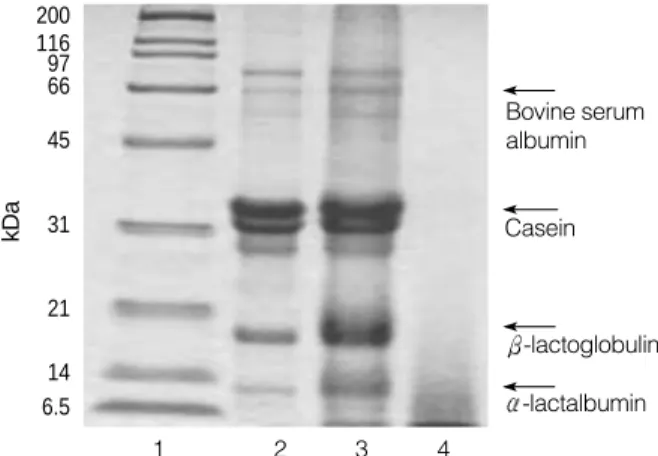
The partially hydrolyzed formula used in this study (HA- 21�) contained all cow’s milk proteins including casein and whey. The average molecular weight is 1.5-5 kDa and peptides with molecular weight over 10 kDa are contained at less than 5%. SDS-PAGE was performed to compare the presence of proteins in whole milk, standard formula, and HA21�. Whole milk (3 mL), standard formula (60 mg), and HA21�(400 mg) were suspended in TCA (20%). After incubation for 30 min at 4℃, samples were centrifuged at 10,000 rpm for 30 min at 4℃. Pellets were washed three times with aceton, and finally freeze-dried. The lyophilized products were suspended in a
sample buffer (Tris-HCl buffer, pH 6.8) and loaded onto the electrophoretic gel. The electrophoretic gel was composed of 12.5% separation gel and 5% stacking gel. SDS-PAGE reve- aled that the main protein band was not detected in HA21� (Fig. 1).
Statistics
Statistically significant differences among the groups were evaluated by using SAS version 8.0 program. Chi-square test was used to compare the differences of cumulative incidence and prevalence between the groups. p value less than 0.05 was considered significant.
RESULTS
One-hundred and twenty-seven families were recruited at the beginning of the study. Of these, the infants who were lost during follow-up and those who were breast milk-fed mixed with standard formula for the first 4 months were excluded. A total of 69 infants completed our 6 month-long study. Follow- ing the instructions from the parents, 15, 32 and 22 infants were included in the PHF, SF, and BM group, respectively (Table 1). Most of the infants enrolled in this study were born to mothers with allergy, while 3 of them had paternal allergy history (2 in PHF group and 1 in SF group).
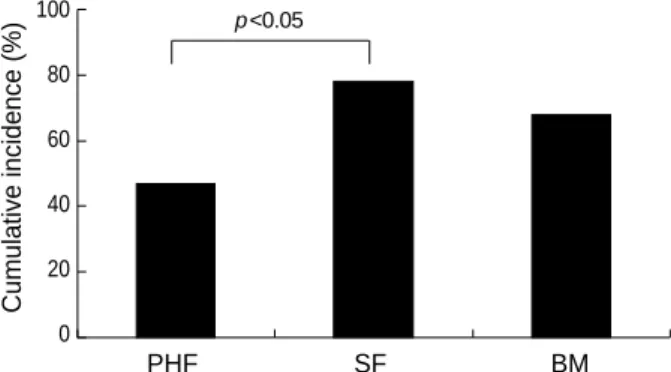
During the study period, atopic dermatitis developed in 7 infants in the PHF group, while 25 and 15 infants manifested atopic dermatitis in the SF and BM group, respectively (Table 1). Gastrointestinal symptoms and urticaria were combined in some of them. The PHF group showed significantly less cu- mulative incidence of atopic dermatitis compared with the SF group (47% vs. 78%, p<0.05, Fig. 2). Although the cumula- tive incidence in the BM group was higher than that in the PHF group (68% vs. 47%), there was no statistically signifi- cant difference between them. The prevalence of atopic der-
1 2 3 4
Bovine serum albumin
Casein
-lactalbumin -lactoglobulin
Fig. 1.SDS-PAGE of standard marker (lane 1), whole milk (lane 2), standard formula (lane 3) and HA21�(lane 4). The gel was stained with coumassie blue.
kDa
6.5 14 21 31 45 66 11697 200
matitis at 6 months of age was 20% in the PHF group, 59%
in the SF group, and 41% in the BM group, respectively. The prevalence of atopic dermatitis in the PHF group was signifi- cantly lower compared with the SF group (p<0.05, Fig. 3).
Our results suggest that partially hydrolyzed formula has a pre- ventive effect on the development of atopic dermatitis com- pared with the standard formula. The onset age and disease severity were not different among the babies from each group (Table 1).
Body weight and height at birth and at 6 months of age were compared. There was no statistically significant difference among the 3 groups, suggesting that partially hydrolyzed for- mula is nutritionally adequate compared with either breast milk or standard formula (Table 2).
DISCUSSION
For the prophylaxis of atopic disease, the extensively hydro- lyzed formula seemed to be superior to the partially hydrolyzed formula (2). This is consistent with the fact that the exten-
sively hydrolyzed formula contains peptides with low molec- ular weight<1.5 kDa, which has been suggested as non-aller- genic (12). However, our results showed that the significantly less number of atopic dermatitis occurred in high risk infants fed with the partially hydrolyzed formula compared with the standard cow’s milk formula, although this study did not com- pare the effects between the extensively hydrolyzed formula and the partially hydrolyzed formula. This data support the previous reports (4, 8, 13, 14), in which the partially hydrolyzed formula prevented the development of either atopic disease or cow’s milk allergy. In addition, no difference in the rate of growth was observed between the PHF and SF group. Based on the fact that several factors such as cost, taste, and nutri- tional adequacy should be considered before determining the choice of the formula, our results suggest that the partially hydrolyzed formula can be used as an alternative to prevent the development of atopic dermatitis in high risk infants. This is compatible with the recommendation by the American Academy of Pediatrics, in which infants at high risk for devel- oping allergy, identified by a strong family history of allergy, may benefit from possibly a partial hydrolysate formula (15).
Nine to twelve percent of all children born after 1970 have had atopic dermatitis, and the prevalence has increased since before 1960, when 2% to 5% of children were affected (16).
In our study, the cumulative incidence and the prevalence of atopic dermatitis at the age of 6 months in infants fed with the standard formula were 78% and 59%, respectively, which were
Onset age and SASSAD score were expressed as mean±standard de- viation. Serum total IgE was expressed as geometric mean with range in the parenstheses. PHF group, Partially hydrolyzed formula group; SF gro- up, Standard formula group; BM group, Breast milk feeding group; AD, Atopic dermatitis; SASSAD, Six areas, six symptoms in atopic dermatitis.
PHF group SF group BM group Total number 15 (5/10) 32 (17/15) 22 (10/12)
(male/female)
Parent’s serum 412 (200-2000) 293 (200-981) 303 (200-831) total IgE (kU/L)
Number of AD 7 25 15
patients
Onset age 2.9±2.1 1.8±1.5 1.8±1.2
(months)
SASSAD score 2.0±1.0 5.3±3.4 4.2±4.3
at 6 months
Table 1.Clinical characteristics of the 3 study groups
Weight (kg) Male 8.3±0.1 8.4±0.7 8.2±0.7 Female 7.8±0.5 7.7±0.5 8.1±0.5 Height (cm) Male 70.7±1.4 70.0±1.3 68.4±2.7
Female 68.0±1.1 67.0±1.2 66.7±0.5 PHF group
(n=15)
SF group (n=32)
BM group (n=22) Table 2. Growth at 6 months of age
Weight and height were expressed as mean±standard deviation. PHF group, Partially hydrolyzed formula group; SF group, Standard formula group; BM group, Breast milk feeding group.
PHF SF BM
100 80 60 40 20 0
Fig. 2.Cumulative incidence of atopic dermatitis for 6 months. There was significant difference between the PHF and SF group (p<0.05).
PHF group, Partially hydrolyzed formula group; SF group, Standard formula group; BM group, Breast milk group.
Cumulative incidence (%)
p<0.05
PHF SF BM
100 80 60 40 20 0
Fig. 3.Prevalence of atopic dermatitis at 6 months. There was sig- nificant difference between the PHF and SF group (p<0.05). PHF group, Partially hydrolyzed formula group; SF group, Standard for- mula group; BM group, Breast milk group.
Prevalence (%)
p<0.05
higher than those in general population. This is probably due to the particular selection of infants at high risk for this study.
The small number of study population and the age at less than 1 yr wherein most patients with atopic dermatitis manifested symptoms partly contributed to this high rate. Indeed 50% of cumulative incidence of atopic symptoms at 6 months in high risk infants was reported by Oldaeus et al. (2), while the preva- lence of cow’s milk allergy at the age of 6 months was reported to be 43% (14).
Nevertheless, some limitations should be considered to anal- yze the results from our study. First, the infants were not ran- domly assigned to the PHF, SF, or BM group because it con- cerned us as an ethical problem to recommend the standard formula feeding to the infants at high risk. Second, this study was conducted for a short period of just 6 months, and conse- quently, it was not determined whether the avoidance of highly allergenic food during the first 6 months can prevent the devel- opment of atopic disease in later life, although this period can be a critical time. Third, in order to evaluate the effects of the partially hydrolyzed formula, the occurrence of atopic disease was checked in this study. No immunologic or food challenge confirmation was done. These tests for confirming cow’s milk allergy will support the preventive effects of the partially hyd- rolyzed formula because allergy prevention is antigen-specific.
Breast milk is the ideal source of nutrition with immunolog- ical, physiological, and psychological advantages for infants through the first year of their lives. In terms of the prevention of allergy, breast milk may decrease allergic sensitization by reducing both exposure to and intestinal absorption of food allergens (17). Factors within breast milk such as immunoglob- ulins, especially secretory IgA (18) and mucosal growth factor (19), are responsible for reduced absorption of antigenic foods.
However, debate exists as to whether breastfeeding prevents, delays, or increases the development of allergic diseases (20-26).
Differences in the design, quality, size of the study and the duration of breastfeeding may account for this disparity. In our study, the cumulative incidence and the prevalence of ato- pic disease at 6 months in the BM group was higher than those in the PHF group, even though the differences were not sta- tistically significant. Increased incidence of atopic dermatitis in the BM group might be partly due to food proteins passed through maternal breast milk. This is based on previous stud- ies, in which protein from cow’s milk and egg were detected in breast milk after ingestion (21), and maternal diet devoid of cow’s milk, egg, and fish during 3 months of lactation decre- ased both current prevalence and the cumulative incidence of atopic dermatitis at age 4 in children with atopic disease hered- ity (27). Our findings suggest that in some cases maternal re- striction of highly allergenic foods during lactation or hypoal- lergenic formula feeding instead of breast milk should be used as an alternative to breastfeeding.
In conclusion, our results suggest that early feeding of par- tially hydrolyzed formula to infants at high risk has a short- term preventive effect during the first 6 months of their lives.
It is necessary to evaluate the long-term effects of partially hy- drolyzed formula on the prevention of development of atopic diseases.
ACKNOWLEDGMENTS
The authors appreciate the parents and their babies who par- ticipated in this study. We also thank Mail Dairy Industry for providing the formula and assistance to the survey.
REFERENCES
1. Bousquet J, Burney P. Evidence for an increase in atopic disease and possible causes. Clin Exp Allergy 1993; 23: 484-92.
2. Oldaeus G, Anjou K, Bjorksten B, Moran JR, Kjellman NI. Extensive ly and partially hydrolysed infant formulas for allergy prophylaxis.
Arch Dis Child 1997; 77: 4-10.
3. Zeiger RS, Heller S. The development and prediction of atopy in high- risk children: follow-up at age seven years in a prospective random- ized study of combined maternal and infant food allergen avoidance. J Allergy Clin Immunol 1995; 95: 1179-90.
4. Chan YH, Shek LP, Aw M, Quak SH, Lee BW. Use of hypoallergenic formula in the prevention of atopic disease among Asian children. J Paediatr Child Health 2002; 38: 84-8.
5. Vandenplas Y, Hauser B, Van den Borre C, Clybouw C, Mahler T, Hachimi-Idrissi S, Deraeve L, Malfroot A, Dab I. The long-term effect of a partial whey hydrolysate formula on the prophylaxis of atopic dis- ease. Eur J Pediatr 1995; 154: 488-94.
6. Arshad SH, Matthews S, Gant C, Hide DW. Effect of allergen avoid- ance on development of allergic disorders in infancy. Lancet 1992;
339: 1493-7.
7. Mallet E, Henocq A. Long-term prevention of allergic disease by using protein hydrolysate formula in at risk infant. J Pediatr 1992; 121:
S95-100.
8. Chirico G, Gasparoni A, Ciardelli L, De Amici M, Colombo A, Ron- dini G. Immunogenicity and antigenicity of a partially hydrolyzed cow’s milk infant formula. Allergy 1997; 52: 82-8.
9. Choe YH, Moon KR, Seo JW, Sim JG, Yoo KW, Jeong BJ, Hong YM. Nationwide survey on current status of formula feeding in infants.
J Korean Pediatr Soc 2002; 43: 878-88.
10. Jung JA, Nam SY, Han YS, Park YM, Lee JS, Jeon KH, Jeong EH, Ahn KM, Lee SI. The sensitization rates to egg, milk, soybean in chil- dren with atopic dermatitis and acute urticaria. J Asthma Allergy Clin Immunol (Korea) 2001; 21: 610-7.
11. Berth-Jones J. Six area, six sign atopic dermatitis (SASSAD) severi- ty score: a simple system for monitoring disease activity in atopic dermatitis. Br J Dermatol 1996; 135: S25-30.
12. Businco L, Bruno G, Giampietro PG. Prevention and management of food allergy. Acta Paediatr 1999; 430: S104-9.
13. Chandra RK. Five-year follow-up of high-risk infants with family his- tory of allergy who were exclusively breast-fed or fed partial whey hydrolysate, soy, and conventional cow’s milk formulas. J Pediatr
Gastroenterol Nutr 1997; 24: 380-8.
14. Vandenplas Y, Hauser B, Van den Borre C, Clybouw C, Mahler T, Hachimi-Idrissi S, Deraeve L, Malfroot A, Dab I. The long-term effect of a partial whey hydrolysate formula on the prophylaxis of atopic disease. Eur J Pediatr 1995; 154: 488-94.
15. American Acamemy of Pediatrics. Committee on Nutrition. Hypoal- lergenic infant formulas. Pediatrics 2000; 106: 346-9.
16. Kristal L, Klein PA. Atopic dermatitis in infants and children. Pediatr Clin North Am 2000; 47: 877-95.
17. Udall JN, Colony P, Fritze L, Pang K, Trier JS, Walker WA. Develop- ment of gastrointestinal mucosal barrier II. The effect of natural versus artificial feeding on intestinal permeability to macromolecules. Pediatr Res 1981; 15: 245-9.
18. Bjorksten B, Kjellman BN, Zeiger RS. Development and prevention of allergic disease in childhood. In: Middleton E. Jr., Reed CE, Ellis EF, Adkinson NF, Jr., Yunginger JW, Busse WW, editors, Allergy.
5th ed. St. Louis: Mosby, 1998; 816-37.
19. Kleinman RE, Walker WA. Antigen processing and uptake from the intestinal tract. Clin Rev Allergy 1984; 2: 25-37.
20. Host A, Husby S, Osterballe O. A prospective study of cow’s milk
allergy in exclusively breast-fed infants. Acta Paediatr Scand 1988;
77: 663-70.
21. Kilshaw PJ, Cant AJ. The passage of maternal dietary proteins into human breast milk. Int Arch Allergy Appl Immunol 1984; 75: 8-15.
22. Cant A, Marsden RA, Kilshaw PJ. Egg and cow’s milk hypersensitiv- ity in exclusively breast-fed infants with eczema, and detection of egg protein in breast milk. Br Med J (Clin Res Ed) 1985; 291: 932-5.
23. Isolauri E, Tahvanainen A, Peltola T, Arvola T. Breast-feeding of aller- gic infants. J Pediatr 1999; 134: 27-32.
24. Bergmann RL, Diepgen TL, Kuss O, Bergmann KE, Kujat J, Duden- hausen JW. MAS-study group Breastfeeding duration is a risk factor for atopic eczema. Clin Exp Allergy 2002; 32: 205-9.
25. Arvola T, Hvitfelt-Koskelainen J, Eriksson UM, Tahvanainen A, Iso- lauri E. Breastfeeding and allergy counseling: theory and practice.
Acta Paediatr 2000; 89: 365-6.
26. Jarvinen KM, Suomalainen H. Development of cow’s milk allergy in breast-fed infants. Clin Exp Allergy 2001; 31: 978-87.
27. Arshad SH. Food allergen avoidance in primary prevention of food allergy. Allergy 2001; 56: S113-6.