- 42 -
Comparative Study on the Fabrication of Single Grain YBCO Bulk Superconductors using Liquid Infiltration and Conventional
Melt Growth Processes
Asif Mahmooda,b, Byung-Hyuk Juna, Chan-Joong Kima
a Neutron Science Division, Korea Atomic Energy Research Institute (KAERI), 150 Dukjin-dong, Yusong-gu, Daejon 305-353, Republic of Korea
b University of Science and Technology (UST), Yuseong-gu, 305-333 Daejon, Korea (Received 19 August 2009; revised or reviewed 8 September 2009; accepted 10 September 2009)
단결정 YBCO 벌크 초전도체 제조에 대한 액상침투법과 고전적 용융공정의 비교연구
아시프 마흐무드a,b, 전병혁a, 김찬중a
Abstract
With an aim of comparison, single grain Y-Ba-Cu-O (YBCO) bulk superconductors were fabricated using a liquid infiltration growth (LIG) process and a conventional melt growth (MTG) process with top seeding. The MTG process uses an YBa2Cu3O7−x (Y123) powder as a precursor, while the LIG process uses Y2BaCuO5 (Y211)/Ba3Cu5O8 (Y035) pre-forms. The growth of a single Y123 domain on the top seed was successful in the both processes. Different feature between the two processes is the interior microstructure regarding the critical current density (Jc). The LIG-processed YBCO sample showed a lower porosity, more uniform distribution of Y211 particles and the enhanced Y211 refinement compared to the conventional MTG process. The Jc improvement in the LIG process is attributed to the dispersion of finer Y211 particles as well as lower porosity within the Y123 superconducting matrix.
Keywords : Y-Ba-Cu-O bulk, Critical current density, Liquid infiltration and conventional melt-growth processes
I. Introduction
For the improvement of the Jc of single grain YBCO oxide superconductors, various processing
techniques such as a melt-texture growth (MTG) [1], quench and melt-growth (QMG) [2], melt-powder- melt-growth (MPMG) [3], powder-melting process (PMG) [4], solid-liquid-melt-growth (SLMG) [5], etc were developed. Among the fabrication processes, the MTG technique [1] is known to be the simplest one which produces the superconducting bulk with high Jc
*Corresponding author : Chan-Joong Kim
Fax : +82 42 868 8275 E-mail : [email protected]
exceeding 104 A/cm2 even at the high magnetic fields.
Instead of high Jc, the MTG-processed YBCO bulk showed a large levitation force against a permanent magnet due to the large grain size. The large single grain YBCO bulk superconductor can be utilized for many engineering applications, such as magnetic bearings, fault current limiters and flywheel energy storage systems [6].
Although the MTG-processed YBCO bulk superconductors showed very high performance, there are still many problems to be solved for the practical applications of this material. To further improve the Jc
and levitation performance [7] of the MTG-process YBCO bulk superconductors, a modified melt process named liquid infiltration growth (LIG) process was recently developed. Chen et al. [8] reported the advantages of the LIG process and several research groups have been studied to optimize the processing parameters of the modified melt process [9-13].
In contrast to the conventional MTG process which starts with an Y123 powder, the LIG process uses Y211/Y035 pre-formed pellets. During the isothermal melting above the melting point of Y035, the porous Y211 pre-form is filled with an Y035melt to form a large Y123 grain. For the purpose of growing a single domain Y123 superconductor, the sample is slowly cooled through the peritectic temperature with top seeding. The LIG process has several advantages over MTG process: (1) a near-net shape fabrication [8, 11], (2) improved Y211 refinement [9-13] and low porosity [10, 12, 13] in a final Y123 product. There are many parameters to be optimized in the LIG process such as Y211 pre-form density, a holding temperature and time above the peritectic temperature, the weight ratio of Y211 preform and a liquid source preform, etc.
This paper is aimed toward understanding the real beneficial feature of the LIG process compared to the conventional MTG process in fabricating of single domain YBCO bulk superconductors. To compare the beneficial points of the two processes, single grain YBCO bulk superconductors were fabricated by the both processes and the microstructure and Jc were investigated.
II. Experimental
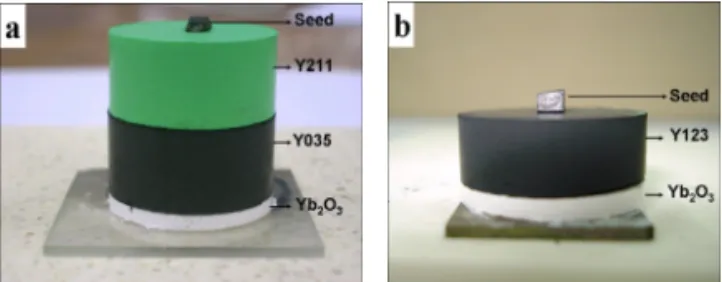
The starting materials used in the present study were Y123, Y211, and Y035 powders. To prepare Y211, Y123 and Y035 pre-forms, each powder was put in a steel mold with a 20 mm diameter and uniaxially pressed into a pellet. The conventional MTG and LIG processes were applied for the fabrication of a single grain YBCO bulk superconductor. The pre-form of the two processes were an Y123 pre-form and Y211/Y035 pellet, respectively (see Fig. 1). For the fabrication of a single grain YBCO superconductor, a top seeding was combined with the applied melt processes.
The details of the pre-form preparation are as follows. In the case of LIG process, for the reaction of an Y211 phase and a liquid-forming Y035 phase, an Y211 pellet was placed on an Y035 pellet. A Sm1.8Ba2.4Cu3.4Oz (Sm1.8) seed was placed on the top of the pre-form (see Fig. 1(a)), and the seeded compacts were positioned at the center of a box furnace. To suppress a subsidiary Y123 nucleation at the bottom, an Yb2O3 plate and MgO single crystal substrate were used as a bottom plate. In the case of the conventional MTG process, the seeding and bottom plating technique were the same as those of the LIG process, but the used pre-form was an Y123 pellet (see Fig. 1(b)).
Fig. 1. Photos of pre-form structure for (a) LIG and (b) conventional MTG processes.
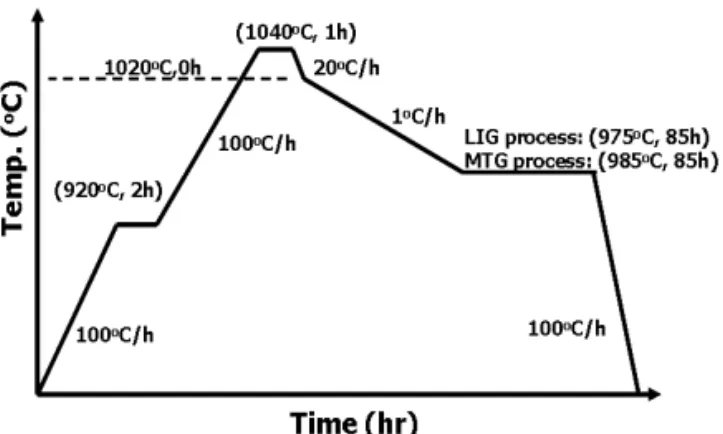
The applied heating schedule for the both processes is shown in Fig. 2. The prepared pre-forms were heated to 1040 oC at a rate of 100 oC/h and maintained at this temperature for 1 h. The pre-forms were then cooled to 1020 oC at a rate of 10 oC/h and
then slowly cooled to 975 oC-985 oC at a rate of 1
oC/h again. During the slow cooling stage, an Y123 single grain grows from the top seed. Finally, the pre-forms were cooled to room temperature at a rate of 100 oC/h. It is expected in the LIG process that during the high temperature heating, the Y035 pellet melts which is infiltrated the porous Y211 pre-form, while in the MTG process the Y123 powder decomposed incongruently into a solid Y211 and a liquid via. a partial melting. After the fabrication of single crystal YBCO bulk superconductors, the samples were annealed at 450 oC–500 oC for 150 h in flowing oxygen for the oxygen embedding in the Y123 lattices.
The interior microstructure within the prepared single Y123 grain samples was investigated by an optical microscope (OM) and a scanning electron microscope (SEM) for the polished/etched surfaces.
The superconducting transition temperature (Tc) and critical current density (Jc) were estimated from the magnetization curves of samples. The rectangular samples with a dimension of about 2x2.5x2 mm3 which cutfrom the top surfaces of the samples were used for the magnetization measurement using a superconducting quantum interference device (SQUID) magnetometer. The Jc at 77 K and for the H//c-axis direction was calculated using a Bean’s critical model [14].
Fig. 2. Schematic illustration of the applied heating schedule.
III. Results and discussion
Figure 3 shows the top view of the YBCO bulk superconductors fabricated by the LIG (Fig. 3a) and the conventional MTG processes (Fig. 3b). The crystals grown at the top surfaces show a rectangular growth mode with four-fold grown sector boundaries.
Fig. 3. Top view of the (a) LIG-processed and (b) MTG- processed YBCO samples.
Figure 4 shows the microstructures of sample at the central region of the LIG-processed (Fig. 4(a)) and MTG-processed sample (Fig. 4(b)). It can be seen in the both samples that many spherical pores, which were reported to form due to the gas evolution during melting [15], are observed in Y123 matrix. The size of the large pores is about few tens of µm and small ones is a few µm. Comparing the two microstructures, the size and number of pores of sample (Fig. 4(a)) is much smaller than those of sample (Fig. 4(b)), indicating that the gas evolution during melt process was much suppressed in the LIG process.
The pore formation in both samples is related to the oxygen gas evolution during melting and is influenced by the precursor powder used. The pre-forms used in the LIG process were Y211/Y035 pellets. During the high temperature heat treatment, only a Y035 powder melts, but the Y211 remains as a solid form. The Y035 melt infiltrates into the porous Y211 pre-form. The pore formation is thus limited in the pore spaces in the Y211 pre-form. Meanwhile, the pre-form of the MTG process was an Y123 pellet.
At the high temperature above the melting point of an Y123 phase, the Y123 pre-form was partially melt into an Y211 and a Y035 liquid. Due to the different oxygen stoichiometery in the Y123 and (Y211 +
Y035), a large amount of oxygen releases in the used per-form, and thus finally form pores of very large size in the pre-form [15]. This is the reason why many more pores of a larger size were observed in the MTG-processed sample.
Fig. 4. Optical micrographs of the polished surfaces of the (a) LIG and (b) conventional MTG-processed Y123 samples.
Figure 5 shows the Y211 particles trapped in the Y123 grains of LIG-processed (Fig. 5(a)) and MTG- processed (Fig. 5(b)) Y123 samples. The round shaped Y211 particles are observed in both samples, which are attributed to the peritectic dissolution of the faceted planes of the Y211 particles prior to trapping into an Y123 grain. The average size of Y211 of the sample (Fig. 5(a)) is much smaller than that of the sample (Fig. 5(b)). The presence of the smaller Y211 size in the LIG processed sample is explained in terms of the reaction route during melting in the both processes. The Y211 particle size in the LIG process can easily be reduced when preparing the Y211 pre-form, while the Y211 size control in the MTG process is difficult because the Y211 is a by-product of the incongruent melting of an Y123 pre-form. In addition, the amount of a melt in the LIG-processed sample is likely to be smaller than that of the MTG-processed sample due to the limited open space for liquid infiltration in the Y211 pre-form. The Y211 in the MTG-processed sample might thus experience the relatively severe Y211 coarsening at the (Y211 + Y035) state due to the larger amount of the liquid.
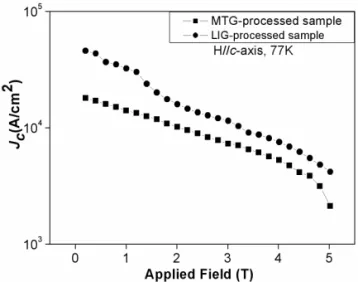
Figure 6 shows Jc-B curves at 77 K and H//c-axis of the LIG-processed and MTG-processed samples.
The Jc values in the magnetic fields of 0-5 Tesla of the LIG-processed sample are higher than that of the MTG-processed sample. The improved Jc is ascribed
to the smaller Y211 particle size (small Y211 particles or the Y211/Y123 interface can act as pinning center [16]) and low porosity [12, 13] in the LIG-processed sample.
It can be said from the experimental results of this study that the LIG technique has several advantages of easier control of Y211 size, distribution, lower porosity and higher Jc compared to the MTG process.
Fig. 5. Scanning electron micrographs of (a) LIG-processed and (b) MTG-processed YBCO sample.
Fig. 6. Jc–B curves of the LIG-processed and MTG- processed Y123 sample.
IV. Conclusions
With an aim of comparison of the LIG and conventional MTG processes, single grain YBCO bulk superconductors were fabricated using the both processes combined with a top seeding. The experimental results shows the importance of the precursor powder which is used to make a pre-form
for the processes; the LIG process starts from an Y211/Y035 pre-form, but the MTG process starts from an Y123 pre-form. The smaller Y211 size, more homogeneous distribution and lower porosity were achieved in the LIG-processed sample. The Jc of the LIG-processed sample is higher in the applied magnetic fields of 0-5 Tesla than the Jc of the MTG-processed sample due to the presence of fine Y211 particles and small amount of pores in the Y123 product.
Acknowledgements
This research was supported by the Electric Power Industry Technology Evaluation and Planning Center, Republic of Korea.
References
[1] S. Jin, T. H. Tiefel, R. C. Sherwood, R. B. Van Dover, M. E. Davis, G. W. Kammlott, and R. A. Fastnacht, Phys. Rev. B, 37, 7850 (1988).
[2] M. Murakami, M. Morita, K. Doi, K. Miyamoto and H.
Hamada, Jpn. J. Appl. Phys., 28, 1189 (1989).
[3] K. Salama, V. Selvamanickam, L. Gao and K. Sun, Appl. Phys. Lett., 54 2352 (1989).
[4] Z. Lian, Z. Pingxian, J. Ping, W. Keguang, W. Jingrong and W.Xiaozu, Supercond. Sci. Technol., 3, 490 (1990).
[5] C. Varanasi, P.J. McGinn, V. Pavate and E.P. Kvam, Physica C, 221, 46 (1994).
[6] A. M. Campbell and D. A. Cardwell, Cryogenics, 37, 567 (1997).
[7] S. Jin, T. H. Tiefel, R. C. Sherwood, M. E. Davis, R. B.
Van Dover, G. W. Kammlott, R. A. Fastnacht and H. D.
Keith, Appl. Phys. Lett., 52, 2074 (1988).
[8] Y. L. Chen, H. M. Chan, M. P. Harmer, V. R. Todt, S.
Sengupta and D. Shi, Physica C, 234, 232 (1994).
[9] N. H. Babu and T. Rajasekharan, L. Menon and S. K.
Malik, J. Am. Ceram. Soc., 82, 2978 (1999).
[10] H. Fang, Y. X. Zho, K. Ravi- chandar and K. Salama, Supercond. Sci. Technol., 17, 269 (2004).
[11] S. Meslin and J. G. Noudem, Supercond. Sci. Technol., 17, 1324 (2004).
[12] A. Mahmood, B. H. Jun, H. W. Park, C. J. Kim, Physica C, 468, 1350 (2008).
[13] K. Iida, N. H. Babu, D. A. Cardwell. Supercond. Sci.
Technol., 20, 1065 (2007).
[14] C. P. Bean, Phys. Rev. Lett., 8, 250 (1962).
[15] C. J. Kim, H. G. Lee, K. B. Kim, G. W. Hing, J. Mater.
Res., 10, 2235 (1995).
[16] M. Murakami, S. Gotoh, H. Fujimoto, K. Yamaguchi, N. Koshizuka, S. Tanaka, Supercond. Sci. Technol., 4, S43 (1991).