†대표저자(e-mail : [email protected])
Effect of Low-temperature Thermal Treatment on Degree of Crystallinity of a Low Density Polyethylene:
1
H Nuclear Magnetic Resonance Study
Chang Hoon Lee and Jae-Kon Choi†
Dept. of Polymer Science & Engineering, Chosun University, Gwangju, 501-759, Korea (Received October 2, 2008, Revised November 4, 2008, Accepted December 2, 2008)
저밀도 폴리에틸렌의 결정화도에 대한 저온 열처리 효과
:
수소 핵자기공명 연구이 창 훈․최 재 곤† 조선대학교 응용화학소재공학과
(2008년 10월 2일 접수, 2008년 11월 4일 수정, 2008년 12월 2일 채택)
ABSTRACT : An effect of low-temperature long-term thermal degradation on a degree of crystallinity of a low density polyethylene (LDPE) was investigated by using 1H solid state nuclear magnetic resonance (SSNMR). Firstly, the long-term thermal treatment makes a color of LDPE from white to pale yellow which is indicative of thermal oxidation. Secondly, it makes the 1H NMR spin-spin and spin-lattice relaxation times (T1) to be long. Lastly, the degree of crystallinity of the semicrystalline aged-LDPE also decreases with thermal treatment. Above all, the T1 increase is envisaged to be due to either a decrease of the amorphous regions governing overall spin-lattice relaxation mechanism in LDPEs or a dynamically restricted motion of specific molecular motions by intermolecular hydrogen bonding or crosslinking. However, since the decrease of crystallinity implies an increase of amorphous regions by the thermal treatment, the former case is contrast to our results. Accordingly, we concluded that the latter effect is responsible for the T1 increase.
요 약 : 저밀도 폴리에틸렌에 대한 장시간 저온 열처리가 저밀도 폴리에틸렌 고분자의 결정화도 에 미치는 효과를 고체 수소 핵자기공명을 이용하여 연구하였다. 장시간 열처리는 첫째, 저밀 도 폴리에틸렌의 색깔을 엷은 노란색으로 변하게 하였고 둘째, 저밀도폴리에틸렌에서 수소 핵 의 스핀-스핀 및 스핀-격자 완화시간을 증가시켰으며, 셋째, 결정화도를 줄어들게 하였다. 먼저, T1의 증가를 저밀도폴리에틸렌의 전체 스핀-격자 완화시간을 결정하는 비정질 영역의 부피 감 소에 의한 것이거나 분자간 가교나 수소결합에 의한 특정 분자 운동 성분의 느려짐에 의해 발 생하는 것으로 고려하였다. 하지만 결정화도의 감소는 열처리에 의한 비정질 영역의 감소를 의 미하므로 전자와는 배치되었다. 따라서 T1의 증가는 후자에 의한 결과임을 알 수 있었다.
Keywords : LDPE, thermal treatment, Degree of crystallinity 1H-NMR
Ⅰ. Introduction
Low density polyethylene (LDPE) has been wide- ly used as a polymeric insulator in high voltage (HV) transmission and distribution cables. However, there are some questions in its service reliability caused by long-term degradation under thermal and/or electric stress.1 For semicrystalline polymers, such long-term degradations can be related to varia- tions of a crystalline fraction which has been known to be very important factor to understand viscoe- lastic, thermal, mechanical, and dielectric properties.
From an experimental point of view, a degree of crystallinity can be estimated by using an X-ray diffraction. In detailed inspection, however, this method is possible only when one has small- and wide-angle X-ray data simultaneously, because the XRD peaks consist of well resolved complex peaks corresponding to crystalline region and the broad single peak responsible for amorphous region.
Problem is that the broad single line corresponds to the whole amorphous region whereas one of the complex peaks from crystalline regions cannot be representative of the overall crystalline region. In results, the XRD method is difficult to determine the degree of crystallinity for semicrystalline poly- mer systems consisting of the crystalline and the amorphous regions.
Solid state nuclear magnetic resonance (SSNMR) techniques can also trace the degree of crystalli- nity.2-4 Since SSNMR characteristics of various sol- id polymers are predominantly dominated by mag- netic dipole-dipole couplings between nuclei, possi- ble changes of morphological and/or dynamical properties can be reflected in NMR line shapes which depend primarily on the spatial distribution of nuclei and spin-lattice relaxation times, very sen- sitive to molecular motions modulating these spatial arrangements of nuclear spins. In particular, since every polymer contains H atom in its structure, 1H nuclear magnetic resonance spectroscopy can be a powerful tool for studying the polymeric systems.
In this works, therefore, the effect of low-temper-
ature thermal treatment on the morphological and dynamical properties of LDPE was investigated by using 1H SSNMR.
Ⅱ. Experiments
Low density polyethylene (LDPE: density = 0.920 g/cm3, MI = 2.0 g/10 min) was obtained by molding a polyethylene under pressure at 120 ℃ for 10 min.
And after, the fresh-LDPE was thermally treated to make an aged-LDPE in oven at 80 ℃ under an air atmosphere for 30 months. In visual inspection, the fresh-LDPE was white, whereas the aged-LDPE was pale yellow. Their detailed informations are sum- marized in Table 1.
Table 1. Treatment Condition on the Fresh- and the Aged-LDPEs
Specimens Treatment Condition Fresh-
LDPE molded under pressure at 120℃ for 10 min Aged-
LDPE
thermally treated the fresh-LDPE in oven at 80℃ under an air atmosphere for 30 months
1H SSNMR were performed at 45 MHz in room temperature. Conventional solid echo sequence (π /2x-τ- π/2y) and inversion recovery (πx-τ- π/2x) were used for obtaining spin-spin and spin-lattice relaxation times, respectively.5 The π/2 and π pulses were 1 μs and 2 μs, respectively. For solid echo, the time separations between two π/2 pulses were ranged from 10 μs to 1 ms, whereas for the inversion recovery, the separation times were covered to 1 s.
The NMR lineshapes were successfully generated by fast Fourier transformation (FFT) of free in- duction decay (FID) signals.
Ⅲ. Results and Discussion
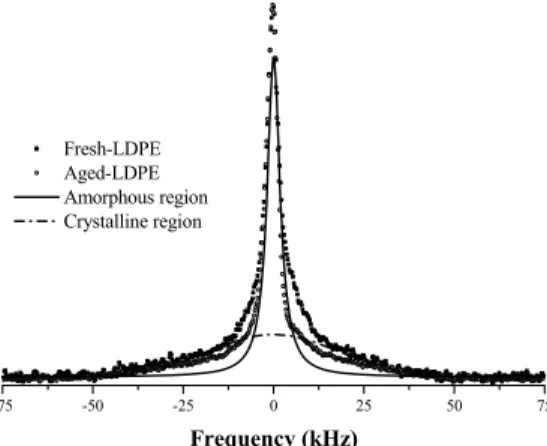
Figure 1 is the typical 1H NMR lineshapes ob- tained for LDPE and aged-LDPE at room tem- perature.
In principle, the half height width, or second mo-
-75 -50 -25 0 25 50 75
Frequency (kHz) Fresh-LDPE
Aged-LDPE Amorphous region Crystalline region
Figure 1. Normalized 1H NMR lineshapes obtained for the fresh- and the aged-LDPEs. Here, the bold rectangle and open circle indicate experimental data, but the solid and dotted lines are Lorentzian and Gaussian functions described in Eq. 1, respectively. Even for the naive visual inspection, it is manifested that the Gaussian part of the aged-LDPE is much small than that of the fresh-LDPE.
ment, M21/2
of 1H NMR absorption line reflects the root-mean square of local dipolar magnetic fields experienced by a typical proton.2-4 Furthermore, it can reflect not only a local molecular structure via the dependence of the local field on the spatial dis- tribution of the spins, but also various molecular motions occurring at rates which are sufficient to average the dipolar couplings. For the case of the semicrystalline solid polymers above in their glass transition temperature, 1H NMR spectra may be composed of two resonance lines with different widths and shapes, expecting to have a broad Gau- ssian line from more rigid ordered or crystalline re- gions and a narrower Lorentzian line from more mo- bile amorphous regions. Under this regime, 1H NMR spectra f (ν) is described as follows:
⌊ ⌋
(1)
Here, A is the area for Gaussian function, B the area for Lorentzian function, and WG and WL are the half-height widths of Gaussian and Lorentzian
functions, respectively. From the fraction of Gau- ssian area function [A/(A+B)], one can determine the degree of crystallinity for each sample. Accor- ding to Eq. (1), the experimental data can be decon- voluted into one Gaussian and one Lorentzian func- tions corresponding to the crystalline and the amor- phous regions, producing the degree of crystal- linities of 47±1 % and 39±1 % for the fresh- and the aged-LDPE, respectively.
Such variation was also confirmed via spin-spin relaxation measurements which allow us to probe strength of the magnetic dipole interactions between neighboring 1H nuclei. For the crystalline region, the
1H molecular motions are severely restricted due to no activation of the α (flip-flop)-process at room temperature. As a consequence, their spin-spin inter- actions may be strong and thus satisfied with a Gaussian function. In contrast to this, for the amor- phous region, the motional states are very vigorous by already activated γ- and β-processes as de- scribed before, leading to exponential function as the separation time increases. Such characteristics should be reflected in the spin-spin relaxations as a linear combination of Gaussian and Exponential decay functions as shown in Figure 2.
Therefore, if the crystalline region decreases, then a
0.0 0.1 0.2 0.3 0.4 0.01
0.1 1
Fresh-LDPE Aged-LDPE
M(t) (arb. unit)
Time (ms)
Figure 2. Spin-spin relaxation times measured at room temperature by the solid echo sequence. The solid and dashed lines indicate the fitting results with the combination of Gaussian and Exponential functions.
fraction of the Gaussian function decreases as well.
For our case, the most noticeable variation in Figure 2 is that the part of exponential decay is lengthened from 186 (±13) μs of the fresh-LDPE to 336 (±28) μs of the aged-LDPE. This implies that the spin-spin interaction of the amorphous region in the aged- LDPE is weakened by two times with respect to that of the fresh-LDPE. This behavior is well match- ed with the decrease of the degree of crystallinity for the aged-LDPE.
Figure 3 shows 1H magnetization recoveries for the fresh-LDPE and the aged-LDPE as a function of time. Each 1H magnetization recovery is well fit- ted to single exponential function. Their time con- stants are 196 (±2.0) ms and 230 (±2.0) ms for the fresh- and the aged-LDPE, respectively. These in- dicate that the thermal degradation makes the 1H spin-lattice relaxation time to be long. In principle, the spin-lattice relaxation time is referred to be a time constant required for a nuclear spin system to attain an equilibrium distribution after sudden dis- turbance, and usually dominated by magnetic dipo- lar couplings which is dynamically modulated by random Brownian motions of spin systems arising from a thermal energy.2,3,6 Therefore, if one denote a correlation time of the molecular motion as τc, the spin-lattice relaxation rate (1/T1) can be written as
∝≪ weak collision limit
∝ ≫ strong collision limit (2)
where T1 is the spin-lattice relaxation time, γ the gyromagnetic ratio, h = h/2π (h: Plank constant), and ω0= γH is the Larmor frequency (H: magnetic field). For the semicrystalline solid polymers, there- fore, the spin-lattice relaxation times should be dif- ferent between the crystalline and amorphous re- gions because in which their correlation times are different from each other. However, if the crystal-
line and amorphous regions are well coupled via spin diffusion mechanism, 1H magnetization can be transferred from one region to another, leading to single time constant. For LDPE, a segmental motion of the amorphous regions was known to occur around -100 ℃ (γ-process) and between -20 ℃ and 10 ℃ (β-process), governing overall spin-lattice re- laxation mechanism. A contribution of the flip-flop α-process in the crystalline regions7 is negligible due to no activation of such motion at room tem- perature. Therefore, the more the amorphous region the shorter the spin-lattice relaxation time is How- ever, as shown in Figure 1, the degree of crystal- linity of the aged-LDPE decreased to be 39 %, im- plying that the amorphous region increased, but its spin-lattice relaxation time was lengthened, sharply conflicted to the theoretical estimation. Why such conflicts take place in the aged-LDPE?
To understand this unconventional phenomenon, it needs to reconsider what happens under long-term thermal treatment of the fresh-LDPE at 80 ℃ under an air atmosphere. To our knowledge, LDPE with- out antioxidants may experience random chain scis- sion, intramolecular chain backbiting and con- tinuous oxidation, which is likely to be activated at the ends of main chains and branches.8 In general, one chain scission produces two methyl molecules.
If the thermal degradation results in paramagnetic oxygens or increasing of a methyl concentration, the
0 200 400 600 800 1000
1E-3 0.01 0.1
[M0-M(t)]/2M0
Time (ms) Aged-LDPE Fresh-LDPE
Figure 3. 1H nuclear magnetization recoveries obtained from the fresh-LDPE and the aged-LDPE (18℃, 45 MHz).
[ ]
1H spin-lattice relaxation time is expected to be dras- tically decreased. To the contrary, if thermal degra- dation gives rise to a ketonic carbonyl and acid func- tionality,9 the formation of terminal methyl groups can be excluded, but the above vinyl groups may restrict chain segmental motions due to hydrogen bonding with neighbouring chains.10 An intramo- lecular chain backbiting can also be a factor for re- stricting chain segmental motions in amorphous regions.11 Indeed, a crude visual inspection for the aged-LDPE reveals a pale yellow color, which is indicative of an oxidation of the fresh-LDPE by thermal treatment during 30 months, whereas an electron paramagnetic resonance shows no signal at room temperature, indicative of the absence of free radical species like the paramagnetic oxygen mole- cules expected for thermal oxidation of the fresh- LDPE. As a consequence, the thermal treatment pre- dominantly gives rise to oxidation degradation with- out any free radicals, and at the same time, makes the 1H NMR spin-lattice relaxation time to be long in the aged-LDPE. Possibly, the thermal degradation either restricts dynamically the segmental motions or makes diminish the volume fraction of the amor- phous regions. These facts suggest that the thermal degradation mainly produce the ketonic carbonyl and acid functionality9 so that their hydrogen bonds or crosslinking to neighbouring chains10 restrict chain segmental motions and make 1H spin-relaxa- tion time to be long. Consequently, the crystallinity comes to decrease in the aged-LDPE, but its 1H spin-lattice relaxation time (T1) increase.
Ⅳ. Conclusion
The effect of low-temperature thermal treatment on morphological and dynamical properties of LDPE was investigated by using 1H solid state nu- clear magnetic resonance spectroscopy. In results, it was found that the thermal degradation predom- inantly led to thermal oxidation and restriction of
the chain segmental motions, making the degree of crystallinity to be decreased but the 1H NMR spin- lattice relaxation rate (T1-1
) to be long.
References
1. Y. Tanaka, N. Ohnuma, K. Katsunami, and Y.
Ohki, “Effects of Crystallinity and Electron Mean- free-path on Dielectric Strength of Low-Density Polyethylene”, IEEE Trans. Electr. Insul., EI-26, 258 (1991).
2. V. J. Mcbrierty and D. C. Douglass, “Recent Advances in the NMR of Solid Polymers”, J.
Polym. Sci.: Macromol. Rev., 16, 295 (1981).
3. Q. Chen and H. Kurosu, “Solid-state NMR studies on semicrystalline Polymers” in Annual Reports of NMR spectroscopy 61, p. 247, Aca- demic Press, New York, 2006.
4. Jiři Spěváček, Josef Baldrian, “Solid-state 13C NMR and SAXS characterization of the amor- phous phase in low-molecular weight poly(ethyl- ene oxide)s”, European Polymer Journal, 44, 4146 (2008).
5. E. Fukushima and S. B. W. Roeder, Experimen- tal Pulse NMR; A Nuts and Bolts Approach, Addison-Wesley, London, 1981.
6. N. Bloembergen, E. Purcell, and R. V. Pound,
“Relaxation Effects in Nuclear Magnetic Reso- nance Absorption”, Phys. Rev., 73, 679 (1948).
7. A. R. Blythe, Electrical properties of polymers, Cambridge Univ. Press, London, 1979.
8. A. Barlow, “The Chemistry of Polyethylene In- sulation”, IEEE Trans. Elec. Ins., 7, 8 (1991).
9. J. V. Benham and T. J. Pullukat, “Analysis of the Types and Amounts of Carbonyl Species Present in Oxidized Polyethylene”, J. Appl.
Polym. Sci., 20, 3295 (1976).
10. R. D. Deanin, Polymer Structure, Properties and Applications, Cahners publication, Boston, 1972.
11. L. C. Dickinson, P. Morganelli, C. W. Chu, Z.
Petrovie, W. J. MacKnight and J. C. W. Chien,
“Molecular Motion in Model Network Polymers”, Macromolecules, 21, 338 (1988).