• 검색 결과가 없습니다.

The Strength of the Lower Trapezius in ViolinistsWith Unilateral Neck Pain

N/A
N/A
Protected

Academic year: 2021

Share "The Strength of the Lower Trapezius in ViolinistsWith Unilateral Neck Pain"

Copied!
6
0
0

로드 중.... (전체 텍스트 보기)

전체 글

(1)

The Strength of the Lower Trapezius in Violinists With Unilateral Neck Pain

Si-hyun Kim

1

, PhD, PT, Kyue-nam Park

2

, PhD, PT

1Kinetic Ergocise Based on Movement Analysis Laboratory

2Dept. of Physical Therapy, College of Medical Science, Jeonju University

Abstract 1)

Violinists tend to position the neck asymmetrically to hold the violin between the chin and the left shoulder. Asymmetrical neck posture may induce unilateral neck pain. Previous studies have suggested that individuals with unilateral neck pain exhibit reduced muscle strength of the lower trapezius, but no study has investigated violinists with unilateral neck pain. To this end, we recruited 18 violinists with unilateral neck pain for the present study in which the side on which neck pain was experienced, pain duration, and intensity were recorded. Lower trapezius strength was measured bilaterally in each subject using a handheld dynamometer. Significant differences in lower trapezius strength were evident between the ipsilateral and contralateral sides of neck pain (p<.05). No significant association between neck pain intensity or duration, and the extent of a deficit in lower trapezius strength, was evident (both p>.05).

The association between the sides of weakened lower trapezius strength and neck pain was significant (p<.05). In conclusion, violinists with unilateral neck pain exhibited significantly less lower trapezius strength on the ipsilateral compared to the contralateral side of the pain. Unilateral neck pain more frequently involved the left side of the neck, which is used to stabilize the violin during playing. Thus, our study suggests that a possible relationship exists between muscle weakness in the lower trapezius and neck pain.

Key Words: Lower trapezius muscle; Strength; Unilateral neck pain; Violin.

Introduction

Violinists assume static postures, and hold their instruments in the same position for several hours (Wilke et al, 2011). The static posture features lateral bending and/or rotation of the neck (Park et al, 2012). Repetitive or persistent lateral bending or ro- tation triggers an asymmetrical cervical posture, cre- ating inappropriate mechanical stress on the side of the neck, inducing unilateral neck pain (Sahrmann, 2010; Wilke et al, 2011). A previous study found that lateral bending of the neck, rather than axial rotation (assumption of a more asymmetrical posture), may contribute to neck pain in some violinists (Park et al, 2012).

Excessive contraction of the upper trapezius mus-

cle during playing also induces an asymmetrical pos- ture (Park et al, 2012). In particular, the left upper trapezius is used to hold the violin between the chin and the left shoulder, causing sustained muscle con- traction during playing (Falla and Farina, 2005; Shan and Visentin, 2003).

Overactivity of the upper trapezius muscle can in- duce middle and lower trapezius muscle weakness (Kelley, 1995; Pink and Tibone, 2000). Page et al (2010) also showed that the upper trapezius was prone to tightness, whereas the middle and lower trapezius were more weakened. Lower trapezius can contribute to scapular depression (Reis et al, 1979).

During playing the violin, overactivity of unilateral

upper trapezius, especially left side may induce ex-

cessive scapular elevation unless lower trapezius sta-

Corresponding author: Kyue-nam Park [email protected]

(2)

bilize the scapula by scapula depression. Muscle dis- use contribute to muscle weakness in patients with unilateral neck pain (Fernández-de-las-Peñas et al, 2008). Hence, a previous study suggested that more investigation should be needed to understand the correlation between lower trapezius and unilateral neck pain (Petersen and Wyatt, 2011).

Previous studies recorded lower trapezius weak- ness in individuals with unilateral neck pain (Choudhari et al, 2012; Petersen and Wyatt, 2011).

The latter authors showed that individuals with uni- lateral neck pain had less lower trapezius strength on the ipsilateral side of the pain than the con- tralateral side. Choudhari et al (2012) compared upper and middle trapezius strengths with lower trapezius strength in individuals with unilateral neck pain, and found no significant between-side difference in upper trapezius strength, but found that lower trapezius strength was lower than that of the middle trapezius on the side of neck pain compared to the opposite side (Choudhari et al, 2012).

Studies have also found that hand dominance may affect the side of unilateral neck pain, but these re- sults are controversial (Choudhari et al, 2012;

Petersen and Wyatt, 2011). One study found no sig- nificant correlation between hand dominance and the side of neck pain (Petersen and Wyatt, 2011).

Another study suggested that the side of neck pain was more commonly the dominant side (Choudhari et al, 2012). However, regardless of dominant hand, vi- olinists use the left hand to stabilize the instrument, and the right hand to move the bow (Wilke et al, 2011).

Although deficits in lower trapezius muscle strength have been found in individuals with unilat- eral neck pain, no study has explored lower trapezius muscle strength in violinists with unilateral neck pain. The lower trapezius strength measurement would be needed for violinists, who commonly as- sume an asymmetrical neck posture for several hours a day, day after day during playing. The primary purpose of the present study was to compare the

lower trapezius strengths of the ipsilateral and con- tralateral sides of the neck in violinists with unilat- eral neck pain. The secondary purpose was to ex- plore the relationship between the intensity of neck pain or pain duration and lower trapezius strength.

In addition, we examined the relationship between the side of neck pain and the side of the weaker lower trapezius muscle.

Methods

Subjects

Eighteen violinists with neck pain were recruited from the University of the Arts in Korea, and each completed a questionnaire describing the side and duration of neck pain. Subjects who reported unilat- eral neck-shoulder pain at a level above 3 (of a total score of 10) on a visual analog scale (VAS) after violin practice, were included in the study. The sub- jects were asked to rate the average level of neck-shoulder pain after violin practice, over the past 3 months, on a 10 ㎝ VAS; 0 indicated no pain and 10 indicated the worst pain imaginable. Dominant hand was right in subjects. Prior to the study, the principal investigator explained all procedures to the subjects, all of whom signed informed consent forms.

Measurement of lower trapezius muscle strength

A handheld dynamometer (HHD) (DFE2-200, Chatillon, Florida, USA) was used to measure lower trapezius strength. The HHD has been shown to ex- hibit high inter- and intra-rater reliability, and to yield valid data (Bohannon and Andrews, 1987;

Michener et al, 2005).

Procedures

Lower trapezius muscle strength was measured

using Kendall’s method (Kendall et al, 2005). Each

subject was placed in the prone position, and a rolled

towel was placed under the forehead to maintain the

(3)

Variables Mean±SD

a

Age (year) 21.2±.9

Height (㎝) 161.8±5.1

Body mass (㎏) 47.9±4.8

VAS

b

(㎝) 5.7±2.4

Duration of UNP

c

(year) 8.2±3.3 Number of left side of UNP 15 Number of right side of UNP 3

a
mean±standard deviation,

b

visual analog scale,

c

unilateral neck pain.

Table 1. General characteristics (N=18)

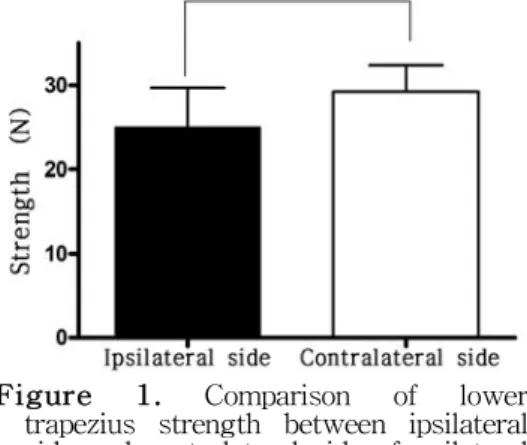
Figure 1. Comparison of lower trapezius strength between ipsilateral side and contralateral side of unilateral neck pain (Error bars denote standard deviation. *p<.05).

neck in a neutral position, thus prohibiting excessive neck flexion during measurement. Each subject was then asked to raise an arm diagonally overhead, in line with the fibers of the lower trapezius muscle (Kendall et al, 2005). All subjects were able to as- sume this test position. To prevent compensation, the tester manually fixed the contralateral inferior scapula.

Each subject was asked to maintain the arm in the test position as a tester applied resistance. The HHD sensor was positioned at the one-third position of the distal forearm, and downward force was applied by a tester until maximal muscular exertion was overcome.

Two consecutive trials were performed on each upper extremity, with a 30 s rest between trials. The mean trial data from either side were used in the analysis (Petersen and Wyatt, 2011). The initial side of meas- urement was randomized, and the tester was blinded to the side of neck pain.

Statistical analysis

The age, weight, height, pain duration, and side of pain of the subjects were recorded. The paired t-test was employed to compare differences between lower trapezius strength on the ipsilateral and con- tralateral sides of the neck in subjects with unilat- eral neck pain. The percentage of strength deficit on the ipsilateral side was determined by subtracting the lower trapezius strength on the ipsilateral side from the contralateral side and then dividing the value by lower trapezius strength on the con- tralateral side. The correlation coefficient between VAS score and percentage strength deficit was cal- culated using Spearman’s rank correlation test. The correlation between pain duration and percentage strength deficit was calculated via the Pearson cor- relation analysis. The chi-squared test was used to explore the existence of any association between the side of the neck pain and the side of the weaker lower trapezius muscle. The significance level was set at p<.05. All statistical analyses were performed using SPSS ver. 18.0 software (SPSS Inc., Chicago, IL, USA).

Results

Age, height, weight, playing duration, pain duration, pain intensity and number of side of unilateral neck pain are summarized in Table 1. Lower trapezius strength on the ipsilateral side of neck pain [mean±standard deviation (mean±SD): 25.03±19.76 N]

was significantly less than that on the contralateral side (mean±SD: 29.22±13.46 N) (p<.05; mean difference: -4.2 N, 95% confidential interval: -8.0 N, -.4 N) (Figure 1).

Mean±SD for percent of strength deficit on the ipsi-

lateral side was 20.42±18.21%. No significant association

between VAS score and percentage strength deficit was

apparent (r=-.02, p=.93), and no significant association

between pain duration and percentage strength deficit

was noted (r=.29, p=.25). The association between the

side of the neck pain and the side of the weaker

lower trapezius was significant (x

2

=5.29, df=1, p<.05).

(4)

Discussion

We found that violinists with unilateral neck pain had less lower trapezius strengths on the ipsilateral than the contralateral side of the neck pain. A sig- nificant association was evident between the side of weaker lower trapezius and that of neck pain. We found no significant association between the intensity or duration of neck pain, and percentage strength deficit. Petersen and Wyatt (2011) found that the lower trapezius strength was weaker in those with unilateral neck pain. Choudhari et al (2012) found no significant difference (compared to subjects without unilateral neck pain) in upper trapezius strength, but significant differences in middle trapezius and lower trapezius strengths, consistent with our finding that violinists with unilateral neck pain exhibited lower trapezius weakness on the side of pain, compared to the non-painful side.

The lower trapezius muscle is optimally used for stabilization, whereas the upper trapezius is more appropriately used for movement (Lindman et al, 1990). Previously, violinists with neck pain exhibited more muscle activity in the left upper trapezius dur- ing playing compared to those without neck pain (Park et al, 2012). In violinists with neck pain, the left upper trapezius is used to stabilize the instru- ment, rather than for movement, although use of the upper trapezius muscle for movement would be more appropriate (Lindman et al, 1990). Increased use of the upper trapezius and reduced use of the lower trapezius may induce a muscular imbalance leading to upper trapezius tightness and lower trapezius weakness (Cools et al, 2007; Reinold et al, 2009). In the present study, we found that if the violin was played for several years, limited use of the lower trapezius to stabilize the neck and scapula during playing could induce lower trapezius weakness about 20.4% strength deficit. However, further studies are needed to determine whether a cause-and-effect re- lationship exists between unilateral neck pain and lower trapezius strength in violinists.

83% of the subjects (n=15) in this study showed left-side affection of unilateral neck pain, weakened strength of lower trapezius. And there was sig- nificant association between the side of the neck pain and the side of the weaker lower trapezius. The side of the neck and scapula of the all subjects was same who used the left side to stabilize the violin, and the right side to move the bow in this study.

During playing the violin, it is easier to protract and elevate the left for stabilizing than the right scapula (Ackermann et al, 2002). Although repetitive bilateral scapular stress can cause biliateral neck pain, pro- longed uneven loading of the neck, especially left lateral bending and flexion, causes unilateral pain, especially on the left side (Fry, 1986). Thus, repeti- tive and sustained use of left-side musculature may explain higher prevalence of unilateral neck pain in left side. Another possible cause about weakened lower trapezius in left side may suggest that right side of scapular musculature use dynamically for moving the bow, resulting higher strength of right lower trapezius during playing compared to static left side regardless of side of unilateral neck pain.

No significant association was evident between VAS score and percentage of lower trapezius strength deficit on the side of neck pain, suggesting that violinists with higher levels of pain did not have greater deficits in strength than those with lower levels of neck pain. This lack of relationship between lower trapezius strength and neck pain intensity was consistent with data from a previous study (Pearson et al, 2009). We also found no significant association between pain duration and percentage of strength deficit, suggesting that violinists with unilateral neck pain of a longer duration did not have weaker lower trapezius muscles than those with shorter pain durations. This is in accordance with a previous finding that strength deficit and pain duration did not correlate (Petersen and Wyatt, 2011).

Although we found no significant correlation

among lower trapezius strength, intensity of neck

pain, or pain duration, our results cannot be general-

(5)

ized to all violinists with lower trapezius strength deficits, because the violinists whom we evaluated could raise their arms from the prone position, against gravity. This means that muscle function was better than fair. In addition, we compared mus- cle strengths between sides; side-to-side differences in lower trapezius strength may also be found in healthy violinists or in those with bilateral neck pain.

Hence, future work should compare violinists without neck pain, and with either unilateral or bilateral pain.

In addition, this study did not investigate the strength of another scapulothoracic muscles except of lower trapezius, although another scapulothoracic muscles can influence the unilateral neck pain (Page et al, 2010). Future study should be needed to com- pare another scapulothoracic muscle strength such as upper and middle trapezius muscles, serratus anterior muscle.

Conclusion

Violinists with unilateral neck pain exhibited sig- nificantly less lower trapezius strength on the ipsi- lateral side of the pain compared to the contralateral side. These results suggest an possible association between unilateral neck pain and imbalanced strength of lower trapezius in violinists.

References

Ackermann B, Adams R, Marshall E. The effect of scapula taping on electromyographic activity and musical performance in professional violinists.

Aust J Physiother. 2002;48(3):197-203.

Bohannon RW, Andrews AW. Interrater reliability of hand-held dynamometry. Phys Ther. 1987;67(6):

931-933.

Choudhari R, Anap D, Rao K, et al. Comparison of upper, middle, and lower trapezius strength in individuals with unilateral neck pain. J Spine.

2012;1(3):1-3. http://dx.doi.org/10.4172/2165-7939.

1000115

Cools AM, Dewitte V, Lanszweert F, et al.

Rehabilitation of scapular muscle balance: Which exercises to prescribe? Am J Sports Med. 2007;

35(10):1744-1751.

Falla D, Farina D. Muscle fiber conduction velocity of the upper trapezius muscle during dynamic contraction of the upper limb in patients with chronic neck pain. Pain. 2005;116(1-2):138-145.

Fernández-de-las-Peñas C, Albert-Sanchís JC, Buil M, et al. Cross-sectional area of cervical multi- fidus muscle in females with chronic bilateral neck pain compared to controls. J Orthop Sports Phys Ther. 2008;38(4):175-180.

Fry HJ. Incidence of overuse syndrome in the sym- phony orchestra. Med Probl Perform Art. 1986;1 (2):51-55.

Kelley M. Anatomic and biomechanical rationale for rehabilitation of the athlete’s shoulder. J Sport Rehab. 1995;4(2):122-154.

Kendall FP, McCreary EK, Provance PG, et al.

Muscles: Testing and function with posture and pain. 5th ed. Baltimore, MD, Lippincott Williams

& Wilkins, 2005:330.

Lindman R, Eriksson A, Thornell LE. Fiber type composition of the human male trapezius mus- cle: Enzyme-histochemical characteristics. Am J Anat. 1990;189(3):236-244.

Michener LA, Boardman ND, Pidcoe PE, et al.

Scapular muscle tests in subjects with shoulder pain and functional loss: Reliability and con- struct validity. Phys Ther. 2005;85(11):1128-1138.

Page P, Frank CC, Lardner R. Assessment and Treatment of Muscle Imbalance: The Janda approach. Champaign, IL, Human Kinetics, 2010:52-53.

Park KN, Kwon OY, Ha SM, et al. Comparison of electromyographic activity and range of neck motion in violin students with and without neck pain during playing. Med Probl Perform Art.

2012;27(4):188-192.

(6)

This article was received September 27, 2014, was reviewed September 27, 2014, and was accepted November 1, 2014.

Pearson I, Reichert A, De Serres SJ, et al. Maximal voluntary isometric neck strength deficits in adults with whiplash-associated disorders and association with pain and fear of movement. J Orthop Sports Phys Ther. 2009;39(3):179-187.

http://dx.doi.org/10.2519/jospt.2009.2950

Petersen SM, Wyatt SN. Lower trapezius muscle strength in individuals with unilateral neck pain.

J Orthop Sports Phys Ther. 2011;41(4):260-265.

http://dx.doi.org/10.2519/jospt.2011.3503

Pink MM, Tibone JE. The painful shoulder in the swimming athlete. Orthop Clin North Am. 2000;

31(2):247-261.

Reis FP, de Camargo AM, Vitti M, et al.

Electromyographic study of the subclavius muscle.

Acta Anat (Basel). 1979;105(3):284-290.

Reinold MM, Escamilla RF, Wilk KE. Current con- cepts in the scientific and clinical rationale be-

hind exercises for glenohumeral and scap- ulothoracic musculature. J Orthop Sports Phys Ther. 2009;39(2):105-117. http://dx.doi.org/10.2519/

jospt.2009.2835

Sahrmann SA. Movement System Impairment Syndromes of the Extremities, Cervical and Thoracic Spines. St Louis, Mosby, 2010:66-67.

Shan G, Visentin P. A quantitative three-dimensional analysis of arm kinematics in violin performance.

Med Probl Perform Art. 2003;18(1):3-10.

Wilke C, Priebus J, Biallas B, et al. Motor activity

as a way of preventing musculoskeletal prob-

lems in string musicians. Med Probl Perform

Art. 2011;26(1):24-29.

수치

Figure  1.  Comparison of lower trapezius strength between ipsilateral side and contralateral side of unilateral neck pain (Error bars denote standard deviation

참조

관련 문서

In the change of physical strength, The exercise group showed statistically significant differences in muscle strength(right), muscle strength(left),

Second, there was no significant difference in the effect of participants' motivation according to age, final educational attainment, motivation to

In exercise group, change in physical strength after measurement showed significant increase in muscular strength, muscle endurance, cardiovascular endurance, agility,

Sports Massage Using Thumb Pressure on the Effects on Subjective Neck

There was no significant difference between the groups in problems of eating habits, but the obesity group considered overeating as a problem while the normal

The improvement factors of the performance showed significant increase in muscle strength, muscle endurance, cardiovascular endurance, power, agility and

In the health fitness category of the adult women who underwent instrument pilates exercise, they were statistically significant in muscle strength,

In the exercise group health related fitness factors, cardiorespiratory endurance, muscular strength, muscular endurance, flexibility, showed statistically significant