Elastomers and Composites
Vol. 55, No. 1, pp. 6~12 (March 2020) Print ISSN 2092-9676/Online ISSN 2288-7725 DOI: https://doi.org/10.7473/EC.2020.55.1.6
Analysis of Peroxide Curing Agents in EVA Compounds and Vulcanizates
Eunji Chae and Sung-Seen Choi
†Department of Chemistry, Sejong University, 209 Neungdong-ro, Gwangjin-gu, Seoul 05006, Republic of Korea (Received October 8, 2019, Revised November 19, 2019, Accepted November 20, 2019)
Abstract: Poly(ethylene-co-vinyl acetate) compounds and vulcanizates containing dicumyl peroxide (DCP) (HD) were pre- pared, and the curing agent and reaction products were analyzed using gas chromatography/mass spectrometry (GC/MS).
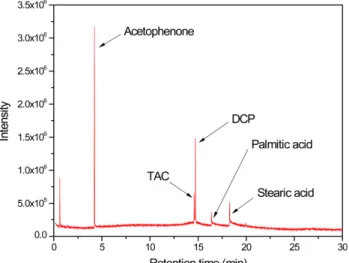
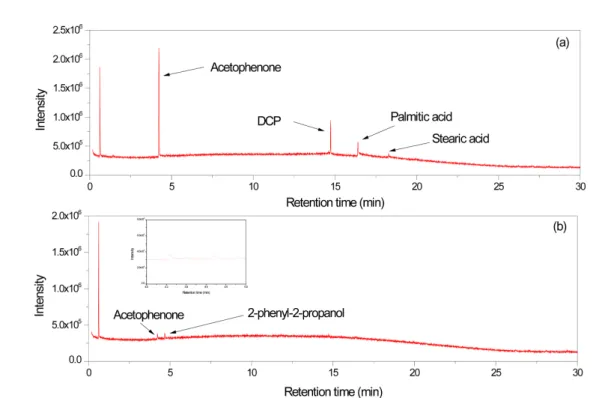
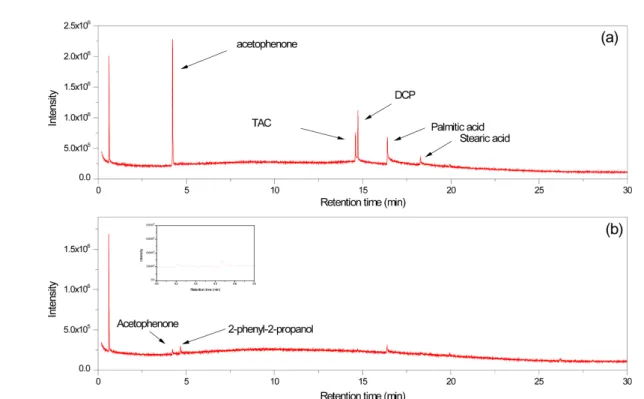
Samples containing trially cyanurate (TAC) and DCP (HDT) were also prepared and analyzed. Some raw DCP were decom- posed in the injector region of GC to produce acetophenone. DCP was detected in the HD compound but was not observed in the HD vulcanizate, and instead acetophenone and 2-phenyl-2-propanol were detected. Both DCP and TAC were observed in the HDT compound but not in the HDT vulcanizate, where acetophenone and 2-phenyl-2-propanol were detected. Thus, some of the DCP decomposed during the compounding process. The formation mechanism for acetophe- none and 2-phenyl-2-propanol during the crosslinking reaction was identified, and differences in the crosslinking reactions of HD and HDT compounds were discussed.
Keywords: EVA, DCP, TAC, Reaction products, GC/MS
Introduction
Poly(ethylene-co-vinyl acetate) (EVA)는 에틸렌과 비닐 아 세테이트(VA)의 공중합체이다. EVA의 가교는 과산화물 (peroxide), 전자 빔, 실란 화합물 등을 이용하여 이루어지는 데, 과산화물 가교가 가장 널리 사용되고 있다.
1-7가교에 사 용하는 과산화물에는 dicumyl peroxide (DCP), perbutyl peroxide, dibenzyl peroxide, 2,5-bis(tert-butylperoxyl)-2,5- dimethylhexane 등이 있으며, 이 중 DCP가 EVA 가교에 주로 사용된다.
1-3가교제 이외에 공가교제(curing coagent)를 함께 사용하여 특성을 향상시킨다. 주로 사용하는 공가교제는 trially cyanurate (TAC)이며, 그 외에 trimethylolpropane triacrylate (TMPTA), trimethylolpropane trimethacrylate (TMPTMA), triallyl isocyanurate (TAIC) 등이 있다.
8-10DCP에 의한 EVA의 가교 과정은 DCP의 분해로 생성된 cumyl oxide 라디칼이 EVA 사슬에서 수소를 빼앗아 EVA 라 디칼을 형성하는 것으로 시작된다(Scheme 1).
11EVA 사슬의 에틸렌 단위와 VA 단위에서 라디칼이 만들어질 수 있다. 이 때, 에틸렌 단위에 생성된 2개의 EVA 라디칼이 가교결합을 형성할 수 있으며, VA 단위에 생성된 EVA 라디칼 2개가 만 나 가교결합을 할 가능성도 있다. 뿐만 아니라 에틸렌 단위에 존재하는 라디칼과 VA 단위에 존재하는 라디칼이 만나 가교 결합이 이루어질 수도 있다.
DCP는 Scheme 2와 같이 분해되어 라디칼을 형성한다.
12이 라디칼은 메틸기가 떨어지면서 재배열이 일어나 아세토페논 (acetophenone)을 형성한다. 혹은 주변의 수소를 취하여 2-페 닐-2-프로판올(2-phenyl-2-propanol)이 형성될 수 있다. Loan 은 IR 분광법을 이용하여 DCP의 분해 생성물인 아세토페논 과 2-페닐-2-프로판올을 분석하였다.
13아세토페논은 1730 cm
1, 2-페닐-2-프로판올은 3520 cm
1에서 IR 흡수를 나타낸 다. Mlejnek은 DCP가 포함된 폴리에틸렌을 GC를 사용하여 분석하였으며, DCP의 분해 생성물로 메탄, 아세토페논, 2-페 닐-2-프로판올이 검출되었음을 보고하였다.
14TAC와 같은 공가교제를 사용하면 가교 효율이 향상된다.
15가교 효율과는 별도로 과산화물 가교에서 공가교제는 가교의 분자 구조에 영향을 줄 수 있다. 가교 반응 동안 공가교제를 중심으로 가교를 형성할 수 있다. 공가교제를 첨가하면 가교 시간이 단축되고, 오일 등에 대한 내성이 향상된다.
16또한, 과 산화물의 효율이 높아지고, 유연성, 인장강도와 경도가 증가 한다.
본 연구에서는 EVA의 배합물과 가교물에서 가교제와 그 반 응 생성물을 분석하였다. 분석 결과를 바탕으로 가교 반응을 설명하였으며 TAC에 의한 반응도 제안하였다. 가교제로 스 테아린산(stearic acid), 산화아연, DCP와 TAC를 사용하였다.
이때 TAC의 유무에 따른 비교를 위하여 DCP만을 사용한 EVA와 DCP와 TAC를 함께 사용한 EVA의 배합물과 가교물 을 준비하였으며, 용매로 잔류 유기물을 추출하여 GC/MS로 분석하였다.
†