J Korean Surg Soc 2013;84:140-153 http://dx.doi.org/10.4174/jkss.2013.84.3.140
ORIGINAL ARTICLE
JKSS JKSS JKSS
Journal of the Korean Surgical Society pISSN 2233-7903ㆍeISSN 2093-0488
Received October 12, 2012, Revised December 12, 2012, Accepted January 6, 2013 Correspondence to: Yoonseok Heo
Department of Surgery, Inha University School of Medicine, 366 Seohae-daero, Jung-gu, Incheon 400-103, Korea Tel: +82-32-890-3431, Fax: +82-32-890-3097, E-mail: [email protected]
*These authors contributed equally to this study.
cc Journal of the Korean Surgical Society is an Open Access Journal. All articles are distributed under the terms of the Creative Commons Attribution Non-Commercial License (http://creativecommons.org/licenses/by-nc/3.0/) which permits unrestricted non-commercial use, distribution, and reproduction in any medium, provided the original work is properly cited.
Validation of the Korean translation of obesity-related problems scale assessing the quality of life in obese Korean
Yeon Ji Lee
*, Kon-Hak Moon
*, Ji-Ho Choi, Min-Jung Cho, Seok Hwan Shin
1, Yoonseok Heo
1Departments of Family Medicine and 1Surgery, Inha University School of Medicine, Incheon, Korea
Purpose: The objective of this study was to translate the obesity-related problems (OP) scale for Koreans and to validate it for use in Korean populations. Methods: Translation and back-translation of the OP scale was performed and a pilot test was conducted. Following this, patients who had received treatment at the Obesity Center of Inha University Hospital were se- lected for participation in the field test. Cronbach’s alpha (α) was used for assessment of the internal consistency of the OP scale. Spearman’s correlation coefficients were used to assess the concurrent validity between the OP scale, the EuroQoL-5D (EQ-5D), and the Beck depression inventory (BDI) scale. One-way analysis of variance and t-test were used to assess the fac- tors associated with the OP scale. Results: A total of 67 individuals participated in the field study. The standardized Cronbach’s α of the OP was 0.913. A significant negative correlation was observed between the OP scale and the EQ-5D and a positive correlation was observed between the OP scale and the BDI (the correlation coefficient with EQ-5D = -0.316, and the BDI = 0.305, P < 0.05). Conclusion: The results of this study prove that the Korean version of the OP has been translated and adapted correctly in order to meet the standard of its use.
Key Words: Obesity, Quality of life, Questionnaires, Validity, Obesity-related problems scale
INTRODUCTION
In March 2011, the World Health Organization reported that obesity has more than doubled worldwide since 1980 [1] and public healthcare spending on obesity has also ris- en significantly worldwide, including Korea [2]. Obesity is known to be related to a variety of health problems, in- cluding type 2 diabetes, hypertension, dyslipidemia, and
sleep apnea [3-5]. Besides physical health problems, it has been reported that obese persons have a lower quality of life (QoL) than their normal weight counterparts [6]. The lower QoL of obese patients is caused by psychosocial functioning as well as impaired physical status [7-10].
Obese persons are more likely to be concerned about their weight and body shape and they have tendency to avoid public places or group activities [11]. In addition, mental
distress is observed in patients who have difficulty man- aging the hardship of obesity [12]. Therefore, assessment of QoL and psychosocial functioning is a key factor in eval- uation of psychosocial health in obese patients [13].
There are several well-established questionnaires for evaluation of QoL for the general and the disabled pop- ulation, however, they only focus on broad dimensions of health problems and cannot identify obesity-specific QoL problems. Therefore, various obesity-specific health-re- lated QoL questionnaires have been developed and pub- lished during the last few decades. Among them, an obe- sity-related problems (OP) scale developed from the Swedish obese subjects (SOS) study group assesses QoL of obese persons, mainly focusing on the impact of obesity on psychosocial functioning [13-15]. This self-assessed mod- ule is comprised of eight questions concerning how both- ered the person is by obesity in everyday life. The OP scale assesses psychosocial health status of obese persons, and long-term effects of weight loss achieved either by a bari- atric operation or medication, and may also be applicable in nonobese populations [14-16]. The OP scale has been va- lidated in various languages for diverse obese populations and it is also available for use in epidemiological studies which include nonobese populations for comparison of obesity-related QoL between groups [16-18]. For these rea- sons, we decided to translate and validate the Korean ver- sion of the OP scale on a preferential basis.
METHODS
Validation process
The validation procedure is composed of three steps:
translation-back translation procedure, pilot study, and field study and verification of internal consistency is needed.
Translation was performed according to the standards outlined by the Reports of the International Society for Pharmaco-Economics and Outcomes Research Task Force for Translation and Cultural Adaptation [16]. The OP scale was translated from the original language (English) into Korean by two native speakers of Korean who were fluent and have a clear understanding of conceptual meanings in
both English and Korean. The translations were compared by the coordinator (YJL) of the study and discrepancies were resolved by discussion, and a provisional single for- ward translation was generated. This version was then back translated by two native independent English speak- ers who were also fluent in Korean. These were evaluated by the coordinator and compared with the original version to ensure conceptual equivalence of the translation.
The second step was the pilot study. The Korean version of the OP was tested on a sample of 20 overweight patients.
The pilot test was conducted in order to identify and solve any potential problems in the translations, such as word- ing that might be confusing or difficult to understand.
After administration of the translated questionnaire, a structured interview was conducted with each patient, individually. In order to ensure that questions were an- swered properly, the structured interview was directed to- ward each item separately and queried by concerning its thoroughness and its difficulty with regard to answering and comprehending. A final text with all forward and backward translations accompanied any key memoranda relevant to the process of translation and the procedure followed, yielding a final translation. The final translation was summarized and sent to the authors of the original questionnaire for review and approval of the question- naire.
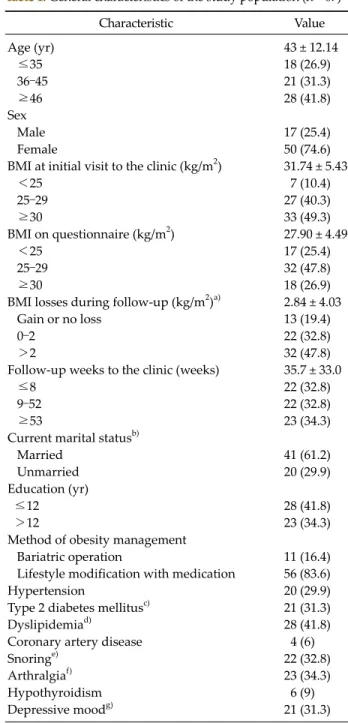
The field study was approved by the Ethics Committee at Inha University Hospital (Inha 11-56) and patients were previously informed about the study and its voluntary nature. Informed consents were obtained prior to admin- istration of the questionnaires. The questionnaires were administered once, when eligible participants visited the obesity center of Inha University Hospital between Au- gust 2011 and November 2011. A total of 71 patients who were received treatment at the obesity center were asked to fill out a self-questionnaire of the Korean OP scale; four patients declined. A total of 67 subjects were finally in- cluded in the analysis; age of subjects was 43 ± 12.14 years old. All participants completed the OP scale, a validated Korean version of EuroQoL-5D (EQ-5D), a Beck depres- sion inventory (BDI), and study-specific questionnaires on current and past health status, use of medical care and medications, socioeconomic status, dietary habits, phys-
Characteristic Value
Age (yr) 43 ± 12.14
≤35 18 (26.9)
36–45 21 (31.3)
≥46 28 (41.8)
Sex
Male 17 (25.4)
Female 50 (74.6)
BMI at initial visit to the clinic (kg/m2) 31.74 ± 5.43
<25 7 (10.4)
25–29 27 (40.3)
≥30 33 (49.3)
BMI on questionnaire (kg/m2) 27.90 ± 4.49
<25 17 (25.4)
25–29 32 (47.8)
≥30 18 (26.9)
BMI losses during follow-up (kg/m2)a) 2.84 ± 4.03
Gain or no loss 13 (19.4)
0–2 22 (32.8)
>2 32 (47.8)
Follow-up weeks to the clinic (weeks) 35.7 ± 33.0
≤8 22 (32.8)
9–52 22 (32.8)
≥53 23 (34.3)
Current marital statusb)
Married 41 (61.2)
Unmarried 20 (29.9)
Education (yr)
≤12 28 (41.8)
>12 23 (34.3)
Method of obesity management
Bariatric operation 11 (16.4)
Lifestyle modification with medication 56 (83.6)
Hypertension 20 (29.9)
Type 2 diabetes mellitusc) 21 (31.3)
Dyslipidemiad) 28 (41.8)
Coronary artery disease 4 (6)
Snoringe) 22 (32.8)
Arthralgiaf) 23 (34.3)
Hypothyroidism 6 (9)
Depressive moodg) 21 (31.3)
Values are presented as mean ± standard deviation or number (%).
BMI, body mass index.
a)Change of BMI between initial check up and at the time of questionnaire was taken. b)If the patient is divorced or bereaved, this is considered unmarried. c)Considered to have diabetes if the patient meets the 2010 criteria outlined by the American Diabetes Association or is taking a diabetic medication or on insulin. d)Considered to have dyslipidemia if the patient meets the criteria outlined by the National Cholesterol Education Program expert panel III or is taking lipid lowering medication.
e)Reported to snore by self or by a third member. f)Difficulties exercising due to pain on movement of any joints or muscles.
g)More than five depressive episodes outlined in Diagnostic and Statistical Manual of Mental Health Disorders (4th edition) for more than two weeks.
Table 1. General characteristics of the study population (n = 67) ical activity habits, weight history, and familial history of
obesity. In addition, comorbidity and clinical data were al- so collected from the patients’ medical records. Baseline characteristics are shown in Table 1.
Questionnaires for validation
We compared the OP scale [11-18] (appendix 1 for trans- lated Korean version) with the EQ-5D [19,20] and BDI [21-23] in order to evaluate the external validity.
The OP is a brief condition-specific measurement com- prising eight questions on a four-point scale concerning how bothered subjects are by their obesity in relation to so- cial activities: private gatherings at home or at a friend’s or relative's home, going to restaurants, participation in com- munity activities (courses, etc.), holidays away from home, trying on and buying clothes, bathing in public pla- ces, and intimate relations. Answers ranged from “defi- nitely bothered” to “definitely not bothered” with two in- termediate states, “mostly bothered” and “not so both- ered”. Responses were aggregated to a total scale score and transformed to a 0 to 100 scale. Higher scores indicate more psychosocial dysfunction (appendix 2 for OP gen- eral scoring instruction).
The EQ-5D is a generic questionnaire, which can be ap- plied to a wide range of patient populations for assess- ment of multiple domains of functioning. The EQ-5D que- stionnaire includes five questions about the subjects’ state of health for measurement of mobility, self-care, perform- ance of usual activities, pain or discomfort, and anxiety or depression. Each dimension is rated on a three-level scale from 1 (no problem) to 3 (inability to perform or extreme problem). The combined dimensions describe 243 theoret- ically possible states of health that can be converted into a weighted health index score in which the higher the score the better the QoL. We used the weights published by Lee et al. [19] to calculate a single summary score from the five descriptive items of the EQ-5D. Details have been reported elsewhere [19,20].
The BDI, which consists of 21 items, is the most widely used instrument for identification of depression. It uses depression criteria in line with the Diagnostic and Statistical Manual of Mental Health Disorders (4th edi- tion) [21]. The BDI is easy to complete, score, and interpret,
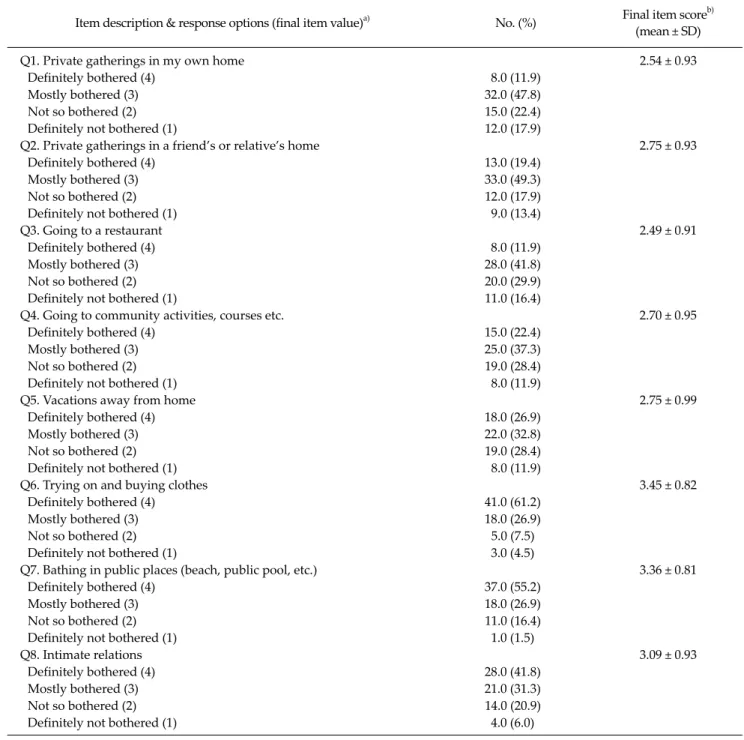
Item description & response options (final item value)a) No. (%) Final item scoreb) (mean ± SD)
Q1. Private gatherings in my own home 2.54 ± 0.93
Definitely bothered (4) 8.0 (11.9)
Mostly bothered (3) 32.0 (47.8)
Not so bothered (2) 15.0 (22.4)
Definitely not bothered (1) 12.0 (17.9)
Q2. Private gatherings in a friend’s or relative’s home 2.75 ± 0.93
Definitely bothered (4) 13.0 (19.4)
Mostly bothered (3) 33.0 (49.3)
Not so bothered (2) 12.0 (17.9)
Definitely not bothered (1) 9.0 (13.4)
Q3. Going to a restaurant 2.49 ± 0.91
Definitely bothered (4) 8.0 (11.9)
Mostly bothered (3) 28.0 (41.8)
Not so bothered (2) 20.0 (29.9)
Definitely not bothered (1) 11.0 (16.4)
Q4. Going to community activities, courses etc. 2.70 ± 0.95
Definitely bothered (4) 15.0 (22.4)
Mostly bothered (3) 25.0 (37.3)
Not so bothered (2) 19.0 (28.4)
Definitely not bothered (1) 8.0 (11.9)
Q5. Vacations away from home 2.75 ± 0.99
Definitely bothered (4) 18.0 (26.9)
Mostly bothered (3) 22.0 (32.8)
Not so bothered (2) 19.0 (28.4)
Definitely not bothered (1) 8.0 (11.9)
Q6. Trying on and buying clothes 3.45 ± 0.82
Definitely bothered (4) 41.0 (61.2)
Mostly bothered (3) 18.0 (26.9)
Not so bothered (2) 5.0 (7.5)
Definitely not bothered (1) 3.0 (4.5)
Q7. Bathing in public places (beach, public pool, etc.) 3.36 ± 0.81
Definitely bothered (4) 37.0 (55.2)
Mostly bothered (3) 18.0 (26.9)
Not so bothered (2) 11.0 (16.4)
Definitely not bothered (1) 1.0 (1.5)
Q8. Intimate relations 3.09 ± 0.93
Definitely bothered (4) 28.0 (41.8)
Mostly bothered (3) 21.0 (31.3)
Not so bothered (2) 14.0 (20.9)
Definitely not bothered (1) 4.0 (6.0)
SD, standard deviation.
a)Responses are recoded for final item value before calculating the sum of the responses to the eight items included in the scale. b)Sum of final item value.
Table 2. Item descriptions and the number and percent of responses to each item score (n = 67) and its internal consistency, test-retest reliability, and val-
idity are well established. We used a Korean translation version of the BDI published by Lee and Song [23]. Details have been reported elsewhere [21-23].
Statistical analysis
Frequency tables, means, and standard deviations were used for statistical descriptions of the clinical and socio- demographic variables. The OP scale score was computed to either a final item value or a transformed score for
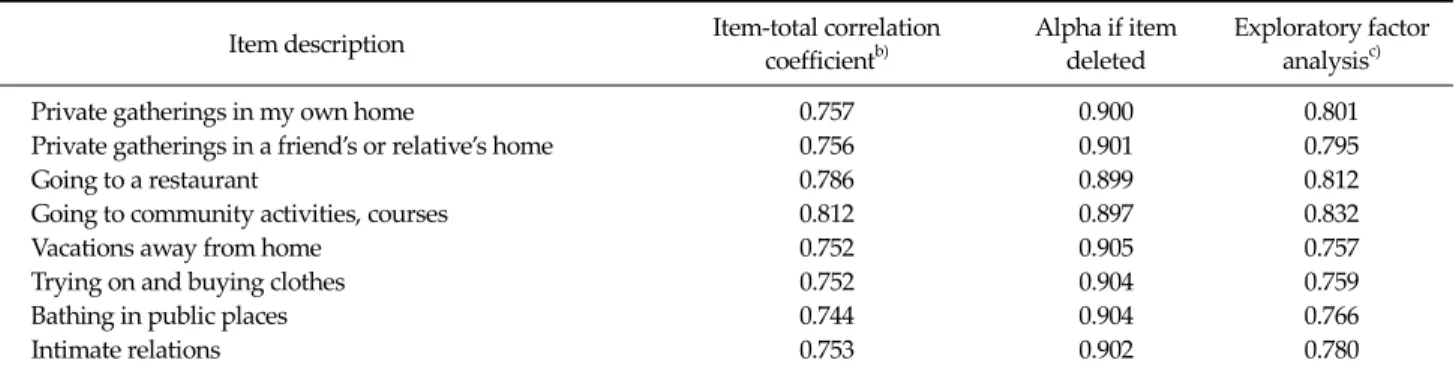
Table 3. Internal consistency and constructive validity of the obesity-related problems scalea)(n = 67)
Item description Item-total correlation
coefficientb)
Alpha if item deleted
Exploratory factor analysisc)
Private gatherings in my own home 0.757 0.900 0.801
Private gatherings in a friend’s or relative’s home 0.756 0.901 0.795
Going to a restaurant 0.786 0.899 0.812
Going to community activities, courses 0.812 0.897 0.832
Vacations away from home 0.752 0.905 0.757
Trying on and buying clothes 0.752 0.904 0.759
Bathing in public places 0.744 0.904 0.766
Intimate relations 0.753 0.902 0.780
a)Standardized Cronbach’s α of obesity-related problems scale = 0.913. b)Statistically significant correlation: level of significance P < 0.05.
c)Extraction method was principal component analysis.
analysis. Internal consistency was assessed using Cron- bach’s alpha (α), and an item-total correlation coefficient (Appendix 3). Factor analysis was performed for examina- tion of constructive validity. For examination of external val- idity, Spearman’s correlation coefficients were used to assess the relationship between the OP scale and EQ-5D or BDI. To identify the factors associated with the OP scale (trans- formed scale score), two-group comparisons were per- formed using t-test and analysis of variance was used in com- parisons of three or more groups. PASW ver. 18.0 (IBM Co., Armonk, NY, USA) was used in performance of all analyses.
RESULTS
At the beginning of the study, we sent an email massage to Dr. Karlsson, who is the author, and obtained the au- thor’s permission for creation of a Korean version of the OP scale. We performed translation and back translation and reported the draft to the author. The pilot study of the Korean translation of the OP scale conducted on 20 pa- tients provided evidence of the acceptability and compre- hensibility of the OP scale’s questionnaire. As a result of the pilot study, we changed four words for the final ver- sion that would be evaluated.
General characteristics of the study population
A total of 67 patients, 43 ± 12.14 years old, were enrolled in this study; 50 patients (74.6%) were female. Mean body mass index (BMI of the study sample was 31.74 ± 5.43kg/m2 when patients visited the obesity center for the first time (initial visit to the clinic). At the time of the study, they had a reduced BMI of 2.84 ± 4.03 kg/m2 and their mean BMI on the questionnaire was 27.90 ± 4.49 kg/m2, with a mean follow up period of 35.7 ± 33.0 weeks. Only 16.4% of the pa- tients had chosen a bariatric operation, and they had all undergone a gastric bypass in the obesity center of Inha University Hospital; 61.2% of patients were married and 41.8% had an education of 12 years or under. The socio- demographic and clinical data of the patients who partici- pated in the field study are shown in Table 1.
Table 2 shows the concrete contents of the OP and re- sponses of our study population. Among eight items, our population reported the highest final item score, and more than 88% were mostly or definitely bothered when they were trying on and buying clothes. In addition, the mean transformed OP score of the total population was 63.0 ± 23.90, suggesting severe psychosocial impairment.
Reliability and constructive validity (Table 3)
The standardized Cronbach’s α of the OP scale was 0.913. Item to total correlation coefficients were all statisti- cally significant (P < 0.05), and ranged from 0.74 to 0.81.The exploratory factor analysis of the eight items in the questionnaire showed factor loading from 0.75 to 0.83 with high homogeneity.
External validity (Table 4)
The correlation coefficient between the OP scale and EQ-5D index was -0.316, while domains of the EQ-5D
Variable Transformed
scalea) P-value Severe impairmentb)
Age (yr) 0.21c)
≤35 64.12 ± 26.20 12 (66.7)
36–45 69.44 ± 17.25 14 (66.7)
≥46 57.44 ± 26.04 14 (50.0)
Sex 0.03d)
Male 52.70 ± 24.34 7 (41.2)
Female 66.50 ± 22.95 33 (66.0)
BMI at initial visit
(kg/m2) 0.04c)
<25 42.86 ± 26.43 1 (14.3)
25–29 68.21 ± 18.82 18 (66.7)
≥30 63.01 ± 25.45 21 (63.6)
BMI on questionnaire
(kg/m2) 0.066c)
<25 55.64 ± 26.35 7 (41.2)
25–29 70.05 ± 19.56 23 (71.9)
≥30 57.41 ± 26.18 10 (55.6)
BMI changes in tertilee) 0.246f)
1st 60.42 ± 28.86 13 (59.1)
2nd 59.66 ± 21.49 11 (50.0)
3rd 68.66 ± 20.64 16 (69.6)
Follow-up weeks to
the clinic (wk) 0.053f)
≤8 69.89 ± 24.16 13 (72.7)
9–52 63.27 ± 24.62 12 (63.6)
≥53 56.16 ± 21.94 10 (43.5)
Current marital status 0.73f)
Married 62.30 ± 22.82 13 (65.0)
Unmarried 64.58 ± 26.88 23 (56.1)
Education (yr) 0.223f)
≤12 2.26 ± 2.81 14 (50.0)
>12 3.81 ± 5.92 15 (65.2)
Method of obesity
management 0.924f)
Bariatric operation 63.64 ± 26.88 34 (60.7) LSM with medication 62.87 ± 23.53 6 (54.5) Values are presented as mean ± standard deviation or number (%).
QoL, quality of life; OP, obsity-related problems; BMI, body mass index; LSM, lifestyle modification.
a)OP scale score transformed to a 0 to 100 scale. Higher the score, higher the psychosocial impairment. b)OP scale score is categorized by the degree of impairment in psychosocial functioning and a score of ≥60 indicates severe impairment.
c)Analysis of variance was performed for statistical analysis.
d)t-test was performed for statistical analysis. e)BMI change over the initial visit and the time of the questionnaire taken. f)P for trend was performed for statistical analysis.
Table 5. Obesity-related QoL impairment measured by OP (n = 67)
Domain OP scale
EuroQol-5D -0.316a)
Mobility 0.097
Self-care 0.126
Usual activities 0.299a)
Pain/discomfort 0.292a)
Anxiety/depression 0.242a) Beck depression inventory 0.305a) Values are presented as Spearman correlation coefficients.
a)P < 0.05.
Table 4. Obesity-related problems (OP) scale correlations with EuroQol-5D and Beck depression inventory scale domains
ranged from 0.097 to 0.299, but was only statistically sig- nificant (P < 0.05) with usual activities, pain/discomfort, and anxiety/depression. OP’s correlation coefficient with the BDI was 0.305, which was statistically significant (P < 0.05).
Obesity-related QoL impairment measured by the OP (Table 5)
Female participants had a higher OP score than males and 66% of females showed severe psychosocial QoL impairment. Participants with a BMI of 25 to 30 on the first visit or at the time of administration of the questionnaire reported a higher OP score than any other BMI range.
Participants’ OP scores showed no association with how much they had reduced their weight. No difference was observed between groups through administration of the method of obesity management.
DISCUSSION
Despite the availability of various obesity specific in- struments for measuring QoL [22-28], we decided to trans- late and validate the Korean version of the OP scale on a preferential basis because the OP has strong advantages.
First, the OP is simply constructed and the questions are easily answered. Second, it is easily computed and the score is easy to understand; for example, a transformed OP score of more than 60 indicated severe obesity-related psy- chosocial impairment, while an OP score less than 40 in- dicated mild impairment. Third, even when half of the questions were unanswered, its transformed score could
be calculated. Fourth, the OP captures frequently reported psychosocial difficulties in the daily life events of obese in- dividuals, such as discomfort in social activities, shop-
ping, or swimming. Assessment of daily difficulties has special meaning in obese patients because it examines the risk of social marginalization [15]. The fifth advantage of the OP scale is that it can be applied to evaluation of im- provement in patients who have undergone bariatric sur- gery or other weight reduction treatments; it is also avail- able for use in epidemiological studies that include non- obese populations for comparison of obesity-related QoL between groups [16-18].
Findings of this study showed constructive validity of the OP and external validity with the EQ-5D and BDI. The OP score showed significant negative correlation with three of five EQ-5D domains, including usual activity, pain or discomfort, and the anxiety or depression domain.
Although mobility and self-care domains of the EQ-5D did not show significant correlation with the OP, this could be explained by the OP’s purpose of design, which focuses on burdens of obesity on quality of psychosocial function in life, not on physical aspects, and which has also been reported in another study [29]. Conversely, this insig- nificant correlation or discrepancy between some do- mains of the EQ-5D and the OP may raise the necessity for instruments for measuring obesity specific QoL.
The BDI showed a significant positive correlation with the OP in Koreans. Because the BDI was essentially devel- oped and validated for assessment of depression risk and obese people frequently showed social withdrawal and depressive moods, it was assumed that the BDI had sig- nificant correlation with the OP, especially in cases of women, and younger adults who were unhappy in their social life because of obesity.
As shown in Table 5, in practice, participants younger than 45 years of age showed a higher OP score than older participants; this higher OP score can be interpreted as in- dicating that obesity has a greater impact on their psycho- social functioning. It is assumed that members of the younger generation are more socially active and they are often expected to be physically well-fitted to various social events. In the same vein, it is understandable that QoL of women was more negatively influenced by an obese status than men.
Even though the group of patients who had undergone bariatric surgery for treatment of obesity had reduced
-7.26 kg/m2 of their original BMI and those in the medi- cation group had lost only a BMI of -1.97 kg/m2 (P < 0.03) from their original measurement, the OP scale showed no statistical difference between the two groups at the time of administration of the questionnaire. This supports the idea that how much weight is lost is not an adequate meas- urement of success in treatment of obesity [24,25]. With this point, the amount of weight loss could only be the sur- rogate end point that allows for an understanding of the progress of the treatment, and the final goal in treatment of obesity should focus on improvement of QoL as well as re- duction of mortality.
Results of the current study demonstrated successful cultural adaptation, translation, and subsequent valida- tion of an instrument for measuring obesity-related QoL in Koreans. However, a small sample size created some limitations in analysis of further studies.
In conclusion, the Korean translation of the OP scale is a valid and reliable instrument for measuring QoL in obese Koreans.
CONFLICTS OF INTEREST
No potential conflict of interest relevant to this article was reported.
ACKNOWLEDGEMENTS
We would like to thank J. Karlsson for his assistance in the translation process and for his permission to use the OP scale for research. Thanks to Tony Moon and Myung- Hoon Roh for performing back-translation. We would also like to thank Hee-Won Lee and Soo-Yoon Moon for pro- viding resources and knowledge.
This work was supported by a Inha University Research Grant 2010.
REFERENCES
1. World Health Organization. Media centre: obesity and
overweight [Internet]. Geneva: World Health Organiza- tion; c2013 [cited 2011 Jul 24]. Available from: http://
www.who.int/mediacentre/factsheets/fs311/en/.
2. Organization for Economic Cooperation and Development (OECD). Statistics from A to Z. Paris: OECD [cited 2011 Jun 30]. Available from: http://www.oecd.org/statistics/.
3. Mokdad AH, Ford ES, Bowman BA, Dietz WH, Vinicor F, Bales VS, et al. Prevalence of obesity, diabetes, and obe- sity-related health risk factors, 2001. JAMA 2003;289:76-9.
4. National Institutes of Health. Clinical Guidelines on the Identification, Evaluation, and treatment of overweight and obesity in adults: the evidence report. Obes Res 1998;6 Suppl 2:51S-209S.
5. National Task Force on the Prevention and Treatment of Obesity. Overweight, obesity, and health risk. Arch Intern Med 2000;160:898-904.
6. Mathias SD, Williamson CL, Colwell HH, Cisternas MG, Pasta DJ, Stolshek BS, et al. Assessing health-related qual- ity-of-life and health state preference in persons with obe- sity: a validation study. Qual Life Res 1997;6:311-22.
7. Le Pen C, Levy E, Loos F, Banzet MN, Basdevant A.
“Specific” scale compared with “generic” scale: a double measurement of the quality of life in a French community sample of obese subjects. J Epidemiol Community Health 1998;52:445-50.
8. Kolotkin RL, Head S, Hamilton M, Tse CK. Assessing im- pact of weight on quality of life. Obes Res 1995;3:49-56.
9. Butler GS, Vallis TM, Perey B, Veldhuyzen van Zanten SJ, MacDonald AS, Konok G. The obesity adjustment survey:
development of a scale to assess psychological adjustment to morbid obesity. Int J Obes Relat Metab Disord 1999;23:
505-11.
10. Barofsky I, Fontaine KR, Cheskin LJ. Pain in the obese: im- pact on health-related quality-of-life. Ann Behav Med 1997;19:408-10.
11. Larsson U, Karlsson J, Sullivan M. Impact of overweight and obesity on health-related quality of life: a Swedish population study. Int J Obes Relat Metab Disord 2002;26:
417-24.
12. Ryden A, Karlsson J, Persson LO, Sjostrom L, Taft C, Sullivan M. Obesity-related coping and distress and rela- tionship to treatment preference. Br J Clin Psychol 2001;
40(Pt 2):177-88.
13. Karlsson J, Taft C, Sjostrom L, Torgerson JS, Sullivan M.
Psychosocial functioning in the obese before and after weight reduction: construct validity and responsiveness of the Obesity-related Problems scale. Int J Obes Relat Metab Disord 2003;27:617-30.
14. Sullivan M, Karlsson J, Sjostrom L, Backman L, Bengtsson C, Bouchard C, et al. Swedish obese subjects (SOS): an in- tervention study of obesity. Baseline evaluation of health and psychosocial functioning in the first 1743 subjects examined. Int J Obes Relat Metab Disord 1993;17:503-12.
15. Karlsson J, Taft C, Ryden A, Sjostrom L, Sullivan M.
Ten-year trends in health-related quality of life after surgi- cal and conventional treatment for severe obesity: the SOS intervention study. Int J Obes (Lond) 2007;31:1248-61.
16. Sullivan M, Karlsson J, Sjostrom L, Taft C. Why qual- ity-of-life measures should be used in the treatment of pa- tients with obesity. In: Bjorntorp P, editor. International textbook in obesity. New York: Wiley; 2001. p.485-510.
17. Wild D, Grove A, Martin M, Eremenco S, McElroy S, Verjee-Lorenz A, et al. Principles of good practice for the translation and cultural adaptation process for patient-re- ported outcomes (PRO) measures: report of the ISPOR Task Force for Translation and Cultural Adaptation. Value Health 2005;8:94-104.
18. Bilbao A, Mar J, Mar B, Arrospide A, Martinez de Aragon G, Quintana JM. Validation of the Spanish translation of the questionnaire for the obesity-related problems scale.
Obes Surg 2009;19:1393-400.
19. Lee YK, Nam HS, Chuang LH, Kim KY, Yang HK, Kwon IS, et al. South Korean time trade-off values for EQ-5D health states: modeling with observed values for 101 health states.
Value Health 2009;12:1187-93.
20. Nan Luo, Johnson JA, Shaw JW, Coons SJ. A comparison of EQ-5D index scores derived from the US and UK pop- ulation-based scoring functions. Med Decis Making 2007;
27:321-6.
21. Diagnostic and statistical manual of mental disorders. 4th ed. Washington, DC: American Psychiatric Association;
1994.
22. Beck AT, Steer RA, Brown GK. Manual for Beck depression inventory-II. San Antonio: Psychological Co.; 1996.
23. Lee YH, Song JY. A study of the reliability and the validity of the BDI, SDS, and MMPI-D scales. Korean J Clin Psychol 1991;10:98-113.
24. Wadden TA, Foster GD, Letizia KA. One-year behavioral treatment of obesity: comparison of moderate and severe caloric restriction and the effects of weight maintenance therapy. J Consult Clin Psychol 1994;62:165-71.
25. Dobson KS. A meta-analysis of the efficacy of cognitive therapy for depression. J Consult Clin Psychol 1989;57:
414-9.
26. Fayers PM, Machin D. Multi-items scales. In: Fayers PM, Machin D, editors. Quality of life: assessment, analysis and interpretation. Chichester: John Wiley; 2000. p.72-90.
27. Tolonen P, Victorzon M. Quality of life following laparo- scopic adjustable gastric banding: the Swedish band and the Moorehead-Ardelt questionnaire. Obes Surg 2003;13:
424-6.
28. Kaukua J, Pekkarinen T, Sane T, Mustajoki P. Health-re- lated quality of life in WHO class II-III obese men losing weight with very-low-energy diet and behaviour mod- ification: a randomised clinical trial. Int J Obes Relat Metab Disord 2002;26:487-95.
29. Ballantyne GH. Measuring outcomes following bariatric surgery: weight loss parameters, improvement in co-mor- bid conditions, change in quality of life and patient satisfaction. Obes Surg 2003;13:954-64.
30. Norris M, Lecavalier L. Evaluating the use of exploratory factor analysis in developmental disability psychological research. J Autism Dev Disord 2010;40:8-20.
Appendix 1. Korean obesity-related problems (OP) scale
당신은 체중이나 체형 때문에 다음과 같은 상황에서 신경 쓰였던 적이 있습니까?
다음 질문을 읽고 당신에게 가장 적합하다고 생각하는 곳에 표시해 주십시오.
매우 신경 약간 신경 별로 신경 전혀 신경
쓰임 쓰임 쓰이지 않음 쓰이지 않음
1. 당신의 집에서 친한 사람들과 만날 때 1 □ 2 □ 3 □ 4 □
2. 친구 또는 친척의 집에서 친한 사람들과 만날 때 1 □ 2 □ 3 □ 4 □
3. 식당에서 외식을 할 때 1 □ 2 □ 3 □ 4 □
4. 지역행사에 참여 하거나 공연을 관람 할 때 1 □ 2 □ 3 □ 4 □
5. 멀리 떨어진 곳으로 여행을 가려 할 때 1 □ 2 □ 3 □ 4 □
6. 옷 가게에서 옷을 입어보거나 구매 할 때 1 □ 2 □ 3 □ 4 □
7. 수영장이나 해변에서 물놀이를 할 때 1 □ 2 □ 3 □ 4 □
8. 친밀한 신체 접촉이 있을 때 1 □ 2 □ 3 □ 4 □
OP Korean Version1.0 ©, Yeon Ji Lee, M.D., Kun‐Hak Moon, M.D.
Obesity Center, Inha University Hospital, Incheon, South Korea. All Rights Reserved
Adapted with permission from Jan Karlsson of University of Gothenburg on-Campus Company.
Appendix 2. Obesity-related problems scale (OP)
Adapted with permission from Jan Karlsson of University of Gothenburg on-Campus Company.
Appendix 3. Statistical notes for evaluating reliability and constructive validity
1. Cronbach’s alpha (α)
According to classical test theory, Cronbach’s α is a coefficient of reliability which is commonly used as a measure of the internal consistency or reliability of a psychometric test score for a sample of examinees.
In statistics, Cronbach’s α is defined as
α =
where K is the number of components (K-items or testlets),
is the variance of the observed total test scores, and is the variance of component i for the current sample of persons.
The word “people” might also be used here.
The standardized Cronbach's α can be defined as
αstandardized =
Theoretically, α varies from zero to 1, since it is the ratio of two variances. Higher values of α are more desirable. When α is greater than 0.9, it is usually assumed that internal consistency of the new instrument is excellent.
Cronbach's α statistic is used widely in the social sciences, business, nursing, and other disciplines, as well as medicine.
Because intercorrelations among test items are maximized when all items measure the same construct, Cronbach's α is widely believed to indirectly indicate the degree to which a set of items measures a single one-dimensional latent construct.
2. Item-total correlation coefficient
An item-total correlation coefficient is one of two statistics in classical test theory, of which the aim is generally to under- stand and improve the reliability of psychological tests. Even though Cronbach’s α provides a convenient index of the total test quality in a single number and reliability, it cannot provide any information for evaluation of single items. Therefore, an item-total correlation coefficient is an index of the discrimination or differentiating power of the item, and is a method used for examining convergent validity, which is part of the analysis to confirm the constructive validity of an instrument.
3. Factor analysis [30]
Factor analysis is a statistical method used for describing variability among observed, correlated variables in terms of a potentially lower number of unobserved variables called factors. Exploratory factor analysis, the most common form of factor analysis, is used to identify the underlying relationships between measured variables. It is commonly used by re- searchers when developing a scale to confirm dimensionality, which is part of the construct validation of an instrument.
Factor loadings are numerical values that indicate the strength and direction of a factor on a measured variable and indicate how strongly the factor influences the measured variable.