Abstract :
Effect of E2F Decoy Oligodeoxynucleotides Gene Therapy on Intimal Hyperplasia in Autogenous Vein Graft of Dogs
Song Ok Lee, M.D., Won Hyun Cho, M.D.
Department of Surgery,
Keimyung University School of Medicine, Daegu, Korea
Key Words :
150
151
Fig. 1. E2F decoy transfection under nondistending pressure.
Fig. 2. Autogenous interposition vein graft at a defected femoral artery.
152
153
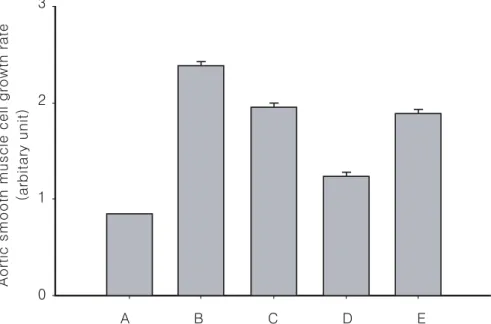
Fig. 3. Effect of E2F decoy on dog aorta smooth muscle cell proliferation. Marked suppression of aortic smooth muscle cell proliferation was noted in D which contains E2F decoy compare with group B, C and E (p < 0.01).
A: normal glucose, 5.5 m b: High glucose (HG), 22 m C: HG + 10% FBS; D: HG + 10% FBS + E2F decoy; E: HG + 10% FBS + mismatched oligodeoxynucleotides.
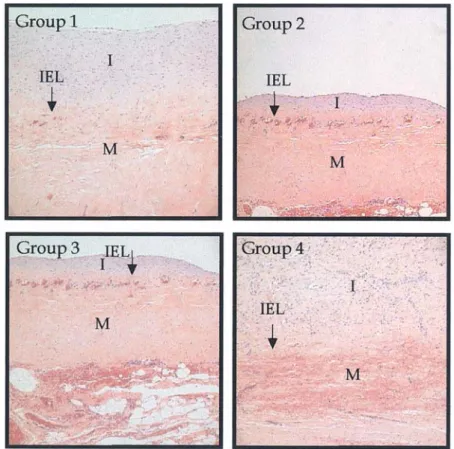
Fig. 4. Light microscopic appearance of vascular anastomotic vein site. Marked suppression of the intimal hyperplasia was showed in E2F decoy-treated group compared with heparin-treated group or mismatched oligodeoxynucleotides (ODN)-treated group. There was no difference between group 2 and 3. Group 1: heparin treated, 4 months after bypass; Group 2: E2F treated, 4 weeks after bypass; Group 3: E2F treated, 4 months after bypass; Group 4: mismatched ODN treated, 4 months after bypass. Arrows indicate location of internal elastic lamina. I: intima; IEL: internal elastic lamina; M: media (H&E stain, original magnification 100).
154
155
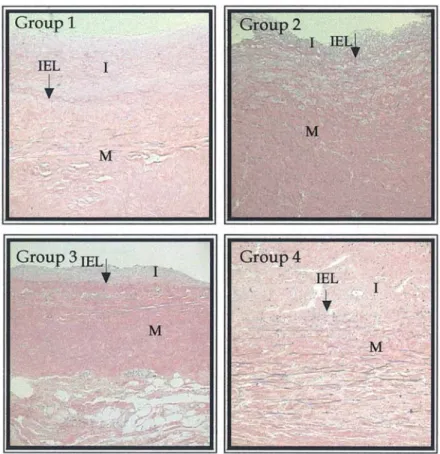
Fig. 5. Elastic stain of vascular anastomotic vein site. Marked suppression of the intimal hyperplasia was showed in E2F decoy-treated group compare with heparin-treated group or mismatched ODN-treated group. There was no difference between group 2 and 3. Group 1: heparin treated, 4 months after bypass; Group 2: E2F treated, 4 weeks after bypass; Group 3: E2F treated, 4 months after bypass; Group 4: mismatched ODN treated, 4 months after bypass. Arrows indicate location of internal elastic lamina. I: intima; IEL: internal elastic lamina; M:
media (Elastic stain, original magnification 100).
Table 1. Intima/media area ratio of proximal and distal anastomotic site of grafted vein
Group 1: heparin treated, 4 months after bypass (n = 3); Group 2: E2F treated, 4 weeks after bypass (n = 3); Group 3: E2F treated, 4 months after bypass (n = 4); Group 4: mismatched ODN treated, 4 months after bypass (n = 4). Group 1 vs Group 3 vs Group 4: p = 0.000, Group 2 vs 3: p = 0.446, Proximal vs distal anastomotic site: p = 0.934.
Group 1 Group 2 Group 3 Group 4
Proximal 1.59 0.31 0.19 0.28 0.22 0.13 1.66 0.31
Distal 1.39 0.29 0.54 0.36 0.29 0.08 1.55 0.27
Total 1.49 0.29 0.37 0.32 0.26 0.11 1.61 0.28
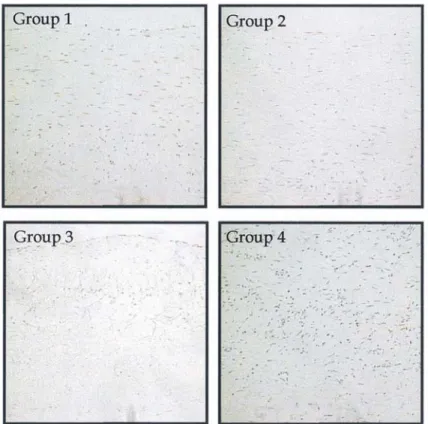
Fig. 6. Proliferating cell nuclear antigen (PCNA) expression in autogenous vein interposition graft at a defected femoral artery treated with heparin, E2F decoy ODN, or mismatched ODN. Expression of PCNA was suppressed in the autografts transfected with E2F decoy. There was no difference between group 2 and 3. Group 1: heparin treated, 4 months after bypass; Group 2: E2F treated, 4 weeks after bypass; Group 3: E2F treated, 4 months after bypass; Group 4: mismatched ODN treated, 4 months after bypass. PCNA-positive cells stained as brownish-black color (Immunohistochemical stain with PCNA antibody, original magnification 200).
156
157
1. Campeau L, Enjalbert M, Lesperance J, Bourassa MG, Kwiterovichp Jr, Wacholder S. The relation of risk factors to the development of atherosclerosis in saphenous vein bypass grafts and the progression of disease in the native circulation: a study 10 years after aortocoronary bypass surgery. N Engl J Med 1984;311:1329-32.
2. Grondin CM. Late results lf coronary artery grafting:
is there a flag on the field? J Thorac Cardiovasc Surg 1984;87:161-6.
3. Reardon MJ, Conkin LD, Reardon PR, Baldwin JC.
Coronary artery bypass conduits: review of current status. J Cardiovasc Surg 1997;97:916-31.
4. Hiebert SW, Lipp M, Nevins JR. ELA-dependent trans-activation of the human myc promotor is mediated by the E2F factor. Proc Natl Acad Sci USA 1980;86:3594-8.
5. Bielinska A, Shivdasani RA, Zhang L, Nabel GJ.
Regulation of gene expression with double stranded phoshorothioate oligonucleotides. Science 1990;250:996-1000.
6. Sullenger BA, Gallardo HF, Unger GE, Giboa E.
Overexpression of TAR sequence renders cells resistant in human immunodeficiency virus replication. Cell 1990;63:601-8.
7. Morishita R, Gibbons GH, Kaneda Y, Ogihara T, Dzau VJ. Pharmacokinetics of antisense oligodeoxyribonucleotides (cyclin B1 and CDC 2 kinase) in the vessel wall in vivo: enhanced therapeutic utility for restenosis by HVJ-liposome delivery. Gene 1994;149:13-9.
8. Newman KD, Dunn PF, Owens JW, Schulick AH, Virmani R, Sukhova G. Adenovirus-mediated gene transfer into normal rabbit arteries results in prolonged vascular cell activation, inflammation and neointimal hyperplasia. J Clin Invest 1995;96:2955- 65.
9. , , , , .
158
159
IL-10
. 2000;14:31-9.
10. Isner JM, Walsh K, Symes J, Pieczek A, Takeshita S, Lowry J, Rosenfield K, et al. Arterial gene transfer for therapeutic angiogenesis in patients with peripheral artery disease. Hum Gene Ther 1996;27:959-88.
11. Baumgartner I, Pieczek A, Manor O, Blair R, Kearney M, Walsh K. Constitutive expression of phVEGF165 after intramuscular gene transfer promotes collateral vessel development in patients with critical limb ischemia. Circulation 1998;97:1114-23.
12. Mann JM, Dzau VJ. Therapeutic applications of transcription factor decoy oligonucleotides. J Clin Invest 2000;106:1071-5.
13. Ahn JD, Morishita R, Kaneda Y, Kim HS, Chang YC, Lee KU. Novel E2F decoy oligonucleotides inhibits in vitro vascular smooth muscle cell proliferation and in vivo neointimal hyperplasia.
Gene Therapy 2002 ;9:1682-92.
14. Herman WRM, Rensing BJ, Stauss BH, Serruys PW. Prevention of restenosis after percutaneous transluminal coronary angioplasty: the search for a
magic bullet . Am Heart J 1991;122:171-87.
15. Popma JJ, Califf RM, Topol EJ. Clinical trial of restenosis after coronary angioplasty. Circulation 1991;84:1426-36.
16. Tanaka H, Sukhova GK, Swanson SJ, Clinton SK, Ganz P, Cybulsky MI. Sustained activation of vascular cells and leukocytes in the rabbit aorta after balloon injury. Circulation 1993;88:1788-803.
17. Clark RE, Apoltolou S, Kardas JL. Mismatch of mechanical properties as a cause arterial prosthesis thrombosis. Surg Forum 1976;27:208-10.
18. Sharefkin JB, Latker C. Early normalization of platelet survival by endothelial seeding of dacron arterial prosthesis in dogs. Surgery 1982;92:385-90.
19. Linder V, Majack RA, Reidy MA. Basic fibroblast growth factor stimulates endothelial regrowth and
proliferation in denuded arteries. J Clin Invest 1990;85:2004-8.
20. Jawien A, Bowen pope DF, Linder V. Platelet derived growth factor promotes smooth muscle migration and intimal thickening in a rat model of ballon angioplasty. J Clin Invest 1992;89:507-11.
21. Bowen pope DF, Mart CE, Seifert RA. Sera and conditioned media contain different isoforms of platelet-derived growth factor (PDGF) which bind to different classes of PDGF receptor. J Biol Chem 1989;264:2502-8.
22. Davies MG, Hagen PO. Pathobiology of intimal hyperplasia. Br J Surg 1994;81:1254-69.
23. Clowes AW, Reidy MA, Clowes MM. Kinetics of cellular proliferation after arterial injury- . smooth muscle growth in the absence of endothelium. Lab Invest 1983;49:327-33.
24. Chervu A, Moore WS. A review of intimal hyperplasia. Surg Gynecol Obstet 1990;171:433-47.
25. Morishita R, Gibbons GH, Horiuchi M, Elison KE, Nakama M, Zhang L. A gene therapy strategy using a transcription factor decoy of the E2F binding site inhibits smooth muscle proliferation in vivo. Proc Natl Acad Sci USA 1995;92:5855-9.
26. Mann MJ, Whittemore AD, Donaldson MC, Belkin M, Conte MS, Polak JF. Ex-vivo gene therapy of human vascular bypass grafts with E2F decoy: the PREVENT single-centre, randomised, controlled trial. Lancet 1999;30:1493-8.
27. Ehsan A, Mann MJ, Dell Acqua G, Dzau VJ. Long term stabilization of vein graft wall architecture and prolonged resistance to experimental atherosclerosis after E2F decoy oligonucleotide gene therapy. J Thorac Cardiovasc Surg 2001;121:714-22.
28. Kawauchi M, Suzuki J, Morishita R, Wada Y, Izawa A, Tomita N. Gene therapy for attenuating cardiac allograft arteriopathy using Ex vivo E2F decoy transfection by HVJ-AVE-Liposome method in mice and nonhuman primates. Cir Res 2000;87:
1063-8.
160
29. Saeki Y, Matsumoto N, Nakano Y, Mory M, Awai K, Kaneda Y. Development and characterization of cationic liposomes conjugated with HVJ (Sendai virus): reciprocal effect of cationic lipid for in vitro and in vivo gene transfer. Hum Gene Ther 1997;8:2133-41.
30. Morishita R, Gibbons GH, Ellison KE, Nakajima M, Zhang L, Kaneda Y. Single intraluminal delivery of antisense cdc2 kinase and proloferating-cell nuclear antigen oligonucleotides results in chronic inhibition of neointimal hyperplasia. Proc Natl Acad Sci USA 1993;90:8474-8.
31. Mann MJ, Gibbons GH, Kernoff RS, Diet FP, Tsao PS, Cooke JP. Genetic engineering of vein grafts
resistant to atherosclerosis. Proc Natl Acad Sci USA 1995;92:4502-6.
32. Nakamura T, Morishita R, Asai T, Tsuboniwa N, Aoki M, Sakonjo H. Molecular strategy using cis- element decoy of E2F binding site inhibits neointimal formation in porcine balloon-injured coronary artery model. Gene Ther 2002;9:488-94.
33. Mann MJ, Gibbons GH, Hutchinson H, Poston RS, Hoyt EG, Robbins RC. Pressure mediated oligonucleotide transfection of rat and human cardiovascular tissues. Proc Natl Acad Sci USA 1999;96:6411-6.
34. Mangi AA, Dzau VJ. Gene therapy for human bypass grafts. Ann Med 2001;33:153-5.